
Get updates about Zaldy Tan and recommended reads from Simon & Schuster.
Plus, get a FREE ebook when you sign up!
An Excerpt from WHAT TO REMEMBER WHEN YOU ARE FORGETTING
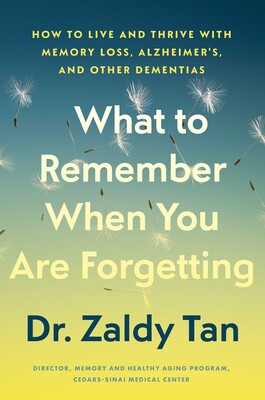
What to Remember When You Are Forgetting
How to Live and Thrive with Memory Loss, Alzheimer's, and Other Dementias
By Zaldy Tan
Media darling and director of Memory and Healthy Aging at Cedars-Sinai Medical Center, Dr. Zaldy Tan’s What to Remember When You Are Forgetting shares the definitive guide to thriving with dementia for the recently diagnosed and their caregivers.
Hardcover
LIST PRICE $30.00
PRICE MAY VARY BY RETAILER
Free shipping when you spend $40. Terms apply.
Free shipping when you spend $40. Terms apply.
Buy from Other Retailers
Building Memories
Anyone who has ever sheltered at home for an approaching snowstorm or hurricane is no stranger to the uncertainty, anxiety, and mild dread that provokes. How long will the storm last? Will the electricity go out? Do you have enough food and water in the pantry? Will your house weather the storm? While we have no control over Mother Nature, we do our best to prepare by stocking up on nutritious food and clean water, and making sure the windows and roof of our home are in good condition; we huddle around the fire and take comfort in the warmth and safety of family.
Like an approaching storm, early-stage dementia is a prompt to stock up on life’s essentials. Having a mental pantry stocked up with good, healthy memories is part of this preparation and will go a long way in weathering any storm. Along with building new positive memories, we must also examine our stockpile of old memories—especially those buried or hidden by our subconscious—that deserve to be consumed now or discarded altogether.
If there is one piece of advice that I can give to a person who just learned they have early-stage Alzheimer’s disease, it’s to travel, spend time with loved ones, deep dive into a hobby, and make the most of their life. To truly experience the heights of joy or the depths of sorrow, one needs access to a lifetime of memories. Squandering the priceless, dwindling commodity that is lucid time is particularly wasteful when one has a fading memory.
It might seem counterintuitive when I say that early-stage AD is an optimal time to build new memories. To be sure, people with early-stage dementia are likely to encounter challenges accessing certain short-term memories, but this does not mean they can no longer form long-term memories. Though it will take a bit more effort and the finer details of events and conversations may escape notice, meaningful memories can still be made during this period, so make them count!
Investing in Sustainable Mental Activities
Crossword puzzles and sudoku are good ways to keep the mind active as we age. But if words and numbers aren’t your thing, there are many other activities that are cognitively stimulating, challenging, and interesting. Visual, verbal, and visuospatial are specific types of memory that involve distinct brain regions. Activities that can help practice memory skills include:
- Visualizing how to travel from one place to another. For example, close your eyes and list the street names, train lines, or highways you need to take to go from your house to your favorite restaurant.
- Memorizing a grocery list. Imagine you are in the grocery store preparing for a dinner party. List the grocery items you would need to pick up to cook a three-course meal.
- Developing picture memory. Look for an interesting picture in a magazine and mentally scan it. The picture should preferably be depicting a scene that includes people and things, such as the famous V-J Day in Times Square photo with a sailor kissing a nurse. Now set it aside and try to draw it from memory. What color was the sailor’s hat? Was there confetti on the street? How many other sailors were in the background and what were they wearing?
- Word list generation. In one minute, name as many four-letter words as you can remember that are not proper nouns that begin with the letter t. Change up the rules (e.g., try words that end with k) to make things more interesting.
- Category naming. In one minute, name all the cold-blooded animals you can think of. Change up the rules (e.g., naming fruits that are red) as desired. These are just some of many examples of cognitively stimulating activities that are enjoyable and challenging. Board and card games are also good ways to keep the mind active. Construction games like Legos, the Rubik’s cube, and picture puzzles are good ways to practice visuospatial skills.
Memories to Let Go
One of the silver linings of having dementia, my patients tell me, is the opportunity to let go of unpleasant memories. Indeed, countless families have told me how their forgetful loved one seems to have become more calm, content, and loving after they released certain memories that previously evoked sadness, anger, or anxiety. While our society puts a lot of value into remembering everything, in reality there are things that are best forgotten. I have treated many patients in the moderate to late stages of Alzheimer’s disease who develop sleep difficulty, become agitated for no apparent reason, or become suddenly combative when a family member or friend walks in the room. While these can certainly come from progression of the disease, I believe that another cause could be unresolved conflicts the person has with people who may not even be aware of their existence. A hurtful comment from years ago or an incident long forgotten can resurface and elicit a sudden rush of emotions. Early-stage dementia is indeed a good time to bring up and try to resolve unpleasant, uncomfortable, or inconvenient memories that we may have buried in the recesses of our consciousness. Think about it like spring cleaning of our emotional self by seeking peace and resolution of old conflicts. While the intact mind can consciously suppress these memories, once dementia progresses, these memories and the negative feelings associated with them can bubble up to the surface at any time. There is indeed no better time to forgive and to ask for forgiveness, to heal old wounds, and to reconnect severed ties.
Remember this. . . . Forget that!
Remember . . .
- When reading books, take notes and summarize important points to ease understanding and recall.
- The early stages of dementia are a good time to travel and create memories.
- Getting separated from the person with memory problems while traveling can be distressing and requires contingency planning.
- Learn mentally stimulating activities during the early stages of dementia that can be sustained through the later stages.
Forget that . . .
- No modifications in travel need be done during early-stage dementia—planning, preparation, and less hectic itineraries will make traveling more enjoyable.
- Crossword puzzles and sudoku are the best mentally stimulating activities in early-stage dementia—no one activity will suit every person’s interest, so try a variety of cognitively challenging exercises that are interesting and enjoyable.
- When dementia sets in, all unresolved conflicts will be forgotten—emotional memories remain intact even in late stages of dementia, and thus it would be best to try to resolve conflicts with family and friends during the early stages.
About the Book
What to Remember When You Are Forgetting
How to Live and Thrive with Memory Loss, Alzheimer's, and Other Dementias
By Zaldy Tan
Media darling and director of Memory and Healthy Aging at Cedars-Sinai Medical Center, Dr. Zaldy Tan’s What to Remember When You Are Forgetting shares the definitive guide to thriving with dementia for the recently diagnosed and their caregivers.
Hardcover
LIST PRICE $30.00
PRICE MAY VARY BY RETAILER
Free shipping when you spend $40. Terms apply.
Free shipping when you spend $40. Terms apply.
Buy from Other Retailers
Listen to the Audiobook
What to Remember When You Are Forgetting
How to Live and Thrive with Memory Loss, Alzheimer's, and Other Dementias
By Zaldy Tan
Read by Feodor Chin
Audio Download
LIST PRICE $26.99
PRICE MAY VARY BY RETAILER
Digital products purchased on SimonandSchuster.com must be read on the Simon & Schuster Books app. Learn more.
Free shipping when you spend $40. Terms apply.
Buy from Other Retailers
Zaldy Tan
Dr. Zaldy Tan is the Director of the Memory & Healthy Aging Program at Cedars-Sinai Medical Center, ranked by the US News and World Report in 2024 as the best hospital on the US West Coast and among the top hospitals in the country. He holds the Carmen & Louis Warschaw Endowed Chair in Neurology and is a professor at the David Geffen School of Medicine, University of California Los Angeles. Dr. Tan was the founding director of the Memory Disorders Clinic at Harvard Medical School/Beth Israel Deaconess Medical Center. Dr. Tan performs aging and dementia research that has been covered by The New York Times, Time, CNN, The Wall Street Journal, NPR, The Washington Post, The Chicago Tribute, Reuters, ABC News, and NBC News. He regularly speaks at major national and international conferences and is the author of Age-Proof Your Mind and What to Remember When You Are Forgetting.
Author Alerts
By clicking 'Sign me up' I agree to the Terms of Use and acknowledge the Privacy Policy and Notice of Financial Incentive. Free ebook offer available to NEW US subscribers only. Offer redeemable at Simon & Schuster's ebook fulfillment partner. Must redeem within 90 days. See full terms and conditions and this month's choices.