

Plus, receive recommendations and exclusive offers on all of your favorite books and authors from Simon & Schuster.
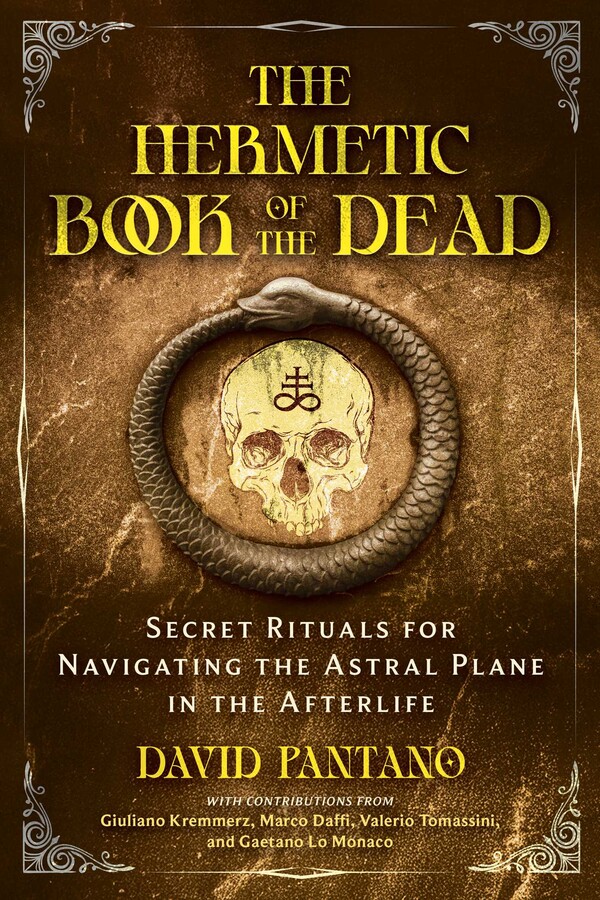
The Hermetic Book of the Dead
Secret Rituals for Navigating the Astral Plane in the Afterlife
Published by Inner Traditions
Distributed by Simon & Schuster
LIST PRICE $50.00
PRICE MAY VARY BY RETAILER
Free shipping when you spend $40. Terms apply.
Buy from Other Retailers
Table of Contents
About the Book
Writings from the Italian occult tradition exploring life, death, and rebirth
• Explores fundamental principles and symbolism of Italian Hermeticism
• Features secret Italian texts, translated for the first time, including an unpublished Renaissance alchemical manuscript
• Offers rituals and parables for spiritual transformation
Egypt and Tibet have long offered maps of the territory the soul must navigate after death. Now, for the first time in English, historian, translator, and esoteric scholar David Pantano illuminates the Italian Hermetic tradition that describes the afterlife journey.
Pantano has curated a range of texts spanning from the Renaissance to the present day, sharing rituals and essays by figures such as Giuliano Kremmerz and Marco Daffi alongside contemporary practitioners Valerio Tomassini and Gaetano Lo Monaco. The collection also includes documents from secret societies and writings from the Corpo dei Pari, a group of underground alchemists and Hermeticists who have been active since the late 1960s.
Pantano also features notables in the Italian mystical tradition such as Dante Alighieri, Giordano Bruno, and Marsilio Ficino, tracing the influence of this unique branch of Hermeticism. By exploring the spiritual lives of his predecessors, he shares Hermetic parables for navigating the astral plane after death and how to live in this lifetime.
Also included is a translation of the Flos Coeli, a Renaissance manuscript that gives a recipe for the Elixir of Life. Pantano pairs this with esoteric interpretations of ayahuasca effects and with secret papers from the Fraternity of Miriam to show how principles of transference can be used with plant medicines to alleviate suffering.
Focusing on death and spiritual rebirth, this is a valuable collection of rituals and discourses on magic, Hermeticism, and consciousness—a guide for the living and a map for the journey in the afterlife.
Excerpt
The Hermetic Madness of Marco Daffi
MAGICAL JOURNEYS
Magical journeys, quests, and odysseys into the abyssal depths of the soul open astral pathways for the spiritual seeker pursuing transcendence. Spiritual seekers are navigators of consciousness in pursuit of transcending the finite dimensions of their Hyliac self to explore the astral realm and integrate with their transpersonal metaphysical root or monad, referred to in the ancient Italic spiritual tradition as the numen (pl. numina). The astral passage unfolds into a vast kaleidoscope of illumination, where archetypal* images and figures manifest in visions, dreams, intuitions, flashbacks, and other spectral representations that are “fixed”* into mnemonic loci and archived in the subconscious for future memory. These spectral images become “fixed” within the mind’s architecture—mapped into subconscious storehouses for future recall. To be fixed in this sense requires absolute inner stillness, a state where consciousness is entirely isolated from the noise of the external world.
Numina manifest through ideographic galleries in “images and figures” drawn from the dark recesses of consciousness. They represent the macrocosmic or transcendent Ideas reflected in the microcosm, from above to below, from the divine to the human, and from an inward to outward perspective. These fundamental “images and figures” yield profound symbolic meanings, intricately woven with layers of attributes that envelop the interpretative scrutiny, awaiting validation.
Investigating the essential nature of numinal beings through the prism of archetypal images and figures provides the seeker with insights into their transcendent nature and associated habitus of values, tendencies, and qualities. This is akin to how basic archetypes serve as building blocks for the multifaceted and nuanced evolution of an individual’s inner life.
Hence, the path toward transcendence beyond the ordinary human condition expands the liminal boundaries of consciousness by unveiling the occult phenomena or numina hidden within the corridors of the subconscious. Numina appear in visions cultivated by the intricate interplay of sympathies and antipathies and are coaxed out from oblivion through incantations and rituals to inform the logos (metadata) underlying the Karmic nature of the discerning investigator.
Astral entities emerge into the light of inner perception adorned in distinctly symbolic attire, taking the shape of eons, shades, archons, avatars, and ancestral memories, among other apparitional possibilities.*
At its core, these activities involve an inner archaeology† that reaches into the profound recesses of the psyche to excavate atavistic reliquiae, the innate characteristics residing within the ancestral layer of the soul, embodied with sub facie humana forms‡ and projected onto visions, dreams, intuitions, premonitions, augurs, and other inner manifestations.
Astral pathways constitute numinal corridors intricately woven within the depths of the subconscious. They are accessed via psychodynamic transits, such as those occurring with a “flash of intuition,” a “visionary escapade,” a “memory recall,” or through more complex interventions involving meditation and rituality, which can induce a specific vibrational “resonance” imbued with magnetic fluids that attract or radiate outward energies.**
Such practices, incorporating theurgy and anamnesis, were utilized by Initiates of ancient Pythagorean and Neoplatonic schools, and pursued further in the nineteenth century by certain advanced adepts affiliated with the Fraternity of Myriam.
Anamnesis refers to the mnemonic operation undertaken by the seeker to recall details of their innate persona by navigating awareness down through the deep recesses of the psyche to mine its ancestral reservoir. From here, the atavistic contents emerge by projection through the subconscious to materialize in internally perceivable images and symbolic visions. By virtue of exerting a similia similiis (“like attracts like”) action, the mnemonic activity arouses psychodynamic projections of spiritual fragments, or atavistic reliquiae, in the form of images and figures that are perceived through the inner senses by the seeker for the exegetic investigation of their occult nature. Gnosis is entrusted with the operative remembering of the powers of the psyche arising in us (remembrance), advanced initiates of the true Great Arcanum, which is incommunicable, and which is revealed-acquired in subdued illumination (as in Zen). The initiate must regard himself as a diasoratta (“one who remembers, recalls”). More narrowly, the memory of seeking the powers of the psyche—when applied to evolution rather than as an end in itself—is sufficient to drive the quest forward. It is as though there is a mysterious antenna that resonates with corresponding frequencies, detecting and connecting with others on the same path—much like finding a genuine companion or discovering a fellow seeker who has joined this current, whether long ago or recently.
With the requisite preparation and aptitude, the seeker can further intensify the resonance to the point of ecstasy by the infusion of amorous humors (fluids, feelings, sensations) that sublimate consciousness into a rarefied state of “Mag”—a trancelike state of magnetism* that harnesses the latent potential of human nature to manifest magical will. Giuliano Kremmerz, the Italian magus, describes this “state of Mag” as a profound level of purity attained by advanced adepts of the Fraternity of Myriam.
The Mag establishes a vinculum (internal connection) linking the “lunar and mercurial bodies”† of the initiate with the “cosmic or ethereal matter” constituting the astral current. The intensity of the vibration induced by the contact of the human astral with cosmic astrality gives rise to occult phenomena illuminated on the astral plane.
The magnetic vibrations encompass energies imbued with transcendent qualities (virtues), converged from the seven universal forces, and manifested as the synthesis of the fluidic composition. These fluids emanate sympathetic or antipathetic energies, charged positively or negatively, reflecting the osiridean or isiac operations inherent in the magical procedure. The astral—specifically, the astral complex of the individual—constitutes the common denominator of these polarized forces, serving as the humus to corresponding infirmities and diseases of the body and as the libidinal agent of attraction in the soul.‡
The practice was meticulously documented by a highly idiosyncratic psychonaut,* Baron Ricciardo Ricciardelli (1900–1969). This Hermetic phoenix pioneered a method of atavistic excavation by undertaking magical journeys through astral realms to explore archetypal vistas appearing in his visions, dreams, and other numinous environments.
Upon summoning these archetypal personas, Ricciardelli would undergo a profound shift in consciousness, entering an altered dimension and transforming into his latent personality that emerged from his occulted self.
The transformation culminated in the embodiment of his archetype, a figure he referred to as Mörköhekdaph and Italianized into Marco Daffi. Ricciardelli claimed that this figure was his reincarnated self, or a lars remanifesting from a previous existence, as a priest of Phoenician ancestry serving at the Pharoah’s court in ancient Egypt 4,000 years ago.
In life, as in writing, Ricciardelli would reference reincarnation not as a hypothetical possibility conceptualized within a particular belief system, but rather as a tangible factum to be experienced and lived. His many astral journeys through past lives are to be understood as essential expeditions to fulfill his life’s mission: to seek atonement for transgressions committed in a prior existence as a priest at the Pharaoh’s court. As a result, he believed that his ethereal lunar body was marred by karmic retribution, stemming from transgressions committed in a previous incarnation involving a sexual trahaison with a pious priestess of the pharaoh’s court, resulting in the identification of a deep-seated imbalance to his personal character.
He would affirm, in a past-life regression, that in preparation for the passage into his current incarnation, he endeavored to rectify the karmic retribution. As an adept, he employed initiatory techniques to construct a provisional or imaginary lunar body. This enabled him to navigate the astral pathway during the conception moment as a dematerialized larval entity, only to remanifest (incarnate) as Baron Ricciardo Ricciardelli. However, devoid of his authentic lunar essence, he, therefore, incarnated as an incomplete avatar.
Furthermore, he was convinced that this inherent imbalance impeded his personal development across the continuum of time and space, impacting his past, present, and future fate. It obscured the memory of his ancient identity and, in his present incarnation, resulted in bearing psycho-physical disturbances such as delayed puberty, sexual dysfunction, impotence, as well as inhibiting the maturation of his feminine nature, embodied by the lunar aspects of his being. This led to a sense of estrangement and frigidity, particularly in his relationships with women. Consequently, he found himself trapped in an unending cycle of instability.
However, the Baron was steadfast in his conviction that unless this karmic obstacle was addressed, it would impede his personal progress toward elevated ontological states. Ricciardelli was consumed by this psycho-ontological predicament, making his life’s mission to resolve it. He feared that if left unaddressed, it would degrade the spiritual patrimony underlying his inherent nobility.
Product Details
- Publisher: Inner Traditions (December 15, 2026)
- Length: 416 pages
- ISBN13: 9798888503485
Browse Related Books
Raves and Reviews
“The Hermetic Book of the Dead is a capstone in Pantano’s series on the Italic Tradition. Here, Pantano reveals to the student of Hermeticism some of the most important concepts and modern practices regarding the very nature of being itself as experienced in a living tradition of Western esotericism. This is a book that one will study, internalize, and come to rely upon.”
– Mark Stavish, author of Egregores and The Path of Freemasonry
“A fascinating collection of rare Italian esoteric writings, hard to find in the original language, beautifully translated and presented by David Pantano—a modern magical hero.”
– Stanislas Klossowski De Rola, author of The Golden Game
“Illuminating the way of magical heroism, this book prepares us not only to combat the negative pull of the numbingly unpoetic soul of modernity but to become magical heroes ourselves.”
– Angel Millar, author of The Three Stages of Initiatic Spirituality
“An extraordinary glimpse into the world of Italian esotericism—a tradition still far too poorly known in the English-speaking world—and a source of fascinating insights into the journey through death that we will all take sooner or later.”
– John Michael Greer, author of The King in Orange
“This remarkable book finally let the cat out of the bag on the initiatic teachings of the Italian Hermetist movement through a selection of writings from various leading avatars. It contains profound and eye-opening insights.”
– Christopher McIntosh, author of Occult Russia and Occult Germany
“In some sacred sodalities and secret societies, solemn, salacious rites persisted well into the Modern Era and beyond. Bringing a whole new meaning to the term ‘the Italian underground,’ Pantano has unearthed for his readers the uniquely Italic remains of a living and breathing tradition of working with the dead that stretches all the way back to the twilight of philosophy.”
– P. D. Newman, author of Theurgy: Theory and Practice
“David Pantano crafts an eloquent synthesis of ancient and modern approaches to the transformative nature of katabasis and the esoteric process of initiatory death, making The Hermetic Book of the Dead essential reading for the living.”
– Gwendolyn Taunton, author of The Path of Shadows
“The Hermetic Book of the Dead opened for me a gateway into the rich, little-known world of Italian occultism, past and present. Its lucid exploration of Kremmerz and Daffi, and the connections drawn to the thought of the great D’Annunzio, who is particularly dear to my heart, make it a deeply rewarding read. This is a book long overdue—we owe David Pantano a special debt for bringing it to light.”
– Christian Bouchet, PhD, founder of Éditions Ars Magna
“David Pantano’s book is essential for introducing readers to the little-known Italian esoteric tradition developed by Giuliano Kremmerz and Marco Daffi and which traces its roots back to Giordano Bruno and Marsilio Ficino. The Hermetic Book of the Dead represents almost a modern Orphic gold tablet for new initiates seeking to understand the soul’s journey after death and how to undertake it: a true discovery for the English-speaking world.”
– Marcello De Martino, PhD, author of Mircea Eliade Esoterico
“Acting as both a preserver of forgotten wisdom and a modern guide, Pantano leads readers on a journey that is as much an internal transformation as it is an external exploration of the afterlife, ensuring the perpetuation of this living tradition to the present day.”
– Travis Trinca, author of The Rosicrucian Compendium
“David Pantano is to be congratulated for making several key texts of Italian occultism available in English for the first time. The writings on Avatars, the Medicinae Dei, and the Hamzur ritual offer a rare insight into the nature of the ultra-secret Italian hermeticists. I look forward to further translations from Pantano with eager anticipation!”
– Alex Sumner, author of Conjuring Demons for Pleasure and Profit
Resources and Downloads
High Resolution Images
-
Book Cover Image (jpg): The Hermetic Book of the Dead
Hardcover 9798888503485