
Plus, receive recommendations and exclusive offers on all of your favorite books and authors from Simon & Schuster.
LIST PRICE $22.00
PRICE MAY VARY BY RETAILER
Get 25% off with code GIFT26 plus free shipping on orders of $40 or more. Discount on physical products only. Terms apply.
Buy from Other Retailers
Table of Contents
Excerpt
Rogue Warrior
Chapter
1
January 1981
IT WAS A BIG FIRST STEP—NINETEEN THOUSAND FEET BETWEEN the soles of my boots and the scrubby jungle—but I didn’t have time to think about that. The green light was on and the jumpmaster was pointing vaguely in my direction, so I blew a polite kiss at him and went out for a walk—took a stroll off the deep end of the C-130’s greasy ramp and dove into the nighttime sky. Just the way I’d done it more than a thousand times before.
The ice-cold slipstream punched at me as the blacked-out plane disappeared overhead. I looked down. Nothing. Almost four miles to the ground—too far to see anything yet, or for anyone down there to have heard the plane.
I looked around me. Zippo. What had I expected? To see my men? That would be impossible, too, of course. We were showing no lights, carried nothing reflective, and were all dressed in dark camouflage tigerstripes, invisible in the blackness above our objective, Vieques Island, in the Caribbean far below.
I clenched my fist and tucked my elbow in silent triumph. Yes! Right on! The first eight seconds of this operation had gone absolutely perfectly. So far, we were ahead of the curve. I checked the altimeter on my wrist then pulled the rip cord. I sensed my chute slip out of the backpack and felt it separate.
I was yanked skyward by the harness in the bungee-cord way you’re always bounced by a chute. Then all of a sudden I veered sharply to my right and began to spiral wildly, uncontrollably, toward the ground.
So much for perfection. I looked up. One of the cells of my sky-blue silk canopy had collapsed in the crosswind. I tugged on the guidelines to shake it out and fill the chute with air, but couldn’t make it happen.
It didn’t help that I was carrying almost a hundred pounds of equipment strapped to a specially built combat vest or attached to my fatigues. The weight was a problem in the thin air during HAHO—high altitude, high opening—jumps. Most of what I carried was lethal. There was my customized Beretta 92-SF in its thigh holster, along with eleven clips of ammo—165 rounds of hollow-point Hydra-Shok, custom-made hot loads that could literally blow a man’s head off. Hanging from a strap attached to my shoulder was a specially modified HK—Heckler & Koch—MP5 submachine gun and 600 rounds of jacketed hollow-point in 30-round magazines.
Then there were the other goodies: flash-bang grenades and thunder-strips to disorient bad guys; strobes and light-sticks for guiding choppers into a drop zone. Wire snips for cutting through fences. And I carried a selection of the miniaturized communications stuff we’d developed—strapped to my waist was a secure Motorola walkie-talkie (it came with lip mikes and earpieces so we could talk and listen to each other while moving. No Secret Service whispering into our shirt cuffs for us).
In the upper right-hand pocket of my combat vest was a satellite transceiver, a SATCOM unit about the same size as a cellular phone. On it I could talk to my boss, Brigadier General Dick Scholtes, who ran the Joint Special Operations Command, back at his Ops Center at Ft. Bragg, North Carolina, as clearly as if I were in the next room instead of almost two thousand miles down the road.
I laughed out loud. Maybe I should punch up Scholtes now. “Hey, General, I’m calling about this little momentary snag that’s developed. Dickie’s about to go squish.”
Another two air cells in the parasail collapsed and the chute folded in half. Okay, so it screwed up. No problem. I’d rehearsed this move maybe eighty, a hundred times during practice jumps. I did a cutaway, jettisoned the faulty canopy, then resumed free-fall. Fifteen thousand feet and cruising.
Five seconds later I yanked the cord on my second chute. It started to open nicely. Then it developed a fissure, folded in half, and collapsed just like number one, and the crazy corkscrewing began all over again.
I didn’t have any more backups.
I tore at the lines with both hands to open the parasail to its full width, screaming profanities into space.
It came to me in the absolutely clear way things come to dying men that I had been the thirteenth jumper to exit the C-130. This was a bad joke on Dickie. This wasn’t the way it was supposed to happen. Down there—where I was about to splatter myself into strawberry-colored goo—were, according to what we’d been told, thirty to forty armed terrorists, a hostage, and a hijacked nuclear weapon.
This clandestine airborne assault was the culmination of five months of bone-wrenching, take-it-to-the-limit training—eighteen hours a day, seven days a week. I was spiraling wildly in the blackness because the U.S. Navy, in its infinite wisdom, had chosen me to design, build, equip, train, and lead what I now believed to be the most effective and highly secret counterterror force in the world—SEAL Team Six.
Admiral Thomas Hayward, the chief of naval operations, gave me the order to create the unit himself, not ninety days after our disastrous April 1980 rescue attempt of the American hostages held in Tehran.
What the CNO had said to me was unequivocal: “Dick, you will not fail.”
I took his words to heart. SEAL Team Six trained harder than any unit had ever trained before, waiting for the opportunity to show the skeptical bureaucrat-sailors and dip-dunk bean-counters prevalent in Washington that it was possible for the U.S. Navy to fight back effectively against terrorists. I had cut more than a few corners and stepped on a shoe store full of toes carrying out Admiral Hayward’s order.
And I hadn’t failed—until now, it seemed. Was it now all going to come to this? Dickie gets slam-dunked and misses all the fun while the rest of the guys get to kick ass and take names?
No way. I was only forty—far too young to die. I yanked on the guides again. No fucking way I was going to buy it. Not like this. Not because my outrageously expensive, personally selected, ingeniously modified, packed-by-my-own-loving-hands, goddamn fucking parachute didn’t work.
I dragged at the lines with as much force as I could muster. Finally, the two far right-hand cells filled with air and I began a controlled descent, spiraling in lazy circles as I hung in the harness, sweating, and tried to figure out where the hell I was.
Where I was, was about three miles out over the ocean, the speed of the C-130 and the free-fall having carried me way off my original flight path. I could see beach below, so I checked my compass and altimeter and changed course, parasailing back toward the prearranged 300-square-yard landing zone, a little airstrip cut into the rough countryside about half a mile from where the terrorists were holed up. We’d chosen it as our assembly point from an ultra-high-resolution NSA satellite photo that had been faxed to us during our flight down from Norfolk.
I was at eleven thousand feet now, and by my best guesstimate I had about ten miles before touchdown. I watched the breakers wash ashore more than two miles beneath my feet, phosphorescent white crescents moving in rippling, parallel lines. Beyond the sea was the jungle. It was, as I knew from the intel pictures, scrubby jungle, the kind common to much of the Caribbean and Latin America. Not rain forest, thank God, with its treacherous high canopy of trees that made parachute landings a bitch. If it’d been rain forest we’d have had to jump way offshore and land on a narrow strip of beach, or come in by sea, swimming from a mother ship, an innocent-looking, apparently civilian vessel that passed far off the coast, or landing in specially modified IBSs—rubberized inflatables that, along with us, were dropped by ships or low-flying planes.
I looked up. No stars. No moon. The chute was now working perfectly, and from the way the wind was blowing, I knew I’d make the landing zone easily. I had a twenty-minute glide ahead of me, and I decided to sit back and enjoy the ride.
I figured I could. Surprise would certainly still be on our side. All the intelligence we’d received during our flight from the States indicated the bad guys wouldn’t be expecting us. Not so soon. That’s what made SEAL Team Six so special. We were unique; a small, highly mobile, quick-reaction team trained to do one job: kill terrorists and rescue hostages, and do it better than anybody in the world. Nobody could move as fast as we could. No other unit could come out of the water, or the sky, with equal ease.
Delta Force, the Army’s hostage-rescue unit originally commanded by my old colleague and sometime rival Colonel Charlie Beckwith, was good. But it was also big—more than two hundred operators—and it was cumbersome as a bloody elephant to move. My entire unit numbered only ninety, and we traveled light. We had to go that way: often, we had to swim to our objective with everything we’d need in tow.
Tonight, fifty-six SEAL Six jumpers parachuted off the ramps of two C-130s that had taken off from Norfolk, Virginia, six and a half hours previously. If my chute was the only one that had screwed up, they’d all be on final approach to the LZ by now, gliding into circular formations of seven, then dropping onto the ground by quickly pulling up, or flaring, just before their feet touched. It kept you from being dragged by your chute and making a furrow with your face.
Normally I’d have been a part of the pattern, but I’d been unavoidably detained and wanted to get onto the ground fast, so I flew a straight approach into the LZ. As I came in, I could hear ambient canopy flutter all around me, and I knew the team was S-turning to eat up ground speed, then corkscrew circling and landing just as we’d trained to do. As for me, I came in fast and high—I didn’t brake as I was supposed to, never flared, and took out a small tree at the end of the overgrown runway. I never even saw it coming. I was at maybe fifteen feet or so and then—blam—took the trunk smack in the face.
It was a good hurt. The kind that made me feel I was alive. I left the canopy up in the foliage, hit the deck, and started to assemble the teams.
We did a fast count. I was ecstatic. Every man had made the LZ with equipment intact. I called JSOC—the Joint Special Operations Command—on the SATCOM and reported we were fifty-six out of fifty-six on the ground and were about to move.
Paul Henley, my XO—Six’s executive officer, who I’d nicknamed PV because of his Prince Valiant haircut—and I formed the teams into four prearranged assault groups.
I punched Paul on the upper arm. “Let’s go hunting.”
Following our NSA maps, we moved off silently into the jungle to the southwest, single file, weapons at the ready. We functioned entirely through hand signals, the way I’d done in Vietnam more than a decade earlier. Our moves were choreographed into a deadly sort of ballet—pas de mort—we’d worked on for months. No one spoke. No one had to. By now, PV and I thought alike. He’d been the first man I’d chosen for Six, a bright, energetic, capable young SEAL officer who could jump and shoot and party with the best of them.
Moreover, unlike me, he was an Academy grad, which gave Six some cachet with the bean counters. The Navy’s caste system has the reputation of being about as rigid as any in the world. The first thing most Navy officers do when they meet you is look at your hands to see whether or not you’re wearing a Naval Academy class ring. If you do, then you’re a part of the club. If you don’t, then you’re an untouchable. I was the original untouchable. The only things I wore on my knuckles were scars. But I loved my work and was uncommonly good at it, and in a few rare cases—mine included—the Navy establishment rewards ability almost as nicely as it does jewelry.
I checked my watch. Twenty-one seventeen. Two minutes behind the schedule I kept in my head.
• • •
We’d gotten the word to move twenty-seven hours beforehand. It came from JSOC. The first info was pretty sketchy: a Puerto Rican terrorist group called the Macheteros, or “machete wielders,” had broken onto the National Guard airfield just outside San Juan and destroyed $40 million worth of planes and equipment. That much of the story would make it into the newspapers.
What wouldn’t be reported, according to JSOC, was that during the attack the Macheteros—we commonly referred to terrorists in the radio phonetic term as Ts, or tangos—took a hostage, and a pallet load of equipment. Including, it was believed, a nuclear weapon. No one was sure. Don’t ask how no one could be sure whether or not an A-bomb was missing. This was the United States Air Force after all—home of $600 toilet seats and $200 pliers.
Anyway, the Macheteros, I was told, had managed to evade police dragnets, roadblocks, and SWAT teams and disappear. Except that U.S. intelligence tracked them to Vieques, a small island due east of Puerto Rico, where they had a clandestine training camp. That was where they were now.
I knew Vieques Island. I’d trained there as a member of Underwater Demolition Team 21 two decades ago. It seemed somehow incongruous that a bunch of tangos would choose for their clandestine base an island that normally crawled with U.S. military personnel.
Moreover, we’d had so many false alarms, I was suspicious that this scramble was just another cry-wolf operational drill, or another training exercise to be done in “real time,” known as a full mission profile. Indeed, we’d been scrambled by Dick Scholtes before, only to find out while we were in the air on the way to the “target” that we were part of some goatfuck war game JSOC had based on a real incident, to make us think we were playing for keeps.
Game or not, I was willing to play along. We had never performed a massed night jump over a hostile target. We’d also never coordinated so many elements at once—clandestine insertion, taking down the target, snatching a hostage and a nuke, and synchronizing an extraction from a hot landing zone was as complicated a series of tasks as SEAL Team Six had been required to perform in its short history.
The call-up had gone right according to schedule. Each man at Six carried a beeper at all times. When it went off, he had four hours to show up at a prearranged location with his equipment.
During the initial hours, while the crews were assembling, PV and I called in my ops boss, Marko, and Six’s master chief petty officer, Big Mac, and we began putting together our basic strategy. That’s the way it worked at Six. Officers, petty officers (Navy noncoms), and enlisted all had a say in what went on, although I made the ultimate aye-or-nay decision on everything.
We realized from the start that a seaborne operation was out of the question because it would have taken too long to land from a mother ship. That meant we’d be launching an air strike. And given the location of the terrorist camp, it would be easier to go straight in than drop us eight or ten miles offshore with our boats.
The first intelligence we received came from a guy I’ll call Pepperman, a former Marine lieutenant colonel who was working special ops assistance at the National Security Agency at Ft. Meade, Maryland, out of a room five or six stories below ground. That basement room was the hub for covert and clandestine operations all over the world, and my old friend Pepperman sat there like a balding Buddha, watching and listening as things went down.
Pepperman—I called him that because he grew his own incredibly hot Thai peppers in the backyard of his suburban Maryland home, a culinary holdover from his special ops days behind the lines in Southeast Asia—was one of those wonderful, ex-military scavengers who could get you anything, anytime. In Vietnam he’d probably been the type who could lay his hands on a bottle of Chivas or a case of beer even though he was six days into a ten-day long-range patrol behind the Green Line in Cambodia. Now, he was in the code-word-secret classified-information business, and there wasn’t much he couldn’t come up with, if you were a friend in need—and if you had the proper clearances, which I did.
He immediately supplied us with the kind of info that allowed me to outline our basic strategy: a thumbnail of who the bad guys were, their history, modus operandi, and basic political and military objectives. It didn’t take long to reach the bottom line: these people weren’t nice.
The Macheteros had been active since 1978. They were a small, well-financed, tightly organized guerrilla force of ultranationalists. Their objective was to wage a terrorist war against what they called “U.S. colonialist imperialism” in the broadside “communiquès” they distributed following dozens of attacks. They’d received training in Eastern Europe courtesy of the KGB—and they’d learned their deadly lessons well. The Macheteros had staged a number of lethal, effective attacks. Half a dozen Puerto Rican policemen had been shot, and in the fourteen months before the current raid, they’d murdered two U.S. sailors and wounded three other American military personnel in separate ambushes.
About an hour into the planning, my jumpmaster, a boatswain’s mate I called Gold Dust Frank, showed up. I gave him a quick rundown of what was going on. Then he and PV, who had been a member of the Navy’s parachute team, began to work out the intricacies of a 56-man clandestine jump and a ten-nautical-mile glide, given the approximate load each man would be carrying, the topography of Vieques Island, and the sort of landing zone we’d be dropping into.
Another pair of SEAL Six petty officers, Horseface and Fingers, showed up. They were my top demolition experts, and they started to assemble the explosive bundles necessary to take down an armed installation. Except they had a question or two I couldn’t answer.
Like: “How thick are the doors, Skipper? And are they wood or metal?”
“What am I, a goddamn clairvoyant?” I punched up the all-knowing Pepperman in his NSA basement.
“Pepperman, Dickie here. Can you give us an info dump on door thickness and material?”
He laughed out loud. “That’s always Delta’s first question, Marcinko, you dipshit asshole. What’s the matter, can’t you be original?”
I loved it when he talked like that. “Screw you, shit-for-brains.” I asked him to fax us a quick flick of the target area—the terrorist camp—so Horseface could determine the approximate size of a charge that would breach the door without blowing up the hostage inside. Meanwhile, Fingers (he was called that because he’d lost a couple doing demolition work) began building the other explosive charges—the ones we’d use to destroy the nuclear device if it couldn’t be brought out with us.
“I got a Blackbird working, Dick,” Pepperman said. That was good. It meant he’d already scrambled an SR-71 spy plane and its cameras were snap-snap-snapping away from 85,000 feet. At that height the bird was invisible to the normal eye—even to most binoculars. We’d have pictures in a couple of hours at most. “And we’ll start getting full imagery in seven, eight hours,” Pepperman continued.
“Full imagery” was the stuff from one of the KH-11—for Keyhole-11—spy satellites that NSA operated in conjunction with the CIA and the military. “Sounds good. Keep me posted, cockbreath.” I rang off before he could insult me back.
Our communications maven—I called him Ameche, after Don Ameche, who played Alexander Graham Bell in the thirties movie—reported for work. He began getting the SATCOM relays up and working. We don’t like to go through the operator in SEAL Team Six; we’re much more a directdial outfit. Our portable phones were called PSC-1 manpacks, which in Navyspeak translates as Portable Satellite Communications terminals.
PV and I worked the phones, negotiating with the Air Force to set the pickup time so Six, the hostage, and the nuke could all be exfiltrated by HH-53 choppers flown from the Air Force’s 20th Special Operations Squadron at Hurlburt Field, located on the western edge of the Eglin Air Force Base complex in Florida. Coordination was important: the four HH-53s had to be refueled in flight by a pair of MC-130E Combat Talon aircraft; moreover, they couldn’t arrive too early because they’d give our position away. If they kept us waiting, they’d leave us vulnerable in hostile—potentially deadly—territory. Once airborne, they’d sprint us from Vieques to a friendly airfield on the main island, about eleven minutes away. There, we’d rendezvous with a C-141 StarLifter out of Charleston, South Carolina, which would in turn move us and our packages back to CONUS—the CONtinental United States.
The team started to arrive midevening; guys drifting in from all over the Virginia Beach area. We looked like a bunch of dirtbags. The Navy called it “modified grooming standards.” I called it ponytails, earrings, beards, and Fu Manchu mustaches, biker’s jackets, tank tops, and T-shirts.
The guys’ cars and pickup trucks were crammed to overflowing with gear, covered with tarps or canvas. I’d bought them the best of everything, from mountaineering equipment to Draeger bubbleless underwater breathing apparatus. And until we were able to build each team member his own personal equipment cage, they had to bring everything with them each time there was a call-up. Who knew where we’d be going.
We went wheels up at 1400 hours. The guys looked tired but ready as they settled as comfortably as they could in the canvas cargo sling seats that ran up and down the sides of the C-130’s fuselage, or sacked out on the cargo pads that lay strewn on the greasy floor. Our shrink, Mike the Psych, wandered up and down, making sure nobody got too apprehensive. We’d learned from Delta that an SOB—Shrink On Board—was a good idea. First, you didn’t want a guy who’d go bonkers on you jumping with the team. Mike knew these men—if he sensed there might be a problem, I trusted him to let me know immediately.
Once we got airborne, I’d formulate our final plans based on the information and pictures that would start arriving on our scrambled fax machines. PV and I were on separate aircraft, but we could talk on secure phones and share information, or consult with Dick Scholtes at Ft. Bragg or call Pepperman in his Maryland basement for advice if we needed to.
I climbed the ladder to the cockpit and peered through the windshield, watching the sky darken. Pretty soon we’d refuel, a pair of KC-135 tankers lumbering above us at four hundred knots while the pilots nudged our C-130s up to the trailing fuel drogues, plugged up, and sucked gas. Absentmindedly, I dropped the clip out of my Beretta and popped a round into my palm. The clip—in fact, every round of ammunition carried tonight by SEAL Team Six—came from a special section of the base ammo lockers. It had been preloaded into magazines for our Berettas and HK submachine guns. Its release had been authorized by JSOC just prior to our departure.
Something was awry. The weight was wrong—lighter than the custom load I’d helped design. I dragged my fingernail across the dull lead hollow-point and left a track. It was a compound bullet—a goddamn training round. They were sending us on another pus-nuts exercise—a full mission profile.
Goddammit—the Macheteros were real enough, why the hell not let us take ’em on? We’d designed a good mission, based on real intelligence—and were executing it according to the numbers. Why the hell didn’t they let us do what we’d been trained to do? A decade and a half ago, in Vietnam, I’d learned firsthand what SEALs did best: hunt men and kill them. But even in Vietnam, the system kept me from hunting and killing as many of the enemy as I would have liked. Since Vietnam, no one had given me the chance to do that job again—until I’d been ordered to create this team of men whose only job, I was promised, would be the hunting and killing of other men.
Now the system was at it again. We were ready. Capable. Deadly. Why the hell weren’t we being used? I’d never considered SEALs strategic weapons—expensive systems that you keep in your arsenal as deterrents, but don’t use. SEALs are tactical. We want to be sent on missions. We wanted to shoot and loot, hop and pop—do all the wonderful, deadly things that SEALs are supposed to do.
I’d begun to believe we were finally getting our chance. The bullet in my palm told me otherwise.
Furious, I started for the secure radio to call Paul and tell him this was just another in the series of games our command structure was playing on us. Halfway down the ladder I stopped. Dickie had a better idea. I’d play out this little charade as if I didn’t know any better and turn it into my own war game.
I probably had more unanswered questions than JSOC anyway. Like, how would my men perform during this complicated series of tasks? They were all good—but which ones would become great under the pressure of keeping to a tight combat schedule? Would any of them realize we weren’t doing this for real—and if they did, what would their reactions be?
I wanted to learn which of them I could order to do a job—even though it might mean their deaths. Being cannon fodder was part of the assignment. Every man who’d volunteered for SEAL Team Six knew he was expendable—from me, right down to the youngest kid on the team. This was an opportunity to test that resolve—to see which ones would play for keeps, and which ones would, at the last instant, hold back.
That’s what SEAL Team Six was all about, anyway—playing for keeps. Oh, sure, the goddamn technology of war was almost beyond comprehension—and it wasn’t just air-refueling or high-tech satellites either, anymore, but microburst transmitters and stealth aircraft and hundreds of billions of dollars invested in technotoys—laser-guided, shoulder-fired missiles, computer-assisted antitank guns, “smart” bombs, and a whole collection of weapons that the assholes in the Pentagon were quick to tell you could think for themselves.
Today you could sit in a fighter, press a missile launch button, and kill an enemy twenty, thirty, forty miles over the horizon, watching his plane explode on a TV screen, just like the video games my kids played.
And yet, what it really came down to, after all the bullshit and the computers and the video, was the very basic question embodied by the bullet in my hand. Could one of my men look another human being in the eyes, then pull the trigger and kill that person without hesitating for an instant?
In Vietnam, I’d discovered who could kill and who couldn’t in combat. But that was fifteen years ago, and less than half of SEAL Team Six had ever been in combat. So there was only one way to find out who’d pull the trigger, and who’d freeze—which was to play this thing out and see who did his job and who didn’t. War, after all, is not Nintendo. War is not about technology or toys. War is about killing.
About the Author
Photo Credit:
Richard Marcinko was a US Navy SEAL commander and Vietnam War veteran. He was the first commanding officer of SEAL Team Six. After retiring from the navy, he became an author, radio host, military consultant, and motivational speaker. He is the author of The Rogue Warrior®’s Strategy for Success: A Commando’s Principles of Winning, and the New York Times business bestseller Leadership Secrets of the Rogue Warrior: A Commando’s Guide to Success. In addition to his bestselling autobiography, Rogue Warrior, he coauthored with John Weisman the New York Times bestselling novels Rogue Warrior: Red Cell, Rogue Warrior: Green Team, Rogue Warrior: Task Force Blue, Rogue Warrior: Designation Gold, Rogue Warrior: Seal Force Alpha, Rogue Warrior: Option Delta, and Rogue Warrior: Echo Platoon. He died on December 25, 2021.
Product Details
- Publisher: Atria Books (December 19, 2026)
- Length: 432 pages
- ISBN13: 9781668293454
Browse Related Books
Resources and Downloads
High Resolution Images
-
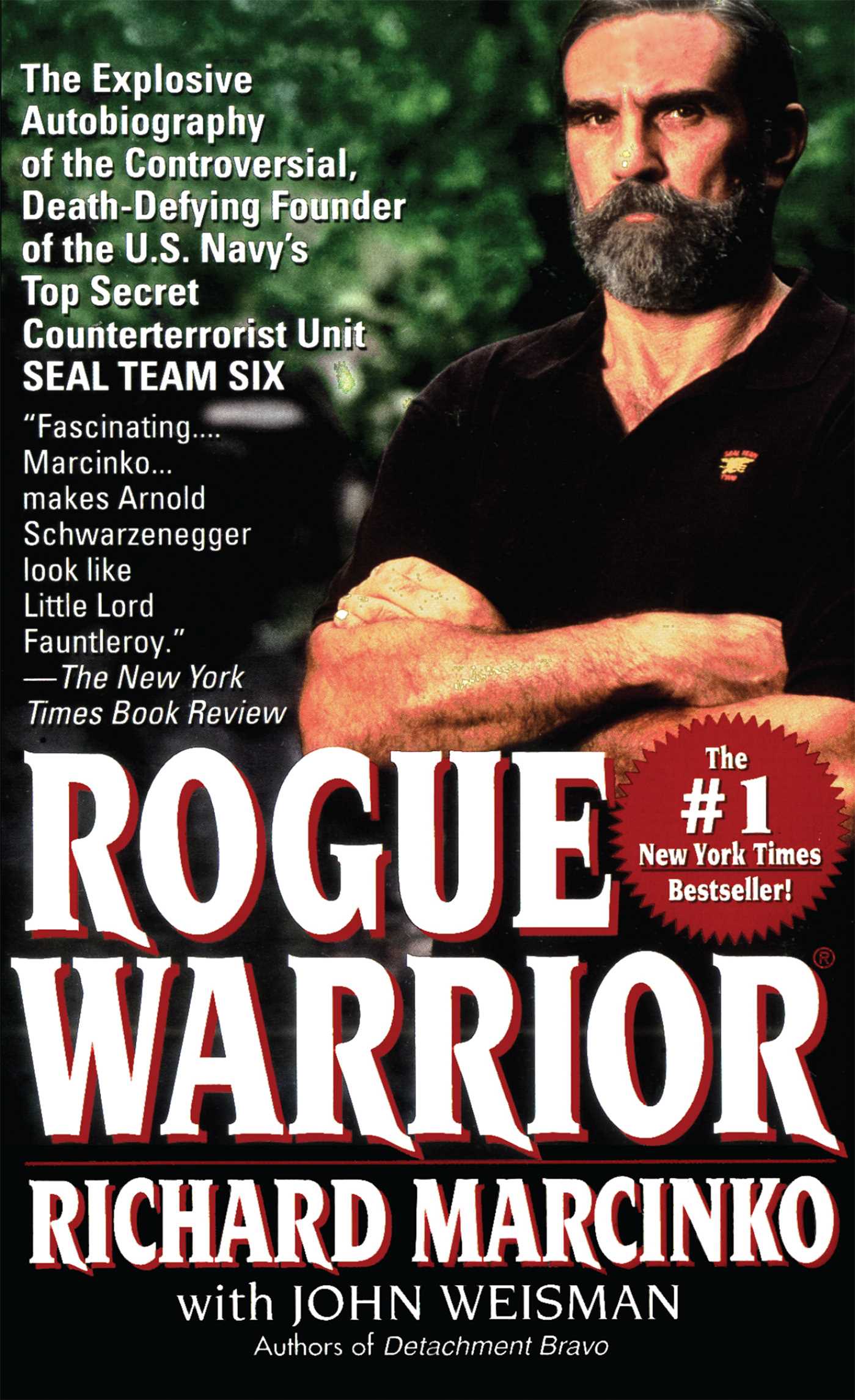
Book Cover Image (jpg): Rogue Warrior: Rogue Warrior I
Trade Paperback 9781668293454
-
Author Photo (jpg): Richard Marcinko Photo Credit:(0.1 MB)
Any use of an author photo must include its respective photo credit