
Plus, receive recommendations and exclusive offers on all of your favorite books and authors from Simon & Schuster.
0:00 /
LIST PRICE $14.99
PRICE MAY VARY BY RETAILER
Digital products purchased on SimonandSchuster.com must be read on the Simon & Schuster Books app. Learn more.
Get 20% off with code SPOOKY plus free shipping on orders of $40 or more. Discount on physical products only. Terms apply.
Buy from Other Retailers
Table of Contents
About the Book
“Few skewer sanctimony quite like Irving at his best. More important: I fell in love, once again, with his people.” —Peter Orner, The New York Times Book Review
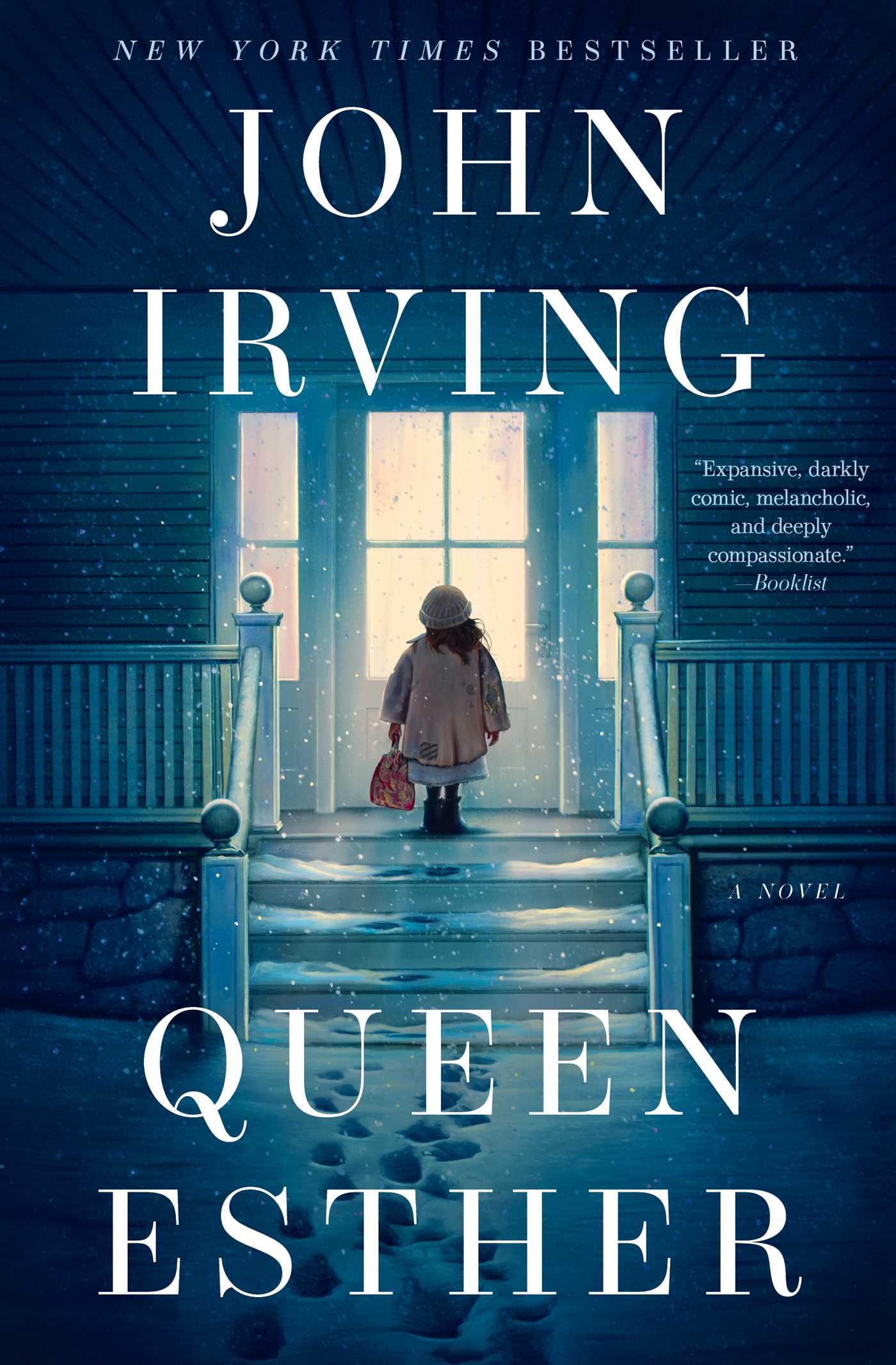
After forty years, John Irving returns to the world of his bestselling classic novel and Academy Award–winning film The Cider House Rules, revisiting the orphanage in St. Cloud’s, Maine, where Dr. Wilbur Larch takes in Esther—a Viennese-born Jew whose life is shaped by anti-Semitism.
“A story that’s unmistakably Irving—amiably peopled, compellingly plotted and, above all, compassionate for its characters” (NPR).
Esther Nacht is born in Vienna in 1905. Her father dies on board the ship to Portland, Maine; her mother is murdered by anti-Semites in Portland. Dr. Larch knows it won’t be easy to find a Jewish family to adopt Esther; in fact, he won’t find any family who’ll adopt her.
Not just a story of survival, but a profound exploration of coming of age, identity, belonging, and the enduring impact of history on our personal lives, Queen Esther “is richly textured with unforgettable characters, vivid settings, and familial love that will stay with you long after you put the book down” (The Jewish Book Council), showcasing why Irving remains one of the world’s most beloved, provocative, and entertaining authors—a storyteller of our time and for all time.
After forty years, John Irving returns to the world of his bestselling classic novel and Academy Award–winning film The Cider House Rules, revisiting the orphanage in St. Cloud’s, Maine, where Dr. Wilbur Larch takes in Esther—a Viennese-born Jew whose life is shaped by anti-Semitism.
“A story that’s unmistakably Irving—amiably peopled, compellingly plotted and, above all, compassionate for its characters” (NPR).
Esther Nacht is born in Vienna in 1905. Her father dies on board the ship to Portland, Maine; her mother is murdered by anti-Semites in Portland. Dr. Larch knows it won’t be easy to find a Jewish family to adopt Esther; in fact, he won’t find any family who’ll adopt her.
Not just a story of survival, but a profound exploration of coming of age, identity, belonging, and the enduring impact of history on our personal lives, Queen Esther “is richly textured with unforgettable characters, vivid settings, and familial love that will stay with you long after you put the book down” (The Jewish Book Council), showcasing why Irving remains one of the world’s most beloved, provocative, and entertaining authors—a storyteller of our time and for all time.
Reading Group Guide
Get a FREE ebook by joining our mailing list today! Plus, receive recommendations for your next Book Club read.
By clicking 'Sign me up' I agree to the Terms of Use and acknowledge the Privacy Policy and Notice of Financial Incentive. Free ebook offer available to NEW US subscribers only. Offer redeemable at Simon & Schuster's ebook fulfillment partner. Must redeem within 90 days. See full terms and conditions and this month's choices.
“Not enough was known about where those orphans came from. With orphans, too much is missing; there’s always something you don’t know” (page 7). Discuss the importance of familial belonging in Queen Esther. What does it mean to “come from” somewhere? How does the novel challenge or uphold your understanding of having a “home”?
From the Book of Esther, after which Esther Nacht is named, to Charles Dickens’s Great Expectations, to Jimmy Winslow’s The Dickens Man, stories play a major role in Queen Esther. Discuss the role of stories and storytelling in the novel. What does it mean to “have a story”? How is the importance of storytelling to Jimmy similar to or different from its importance to Esther? Why do you think Jimmy is attracted to being a storyteller?
The threat of Hard Rain’s “alleged overreaction to thunderstorms” (page 227) hangs over Jimmy’s stay in Vienna. What role does Hard Rain play in Queen Esther, and how might we interpret her fear of thunderstorms? Is it significant that, when a thunderstorm does come, Hard Rain doesn’t “overreact” in the way Jimmy, Claude, and Jolanda have been anticipating?
“Hard Rain is a woman” is a phrase repeated several times in Queen Esther. It’s one of the first things Jolanda teaches Siegfried to say in English, and it’s what Jimmy writes in Siegfried’s copy of Roommates in Vienna when they meet in Jerusalem. What is the significance of this refrain in the novel?
Although Jimmy is a heterosexual man, he is surrounded by sexual minorities: Honor is asexual, Jolanda is a lesbian, and Mieke is a lesbian who wants “to try it with a guy” (page 197). Discuss the portrayal of sex and sexuality in Queen Esther. What role does sex play in Jimmy’s life? In what way does the novel either challenge or uphold traditional notions of sex and sexuality?
Queen Esther starts with a history of the Winslow family in America: “Beginning in Puritan times, more Winslows kept coming” (page 1). Why do you think the novel begins this way? What role does family history play in Queen Esther? How, if at all, does personal history intersect with national history?
In Chapter 8, we learn that Esther wants the following quote from Jane Eyre tattooed on her chest: “I care for myself. The more solitary, the more friendless, the more unsustained I am, the more I will respect myself” (page 71). Why do you think Esther is so drawn to this quote? What do you think Jimmy would make of it? If Jimmy were to get a tattoo, what words or image do you think he might choose?
“In Great Expectations,” says Thomas Winslow to Jimmy, “. . . you will love the characters you’re supposed to love, and you’ll hate the ones you’re supposed to hate” (page 138). How does Tommy’s reading of Great Expectations play out in Queen Esther? Do you think we’re “supposed to love” some people, and “supposed to hate” others? How does the novel reaffirm or complicate this conception of love and hate? Support your ideas with reference to the text.
Esther is left at the orphanage at St. Cloud’s by two female “anti-Semites” (page 65); Jimmy is raised with two mothers and no father; Vienna, Jimmy’s daughter, is raised with a father and two mothers; and Siegfried is adopted by Annelies when the anti-Semitic Irmgard dies. These are just a few examples of how motherhood is portrayed and reconfigured in Queen Esther. Discuss the novel’s portrayal of mothers and motherhood. What do you think of the idea that “giving birth to a child and being a mother [are] two separate choices” (page 154)? Support your ideas with reference to the text.
“ ‘There is a telescope that sees into the future, Jimmy—it’s called the passage of time. Just wait and see,’ [Irmgard] said, closing the door” (page 329). Discuss the significance of this quote, and of the passage of time more broadly, in Queen Esther. What does it mean to see into the future by means of the passage of time? From the very first Winslow on board the Mayflower in 1620, to Jimmy Winslow in Jerusalem in 1981, the novel covers a long span of time. How is the passage of time portrayed in the novel?
From the Book of Esther, after which Esther Nacht is named, to Charles Dickens’s Great Expectations, to Jimmy Winslow’s The Dickens Man, stories play a major role in Queen Esther. Discuss the role of stories and storytelling in the novel. What does it mean to “have a story”? How is the importance of storytelling to Jimmy similar to or different from its importance to Esther? Why do you think Jimmy is attracted to being a storyteller?
The threat of Hard Rain’s “alleged overreaction to thunderstorms” (page 227) hangs over Jimmy’s stay in Vienna. What role does Hard Rain play in Queen Esther, and how might we interpret her fear of thunderstorms? Is it significant that, when a thunderstorm does come, Hard Rain doesn’t “overreact” in the way Jimmy, Claude, and Jolanda have been anticipating?
“Hard Rain is a woman” is a phrase repeated several times in Queen Esther. It’s one of the first things Jolanda teaches Siegfried to say in English, and it’s what Jimmy writes in Siegfried’s copy of Roommates in Vienna when they meet in Jerusalem. What is the significance of this refrain in the novel?
Although Jimmy is a heterosexual man, he is surrounded by sexual minorities: Honor is asexual, Jolanda is a lesbian, and Mieke is a lesbian who wants “to try it with a guy” (page 197). Discuss the portrayal of sex and sexuality in Queen Esther. What role does sex play in Jimmy’s life? In what way does the novel either challenge or uphold traditional notions of sex and sexuality?
Queen Esther starts with a history of the Winslow family in America: “Beginning in Puritan times, more Winslows kept coming” (page 1). Why do you think the novel begins this way? What role does family history play in Queen Esther? How, if at all, does personal history intersect with national history?
In Chapter 8, we learn that Esther wants the following quote from Jane Eyre tattooed on her chest: “I care for myself. The more solitary, the more friendless, the more unsustained I am, the more I will respect myself” (page 71). Why do you think Esther is so drawn to this quote? What do you think Jimmy would make of it? If Jimmy were to get a tattoo, what words or image do you think he might choose?
“In Great Expectations,” says Thomas Winslow to Jimmy, “. . . you will love the characters you’re supposed to love, and you’ll hate the ones you’re supposed to hate” (page 138). How does Tommy’s reading of Great Expectations play out in Queen Esther? Do you think we’re “supposed to love” some people, and “supposed to hate” others? How does the novel reaffirm or complicate this conception of love and hate? Support your ideas with reference to the text.
Esther is left at the orphanage at St. Cloud’s by two female “anti-Semites” (page 65); Jimmy is raised with two mothers and no father; Vienna, Jimmy’s daughter, is raised with a father and two mothers; and Siegfried is adopted by Annelies when the anti-Semitic Irmgard dies. These are just a few examples of how motherhood is portrayed and reconfigured in Queen Esther. Discuss the novel’s portrayal of mothers and motherhood. What do you think of the idea that “giving birth to a child and being a mother [are] two separate choices” (page 154)? Support your ideas with reference to the text.
“ ‘There is a telescope that sees into the future, Jimmy—it’s called the passage of time. Just wait and see,’ [Irmgard] said, closing the door” (page 329). Discuss the significance of this quote, and of the passage of time more broadly, in Queen Esther. What does it mean to see into the future by means of the passage of time? From the very first Winslow on board the Mayflower in 1620, to Jimmy Winslow in Jerusalem in 1981, the novel covers a long span of time. How is the passage of time portrayed in the novel?
About the Author
Photo by Katherine Holland
John Irving was born in Exeter, New Hampshire, in 1942. His first novel, Setting Free the Bears, was published in 1968, when he was twenty-six. He competed as a wrestler for twenty years, and coached wrestling until he was forty-seven. He is a member of the National Wrestling Hall of Fame in Stillwater, Oklahoma. In 1980, Mr. Irving won a National Book Award for his novel The World According to Garp. In 2000, he won the Oscar for Best Adapted Screenplay for The Cider House Rules. In 2013, he won a Lambda Literary Award for his novel In One Person. Internationally renowned, his novels have been translated into almost forty languages. His all-time bestselling novel, in every language, is A Prayer for Owen Meany. A dual citizen of the United States and Canada, John Irving lives in Toronto.
Product Details
- Publisher: Simon & Schuster (November 4, 2025)
- Length: 432 pages
- ISBN13: 9781501189463
Browse Related Books
Raves and Reviews
"Few skewer sanctimony quite like Irving at his best. More important: I fell in love, once again, with his people."
– Peter Orner, The New York Times Book Review
"A story that's unmistakably Irving — amiably peopled, compellingly plotted and, above all, compassionate for its characters."
– NPR
"Irving masterfully threads the narrative, from New England to Vienna to Jerusalem, while exploring the themes he frequently wrestles with—orphans, sexuality, and found families. Irving’s luminous prose embodies his singular gifts; the novel is expansive, darkly comic, melancholic, and deeply compassionate, conveying a profound empathy for his flawed characters. Countless literary references, lyrical flourishes, and allusions add depth to the Dickensian motif as Irving brilliantly blends moral ambiguity and emotional truth in this essential addition to his oeuvre."
– Booklist (starred)
"Queen Esther is richly textured with unforgettable characters, vivid settings, and familial love that will stay with you long after you put the book down."
– The Jewish Book Council
"To read a John Irving novel is to call to mind the classic works of Charles Dickens with their broad, melancholy searches for families lost and their acceptance of families made. Irving’s new work is especially potent."
– Steven Whitton, The Anniston Star
"The novel is quintessential Irving: layered, funny, heartbreaking, and full of the strange humanity he has always captured so well.”
– Canadian Jewish News
“It’s hard to imagine this historical novel landing at a more timely moment.”
– Zoomer
“Irving has a lot on his mind [in Queen Esther] — the flow of history, to be sure, but also relationships, the nature of identity and the gnawing horror of antisemitism.”
– National Post
“A profound exploration of identity and belonging, shaped by a story of survival and a call for tolerance.”
– Diario de Burgos
“Irving continues to believe in the novel as an art form, and in characters conceived as moral destiny."
– Ángeles López, La Razón
Resources and Downloads
High Resolution Images
-
Book Cover Image (jpg): Queen Esther
eBook 9781501189463
-
Author Photo (jpg): John Irving Photo by Katherine Holland(0.1 MB)
Any use of an author photo must include its respective photo credit