
Plus, receive recommendations and exclusive offers on all of your favorite books and authors from Simon & Schuster.
0:00 /
LIST PRICE $20.00
PRICE MAY VARY BY RETAILER
Free shipping when you spend $40. Terms apply.
Buy from Other Retailers
Table of Contents
About the Book
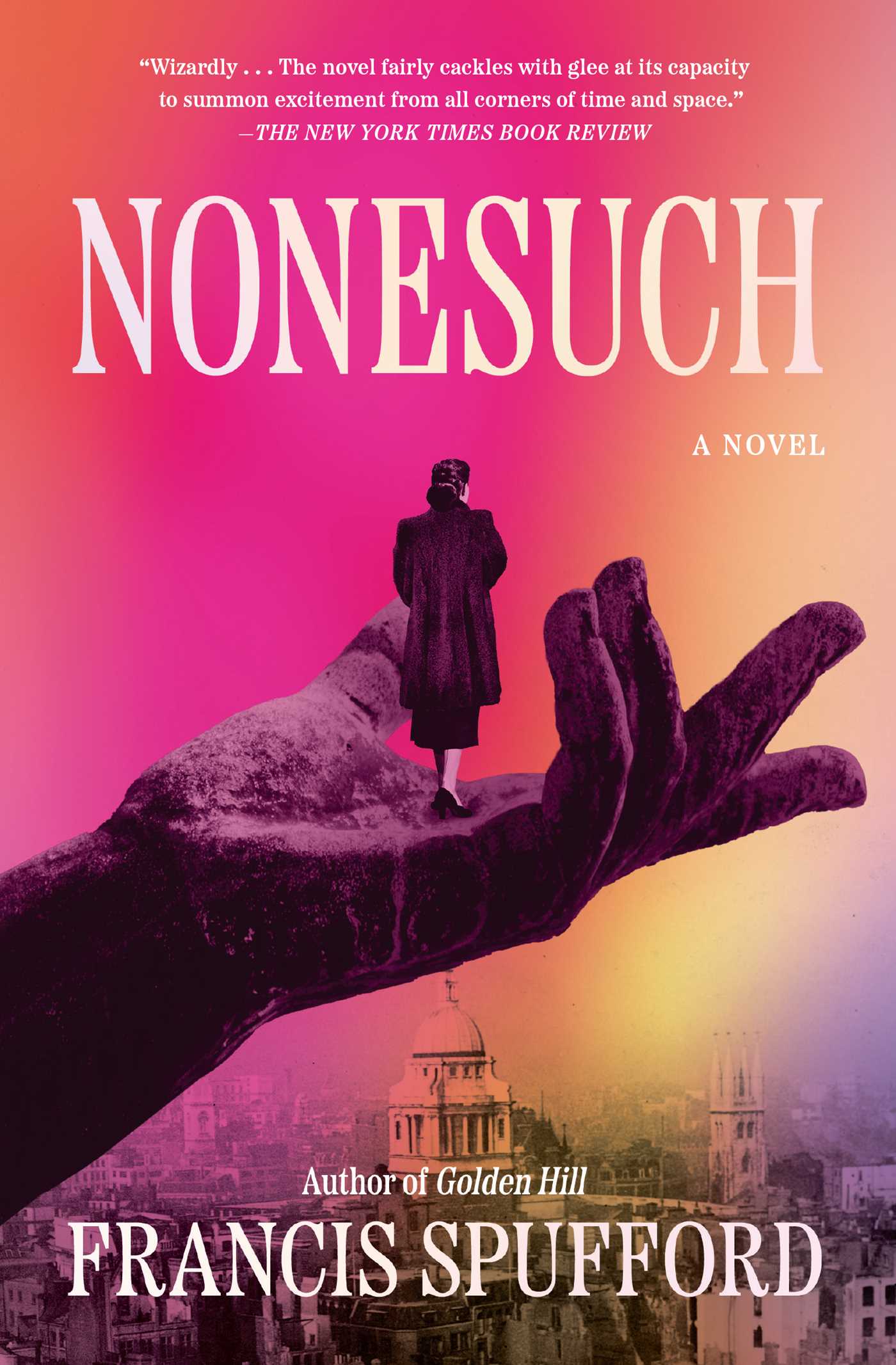
A spellbinding tale about an ambitious young woman who must thwart an occult plot by time-traveling fascists during the chaos of the London Blitz—from “one of our most powerful writers of wayward historical fiction” (The Washington Post).
“The novel fairly cackles with glee at its capacity to summon excitement from all corners of time and space.” —The New York Times Book Review
Following the acclaim of Golden Hill and Cahokia Jazz, Francis Spufford delivers a masterpiece of literary fantasy, hailed by Joe Hill as “a book that scoops up all the wonder and hope and pleasure of the Narnia novels, and pours it into a story for grown-ups.”
It’s the summer of 1939, and the air in London is thick with the tension of impending war. Iris Hawkins, a fiery young financial secretary, has a chance encounter with Geoff, a genius engineer from the new technology of television. What was supposed to be one night of abandon draws her instead into a nightmare of otherworldly pursuit—into a reality where time bends, spirits can be summoned, and history hangs by a thread. Soon there are Nazi planes droning overhead. In a time when death falls randomly from above each night, when the streets are darker than the wildest forest and all the men are away in uniform, the defense of the city is in the hands of its women. But Iris has more to contend with than just the terrors of the Blitz. Over the rooftops of burning London, in the twisted passages between past and present, through the vast night sky and across the tiny screens of early television, a fascist fanatic is travelling with a gun in her hand, and only Iris can stop her altering the course of history forever.
Both a thrilling page-turner and a profound exploration of ambition, love, and the fight against tyranny, Nonesuch is a story that is as enchanting as it is urgent. Packed with twists, tension, and wonder, it is a triumph of storytelling.
Excerpt
1. Wild Wood: August 1939 Wild Wood August 1939 i
She was on the up escalator at Leicester Square Tube station, checking her lipstick in the mirror of her compact. On the other side, tired clerks and shopgirls were being funneled away downward, weary at day’s end, ready for home and supper, but over here, riding up past the panels of polished wood, past the framed advertisements for face cream and cigarettes, past the bronze torches throwing roundels of electric glow onto the tilted white ceiling above—over here she was in a chattering crowd, being carried up to pleasure on the ever-cycling treads of the magic staircase.
Up ahead was the circular ticket-hall, and the hot light of an August evening spilling into it from every exit. Up ahead were shows, dinner, dancing, the teasing and pleasing and tasting and smiling and satisfying of a West End night. A weekday night, true, not the dionysiad of a Friday or a Saturday night—and with the news pressing at it, pinching at the pleasure, trying to extinguish it with worry if you paid attention. But still with anticipation enough in it to quicken the pulse. Still with the hours of promise ahead. The air was warm and getting warmer. She was wearing the silver dress, bias-cut so it flowed over curves and clung there mermaid-close. It was right for the Savoy, but it needed protecting till she got there. Up to August, hem twitched in her free hand to keep it out of the treads. Up to the late-summer glow in the cheeks and the prickle at the hairline; up to city dust and city speed and city noise. Up to the twenty thousand streets! To the babble of the pavements, to the bray of horns and the bells and the shouts of the newsboys selling bad news and the snatches of music from opened doors. To the lively air, with all its smells of petrol and beer and perfume and tobacco and cooking food swirled into motion by the busy passage of human bodies. To the foyers of the theaters, where the crowds were in strict evening dress, and the democratic glamour of the cinemas, where people were dressed and dressed up any way they liked. Up to gold and to gilding, to dear and to cheap delight. Up to life, waiting to be seized, moment by moment, every chance not taken lost forever.
But as she stepped out into the evening on the Charing Cross Road, her senses busy, more was happening around her than her eyes could see or her ears hear. Above the billboards and the rooftops where the sunlight was ripening to orange-gold, the air over London quivered, and not just with heat. The August sky was furrowed with vibrations, but such fine ones, such fast and delicate oscillations, such minute needle-point jittering of the fabric of empty space, that she would have needed to be an organism made of something finer than flesh and blood to feel the quick waves moving. Or to turn on a radio. It was humans who had written themselves onto the air, after all, adding the means to carry their own concerns along on the slight accelerations, or the slight deformations, of what was traveling along up there anyway. Twist that dial. Between the bands of crackle were flying voices in all the languages that filled the sixteen skies of Europe, and skimmed more weightlessly than midges over the waters of the Rhine and the Danube and the Thames and the Volga. Fearful voices, complacent voices, threatening voices, triumphant voices, all reporting what Mr. Molotov had agreed with Mr. Ribbentrop, and repeating Poland, Poland, Poland. And music! Europe danced tonight, frantically, to a babel of rhythms. Congas in Paris, violins in Vienna, kettledrums in Berlin, saxophones in Soho, an impossible orchestra. Last, among the voices and the instruments, a single signal, very recent, carrying pictures. One fuzzy thread of images. Turn the dial to the needle-fine shaking of the sky at 45 million hertz, and what was that? A white pill of light streaked across a gray herringbone soup that was meant to be grass. Len Hutton, 165 not out, was hitting the last ball of the last Test match before war stopped play. A draw against the West Indies. Another fraction of a turn and it was only the thick hiss of static again in the shaking sky.
Charlie Tremlett was waiting for her at the steps of St. Martin-in-the-Fields, looking exactly like what he was: a floppy-haired overgrown schoolboy, with a schoolboy’s straightforward appreciation and gratitude for what felt good. A pleasantly rangy sportsman’s body. Honorable according to his lights; too dumb for complications, in her experience so far. As she approached he was taking a pull from a flask, which he tucked hastily away. It seemed a bit hasty altogether for the very beginning of an evening. She didn’t think of him as a drinker, except in the ordinary social sense. But then when she got close she saw there was an expression on his face she was unfamiliar with, and it deepened as he took in the silver dress. Disapproval? No, embarrassment.
“You look ripping, Iris,” he said.
“But?”
“What do you mean?” he said.
“I mean, your next word is obviously going to be ‘but.’ You look ripping, Iris, but something. But what?”
“Oh, I get you. Well. The thing is, here you are, all dressed up—and the chap we’re meeting up with, and the girl he’s got along—well, they’ve rather put the kibosh on the Savoy. They’ve booked us a table for supper at some frightful little Eyetie place in Soho. And I sort of have to go along because—well—you know how it is—”
She did. Because Charlie was a jobber on the Stock Exchange floor, by all accounts a reasonably effective one, he depended for his income on a flow of orders from brokers like tonight’s chap, who needed therefore to be cosseted, gone along with, indulged in whatever their idea of an agreeable time might be.
“I’m most frightfully sorry,” Charlie said, sounding as if he were about twelve and on the headmaster’s carpet. “Feel like I dragged you out under false pretenses. And you looking so glamorous too.”
“Never mind,” said Iris. “Not your fault. Come on then, let’s go and butter up your broker. We can always double back to the Savoy later, and do a little dancing then. And things. No rule against that, is there?”
“No,” said Charlie, brightening. “No, there isn’t. Thank you. You’re a wonderful girl.”
“And don’t you forget it,” she said, and took his arm, having restored the gleam of anticipation to his eye. Probably to hers too: the advantage of a really expensive hotel, especially if you kept the desk staff well-oiled as Charlie took care to, was that they operated by quite different rules of respectability. The beds at the Savoy were wide, firm and comfortable.
“So, who is this chap of yours?” she asked as they were heading north.
“Bit of an odd fish, actually,” said Charlie.
“In what way? You know, apart from his thing for spaghetti.”
“Oh, very good.—Well, he’s terribly clever, and apparently he’s some kind of socialist,” Charlie said, with the air of one naming an obscure disease.
“You don’t get many of those in the City.”
“No! But Cleaverings don’t mind, it seems, because he is so clever. Makes them a packet, even if he disapproves. And he hangs about with all sorts of nobs and intellectuals—tries to teach the Labour front bench the financial ABC, that sort of thing.”
“Charlie—” she said uncertainly.
“What? Oh good grief, what a hole.”
They were standing in front of a narrow slot of a restaurant next to an Italian grocer’s, sharing with it a strong mingled smell of good olive oil and garlic. It wasn’t a hole, though it had none of the Savoy dining room’s chromium and chandeliers. It was dim, with candles on the little round tables, but the side wall had a mural on it receding into chiaroscuro that had Serious Art written all over it. She could tell what kind of place it was, and who its habitués were likely to be, even if Charlie couldn’t, and she hesitated on the threshold. But he was already through the door, grinning cheerily.
“Miles, old man!” he cried. She followed.
The odd fish was seated about two-thirds of the way back into the gloom. He had one of those male faces which, even when its owner is still in his twenties, shows what he will be like in confident middle age. Lidded eyes, hair receding from temples gleaming in the candlelight. He stood up.
“Charlie, good evening,” he said. “May I introduce Eleanor?”
His companion, sprawled in her chair in a tweed skirt and a frayed brown jumper, lifted the hand that was holding a cigarette from table height to head height in salute. She seemed to have a bandage round her wrist.
“Hello!” said Charlie. “This is Iris. Lovely girl, works at C&B.”
“Good evening,” said Charlie’s broker again. “Miles Ormond.”
“Hallo,” said Iris, “Iris Hawkins,” and heard Watford unmistakably in her own vowels, as if she had whole avenues of prosperous-but-not-posh suburbia tucked away in there. And the Girls’ Grammar School. And the future she hadn’t wanted, in which a good girl could hope for a nice young man with prospects in the building trade, or a solicitor’s office. That world, lost but refusing to be gone, inexorably following her around and speaking out of her mouth.
“I hope you don’t mind,” Ormond said, “I took the liberty of ordering the wine. Montepulciano. Pretty good, I think.” He poured.
“Oh, vino is vino, as far as I’m concerned,” said Charlie. “In vino veritas, hahaha. Cheers.”
The wine was black with occasional garnet points in the candlelight. Iris looked at Ormond’s Eleanor across the table, and saw nothing to contradict her fears and everything to confirm them. Short red curls, darkened like the wine in the gloom. No makeup at all. No nail varnish either; gray stuff under the fingernails instead. Eleanor looked back, something in her face that Iris very much did not want to kindle into amusement.
“What a dress,” she said, blowing smoke, and her voice—oh of course it did—had the ringing confidence of Oxford women’s colleges, and radio announcers, and actresses trained at RADA. “Very glamorous indeed. Almost Hollywood.” Her tone was not hostile. More zoological.
“Isn’t it marvelous?” said Charlie. “Trust Iris for the glad rags! So, what are we eating?”
Ormond passed across the menu. Charlie furrowed his brow at it.
“I thought I was dressing for a different kind of evening,” said Iris quietly. Charlie shot her a look of reproach, evidently taking this as unhelpful criticism of their hosts.
“I can see that,” said Eleanor, kindly. “Don’t worry: you really do look marvelous. I couldn’t wear anything like that. I ruin good clothes just by looking at them.”
“Bis-tecca al-la Fi–, alla Fi—” Charlie spelled out. “Is that a steak? I could inhale a steak tonight very happily.”
“What happened to your hand?” Iris asked.
“Chisel slipped,” said Eleanor briefly. “Occupational hazard. ’Nother one for my collection of cuts and bruises.” She put out the cigarette, and spread her fingers in the candle glow. They were covered in little white lines that Iris realized must be scars.
“Just don’t actually chop anything off,” said Ormond mildly. “I like your hands with all the fingers attached. I’m fond of them.”
“Gosh,” said Charlie. You could almost see, marching across his forehead in illuminated letters like a headline at Piccadilly Circus, the words YOURS IS A RUM ONE, ISN’T SHE? The idiot still hadn’t grasped the situation. “So, sorry, is that a steak?”
“Yes,” said Ormond. “What about you?” he asked Iris. “I thought I’d fill Eleanor here up with liver and sage, while I had the chance. She could do with the iron. Internally, not externally, for a change.”
He had a way of saying something funny, she saw, while remaining completely straight-faced. It might not have been a test, but ignoring the joke seemed like a short way of demonstrating that she wasn’t worth joking with.
“I’m not in a very ferrous mood,” she said, and Ormond tilted his head an appreciative half an inch: probably his equivalent of a hearty guffaw. “Would you choose for me?” Iris went on. “I don’t really know my way around Italian food.”
“Surely. How hungry are you, if you don’t mind my asking?”
“Reasonably.”
“Very well then, one reasonable Italian supper coming up.” Ormond summoned the waiter—summoned him by name—and then ordered, at length and in Italian, for all of them.
“The gift of tongues!” said Charlie. “My mother spoke French, but somehow it passed me by.” He had downed his glass of wine and he was getting pinker.
“I don’t expect you’ve ever needed it,” said Eleanor.
“That I have not,” agreed Charlie earnestly. “Always happy to stay with the colonial issues and the Kaffirs, you see. Can’t specialize in everything.”
“ ‘Kaffirs’?” said Eleanor, raising an eyebrow.
“South Af—” Iris began, and at the same time Ormond said, “Mining stocks.” He stopped and waved his hand at her to proceed.
“Shares in South African mines,” said Iris.
“Yes; and talking of that,” said Charlie winningly, “I had a thought or two you might be interested in.”
“Really?” said Ormond. “It’s hard to believe there’s going to be much of a private market for gold, for the next little while at least.”
“You mean because of the news,” said Charlie. “Come, come, my dear chap: Don’t people always make a bit of a beeline for gold when there’s a crisis? And I’ve heard—” Off he went, into a sales pitch for the splendid prospects of a particular mine under development west of Johannesburg. Ormond listened courteously, and went on listening while waiters brought an array of plates and dishes of all sizes. In front of Charlie they placed a steak, sizzling. In front of Iris, two green and purple figs, with a tiny cream cheese in the shape of a heart.
“Oh, that’s very nice,” said Eleanor. She had been served what looked like a piece of toast, with a smear of tomato on top.
“Would you rather swap?” said Iris.
“No!” said Eleanor, laughing.
Iris cut herself a small wedge of fig and dabbed it cautiously with the cheese. Her only previous acquaintance with figs was with the dried kind, offered as a constipation remedy or the filling of a biscuit, and she was expecting the same slightly fusty, gummy sweetness. Instead the combination was… delicious.
“Good, isn’t it?”
She took another mouthful. Charlie talked on; Ormond listened on, eating something unidentifiable with a fork, and expressing with the set of his shoulders a sardonic disbelief which Charlie seemed totally unable to read. The two women looked at each other.
“You’re a sculptor?” said Iris.
“Yes,” said Eleanor. “At the Slade.”
“Well, it was either that or a painter, as soon as I saw your nails.”
Eleanor turned the hand that was holding her toast-thing, and regarded them complacently.
“Filthy, aren’t they? You can get the stonedust out, but it takes so much scrubbing, and they’ll only get like that again tomorrow, so why bother.”
Iris looked down at herself, silver-clad, manicured.
“I suppose you have to, if you work in an office,” Eleanor offered. “So what do you do?”
“I’m a secretary,” said Iris.
“And is that interesting?”
Iris gave this question the answer it deserved, which was none at all. She pretended instead to be fully occupied by cutting up and eating the figs and cheese, but its deliciousness was of the miniature variety, and all too soon she had to look back up. Eleanor, with a puzzled expression, was trying to catch Ormond’s eye. Probably in a moment she would succeed: Charlie’s continuing sales pitch for gold stocks was taking on a hectic edge, as Ormond was responding less and less. He had finished whatever-it-was he had been served and was gazing into his wineglass, bored endurance legible on his face. It was seeming less and less likely that the end of the meal could be reached successfully.
“So,” Iris said suddenly, to Ormond. “What assets do you think make sense, if war comes?”
Charlie glared at her. She had never tried to get him out of a conversational jam before, it not having been that kind of connection, and he did not seem to welcome the idea of being helped. Perhaps he didn’t recognize that that was what she was doing.
“When war comes, surely,” said Ormond.
“You think it’s as certain as that?” she began to reply, but Charlie talked over her.
“Oh come on!” he said. “We don’t know, do we? A year ago, war looked like an absolute sure thing, panic in the streets and all that, I was talking to my old dad about a billet in the East Surreys, ready to do my duty—and then it made a noise like a hoop and rolled away. No war. Everyone calmed down again. My money says: same again. The johnnies in the Foreign Office will do their stuff and this time next month, we’ll all be laughing about it. Don’t you think?”
“I’m afraid not,” said Ormond. “This time, from everything I hear, we’re in for it.”
“Where should the clever money go then, if not gold?” Iris asked him. “America? Is that far enough away?”
“Interesting,” said Ormond, turning slightly to face her. “Probably yes, in the sense that, if the world burns, it would take a long time for the flames to reach Wall Street. But not necessarily for British investors.”
“Why?”
“Iris!” said Charlie between his teeth.
She ignored him, and so did Ormond.
“Because I cannot imagine any way for Britain to fund a war—a big war—without mobilizing British holdings abroad. The paperwork is already drawn up to forbid the export of capital. When war comes, and the money runs out, every share that anyone owns over here in Westinghouse or US Steel or Paramount Pictures is going to be requisitioned in short order.”
“The money runs out?” Charlie repeated incredulously. “The money runs out? Poppycock. Sorry, but—really! This is the financial capital of the world, old man.”
The waiter was hovering, trying to take away plates and to put down new ones, but Ormond was ignoring him; he was leaning into the candle flame to light a new cigarette, fully engaged for the first time.
“Take the total of British gold and dollar reserves,” he said. “Slightly north of five hundred million in sterling. Then estimate the cost of total war—say, four million a week—and divide by it. The money runs out in two and a half years. And that’s if we’re winning.”
“Of course we’d win,” said Charlie. He poured himself another glass of wine, sloppily.
“I hope so,” said Ormond. “I really do. But whether we’re winning or losing, the emphasis—to answer your question, Iris—is going to be on budgeting for survival, by managing demand and directing resources.”
“You’re assuming that Mr. Keynes is going to be in the ascendancy at the Treasury?”
“I am, yes,” said Ormond.
“Despite everyone still arguing about the General Theory?”
“Oh, you don’t have to agree with it to be influenced by it. You don’t even have to have read it. He’s won; he’s won so thoroughly he’s become part of common sense.”
“Voices in the air?” said Iris.
“Exactly!” said Ormond, laughing. “Exactly so. You’ve read it yourself then, I take it?”
“Yes, I have.”
“And… what did you say you do for a living, Miss Hawkins?”
“She says she’s a secretary,” put in Eleanor.
“Hmm,” said Ormond.
“Iris!” hissed Charlie. “You’re making a fool of yourself.” He was staring at her as if she’d grown a second head.
She was just as surprised. She had had no clue that anger was anywhere close under Charlie’s amiable surface. On the whole she was confident she could spot the angry men and steer clear of them. You had to be able to, if you were of any kind of adventurous disposition.
“One of us is,” said Iris. Eleanor was looking from person to person. There was a sharp burn in Iris’s leg. Charlie had tried to kick her under the table, and missed, and got the side of her calf instead, by the feel of it scraping off some skin.
“Now,” said Charlie, with a tight and over-toothed smile, “that’s all very well, but it’s a bit airy-fairy for a practical chap like me. Not to mention desperately gloomy! Wine, women and song are more my watchword. Watchwords, I suppose. Three of them!”
Iris was gazing at her plate, where little pale parcels dribbled with green oil had appeared. She felt a tentative tap on the back of her hand: two of Eleanor’s fingers, sandpapery to the touch.
“Would you care to come and powder your nose?” Eleanor asked.
“Yes I would. Thank you.”
“This way, then. We’ll leave them to the wine and song, shall we.”
They wove between the tables. Eleanor knew the way, as a regular. The Ladies, at the maximally dark, very back end of the restaurant, was a little cubbyhole with only just enough standing room for two. But it had a light over the mirror bright enough to show, when she pulled up the hem of the dress, that Charlie had torn a hole in her stocking and, yes, in her skin too. A dark-red trickle was running towards her ankle. She breathed through her nose and tried to smile.
“Oh dear,” said Eleanor. “Would you like a sticking plaster? I never have a lipstick on me, and I rarely have a clean handkerchief, but I do always carry sticking plasters. Peculiar habits of the profession, you see.”
“Yes. Please.”
“Gosh, it’s tight in here, isn’t it. Tell you what, you roll down the stocking, and I’ll get down here and see if I can minister to the affected part. Look,” she went on, a moment later and crouched at Iris’s feet, “I think I was rude to you, back in there. And is that interesting?” She was mimicking her own voice. “Just what my mother would say.—Here we go, hold still.—So patronizing. Do you ever get that? You open your mouth, and your mother’s voice comes out?”
“Not really,” said Iris, ignoring the door in her mind, the one with the scorch marks round it, that led to everything mother-related. “Thank you. You’re being very kind.”
“Basic comradeship among females, I assure you. There; how’s that?”
“Much better. He’s ruined the stocking, though.”
“It won’t show, honestly. Not with your hemline down there. It really is a marvelous dress. Give me a hand up? I’m only a trainee contortionist.”
“You all talk such nonsense all the time,” Iris said, heaving at Eleanor. She was surprisingly heavy. Stone-cutting muscles, presumably.
“ ‘You all’?” Eleanor queried. “Oh, you mean us educated bods. But you don’t do so badly at nonsense yourself. ‘Ferrous’ was very funny, I liked that. I suppose,” she went on cautiously, “that your chap in there isn’t quite such an idiot as he seems?”
“He is, though. He’s exactly that much of an idiot.”
“Then… why…?”
The gap across worlds was just too great. Not so much the class one, as the perpetual gulf between bad girls and good. Eleanor no doubt was full of advanced and tolerant ideas about all sorts of things—had queer friends, sunbathed with nothing on her top half, was familiar with the works of Marie Stopes. But if she said to her, Because he’s quite good in bed, there’d be blushing, and awkward silence, and a sudden end to basic comradeship among females.
She settled for: “Well, he’s not exactly my chap. Not in a serious way. He just takes me out, now and again.”
“Oh,” said Eleanor. “I thought he was… oh.”
“No, he’s not. He’s just a boyfriend.” The inoffensive word; the one that Iris hoped would stop the downward relegation of the pretty-but-common girl that was going on in Eleanor’s mind, before it arrived down in the grim commercial cellar of human arrangements. “And he is an idiot. He’s made a complete hash of this evening. He’s—mistaken the nature of the occasion,” she said, turning her voice into a parody of Eleanor’s parody of herself. Eleanor grinned. “He thought it was going to be a cigars-and-chorus-girls kind of thing. When in fact you’re actually Mr. Ormond’s fiancée, aren’t you.”
“We’re engaged, yes,” said Eleanor.
“And he still hasn’t worked it out. And when he does he’s going to be unbearably ashamed, and he’s going to be too much of a dolt to hide it. He’s going to behave as if he’s accidentally brought a tart to meet a duchess. I’m not a tart,” she said fiercely.
“I can tell you’re not,” said Eleanor. “I’m not a duchess, for that matter.”
“You’re respectable, that’s what counts. You belong with the sisters of people he went to school with. He’s not a subtle thinker.”
“He’s not, is he. He was gawping like a goldfish when you started talking economics with Miles.”
“Well, he’s never heard me say anything like that. He looks at me and he sees, you know, bosom and hips.”
“And you don’t… mind?” asked Eleanor.
“Not till now. Because it’s not his brain I’m interested in either. I look at him and—well, anyway. It’s been fun, usually. But this is horrible.—Sorry.”
“Oh, don’t be silly. I see that it is. You’re sitting there waiting for him to humiliate you, and when you tried to save him from himself, the stupid swine kicked you.”
“Yes.”
Eleanor considered. “Do you want a rescue?” she said.
“What do you mean?”
“Well, it would mean ditching your dinner—and losing the rest of whatever you and the swine had planned for the evening—but there’s a back way out through the kitchen, I happen to know. We could run away.”
“What about Charlie and…?”
“I can send in a note with the waiter. Miles will cope; Miles always copes, he’s very soothing. And he knows where we’re going on to. He can meet me there.”
“Are you sure? You lose your supper too.”
“Oh well. Call it my good deed for the day.”
“Charlie will be furious.”
“How tragic…”
ii
Cambridge Circus was all busy glare from the neon signs in red and green and white and blue. It was dark now, but the night was sealed away somewhere up above, beyond the radiant glow.
“What now?” said Eleanor, when the escape was complete and they were standing on the curb, getting their breath back.
Already, the rush of the laughing run through the alley full of dustbins was fading. Already they were remembering—well, Iris was, and she supposed Eleanor was—that they were two strangers.
“I mean,” said Eleanor, turning the face on her which, now she was seeing it by brighter light, seemed to Iris to have a kind of childishness about it, “what are you going to do next?” A face left clean and somehow unformed by the refusal to do the labor of being pretty.
“I suppose I’ll go home and put on something more sensible. Anyway, thanks—”
“But that sounds a bit dismal. You’ve lost your evening.”
“Oh well.”
“What were you going to do tonight, if you don’t mind my asking?”
“He was going to take me dancing at the Savoy,” Iris said, leaving out the part about the beds.
“Yes, well, look: here’s a thought. Where we’re going there’ll be dancing. It’s a sort of club, up beyond Fitzroy Street. They’re doing abstract film reels tonight, but they’re all set to dance music—you know, for the rhythm—and I bet people get up and move their feet. You could come. Why don’t you come?”
Iris frowned. “Why on earth would you want me to? I’m not a stray dog, you know. You don’t have to take me home just because you’ve patted me.”
“Heavens you’re prickly, aren’t you? I just think it would be fun. It seems like a night for impulses, what with the world threatening to end and all that. Go on! Throw yourself on the mercy of strangers! Even if it’s dreadful—even if it turns out we’re dreadful—it’ll still be more fun than retiring defeated to wash your hair.”
Iris looked at the face under the red curls again. Some maddening patronage was in there, yes: but also a kind of innocent recklessness. It was the face of someone who had always found the world safe, the face of someone who had never had to fear consequences. Someone who had never needed guile, or lies, or pretense to ease their path. Lucky her, thought Iris, who would have been inclined to hate her a little, on other nights. When Iris ran risks, she knew what the risk was; she calculated risk against reward. But tonight (when the world might be ending) it seemed more enviable to be the kind of person who, having run from a restaurant, wanted to scoop up the stranger you’d done it with and to keep on running while the running was good.
“Dancing intellectuals,” she said cautiously.
“Well, yes,” said Eleanor. And then, defiantly: “Yes! Oxford bags and peculiar frocks in motion!”
“Wouldn’t I stick out like a sore thumb in this?” asked Iris, waving at the silver dress.
“No. They’d think it was ironic, and you were terribly clever for wearing it. And I guarantee, I absolutely guarantee, it won’t be the oddest outfit in the room. I said peculiar; I meant peculiar. Last time we went, there was a chap in a suit made of cardboard.”
“Cardboard?”
“Yes! The corrugated kind, cut so the lines all ran north-south, and looked like pinstripes. I thought: My dear fellow, I hope it doesn’t rain on the way home, or you’re going to turn into a naked surrealist before you reach Highgate.”
“Pinstripe papier-mâché…”
“Exactly! Oh, go on, come with us, do. We’ve got different idiots.”
“You really want me to?”
“I wouldn’t ask if I didn’t,” said Eleanor, and Iris thought that was probably true. Oh, the hell with it. Time to borrow that sense of immunity, for a little while. Time to follow where impulse led, in the anxious city.
“All right!” she said, and grinned at her own lack of calculation.
“Attagirl!” said Eleanor. “You won’t be sorry. Or maybe you will, but you won’t be bored, I promise.”
They walked on northward together, the bright lights of Soho becoming, as they crossed Oxford Street, the dimmer and more bohemian streets of Fitzrovia. A busy evening here too, but more concentrated on pubs, bars, doors into obscurer spaces from which obscurer music leaked.
“What kind of sculpture do you do?” Iris asked, to avoid silence.
“Depends,” Eleanor said.
“On?”
“Whether it’s my own stuff or commissions. I’ve just done a mother and baby frieze for a clinic in Islington, and they wanted that, you know, pretty conventional. Smiley white marble. And I’m supposed to come up with something called ‘The Spirit of Vitamins,’ heaven help me, for a chemical company. Tosh like that. But when I can please myself I like playing with curves.”
“I see.”
“Do you? It goes wrong more often than it goes right, and I usually can’t explain why, even to myself. But what about you?”
“What do you mean?”
“I mean,” said Eleanor, fixing her with the frank and unguarded gaze again, “what are you? You’re not a floozy, we’ve established that. Though you might be posing as one, for reasons of your own.—That’s interesting. And you’re not a secretary, except in a temporary wage-slave sort of a way. So what are you?”
Iris wondered about saying, I’m a woman who likes men, having thought of one more reason why Eleanor might have wanted to carry her off. But she didn’t think there was anything unhelpfully romantic going on. The temperature of things between Eleanor and Ormond had been low, but relaxed and affectionate, like a gas ring steadily burning away when its flames were turned down into little blue buds, and she wasn’t picking up anything flirtatious now, not that she had much practice at spotting it in girls.
“I don’t quite know,” she said. “But I think… that I might be one of whatever your Miles is. If they’d let me.”
“You mean, about money, and the stock market and everything?”
“Yes.”
“Do they let women do that?”
“No,” said Iris. “Not here. In America women can be stockbrokers, but here they can’t be brokers, or jobbers, or even brokers’ clerks.”
“So will you go to America, then?”
Iris laughed. “I don’t think anyone’s going anywhere for a while, do you?”
“I suppose not,” said Eleanor. “It’s funny, isn’t it. You think you’ve made up your mind to a war coming, but you keep all these ordinary little expectations going as well, and it isn’t till something contradicts them, one after the other, that you realize, oh, that’s going to go too, isn’t it?”
Iris could have said, but didn’t, that traveling to America would never have been “an ordinary little expectation” to her. Instead she nodded. “We’re all imagining it,” she said, “the war; and the one thing you can be sure of is that we’re imagining it wrong.”
“You think it’ll be worse?”
“I think it’ll be real.”
“Miles says he thinks that the stock market, and all of that—all the clever moneymaking—is going to be swept away.”
“Does he? I notice he doesn’t mind having enough for nice Italian food. And good wine.”
“And buying pictures,” said Eleanor cheerfully. “And a house in the country. And a fast car. You know what he says? ‘I’m a socialist, not St. Francis of Assisi.’ He’s got a job at the Treasury ready for him as soon as the balloon goes up. Oh, here we are.”
“Here” was a flight of steel steps leading down to the basement of a newish commercial building, slightly taller than the general three-story scale of the street. Iris had been seeing an odd multicolored flickering coming up from it, ever since they turned the street corner, and now she was looking down the steps, she was facing the source of it, a line of basement windows flashing in shockingly bright and pure colors, turquoise and blood-orange and incandescent yellow. Dark human figures were moving against the colors, and they and the colors too were shifting in time to a familiar tune, pumping out at high amplification. It was being played on a weird mixture of instruments, including a violin. But it was, of all things, “The Lambeth Walk.” Cockney knees-up music. Well, West End Cockney knees-up music.
“Three bob, please,” said a man with a beard at a little table just inside the basement door. Beyond him was colored chaos. “I’m afraid we’ve got to cover the equipment hire tonight.”
“I’ll get this!” Eleanor said, raising her voice. “Welcome to the Kinesis Club!”
Iris stepped past, and the colors engulfed her.
There was a wide white screen on the far wall—maybe just a bedsheet tacked up—and a projector was playing onto it from a metal tower near the man taking the three-bob entry charge. But the room was so low that the dancers were stepping in and out of the beam, so the colors were playing on their bodies as well as on the screen. Not pictures; flying blobs and lines, sometimes splooged in their violet or scarlet as if they had been finger-painted, sometimes in moving motifs as if printed on by a half potato. She had never seen anything like it. And through the pulsating blizzard of color, four or five couples, not all couples in which men were paired with women, were performing a meticulous Lambeth Walk, slide steps, arm-in-arm promenades and all. Just as in the show, which she had seen from a good seat in the Dress Circle with Charlie. Only with the difference that here, instead of stage Cockneys, the dancers were two men in sailors’ trousers stripped to the waist, a very tall woman in tweeds with a face like an intelligent horse, an Indian in a turban and a tailcoat, a petite exquisite blonde in what Iris suspected was Schiaparelli evening wear of fabulous price, and a batch of more predictable souls in, indeed, Oxford bags and open shirts (male) or versions of Eleanor’s skirt and sweater (female). And all of them were doing the Walk with—not mockery, exactly, but a kind of solemn comic detachment. Bohemian clowning. It was very funny, but if you laughed you’d spoil the joke. Iris covered her mouth with her hand.
Eleanor, appearing at her side, said something in her ear.
“What?”
“I said, let’s sit down for a—oh, here we go.”
The film ended, and with it the dance, on a screen of names that meant nothing to her. Someone turned on the overhead lighting, and in a blink the room was transformed from a cavern of jewel-light to a concrete-floored, bare-walled cellar. Cables ran around the edges of the floor, and little tables were arranged in a U around the dance floor.
“They’re never very long, these films,” Eleanor said, bagging a table. The dancers settled around them. There was the rasp of many matches being struck. “They can’t be. So you get three minutes of astonishment—three minutes of ecstasy, if you want to be grand about it—and then you have to wait ten minutes while they change the reel and get set back up.”
“I’ve never—” Iris began, and changed her mind. “Why can’t they be longer?”
“Because the chap from New Zealand who does them paints the film by hand.”
“What, straight onto the celluloid?”
“Yes. So three minutes, at twenty-four frames a second, that must be, what—”
“Four thousand three hundred and twenty paintings,” said a boy at the next table, without looking round. He didn’t say it as if he meant to butt into the conversation, or as if he was showing off. It seemed reflexive. Someone nearby had asked for a calculation and he had provided it.
“Probably,” said Eleanor.
“No, definitely,” said Iris.
The boy grunted.
“Anyway, it means that making them is incredibly fiddly and labor-intensive. Six months’ work for three minutes. I can hardly imagine the patience—”
“Ridiculous, really,” the boy said. “Looks avant-garde. Actually, handicrafts. Whittling. Crochet. Basket-making, with light.”
“You don’t like them?” said Iris. She could only see the back of his head, where a particularly savage crop had left a sheen of blond fuzz on long, vulnerable tendons.
“Didn’t say that,” said the boy, talking downwards.
“Not modern enough for Geoff,” said one of the other men at the boy’s table, comfortably. An older man, forties, with a matinée-roguish face, wearing a dinner jacket that was perhaps not ironic. “Not electrical enough.”
“Not clever enough for Geoff,” said the Schiaparelli blonde, who was sitting there too. “Clever Geoff. Stop being clever, Geoff, and give me a light.”
She had a box of matches an inch from her left hand, but instead she folded her fingers together, and leaned over towards the boy with a gold-tipped cylinder inserted in a carmine pout. Iris looked at her, fascinated. She was worth looking at. She must be only about Iris’s own age, but if Eleanor was at one extreme of the spectrum in refusing to do any of the performance of beauty, this was a face at the opposite end. It was plucked, powdered, polished, armored in beauty. The features had, naturally, the delicate uniform smallness towards which everyone else had to struggle by de-emphasizing this, exaggerating that and hiding the other. The hair was like white silk. The fatness of the pearls round her neck showed off its slenderness.
The boy struck a match and turned his head to hold it out to her, revealing a flop of hair on his forehead, hollow cheeks and innocently intent eyes; also, on this face, a look of abject adoration. The beauty took the hand holding the match between finger and thumb to steady it. A pinch, not a caress. When she inhaled, a pair of mean little lines appeared, bracketing the rosebud mouth. A small mouth, thought Iris; not a generous mouth.
“Yes?” said the blonde, feeling the gaze. She didn’t turn her head Iris’s way, but she blew out a thin stream of smoke on Iris’s side of her mouth.
“You’ve got him very well trained,” said Iris.
“Do I know you?” said the blonde, glacially. Her voice had underheated country houses in it. Dogs. Thorn hedges. Icy ditches.
“I doubt it,” said Iris.
“Quite.” One flick of the eyes was bestowed on her, gray and crystalline and contemptuous.
“I say,” broke in Eleanor, speaking to the matinée actor in the dinner jacket rather than to either of them, “aren’t you that chap who does the radio announcements? Michael Frobisher?”
“Was that chap,” said Frobisher, showing off excellent and very large teeth. “Now the chap doing announcements for the television service. Consequently, seen by nobody. Heard by nobody, either. Tragic waste. Three years of pioneering brilliance, and what for? There we sit on the hilltop at Alexandra Palace, pouring charm and intelligence into the ether, where it all floats away unwitnessed—unnoticed—unenjoyed…”
He sounded perfectly happy about it. Perhaps because he felt sure that his charm would never run out. There would always be gallons more.
“That’s not true!” protested Eleanor.
“You mean you’ve actually seen one of our programs?” Frobisher enquired.
“Well—no. Not as such,” said Eleanor. “But a couple of my friends have been in your around-the-galleries thingummy, and they say it’s very good. Good questions. Serious. The kind of thing with enough to-and-fro really to help build the audience for contemporary art.”
“Does it build ours, that’s the question,” said Frobisher. “But, good; that’s very gratifying. Your friends are…?”
“Oliver O’Reilly and Madeleine Levinson.”
“Right, right. Yes. Splendid. I remember them.”
“So do I,” said the blonde. “The Jewess with the limp, wasn’t she?”
“And you’re…?” pursued Frobisher.
“Eleanor Armbruster.”
“Heavens, I think I’ve seen some of your work. The Oriel Gallery?”
“That’s right.”
“Well; hallo. I should introduce us. You have in fact got before you a small colony of the BBC. Me, vocal dogsbody. Lall Cunningham, our booker, who persuades visiting stars that for thirty guineas they should taxi up from the West End and do their turn for us as well—”
“Frightful people, most of them,” said the blonde.
“Lally is not in a good mood this evening,” said Frobisher. “As perhaps you can tell. And Geoffrey here, who is one of our technical wizards, fresh from filming the Test match.”
“What was the score?” said Iris, testing a theory.
“England 366 for three in 76 overs, Hutton 165 not out. Hammond, bowled Clarke, 138—”
“Thanks,” said Iris. “Do you like cricket?”
“No,” said Geoff.
Eleanor and Frobisher went off into a rapid roll-call of all the people they did and didn’t know in common, with occasional interventions from Lally the ice cube. Technical Geoff said nothing. Neither did Iris. She had guessed at first that it must be smooth, handsome, middle-aged Frobisher that Lall was really with, with the boy kept on a string for amusement: but that didn’t seem quite right now. There was no inclining towards Frobisher, on Lall’s side—the spine was ramrod-straight—and no pride of possession on Frobisher’s. If anything, a slight disdainful humor at her expense. To which no reaction at all appeared on the alabaster face. Only, the manicured fingers on the hand not holding the cigarette were in motion under the table-edge, Iris saw. Plucking minutely at Madame Schiaparelli’s fabric on her thigh. Nursing a fold of silk between finger and thumb.
Someone came round with a jug, and poured tumblers of a nasty but powerful fruit punch. Surely it was time for the next film, the next dance? The art-world gossip was not entertaining, if you were on the outside of it, and it wasn’t what Iris wanted from an evening of impulses followed, of strangers and bright colors.
The bearded man who’d taken the money was at the projector tower, but pulling at cables unavailingly, and looking frustrated.
“I’m sorry,” he said, raising his voice to the room. “Could someone who knows more than me take a look at this?”
“Fix it, Geoff,” said Lall.
“Yes, fix it, Geoff,” said Iris.
He was already getting up; he gave her, for the first time, a startled direct glance. His face was all angles—beaky nose, lantern chin—but with a glow of anxiety or self-consciousness on it that counteracted the austere lines. His sharp cheekbones were pink, what with the unexpected experience of being teased by a stranger arriving on top of being commanded by his ice-maiden. And as he moved over to the projector tower, she saw that he was gangly. He had long arms and big hands, long legs and big shoes. He crouched to check the connections, knees almost up to the shoulders of his sports jacket, stood on tiptoe to fiddle with the gate of the projector, and then walked the cables back across the floor to the amps under the screen, head down, taking quick weaving steps, a long finger on each hand out and pointing in the air and clearly tracing an electrical pathway. It was deft, even graceful, in an odd sort of way: a body being treated as if it were invisible to everyone else’s eyes, a body being used to think with. He adjusted something and came back.
“Try now, Donald,” he said. The projector whirred, the screen lit, a Latin drumbeat came from the speakers, and his face, as he nodded with satisfaction in the moment the overhead lights went off, reminded Iris strongly of something. Something unlikely. Not a person she knew; not even a photograph of a person. Not a real person at all. A drawing: a drawing in a book. The same long face, the same puzzled bright eyes. But with a frame around it. A metal frame. A helmet. Then she got it. It was an old picture-book illustration of Don Quixote she was thinking of. But young, and gazing at technical windmills. Take away the armor, take away forty years, and that was this Geoff. Don Quixote as a boy.
Then the dark filled with vertical lines of color pulsing and jiggling, swaying to left and right, and everyone surged up from their seats and emulated them, rumba-ing to clarinet and bongos, and to mauve and bottle-green and scarlet printing themselves on moving skin as much as on the screen. Hurricanes of dots swirled and jittered. Eleanor was up dancing with Frobisher, Lall had claimed Geoff as of right, and Iris found herself shaking her hips with one of the two bare-chested sailors. It was a very nice chest, hard and warm and wide and developed, with a satisfactory heat and a satisfactory smell of clean male sweat coming off it. But the hand on her hip as she swung it was light, was entirely proper. And what she felt under her own hand, as it rode on the snaky flexing of the sailor’s narrow waist, was all the pleasure of performance, not even slightly the pleasure of female company. Not one for the ladies, this mariner.
Lall went by with Geoff, and Iris saw that detachment ruled over there as well. No touch at all. Geoff, slightly to her surprise, was dancing with enthusiasm, giving himself to the rhythm in birdlike jerks. But Lall, opposite him, was minimal, keeping him focused on her entirely with her face, and reducing her hip movement—not that there was much to her hips anyway—to a set of disdainful twitches. She was perfectly in time, of course, but she moved as if she disliked even the tiny loosening of the space between neck and knees that she was consenting to. Her spine stayed straight. Her pelvis was not being allowed to get any ideas. It astonished Iris that Geoff couldn’t see it, but apparently not. The idiot gaze of hope stayed on his face as if plastered there. It was annoying.
When the film ended and the lights went up, she saw that Miles Ormond had arrived, smiling and unflustered. She tried to apologize, but he shook it off.
“I’m used to dealing with wild bores,” he said. “Think nothing of it.”
She would have liked to pick up the conversation she had started to have with him in Soho, but when she ventured a remark in that direction, he made it politely clear that Charlie had exhausted his entire willingness to talk about the markets. In any case, he too was pulled promptly towards the glamour represented by Frobisher, and very quickly what developed was a three-cornered conversation between Frobisher, Ormond and Eleanor, with occasional contributions by Geoff and Lally, and her sitting at the edge, trying not to feel redundant.
The next film was less danceable. Noodling woodwind accompanied an experiment with human figures in it for once, a silhouetted businessman with an umbrella and a silhouetted tennis player with a racket, who when they moved left a smeared rainbow trail on the air. It was pretty to look at it, but it didn’t get you out of your chair, and the conversation at their two tables went on regardless.
“The charm of it,” Frobisher was saying, “is that no one knows exactly what will work on television. It’s a new medium. It’s not cinema, though you can show films on it, and it’s not a little theater in the corner of the room, though we have had some success with squeezing plays onto it.”
“You have to get the close-ups right,” said Geoff.
“You do, you certainly do; and that can be, if you’ll pardon my French, a complete pain in the arse, what with the cameras not moving. You have to know at the outset that at minute forty-three and eleven seconds, you’re going to want to fill the screen with the sensitive profile of the younger Gielgud, and your camera has to be lined up ready. And then there’s every chance that your actor will miss his mark slightly, since it doesn’t matter on the stage, and then what the waiting millions get is a lovely gray-toned study of his ear.”
“ ‘Waiting millions’?” said Ormond, with an eyebrow raised.
“What am I saying? Waiting hundreds. Waiting thousands, maybe.”
“Tens of thousands now,” put in Geoff. “I was doing the Radiolympia broadcast last week, and apparently the total number of sets sold is up to twenty thousand or so.”
“Which is not bad going,” said Frobisher, “for a thing the size of a cocktail cabinet, with a screen no bigger than your hand, that costs ten weeks or more of the average wage.”
“Well, it’s not for everyone, is it?” said Lall.
“But what I’m trying to say,” said Frobisher, exhibiting his teeth, “is that it’s exciting to be in at the beginning. And there’s a kind of freedom in having hardly anyone watching. You can discover what it can do which nothing else can.”
“And what is that?” said Eleanor. “What are the new tricks in your magic box? What can you do, by painting with electricity?”
“Oh, I like that,” said Frobisher. “Well: I would say, immediacy.”
“Presence,” said Geoff.
“Enchantment,” said Lall.
“I think you’re going to have to explain all of those,” said Ormond.
“Would you, though, if we actually had a, a receiver?” asked Eleanor. “Art needs explanation sometimes, but does this?”
“No, it doesn’t,” said Frobisher. “That’s the thing. If you’re actually watching television, it doesn’t need explaining at all. It just works on you.”
“A self-evident aesthetic,” said Eleanor, interested.
“But we’ve never seen it,” said Iris. Lall flicked her a glance, as if to say, Who cares?
Frobisher extended the broadcast of his charm briefly in the direction of the less important girl, and smiled at her. “All right. Imagine that the gray little glass circle, in your luxurious cocktail cabinet, warms up to become a sort of magic keyhole. You don’t look at it, you look through it.”
“And what do you see?” said Eleanor.
“Things happening right now. Not grave and considered utterances, but a kind of visual chatter. News, yes; but also tap-dancing feet, movie stars without a script, someone hitting a six, the very moment when a snake-charming-lady’s python escapes across the studio floor.”
“Nightmare!” said Lall.
“And then somehow it doesn’t matter that the keyhole is tiny. You can’t look away.”
“That’s what I meant about presence,” said Geoff, his ears reddening. “It makes you feel you’re there. And not just in one place, either. It’s a flow. It’s here, and then here, and then here. You’re at the zoo, you’re watching the Life Guards go by, you’re at the races, you’re looking at Jasmine Bligh’s smile as she answers the phone on Picture Page, you’re in the world.”
“Montage,” said Eleanor, knowledgeably.
“But not put together by a director. Not someone’s deliberate, you know, selection of images. That they’ve thought about and put in order. More a kind of pack shuffled by… television itself. Or by life itself—that’s how it feels, anyway. And it doesn’t need rewinding, or six months’ work with a paintbrush. It never stops.”
“Well, not till our daily three hours of broadcast time are over, anyway,” said Frobisher. “But—yes.”
“Eloquent Geoff,” said Lall, freezing him back into shyness, as she surely intended.
“And enchantment?” inquired Ormond politely.
“Oh, you know,” she said, the carmine lips hardly moving. “It’s a modern spell, isn’t it. It makes you look, it keeps you looking. Cinema is for the people. Television is for those who need a private connection to power. A circuit to connect them to what they adore. It’s like Signor Mussolini says: man is made to adore and to obey.”
“I… think that was Disraeli,” said Ormond, a laugh in his voice that Lall did not like at all.
“Oh?” she said, glacially.
“So you see it growing, do you?” said Eleanor to Frobisher, after a momentary frown. “Television?”
“In the long run, certainly. When we’ve ironed out the kinks. When the cameras get better. When the sets get cheaper. I’m sure it’s going to be a frivolity that the world will take to, like… chewing-gum or nylons. But in the short run,” Frobisher said, losing the smile, “I’m afraid it’s a frivolity the world can’t afford. If war comes, they’ll switch us off, like that.” He snapped his fingers.
“There’ll be no need for that,” Lall said. “You’ll see. Cooler heads will prevail. Sensible people know that Germany has no hostile intentions towards us. Rather the opposite. All we have to do is to keep our nose out of European squabbles that don’t concern us.”
“You think we should let them gobble up Poland, like they did Czechoslovakia?” said Ormond, all laughter drained out of his voice too.
“I think,” said Lall, holding the word with tongs and making it clear she regarded it as a disreputable activity, “that we should be grateful to the Führer for taking care of Bolshevism, for all our sakes.”
“I’m afraid I have a lingering attachment to democracy,” said Ormond, and turned unmistakably away from her. Eleanor followed suit. Frobisher looked down at the table. Geoff was embarrassed.
Another film began: back to flying red triangles and vibrating dots, to a Cuban beat.
Lall, feeling Iris’s fascinated attention still on her as the others seized the excuse to stand up, snapped, “What are you looking at?”
“A fascist, apparently,” said Iris.
“Well, better that than a suburban slut like you.”
“Oh,” said Iris. “Oh. Well: come on, Geoffrey. Come and dance with me.”
iii
Out on the floor, out where the dark shook with colors to the sound of maracas, Geoff started his bird-dance again, evidently expecting Iris to get no closer than Lall had. She put her hand on his shoulder and pulled. When he was up against her, she grabbed his waving right hand and put it on the slippery silver at her hip, where it trembled. Trembled uncertainly, but not indifferently. Then she steered them both back into the rhythm. This one was faster, with skittering horns and then a pounding piano. Across a background like slightly yellowed printer’s paper, frantic asterisks rolled and bounced, changing hues every fraction of a second. The two of them sashayed and shook, prestissimo, Geoff startled but willing, a look of concentration on his face. He was pleasingly but not enormously taller than her, despite the gangliness; and despite the look of not having grown all the way into the length of his limbs, what was under the sports jacket and the open white shirt was knotty, not soft. His head, bent forward, was close enough for speech. The dark and the rhythm made a temporary privacy.
“You don’t agree with her about that stuff, do you?” she asked.
“God, no,” said Geoff.
“Then why are you so stuck on her?”
“Is it that obvious?”
“Yes!”
“It’s just that she’s so… so…”
“Lovely? Yes, she is. But you’re not ever going to have her, you know.”
His eyes went wide, and he nearly lost the beat.
“I’m not—You can’t—I mean, that’s not what I—I—”
“Yes, it is. But you’re wasting your time.”
“You don’t know her! You don’t know me. You don’t know anything about me.”
“I know she’s not interested. If it helps, I don’t think it’s personal.”
“What do you mean?”
“Lall’s not up for passion at all, with anyone. Except maybe the Führer. She doesn’t want to feel. She doesn’t want to open up. She doesn’t want anything getting too close.”
“How can you tell?”
“Because if she wanted you, Geoff, she wouldn’t dance with you three feet away. She’d dance with you like this.”
Iris put both arms round his neck and came in all the way from conventionally near to skin-mashed-against-skin near, her chest into his chest, pressing up so he’d feel the whole length of her body against the whole length of his. Her shaking hips she brought up hard into him, and added some forward stirring and nuzzling and bumping. The little liquefying flame lit in her; she could feel what she was doing to him. Oh, now the evening had its recklessness back. She bit her lower lip, and stared into his eyes with dumb greed from two inches away.
“Like that,” she said, stopping.
“What—what are you doing?”
“Demonstrating.”
“But—do you—”
“You’re wondering, is she just demonstrating? Or does she mean it? What do you think, Geoff?”
“I don’t know,” he said.
The film ended. The music stopped. The lights went on.
“I’ll tell you what,” she said quietly. “Call us a taxi, right now, take me somewhere with a bed, and I’ll show you whether I mean it or not.”
He stared.
“Come on,” she said. “The world’s ending. So they say.”
“I can’t just leave,” he said.
“Yes you can. You can walk me out, right now. Straight past them. Straight to the door.”
He shook his head, but with disbelief not refusal. And past sour-faced beautiful Lall, past laughing Frobisher, past ironic Ormond, past disbelieving Eleanor who was nevertheless patting her hands together in mock-applause—Iris didn’t think it was likely she’d ever see her again, but she was glad she enjoyed the spectacle—past all the dancing intellectuals and Donald on the door, she marched him out. Outside on the pavement she kissed him hard, immediately, to seal the bargain, and then ran hand in hand with him in the direction of a cab with its yellow FOR HIRE light on.
“Where to, guvnor?” asked the driver.
“Um—Hampstead,” said Geoff.
They scrambled in, the taxi backed and turned, and then they were off, sliding together on the wide, worn, slippery shelf of the back seat while London flowed backward past them. She had hoped for some mansion-block much nearer by, in Marylebone or Bloomsbury, somewhere reachable while the first energy of impulse was still upon them. She didn’t want to wait, she didn’t want to think. She didn’t really want to talk. She kissed Geoff some more—a big mouth with narrow lips, some clashing of teeth as he got keener, a tongue startled to feel her tongue coming exploring—and there it was, the usual feeling of discovery, of difference in sameness, of being permitted to touch and taste the foreign way another body, a male body, did the familiar business of being human. Rougher, bigger, harder: always different, and the same thrill every time. Touch to touch, wet inner lip to wet inner lip, skin to skin. The world getting warmer, and smaller, and all concentrated on this, here, now. She did what she had been wanting to do, and slipped her hand down inside the open neck of his shirt. He was August-bare underneath it, as she had hoped, and she found a long smooth hot hairless boy’s chest, skin tight on the ribs. His nipples were small and flat, threepenny bits of creased chamois. She flicked one with a nail, and he made a sound in his throat; she squeezed it hard between finger and thumb, and he gasped into her busy mouth. His own hands, which had hovered uncertainly in his lap, went onto her convulsively, and started to squeeze and grasp, not gently.
“Oi!” said the cabby sharply. “That’s enough of that. Bit o’ decency, please. Get to where you’re going, and you can grope each other all you like. But this is a licensed conveyance, not a knocking-shop.”
Geoff pulled away, abashed. Turned away too; looked out of the side window at whatever North London street they were trundling along. In the dark of the cab it was difficult to tell, but she suspected there was another blush coloring his skin. A shameable boy. Not abashed herself, not ashamed, but anxious in case the moment cooled away into doubts and hesitations and second thoughts, she reached for his hand, and held it tight, trying to send into the grip certainty, and assurance, and promise, or all that warm fingers could communicate of those things; enough of those things to win the race against doubt, as the car rose up, and up, and up, on some steepening avenue. She had no idea how much time had passed, or how much farther they had to go. Behind, London was starting to gather into a pool of sparkles, diamonds and rhinestones poured together in a black basin.
“All right,” said the driver. “Where exactly am I taking you two lovebirds, then?”
Geoff cleared his throat. “Wildwood Terrace, please.”
“Back of bloody beyond.”
Geoff, having looked up to speak to the driver, swallowed and looked at their joined hands, and then at her. The cone of brightness from a streetlamp swiveled across his face, wiping away shadow for a moment. His expression was not one of doubt or of impulse fading away. Not at all. It was the purest look of wonderment Iris had ever seen, let alone provoked on her own account; and seeing it, so palpably not the expression of someone who knew how this game was played, she felt a sensation that was new in quite a different way from the greedy novelty of learning a new body. It was a kind of dismay. She looked at his wonder, and her heart misgave her. She thought of the faces she was used to lovers making. Charlie’s schoolboy greed as he spread her wide on Egyptian cotton sheets. Weather-beaten Jack the spirits salesman, looking down at her with cheerful approval, takes-one-to-know-one approval, as she tried something out on him. Sly victorious glances from Lancelot the petroleum futures king, as she sat on his knee in a suite in Brighton, all the while quite confident that the victory was hers. Each face made plain by desire. Nothing mysterious in them, nothing to worry about in them. (Though it was not nice to realize that Charlie’s might have been hiding anger without her knowing it.) This was different, this… astonished awe. No telling what he understood, or didn’t. No telling what such a face might ask of her. Now she was the one looking away, to avoid his eye.
The taxi crested the brow of the hill. Another little street or two, toy-pretty, and then out into a moonlit emptiness of grass and trees. The Heath, presumably. She peered: something was moving there, metallic in the pale white light. Monstrous earthworm segments, rearing and swelling, which suddenly, when she saw the crew laboring at the cables that held one, resolved into barrage balloons being prepared for launch.
“Can I ask you something?” Geoff said, in a near-whisper for privacy’s sake.
“Maybe not,” she muttered, looking down.
“It’s just… I don’t know your name.”
It must have never come up, in the conversation at the table.
“Iris,” she said.
“Iris what?”
“Does it matter?”
“Of course it matters,” he said, smiling at her as the taxi slowed: and now she was slightly afraid of him and his innocence. But she still wanted him.
The cab dropped them at a leafy little junction, where odd little houses hid behind trees. When the engine noise had died away, there was a countryside hush, loudly silent if your ears were used to London, most peculiar to find in London. The nearest streetlamp had an apple tree leaning over and around the lantern, so that heavy sprays of russet and green fruit dappled the light and shone in it. It was as if, having found a wild space unexpectedly contained within the city, they had now found a village within that; and, going further in and in, might find more and more secrets, ever smaller. It made Iris think of the telescoping children’s poem which led you through city, street, house, room, cupboard, drawer and box, until in the inmost chamber of the inmost chamber, there was the key that unlocked the whole city. She shivered, and Geoff, thinking she was cold, took off his sports jacket and chivalrously draped it over her shoulders.
“We’ll have to be quiet,” he said, leading her away up a lane which after one more streetlamp was all green darkness. A garden gate that stuck, and the dimly seen outline of a house, lightless and somehow lopsided.
“Why?” she said—whispered, obediently.
“Because my father will be asleep downstairs.”
“Geoff—”
But he had her by the hand, and since she did still want him, she followed him across a summer-sappy dimness and dampness where long grass swished, to a door he eased open with a latchkey. Inside there was no light at all, except stray gleams through the fanlight, but it was paper-smelling, and dust-smelling, and loomingly cluttered. There were silhouettes of unidentifiable tall things along the hall wall, like a collection of many grandfather clocks, and the stairs they crept up were piled high with something-or-other on the left-hand side. It was about the opposite of the setting she had imagined for him—she had thought of ultra-modern bareness, smooth surfaces of glass and steel for technical Geoff, not a chaotic junkyard.
A little landing at the top, with boards that creaked. A door Geoff opened, and beckoned her through.
But she mouthed “Bathroom?” at him, and he pointed her to the next door along. There was a light switch, but she put in her cap in the dark, not wanting to see what she suspected, lit up, would be the smeared and moldy fox-den horror of male bad housekeeping. Rings in the bath. Patinated toothpaste spatter on the mirror. Never-dried bathmat growing algae. The darkness could keep it.
In darkness she crept back to Geoff’s bedroom, tapped, and went in. Inside, to her relief, order. He had lit a tiny side-lamp, the bulb no bigger than a pea, and the small yellow glow illuminated a rack of identical jackets, a stack of ironed white shirts, shelves on which the books were arranged in strict descending order of size. And an immaculately made-up single bed, with a red coverlet and a clean sheet. There were signs too of the child’s bedroom this had once been—a model biplane hanging on threads under the eaves, where a dormer window with diamond panes looked out on the overgrowth of the garden, and the last streetlamp beyond. But she didn’t look at those. She looked at Geoff standing with his head tilted under the low ceiling, and if his eyes were shining disconcertingly, he was also looking at her down and up and down again, in the silver dress, and at the warm lick of his gaze she found that her little flame was still burning. Was growing and spreading, in fact.
He whispered something, but too quietly for her to hear. She stepped closer.
“You said you’d prove me something if I found you a bed,” he said.
She put her hands on his shoulders.
“And that’s the bed, is it?”
“Mm-hmm.”
And at this, at the straightforward challenge of it, it became possible to ignore all the strangeness of the place, and the night, and of him, and of her own lurching sense of stepping off the known world’s edge and falling—and to get back to the service of her flame. And his. She could kiss him again, and let her hands go exploring again, and feel his on her pressing and molding and squeezing, with increasing confidence and force. And could tumble him over onto the bed, and join him in his splay of long limbs, and find where the two of them fitted, and where the fulcrum was on his bony hip where you could rub an ache. And feel the world getting smaller and simpler, in the old old way; feel it becoming all one thing that she was confident of, in which she knew she had power. Smaller. Simpler. Hotter.
When they were hot enough, and both breathing hard, an August sheen of damp on both their faces because it was not cool in the little room under the low eaves, she pushed back the flop of blond hair from his forehead, and said happily, “Now take all your clothes off.”
“Are you going to—?” he asked, nodding at the silver dress.
“We’ll come to that,” she said. “But you first.”
He started fumbling at his buttons as he lay there.
“No,” she said. “Stand up so I can see you. I want to see you.”
She could have turned off the little lamp but she really didn’t want to spare his blushes; and indeed, lying on her side watching him like a cat, with a smile and unwavering eyes so he would know how completely he was being seen, it was blushes she saw. They bloomed on him, paleness and fairness and gingery-brownness delicately transformed by slow tides of pink. A better show than any of the dancing asterisks earlier. His knees and elbows were boles of bone, not yet in proportion with narrow legs and arms. Foal boy. Fool boy.
He came back to her naked and she lay on top of him, enjoying the slide of the silver fabric against the stick of his quivering skin. He was really very pale, in the parts the sun did not reach: a stark white, that came up instantly in red lines where she scratched him gently. She kissed him some more. He clasped her, and started to heave under her, trying to push up at her where she was pressing down on him, trying to get between her thighs as much as the dress would allow, but she was not quite ready for that. She gave him the bitten-lip look again, this time with a smile in it, and watched him melt into helplessness—and then began to work her way down him, with hands and mouth. A lick and a kiss and a stroke and a scrape and a nip. When she reached his groin, his arms and legs convulsed as if she were sending electric current through him.
“What—what are you doing?” he gasped.
She freed her mouth. “Something a man taught me. I didn’t like him much, but I like doing this. I’ll stop if you want. Do you want me to stop?”
“… No,” said Geoff, somewhere between a groan and a squeak.
The smallest of small worlds now. Closed eyes and a full mouth. If this was the key to the city, there was no cold metal to it. It was a living charm. Warmth in the inmost box of the world. Outside, the night, rumors of war, balloons on steel hawsers rising, Poland, Parliament recalled, Mr. Chamberlain to speak on the radio, Stalin and Molotov, Hitler and Ribbentrop. In here, a raw and tender and salty warmth.
When he was ready—when she was ready, too—she came back up him, hitched the silver dress up round her waist, and climbed on him. They fitted together well, and now she wanted him to move, using her weight to ease his galvanized upward lurches into smoother riding for both of them. His eyes were wide, and his mouth was wide open too, a silent O of astonishment. She would have welcomed his hands on her but they were clutching at his neat red bedspread. Fast riding. Faster riding, maybe too fast, a canter becoming a gallop—
“I’m going—to—” Geoff started saying.
“No you’re not,” she said, stopping dead. She fixed him sternly with her eyes. “Tell me the primes, Geoff.”
“What?”
“Prime numbers. Tell me them. One, three, five—go on.”
“Seven!”
“Good.”
“Eleven. Thirteen.”
“Yes?”
“Seventeen. Nineteen. Twenty-three.”
“Good boy. Keep going.”
“Twenty-nine. Thirty-one. Thirty-seven.”
She began moving again, very gently, with extra pressure and attention to what worked for her, because clearly Geoff was going to be just fine the moment she released the numerical leash. A grind against the bone. There and there and there.
“Forty-one, forty-three, forty-seven, fifty-one—”
“Yes—”
“Fifty-three, fifty-seven, fifty-nine—”
“Yes!”
“Sixty-one, sixty-seven—”
“Yes!”
She put her hand over his mouth to stop the numbers, and felt him come undone on the instant, pulsing upward into her as she gripped and shook and blazed around him, drinking the cup of pleasure down and down and down. And down. Then she fell forward onto him laughing, and lay in a wreck of satisfaction with her face against his ear. Take that, oncoming war. Take that, obstinate world. Take that, Charlie. Take that, posh bitch Lall. Score one for suburban sluts.
It was only when her breathing had slowed that she realized that the faint sound she could hear was not Geoff laughing too. She lifted her head, and found that he was weeping, a trickle of tears running from the corner of each stricken eye.
“Hey,” she said in alarm. None of her other men had cried. “What is it? Sweet boy, what’s the matter?”
“… I don’t know.”
“Well, hush then. It’s all right. Everything’s all right, isn’t it.”
She twisted round and patted at him awkwardly. She was too unstrung for this. Too dismantled to make an effort of understanding. Or to want to. But then a thought struck her—a simple one.
“That wasn’t… your first time, was it?”
“… Yes.”
“Oh. Well then.” A part of her would have liked to crow. To sing out inwardly, Well, you’re going to remember that then, Don Quixote! But the urge was thwarted by the sight of his face. “Look, it’s a bit of a shock for everyone, the first time, that’s all. It’s a new feeling, isn’t it. You think you’ve been turned inside out, you think you… might not be the same person anymore.” More memory than she wanted came bubbling up; she pushed it down. “But then in a little while you find you’re still just the same.”
“I don’t feel just the same.”
“In a minute, I said. Give it a minute.”
“I thought it would be different from that.”
“You thought it would be with her, right?” His Nazi object of adoration whose thighs were held together with industrial adhesive.
“I thought it would be different. I thought it would be… less lonely.”
“Lonely!”
“Maybe that’s not the right word.”
“I’m just here, you know.”
“I know. You’re very kind,” he said politely.
“No,” she said, “I’m not, particularly. But on the whole people are glad I’m there. On the whole they don’t weep and wail if I decide I want to give them what I just gave you.”
“I’m sorry,” he said, his eyes welling anew.
“Oh—” she began and stopped, anger and compunction hopelessly mixed up inside her. Instead she draped her arms around him in an approximation of comfort. Hell. This was what her misgivings in the taxi had been trying to warn her about. She thought of saying, Don’t be so damn innocent. But he was innocent, wasn’t he? She had known that; that was the appeal. And whatever she thought of saying, whatever protest she thought of uttering, it wouldn’t restore her animal contentment of a minute ago: the yawning cat feeling, the well-stroked feeling. All that was tangled now, spoiled now, by knowing that for him what she’d just done had been, of all things, lonely. Her mouth, her hands, him inside her: lonely. Her eyes on his skin, her skillful management of his desire: lonely. Lonely! The little bastard. Her draped arms seemed to be settling into a rigid frame. She longed to move them. How much comfort was enough comfort? And her rucked-up dress and her bare bottom half were feeling squalid now instead of pleasantly abandoned. She had imagined that that was going to be Act One of their night together. He was young, he had some go in him. She had been looking forward to getting properly naked herself; showing her skin to his eyes, and seeing him look. Fat chance of that, clearly.
He made another unexpected sound. A murmur. And looking back at him, from the frustrated place inside her head where she had gone, Iris found that having delivered his spoiling word, having wept, Geoff had gone to sleep. Light snores. The thin, sculpted lips falling open. She was offended, but also relieved. She could get away now. She unlocked her arms and took the hand off his temple, where she had been absently stroking the white-blond hair, and began to lift herself up off him with as much precaution as she could manage, so the weight might come off him in stages too slow to be noticed. No more conversation; please, no more conversation. When I am standing up, she told herself, I will begin to feel normal. And when I find my way out of this hot little trap of a house, located who-knows-where, I will feel more normal. And when I get home, I will be all the way back to normal. I will be my reliable self again. I will.
She found her knickers on the floor, and her bag, and she turned off the little light by the bed so she shouldn’t have to gaze at his fine bones and his closed eyelids as she went. Without it, the room was all shadow, except for the small spill of moonlight and distant streetlamp that fell in through the dormer window.
On her silent way out, towards the bathroom and then the stairs, something moved in the bright parallelogram on the floor, catching her eye. Some flaw in the light, some twitch in the shadow. She went closer to the dormer to look, knocking her head on the toy biplane. Something in the movement was odd; wrong. Not in the right repertoire for things seen out of cottage windows.
She squinted, and down under the last streetlight she saw that a figure was standing. A man in a long coat and a hat, seemingly. Too many clothes to be comfortable on an August night, maybe, but otherwise ordinary enough. Except that this man was slowly bending his head over onto his shoulder. Not just tilting it, or leaning. Laying it absolutely flat there, at ninety degrees, in a way that the human neck did not permit. Apart from the hat—why didn’t the hat fall off?—it didn’t look in silhouette like a head at all, but some flaccid appendage, slackly creasable. She thought of the barrage balloons, half-inflated, swelling and blundering. Then up from the shoulder swung the head, if it was a head, through the vertical and all down onto the other shoulder. A smooth movement, like the swing of a metronome. Or as if he had no bones in him, but were a skin loosely filled with some fluid, like the balloons. She felt the hair standing up on the sweat-damp nape of her neck: back to animal reactions, but fear now, not contentment. A creature’s reaction to discovering nearby in the dark a thing that moved as if it lived, but could not be assigned to any of the known categories of safe or dangerous.
And then, as if he felt her eyes on him, the figure turned, and his face was incomprehensible too. Incomprehensibly wrong. He was the distance of a garden and a stretch of pavement away, with the branches of a tree in between and only the uncertain top-down glow of the streetlamp to illuminate him. But she should still have been able to make out the familiar pattern of features. A line of shadow for a mouth, dark pits for eyes. There the patches of shadow were, under the hat, but not in the right places for eyes and mouth. Not where eyes and mouth could plausibly be. The face refused to be a face, refused to compose. Yet with this face that was not a face he, or maybe it, seemed to be watching her in return. Its gaze had found her without hesitation, though she should have been completely invisible from the lane, behind glass in a darkened room. Securely out of sight. Instead she had the shocking conviction that neither distance, nor darkness, nor even the walls of the cottage were any obstacle to it at all. In the attention of this thing, walls faded to transparency, were as thin as veils, as spiders’ webs. Her damp skin, her beating heart, her clenched hands were no more hidden from it than if it had been standing right in front of her. In the room with her. In the reach of boneless arms—
It moved! It stepped off the pavement, away from the lamplight, into the deeper shadow on the far side of the lane. There she couldn’t see it anymore, shadow-camouflaged, shadow-consumed. But first she had seen its walk, a pouring motion, jointless and inhuman. She stared into the dark, heart pounding. No movement that she could detect. Nothing. No noise either, though she strained her ears to try to catch, over the thump of her own pulse, anything like a footfall. Anything like the rustle of leaves, the swish of grass, disturbed by a boneless tread. Or, worst, the click of the latch of Geoff’s garden gate, which would mean that it was coming in, gliding up the overgrown path, preparing to press its way into the cluttered hall. But there was nothing. If she opened the window a crack, she might be able to hear more, to pick up finer stirs or displacements in the hot night air—but she felt an instinctive repulsion at the idea of having any fewer barriers between her and the thing outside, even a thin and useless one like a pane of glass. Stay in the cave, said animal wisdom. Stay very still. If there is any doubt about whether the thing outside in the dark is hunting, you do not want to meet it. She had shrunk back from the window without making any conscious choice.
But after two minutes, five minutes, some uncountable amount of time had passed, measured by pulse beats, not knowing became an anguish in itself. She had to look. She dropped to her knees and shuffled like that to the floor in front of the dormer. Slowly, slowly, she raised her head, until her eyes were just at the level of the sill. She peered over. There was still no movement at all in the shadows beyond the streetlamp. Nothing in the blackness to say for sure that the watcher was standing there, in its wrongness. But nothing to say for sure that it wasn’t, either.
She waited till her knees ached. Her heart slowed, and the panic receded, and a thread of a suggestion that she was behaving absurdly entered her mind and thickened there. The longer she saw nothing strange down on the road, the harder it became to be sure that she had ever seen anything at all. For what makes no sense is hard to hold on to. Recognition is what allows us to take hold of a perception, and to hold it fast in memory. Without recognition, a sight scrabbles for attachments in your mind and finds nothing there to fit it, and when the immediate terror is over it fades, dreamlike. Yet very like the residue of a nightmare, though the experience was going, going, almost gone, a sharp ghost of the sensation remained, alive in her body if no longer in her mind: the sensation of being transfixed by inexorable attention through walls turned thin as cobwebs. And she knew with absolute certainty that she was not going outside in the dark herself, to run even the slightest risk of meeting a thing without a face.
But that meant staying here, in the bottled heat of Geoff’s room, until dawn. There he still was, naked and sleeping easy, untouched by whatever had just happened. (Or had not.) Already he had begun to seem like yesterday’s problem. She was reluctant to get close to him again, but the alternative was an upright chair at his desk, gazing at exactly ranked books it was too dark to read, and which no doubt would be about electrical engineering anyway. She went as silently as she could to the bathroom, to wash; and when she came back she arranged herself next to him on the bed with her back turned.
He breathed, and she couldn’t refuse to hear it. A steady push and pull of air, close behind her. Treat it like wind, she thought, or like surf on a beach; some natural noise, soothing if anything. Between the sound of Geoff and the memory of fear she threaded her way by thinking, her reliable standby, about money. Its complications. Its possibilities. The unsolved problem of where money could safely go, if war was coming. Money reproducing itself at 4 percent interest forever, if you had enough of it to start off with. The impossibility of ever growing rich in one lifetime at 4 percent interest, if you started off with not very much. The need for risk. The need to find the quicksilver flows of money in quantity, money in abundance, and to divert some of it. Money coming, money going. Money as gold, as paper, as credit. Money breathing in and out of the recesses of the economy like the sound of a man sleeping. Until her thoughts lost all coherence, and she wandered through other bedrooms where boys hung model airplanes from the ceiling, but unscathed, unburned, for this was merely a dream visit, light-footed, consequenceless.
Light woke her, brazing its way gold and green through the window. A moment of panic, but her watch showed her that it was only five o’clock, first light of a high-summer dawn. Up and to the window. Anything visible up the lane that shouldn’t be? Of course not. The simplest explanation, after all, was that when Geoff had dropped off to sleep so had she, and everything else had been a dream. The bad dream of a night that had gone wrong. Having thought this, she seized on it as the version of things that was going to be the truth from now on. And she gathered her things, and nearly made it out of the room before Geoff woke. He looked at her sleepily. She looked at him and was obliged to agree with her greedy self of the evening before that he was beautiful.
“You’re going?” he mumbled. “How do I find you again?”
“Sweet boy,” she said vaguely, and fled.
There was cool in the air outside, and freshness from the dew. Birdsong louder than traffic. A short walk in the dawn took her to a bus-stop, an early bus took her to a Tube station just opening up, and the first southbound train took her home. All in good time for her to shed the silver silk, and bathe and dress and drink a cup of tea and eat a piece of toast; and then to set off once more, a unit in the tide of office workers, reaching the Mariner Building yawning but on time, as if nothing had happened at all.
Reading Group Guide
Get a FREE ebook by joining our mailing list today! Plus, receive recommendations for your next Book Club read.
By clicking 'Sign me up' I agree to the Terms of Use and acknowledge the Privacy Policy and Notice of Financial Incentive. Free ebook offer available to NEW US subscribers only. Offer redeemable at Simon & Schuster's ebook fulfillment partner. Must redeem within 90 days. See full terms and conditions and this month's choices.
This reading group guide for NONESUCH includes discussion questions and ideas for enhancing your book club. The suggested questions are intended to help your reading group find new and interesting angles and topics for your discussion. We hope that these ideas will enrich your conversation and increase your enjoyment of the book.
Topics & Questions for Discussion
The prologue thrusts the reader into the middle of a magical story and ends with the line “But that was much later.” How does this set the scene for the story and its characters? What does it tell us about the story’s world?
After leaving Wildwood Terrace, how do Iris’s feelings shift after her night with Geoff? Do you think they would have met again had it not been for the angel?
While discussing their first meeting at the Kinesis Club, Iris tells Lall “I took Fortress Geoff pretty much by surprise attack, if you know what I mean” (page 151). Besides what she is insinuating, in what other ways does this ring true?
While Iris is initially hesitant to return to Wildwood Terrace and visit Mr. Hale, what do you think compels her to continue returning?
How does Iris and Geoff’s relationship grow once he is drafted into the army? Reflect on how Iris’s perspective changes in her letters to him after her initial hesitation to respond.
Were you surprised by the book’s portrayal of the angels? If so, in what way?
Discuss the parallels between the Order and Grand Master and the fascists during World War II. How do you feel about Mr. Hale being a member of the Order, something Bluey even pointed out?
Iris and Lall have opposing motives throughout the story, beginning with their initial conversation on their political views up until the journey to Nonesuch. What are the similarities between the two women?
Much of the book takes place during the London Blitz. How does this historical context contribute to the tension of Iris’s mission to find Nonesuch?
During one of the nightly raids, Iris reflects on her relationship with Geoff after he visits on leave. She reminds herself “He is motherless. . . . He is frightened of the people he loves disappearing” (page 315). In what ways can we see how Geoff’s upbringing affects him and his relationship with Iris?
Iris confesses her ambitions to be rich in a conversation with Geoff about the war. She admits “I do like money. . . . I want to be a tycoon . . . and when I am, I want everyone to know that I’m also Iris Hawkins from Watford” (pages 394–95). Do her aspirations surprise you? Recall other parts in the book where we may have seen these ambitions hinted at earlier.
Which London do you think Iris feels more at home in, the safe but conventional city of the opening, or the place of fire and ruin we see London becoming?
Nonesuch is both a historical novel and a fantasy. In your opinion, what does it gain by mixing the two? Or would you have preferred it be completely one or the other?
Enhance Your Book Club
Discuss what you hope to see in the upcoming sequel, Arcady. What predictions do you have for Iris, Geoff, and the rest of London?
Light Perpetual, also by Francis Spufford, delves into twentieth century history in London, starting in 1944. Discuss how the author weaves in real-life events into his stories and how London compares in both novels.
About the Author
© Antonio Olmos
Francis Spufford began as the author of four highly praised books of nonfiction. His first book, I May Be Some Time, won the Writers Guild Award for Best Nonfiction Book, the Banff Mountain Book Prize, and a Somerset Maugham Award. It was followed by The Child That Books Built, Backroom Boys, and most recently, Unapologetic. But with Red Plenty, he switched to the novel. Golden Hill won multiple literary prizes on both sides of the Atlantic; Light Perpetual was longlisted for the Booker Prize; and Cahokia Jazz was longlisted for the Carnegie Medal for Excellence in Fiction and won the Sidewise Award for Alternate History. In England, he is a Fellow of both the Royal Society of Literature and the Royal Historical Society. He teaches writing at Goldsmiths College, University of London.
Product Details
- Publisher: Scribner (March 30, 2027)
- Length: 512 pages
- ISBN13: 9781668214398
Browse Related Books
Raves and Reviews
“The novel fairly cackles with glee at its capacity to summon excitement from all corners of time and space...[Nonesuch] does what few time-travel fantasies do: It laughs about the pleasure that can be had once we grant ourselves the power to change history. At the same time, however, it asks questions, as all time-travel novels do, about who gets to tinker with time, and who lives at its mercy.” —Louisa Hall, New York Times
“Radiant...This is a book interested more in people and place than in plot, and Iris—one of the most perceptively written women ever produced by a male novelist—shares main-character status with London itself. Spufford, a vivid stylist, wants the reader to feel and smell and hear what it was like to live in the city during wartime.” —Laura Miller, Slate
“Nonesuch is a historical fantasy set during the second world war, every paragraph of which is packed with authorial zest.” —The Guardian
“The sheer scale of Spufford’s imagination allows for some truly cinematic set pieces. As much as I loved the spectacle—which at one point has Iris hundreds of feet in the sky as German bombers hammer London—it’s the authentic moments, grounded in history, that hit home.” —Locus
“[A] breezy genre mash-up... there are lively depictions of the Blitz, plenty of sex and a rom-com’s worth of flirtatious patter." —Sam Sacks, Wall Street Journal
"A time-bending tale populated by specters and Nazi planes." —The New York Times, "The Novels Everyone Will Be Talking About in 2026"
"It’s His Dark Materials meets the blitz: the deep satisfactions of children’s literature reclaimed for adults who still want stories in which the world is wondrous." —Observer (UK)
"If you read books for a living, the calling probably started with a moment of utter entrancement: a novel you couldn't bear to set down ... such books are rarer these days, but they do still happen ... Nonesuch does the trick ... This novel deserves to be a colossal success."
—The Spectator
"Brilliantly brought to life by a literary magician, who ends with a plot twist equivalent to making someone disappear ... all Spufford has to do now is repeat the same trick, just as well." —The Telegraph
“A lavish historical fantasy of a secretary and her lover battling time-traveling fascists on the eve of WWII… Spufford sustains the tension all the way to the miraculous finale. Readers will be enthralled.” —Publishers Weekly, Starred Review
"Equal parts stunning historical fiction and daring fantasy, Nonesuch is a remarkable journey into the imagination of a brilliant writer.” —BookPage, Starred Review
"I feel like I've been waiting all my adult life for Nonesuch to come along: a book that scoops up all the wonder and hope and pleasure of the Narnia novels, and pours it into a story for grown-up. The book itself is a kind of enchantment, as powerful as any of the great and harrowing spells cast within its pages, and I was entirely ensorcelled. You simply. Must. Read. This. Book." —Joe Hill
"Nonesuch salts actual history with the conventions of the fantastic in a way that thrills me, but by now that feels like a trademark of Spufford’s writing. Here are the most interesting (and terrifying angels) since Madeline L’Engle, and the human characters, too, are so full of life and feeling they practically set fire to the pages as you turn them." —Kelly Link, Pulitzer Prize finalist and author of The Book of Love
"What a joy! Bejewelled with dazzling prose, propulsive as a rocket, mandala-complex in its worldbuilding, and corkscrewing jubilantly through fantasy, history, romance, occultism, adventure, and the wartime Stock Exchange, Nonesuch is a novel with endless ingenuity and an enormous heart." —Kaliane Bradley, New York Times bestselling author of The Ministry of Time
"Spufford’s novels hit the sweet spot between literary brilliance and hopelessly addictive." —Mail on Sunday
"Pulls no punches in its exploration of the particular character of British fascism . . . Nonesuch is more of a genre-defying, time-and-space-bending experience rather than a novel: at once historical and extremely timely for our current political climate." —Dazed Digital
"A gripping, otherworldly adventure set during the London Blitz. . . . Nonesuch is a rollicking read. Superbly plotted, it thunders along at breakneck speed until the gasp-inducing, heartbreaking final twist. " —The Bookseller (UK)
Resources and Downloads
High Resolution Images
-
Book Cover Image (jpg): Nonesuch
Trade Paperback 9781668214398
-
Author Photo (jpg): Francis Spufford © Antonio Olmos(0.1 MB)
Any use of an author photo must include its respective photo credit