

Plus, receive recommendations and exclusive offers on all of your favorite books and authors from Simon & Schuster.
0:00 /
LIST PRICE $28.99
PRICE MAY VARY BY RETAILER
Free shipping when you spend $40. Terms apply.
Buy from Other Retailers
Table of Contents
About the Book
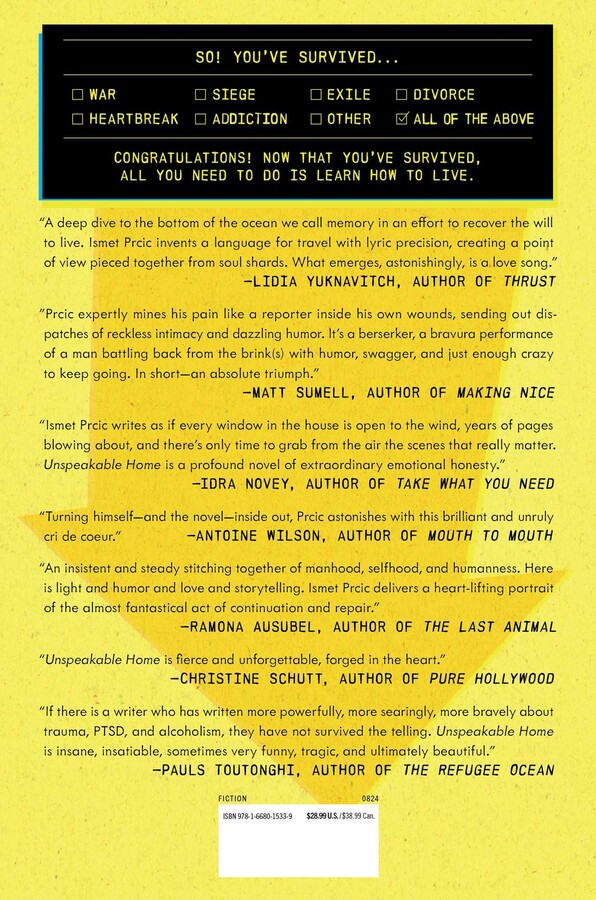
From award-winning writer Ismet Prcic, a “brutal and tender and beautiful” (Tommy Orange, author of Wandering Stars) novel that is “part existential cry…part anguished confession…a transfiguring of personal memory to obscure the terrible cost of exile” (The New York Times).
Having fled his war-torn hometown of Tuzla in Bosnia-Herzegovina as a teenager, our narrator, Izzy, found love and a measure of stability in California with his beloved. But his American marriage couldn’t survive his Bosnian brokenness, the trauma so entrenched and insidious that it became impossible to communicate to anyone outside of himself—even the person he loved most. Now, as he writes in the first of many courageously candid fan letters to the comedian Bill Burr, he knows he must try.
“An adventurous novel that meshes a fragmented narrative with a broken soul” (Kirkus Reviews), Unspeakable Home takes us through Izzy’s memories and confessions as he reflects on his bomb-ravaged childhood, the implosion of his relationships, and an agonizing battle with alcoholism. As multiple narrators surface in fragments with increasingly tenuous connections to reality, Ismet Prcic unearths the psychological cost of exile and shame with a roving, kinetic energy and a sharp, searching sense of humor.
What emerges is a vivid and poignant exploration of the stories we create to hide the deepest parts of our identity from ourselves, as well as a hard-won, life-affirming promise of redemption.
Having fled his war-torn hometown of Tuzla in Bosnia-Herzegovina as a teenager, our narrator, Izzy, found love and a measure of stability in California with his beloved. But his American marriage couldn’t survive his Bosnian brokenness, the trauma so entrenched and insidious that it became impossible to communicate to anyone outside of himself—even the person he loved most. Now, as he writes in the first of many courageously candid fan letters to the comedian Bill Burr, he knows he must try.
“An adventurous novel that meshes a fragmented narrative with a broken soul” (Kirkus Reviews), Unspeakable Home takes us through Izzy’s memories and confessions as he reflects on his bomb-ravaged childhood, the implosion of his relationships, and an agonizing battle with alcoholism. As multiple narrators surface in fragments with increasingly tenuous connections to reality, Ismet Prcic unearths the psychological cost of exile and shame with a roving, kinetic energy and a sharp, searching sense of humor.
What emerges is a vivid and poignant exploration of the stories we create to hide the deepest parts of our identity from ourselves, as well as a hard-won, life-affirming promise of redemption.
Excerpt
Slouching Toward Pichka Materina
Two Bosnian-born Brits wait at a pedestrian crossing.
A man across the street from them bounds right into traffic, causing havoc. Brakes squeal, horns scream, motorists raise bloody hell. The man somehow makes it across alive, not without a certain clownish, apologetic charm.
“How much you bet he’s one of ours?” the first Brit says to the other in Bosnian. She giggles, shaking her head.
“Excuse me, sir,” the first Brit asks the clown in English, “but where are you from?”
“Iz pichke materine,”* the man says in Bosnian.
Both Brits burst into laughter.
The man’s eyes widen.
“Just like the two of you,” he adds in English. “Just like everyone.”
*Pichka Materina = Mother’s Cunt
—WITNESSED IN LONDON, UK, CIRCA 2005
“We’re not here to answer cuntish questions.”
—GUY DEBORD
“In America you vatch television; in Soviet Russia the television vatches you.”
—YAKOV SMIRNOFF
We made it through what passed as childhood in Yugoslavia in the ’80s and into the gaucheness and ungainliness of adolescence just as our country was sent back into its mother’s cunt. It happened in the early ’90s. You probably saw some of it, spun this way or that, on your TV.
You and your fucking TV!
We loved you, though, still do, your cheery, mollifying sitcoms in which the TV set laughs at its own jokes, and your prescribed, moralistic dramas, the abridged binary worldview of good guys and bad guys, your representations of human conflict that can be summed up with the sentence: You lied to me! as if lying hasn’t been the only reasonable evolutionary response to what we vaguely like to call “reality,” your cultural exports that made the complex, fucked-up lives we in Yugoslavia both witnessed and lived feel easier to take, so much so that when we, the TZ PUNX (Tuzla punks), got pinched for, say, breaking into a newspaper kiosk to steal porn and cigarettes, we were so young and primed by your worldview that we actually believed we had rights, like you have in the States, and demanded said rights from the obtuse meat slabs that were Tuzla’s cops—kerovi—who leered and kneed us in the ribs and, using our Mohawks and long hair, guided our skulls into various durable surfaces, bloodsplit our ears by pulling off our earrings, and full-on stole our stolen Doc Martens and leather jackets.
We really wanted to be like you. If you asked us TZ PUNX in the early ’90s, we would have happily hung the Stars-and-stripes off of every Soviet-style balcony in our town. Shit, we would have tattooed them on our foreheads. Not because your stars and stripes are beautiful, not by a long shot, but because it would piss off our parents and grandparents and the other miserable commie and old and nuevo-nationalist fucks in charge of everything in our lives.
And yes, we sometimes made fun of some of your punks because they were “raging” against guitar solos that were too long in the ’70s. Kudos for that noble effort and all but, with all due respect, suck it a little. Your Natives and your Blacks were way more punk than any of your so-called All-Americans. Death, baby! Bad Brains, baby! Right?
But let’s stay on topic, shall we?
Mother’s cunt, or pichka materina, as we say, is where the so-called Yugoslavs used to send a lot of things and people, rhetorically, on a daily basis. It was the national pastime. A footballer kicks a ball into a post instead of the goal; send him to his mother’s cunt. A plate of chevapi slips out of hand onto the pine-needle-covered ground at some May Day celebration in butt-fuck Pozarnica; send it to its mother’s cunt. A D string breaks in the middle of a sevdalinka in the early-morning hours of a party when only the true raja—only the cool, essential members of the party—are still up (read: true alcoholics with a built-up tolerance); e nek se goni u pichku materinu.
We could easily have said that “war sent our country to hell” and made more sense here, but we’re not in the business of sugarcoating shit for you. It was back into its mother’s cunt that it was sent, back into the uterus, back into the place where its pieces were first put together and made into a whole, and back there it was backward unmade. The so-called Yugoslavs shoved it way up there and unmade it so well that we, their children, awakened without a homeland.
We belonged nowhere, so we formed our own tribe, chose our own markings and names, our own rituals and sounds. We wrote our own story. Good riddance, beloved homeland; you can go fuck yourself now.
We emancipated ourselves with glue sniffing and laughter in the face of our parents’ grave, fear-soaked talking-tos. Igor the Punk from Titova Street, who wore a giant encircled A on his T-shirt and who broke the communal light switches in buildings’ vestibules with his forehead as soon as they were installed, and who one time, when his own father caught him red-handed with shards of cheap plastic at his feet, gave his father (he didn’t know it was his father) a shiner in the darkness. He got his ass beat to a pulp, of course, but he kept on breaking the damn switches anyway, until somebody from the apartment-dwellers council thought to reinforce them in steel. Igor then started using a screwdriver on them, until his fed-up father sat him down and told him he had to stop or leave the house for good. Igor squatted on the living room rug and started to strain and grimace, as if in terrible pain. His father asked him what was going on.
“I’m trying real hard here to give a shit, Pops, but as you can see, no cigar!”
Before the war, we were kids who still somewhat respected grown-ups and gave a shit about getting together and playing games like football—sorry, soccer. We would gather after school on the grass behind the boxy building called Furnace One, called that not on account of its incendiary little apartments in the summertime, like everybody thinks, but because the area on which our ward stood was in the time of the Austro-Hungarian Empire known for distillation of local plum brandy using big furnaces. In our time, it was considered a tough neighborhood.
Skojevska je oshtar greben,
dodjesh poshten, odesh jeben.
Or, “Skojevska Street is a sharp, gnarly ridge / you may come here all honest but you’ll leave here all fucked.” This is an artless, unrhyming translation. You’re welcome. (Also, the word jeben, or “fucked,” used in this way can be translated as both “to fuck,” as in doing the fucking, and “being fucked with,” as in receiving whatever the fucker can unleash. Both are powers.)
Once there on that patch of grass, we would divide ourselves into cliques or teams, scream and kick soccer balls and each other’s shins, get kicked out of games for missing goals and pestered by resident drunkards. There was this birtija called Snack Bar right around the corner, and the lowlife inebriates who lived there would come out to take leaks right there in full view of us children. The most insufferable of them, one Anto the Hand—nicknamed that because he only had one—would always try to play with us for a while, make a jackass of himself, and wouldn’t leave us alone until the soccer ball ended up in the river.
The river always claimed our balls.
River, however, is too generous a term for this stinky, pond-scummy trickle of mostly sewage, forced by sun-bleached concrete embankments into orderly flow through the town. Most of the time, after retrieving the ball, all we had to worry about was wiping it on the grass to get rid of scum and sludge and solids. But every once in a while, usually in spring, after a snowmelt, this so-called river would become a monster.
One of us overzealous soccer-star wannabes would punt a mangy ball too hard through a netless goal. The ball would bounce off the edge of the embankment straight into the clayey, engorged river. We would all start running downstream and the punter would sprint ahead of us, ahead of the ball, climb down the sloping concrete to the water’s edge, and try to recover it with his extended leg or a stick. Often, if the ball caught a current down the middle of the river, the kids on the other side of it—attracted by all the hoopla—would throw helpful rocks, trying to nudge the ball within the punter’s reach, often splashing him in the process with filth.
But sometimes it was the river that would reach up instead, nab the punter, suck him in, swallow him, and then tumble him downstream. The punter’s best friend or older brother would run way ahead, climb down the embankment, and try to save his friend or brother in the same way their friend or brother tried to save the ball. Sometimes they would also get nabbed. Sometimes even grown-ups would get involved and some Good Samaritan—a firefighter on a day off or a soldier on leave—would jump in and save the boys or just one of them. And sometimes they too would succumb to the water’s rush, leaving nobody whom we could later thank for saving our lives and/or blame for not saving our brothers’.
Skojevska je oshtar greben…
We were natives of our ward and newcomers and every mix and mutt in between: blue bloods and peasants, bruisers and cowards, lower- and middle-class latchkey kids. Our parents were teachers and miners, engineers and nurses, artists and lovable fuckups. Our parents were also drunkards and psychopaths, religious communists and secret nationalists, borderline personalities and depressives, but good enough eggs, we guessed.
The walls of our apartments were adorned with kitschy needlework and woolen tapestries, Arabic calligraphy and Orthodox and Catholic religious icons, portraits of Comrade Tito, or peeling yellowed wallpaper bubbling damply.
Once a year we piled into our families’ sad Fiat sedans and endured pukey, serpentine excursions to the Adriatic seaside, stayed in our fathers’ companies’ trailers in Neum and Podgora, in Makarska and Bashko Polje and Orebich. We made friends with the locals, touched their boobies in the backs of theaters showing movies starring Steven Seagal and Eric Roberts, Bud Spencer and Terence Hill. We swam and fished shparove off the docks, pretended our pasty, peasantly parents were not our parents, and hoped that the Vespa guy with a cooler on the back would drive by the beach when our parents were still in the water and yell his customary Pepsi-Cola, Mirinda, pivo! so we could rush to him, beg him to sell us a beer.
In the winters—nothing. We didn’t have money to go anywhere in the winters. We just stomached the cold and the snow and the Tuzla salt mines’ briny industrial slush on the roads. We sniffled and sighed, dug our hands into our pockets of Spitfire and Levi’s jackets, pined over girls who thought nothing of us. We went to crowded student clubs, sweated and swore, peacocked and thought that things could only get better or worse. We moshed to new American punk rockers and old American and British ones, watched as some of us who slipped on beer-soaked tile got kicked and punched in the mosh pits by peasants who came to underground clubs not because of music and strobe lights or to show off in front of punky girls but to anonymously kick fallen bodies when they were down on the ground.
In your movies, your male teenagers lose their virginity under the bleachers, or in the backs of gas hogs parked on dusty vistas in the middle of the night, or in dorms and Motel 6 rooms. In our neck of the woods your no-good cousin sits you down just as the first peach fuzz of mustache darkens your upper lip and plops hard-core German pornography in your lap and starts teaching you how to finger pussy. You ask him, What does it feel like to be with a girl? and he sends you to get him a jar of honey from the pantry, leaves the jar out in the blazing sun for a while, then calls you over, takes you by the wrist, and dips your forefinger into the honey to the second knuckle, and pulls it out. You scrutinize how the hollow in the honey closes as your finger tingles with warmth and newness. See how it closes? the no-good cousin asks, and you nod because you do. That’s how it feels.
He also says, Don’t be a fool. All of your friends are gonna go around falling in love like greenhorns, getting their hearts broken by, like, four pretty-faced girls in the school. Fuck that. You have to go for the ugly ones. That’s where the pussy is. You gotta blanket the market.
Your twenty-five-year-old no-good cousin, who never finished high school and got a trucking route at sixteen, who lived in his parents’ attic with his new bride—an unwed mother of two (one of whom was his)—whom he mercilessly squeezed and groped in front of children and elders alike (to the sallow woman’s shame and chagrin), he, the no-good cousin, he promises the sixteen-year-old you he’s gonna get you some this month, then plucks you off the street one day in his hearse (a side gig of his) with a cadaver in the back and takes you to the shores of the slightly toxic waters of Lake Modrac, where he introduces you to a woman who looks like the mother of the sallow woman he cohabitates with, pushes you into the woman’s bedroom, and leaves the door ajar, turns on the TV in the living room. He watches a local derby between Sloboda and Chelik, narrating the action, as the woman who could be your mother opens up her robe and tells you to get in.
Malo vas je, malo vas je, pi!-chki!-tze!, your cousin, a soccer hooligan, chants from the living room as the dead man sweats in his penultimate hovel outside.
The prostitute puts your ear to her heart and rubs your head until the proximity of boobs gets you hard and then tells you how to go about it. You’re in the incendiary honey jar for three seconds tops and then she’s wiping herself with a kitchen towel, gracelessly.
Coming from a repressed culture and still confused about the birds and the bees, about love and sex, marriage and sex, you ask the woman for her hand in marriage—it’s the least you can do, you think. She laughs and laughs and can’t stop laughing. She beats the sheets on her side of the bed with her fists, and breadcrumbs, pen caps, and a pair of glasses bounce up into the air.
She informs you that it’s not necessary to marry her to fuck her, that any time you procure a bottle of Vecchia and a ride, you’re more than welcome.
You’re confused and exhausted, disappointed and heady.
U pichku materinu! yells your no-good cousin at the TV. Chelik just fuckin’ equalized!
We had city cousins who deigned to talk to us only—preko kurca—when they came over as part of the package to family parties, hosted by our parents, to drink our best shljiva and eat our mezeta, and who later acted like they didn’t know us on the street, scraped the clouds with their haughty noses as soon as our eyes collided in the crowd. They wore Levi’s with tucked-in polo shirts, aviator sunglasses and goatees, and other such horseshit.
Our demented country cousins, in turn, with their boxy LEGO dos and woolen trench coats, would give us a choice of spiderweb-sealed black galoshes from musty Siporex sheds that looked like serial killers’ secret lairs. They would pick rusty hatchets and screwdrivers off the walls and stick them in the inside pockets, saying perfect for the discotheque. They would take us up a mountain to another village, through fields and forests to a secret brothel/club in the woods, painted pastel pink and yellow and called Rainbow, of all things. No windows. One entrance/exit. A stage with a fat fuck behind a synthesizer, and a broken woman in a too-short skirt behind the mic pole, and a sweaty accordion player religiously focused on his finger work. Intermittently the power would go out, and when it came back, sixty percent of the Rainbow’s population was mid-coitus.
City rats, country rats, both we called family; both we called blood.
Until the war, that is, that ultimate prophet that roars at full blast and wakes up even the most comatose of citizens by educating them, by goad and by blow, that the rules they played by all their lives are just agreements that can be changed at any time, that society and reality, safety and money, land and power, law and order, God and country, family, LOVE, for fuck’s sake—yes, LOVE—that these are stories alone.
As the agreement that was Yugoslavia became void, our parents, the “Yugoslavs,” showed their true colors. Some right off the bat packed us up and fucked off with us, with jewelry and photographs, to the various suddenly enemy countries, or neutral ones, or, in one case, Guam.
Of the ones who stayed, some hoarded what they had while others shared with their neighbors, believing that good deeds get repaid. Some carved their existence out of the nonexistence of others. Some joined the army and eroded with war years into skeletons or drunks, or grew oily and bonkers on nationalist slogans, screaming, Them or us.
English and German speakers weaseled into interpreter jobs for the UN, the UNHCR, and world-loving humanitarian organizations up the ass, feeding their kids, squirreling away funds. Award-winning sopranos lost their aria weight, put on miniskirts and fishnets to sing dubious turbo-folk lyrics atop tables and bars, stirring their hips in front of men who were prospects suddenly—rich bus drivers, insane enough to drive the semi-privileged out of the Serb siege for ten thousand deutsche marks a pop.
Those with houses in the country were chased into the crowded living rooms of their urban kin or, if connected, “given” the apartments of some Tuzla Serbs who snuck out of the city on the eve of the attack with their families, promised by the Chetniks (Serbian uber-nationalists) via snail mail that all they had to do was leave and wait out the quick and inevitable fall of Tuzla into Chetnik hands, risk-free. In some instances, there were parties the night before the attack, and some Tuzla Serbs, though their cars were already packed and in the parking lots, warned none of their “fellow Yugoslavs,” none of their friends and neighbors, none of their family members of different ethnicity, of the impending war.
Those with places in the city rented their own master bedrooms to foreigners and spies, so that they themselves could sleep on chaise longues and pullouts, piling the children at the bases of weight-bearing walls away from windows. They crowded together with refugee country relatives in suffering silences, three or four per room, bottling up diligent human grievances. They proclaimed their cheapo stand-up pianos off-limits to their rural kin but shit-grinned and cooed when blue-bereted Martins and Olafs two-finger-“Chopstick”ed the keyboards accustomed to Debussy and Dvorák, drunk on swanky bourbon they never shared with their landladies and landlords.
As always, life was easier for those who didn’t give a shit.
A kid we called Masni, idiot savant on the bucket drums and a bit of a talker, told us a story. Masni’s urban aunt, who lived in a two-story house near a park, housed a UN officer lodger and had no qualms about getting this tiny, mustachioed Swede blackout drunk and selling him, then stealing from him, one and the same ring, numerous times, this rare thirteen-carat diamond ring she first bought off of Masni’s desperate mother for a fifty-kilo bag of flour and five boxes of powdered milk—courtesy of UN cash—who had bought it for the ruble equivalent of three thousand deutsche marks in Volgograd in the late ’80s in hopes that her son might one day propose to his future wife with it.
Masni’s rural aunt, on the other hand, gave so much shit that if she eked out a two-onion harvest she would get on a rickety, banana-seated bicycle and ride the ten-kilometer road to Tuzla to deliver one of them to her sister’s family so they could have a taste as well, then pedal off back into the night.
We kept our Mohawks and long hair and were livid at the high-tech beasts on the hills around our town for having it in them to rain shells on zitty, malnourished civilians in bad shoes and with worse attitude, who inhaled paint-thinner fumes and shady spirits and exhaled blackouts and hangovers, rage, and nonconformity, all of it just to feel a tiny bit sane for a moment.
When the war started, some of us knew it was coming and some of us didn’t. Some of us shaved our ’hawks and were sent abroad, to America, Australia, Europe, by our parents. Those of us who didn’t have family elsewhere just hunkered down, trying to learn the new rules, opposite from the old ones. Now thou shall kill, and if you don’t, it’s jail for thou or digging trenches on the front lines, a human shield. The older ones among us were picked up by military police, given old rifles, and marched up mountains in our punky sneakers.
The younger ones among us once heard cats fighting behind the “Trans Servis” on Skojevska Street days after all the blood had been washed off, and we were curious and a little drunk and went to investigate just to find an ass—not an ass as in donkey but a human ass in Levi’s 501s, red tab and all, and no torso or legs, just an ass—and somebody said it’s perfect to park a bike in and everybody laughed and one of us poked at it with a stick wanting to see if it belonged to a guy or a girl but then we stopped and walked away in silence, and the cats, they were nowhere to be found.
Skojevska je oshtar greben…
Some of us were hard-core punks and some of us were wannabes, and either way we wore TZ PUNX handwritten on our T-shirts and spray-painted it on Tuzla’s walls. Tuzla was named after a Turkish word that has to do with salt, which is mined but also used to be extracted from an underground saltwater lake directly beneath the town. Displacing the liquid holding up the crust on which everything had been built created growing pockets of vacuum or air under the town and made its streets volatile, and every once in a while, throughout the years, we witnessed asphalt imploding on itself, big sinkholes opening up like hellmouths, devouring citizenry, cars, trees, whole houses.
Those of us who were eighteen and over claimed we were seventeen and under because we didn’t want to get drafted, freaked out by the increasing number of funeral announcements stapled to tree trunks and glued to poster boards, black if you were from a Christian family, green if you were from a Muslim family, and baby blue if you were “other” or just too young to give a shit.
At the beginning of the war, it was easier. People had stockpiles of food and the waterworks were largely undamaged. We had what we called Bucket Parties in our apartments when our parents weren’t around, and the price of admission was alcohol. Those of us who were relatively well off would raid our parents’ liquor cabinets and bring in a bottle of Brazilian coconut liqueur from the back of it, arranging the other bottles to hide our thievery. Those of us who weren’t would scrounge or steal a bottle of beer or risk our lives and siphon slivovitz from our drunkard fathers’ secret stashes into empty mayo jars and add water to the five-gallon canisters until it looked like they were untouched. At the party we would pour all of it into a plastic bucket, mix it around, pour it into mugs and creamers, and drink until we vomited into sinks and potted geraniums.
The New Year’s Eve of 1994, at Frida’s party in Super Blok, all we had was one canister of moonshine we’d made out of sugar and rice and aromatic herbs to cover the almost fatty taste of its high-alcohol content. We poured some of it into a communal soup bowl and slurped it with dessert spoons because Igor the Punk had told us it was easier to get drunk that way. Most of us blacked out before ten p.m. and woke up in the new year parched, lips dehydrated and puckered like sphincters, shivering on foreign tile or parquetry.
At midnight Masni woke up from a nightmare and, finding himself in the complete darkness, hightailed out of there, bounced around the building’s stairways to end up on the deserted Titova Street.
It was snowing. There’d been no cars in years, no traffic to speak of except UN vehicles in the mornings, because the UN could ship in their own gas. He lay in the middle of the street looking up at gunmetal skies, pockmarked facades, shrapnel-chipped balconies, snuffed-out streetlights, the geometry of straight lines of human existence cutting nature into portions.
When he felt the water permeating his clothes, he got up. There was a mysterious coil of human shit steaming at the entrance to Frida’s vestibule, a heartfelt, punk-rock-style sarcastic little nugget of joy.
Happy New Year, it meant.
That winter we used to sit in Galerija on bulky wicker chairs, eight of us around two cups of tarlike coffee, shivering, with crackling empty bellies and all the time in the world, making fun of the waiter with a gap in his teeth and the soldier by the bar who was looped up on grape brandy and livid at the command and his life and the mad dynamics of war and us youths too young to carry Kalashnikovs and hallucinate about pussy in the trenches full of mud and bullet shells. The soldier had no dough to pay for his bill, so to clear the way to the exit he hard-brandished a hand grenade, which slipped out of his hand and haphazardly distributed some shrapnel, the tiniest piece of which ended up in Masni’s back and made him wail like a widow as the café filled up with the savory musk of gunpowder.
Every night at Club Stelekt, trying to find girlfriends though nobody wanted to have anything to do with us, we finally said fuck this, figured we’d do our own thing. Masni’s father was a pretty famous Bosnian musician who, as luck would have it, had gotten stuck touring in Austria when the war started and so Masni lived with just his mother and brother in a big house on the hill, overlooking the old town center, and he had his own room where his mother wouldn’t venture, and an acoustic guitar, and there was a mini recording studio in the attic and a huge storage in the basement filled with exotic musical instruments, Balkan and Scottish bagpipes and Senegalese drums, tooth-missing pianos, and, to our delight, a wine cellar to end them all.
Masni started sneaking out bottles of wine every evening and we would go to a remote place in a park, or to the old zoo—where, nightly, a ravenous lioness roared and roared to be put out of her misery—or down the embankment of the smelly, exhausted Yala River to pour wine into our empty stomachs, puke, and give each other shit for puking, daydream about starting a punk band, dreaming MTV dreams.
It went like that until the cellar was empty.
By that time, we were older. Our Mohawks were overgrown because the winter was bitter. Igor the Punk showed us how to get high off of paint thinner, the only other bottled liquid in the basement, and we haunted the streets of our city under siege, huffed under bridges, atop garages, in graveyards and ancient ruins, got in fights with soccer hooligans and lost, got our noses broken and our mouths burst, and cackled in the faces of our assailants to be beat on some more. Wracked and out of our minds, we raided people’s war gardens and ate scallions raw in handfuls straight out of the ground. We blacked out and woke up in uncanny places with jaundice, TB, crabs. We stopped throwing ourselves down onto the pavement during shellings, felt shrapnel murmur in our hair. We stole our fathers’ handguns and fucked around with them in the park and once one of us got shot by chance in the head by another one of us, and we went high to the funeral, smelling chemically of glue, laughed during prayer and wept during the reception, and a bunch of times we got picked up in army raids and, if of age, got sent to the front lines, where we got our limbs torn off by anti-personnel mines, and shot in the bowels and in the eye and through the jaws.
The Stelekt shut down and our group eroded.
Electricity was available for four hours every four days and hard-core punks stayed at home, slept all day. There was nothing to drink any longer, nothing to huff, eat. There was no point in going out, saying the same words, soberly staring at the same faces, knowing you had nothing in common with the souls staring out of them, nothing but misery, psychosis, paranoia.
Sobriety led to depression, boredom, thoughts of suicide.
We were spent.
In America, teenage punks die from overdoses and cancer, or wrapping their momma’s Mazdas around suburban oak trees, drunk, or just going out with a busy daddy’s BANG, out of pain or out of spite.
We died from boredom and shrapnel, from sharply broken hearts, from slugs. When kerovi raided Stelekt, Igor the Punk, the hardest one of us, a berserker who would crush bricks with his forehead for giggles, made a stand with both middle fingers out. The rifle butts, though, proved harder than even him. He was shoved out to the front lines, where, scrambled up on paint-thinner fumes and who knows what, he stumbled out the mudfucked trench that very night, sans the gun, and zombied miraculously across the minefield to the enemy side, thinking, I’m a Serb too, where, summarily, Serbian Chetniks had him shot, Serb or not.
Masni’s father returned from Austria and brought with him the newest Ramones album, Mondo Bizarro, and the news of their new tour. When Frida, one of the two girl punks we knew, and some others went over to the house to listen to it, the father barged into Masni’s room, wild-eyed and wild-haired, said hello to them, shook their hands, and said rather genuinely but sternly as fuck: How’s it going, comrades? Would you like something, a glass of wine, perhaps? And they thought: Uh-oh!
Maybe some paint thinner in a plastic bag? the man continued in the same manner, and their extremities felt like sandbags. Masni said: Don’t mess with them, Dad! and the man started to laugh, shook his crow’s-nest head, called them knuckleheads, and eventually left the room.
The moment Frida realized the Ramones, on their last tour ever, were gonna play in Dom Sportova Arena in Zagreb, a few hours across the front lines by car, she became obsessed. We have to go! she said to us, but it was the third year of the siege and there was no way of getting out if you were male, if you were close enough to fighting age. I can’t believe you! she said, gnashing her teeth. You’re a pussy hair away from getting rocked by a mortar on a daily basis and you sit here and quibble. This is your life! she screamed, your last chance to see them! This is why you survived these three years! Punks, my ass! she moaned, then mooned us. Aunties, is more like it.
There was no way that we would put our asses on the line and try to cross the inflamed border illegally just to go and see a band—even if we knew all their songs by heart—lest we get caught by our side and sent to dig trenches in the line of fire, or by their side and get our throats cut, end up nameless in group graves, entangled with other gutless, nameless cadavers, or maybe get lucky and survive just to get locked up in a concentration camp and suffer a piecemeal devolution from an individual into a thing. No way.
But when the time came, Frida squeezed out of the siege in the trunk of a fake cab and managed to get to Zagreb in time and saw the Ramones play live (she had pictures and a T-shirt to prove it) and snuck back into Tuzla a week later, unmolested, alive, really alive, more alive than the rest of us ever were.
We all shaved our Mohawks and got jobs, got married, had daughters, sons. We became nurses, teachers, mechanics, religious zealots, hated and lovable fuckups. Grown-ups.
Those of us who stayed talked shit about the diaspora. Those of us who ran away talked shit about the motherland. Those of us who stayed couldn’t wait for those of us who ran away to come back in summertime, in our fancy or trendily shitty foreign garb, to put the cowards in their place, Bosnia-style.
Hey, doctor, who’re you pretending to be; I knew you when you ate boogers!
Hey, writer, how much do you make an hour at Burger King?
Hey, award winner, who do you think you’re gonna satisfy with that dick?
On the trips back home, those of us who ran away avoided the old friends and mosh-pit churners, considering them triggers for our New World depression, PTSD, alcoholism. We pitied the fools who didn’t have it in them to leave the safety of their own culture and make something of themselves in a different one, duke it out in the real wild world. We thought them cowards and peasants, thought because we lived in rented apartments in Chicago or Portland and could go see famous punk bands live that we understood real life better.
Some of us abroad, we still sported Mohawks—if our jobs, wives, let us—and got knowing nods in supermarket lines from balding, yam-shaped ex-punks who, upon seeing our the Exploited T-shirts, always said something sad, like That’s old school. Desiccated, old white bastards in USS Nimitz caps, humping reduced-priced, guaranteed-tender good ole U.S. red meat in grocery baskets, asked us what tribe we belonged to and we said Bosnian, watched their faces smirk. Some of us walked away then, while others iterated that if there was a race war in the U.S. we just wanted to signal to the white American baby boomers that we’re not gonna be on their side, despite our shade of white skin.
We had pigheaded, romantic opposition to change, though we gave in in all the important ways. We abandoned our old culture, our language, our family, and used our whiteness to assimilate. We showered every day even though our mothers back in the old country—living on fixed, always-late pensions—waited until midnight once a week, usually on Sunday, for the cheap electricity rate to heat up the water in the boiler. We cringed as we scraped our leftovers into bins, but scrape we did, to fit in. The originally Muslim ones of us celebrated Christmas and Easter, said grace holding in-laws’ hands, complimented the succulence of dry turkeys. We were asked to teach the rest something in our language, told in tipsy human confidence that they were happy we had made it out of all that mess. The jokers among us made sure to get on video our spouses’ extended families, kids and grown-ups, in reindeer Christmas sweaters, repeating the phrase We love sucking dick in Bosnian and shared it secretly on Balkan social media outlets to likes and likes and likes and likes.
When you Americans find yourselves abroad and stumble into one another at a pub or a stony foreign national monument with your cameras cocked, you recognize yourselves as expats, and even when one of you is a degenerate ex–meth head from Vegas and the other an evangelist from Michigan, there’s a moment when you come together in your basic americanness. You exchange some familiar damn rights and you better believe its, bitch about no ice in the soda out here, wherever here is, disclose hidden finds of the foreign lands you’re in, and have a good one each other in the end.
Us, we hide in plain view. Those of us who ran away, we’d kill to fit in, to not be noticed. We are poster-child immigrants. We make self-deprecating jokes, are first to shit on commies, terrorists, Eastern Europeans, you name it, putting you at ease. And even when at Safeway we come across a couple obviously at each other’s throats, a baggy-eyed woman and a gray man hissing at her in our homeland’s lilt, we don’t make ourselves known to them. We don’t know what side they were on.
Instead, we pick an avocado off a pile and pretend to squeeze it in a knowing way, part of us wondering if our mothers would die without ever trying this buttery alien egg. We pretend we are you in front of our expats because we want to survive.
We don’t crave salad or smoothie; we don’t cleanse or abstain; we eat what’s in front of us. We don’t say I need to get a run in, or a sweat in, or a nap in; we do what we can as long as there are no eyes watching us. We don’t listen to our bodies but commandeer them into the closest hiding places. Our aspirations and dreams are not particular or American. In our messed-with minds, in our traumatic lives, any life would do.
Those of us who dragged ourselves into our forties will feel older than our age. The ones who stayed will watch the unfathomable new generations in our constantly and exponentially changing cities and times. We’ll watch and wonder how they can run marathons and open restaurants and care about regional theater, take their kids to basketball camps, join amateur folklore groups, learn languages, and have open minds—when we feel like this.
We will feel disgusted by them and cheated by life, tuck ourselves into unchanged and familiar city nooks of yore, and sneer at the verve and the élan of the people who grew up after the war. We’ll blame our anger problems, poverty, loveless and sexless marriages, and inability to get work or an erection on the people who dare to believe in the future, these perky, tent-pitching, millennial fucks. We’ll watch them out of our hazy, bloodshot eyes at closing times and use puny pretexts to start some shit every time, head-butt a youngster in the mouth for smiling too hard, for wearing a cap, or for not wearing one.
Those of us who, abroad, were weaned from the bosom of the motherland, we’ll change our names, our Tomislavs into Toms, our Mehmeds into Mikes, our Miloshes into Milos. We’ll respell and repronounce our surnames for the sake of generic English speakers. We’ll chop up our fused consonants and squeeze foreign vowels into their gaping wounds. We’ll neuter our rolling Rs, to us vowel sounds, to accommodate our new friends and neighbors. Over time, we’ll even umlaut our simple vowels, make them ooze or singsong, so much so that when we go back for a visit, our relatives will call us fags.
But here’s the thing.
Those of us who stayed and got married to people who went through the same things as us, we’ll somehow stay married. Despite the shit of life, we and our spouses will reach some kind of equilibrium, see each other not just as partners but as fellow sufferers, survivors of life, and though our children will grow up hearing hissed midnight fights about money and screaming drag-outs full of Mom and Dad’s mother’s cunts, mornings will somehow take care of themselves, and tears and apologies will be expressed or hinted at, and chimbur on sudzuka or maslanjak, coffee and cigarettes, will respawn all the players into a new day, new game.
Those of us who left and who partnered with people who didn’t go through what we went through, we, God bless us, we got fucked. Try to explain to an eighteen-year-old Nordic Lutheran from the suburbs of California—who grew up with cats—that a car-squashed feline on the side of an American freeway is not just a stuffed animal, no matter how much she wants it to be, no matter how much it sucks that it isn’t, just like nine plastic-covered mounds by the bus station in front of your high school back in Tuzla weren’t just mounds of dirt.
But who am I kidding? It’s not all of us who feel like this, just me.
If all of us felt like this, there would be none of us Bosnians left in the world. But we’re still alive and kicking, becoming Miss Australia, a MacArthur Fellow, an Oscar winner, a restaurant owner, a miner, a truck driver, a fisherman, a policewoman, a psychiatry nurse, a PE teacher, a painter, a lovable fuckup, a grandma, a West Point graduate, a database administrator, a pole dancer, a Swedish politician, an inventor of some doodad that helps arteries get rid of fatty plaque.
It’s just me, it seems, just me.
Slouching Toward Pichka Materina
Two Bosnian-born Brits wait at a pedestrian crossing.
A man across the street from them bounds right into traffic, causing havoc. Brakes squeal, horns scream, motorists raise bloody hell. The man somehow makes it across alive, not without a certain clownish, apologetic charm.
“How much you bet he’s one of ours?” the first Brit says to the other in Bosnian. She giggles, shaking her head.
“Excuse me, sir,” the first Brit asks the clown in English, “but where are you from?”
“Iz pichke materine,”* the man says in Bosnian.
Both Brits burst into laughter.
The man’s eyes widen.
“Just like the two of you,” he adds in English. “Just like everyone.”
*Pichka Materina = Mother’s Cunt
—WITNESSED IN LONDON, UK, CIRCA 2005
“We’re not here to answer cuntish questions.”
—GUY DEBORD
“In America you vatch television; in Soviet Russia the television vatches you.”
—YAKOV SMIRNOFF
0.1
We made it through what passed as childhood in Yugoslavia in the ’80s and into the gaucheness and ungainliness of adolescence just as our country was sent back into its mother’s cunt. It happened in the early ’90s. You probably saw some of it, spun this way or that, on your TV.
You and your fucking TV!
We loved you, though, still do, your cheery, mollifying sitcoms in which the TV set laughs at its own jokes, and your prescribed, moralistic dramas, the abridged binary worldview of good guys and bad guys, your representations of human conflict that can be summed up with the sentence: You lied to me! as if lying hasn’t been the only reasonable evolutionary response to what we vaguely like to call “reality,” your cultural exports that made the complex, fucked-up lives we in Yugoslavia both witnessed and lived feel easier to take, so much so that when we, the TZ PUNX (Tuzla punks), got pinched for, say, breaking into a newspaper kiosk to steal porn and cigarettes, we were so young and primed by your worldview that we actually believed we had rights, like you have in the States, and demanded said rights from the obtuse meat slabs that were Tuzla’s cops—kerovi—who leered and kneed us in the ribs and, using our Mohawks and long hair, guided our skulls into various durable surfaces, bloodsplit our ears by pulling off our earrings, and full-on stole our stolen Doc Martens and leather jackets.
We really wanted to be like you. If you asked us TZ PUNX in the early ’90s, we would have happily hung the Stars-and-stripes off of every Soviet-style balcony in our town. Shit, we would have tattooed them on our foreheads. Not because your stars and stripes are beautiful, not by a long shot, but because it would piss off our parents and grandparents and the other miserable commie and old and nuevo-nationalist fucks in charge of everything in our lives.
And yes, we sometimes made fun of some of your punks because they were “raging” against guitar solos that were too long in the ’70s. Kudos for that noble effort and all but, with all due respect, suck it a little. Your Natives and your Blacks were way more punk than any of your so-called All-Americans. Death, baby! Bad Brains, baby! Right?
But let’s stay on topic, shall we?
Mother’s cunt, or pichka materina, as we say, is where the so-called Yugoslavs used to send a lot of things and people, rhetorically, on a daily basis. It was the national pastime. A footballer kicks a ball into a post instead of the goal; send him to his mother’s cunt. A plate of chevapi slips out of hand onto the pine-needle-covered ground at some May Day celebration in butt-fuck Pozarnica; send it to its mother’s cunt. A D string breaks in the middle of a sevdalinka in the early-morning hours of a party when only the true raja—only the cool, essential members of the party—are still up (read: true alcoholics with a built-up tolerance); e nek se goni u pichku materinu.
We could easily have said that “war sent our country to hell” and made more sense here, but we’re not in the business of sugarcoating shit for you. It was back into its mother’s cunt that it was sent, back into the uterus, back into the place where its pieces were first put together and made into a whole, and back there it was backward unmade. The so-called Yugoslavs shoved it way up there and unmade it so well that we, their children, awakened without a homeland.
We belonged nowhere, so we formed our own tribe, chose our own markings and names, our own rituals and sounds. We wrote our own story. Good riddance, beloved homeland; you can go fuck yourself now.
We emancipated ourselves with glue sniffing and laughter in the face of our parents’ grave, fear-soaked talking-tos. Igor the Punk from Titova Street, who wore a giant encircled A on his T-shirt and who broke the communal light switches in buildings’ vestibules with his forehead as soon as they were installed, and who one time, when his own father caught him red-handed with shards of cheap plastic at his feet, gave his father (he didn’t know it was his father) a shiner in the darkness. He got his ass beat to a pulp, of course, but he kept on breaking the damn switches anyway, until somebody from the apartment-dwellers council thought to reinforce them in steel. Igor then started using a screwdriver on them, until his fed-up father sat him down and told him he had to stop or leave the house for good. Igor squatted on the living room rug and started to strain and grimace, as if in terrible pain. His father asked him what was going on.
“I’m trying real hard here to give a shit, Pops, but as you can see, no cigar!”
0.2
Before the war, we were kids who still somewhat respected grown-ups and gave a shit about getting together and playing games like football—sorry, soccer. We would gather after school on the grass behind the boxy building called Furnace One, called that not on account of its incendiary little apartments in the summertime, like everybody thinks, but because the area on which our ward stood was in the time of the Austro-Hungarian Empire known for distillation of local plum brandy using big furnaces. In our time, it was considered a tough neighborhood.
Skojevska je oshtar greben,
dodjesh poshten, odesh jeben.
Or, “Skojevska Street is a sharp, gnarly ridge / you may come here all honest but you’ll leave here all fucked.” This is an artless, unrhyming translation. You’re welcome. (Also, the word jeben, or “fucked,” used in this way can be translated as both “to fuck,” as in doing the fucking, and “being fucked with,” as in receiving whatever the fucker can unleash. Both are powers.)
Once there on that patch of grass, we would divide ourselves into cliques or teams, scream and kick soccer balls and each other’s shins, get kicked out of games for missing goals and pestered by resident drunkards. There was this birtija called Snack Bar right around the corner, and the lowlife inebriates who lived there would come out to take leaks right there in full view of us children. The most insufferable of them, one Anto the Hand—nicknamed that because he only had one—would always try to play with us for a while, make a jackass of himself, and wouldn’t leave us alone until the soccer ball ended up in the river.
The river always claimed our balls.
River, however, is too generous a term for this stinky, pond-scummy trickle of mostly sewage, forced by sun-bleached concrete embankments into orderly flow through the town. Most of the time, after retrieving the ball, all we had to worry about was wiping it on the grass to get rid of scum and sludge and solids. But every once in a while, usually in spring, after a snowmelt, this so-called river would become a monster.
One of us overzealous soccer-star wannabes would punt a mangy ball too hard through a netless goal. The ball would bounce off the edge of the embankment straight into the clayey, engorged river. We would all start running downstream and the punter would sprint ahead of us, ahead of the ball, climb down the sloping concrete to the water’s edge, and try to recover it with his extended leg or a stick. Often, if the ball caught a current down the middle of the river, the kids on the other side of it—attracted by all the hoopla—would throw helpful rocks, trying to nudge the ball within the punter’s reach, often splashing him in the process with filth.
But sometimes it was the river that would reach up instead, nab the punter, suck him in, swallow him, and then tumble him downstream. The punter’s best friend or older brother would run way ahead, climb down the embankment, and try to save his friend or brother in the same way their friend or brother tried to save the ball. Sometimes they would also get nabbed. Sometimes even grown-ups would get involved and some Good Samaritan—a firefighter on a day off or a soldier on leave—would jump in and save the boys or just one of them. And sometimes they too would succumb to the water’s rush, leaving nobody whom we could later thank for saving our lives and/or blame for not saving our brothers’.
Skojevska je oshtar greben…
0.3
We were natives of our ward and newcomers and every mix and mutt in between: blue bloods and peasants, bruisers and cowards, lower- and middle-class latchkey kids. Our parents were teachers and miners, engineers and nurses, artists and lovable fuckups. Our parents were also drunkards and psychopaths, religious communists and secret nationalists, borderline personalities and depressives, but good enough eggs, we guessed.
The walls of our apartments were adorned with kitschy needlework and woolen tapestries, Arabic calligraphy and Orthodox and Catholic religious icons, portraits of Comrade Tito, or peeling yellowed wallpaper bubbling damply.
Once a year we piled into our families’ sad Fiat sedans and endured pukey, serpentine excursions to the Adriatic seaside, stayed in our fathers’ companies’ trailers in Neum and Podgora, in Makarska and Bashko Polje and Orebich. We made friends with the locals, touched their boobies in the backs of theaters showing movies starring Steven Seagal and Eric Roberts, Bud Spencer and Terence Hill. We swam and fished shparove off the docks, pretended our pasty, peasantly parents were not our parents, and hoped that the Vespa guy with a cooler on the back would drive by the beach when our parents were still in the water and yell his customary Pepsi-Cola, Mirinda, pivo! so we could rush to him, beg him to sell us a beer.
In the winters—nothing. We didn’t have money to go anywhere in the winters. We just stomached the cold and the snow and the Tuzla salt mines’ briny industrial slush on the roads. We sniffled and sighed, dug our hands into our pockets of Spitfire and Levi’s jackets, pined over girls who thought nothing of us. We went to crowded student clubs, sweated and swore, peacocked and thought that things could only get better or worse. We moshed to new American punk rockers and old American and British ones, watched as some of us who slipped on beer-soaked tile got kicked and punched in the mosh pits by peasants who came to underground clubs not because of music and strobe lights or to show off in front of punky girls but to anonymously kick fallen bodies when they were down on the ground.
In your movies, your male teenagers lose their virginity under the bleachers, or in the backs of gas hogs parked on dusty vistas in the middle of the night, or in dorms and Motel 6 rooms. In our neck of the woods your no-good cousin sits you down just as the first peach fuzz of mustache darkens your upper lip and plops hard-core German pornography in your lap and starts teaching you how to finger pussy. You ask him, What does it feel like to be with a girl? and he sends you to get him a jar of honey from the pantry, leaves the jar out in the blazing sun for a while, then calls you over, takes you by the wrist, and dips your forefinger into the honey to the second knuckle, and pulls it out. You scrutinize how the hollow in the honey closes as your finger tingles with warmth and newness. See how it closes? the no-good cousin asks, and you nod because you do. That’s how it feels.
He also says, Don’t be a fool. All of your friends are gonna go around falling in love like greenhorns, getting their hearts broken by, like, four pretty-faced girls in the school. Fuck that. You have to go for the ugly ones. That’s where the pussy is. You gotta blanket the market.
Your twenty-five-year-old no-good cousin, who never finished high school and got a trucking route at sixteen, who lived in his parents’ attic with his new bride—an unwed mother of two (one of whom was his)—whom he mercilessly squeezed and groped in front of children and elders alike (to the sallow woman’s shame and chagrin), he, the no-good cousin, he promises the sixteen-year-old you he’s gonna get you some this month, then plucks you off the street one day in his hearse (a side gig of his) with a cadaver in the back and takes you to the shores of the slightly toxic waters of Lake Modrac, where he introduces you to a woman who looks like the mother of the sallow woman he cohabitates with, pushes you into the woman’s bedroom, and leaves the door ajar, turns on the TV in the living room. He watches a local derby between Sloboda and Chelik, narrating the action, as the woman who could be your mother opens up her robe and tells you to get in.
Malo vas je, malo vas je, pi!-chki!-tze!, your cousin, a soccer hooligan, chants from the living room as the dead man sweats in his penultimate hovel outside.
The prostitute puts your ear to her heart and rubs your head until the proximity of boobs gets you hard and then tells you how to go about it. You’re in the incendiary honey jar for three seconds tops and then she’s wiping herself with a kitchen towel, gracelessly.
Coming from a repressed culture and still confused about the birds and the bees, about love and sex, marriage and sex, you ask the woman for her hand in marriage—it’s the least you can do, you think. She laughs and laughs and can’t stop laughing. She beats the sheets on her side of the bed with her fists, and breadcrumbs, pen caps, and a pair of glasses bounce up into the air.
She informs you that it’s not necessary to marry her to fuck her, that any time you procure a bottle of Vecchia and a ride, you’re more than welcome.
You’re confused and exhausted, disappointed and heady.
U pichku materinu! yells your no-good cousin at the TV. Chelik just fuckin’ equalized!
0.4
We had city cousins who deigned to talk to us only—preko kurca—when they came over as part of the package to family parties, hosted by our parents, to drink our best shljiva and eat our mezeta, and who later acted like they didn’t know us on the street, scraped the clouds with their haughty noses as soon as our eyes collided in the crowd. They wore Levi’s with tucked-in polo shirts, aviator sunglasses and goatees, and other such horseshit.
Our demented country cousins, in turn, with their boxy LEGO dos and woolen trench coats, would give us a choice of spiderweb-sealed black galoshes from musty Siporex sheds that looked like serial killers’ secret lairs. They would pick rusty hatchets and screwdrivers off the walls and stick them in the inside pockets, saying perfect for the discotheque. They would take us up a mountain to another village, through fields and forests to a secret brothel/club in the woods, painted pastel pink and yellow and called Rainbow, of all things. No windows. One entrance/exit. A stage with a fat fuck behind a synthesizer, and a broken woman in a too-short skirt behind the mic pole, and a sweaty accordion player religiously focused on his finger work. Intermittently the power would go out, and when it came back, sixty percent of the Rainbow’s population was mid-coitus.
City rats, country rats, both we called family; both we called blood.
Until the war, that is, that ultimate prophet that roars at full blast and wakes up even the most comatose of citizens by educating them, by goad and by blow, that the rules they played by all their lives are just agreements that can be changed at any time, that society and reality, safety and money, land and power, law and order, God and country, family, LOVE, for fuck’s sake—yes, LOVE—that these are stories alone.
As the agreement that was Yugoslavia became void, our parents, the “Yugoslavs,” showed their true colors. Some right off the bat packed us up and fucked off with us, with jewelry and photographs, to the various suddenly enemy countries, or neutral ones, or, in one case, Guam.
Of the ones who stayed, some hoarded what they had while others shared with their neighbors, believing that good deeds get repaid. Some carved their existence out of the nonexistence of others. Some joined the army and eroded with war years into skeletons or drunks, or grew oily and bonkers on nationalist slogans, screaming, Them or us.
English and German speakers weaseled into interpreter jobs for the UN, the UNHCR, and world-loving humanitarian organizations up the ass, feeding their kids, squirreling away funds. Award-winning sopranos lost their aria weight, put on miniskirts and fishnets to sing dubious turbo-folk lyrics atop tables and bars, stirring their hips in front of men who were prospects suddenly—rich bus drivers, insane enough to drive the semi-privileged out of the Serb siege for ten thousand deutsche marks a pop.
Those with houses in the country were chased into the crowded living rooms of their urban kin or, if connected, “given” the apartments of some Tuzla Serbs who snuck out of the city on the eve of the attack with their families, promised by the Chetniks (Serbian uber-nationalists) via snail mail that all they had to do was leave and wait out the quick and inevitable fall of Tuzla into Chetnik hands, risk-free. In some instances, there were parties the night before the attack, and some Tuzla Serbs, though their cars were already packed and in the parking lots, warned none of their “fellow Yugoslavs,” none of their friends and neighbors, none of their family members of different ethnicity, of the impending war.
Those with places in the city rented their own master bedrooms to foreigners and spies, so that they themselves could sleep on chaise longues and pullouts, piling the children at the bases of weight-bearing walls away from windows. They crowded together with refugee country relatives in suffering silences, three or four per room, bottling up diligent human grievances. They proclaimed their cheapo stand-up pianos off-limits to their rural kin but shit-grinned and cooed when blue-bereted Martins and Olafs two-finger-“Chopstick”ed the keyboards accustomed to Debussy and Dvorák, drunk on swanky bourbon they never shared with their landladies and landlords.
As always, life was easier for those who didn’t give a shit.
A kid we called Masni, idiot savant on the bucket drums and a bit of a talker, told us a story. Masni’s urban aunt, who lived in a two-story house near a park, housed a UN officer lodger and had no qualms about getting this tiny, mustachioed Swede blackout drunk and selling him, then stealing from him, one and the same ring, numerous times, this rare thirteen-carat diamond ring she first bought off of Masni’s desperate mother for a fifty-kilo bag of flour and five boxes of powdered milk—courtesy of UN cash—who had bought it for the ruble equivalent of three thousand deutsche marks in Volgograd in the late ’80s in hopes that her son might one day propose to his future wife with it.
Masni’s rural aunt, on the other hand, gave so much shit that if she eked out a two-onion harvest she would get on a rickety, banana-seated bicycle and ride the ten-kilometer road to Tuzla to deliver one of them to her sister’s family so they could have a taste as well, then pedal off back into the night.
0.5
We kept our Mohawks and long hair and were livid at the high-tech beasts on the hills around our town for having it in them to rain shells on zitty, malnourished civilians in bad shoes and with worse attitude, who inhaled paint-thinner fumes and shady spirits and exhaled blackouts and hangovers, rage, and nonconformity, all of it just to feel a tiny bit sane for a moment.
When the war started, some of us knew it was coming and some of us didn’t. Some of us shaved our ’hawks and were sent abroad, to America, Australia, Europe, by our parents. Those of us who didn’t have family elsewhere just hunkered down, trying to learn the new rules, opposite from the old ones. Now thou shall kill, and if you don’t, it’s jail for thou or digging trenches on the front lines, a human shield. The older ones among us were picked up by military police, given old rifles, and marched up mountains in our punky sneakers.
The younger ones among us once heard cats fighting behind the “Trans Servis” on Skojevska Street days after all the blood had been washed off, and we were curious and a little drunk and went to investigate just to find an ass—not an ass as in donkey but a human ass in Levi’s 501s, red tab and all, and no torso or legs, just an ass—and somebody said it’s perfect to park a bike in and everybody laughed and one of us poked at it with a stick wanting to see if it belonged to a guy or a girl but then we stopped and walked away in silence, and the cats, they were nowhere to be found.
Skojevska je oshtar greben…
0.6
Some of us were hard-core punks and some of us were wannabes, and either way we wore TZ PUNX handwritten on our T-shirts and spray-painted it on Tuzla’s walls. Tuzla was named after a Turkish word that has to do with salt, which is mined but also used to be extracted from an underground saltwater lake directly beneath the town. Displacing the liquid holding up the crust on which everything had been built created growing pockets of vacuum or air under the town and made its streets volatile, and every once in a while, throughout the years, we witnessed asphalt imploding on itself, big sinkholes opening up like hellmouths, devouring citizenry, cars, trees, whole houses.
Those of us who were eighteen and over claimed we were seventeen and under because we didn’t want to get drafted, freaked out by the increasing number of funeral announcements stapled to tree trunks and glued to poster boards, black if you were from a Christian family, green if you were from a Muslim family, and baby blue if you were “other” or just too young to give a shit.
At the beginning of the war, it was easier. People had stockpiles of food and the waterworks were largely undamaged. We had what we called Bucket Parties in our apartments when our parents weren’t around, and the price of admission was alcohol. Those of us who were relatively well off would raid our parents’ liquor cabinets and bring in a bottle of Brazilian coconut liqueur from the back of it, arranging the other bottles to hide our thievery. Those of us who weren’t would scrounge or steal a bottle of beer or risk our lives and siphon slivovitz from our drunkard fathers’ secret stashes into empty mayo jars and add water to the five-gallon canisters until it looked like they were untouched. At the party we would pour all of it into a plastic bucket, mix it around, pour it into mugs and creamers, and drink until we vomited into sinks and potted geraniums.
The New Year’s Eve of 1994, at Frida’s party in Super Blok, all we had was one canister of moonshine we’d made out of sugar and rice and aromatic herbs to cover the almost fatty taste of its high-alcohol content. We poured some of it into a communal soup bowl and slurped it with dessert spoons because Igor the Punk had told us it was easier to get drunk that way. Most of us blacked out before ten p.m. and woke up in the new year parched, lips dehydrated and puckered like sphincters, shivering on foreign tile or parquetry.
At midnight Masni woke up from a nightmare and, finding himself in the complete darkness, hightailed out of there, bounced around the building’s stairways to end up on the deserted Titova Street.
It was snowing. There’d been no cars in years, no traffic to speak of except UN vehicles in the mornings, because the UN could ship in their own gas. He lay in the middle of the street looking up at gunmetal skies, pockmarked facades, shrapnel-chipped balconies, snuffed-out streetlights, the geometry of straight lines of human existence cutting nature into portions.
When he felt the water permeating his clothes, he got up. There was a mysterious coil of human shit steaming at the entrance to Frida’s vestibule, a heartfelt, punk-rock-style sarcastic little nugget of joy.
Happy New Year, it meant.
That winter we used to sit in Galerija on bulky wicker chairs, eight of us around two cups of tarlike coffee, shivering, with crackling empty bellies and all the time in the world, making fun of the waiter with a gap in his teeth and the soldier by the bar who was looped up on grape brandy and livid at the command and his life and the mad dynamics of war and us youths too young to carry Kalashnikovs and hallucinate about pussy in the trenches full of mud and bullet shells. The soldier had no dough to pay for his bill, so to clear the way to the exit he hard-brandished a hand grenade, which slipped out of his hand and haphazardly distributed some shrapnel, the tiniest piece of which ended up in Masni’s back and made him wail like a widow as the café filled up with the savory musk of gunpowder.
0.7
Every night at Club Stelekt, trying to find girlfriends though nobody wanted to have anything to do with us, we finally said fuck this, figured we’d do our own thing. Masni’s father was a pretty famous Bosnian musician who, as luck would have it, had gotten stuck touring in Austria when the war started and so Masni lived with just his mother and brother in a big house on the hill, overlooking the old town center, and he had his own room where his mother wouldn’t venture, and an acoustic guitar, and there was a mini recording studio in the attic and a huge storage in the basement filled with exotic musical instruments, Balkan and Scottish bagpipes and Senegalese drums, tooth-missing pianos, and, to our delight, a wine cellar to end them all.
Masni started sneaking out bottles of wine every evening and we would go to a remote place in a park, or to the old zoo—where, nightly, a ravenous lioness roared and roared to be put out of her misery—or down the embankment of the smelly, exhausted Yala River to pour wine into our empty stomachs, puke, and give each other shit for puking, daydream about starting a punk band, dreaming MTV dreams.
It went like that until the cellar was empty.
By that time, we were older. Our Mohawks were overgrown because the winter was bitter. Igor the Punk showed us how to get high off of paint thinner, the only other bottled liquid in the basement, and we haunted the streets of our city under siege, huffed under bridges, atop garages, in graveyards and ancient ruins, got in fights with soccer hooligans and lost, got our noses broken and our mouths burst, and cackled in the faces of our assailants to be beat on some more. Wracked and out of our minds, we raided people’s war gardens and ate scallions raw in handfuls straight out of the ground. We blacked out and woke up in uncanny places with jaundice, TB, crabs. We stopped throwing ourselves down onto the pavement during shellings, felt shrapnel murmur in our hair. We stole our fathers’ handguns and fucked around with them in the park and once one of us got shot by chance in the head by another one of us, and we went high to the funeral, smelling chemically of glue, laughed during prayer and wept during the reception, and a bunch of times we got picked up in army raids and, if of age, got sent to the front lines, where we got our limbs torn off by anti-personnel mines, and shot in the bowels and in the eye and through the jaws.
The Stelekt shut down and our group eroded.
Electricity was available for four hours every four days and hard-core punks stayed at home, slept all day. There was nothing to drink any longer, nothing to huff, eat. There was no point in going out, saying the same words, soberly staring at the same faces, knowing you had nothing in common with the souls staring out of them, nothing but misery, psychosis, paranoia.
Sobriety led to depression, boredom, thoughts of suicide.
We were spent.
In America, teenage punks die from overdoses and cancer, or wrapping their momma’s Mazdas around suburban oak trees, drunk, or just going out with a busy daddy’s BANG, out of pain or out of spite.
We died from boredom and shrapnel, from sharply broken hearts, from slugs. When kerovi raided Stelekt, Igor the Punk, the hardest one of us, a berserker who would crush bricks with his forehead for giggles, made a stand with both middle fingers out. The rifle butts, though, proved harder than even him. He was shoved out to the front lines, where, scrambled up on paint-thinner fumes and who knows what, he stumbled out the mudfucked trench that very night, sans the gun, and zombied miraculously across the minefield to the enemy side, thinking, I’m a Serb too, where, summarily, Serbian Chetniks had him shot, Serb or not.
Masni’s father returned from Austria and brought with him the newest Ramones album, Mondo Bizarro, and the news of their new tour. When Frida, one of the two girl punks we knew, and some others went over to the house to listen to it, the father barged into Masni’s room, wild-eyed and wild-haired, said hello to them, shook their hands, and said rather genuinely but sternly as fuck: How’s it going, comrades? Would you like something, a glass of wine, perhaps? And they thought: Uh-oh!
Maybe some paint thinner in a plastic bag? the man continued in the same manner, and their extremities felt like sandbags. Masni said: Don’t mess with them, Dad! and the man started to laugh, shook his crow’s-nest head, called them knuckleheads, and eventually left the room.
The moment Frida realized the Ramones, on their last tour ever, were gonna play in Dom Sportova Arena in Zagreb, a few hours across the front lines by car, she became obsessed. We have to go! she said to us, but it was the third year of the siege and there was no way of getting out if you were male, if you were close enough to fighting age. I can’t believe you! she said, gnashing her teeth. You’re a pussy hair away from getting rocked by a mortar on a daily basis and you sit here and quibble. This is your life! she screamed, your last chance to see them! This is why you survived these three years! Punks, my ass! she moaned, then mooned us. Aunties, is more like it.
There was no way that we would put our asses on the line and try to cross the inflamed border illegally just to go and see a band—even if we knew all their songs by heart—lest we get caught by our side and sent to dig trenches in the line of fire, or by their side and get our throats cut, end up nameless in group graves, entangled with other gutless, nameless cadavers, or maybe get lucky and survive just to get locked up in a concentration camp and suffer a piecemeal devolution from an individual into a thing. No way.
But when the time came, Frida squeezed out of the siege in the trunk of a fake cab and managed to get to Zagreb in time and saw the Ramones play live (she had pictures and a T-shirt to prove it) and snuck back into Tuzla a week later, unmolested, alive, really alive, more alive than the rest of us ever were.
0.8
We all shaved our Mohawks and got jobs, got married, had daughters, sons. We became nurses, teachers, mechanics, religious zealots, hated and lovable fuckups. Grown-ups.
Those of us who stayed talked shit about the diaspora. Those of us who ran away talked shit about the motherland. Those of us who stayed couldn’t wait for those of us who ran away to come back in summertime, in our fancy or trendily shitty foreign garb, to put the cowards in their place, Bosnia-style.
Hey, doctor, who’re you pretending to be; I knew you when you ate boogers!
Hey, writer, how much do you make an hour at Burger King?
Hey, award winner, who do you think you’re gonna satisfy with that dick?
On the trips back home, those of us who ran away avoided the old friends and mosh-pit churners, considering them triggers for our New World depression, PTSD, alcoholism. We pitied the fools who didn’t have it in them to leave the safety of their own culture and make something of themselves in a different one, duke it out in the real wild world. We thought them cowards and peasants, thought because we lived in rented apartments in Chicago or Portland and could go see famous punk bands live that we understood real life better.
Some of us abroad, we still sported Mohawks—if our jobs, wives, let us—and got knowing nods in supermarket lines from balding, yam-shaped ex-punks who, upon seeing our the Exploited T-shirts, always said something sad, like That’s old school. Desiccated, old white bastards in USS Nimitz caps, humping reduced-priced, guaranteed-tender good ole U.S. red meat in grocery baskets, asked us what tribe we belonged to and we said Bosnian, watched their faces smirk. Some of us walked away then, while others iterated that if there was a race war in the U.S. we just wanted to signal to the white American baby boomers that we’re not gonna be on their side, despite our shade of white skin.
We had pigheaded, romantic opposition to change, though we gave in in all the important ways. We abandoned our old culture, our language, our family, and used our whiteness to assimilate. We showered every day even though our mothers back in the old country—living on fixed, always-late pensions—waited until midnight once a week, usually on Sunday, for the cheap electricity rate to heat up the water in the boiler. We cringed as we scraped our leftovers into bins, but scrape we did, to fit in. The originally Muslim ones of us celebrated Christmas and Easter, said grace holding in-laws’ hands, complimented the succulence of dry turkeys. We were asked to teach the rest something in our language, told in tipsy human confidence that they were happy we had made it out of all that mess. The jokers among us made sure to get on video our spouses’ extended families, kids and grown-ups, in reindeer Christmas sweaters, repeating the phrase We love sucking dick in Bosnian and shared it secretly on Balkan social media outlets to likes and likes and likes and likes.
When you Americans find yourselves abroad and stumble into one another at a pub or a stony foreign national monument with your cameras cocked, you recognize yourselves as expats, and even when one of you is a degenerate ex–meth head from Vegas and the other an evangelist from Michigan, there’s a moment when you come together in your basic americanness. You exchange some familiar damn rights and you better believe its, bitch about no ice in the soda out here, wherever here is, disclose hidden finds of the foreign lands you’re in, and have a good one each other in the end.
Us, we hide in plain view. Those of us who ran away, we’d kill to fit in, to not be noticed. We are poster-child immigrants. We make self-deprecating jokes, are first to shit on commies, terrorists, Eastern Europeans, you name it, putting you at ease. And even when at Safeway we come across a couple obviously at each other’s throats, a baggy-eyed woman and a gray man hissing at her in our homeland’s lilt, we don’t make ourselves known to them. We don’t know what side they were on.
Instead, we pick an avocado off a pile and pretend to squeeze it in a knowing way, part of us wondering if our mothers would die without ever trying this buttery alien egg. We pretend we are you in front of our expats because we want to survive.
We don’t crave salad or smoothie; we don’t cleanse or abstain; we eat what’s in front of us. We don’t say I need to get a run in, or a sweat in, or a nap in; we do what we can as long as there are no eyes watching us. We don’t listen to our bodies but commandeer them into the closest hiding places. Our aspirations and dreams are not particular or American. In our messed-with minds, in our traumatic lives, any life would do.
0.9
Those of us who dragged ourselves into our forties will feel older than our age. The ones who stayed will watch the unfathomable new generations in our constantly and exponentially changing cities and times. We’ll watch and wonder how they can run marathons and open restaurants and care about regional theater, take their kids to basketball camps, join amateur folklore groups, learn languages, and have open minds—when we feel like this.
We will feel disgusted by them and cheated by life, tuck ourselves into unchanged and familiar city nooks of yore, and sneer at the verve and the élan of the people who grew up after the war. We’ll blame our anger problems, poverty, loveless and sexless marriages, and inability to get work or an erection on the people who dare to believe in the future, these perky, tent-pitching, millennial fucks. We’ll watch them out of our hazy, bloodshot eyes at closing times and use puny pretexts to start some shit every time, head-butt a youngster in the mouth for smiling too hard, for wearing a cap, or for not wearing one.
Those of us who, abroad, were weaned from the bosom of the motherland, we’ll change our names, our Tomislavs into Toms, our Mehmeds into Mikes, our Miloshes into Milos. We’ll respell and repronounce our surnames for the sake of generic English speakers. We’ll chop up our fused consonants and squeeze foreign vowels into their gaping wounds. We’ll neuter our rolling Rs, to us vowel sounds, to accommodate our new friends and neighbors. Over time, we’ll even umlaut our simple vowels, make them ooze or singsong, so much so that when we go back for a visit, our relatives will call us fags.
But here’s the thing.
Those of us who stayed and got married to people who went through the same things as us, we’ll somehow stay married. Despite the shit of life, we and our spouses will reach some kind of equilibrium, see each other not just as partners but as fellow sufferers, survivors of life, and though our children will grow up hearing hissed midnight fights about money and screaming drag-outs full of Mom and Dad’s mother’s cunts, mornings will somehow take care of themselves, and tears and apologies will be expressed or hinted at, and chimbur on sudzuka or maslanjak, coffee and cigarettes, will respawn all the players into a new day, new game.
Those of us who left and who partnered with people who didn’t go through what we went through, we, God bless us, we got fucked. Try to explain to an eighteen-year-old Nordic Lutheran from the suburbs of California—who grew up with cats—that a car-squashed feline on the side of an American freeway is not just a stuffed animal, no matter how much she wants it to be, no matter how much it sucks that it isn’t, just like nine plastic-covered mounds by the bus station in front of your high school back in Tuzla weren’t just mounds of dirt.
1.0
But who am I kidding? It’s not all of us who feel like this, just me.
If all of us felt like this, there would be none of us Bosnians left in the world. But we’re still alive and kicking, becoming Miss Australia, a MacArthur Fellow, an Oscar winner, a restaurant owner, a miner, a truck driver, a fisherman, a policewoman, a psychiatry nurse, a PE teacher, a painter, a lovable fuckup, a grandma, a West Point graduate, a database administrator, a pole dancer, a Swedish politician, an inventor of some doodad that helps arteries get rid of fatty plaque.
It’s just me, it seems, just me.
Reading Group Guide
Get a FREE ebook by joining our mailing list today! Plus, receive recommendations for your next Book Club read.
By clicking 'Sign me up' I agree to the Terms of Use and acknowledge the Privacy Policy and Notice of Financial Incentive. Free ebook offer available to NEW US subscribers only. Offer redeemable at Simon & Schuster's ebook fulfillment partner. Must redeem within 90 days. See full terms and conditions and this month's choices.
This reading group guide for Unspeakable Home includes an introduction, discussion questions, ideas for enhancing your book club, and a Q&A with author Ismet Prcic. The suggested questions are intended to help your reading group find new and interesting angles and topics for your discussion. We hope that these ideas will enrich your conversation and increase your enjoyment of the book.
Introduction
Having fled his war-torn hometown of Tuzla, Bosnia, as a teenager, our narrator, Izzy, found love and a measure of stability in California with his beloved. But his American marriage couldn’t survive his Bosnian brokenness, the trauma so entrenched and insidious that it became impossible to communicate to anyone outside of himself—even the person he loved most. Now, as he writes in the first of many courageously candid fan letters to the comedian Bill Burr, he knows he must try. Taking us through Izzy’s memories and confessions as he reflects on his bomb-ravaged childhood, the implosion of his relationships, and an agonizing battle with alcoholism, Unspeakable Home is a vivid and poignant exploration of the stories we create to hide the deepest parts of our identity from ourselves, as well as a hard-won, life-affirming promise of redemption.
Topics & Questions for Discussion
1. How do you interpret the Samuel Beckett epigraph in the context of Unspeakable Home? How does it interact with the quote from Ismet Prcic, which is from page 254 of the novel?
2. Unspeakable Home is a novel that draws from the author’s own life. How does this knowledge affect your reading of the novel? Were there parts of the book that felt more like a memoir to you? How does fictionalization relate to “the nature of language” that Ismet refers to on page 13?
3. The book is punctuated by letters to Bill Burr, an American comedian, who the author thanks in his acknowledgments, writing “his work helped me get through the worst of my gutter days” (page 285). How do these letters change in tone over the course of the novel?
4. “Homo Homini Home Est?” is a play on the Latin proverb “Homo homini lupus est,” which translates to “man is a wolf to man.” In what ways does Prcic explore the concept that man is a home to man?
5. Ismet describes how his short video “A Day in the Life of Homeless Man” closes with the quote “The perceiver and the object perceived cannot be one and the same” (page 40). What is Prcic commenting on here? How does he differentiate between the perceiver and the perceived in this film, and beyond?
6. In “At the National Theatre,” Ismet writes from the perspective of an audience member he once saw in a theater who disrupted the performance. At the end of the chapter, the man stabs an actor who mocked him, only to have the actor jump up seemingly unhurt, and then finally begin to bleed from his wound—but the knife is fake. How does this scene represent the Bosnian character’s relationship to America?
7. In “Bosnian Dream,” Musa Music thinks, “Life, by definition, ends [. . .] It’s the show of life that must go on” (page 104). How does Prcic demonstrate and wrestle with this belief in this chapter, and beyond?
8. Think about other books or media that depict “the ole buggery of escalating into personhood in the upside-down morality of war” (page 220). How are they similar to or different from Unspeakable Home? What about other portrayals of the immigrant experience and “The American Dream”?
9. Izzy reveals that “the loop” is rooted in a sexual assault he experienced when he was very young. What are some other moments before “Bunnylove Savagery” where sexuality is depicted as ugly, shameful, or wrong? How does this revelation impact your reading of the rest of the book?
10. In “4. The Shannon Closing,” Prcic directly implicates the reader: “This is why you’re frustrated reading this. Every time someone interrupts one individualized world to tell you of another means work for you. Nobody wants to hear about another person’s dream, for one. And two, nobody likes to be awakened from their own life, especially into another, just as loosey-goosey and tentative as the one they have to perpetuate to stay in” (page 248). Do you resonate with Prcic’s assumption about what a reader wants? Why or why not?
11. Liner notes are the text on the insert of a record or CD. Why do you think Prcic titled the last section of the book “Liner Notes”? What about “The Bachelor Party 2.0” is reminiscent of the literal function of liner notes in music packaging?
12. The book ends with Ismet’s friend Ben holding up a board representing traumas and strivings that Ismet is to break—a way to visualize how “‘you can train your brain to be happy.’” Ismet asks, “‘Yeah, but for vhat reason is happiness . . . important. Vhat about truth?’” (page 284). Which do you think is more important: happiness or truth? Using the book as evidence, which do you think Prcic finds most important?
Enhance Your Book Club
1. Imagine that there is a vinyl called Unspeakable Home with a Side A and a Side B. Pick ten to twelve tracks for each side that correspond in some way to the content, tone, or themes of each side. Discuss your reasoning.
2. Choose a minor character in Unspeakable Home—for example, Beloved, Hunter, Uncle Bahrija, Gill, the she-wolf—and write a paragraph or two from their perspective. What opinion do they have of Ismet? What do they want for him in life, and how do they help and harm him?
3. Write a letter to a comedian, actor, or another celebrity about a way in which their work has impacted you. Who did you choose and why?
A Conversation with Ismet Prcic
The title Unspeakable Home is from the Samuel Beckett poem “neither,” which you also use as an epigraph. Do you remember when you first encountered the poem? What feelings does it evoke in you?
Growing up a theater dork in Tuzla, I only knew of Samuel Beckett as a playwright for the longest time, and it wasn’t until I was in grad school and I took a class by the late, great experimentalist Raymond Federman (who was a contemporary of Beckett’s), that I discovered his novels and stories. He provided nimble insights into Beckett’s prose, and together with Federman’s own playful writings, encouraged me to play with language, story structure, to try things that are unusual, weird, funny, that fit some of my more, let’s say, performative and expressive natures. I was writing Shards at the time, struggling with my own experimental leanings, fighting off the good-hearted naysayers, people who were afraid the book wouldn’t work, and trying to keep as much of the crazy (faith) in. Federman shared an anecdote that once when he was rereading Beckett’s trilogy, he, by chance, encountered a perfect chunk of writing, that if excerpted from a dense, brick-like paragraph and broken into lines, would make a perfect, meaningful sonnet, and in the iambic pentameter to boot. He wrote to Beckett and asked for a permission to publish it, which was granted. Encouraged, Federman inquired to interview him too. Beckett famously replied with a postcard that said: “There is no inter to view.”
Shards was published by Grove Press, Beckett’s old publisher, which got me hooked up with that fancy blue box set of his complete works. This is where I alighted upon “neither,” a poem that gives the title to Unspeakable Home. It promptly seared itself into my mind, because of its theatricality, its otherworldliness, its almost spiritual grace. I got to admit that the poem’s atmosphere is what I was thinking of when I was writing “Inside the Actor,” though I couldn’t help infusing it with snark and attempted humor. In my search for the title, I went back to it, gathered that this human neitherness he so evocatively captures, especially with the part about the “two lit refuges,” perfectly captures the duality of every refugee of war, as well as make a pretty sound metaphor for immigration which my work touches on for sure.
Based off the citation, “Obligatory Warning” is from “Bunnylove Savagery, or In Place of an Afterword,” but the excerpt doesn’t appear in the latter section. Why is that?
Well, to tell you the truth, I didn’t want to repeat a whole chunk of text twice in the same book because when I did it in Shards some people were kind of complaining. It has to do with problems one encounters structuring an experimental novel. As I was going through pairing down an almost 900-page manuscript into the first novel to make it more traditionally manageable, my teacher and mentor, Michelle Latiolais, suggested I excerpt a part of a chapter that shows up late in Shards and open the book with it, just to pull the reader in and show them immediately what kind of book they were entering. She cited the opening of one of Cormac McCarthy’s works that does that same thing and enlightened me on what it did for his book. But, like I said, I had readers ask why I was repeating whole sections. Mind you, Michelle was the one who told me to add my own quote after Beckett’s in this book, to frontload the attitude of the voice that is telling it and prime the reader for numerous narrators, points of view, etc. So, I agreed. Visually, it might look like I’m putting myself on the same level as Beckett there, but I’m not. It’s painfully evident on that page which one of us can express himself assuredly with style and who is . . . crying to his mommy J, as it were.
What was your day-to-day writing process like for Unspeakable Home? Did you work with any sort of outline? How did it compare to writing Shards, which also drew from your own life?
After finishing Shards, I was elated and empty, the way a performer feels after a premiere; there happened a great emotional and intellectual purge which led to the integration of some of the trauma that is addressed in the book, mainly in terms of my PTSD symptoms. I felt that healing buzz in my body and stopped overreacting to loud sounds, stopped having panic attacks associated with them, and even being in crowds or open spaces became easier to take. However, once the impressions settled and I awoke in my new normal, I realized that I only peeled a single layer of trauma, that in the eleven years it took me to finish Shards I had accumulated other kinds of shit in need of expulsion, or perhaps, the older traumas were free to crawl up to the surface and now I had another full-blown dark wound to transmute. Scared by how arduous it was to write the first book, I balked and decided to write standalone stories and convinced myself I was working on a story collection. These stories were all very dark and strange; they touched on sexuality in an unsatisfying, tangential way, and by and large they would all collapse in on themselves by the end. It was as if I believed in the world of the story I was creating but by the time it came to bringing it to a finish, the ending would destroy the world that I created, or signal that the rules of it might not be the same ones that I started with.
Nobody wanted that book and I was devastated. My life exploded in the meanwhile; I lost my marriage, my health, my self-esteem. I decided to make my life very small and slow, to go into hermit mode and simply survive the Trump and COVID years. There was healing in those years and setbacks, too, but it became clear to me that I had to surrender to the new book the way that I did with the old, come what may. I reread all the stories and noticed that strange sideline sexuality in every story and it dawned on me what layer of personal trauma had to be alchemized next. I knew that, just like in Shards, the overall voice, despite being fragmented and screaming at different frequencies at different times, was still a single voice, being loud and difficult because it was largely ignored for forty-some years. It was time to let that scary, truth-hissing voice in and let it bawl out its story, brash and whiney, righteous and wrong, and let it punch itself out, scream itself out, let it soften too by being heard and seen, loved in spite of it all and accepted like a close family member. Unlike Shards, which needed paring down, Unspeakable Home needed glue and context, and a great facing with the unhealed part of me at the end, something I’ve never even allowed into my conscious thought before. Looking for the glue that can connect these narratives together I decided on the letters to Bill Burr, literally because his voice became part of my daily life. I simply made my favorite comedian part of my writing process, a disembodied consciousness that was there in the absence of real people in my life. In Shards I also used letters to another as glue; in that case, the narrator’s mother. The loneliness and the shame of my divorce was so profound that it only made sense to have the friendly pen pal be a total stranger.
As you were developing and writing Unspeakable Home, did you reach for any books or other media for inspiration?
I thought that I had wasted my time writing the collection. I thought I was finished. On a trip back to Bosnia I got an opportunity to work with Davor Marjanovic, a Bosnian-Canadian filmmaker, who convinced me to collaborate on a screenplay based on Shards. It was exploring my old story through a new medium, writing just for the viewers’ eyes and the ears, that afterword brought me back to my collection with a new drive to organize it into a bigger story, turn it into a novel. It especially helped the harum-scarum afterword of the book, the weird plod toward facing my life’s wound. It was an exercise in internal visualizing of all the different voices in my head and tracking them throughout the flow, editing and trusting that the narrative would find its arc. Writing scenes for the screenplay also helped me write the second-person chapters, allowed me to experiment with slowing down of time and capturing one slow, blown-up moment after the next. It taught me that if I’m careful and systematic in how the experiential information is doled out it does not matter how many things I was juggling in the story.
How do you think the punk philosophy has influenced your writing style?
Growing up in Yugoslavia I read a lot, and pretty early became conscious of the split between literary language and the language that I heard actually spoken around me. If I had to write a school essay about how I spent the summer holiday, and if I actually used the everyday language (the leading thought being use everyday language to tell everyday stories) I’d receive demerits. That’s why I ran to theatre by the way, where when the curtain is drawn and the lights are on nobody but me could decide how the words are spoken to be heard J.This happened in my teenage days, when punk would also make its entrance. Bosnia had its own version of punk in the ’80s and early ’90s. Don’t get me wrong, we had peeps with mohawks wearing leather jackets and patches on their sleeves too. But no, I’m talking about a cult movement called new primitivism. A bunch of actors and musicians in Sarajevo decided to speak in a particularly uncouth and funny way to be able to talk about the country’s deep wounds, commenting on the passing years and making them easier to survive. I was a devotee. I swore to myself that, if I became a writer, I would write my books in the vernacular I live and breathe in. It so happened that I ended up immigrating to the States and had to find a brand-new voice in an entirely new language, but recently I met a scholar in Bosnia who told me that when she was reading Shards in English, she did sense the snark of a Tuzla punk circa 1995. So, I have that going for me, which is nice.
Do you have a favorite Bill Burr stand-up bit?
He got me with that Arnold Schwarzenegger bit. He kept me with his rambunctiously joyous yet dark human sensibilities, hinting at deeper, funnier truths, his authenticity, and the strength in vulnerability, with a cackled swear and a smile on his face, suffering zero fools en route. When I grow up, I’d like to be someone like that.
What sound or noise do you love, and which do you hate?
I kind of cheated and included my real answers into the book J. My favorite noise is an unprompted and meaningful silence; my least favorite noise is that silence when another expects or demands a noise.
Ismet refers to the girl he met in his writing class as “the she-wolf” or “the one that got away” in his letter to Bill Burr that reflects on who he was before he met Beloved (page 191). You then return to the motif in “Bachelor Party 2.0” when Ismet encounters the she-wolf on his camping trip. What does the she-wolf represent to you?
It’s entirely too early to answer this question. I bet Bill Burr would call it burning your own material, something a comedian (artist) apparently shouldn’t do J. The book I’m working on now (working title: Miracula), a concluding tome of novels about my particular set of traumas, is dealing directly with this question, why we attract and are attracted to triggers from our childhoods. It’s the deepest and the most tricky of them all and requires ever-new energies and strategies, ways of thinking and being, risking and protecting yourself as well. And loving. Yourself too, people. Not the ego bullshit but the soul in you, the apex experiencer of your storied lineage, the soul that keeps and feels all its lessons. I’m hoping that because I cannot see yet what I’m creating, I’ll be creating what I seek.
Is there a section, scene, or sentence in the book about which you are especially proud?
That section that ends “Homo Homini Home Est?” first makes me cry, then makes me smile, still. It’s a soft spot on the book’s skull for me. It gives me strength and mollifies at the same time. The pride is in surviving what got me writing it, coming to terms with integrating its lessons and still go on into the world with hope and faith.
What is the relationship between truth and happiness?
You can’t be happy in an untrue thing. Integration with what is, warts and all, is paramount for the soul to feel happy, integrated, whole. Any hiding of facts, any downplaying of faults, any swallowing of real and willful projecting of “desired” emotions, any breaking off pieces of self to fit into “desired” outcomes cannot lead to happiness, at least not in the way I define it here. I think of it this way because my life has been a weird one to me. I thought I was chronicling it by seizing my little life lessons and downloads by turning them into literature that I’d like to read. I didn’t expect that the way I was doing that—brutally in a way, punk-rock style—was making my experience of life brutal as well. At the end of this (second) book, I allowed a little bit of a healing voice to come out and play, however pathetic J, and experienced true healing in my real life. The challenge now is to write the third part of the trauma trilogy in a voice that will support full integration. A lofty-sounding thing for sure, but what else can I do with my time on this planet? As I’m writing these answers—and I’m late, so late—I’m riding a wave of a particular personal transformation. An impresario in Germany invited me to come to a theater festival in Hamburg and present my work. I asked him if I could do a little ritual at the end, a private moment I wanted to share with the public in the style of theatre happenings that were so popular in the ’60s. I proposed to have a moderated conversation with an author collapse into a theatrical event. He said yes, so I hung a skeleton on the stage and dressed him up in my old clothes, from when I was a punk in California. I have told the audience that throughout the entire time I was writing Unspeakable Home, a similar Halloween decoration was hanging in the makeshift library in my tiny apartment in Salem. When friends came by, they all would flinch at this gruesome display, a version of their Bosnian buddy swaying from the ceiling and probably feared for my mental health. But after I started healing this particular set of wounds using somatic therapy and shadow work and reported all the steps by writing my experiences down, the skeleton in my room was eliciting sad emotions. So much so that in one of my therapy sessions I even visualized myself burying it at my favorite graveyard in Salem. My therapist called it “the loving burial of your former self.” So, on the stage in Hamburg, as the moderated conversation came to an end and we had a little Q&A with the audience, I had an actor read a portion of Unspeakable Home over God mic as I took all my possessions and transferred them to the skeleton, took off and put on him the clothes I had on me as well. I shaved off all the hair on my head (those stylings were part of the mask as well) and made a break with the writer of that book, because the next one . . . somebody new has to write the new chapter. Somebody freer, braver, better, crazier, stronger. Wish me dumb luck, people! J Pray for mojo!
Introduction
Having fled his war-torn hometown of Tuzla, Bosnia, as a teenager, our narrator, Izzy, found love and a measure of stability in California with his beloved. But his American marriage couldn’t survive his Bosnian brokenness, the trauma so entrenched and insidious that it became impossible to communicate to anyone outside of himself—even the person he loved most. Now, as he writes in the first of many courageously candid fan letters to the comedian Bill Burr, he knows he must try. Taking us through Izzy’s memories and confessions as he reflects on his bomb-ravaged childhood, the implosion of his relationships, and an agonizing battle with alcoholism, Unspeakable Home is a vivid and poignant exploration of the stories we create to hide the deepest parts of our identity from ourselves, as well as a hard-won, life-affirming promise of redemption.
Topics & Questions for Discussion
1. How do you interpret the Samuel Beckett epigraph in the context of Unspeakable Home? How does it interact with the quote from Ismet Prcic, which is from page 254 of the novel?
2. Unspeakable Home is a novel that draws from the author’s own life. How does this knowledge affect your reading of the novel? Were there parts of the book that felt more like a memoir to you? How does fictionalization relate to “the nature of language” that Ismet refers to on page 13?
3. The book is punctuated by letters to Bill Burr, an American comedian, who the author thanks in his acknowledgments, writing “his work helped me get through the worst of my gutter days” (page 285). How do these letters change in tone over the course of the novel?
4. “Homo Homini Home Est?” is a play on the Latin proverb “Homo homini lupus est,” which translates to “man is a wolf to man.” In what ways does Prcic explore the concept that man is a home to man?
5. Ismet describes how his short video “A Day in the Life of Homeless Man” closes with the quote “The perceiver and the object perceived cannot be one and the same” (page 40). What is Prcic commenting on here? How does he differentiate between the perceiver and the perceived in this film, and beyond?
6. In “At the National Theatre,” Ismet writes from the perspective of an audience member he once saw in a theater who disrupted the performance. At the end of the chapter, the man stabs an actor who mocked him, only to have the actor jump up seemingly unhurt, and then finally begin to bleed from his wound—but the knife is fake. How does this scene represent the Bosnian character’s relationship to America?
7. In “Bosnian Dream,” Musa Music thinks, “Life, by definition, ends [. . .] It’s the show of life that must go on” (page 104). How does Prcic demonstrate and wrestle with this belief in this chapter, and beyond?
8. Think about other books or media that depict “the ole buggery of escalating into personhood in the upside-down morality of war” (page 220). How are they similar to or different from Unspeakable Home? What about other portrayals of the immigrant experience and “The American Dream”?
9. Izzy reveals that “the loop” is rooted in a sexual assault he experienced when he was very young. What are some other moments before “Bunnylove Savagery” where sexuality is depicted as ugly, shameful, or wrong? How does this revelation impact your reading of the rest of the book?
10. In “4. The Shannon Closing,” Prcic directly implicates the reader: “This is why you’re frustrated reading this. Every time someone interrupts one individualized world to tell you of another means work for you. Nobody wants to hear about another person’s dream, for one. And two, nobody likes to be awakened from their own life, especially into another, just as loosey-goosey and tentative as the one they have to perpetuate to stay in” (page 248). Do you resonate with Prcic’s assumption about what a reader wants? Why or why not?
11. Liner notes are the text on the insert of a record or CD. Why do you think Prcic titled the last section of the book “Liner Notes”? What about “The Bachelor Party 2.0” is reminiscent of the literal function of liner notes in music packaging?
12. The book ends with Ismet’s friend Ben holding up a board representing traumas and strivings that Ismet is to break—a way to visualize how “‘you can train your brain to be happy.’” Ismet asks, “‘Yeah, but for vhat reason is happiness . . . important. Vhat about truth?’” (page 284). Which do you think is more important: happiness or truth? Using the book as evidence, which do you think Prcic finds most important?
Enhance Your Book Club
1. Imagine that there is a vinyl called Unspeakable Home with a Side A and a Side B. Pick ten to twelve tracks for each side that correspond in some way to the content, tone, or themes of each side. Discuss your reasoning.
2. Choose a minor character in Unspeakable Home—for example, Beloved, Hunter, Uncle Bahrija, Gill, the she-wolf—and write a paragraph or two from their perspective. What opinion do they have of Ismet? What do they want for him in life, and how do they help and harm him?
3. Write a letter to a comedian, actor, or another celebrity about a way in which their work has impacted you. Who did you choose and why?
A Conversation with Ismet Prcic
The title Unspeakable Home is from the Samuel Beckett poem “neither,” which you also use as an epigraph. Do you remember when you first encountered the poem? What feelings does it evoke in you?
Growing up a theater dork in Tuzla, I only knew of Samuel Beckett as a playwright for the longest time, and it wasn’t until I was in grad school and I took a class by the late, great experimentalist Raymond Federman (who was a contemporary of Beckett’s), that I discovered his novels and stories. He provided nimble insights into Beckett’s prose, and together with Federman’s own playful writings, encouraged me to play with language, story structure, to try things that are unusual, weird, funny, that fit some of my more, let’s say, performative and expressive natures. I was writing Shards at the time, struggling with my own experimental leanings, fighting off the good-hearted naysayers, people who were afraid the book wouldn’t work, and trying to keep as much of the crazy (faith) in. Federman shared an anecdote that once when he was rereading Beckett’s trilogy, he, by chance, encountered a perfect chunk of writing, that if excerpted from a dense, brick-like paragraph and broken into lines, would make a perfect, meaningful sonnet, and in the iambic pentameter to boot. He wrote to Beckett and asked for a permission to publish it, which was granted. Encouraged, Federman inquired to interview him too. Beckett famously replied with a postcard that said: “There is no inter to view.”
Shards was published by Grove Press, Beckett’s old publisher, which got me hooked up with that fancy blue box set of his complete works. This is where I alighted upon “neither,” a poem that gives the title to Unspeakable Home. It promptly seared itself into my mind, because of its theatricality, its otherworldliness, its almost spiritual grace. I got to admit that the poem’s atmosphere is what I was thinking of when I was writing “Inside the Actor,” though I couldn’t help infusing it with snark and attempted humor. In my search for the title, I went back to it, gathered that this human neitherness he so evocatively captures, especially with the part about the “two lit refuges,” perfectly captures the duality of every refugee of war, as well as make a pretty sound metaphor for immigration which my work touches on for sure.
Based off the citation, “Obligatory Warning” is from “Bunnylove Savagery, or In Place of an Afterword,” but the excerpt doesn’t appear in the latter section. Why is that?
Well, to tell you the truth, I didn’t want to repeat a whole chunk of text twice in the same book because when I did it in Shards some people were kind of complaining. It has to do with problems one encounters structuring an experimental novel. As I was going through pairing down an almost 900-page manuscript into the first novel to make it more traditionally manageable, my teacher and mentor, Michelle Latiolais, suggested I excerpt a part of a chapter that shows up late in Shards and open the book with it, just to pull the reader in and show them immediately what kind of book they were entering. She cited the opening of one of Cormac McCarthy’s works that does that same thing and enlightened me on what it did for his book. But, like I said, I had readers ask why I was repeating whole sections. Mind you, Michelle was the one who told me to add my own quote after Beckett’s in this book, to frontload the attitude of the voice that is telling it and prime the reader for numerous narrators, points of view, etc. So, I agreed. Visually, it might look like I’m putting myself on the same level as Beckett there, but I’m not. It’s painfully evident on that page which one of us can express himself assuredly with style and who is . . . crying to his mommy J, as it were.
What was your day-to-day writing process like for Unspeakable Home? Did you work with any sort of outline? How did it compare to writing Shards, which also drew from your own life?
After finishing Shards, I was elated and empty, the way a performer feels after a premiere; there happened a great emotional and intellectual purge which led to the integration of some of the trauma that is addressed in the book, mainly in terms of my PTSD symptoms. I felt that healing buzz in my body and stopped overreacting to loud sounds, stopped having panic attacks associated with them, and even being in crowds or open spaces became easier to take. However, once the impressions settled and I awoke in my new normal, I realized that I only peeled a single layer of trauma, that in the eleven years it took me to finish Shards I had accumulated other kinds of shit in need of expulsion, or perhaps, the older traumas were free to crawl up to the surface and now I had another full-blown dark wound to transmute. Scared by how arduous it was to write the first book, I balked and decided to write standalone stories and convinced myself I was working on a story collection. These stories were all very dark and strange; they touched on sexuality in an unsatisfying, tangential way, and by and large they would all collapse in on themselves by the end. It was as if I believed in the world of the story I was creating but by the time it came to bringing it to a finish, the ending would destroy the world that I created, or signal that the rules of it might not be the same ones that I started with.
Nobody wanted that book and I was devastated. My life exploded in the meanwhile; I lost my marriage, my health, my self-esteem. I decided to make my life very small and slow, to go into hermit mode and simply survive the Trump and COVID years. There was healing in those years and setbacks, too, but it became clear to me that I had to surrender to the new book the way that I did with the old, come what may. I reread all the stories and noticed that strange sideline sexuality in every story and it dawned on me what layer of personal trauma had to be alchemized next. I knew that, just like in Shards, the overall voice, despite being fragmented and screaming at different frequencies at different times, was still a single voice, being loud and difficult because it was largely ignored for forty-some years. It was time to let that scary, truth-hissing voice in and let it bawl out its story, brash and whiney, righteous and wrong, and let it punch itself out, scream itself out, let it soften too by being heard and seen, loved in spite of it all and accepted like a close family member. Unlike Shards, which needed paring down, Unspeakable Home needed glue and context, and a great facing with the unhealed part of me at the end, something I’ve never even allowed into my conscious thought before. Looking for the glue that can connect these narratives together I decided on the letters to Bill Burr, literally because his voice became part of my daily life. I simply made my favorite comedian part of my writing process, a disembodied consciousness that was there in the absence of real people in my life. In Shards I also used letters to another as glue; in that case, the narrator’s mother. The loneliness and the shame of my divorce was so profound that it only made sense to have the friendly pen pal be a total stranger.
As you were developing and writing Unspeakable Home, did you reach for any books or other media for inspiration?
I thought that I had wasted my time writing the collection. I thought I was finished. On a trip back to Bosnia I got an opportunity to work with Davor Marjanovic, a Bosnian-Canadian filmmaker, who convinced me to collaborate on a screenplay based on Shards. It was exploring my old story through a new medium, writing just for the viewers’ eyes and the ears, that afterword brought me back to my collection with a new drive to organize it into a bigger story, turn it into a novel. It especially helped the harum-scarum afterword of the book, the weird plod toward facing my life’s wound. It was an exercise in internal visualizing of all the different voices in my head and tracking them throughout the flow, editing and trusting that the narrative would find its arc. Writing scenes for the screenplay also helped me write the second-person chapters, allowed me to experiment with slowing down of time and capturing one slow, blown-up moment after the next. It taught me that if I’m careful and systematic in how the experiential information is doled out it does not matter how many things I was juggling in the story.
How do you think the punk philosophy has influenced your writing style?
Growing up in Yugoslavia I read a lot, and pretty early became conscious of the split between literary language and the language that I heard actually spoken around me. If I had to write a school essay about how I spent the summer holiday, and if I actually used the everyday language (the leading thought being use everyday language to tell everyday stories) I’d receive demerits. That’s why I ran to theatre by the way, where when the curtain is drawn and the lights are on nobody but me could decide how the words are spoken to be heard J.This happened in my teenage days, when punk would also make its entrance. Bosnia had its own version of punk in the ’80s and early ’90s. Don’t get me wrong, we had peeps with mohawks wearing leather jackets and patches on their sleeves too. But no, I’m talking about a cult movement called new primitivism. A bunch of actors and musicians in Sarajevo decided to speak in a particularly uncouth and funny way to be able to talk about the country’s deep wounds, commenting on the passing years and making them easier to survive. I was a devotee. I swore to myself that, if I became a writer, I would write my books in the vernacular I live and breathe in. It so happened that I ended up immigrating to the States and had to find a brand-new voice in an entirely new language, but recently I met a scholar in Bosnia who told me that when she was reading Shards in English, she did sense the snark of a Tuzla punk circa 1995. So, I have that going for me, which is nice.
Do you have a favorite Bill Burr stand-up bit?
He got me with that Arnold Schwarzenegger bit. He kept me with his rambunctiously joyous yet dark human sensibilities, hinting at deeper, funnier truths, his authenticity, and the strength in vulnerability, with a cackled swear and a smile on his face, suffering zero fools en route. When I grow up, I’d like to be someone like that.
What sound or noise do you love, and which do you hate?
I kind of cheated and included my real answers into the book J. My favorite noise is an unprompted and meaningful silence; my least favorite noise is that silence when another expects or demands a noise.
Ismet refers to the girl he met in his writing class as “the she-wolf” or “the one that got away” in his letter to Bill Burr that reflects on who he was before he met Beloved (page 191). You then return to the motif in “Bachelor Party 2.0” when Ismet encounters the she-wolf on his camping trip. What does the she-wolf represent to you?
It’s entirely too early to answer this question. I bet Bill Burr would call it burning your own material, something a comedian (artist) apparently shouldn’t do J. The book I’m working on now (working title: Miracula), a concluding tome of novels about my particular set of traumas, is dealing directly with this question, why we attract and are attracted to triggers from our childhoods. It’s the deepest and the most tricky of them all and requires ever-new energies and strategies, ways of thinking and being, risking and protecting yourself as well. And loving. Yourself too, people. Not the ego bullshit but the soul in you, the apex experiencer of your storied lineage, the soul that keeps and feels all its lessons. I’m hoping that because I cannot see yet what I’m creating, I’ll be creating what I seek.
Is there a section, scene, or sentence in the book about which you are especially proud?
That section that ends “Homo Homini Home Est?” first makes me cry, then makes me smile, still. It’s a soft spot on the book’s skull for me. It gives me strength and mollifies at the same time. The pride is in surviving what got me writing it, coming to terms with integrating its lessons and still go on into the world with hope and faith.
What is the relationship between truth and happiness?
You can’t be happy in an untrue thing. Integration with what is, warts and all, is paramount for the soul to feel happy, integrated, whole. Any hiding of facts, any downplaying of faults, any swallowing of real and willful projecting of “desired” emotions, any breaking off pieces of self to fit into “desired” outcomes cannot lead to happiness, at least not in the way I define it here. I think of it this way because my life has been a weird one to me. I thought I was chronicling it by seizing my little life lessons and downloads by turning them into literature that I’d like to read. I didn’t expect that the way I was doing that—brutally in a way, punk-rock style—was making my experience of life brutal as well. At the end of this (second) book, I allowed a little bit of a healing voice to come out and play, however pathetic J, and experienced true healing in my real life. The challenge now is to write the third part of the trauma trilogy in a voice that will support full integration. A lofty-sounding thing for sure, but what else can I do with my time on this planet? As I’m writing these answers—and I’m late, so late—I’m riding a wave of a particular personal transformation. An impresario in Germany invited me to come to a theater festival in Hamburg and present my work. I asked him if I could do a little ritual at the end, a private moment I wanted to share with the public in the style of theatre happenings that were so popular in the ’60s. I proposed to have a moderated conversation with an author collapse into a theatrical event. He said yes, so I hung a skeleton on the stage and dressed him up in my old clothes, from when I was a punk in California. I have told the audience that throughout the entire time I was writing Unspeakable Home, a similar Halloween decoration was hanging in the makeshift library in my tiny apartment in Salem. When friends came by, they all would flinch at this gruesome display, a version of their Bosnian buddy swaying from the ceiling and probably feared for my mental health. But after I started healing this particular set of wounds using somatic therapy and shadow work and reported all the steps by writing my experiences down, the skeleton in my room was eliciting sad emotions. So much so that in one of my therapy sessions I even visualized myself burying it at my favorite graveyard in Salem. My therapist called it “the loving burial of your former self.” So, on the stage in Hamburg, as the moderated conversation came to an end and we had a little Q&A with the audience, I had an actor read a portion of Unspeakable Home over God mic as I took all my possessions and transferred them to the skeleton, took off and put on him the clothes I had on me as well. I shaved off all the hair on my head (those stylings were part of the mask as well) and made a break with the writer of that book, because the next one . . . somebody new has to write the new chapter. Somebody freer, braver, better, crazier, stronger. Wish me dumb luck, people! J Pray for mojo!
About the Author
Photo courtesy of author
Ismet Prcic was born in Tuzla, Bosnia-Herzegovina in 1977 and immigrated to America in 1996. His first novel, Shards, was a New York Times Notable Book, a Chicago Sun-Times Best Book of the Year, as well as the winner of the Sue Kaufman Prize and the Los Angeles Times Art Seidenbaum Award for first fiction.
Product Details
- Publisher: Avid Reader Press/Simon & Schuster (August 6, 2024)
- Length: 304 pages
- ISBN13: 9781668015339
Browse Related Books
Raves and Reviews
"Part existential cry, part urinal graffito, part anguished confession, Unspeakable Home is a survival strategy, a transfiguring of personal memory to obscure the terrible cost of exile." —The New York Times Book Review
"At once sobering and intoxicating, hilarious and sad, brutal and tender and beautiful." —Tommy Orange, author of Wandering Stars
"An adventurous novel that meshes a fragmented narrative with a broken soul. . . Tricky, prismatic, sardonic. . . Prcic has an excellent command of the everyday anxieties of the maintenance alcoholic—the deceptions of loved ones, the small preparations. And Prcic can be funny, with a hyperactive comic tone that cuts to the heart of his struggle." —Kirkus Reviews
"[A] clever and moving work of autofiction. . . Prcic adeptly portrays his characters’ shaky lives and painful pasts, and the blend of autobiography and metafiction evokes Izzy’s disorientation. Prcic’s impressive talents are on full display." —Publishers Weekly
“Turning himself—and the novel—inside out, Prcic astonishes with this brilliant and unruly cri du cœur.” —Antoine Wilson, author of Mouth to Mouth
"Through an ambitious structure reflecting his own war-torn psyche, Prcic expertly mines his pain like a reporter inside his own wounds, sending out dispatches of reckless intimacy and dazzling humor, the wild and particular pyrotechnics of his grief-deranged heartwreck on glorious display. I found not only solace and camaraderie in his longing for homes lost, but the inspiration to continue on in the face of profound sorrow. It's a berserker, bravura performance of a busted and booze-soaked heart sorting through its own broken pieces to survive, of a man battling back from the brink(s) with humor, swagger, and just enough crazy to keep going. In short—an absolute triumph." —Matt Sumell, author of Making Nice
"Ismet Prcic writes as if every window in the house is open to the wind, years of pages blowing about, and there's only time to grab from the air the scenes that really matter, the ones written with such candor and boldness of mind that they can't get lost. They are too necessary. Unspeakable Home is a profound novel of extraordinary emotional honesty." —Idra Novey, author of Take What You Need
"Unspeakable Home is fierce and unforgettable, forged in the heart. It is a darkly funny, surprising, and sad accounting of the Bosnia that broke the refugee-narrator, and of the phantom actor he became on the California set. Home, love, self—Prcic, the drinker, puts a match to it all in scorching scenes that sear the eyes. And still, there is promise of return." —Christine Schutt, author of Pure Hollywood
“Reading Unspeakable Home is humbling, unnerving, and reading it also gives audition to a voice that might otherwise be screaming alone. A novel as powerful as Last Exit to Brooklyn and as necessary, with a manifold character who refuses 'the chaos of anonymity or silence.' A brilliant and deadly serious comic novel." —Michelle Latiolais, author of Widow and She
“After a dramatic escape from war in Bosnia, a quieter violence begins: the character of Izzy finds that his heart, body and head are littered with landmines and craters, that beginning again will not be as simple as waking up in America. Unspeakable Home is an insistent and steady stitching together of manhood, selfhood, humanness. Here is light and humor and love and storytelling. Ismet Prcic delivers a heart-lifting portrait of the almost fantastical act of continuation and repair.” —Ramona Ausubel, author of The Last Animal
“Unspeakable Home is a deep dive to the bottom of the ocean we call memory in an effort to recover the will to live. Ismet Prcic invents a language for travel with lyric precision, from the point of view of a refugee in exile, creating a point of view pieced together from soul shards. The war zones are literal and symbolic: Bosnia, childhood, love, the bomb laden terrain of addiction. What emerges, astonishingly, is a love song.” —Lidia Yuknavich, author of Thrust
"If there is a writer who has written more powerfully, more searingly, more bravely about trauma, PTSD, and alcoholism—they have not survived the telling. Ismet Prcic shows us the inside of this cunning, baffling, and powerful disease—one that has claimed so many brilliant writers, and also made living with them nearly impossible. A book that is insane, insatiable, sometimes very funny, tragic, and ultimately beautiful. It is a book that crosses the globe, and in that crossing, delineates a wide swath of the human heart." —Pauls Toutonghi, author of Red Weather, Evel Knievel Days, and The Refugee Ocean
"Laughter and madness. Madness and laughter. Ismet Prcic's Unspeakable Home is that rarity, a book both painful and funny. It will cost you, but read it." —Lou Mathews, author of Shaky Town
Resources and Downloads
High Resolution Images
-
Book Cover Image (jpg): Unspeakable Home
Hardcover 9781668015339
-
Author Photo (jpg): Ismet Prcic Photo courtesy of author(0.1 MB)
Any use of an author photo must include its respective photo credit