
Plus, receive recommendations and exclusive offers on all of your favorite books and authors from Simon & Schuster.
0:00 /
LIST PRICE $13.99
PRICE MAY VARY BY RETAILER
Digital products purchased on SimonandSchuster.com must be read on the Simon & Schuster Books app. Learn more.
Free shipping when you spend $40. Terms apply.
Buy from Other Retailers
Table of Contents
About The Book
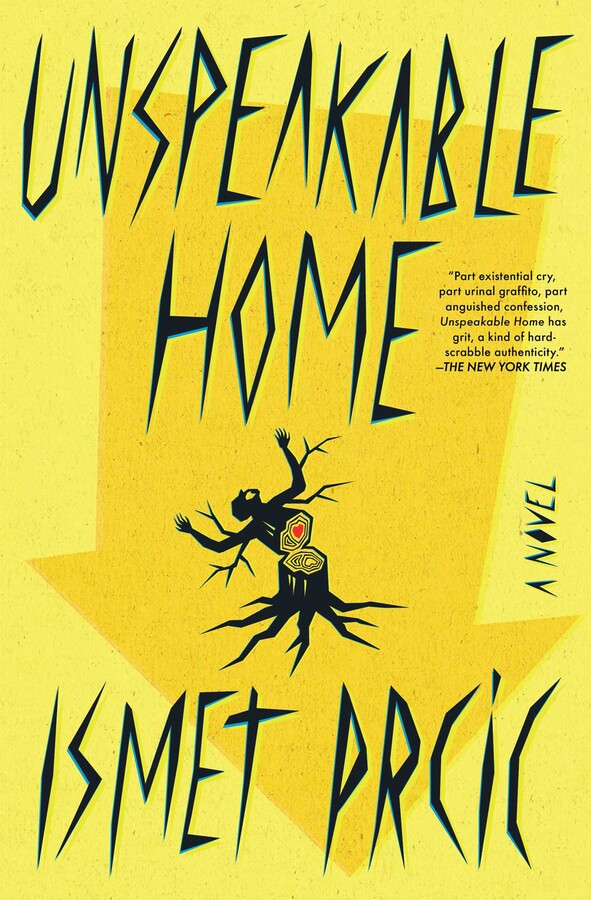
From award-winning writer Ismet Prcic, a “brutal and tender and beautiful” (Tommy Orange, author of Wandering Stars) novel that is “part existential cry…part anguished confession…a transfiguring of personal memory to obscure the terrible cost of exile” (The New York Times).
Having fled his war-torn hometown of Tuzla in Bosnia-Herzegovina as a teenager, our narrator, Izzy, found love and a measure of stability in California with his beloved. But his American marriage couldn’t survive his Bosnian brokenness, the trauma so entrenched and insidious that it became impossible to communicate to anyone outside of himself—even the person he loved most. Now, as he writes in the first of many courageously candid fan letters to the comedian Bill Burr, he knows he must try.
“An adventurous novel that meshes a fragmented narrative with a broken soul” (Kirkus Reviews), Unspeakable Home takes us through Izzy’s memories and confessions as he reflects on his bomb-ravaged childhood, the implosion of his relationships, and an agonizing battle with alcoholism. As multiple narrators surface in fragments with increasingly tenuous connections to reality, Ismet Prcic unearths the psychological cost of exile and shame with a roving, kinetic energy and a sharp, searching sense of humor.
What emerges is a vivid and poignant exploration of the stories we create to hide the deepest parts of our identity from ourselves, as well as a hard-won, life-affirming promise of redemption.
Having fled his war-torn hometown of Tuzla in Bosnia-Herzegovina as a teenager, our narrator, Izzy, found love and a measure of stability in California with his beloved. But his American marriage couldn’t survive his Bosnian brokenness, the trauma so entrenched and insidious that it became impossible to communicate to anyone outside of himself—even the person he loved most. Now, as he writes in the first of many courageously candid fan letters to the comedian Bill Burr, he knows he must try.
“An adventurous novel that meshes a fragmented narrative with a broken soul” (Kirkus Reviews), Unspeakable Home takes us through Izzy’s memories and confessions as he reflects on his bomb-ravaged childhood, the implosion of his relationships, and an agonizing battle with alcoholism. As multiple narrators surface in fragments with increasingly tenuous connections to reality, Ismet Prcic unearths the psychological cost of exile and shame with a roving, kinetic energy and a sharp, searching sense of humor.
What emerges is a vivid and poignant exploration of the stories we create to hide the deepest parts of our identity from ourselves, as well as a hard-won, life-affirming promise of redemption.
Reading Group Guide
Get a FREE ebook by joining our mailing list today! Plus, receive recommendations for your next Book Club read.
By clicking 'Sign me up' I agree to the Terms of Use and acknowledge the Privacy Policy and Notice of Financial Incentive. Free ebook offer available to NEW US subscribers only. Offer redeemable at Simon & Schuster's ebook fulfillment partner. Must redeem within 90 days. See full terms and conditions and this month's choices.
This reading group guide for Unspeakable Home includes an introduction, discussion questions, ideas for enhancing your book club, and a Q&A with author Ismet Prcic. The suggested questions are intended to help your reading group find new and interesting angles and topics for your discussion. We hope that these ideas will enrich your conversation and increase your enjoyment of the book.
Introduction
Having fled his war-torn hometown of Tuzla, Bosnia, as a teenager, our narrator, Izzy, found love and a measure of stability in California with his beloved. But his American marriage couldn’t survive his Bosnian brokenness, the trauma so entrenched and insidious that it became impossible to communicate to anyone outside of himself—even the person he loved most. Now, as he writes in the first of many courageously candid fan letters to the comedian Bill Burr, he knows he must try. Taking us through Izzy’s memories and confessions as he reflects on his bomb-ravaged childhood, the implosion of his relationships, and an agonizing battle with alcoholism, Unspeakable Home is a vivid and poignant exploration of the stories we create to hide the deepest parts of our identity from ourselves, as well as a hard-won, life-affirming promise of redemption.
Topics & Questions for Discussion
1. How do you interpret the Samuel Beckett epigraph in the context of Unspeakable Home? How does it interact with the quote from Ismet Prcic, which is from page 254 of the novel?
2. Unspeakable Home is a novel that draws from the author’s own life. How does this knowledge affect your reading of the novel? Were there parts of the book that felt more like a memoir to you? How does fictionalization relate to “the nature of language” that Ismet refers to on page 13?
3. The book is punctuated by letters to Bill Burr, an American comedian, who the author thanks in his acknowledgments, writing “his work helped me get through the worst of my gutter days” (page 285). How do these letters change in tone over the course of the novel?
4. “Homo Homini Home Est?” is a play on the Latin proverb “Homo homini lupus est,” which translates to “man is a wolf to man.” In what ways does Prcic explore the concept that man is a home to man?
5. Ismet describes how his short video “A Day in the Life of Homeless Man” closes with the quote “The perceiver and the object perceived cannot be one and the same” (page 40). What is Prcic commenting on here? How does he differentiate between the perceiver and the perceived in this film, and beyond?
6. In “At the National Theatre,” Ismet writes from the perspective of an audience member he once saw in a theater who disrupted the performance. At the end of the chapter, the man stabs an actor who mocked him, only to have the actor jump up seemingly unhurt, and then finally begin to bleed from his wound—but the knife is fake. How does this scene represent the Bosnian character’s relationship to America?
7. In “Bosnian Dream,” Musa Music thinks, “Life, by definition, ends [. . .] It’s the show of life that must go on” (page 104). How does Prcic demonstrate and wrestle with this belief in this chapter, and beyond?
8. Think about other books or media that depict “the ole buggery of escalating into personhood in the upside-down morality of war” (page 220). How are they similar to or different from Unspeakable Home? What about other portrayals of the immigrant experience and “The American Dream”?
9. Izzy reveals that “the loop” is rooted in a sexual assault he experienced when he was very young. What are some other moments before “Bunnylove Savagery” where sexuality is depicted as ugly, shameful, or wrong? How does this revelation impact your reading of the rest of the book?
10. In “4. The Shannon Closing,” Prcic directly implicates the reader: “This is why you’re frustrated reading this. Every time someone interrupts one individualized world to tell you of another means work for you. Nobody wants to hear about another person’s dream, for one. And two, nobody likes to be awakened from their own life, especially into another, just as loosey-goosey and tentative as the one they have to perpetuate to stay in” (page 248). Do you resonate with Prcic’s assumption about what a reader wants? Why or why not?
11. Liner notes are the text on the insert of a record or CD. Why do you think Prcic titled the last section of the book “Liner Notes”? What about “The Bachelor Party 2.0” is reminiscent of the literal function of liner notes in music packaging?
12. The book ends with Ismet’s friend Ben holding up a board representing traumas and strivings that Ismet is to break—a way to visualize how “‘you can train your brain to be happy.’” Ismet asks, “‘Yeah, but for vhat reason is happiness . . . important. Vhat about truth?’” (page 284). Which do you think is more important: happiness or truth? Using the book as evidence, which do you think Prcic finds most important?
Enhance Your Book Club
1. Imagine that there is a vinyl called Unspeakable Home with a Side A and a Side B. Pick ten to twelve tracks for each side that correspond in some way to the content, tone, or themes of each side. Discuss your reasoning.
2. Choose a minor character in Unspeakable Home—for example, Beloved, Hunter, Uncle Bahrija, Gill, the she-wolf—and write a paragraph or two from their perspective. What opinion do they have of Ismet? What do they want for him in life, and how do they help and harm him?
3. Write a letter to a comedian, actor, or another celebrity about a way in which their work has impacted you. Who did you choose and why?
A Conversation with Ismet Prcic
The title Unspeakable Home is from the Samuel Beckett poem “neither,” which you also use as an epigraph. Do you remember when you first encountered the poem? What feelings does it evoke in you?
Growing up a theater dork in Tuzla, I only knew of Samuel Beckett as a playwright for the longest time, and it wasn’t until I was in grad school and I took a class by the late, great experimentalist Raymond Federman (who was a contemporary of Beckett’s), that I discovered his novels and stories. He provided nimble insights into Beckett’s prose, and together with Federman’s own playful writings, encouraged me to play with language, story structure, to try things that are unusual, weird, funny, that fit some of my more, let’s say, performative and expressive natures. I was writing Shards at the time, struggling with my own experimental leanings, fighting off the good-hearted naysayers, people who were afraid the book wouldn’t work, and trying to keep as much of the crazy (faith) in. Federman shared an anecdote that once when he was rereading Beckett’s trilogy, he, by chance, encountered a perfect chunk of writing, that if excerpted from a dense, brick-like paragraph and broken into lines, would make a perfect, meaningful sonnet, and in the iambic pentameter to boot. He wrote to Beckett and asked for a permission to publish it, which was granted. Encouraged, Federman inquired to interview him too. Beckett famously replied with a postcard that said: “There is no inter to view.”
Shards was published by Grove Press, Beckett’s old publisher, which got me hooked up with that fancy blue box set of his complete works. This is where I alighted upon “neither,” a poem that gives the title to Unspeakable Home. It promptly seared itself into my mind, because of its theatricality, its otherworldliness, its almost spiritual grace. I got to admit that the poem’s atmosphere is what I was thinking of when I was writing “Inside the Actor,” though I couldn’t help infusing it with snark and attempted humor. In my search for the title, I went back to it, gathered that this human neitherness he so evocatively captures, especially with the part about the “two lit refuges,” perfectly captures the duality of every refugee of war, as well as make a pretty sound metaphor for immigration which my work touches on for sure.
Based off the citation, “Obligatory Warning” is from “Bunnylove Savagery, or In Place of an Afterword,” but the excerpt doesn’t appear in the latter section. Why is that?
Well, to tell you the truth, I didn’t want to repeat a whole chunk of text twice in the same book because when I did it in Shards some people were kind of complaining. It has to do with problems one encounters structuring an experimental novel. As I was going through pairing down an almost 900-page manuscript into the first novel to make it more traditionally manageable, my teacher and mentor, Michelle Latiolais, suggested I excerpt a part of a chapter that shows up late in Shards and open the book with it, just to pull the reader in and show them immediately what kind of book they were entering. She cited the opening of one of Cormac McCarthy’s works that does that same thing and enlightened me on what it did for his book. But, like I said, I had readers ask why I was repeating whole sections. Mind you, Michelle was the one who told me to add my own quote after Beckett’s in this book, to frontload the attitude of the voice that is telling it and prime the reader for numerous narrators, points of view, etc. So, I agreed. Visually, it might look like I’m putting myself on the same level as Beckett there, but I’m not. It’s painfully evident on that page which one of us can express himself assuredly with style and who is . . . crying to his mommy J, as it were.
What was your day-to-day writing process like for Unspeakable Home? Did you work with any sort of outline? How did it compare to writing Shards, which also drew from your own life?
After finishing Shards, I was elated and empty, the way a performer feels after a premiere; there happened a great emotional and intellectual purge which led to the integration of some of the trauma that is addressed in the book, mainly in terms of my PTSD symptoms. I felt that healing buzz in my body and stopped overreacting to loud sounds, stopped having panic attacks associated with them, and even being in crowds or open spaces became easier to take. However, once the impressions settled and I awoke in my new normal, I realized that I only peeled a single layer of trauma, that in the eleven years it took me to finish Shards I had accumulated other kinds of shit in need of expulsion, or perhaps, the older traumas were free to crawl up to the surface and now I had another full-blown dark wound to transmute. Scared by how arduous it was to write the first book, I balked and decided to write standalone stories and convinced myself I was working on a story collection. These stories were all very dark and strange; they touched on sexuality in an unsatisfying, tangential way, and by and large they would all collapse in on themselves by the end. It was as if I believed in the world of the story I was creating but by the time it came to bringing it to a finish, the ending would destroy the world that I created, or signal that the rules of it might not be the same ones that I started with.
Nobody wanted that book and I was devastated. My life exploded in the meanwhile; I lost my marriage, my health, my self-esteem. I decided to make my life very small and slow, to go into hermit mode and simply survive the Trump and COVID years. There was healing in those years and setbacks, too, but it became clear to me that I had to surrender to the new book the way that I did with the old, come what may. I reread all the stories and noticed that strange sideline sexuality in every story and it dawned on me what layer of personal trauma had to be alchemized next. I knew that, just like in Shards, the overall voice, despite being fragmented and screaming at different frequencies at different times, was still a single voice, being loud and difficult because it was largely ignored for forty-some years. It was time to let that scary, truth-hissing voice in and let it bawl out its story, brash and whiney, righteous and wrong, and let it punch itself out, scream itself out, let it soften too by being heard and seen, loved in spite of it all and accepted like a close family member. Unlike Shards, which needed paring down, Unspeakable Home needed glue and context, and a great facing with the unhealed part of me at the end, something I’ve never even allowed into my conscious thought before. Looking for the glue that can connect these narratives together I decided on the letters to Bill Burr, literally because his voice became part of my daily life. I simply made my favorite comedian part of my writing process, a disembodied consciousness that was there in the absence of real people in my life. In Shards I also used letters to another as glue; in that case, the narrator’s mother. The loneliness and the shame of my divorce was so profound that it only made sense to have the friendly pen pal be a total stranger.
As you were developing and writing Unspeakable Home, did you reach for any books or other media for inspiration?
I thought that I had wasted my time writing the collection. I thought I was finished. On a trip back to Bosnia I got an opportunity to work with Davor Marjanovic, a Bosnian-Canadian filmmaker, who convinced me to collaborate on a screenplay based on Shards. It was exploring my old story through a new medium, writing just for the viewers’ eyes and the ears, that afterword brought me back to my collection with a new drive to organize it into a bigger story, turn it into a novel. It especially helped the harum-scarum afterword of the book, the weird plod toward facing my life’s wound. It was an exercise in internal visualizing of all the different voices in my head and tracking them throughout the flow, editing and trusting that the narrative would find its arc. Writing scenes for the screenplay also helped me write the second-person chapters, allowed me to experiment with slowing down of time and capturing one slow, blown-up moment after the next. It taught me that if I’m careful and systematic in how the experiential information is doled out it does not matter how many things I was juggling in the story.
How do you think the punk philosophy has influenced your writing style?
Growing up in Yugoslavia I read a lot, and pretty early became conscious of the split between literary language and the language that I heard actually spoken around me. If I had to write a school essay about how I spent the summer holiday, and if I actually used the everyday language (the leading thought being use everyday language to tell everyday stories) I’d receive demerits. That’s why I ran to theatre by the way, where when the curtain is drawn and the lights are on nobody but me could decide how the words are spoken to be heard J.This happened in my teenage days, when punk would also make its entrance. Bosnia had its own version of punk in the ’80s and early ’90s. Don’t get me wrong, we had peeps with mohawks wearing leather jackets and patches on their sleeves too. But no, I’m talking about a cult movement called new primitivism. A bunch of actors and musicians in Sarajevo decided to speak in a particularly uncouth and funny way to be able to talk about the country’s deep wounds, commenting on the passing years and making them easier to survive. I was a devotee. I swore to myself that, if I became a writer, I would write my books in the vernacular I live and breathe in. It so happened that I ended up immigrating to the States and had to find a brand-new voice in an entirely new language, but recently I met a scholar in Bosnia who told me that when she was reading Shards in English, she did sense the snark of a Tuzla punk circa 1995. So, I have that going for me, which is nice.
Do you have a favorite Bill Burr stand-up bit?
He got me with that Arnold Schwarzenegger bit. He kept me with his rambunctiously joyous yet dark human sensibilities, hinting at deeper, funnier truths, his authenticity, and the strength in vulnerability, with a cackled swear and a smile on his face, suffering zero fools en route. When I grow up, I’d like to be someone like that.
What sound or noise do you love, and which do you hate?
I kind of cheated and included my real answers into the book J. My favorite noise is an unprompted and meaningful silence; my least favorite noise is that silence when another expects or demands a noise.
Ismet refers to the girl he met in his writing class as “the she-wolf” or “the one that got away” in his letter to Bill Burr that reflects on who he was before he met Beloved (page 191). You then return to the motif in “Bachelor Party 2.0” when Ismet encounters the she-wolf on his camping trip. What does the she-wolf represent to you?
It’s entirely too early to answer this question. I bet Bill Burr would call it burning your own material, something a comedian (artist) apparently shouldn’t do J. The book I’m working on now (working title: Miracula), a concluding tome of novels about my particular set of traumas, is dealing directly with this question, why we attract and are attracted to triggers from our childhoods. It’s the deepest and the most tricky of them all and requires ever-new energies and strategies, ways of thinking and being, risking and protecting yourself as well. And loving. Yourself too, people. Not the ego bullshit but the soul in you, the apex experiencer of your storied lineage, the soul that keeps and feels all its lessons. I’m hoping that because I cannot see yet what I’m creating, I’ll be creating what I seek.
Is there a section, scene, or sentence in the book about which you are especially proud?
That section that ends “Homo Homini Home Est?” first makes me cry, then makes me smile, still. It’s a soft spot on the book’s skull for me. It gives me strength and mollifies at the same time. The pride is in surviving what got me writing it, coming to terms with integrating its lessons and still go on into the world with hope and faith.
What is the relationship between truth and happiness?
You can’t be happy in an untrue thing. Integration with what is, warts and all, is paramount for the soul to feel happy, integrated, whole. Any hiding of facts, any downplaying of faults, any swallowing of real and willful projecting of “desired” emotions, any breaking off pieces of self to fit into “desired” outcomes cannot lead to happiness, at least not in the way I define it here. I think of it this way because my life has been a weird one to me. I thought I was chronicling it by seizing my little life lessons and downloads by turning them into literature that I’d like to read. I didn’t expect that the way I was doing that—brutally in a way, punk-rock style—was making my experience of life brutal as well. At the end of this (second) book, I allowed a little bit of a healing voice to come out and play, however pathetic J, and experienced true healing in my real life. The challenge now is to write the third part of the trauma trilogy in a voice that will support full integration. A lofty-sounding thing for sure, but what else can I do with my time on this planet? As I’m writing these answers—and I’m late, so late—I’m riding a wave of a particular personal transformation. An impresario in Germany invited me to come to a theater festival in Hamburg and present my work. I asked him if I could do a little ritual at the end, a private moment I wanted to share with the public in the style of theatre happenings that were so popular in the ’60s. I proposed to have a moderated conversation with an author collapse into a theatrical event. He said yes, so I hung a skeleton on the stage and dressed him up in my old clothes, from when I was a punk in California. I have told the audience that throughout the entire time I was writing Unspeakable Home, a similar Halloween decoration was hanging in the makeshift library in my tiny apartment in Salem. When friends came by, they all would flinch at this gruesome display, a version of their Bosnian buddy swaying from the ceiling and probably feared for my mental health. But after I started healing this particular set of wounds using somatic therapy and shadow work and reported all the steps by writing my experiences down, the skeleton in my room was eliciting sad emotions. So much so that in one of my therapy sessions I even visualized myself burying it at my favorite graveyard in Salem. My therapist called it “the loving burial of your former self.” So, on the stage in Hamburg, as the moderated conversation came to an end and we had a little Q&A with the audience, I had an actor read a portion of Unspeakable Home over God mic as I took all my possessions and transferred them to the skeleton, took off and put on him the clothes I had on me as well. I shaved off all the hair on my head (those stylings were part of the mask as well) and made a break with the writer of that book, because the next one . . . somebody new has to write the new chapter. Somebody freer, braver, better, crazier, stronger. Wish me dumb luck, people! J Pray for mojo!
Introduction
Having fled his war-torn hometown of Tuzla, Bosnia, as a teenager, our narrator, Izzy, found love and a measure of stability in California with his beloved. But his American marriage couldn’t survive his Bosnian brokenness, the trauma so entrenched and insidious that it became impossible to communicate to anyone outside of himself—even the person he loved most. Now, as he writes in the first of many courageously candid fan letters to the comedian Bill Burr, he knows he must try. Taking us through Izzy’s memories and confessions as he reflects on his bomb-ravaged childhood, the implosion of his relationships, and an agonizing battle with alcoholism, Unspeakable Home is a vivid and poignant exploration of the stories we create to hide the deepest parts of our identity from ourselves, as well as a hard-won, life-affirming promise of redemption.
Topics & Questions for Discussion
1. How do you interpret the Samuel Beckett epigraph in the context of Unspeakable Home? How does it interact with the quote from Ismet Prcic, which is from page 254 of the novel?
2. Unspeakable Home is a novel that draws from the author’s own life. How does this knowledge affect your reading of the novel? Were there parts of the book that felt more like a memoir to you? How does fictionalization relate to “the nature of language” that Ismet refers to on page 13?
3. The book is punctuated by letters to Bill Burr, an American comedian, who the author thanks in his acknowledgments, writing “his work helped me get through the worst of my gutter days” (page 285). How do these letters change in tone over the course of the novel?
4. “Homo Homini Home Est?” is a play on the Latin proverb “Homo homini lupus est,” which translates to “man is a wolf to man.” In what ways does Prcic explore the concept that man is a home to man?
5. Ismet describes how his short video “A Day in the Life of Homeless Man” closes with the quote “The perceiver and the object perceived cannot be one and the same” (page 40). What is Prcic commenting on here? How does he differentiate between the perceiver and the perceived in this film, and beyond?
6. In “At the National Theatre,” Ismet writes from the perspective of an audience member he once saw in a theater who disrupted the performance. At the end of the chapter, the man stabs an actor who mocked him, only to have the actor jump up seemingly unhurt, and then finally begin to bleed from his wound—but the knife is fake. How does this scene represent the Bosnian character’s relationship to America?
7. In “Bosnian Dream,” Musa Music thinks, “Life, by definition, ends [. . .] It’s the show of life that must go on” (page 104). How does Prcic demonstrate and wrestle with this belief in this chapter, and beyond?
8. Think about other books or media that depict “the ole buggery of escalating into personhood in the upside-down morality of war” (page 220). How are they similar to or different from Unspeakable Home? What about other portrayals of the immigrant experience and “The American Dream”?
9. Izzy reveals that “the loop” is rooted in a sexual assault he experienced when he was very young. What are some other moments before “Bunnylove Savagery” where sexuality is depicted as ugly, shameful, or wrong? How does this revelation impact your reading of the rest of the book?
10. In “4. The Shannon Closing,” Prcic directly implicates the reader: “This is why you’re frustrated reading this. Every time someone interrupts one individualized world to tell you of another means work for you. Nobody wants to hear about another person’s dream, for one. And two, nobody likes to be awakened from their own life, especially into another, just as loosey-goosey and tentative as the one they have to perpetuate to stay in” (page 248). Do you resonate with Prcic’s assumption about what a reader wants? Why or why not?
11. Liner notes are the text on the insert of a record or CD. Why do you think Prcic titled the last section of the book “Liner Notes”? What about “The Bachelor Party 2.0” is reminiscent of the literal function of liner notes in music packaging?
12. The book ends with Ismet’s friend Ben holding up a board representing traumas and strivings that Ismet is to break—a way to visualize how “‘you can train your brain to be happy.’” Ismet asks, “‘Yeah, but for vhat reason is happiness . . . important. Vhat about truth?’” (page 284). Which do you think is more important: happiness or truth? Using the book as evidence, which do you think Prcic finds most important?
Enhance Your Book Club
1. Imagine that there is a vinyl called Unspeakable Home with a Side A and a Side B. Pick ten to twelve tracks for each side that correspond in some way to the content, tone, or themes of each side. Discuss your reasoning.
2. Choose a minor character in Unspeakable Home—for example, Beloved, Hunter, Uncle Bahrija, Gill, the she-wolf—and write a paragraph or two from their perspective. What opinion do they have of Ismet? What do they want for him in life, and how do they help and harm him?
3. Write a letter to a comedian, actor, or another celebrity about a way in which their work has impacted you. Who did you choose and why?
A Conversation with Ismet Prcic
The title Unspeakable Home is from the Samuel Beckett poem “neither,” which you also use as an epigraph. Do you remember when you first encountered the poem? What feelings does it evoke in you?
Growing up a theater dork in Tuzla, I only knew of Samuel Beckett as a playwright for the longest time, and it wasn’t until I was in grad school and I took a class by the late, great experimentalist Raymond Federman (who was a contemporary of Beckett’s), that I discovered his novels and stories. He provided nimble insights into Beckett’s prose, and together with Federman’s own playful writings, encouraged me to play with language, story structure, to try things that are unusual, weird, funny, that fit some of my more, let’s say, performative and expressive natures. I was writing Shards at the time, struggling with my own experimental leanings, fighting off the good-hearted naysayers, people who were afraid the book wouldn’t work, and trying to keep as much of the crazy (faith) in. Federman shared an anecdote that once when he was rereading Beckett’s trilogy, he, by chance, encountered a perfect chunk of writing, that if excerpted from a dense, brick-like paragraph and broken into lines, would make a perfect, meaningful sonnet, and in the iambic pentameter to boot. He wrote to Beckett and asked for a permission to publish it, which was granted. Encouraged, Federman inquired to interview him too. Beckett famously replied with a postcard that said: “There is no inter to view.”
Shards was published by Grove Press, Beckett’s old publisher, which got me hooked up with that fancy blue box set of his complete works. This is where I alighted upon “neither,” a poem that gives the title to Unspeakable Home. It promptly seared itself into my mind, because of its theatricality, its otherworldliness, its almost spiritual grace. I got to admit that the poem’s atmosphere is what I was thinking of when I was writing “Inside the Actor,” though I couldn’t help infusing it with snark and attempted humor. In my search for the title, I went back to it, gathered that this human neitherness he so evocatively captures, especially with the part about the “two lit refuges,” perfectly captures the duality of every refugee of war, as well as make a pretty sound metaphor for immigration which my work touches on for sure.
Based off the citation, “Obligatory Warning” is from “Bunnylove Savagery, or In Place of an Afterword,” but the excerpt doesn’t appear in the latter section. Why is that?
Well, to tell you the truth, I didn’t want to repeat a whole chunk of text twice in the same book because when I did it in Shards some people were kind of complaining. It has to do with problems one encounters structuring an experimental novel. As I was going through pairing down an almost 900-page manuscript into the first novel to make it more traditionally manageable, my teacher and mentor, Michelle Latiolais, suggested I excerpt a part of a chapter that shows up late in Shards and open the book with it, just to pull the reader in and show them immediately what kind of book they were entering. She cited the opening of one of Cormac McCarthy’s works that does that same thing and enlightened me on what it did for his book. But, like I said, I had readers ask why I was repeating whole sections. Mind you, Michelle was the one who told me to add my own quote after Beckett’s in this book, to frontload the attitude of the voice that is telling it and prime the reader for numerous narrators, points of view, etc. So, I agreed. Visually, it might look like I’m putting myself on the same level as Beckett there, but I’m not. It’s painfully evident on that page which one of us can express himself assuredly with style and who is . . . crying to his mommy J, as it were.
What was your day-to-day writing process like for Unspeakable Home? Did you work with any sort of outline? How did it compare to writing Shards, which also drew from your own life?
After finishing Shards, I was elated and empty, the way a performer feels after a premiere; there happened a great emotional and intellectual purge which led to the integration of some of the trauma that is addressed in the book, mainly in terms of my PTSD symptoms. I felt that healing buzz in my body and stopped overreacting to loud sounds, stopped having panic attacks associated with them, and even being in crowds or open spaces became easier to take. However, once the impressions settled and I awoke in my new normal, I realized that I only peeled a single layer of trauma, that in the eleven years it took me to finish Shards I had accumulated other kinds of shit in need of expulsion, or perhaps, the older traumas were free to crawl up to the surface and now I had another full-blown dark wound to transmute. Scared by how arduous it was to write the first book, I balked and decided to write standalone stories and convinced myself I was working on a story collection. These stories were all very dark and strange; they touched on sexuality in an unsatisfying, tangential way, and by and large they would all collapse in on themselves by the end. It was as if I believed in the world of the story I was creating but by the time it came to bringing it to a finish, the ending would destroy the world that I created, or signal that the rules of it might not be the same ones that I started with.
Nobody wanted that book and I was devastated. My life exploded in the meanwhile; I lost my marriage, my health, my self-esteem. I decided to make my life very small and slow, to go into hermit mode and simply survive the Trump and COVID years. There was healing in those years and setbacks, too, but it became clear to me that I had to surrender to the new book the way that I did with the old, come what may. I reread all the stories and noticed that strange sideline sexuality in every story and it dawned on me what layer of personal trauma had to be alchemized next. I knew that, just like in Shards, the overall voice, despite being fragmented and screaming at different frequencies at different times, was still a single voice, being loud and difficult because it was largely ignored for forty-some years. It was time to let that scary, truth-hissing voice in and let it bawl out its story, brash and whiney, righteous and wrong, and let it punch itself out, scream itself out, let it soften too by being heard and seen, loved in spite of it all and accepted like a close family member. Unlike Shards, which needed paring down, Unspeakable Home needed glue and context, and a great facing with the unhealed part of me at the end, something I’ve never even allowed into my conscious thought before. Looking for the glue that can connect these narratives together I decided on the letters to Bill Burr, literally because his voice became part of my daily life. I simply made my favorite comedian part of my writing process, a disembodied consciousness that was there in the absence of real people in my life. In Shards I also used letters to another as glue; in that case, the narrator’s mother. The loneliness and the shame of my divorce was so profound that it only made sense to have the friendly pen pal be a total stranger.
As you were developing and writing Unspeakable Home, did you reach for any books or other media for inspiration?
I thought that I had wasted my time writing the collection. I thought I was finished. On a trip back to Bosnia I got an opportunity to work with Davor Marjanovic, a Bosnian-Canadian filmmaker, who convinced me to collaborate on a screenplay based on Shards. It was exploring my old story through a new medium, writing just for the viewers’ eyes and the ears, that afterword brought me back to my collection with a new drive to organize it into a bigger story, turn it into a novel. It especially helped the harum-scarum afterword of the book, the weird plod toward facing my life’s wound. It was an exercise in internal visualizing of all the different voices in my head and tracking them throughout the flow, editing and trusting that the narrative would find its arc. Writing scenes for the screenplay also helped me write the second-person chapters, allowed me to experiment with slowing down of time and capturing one slow, blown-up moment after the next. It taught me that if I’m careful and systematic in how the experiential information is doled out it does not matter how many things I was juggling in the story.
How do you think the punk philosophy has influenced your writing style?
Growing up in Yugoslavia I read a lot, and pretty early became conscious of the split between literary language and the language that I heard actually spoken around me. If I had to write a school essay about how I spent the summer holiday, and if I actually used the everyday language (the leading thought being use everyday language to tell everyday stories) I’d receive demerits. That’s why I ran to theatre by the way, where when the curtain is drawn and the lights are on nobody but me could decide how the words are spoken to be heard J.This happened in my teenage days, when punk would also make its entrance. Bosnia had its own version of punk in the ’80s and early ’90s. Don’t get me wrong, we had peeps with mohawks wearing leather jackets and patches on their sleeves too. But no, I’m talking about a cult movement called new primitivism. A bunch of actors and musicians in Sarajevo decided to speak in a particularly uncouth and funny way to be able to talk about the country’s deep wounds, commenting on the passing years and making them easier to survive. I was a devotee. I swore to myself that, if I became a writer, I would write my books in the vernacular I live and breathe in. It so happened that I ended up immigrating to the States and had to find a brand-new voice in an entirely new language, but recently I met a scholar in Bosnia who told me that when she was reading Shards in English, she did sense the snark of a Tuzla punk circa 1995. So, I have that going for me, which is nice.
Do you have a favorite Bill Burr stand-up bit?
He got me with that Arnold Schwarzenegger bit. He kept me with his rambunctiously joyous yet dark human sensibilities, hinting at deeper, funnier truths, his authenticity, and the strength in vulnerability, with a cackled swear and a smile on his face, suffering zero fools en route. When I grow up, I’d like to be someone like that.
What sound or noise do you love, and which do you hate?
I kind of cheated and included my real answers into the book J. My favorite noise is an unprompted and meaningful silence; my least favorite noise is that silence when another expects or demands a noise.
Ismet refers to the girl he met in his writing class as “the she-wolf” or “the one that got away” in his letter to Bill Burr that reflects on who he was before he met Beloved (page 191). You then return to the motif in “Bachelor Party 2.0” when Ismet encounters the she-wolf on his camping trip. What does the she-wolf represent to you?
It’s entirely too early to answer this question. I bet Bill Burr would call it burning your own material, something a comedian (artist) apparently shouldn’t do J. The book I’m working on now (working title: Miracula), a concluding tome of novels about my particular set of traumas, is dealing directly with this question, why we attract and are attracted to triggers from our childhoods. It’s the deepest and the most tricky of them all and requires ever-new energies and strategies, ways of thinking and being, risking and protecting yourself as well. And loving. Yourself too, people. Not the ego bullshit but the soul in you, the apex experiencer of your storied lineage, the soul that keeps and feels all its lessons. I’m hoping that because I cannot see yet what I’m creating, I’ll be creating what I seek.
Is there a section, scene, or sentence in the book about which you are especially proud?
That section that ends “Homo Homini Home Est?” first makes me cry, then makes me smile, still. It’s a soft spot on the book’s skull for me. It gives me strength and mollifies at the same time. The pride is in surviving what got me writing it, coming to terms with integrating its lessons and still go on into the world with hope and faith.
What is the relationship between truth and happiness?
You can’t be happy in an untrue thing. Integration with what is, warts and all, is paramount for the soul to feel happy, integrated, whole. Any hiding of facts, any downplaying of faults, any swallowing of real and willful projecting of “desired” emotions, any breaking off pieces of self to fit into “desired” outcomes cannot lead to happiness, at least not in the way I define it here. I think of it this way because my life has been a weird one to me. I thought I was chronicling it by seizing my little life lessons and downloads by turning them into literature that I’d like to read. I didn’t expect that the way I was doing that—brutally in a way, punk-rock style—was making my experience of life brutal as well. At the end of this (second) book, I allowed a little bit of a healing voice to come out and play, however pathetic J, and experienced true healing in my real life. The challenge now is to write the third part of the trauma trilogy in a voice that will support full integration. A lofty-sounding thing for sure, but what else can I do with my time on this planet? As I’m writing these answers—and I’m late, so late—I’m riding a wave of a particular personal transformation. An impresario in Germany invited me to come to a theater festival in Hamburg and present my work. I asked him if I could do a little ritual at the end, a private moment I wanted to share with the public in the style of theatre happenings that were so popular in the ’60s. I proposed to have a moderated conversation with an author collapse into a theatrical event. He said yes, so I hung a skeleton on the stage and dressed him up in my old clothes, from when I was a punk in California. I have told the audience that throughout the entire time I was writing Unspeakable Home, a similar Halloween decoration was hanging in the makeshift library in my tiny apartment in Salem. When friends came by, they all would flinch at this gruesome display, a version of their Bosnian buddy swaying from the ceiling and probably feared for my mental health. But after I started healing this particular set of wounds using somatic therapy and shadow work and reported all the steps by writing my experiences down, the skeleton in my room was eliciting sad emotions. So much so that in one of my therapy sessions I even visualized myself burying it at my favorite graveyard in Salem. My therapist called it “the loving burial of your former self.” So, on the stage in Hamburg, as the moderated conversation came to an end and we had a little Q&A with the audience, I had an actor read a portion of Unspeakable Home over God mic as I took all my possessions and transferred them to the skeleton, took off and put on him the clothes I had on me as well. I shaved off all the hair on my head (those stylings were part of the mask as well) and made a break with the writer of that book, because the next one . . . somebody new has to write the new chapter. Somebody freer, braver, better, crazier, stronger. Wish me dumb luck, people! J Pray for mojo!
About The Author
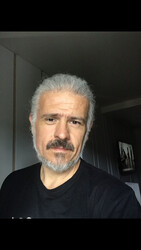
Photo courtesy of author
Ismet Prcic was born in Tuzla, Bosnia-Herzegovina in 1977 and immigrated to America in 1996. His first novel, Shards, was a New York Times Notable Book, a Chicago Sun-Times Best Book of the Year, as well as the winner of the Sue Kaufman Prize and the Los Angeles Times Art Seidenbaum Award for first fiction.
Product Details
- Publisher: Avid Reader Press/Simon & Schuster (August 6, 2024)
- Length: 304 pages
- ISBN13: 9781668015353
Browse Related Books
Raves and Reviews
"Part existential cry, part urinal graffito, part anguished confession, Unspeakable Home is a survival strategy, a transfiguring of personal memory to obscure the terrible cost of exile." —The New York Times Book Review
"At once sobering and intoxicating, hilarious and sad, brutal and tender and beautiful." —Tommy Orange, author of Wandering Stars
"An adventurous novel that meshes a fragmented narrative with a broken soul. . . Tricky, prismatic, sardonic. . . Prcic has an excellent command of the everyday anxieties of the maintenance alcoholic—the deceptions of loved ones, the small preparations. And Prcic can be funny, with a hyperactive comic tone that cuts to the heart of his struggle." —Kirkus Reviews
"[A] clever and moving work of autofiction. . . Prcic adeptly portrays his characters’ shaky lives and painful pasts, and the blend of autobiography and metafiction evokes Izzy’s disorientation. Prcic’s impressive talents are on full display." —Publishers Weekly
“Turning himself—and the novel—inside out, Prcic astonishes with this brilliant and unruly cri du cœur.” —Antoine Wilson, author of Mouth to Mouth
"Through an ambitious structure reflecting his own war-torn psyche, Prcic expertly mines his pain like a reporter inside his own wounds, sending out dispatches of reckless intimacy and dazzling humor, the wild and particular pyrotechnics of his grief-deranged heartwreck on glorious display. I found not only solace and camaraderie in his longing for homes lost, but the inspiration to continue on in the face of profound sorrow. It's a berserker, bravura performance of a busted and booze-soaked heart sorting through its own broken pieces to survive, of a man battling back from the brink(s) with humor, swagger, and just enough crazy to keep going. In short—an absolute triumph." —Matt Sumell, author of Making Nice
"Ismet Prcic writes as if every window in the house is open to the wind, years of pages blowing about, and there's only time to grab from the air the scenes that really matter, the ones written with such candor and boldness of mind that they can't get lost. They are too necessary. Unspeakable Home is a profound novel of extraordinary emotional honesty." —Idra Novey, author of Take What You Need
"Unspeakable Home is fierce and unforgettable, forged in the heart. It is a darkly funny, surprising, and sad accounting of the Bosnia that broke the refugee-narrator, and of the phantom actor he became on the California set. Home, love, self—Prcic, the drinker, puts a match to it all in scorching scenes that sear the eyes. And still, there is promise of return." —Christine Schutt, author of Pure Hollywood
“Reading Unspeakable Home is humbling, unnerving, and reading it also gives audition to a voice that might otherwise be screaming alone. A novel as powerful as Last Exit to Brooklyn and as necessary, with a manifold character who refuses 'the chaos of anonymity or silence.' A brilliant and deadly serious comic novel." —Michelle Latiolais, author of Widow and She
“After a dramatic escape from war in Bosnia, a quieter violence begins: the character of Izzy finds that his heart, body and head are littered with landmines and craters, that beginning again will not be as simple as waking up in America. Unspeakable Home is an insistent and steady stitching together of manhood, selfhood, humanness. Here is light and humor and love and storytelling. Ismet Prcic delivers a heart-lifting portrait of the almost fantastical act of continuation and repair.” —Ramona Ausubel, author of The Last Animal
“Unspeakable Home is a deep dive to the bottom of the ocean we call memory in an effort to recover the will to live. Ismet Prcic invents a language for travel with lyric precision, from the point of view of a refugee in exile, creating a point of view pieced together from soul shards. The war zones are literal and symbolic: Bosnia, childhood, love, the bomb laden terrain of addiction. What emerges, astonishingly, is a love song.” —Lidia Yuknavitch, author of Thrust
"If there is a writer who has written more powerfully, more searingly, more bravely about trauma, PTSD, and alcoholism—they have not survived the telling. Ismet Prcic shows us the inside of this cunning, baffling, and powerful disease—one that has claimed so many brilliant writers, and also made living with them nearly impossible. A book that is insane, insatiable, sometimes very funny, tragic, and ultimately beautiful. It is a book that crosses the globe, and in that crossing, delineates a wide swath of the human heart." —Pauls Toutonghi, author of The Refugee Ocean
"Laughter and madness. Madness and laughter. Ismet Prcic's Unspeakable Home is that rarity, a book both painful and funny. It will cost you, but read it." —Lou Mathews, author of Shaky Town
Resources and Downloads
High Resolution Images
-
Book Cover Image (jpg): Unspeakable Home
eBook 9781668015353
-
Author Photo (jpg): Ismet Prcic Photo courtesy of author(0.1 MB)
Any use of an author photo must include its respective photo credit