
Get updates about M. H. Ayinde and recommended reads from Simon & Schuster.
Plus, get a FREE ebook when you sign up!
Read an Excerpt
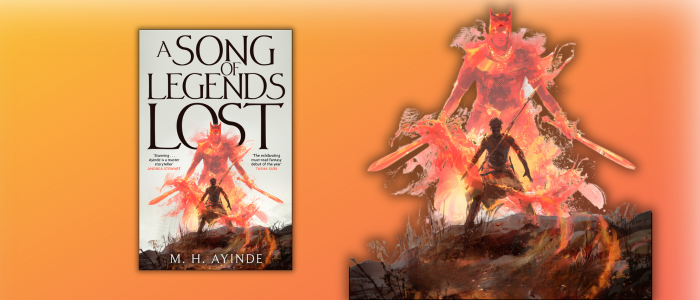
A Song of Legends Lost
By M. H. Ayinde
“The exhilarating must-read fantasy debut of the year.” —Tasha Suri, World Fantasy Award–winning author
An unforgettable tale of revenge and rebellion unfolds when an inexperienced king implements a doomed plan to end a thousand-year war in this relentlessly gripping epic fantasy debut.
Trade Paperback
LIST PRICE $21.00
PRICE MAY VARY BY RETAILER
Get 20% off with code SPOOKY plus free shipping on orders of $40 or more. Discount on physical products only. Terms apply.
Get 20% off with code SPOOKY plus free shipping on orders of $40 or more. Discount on physical products only. Terms apply.
Buy from Other Retailers
ONE
Temi
By the time Temi arrived, not even bones remained to send to the ancestors. She stood at the edge of the abandoned wharf, looking out across the small, muddy beach at what remained of her uncle’s boat. The hull was charred and blackened, as were the oars, and nothing moved within. No sign of her uncle and cousins. No sign of their cargo. And yet she had heard the screams as she ran down the dirt road. Had seen the strange green flames from the top of the hill.
Temi slipped down onto the riverbank, her bare feet sinking into cool mud. Beyond the boat, the River Ae crawled by, ruddy and sluggish as always. Great galleys slid through its waters, but nobody noticed this tiny, abandoned harbour in a ruined corner of the City of Nine Lords. Beyond the river wall on the far bank stood the shacks and huts of the district of Lordsgrave, and beyond those, like knives thrusting towards the sky, loomed the jagged crystal towers of the vanished Scathed.
Temi dropped to her knees. The curiously sweet tang of the fire caught in her throat as she blinked back tears. Four of her family were dead. An entire shipment of their cargo was lost. Six moons’ earnings had been taken by the flames. And the worst part was the driving rain would turn whatever ashes remained to sludge. She’d have nothing left of her cousins to burn on the pyre. Nothing to send on to the ances-tral realm.
“This was no accident,” said a voice behind her. Temi turned to see an old woman squatting in the mud. The many layers of her linen robes were plastered to her portly frame. At first glance, she resembled a nun—the bald head, the tataued feet —but the rings on her fingers and the crystal at her throat told a different tale.
“Do I know you, Old Auntie?” Temi said. Few souls came to the abandoned harbour. Surely this woman had heard the screams too, had smelt the strange, sweet smoke? And yet the smile she offered Temi was calm.
“No,” the crone said. “But I simply couldn’t walk by such terrible grief. Who were they, these poor souls?”
Temi drew in a shaking breath and unclenched her fists. “Relatives,” she said. “Cousins, from Jebba Province. Weren’t close family, but they’re family still. What’s it to you, anyway?”
“No ordinary fire could do this,” the crone said, nodding towards the ruined boat. “What natural flame turns bone to ash but leaves the wood beneath merely charred? And in these rains! No, someone powerful has done this, child. Someone who wanted them gone.”
“They never hurt nobody,” Temi muttered. “They’re just traders.”
“Traders, eh? Docking out here, so far from the market?” The crone settled down in the mud, the rain sliding off her bald head in sheets. “You know, when I was a girl, this part of the river was used by smugglers. The Ae is the lifeblood of our great City of Nine Lords, and the spine of the Nine Lands. All sorts of things travel up its poisoned waters. Mind telling me what it was your family traded in?”
Temi looked away. “That ain’t your concern, Old Auntie.” Likely the old woman was simply a curious traveller—there were enough of those in Lordsgrave. But the ancestors turned from souls who were loose with their tongues.
The crone stared thoughtfully at the wreckage. “Such a tragedy,” she muttered. Then she pushed to her feet and set to opening the pack that stood beside her. “You’ll never get a spirit wood fire going in this. By the time the rains stop, everything will be washed away. I heard a story once, about a man who drowned. Swept out on the Ae during a storm. He was never seen again. His family had no body to burn, and so he did not return to the ancestors. When his wife died, though their children burned her body, her spirit lingered, searching for him still. Do you wish to remain forever roaming the city, seeking the bodies of your lost kin?” She jerked her chin towards the river. “Spirit wood won’t burn in this, but I have something better.”
Temi couldn’t muster up the energy to question, and so she knelt silently as the crone set to work, her wrapper clinging to her legs, her braids heavy with the rain. The crone hitched up her skirts and darted about the blackened boat, sprinkling something from a pouch in her hand. It looked like sawdust to Temi, and much of it blew away in the wind, but some fell upon the mud and shallows, sparkling like tiny jewels.
Soon, the old woman stood rubbing her gnarled hands and removing her outer robe. The body beneath, in its closeclothes, was wholesomely round and soft bellied. As rain slid out of the grey sky, the crone danced, hands lifting and dropping as she chanted in the Forbidden Tongue. Temi watched her, feeling numb, until she heard a shuffling at her back.
She turned, expecting to see a lizard or a rat, but it was a cat; a scrawny thing hiding in the old woman’s pack. Temi held out her hand instinctively, but the creature hissed at her and flinched away.
“Well fuck you too,” Temi muttered, and turned back.
The old woman had worked herself up into a frenzy. Her eyes rolled, and her arms and legs jerked as she danced. Temi was just wondering whether she should say something to stop the crone before she gave herself a seizure, when the dancing ceased, and the crone dropped her hands, and as she did so, a perfect circle of green fire rushed to life around the ruined boat.
Temi scrambled backwards in surprise as the keen green flames flared and then softened. Now, a merry ring surrounded Uncle Leke’s boat. Neither the wind nor the driving rain seemed to touch it. Even the ruddy waters of the Ae could not wash it away. It was as irrepress-ible as the City of Nine Lords itself.
“Oh, ancestors!” the crone intoned, lifting her hands to the skies.
“Oh, ancestors, please guide your children . . . What were their names?”
“Leke,” Temi said, her voice catching. Who else had been planning to come with him this time? “Raluwa. Abeni. Sede.”
“Please guide your sweet children, Leke, Raluwa, Abeni, and Sede, safely back to you, oh, ancestors. Guide their spirits beyond the pyre and into your realm, that they might be reunited with you for all eternity. Let the tears of those they leave behind serve as an offering, and proof of their worth.”
Temi heard the cat shuffling behind her again as the crone hobbled over, eyes fever bright. “It is done,” she said, squatting down. “They have crossed. They will return to those they loved.” She squeezed Temi’s shoulder.
“What about the spirit wood?” Temi said.
The crone smiled. “You see before you an ancestral circle formed from the shavings of a very rare kind of techwork. It is called Dust of Ancestral Light.” She eyed Temi. “Does that trouble you? I assure you, it has been Cleansed.”
“Techwork, is it?” Temi said.
“Just so.”
“But you’ve made it safe for me. How kind.”
“Think nothing of it, my child.”
“Just one thing, though.” Temi grabbed the woman’s wrist. Held her fast. “There’s no such thing as Dust of Ancestral Light. And you’re a fucking liar.”
The crone’s face hardened. “Traders, were they?”
“Yes, traders. And we know a thing or two about Scathed relics. You can’t use techwork to send souls to the ancestral realm.”
“Such ingratitude,” the crone muttered, trying to extract her arm.
“Why would you want to trick me?” Temi said, voice rising with her temper. “I’m sitting here looking at the ashes of my family, and you come serving up this shit. What do—” She heard the shuffling again and turned around to see the cat creeping towards the crone’s pack. In its mouth was a coin. Her coin. Part of the payment that had been in her satchel.
Temi dived for the crone’s pack; tore it open. There lay three more golden suns. There lay little Maiwo’s beaded necklace, a gift for Uncle Leke.
“You thief!” Temi cried, grabbing the woman’s arm again.
The crone snorted. “You ungrateful brat. It was a small price to pay for the peace that I was about to give you.”
“A peace built on lies!”
“Let go of me or you shall regret we ever met.”
“I already do!” Temi shouted. She glanced at the pack. “Where’s the rest of my money?”
“What money?”
Temi tightened her grip. “Give it back, or ancestors help me, I’ll take it from you.”
“Oh no you won’t,” the crone said, touching Temi’s free arm with a sickening smile. Something sharp bit into Temi’s skin.
“Ow!” Temi cried, releasing the crone. A perfect circle of blood welled in the brown flesh of her left arm, next to her family tatau. “You cut me!”
“Yes, and that’s not all,” the crone snarled. She lifted her hands. One of her many rings began to glow. “I place a curse upon you!”
“Oh, please—”
“I place a curse upon you, Temi of the City of Nine Lords; Temi of the Arrant Hill bakers—”
“How do you know my name?”
“I curse you! Now, and forevermore!”
The crone began to shake, her eyes rolling up, her lips quivering with unspoken words. The ring—blackglass set with a red gem—glowed more brightly, pulsing ever faster.
“I grew up in Lordsgrave, witch,” Temi said. “You can’t scare the likes of me.”
But then the light from the ring flared, and a great force knocked Temi backwards, and all was darkness and silence.
*
Temi woke chilled to her core and with a dull throbbing in the back of her head. For a moment, she wondered why her brother had left the window open. Then she remembered. The river. The boat. The ashes.
Temi sat up, rubbing her head. The sky beyond the line of buildings was a rich blue, the remaining clouds tinged with the familiar golden glow that emanated from the king’s palace at the heart of the city. Mercifully, the rains had stopped. Traffic crawled by on the river beyond.
Temi groaned and rolled onto all fours, trying to piece together what had happened. Then her hand touched something soft, and she remembered the crone. No; the spirit witch—for that was surely what she was. A nun cast out by her peers for dabbling in techwork. To her surprise, the old woman lay on her back in the mud, eyes open, mouth open, arms spread wide.
“Don’t play dead,” Temi muttered, reaching for her satchel. The witch’s pack lay a few paces away. Temi could still see the curve of Maiwo’s necklace in the half- light. She crawled over and took it back, and her coins too. Then she turned to the witch.
The woman lay unchanged. Tentatively, Temi reached out and poked the woman’s hand. Then touched her again, more forcefully this time.
The witch sat up, drawing in a great raking breath. Her eyes had rolled back, but she turned towards Temi and croaked, “The ancestors have spoken! The king must fall by your hand!”
Then a terrible choking gripped her, and she clawed at her throat before collapsing back where she had lain only moments before.
“Shit,” Temi muttered.
She watched, wondering for a moment if the witch was playing another trick: trying to escape through feigned death. But as she stared at the crone’s chest, looking for movement, counting her own breaths, it became clear. The old woman would never stand again. How she could simply have dropped down dead, Temi could not imagine, and wasn’t particularly inclined to. Perhaps, in her rapture, the woman’s heart had given up. Or perhaps Leke and her cousins truly had crossed the pyre and had sent the witch her death as punishment for her misuse of their names. It didn’t matter. What mattered was that someone had murdered four of her kin, and the last thing Temi needed was to be found at a wellknown smuggling cove with a cooling corpse beside her.
She checked the boat one last time, just to be sure. Perhaps she’d been wrong. Perhaps they had swum to safety. But no; there among the blackened sludge was Leke’s single gold tooth. She scooped it up, along with the sludgy ashes that remained, and deposited the lot in her satchel. Maybe there would be enough there to burn; whatever the witch had claimed, she could still try.
Something nudged against her leg. Temi looked down to see the witch’s strange cat. It mewled piteously at her.
“You two- faced little shit,” Temi muttered. But still, she held out her hand and let it lick her with a hot, rough tongue. Perhaps it saw in her a kindred spirit. They were both grieving now. But when she looked more closely, she saw it was no normal cat. Beneath its matted grey fur, she glimpsed blinking lights . . . A twist of metal where the outer skin had peeled away. This was no cat, not truly. This was something else.
Temi lifted her foot. It would be a simple thing, just to bring her heel down. To grind the creature’s glowing eyes into the mud. It was a greyblood. A tool of the enemy. A destroyer of civilisations. It was her duty to rid the Nine Lands of it.
Temi sighed. “Follow me if you like,” she said, pulling her satchel full of ancestors over her head. “I won’t stop you.” And she set off home.
*
At sunset, Sister Relina the Humble, High Shadedaughter of the Eighth Circle of Enlightenment, sat up in the muddy darkness. She drew in a painful breath and blinked the moisture back into her eyes. Her pack still lay where she’d left it—the foolish girl hadn’t thought to take it with her. But the techwork abomination was gone. That was something, at least.
Sister Relina lifted her hands, closed her eyes, and muttered under her breath. She touched the sacred jewel embedded in her skull and called softly to the ancestors to send her words to the Holy Mother.
And presently, the ancestors answered.
[Speak,] the ancestors said. [The Holy Mother is listening.]
“Your Holiness,” Relina said. “It is done. I have prepared the one who will bring down the king.”
Good, came the reply. Now let us hope that we have acted in time.
TWO
Jinao
“Here, let me help you,” the soldier beside him said, as the ox- drawn wagon jolted and rumbled.
She was a slight thing, with quick wary eyes and a serious slant to her mouth. No more than twenty, Jinao guessed, which made her near a decade younger than he, and yet she tightened his grass- pipe cuirass deftly, weaving the straps in and out. He could feel the other warriors watching behind their black and silver warpaint, some not bothering to hide their amusement. To them, this was just another battle in Aranduq bay, another day spent driving the greyblood hordes back into the sea. It had been moons now since the latest attacks began, and these warriors had seen it all.
“Your first time, is it?” she said to him.
“Uh—yes,” Jinao said.
The wagon rocked and the man sitting on Jinao’s left slammed into him. He shoved at Jinao irritably before righting himself. At the back, some of the older soldiers had started up a war song. The words were meant to rouse, meant to stir warriors to do great deeds, yet all they did was tighten the knot in Jinao’s stomach. Through the narrow window, Jinao watched Aranduq City slide by, a rain- drenched blur of bowing palms and bamboo huts. There could be no running back to the palace of Thousand Domes now, high on its hill at the city’s heart. In mere moments, they would reach the mouth of the River Ae—the Gateway to the Nine Lands.
“I’m Leling,” the girl said. “And you . . .?”
“Er . . . Janzen,” Jinao said.
“Well, Janzen; no need to worry. The invokers are already on the riverbank. You probably won’t even need to fight! Since the other clans arrived, we’ve been able to repel them every time.” She frowned. “You know, you don’t need your mask down yet.” Her own war- mask rested in her lap, its garish eagle- face snarling up at him. “You’ll roast under there.” She reached towards his face, and Jinao jerked his head away. The last thing he needed just then was for someone to recognise him.
“OK, OK!” she said, holding up hands hard with callouses. “Just trying to help. Want some advice? When they open them doors, just run, you hear me? You start running. Try a bit of roaring, too. Never goes amiss. You run and you roar, and you always aim for the eye. Most greybloods got spines like stone . . . the Scathed made ’em that way deliberately, to do all their heavy work. So you got no chance taking the head. But the eyes—those what still have eyes—is usually crystal, and if you can just shatter one and work through to what passes for brains, only they ain’t soft like human brains, you see—”
“I do see,” Jinao said swiftly, swallowing down the sour burn that climbed up his throat.
“Good. Now the other thing is, if you can hook their techwork veins with the end of your . . . what is that, an axe? Who gave you an axe? Captain, this one here’s got an axe!”
The captain, a squat man with a blunt wedge of a face, whom Jinao knew he should be able to name, knew his brother and sister would know on sight, looked around from his perch by the door. Jinao felt his pulse quicken.
“You,” the captain called across to him. “Name?”
“J-Janzen, sir!” Jinao said, disliking the tremor in his voice. “Uh . . . they told me to bring an axe . . . They said—”
“Don’t have a clue who the fuck you are. Why’s your mask down already? Show me your face.” The captain leaned forward, grass skirt falling about his painted legs—legs that were as thick as Jinao’s waist, and all of it muscle.
Jinao fumbled at the feathers, mind racing. “I, um . . . the catch is stuck. Just trying to lift it, sir, hold on.”
The captain pushed aside the woman next to him. “Where’s your sword? Are you even from this battalion? Show me your—”
And then the world flipped. Jinao was flying; falling. Something smashed into his shoulder. He was aware of shouting, of the captain trying to raise his voice above the chaos. Beyond the walls of the wagon, he heard screaming, pleading, the clang of metal.
And greybloods. The growls, the inhuman screams, the shouts in the greyblood tongue. Jinao landed on his back—on top of someone, he realised. He rolled off and found the wagon lay on its side. The captain had forced open the door and it now gaped up at the dull grey sky.
“Out, you lazy fuckers!” the captain screamed. “Out out out! You want to see humanity go the way of the Scathed? You are all that stands between your province, your king, and annihilation! Out!”
And out they poured, clambering one over the next, heaving themselves through the opening with weapons drawn. Kampilans. They carried kampilans; he should have known.
“Let’s kill some greybloods!” Leling screamed at him, before leaping for the sky and disappearing.
It took Jinao three attempts to reach the opening. Two soldiers remained in the wagon, both injured. One was conscious, and despite the painful angle of his knee, Jinao was sure the man was laughing at him.
Then Jinao was out, and chaos swirled around him. It was no battle. It was a storm. Bodies piled upon each other. Captains screaming as their soldiers desperately tried to form ranks. Horses rearing, unable to move, their eyes flashing, their crystal bodies bright with exertion. Aranduq estuary spread out before him—their bamboo wagon had flipped over in a great crater in the mud- road that led down to the sea. One of its massive iron wheels still spun. To Jinao’s left stood the tumbledown shacks of lowbloods, all abandoned now. To his right, the grey sweep of the River Ae stretched into the distance.
Three large greybloods strode within the tumult. The nearest looked unsettlingly human; only its blunt, triangular head and grey skin marked it as something else. It tore and slashed as it stalked through the mass of soldiers, its ragged clothing billowing around it. Yellow eyes met Jinao’s and the creature smiled, revealing a mouth of blinking techwork. Behind it came smaller greybloods, six- legged beasts with heads that were all jaw. They leapt like rabid dogs, biting off faces, slicing souls from navel to neck, ripping limbs from bodies . . .
Where were the invokers? For nearly ten moons now, Jinao’s mother had been hosting them up at Thousand Domes: warriors from every invoker clan, come to defend the Gateway to the Nine Lands. Why weren’t they here, lifting their hands to call their ancestors back from beyond the pyre?
Jinao blundered towards the riverbank. There was nothing noble about the chaos that whirled around him, nothing grand. It was bodies writhing in the dirt; it was desperate souls using teeth and nails and feet, shrieking and crying and begging. It was blood and piss and dirt and limbs; so many limbs, tossed like offerings to the ancestors. Now and then, a lieutenant would streak past, screaming an order, or slicing down with a sword. But where were the battle lines? Where were the shield- bearers forming up? Where were the spear- wielders, driving the enemy back? He saw none of that here, only—
Something slammed into Jinao as he stepped out of the line of palms and onto the sand, and for long moments the world was a swirl and a ringing in his ears and a searing pain between his eyes. Then the ground struck, and the breath was knocked from him, and when Jinao opened his eyes again, it was to see a body collapsing towards him. He was fast enough to roll to the side, but it landed so close that his face was splashed with blood and viscera and ancestors knew what else . . . some silver fluid, surely something from the techwork bowels of a greyblood.
Jinao turned his head to one side and vomited.
He’d been a fool to come. An utter fool. Go to battle, he’d told himself. Prove yourself in battle. Show that you are worthy of the blood that runs in your veins. Then, perhaps, the ancestors will finally choose you for the Bond . . .
Jinao’s stomach heaved again. He sat up. All around him lay corpses, some crusted with blood, others twitching and sparking—fallen greybloods. The metallic tang of blood combined with the familiar ripeness of the river made his head spin. Craning back, he saw the wagon on its side, not more than ten paces away, and emblazoned with the white bonetree of the invoker Clan Mizito. His family insignia. His ancestors’ crest. If he crawled . . . If he dragged himself over the sludge and the bodies, he could reach it. He could hide there until their foe had been vanquished. He could creep back to the palace by the rear entrance . . .
“Lotus Company! Form up!”
Lotus Company . . . He knew that name; part of his sister’s battalion. And suddenly there she was: Jemusi, standing in the stirrups of her horse, one painted arm raised as she shouted commands, and Jinao’s heart soared. How many times, as a boy, had he dreamed of riding out with her? How many times, as they sat together in the palm gardens and counted stars, had he dreamed of them standing side by side, invoking the spirit of Mizito, smashing a thousand greybloods with a single blow?
“Quartet! To me!” Jemusi screamed, and Jinao stared, transfixed, as four masked warriors appeared, encircling his sister, protecting her. Her grass skirt flared around her painted legs as she leapt from her horse onto the sands. Jemusi raised both arms, her tataus already glowing with the light of invocation, and began the sacred dance. She whirled and leapt, her arms a blur. Then she threw back her head, her long black braid snapping behind her in the wind, her eyes closed, her expression beatific.
“Mizito, spirit of my fathers, hear me!” she cried, and Jinao felt tears spring to his eyes, felt his chest tighten. “Mizito, spirit of my mothers, hear me!” And now it wasn’t just Jemusi’s skin that glowed. The air around her brightened, and there came a keening from the sky, a quickening that set the hairs on the back of Jinao’s neck to rising, made his palms tingle. “Mizito, Lord of the Eagle, Master of the Bonetree . . . hear me now, and come!”
And so he did. Jemusi’s body convulsed as light bled from her every pore and coalesced in the air before her, taking on form and shape: a man, near twice the size of a mortal, clad head to toe in black and silver scale armour. His eyes, just visible behind his eagle mask, glowed an impossible blue. Black glyphs played along the pale length of his staff, Stillness, and where it struck, greybloods fell screaming, their techwork innards jolting as they perished. Jemusi knelt on the sand, her eyes still closed, and Jinao imagined he could see the sweat beading on her painted forehead; hear the rasping of her breath as she strained to keep the link with the ancestral realm, strained to keep her forefather here to defend them.
Then a great cry sounded from somewhere to his left, and Jinao turned. A hulking greyblood stood within a circle of corpses, a pale creature that Jinao recognised instantly from a hundred paintings and songs; a towering figure with grey skin, and the swollen body of a man, its hands gripping jagged blades. Its bald head looked tiny atop its muscular shoulders, but nothing could mask the leer of its smile, the shine of its pointed white teeth.
The Bairneater.
A score of warriors surrounded the Bairneater; souls in the armour of every province in the Nine Lands. As Jinao stared, he realised the Bairneater held something, or rather something was caught on its left blade . . .
Impaled there.
It was a body; limp, its blood tracing a red river down the Bairneater’s powerful arm. Long black hair fell from the victim’s head. Its shining warpaint glinted in the morning sun.
“Sulin!” came a man’s cry. “First General Sulin has fallen!”
And even there, Jinao heard his brother Julon shout, “Mother!” From somewhere off by the shoreline, Julon’s nimble blue horse appeared, and Julon rode high, his arms flung wide. “Mizito, spirit of my fathers, hear me!” he screamed, his voice strained with emotion. He leapt from the horse, rolling as he landed, before he began the sacred dance, his movements rushed and imprecise. Behind him, his quartet scrambled to form up, to surround him. “Mizito, spirit of my mothers, hear me! Mizito, Lord of the Eagle, Master of the Bonetree, hear me now, and come!”
Jinao stood there, frozen, unable to comprehend what was happening. Fallen. His mother, First General Sulin Mizito, the woman they called the Guardian of the Ae, ruler of the province of Cagai, she who had slain the Farseeker and the Three Dancers, had fallen.
The Bairneater, meanwhile, turned to flee with its prize, and it was only now that Jinao realised he stood in its path. A second incarnation of Mizito appeared, invoked by Jinao’s brother. It bore down upon the Bairneater, but the greyblood was fast, and emotion seemed to have weakened Julon’s link with the ancestral realm, for Mizito stumbled twice, and twice more seemed to lose cohesion for a heartbeat.
Fallen. Jinao’s mother had fallen. As the Bairneater thundered towards Jinao, he saw the creature still held her body. The Bairneater loved trophies—every soul in the Nine Lands knew that—but its trophies were the skulls and trinkets of the young: a lock of hair; a wooden toy; a tiny, severed hand. Sulin Mizito was a woman past sixty.
Jinao’s only thought, as the Bairneater thundered towards him, was that if this greyblood took his mother, they would not be able to send her spirit beyond the pyre. There would be no dances around the fire, no wine drunk in her honour, no songs and laughter.
And Jinao would not be able to curse her name as he watched her burn.
So he hefted his axe, and he closed his eyes, and as the Bairneater leapt, he swung.
Then the world came crashing down upon him, and all was darkness.
*
“There’s another here, look.”
“Is she alive?”
“Hold on . . . no. Sisters, another dead one!”
Jinao blinked against a fine, warm rain. Palms swayed lazily above him. The sun was a yellow smudge behind hazy grey clouds. For a moment, he could not think why he was outside, what had happened, but then it all came back in a terrible flood. The battle. The Bairneater. His mother.
Jinao sat up.
Around him lay a sea of bodies. The riverbank was littered with people picking over the destruction: nuns, soldiers, scavenging lowbloods. Beyond the line of palms, beyond the bamboo rooftops of the city, stood the palace of Thousand Domes, high on its hill: a nest of bulbous blackglass buildings and smaller, bamboo greathouses spread among white bonetree orchards. What a fool he’d been to leave it.
To his left lay the corpse of a greyblood, its fingers still twitching. Flesh covered those fingers, flesh much like Jinao’s, but beneath the torn fingernails gleamed metal instead of blood. Had it slipped into the skin of a victim, like a trouper slipping into costume? Or had it grown the skin somehow, in the foul depths of its Feverlands home? This creature, now as dead as the dozens of warriors around it, was ancient beyond measure. It had been old long before humanity had dragged itself up out of the mud. Jinao knew he should hate it, for what it had done to the Scathed, for what it would do to humanity, given the chance. And yet its face—so curiously humanlike—looked sad in its death throes.
Jinao could hear Sister Jassia’s voice in his mind, droning on at one of her sermons by the palace shrine. Do not pity them. Some may resemble people, but people they are not. They fashion themselves after us, but this is only to play on our sympathies. They wiped out their Scathed creators, and they yearn to wipe out humanity, too. So harden your heart against them, because they will not stop until all mortal souls are dead.
Jinao had never quite understood why greybloods were so bent on destroying the Nine Lands. Sister Jassia claimed that it was the techwork that lay buried under human cities and towns—it not only lured them, it nourished them; they needed it to survive. Jinao had heard others whisper that the truth was greybloods sought to stamp out all remaining traces of the Scathed. That included the human cities that were built amid their ruins.
Two pages in the black and white grass skirts of Clan Mizito wove a path among the bodies, scanning for survivors. When one—a gangly girl with a mop of ragged hair—caught sight of Jinao, she rushed towards him.
“Where are you hurt?” she asked. “Sisters! Sisters, this one is alive!”
Mercifully, his mask was still in place, but there was no sign of his mother’s body, nor of his brother Julon. Jinao’s throat felt painfully raw, but he swallowed against it and said, “The First General?”
The gangly page lowered her head. “First General Sulin Mizito has fallen. Slain by the Bairneater, may the ancestors preserve her soul.”
Something within Jinao soared. He pushed it down, hating himself. A woman had died. A cruel, vain, monstrous woman, but a woman nonetheless, and beloved of thousands.
“Her body?” Jinao managed.
“Don’t worry,” the other page said, touching his hand. He was a squat youth with tightly curled hair and a heavy brow. “Julon recovered her body. He chopped off the Bairneater’s arm! The monks took the arm for Cleansing. If we’re lucky, the beast will die of its wounds.”
“Invoker Julon,” the girl hissed. She lifted her gourd to Jinao’s lips, and he drank gratefully, the water as sweet and smooth as wine. “Besides, the monks didn’t take it. Invoker Jemusi smashed the arm to pieces, right after she fought off the Woodsmaiden.”
Julon? Julon had severed the arm? Jinao was sure he could remember the bite of his own axe hitting skin, the snarl of the techwork beneath, the hot spray of greyblood ichor. But perhaps he’d been dreaming.
“The Woodsmaiden wasn’t here!” the boy said.
“She was! She came with all her children, and they carried off six palace servants and Lord Jinao Mizito.”
The boy frowned. “Who?”
“You know . . . the soulbarren one. The middle brother. You remember.
Tall, scrawny. He is nowhere to be found, but one of the archers says she saw the Woodsmaiden carrying him off to her lair, to breed with him and add to her infernal brood.” Tall, scrawny, soulbarren. Jinao was so used to those words that they scarcely registered. His thoughts were of the palace, of all those within it . . .
He struggled to rise. “There are greybloods in Thousand Domes?”
“Oh no, they’re long gone! Invoker Kartuuk of Clan Itahua drove them out.” She pressed the gourd to his lips again. “I cannot wait for the day of the funeral! It will be the grandest celebration of the decade! Maybe even the king will come!”
“Don’t be stupid,” the boy said. “Clan Ahiki never leaves the City of Nine Lords.”
“Maybe they’ll come for the Day of Choosing, then!” the girl said. “I hope the new invoker is Wateng. No one is faster with a staff than he . . .”
And so they prattled on, but all Jinao could think about was that now he had another chance. Now, another from his family would present themselves at the great shrine, and Mizito would answer their call. Now, finally, it might be his turn.
“. . . and anyway,” the squat page said, “they need another strategist, with Invoker Jethar still missing. It’ll be someone like Tiani. Soldier? Soldier, where are you going?”
Jinao swayed, his head a throbbing weight, his pulse a war drum in his ears. But he was upright. Bruised, yes, but otherwise whole. So he gritted his teeth and set off across the sands.
THREE
Temi
Lordsgrave. Easternmost of the nine mighty districts. Cesspit of Nine Lords, the greatest city that had ever stood. The slums, to most, but it was and would always be Temi’s world; the most beautiful place in the land. Before her stretched a vista of decaying shacks and bamboo roofs. The streets were narrow and dirty, and the people were barefoot. Ah, the people! So many. Crowds everywhere, arguing and shouting and laughing, a dozen languages rolling over each other. Beggars chortled drunkenly under the shade of palms. Naked children clattered over the rooftops. The ceaseless stench that rose from the docks was as familiar and comforting as a childhood song, and the breeze that kissed Temi’s bare shoulders merely spread it around, could never hope to banish it.
Temi stood still, hands still shaking, while the world swirled around her. Dead. Leke and Raluwa and Abeni and Sede, all dead. At twentytwo, Temi was just five rains younger than Leke, and yet she had always known him as uncle. She had only met him once before in her life, when he’d last made the long journey north from Jebba. Every dry season, Uncle Moloko sent a new set of cousins up the River Ae to the capital, their hull filled with techwork they had gathered from the wetwoods or the desert. Temi or her brother Tunji would meet them at the abandoned wharf, coin would change hands, and the techwork would be quietly taken home to their compound. They’d host the southerners for a moon or so, a rite of passage to them now. Tunji would take them to the heart of the city, to the very edge of the Garden, from where they could glimpse the golden ziggurats of the king.
Temi would take them drinking.
But not this time. Temi stood at the bottom of Arrant Hill, the implications only now running through her mind. Someone had killed them—that much the spirit witch had been truthful about. Not the king’s monks—they’d simply cart them off to the White Isle, or the gallows if they wanted to make an example to others who might dare to touch Forbidden relics. Not local thieves—they would never have the resources, nor the inclination, since half the thugs Temi knew still came to her family’s bakery for their bread.
And there it stood, at the top of Arrant Hill. Her home. Though it was the only brick building in the neighbourhood, it did not look like much. Indeed, aside from the swinging wooden sign painted with a loaf of Yennish blackbread, the building seemed a ruin. Creeping ivy and violets grew across its walls and through the gaps in its tired slate roof. Lizards sunned themselves on the crumbling bricks.
As a child, Temi had thought nothing of her light- skinned relatives sailing down every dry season, their holds filled with techwork. She had thought nothing of her dark- skinned kin sailing up from Jebba during the rains, their boats carrying much the same. Only later did she realise that none but monks should touch techwork, and that no one at all should be so reckless as to attempt to use it. Only later did she learn that techwork was what lured greybloods to attack.
And only later did she hear the whispers that, if you knew the monks’ secret ways, well . . . the cursed relics of the Scathed People could prove very useful indeed.
It had been a neat arrangement, their profits split three ways: every morning, customers would line up outside the bakery for gozleme or roti or sweetbread, and when they slipped in a little extra coin, Aunt Yeshe would reach under the counter and pull out a piece of techwork: a water votive. And that night, if their customers placed this small tangle of silver in their water buckets . . . Why, then they’d find the dirt and disease all gone and their morning drink sweet as a mountain spring.
Temi quickened her pace as she approached, anticipating the smell of cinnamon and cloves. Any moment, she’d hear Yeshe’s gravelly voice, bellowing orders or cackling at some bawdy joke. As Temi drew near, she realised people were watching her. Serati, the old seamstress, outside her hut. The elders at the ogogoro tavern. The children scrubbing washing outside their mudbrick homes. She knew the names of them all, but none of them greeted her.
There was no line outside the bakery. Temi could see only one customer within. Old Baba, her grandfather, sat in his usual spot outside the door, dozing in his rocking chair, blanket over his scrawny legs.
Temi strode up to the door, preparing herself, and then the customer within turned.
She was a highblood, or at least someone wealthy, from her flowing silk dress. A woman of perhaps thirty rains. Small wonder no one on the street had greeted her: the woman’s muscular brown arms were criss- crossed with intricate blue and green tataus. Everyone in the district knew who wore that pattern of eyes within waves—the Chedu Family, who ran much of northern Lordsgrave.
“I told you, I never heard of no Tunji,” Aunt Yeshe was saying as Temi slipped through the door. Temi’s aunt was a hard woman, all angles and sneer, her dark skin smooth despite over sixty rains of life. White peppered her close- cropped, tightly curled hair. She shot Temi a warning glance, then turned back to her customer.
“Are you sure?” the woman said. “You are the Arrant Hill bakers, are you not?”
“Oh, Tunji,” Yeshe said. “Your pronunciation was all wrong. He lives here sometimes. He’s away at the moment.” She turned to the rows of shelves behind her, laden with bread and pastries. “I take a message?”
“It’s best if I speak with him myself. When will he be back?”
Yeshe puffed out her cheeks and folded her arms. “Now there’s a question. Could be anything from a day to a moon. He’s gone to Jebba Province. Left ages ago.”
The woman’s dazzling smile didn’t quite reach her eyes. “Well, he owes me money. I’m here to collect.”
Temi strode up to the polished wooden counter behind which her aunt stood. “Hello, Auntie,” she said. “Everything all right?”
“Money?” Yeshe said, ignoring Temi. “Don’t know nothing about that.”
“He stole from me,” the stranger said.
Yeshe leaned on the counter. “Now you listen here, girl. My nephew ain’t no thief, so—”
The woman moved so fast Temi had no time to react. In a heartbeat, she had a knife to Yeshe’s neck—where she’d been hiding it only the ancestors knew. She pulled the old woman down onto the counter with her free hand and leaned close, her voice still honey and silk.
“You let her go!” Temi cried.
“Stay back,” the stranger said, “or I’ll slice your aunt’s neck open. Understand me?”
Temi said nothing, but rage simmered within her as she stood frozen.
“Now I know Tunji is here somewhere. So you’re going to deliver a message to him. The next time he crosses the river and sells techwork on one of our streets, it won’t be me coming here with a warning. It’ll be Ba Casten, and he isn’t as forgiving as I am.” Her grip tightened and Aunt Yeshe squeezed her eyes tight. “Tunji sold votives up by Northlands. Those are our streets. By selling there, he’s stolen from my family. You let him know that Harvell of the Chedu Family will be back here in six days to collect the ten suns he owes.”
“Ten suns!” Yeshe croaked. “We can’t possibly—”
The woman jerked her hand and Yeshe let out a groan as her face pressed into the counter. “Ten suns. Six days. I’ll be back to collect.”
Then the woman, Harvell, pushed Yeshe away and strode past Temi, catching her eye as she walked.
“We’ll have your money,” Temi said, watching her go. In the street outside, people curved out of Harvell’s path and cast anxious looks after her as she strode away. Temi waited until the woman had gone from sight and then hurried over to her aunt.
“Ancestors, you all right?” Temi said. “Let’s see your neck.”
“Stop being stupid,” Yeshe snapped, batting her hands away. “I’m fine. Where’s Leke? He got the goods?”
Temi drew in a slow breath. “Auntie, they . . . they was killed. All burned up, not even bones left.”
“Killed?” Yeshe took a step back.
“Yes, Auntie. And not in no normal fire.”
“Shit.” Yeshe drew in a long breath, her scowl deepening. “Shit. You sure none of ’em got out? Swam or nothing?”
“I’m sure.”
Yeshe strode across the chipped tiles of the bakery floor and turned the sign to closed. “That explains that Harvell woman. Your brother’s done some stupid shit in his short life, but this really takes the prize. What was he thinking, selling techwork north of the river—” Yeshe recoiled. “Ancestors, what is that thing?”
Temi looked down to find the spirit witch’s ugly cat sitting at her heels, its golden stare fixed on Yeshe. She had assumed the creature would lose itself to the bustle and smells of their journey, but no, somehow it had slipped into the shop behind her. Only now did Temi recall the crone’s words: The ancestors have spoken. Had she foreseen something? Was this all part of her curse? And what was it she’d said about the king?
“It’s a cat,” Temi said.
“Don’t look like no cat to me. What is it, diseased? Don’t be bringing no diseased animals in here, Tem. Last thing we need. Maiwo!”
A moment later, a scrawny child of eight rains came scampering out of the kitchen: Maiwo, one of the many nephews and nieces Yeshe minded while their elders worked.
“Go get everyone,” Yeshe said. “Family meeting at highsun.”
“Everyone?” Maiwo said, frowning.
“Yes, everyone. Go on, get going!”
And by highsun, when Temi had had several cups of ogogoro and paid her respects to Leke and the others at the family shrine, they were gathered. The bakers of Arrant Hill. Near thirty souls in total: her aunts, uncles, cousins, all crowded around the old bamboo table. Their home had one main room: the vast family room that opened out onto their yard. Out there, under the shade of the wall, Old Baba sat teaching the children their numbers. The only person absent was Tunji . . . and their mother, though there was nothing unusual about that.
“When your grandparents started this business,” Yeshe said, “we had only one rule.”
She stood at the head of the table, her wife Selek to her left, and Old Mama Elleth, Temi’s Yennish grandmother, to her right. This was the stalwart triumvirate that had long run their business; this was the three- headed beast that kept their family together. Selek, painted and powdered despite her advanced years, stood like a highblood lord who had fallen on hard times. Few swept down the dirt- roads of Lordsgrave with as much poise as she. Mama Elleth was a different creature altogether: plump and pale and soft. But her ready smiles and easy laugh hid a sly wit.
“Any of you dozy lot care to remind me what that rule is?” Yeshe said, leaning her gnarled brown hands on the table.
“No selling beyond the Hill!” Kierin said, smiling broadly. Temi’s cousin’s pale shoulders were thick with muscle from his days spent hauling at the docks.
“Well done. Now, thanks to Tunji, who’s yet to grace us with his presence, we have a problem. I am sorry to have to tell you that Uncle Leke and the others was murdered this morning.”
Temi lowered her head as cries of disbelief rose around her.
“Temi- girl saw it all. Didn’t you, Tem? It weren’t no accident, neither. Then, next thing, we get a visit from a lovely lady called Harvell. Harvell of the Chedu Family.”
“What do the Families want with us?” Uncle Amaan said. He sat at the corner of the table, his youngest child sleeping on one shoulder, his long hairlocs swept over the other.
“Turns out our Tunji’s been taking water votives across the river and selling right under the Chedus’ noses. Now, all your Mama Elleth ever wanted . . .” Yeshe said, and here she jabbed a finger at her softly smiling neighbour. “All she ever wanted was to bring clean water to these parts. All your Old Baba out there ever wanted was to use his mind to help others. Not to make no profit. Not to muscle in on whatever it is the Families do. Now they’re demanding ten suns’ recompense, and if we don’t get it to ’em, you can bet they’ll be dishing out more of what Leke got. So, first thing I’m gonna say is this: you watch your backs in the coming days. Don’t be going out at highsun. Don’t be talking to no strangers.”
“Where is Tunji, anyway?” Mtobi said, rapping their painted nails on the table. They had their father, Amaan’s, slender build, but wore their tightly curled hair in neatly patterned braids. “Shouldn’t he be here?” They shot Temi a knowing look. Temi shrugged.
“Next thing we need to figure out is how we’re going to get ten suns to them in six days,” Yeshe continued. “Now, I’m asking each of you to empty your pockets. Check your secret chests. Call in those favours. We really don’t need no trouble from Ba Casten and the Chedus.”
There came a rattling from the kitchen.
“Tem, you go,” Yeshe said.
“Yes, Auntie.”
Temi padded across the room and through the cramped kitchen, where Mama Elleth’s brick oven stood cooling. She crossed the empty shop and strode up to the door, where a scrawny beggar- woman was trying to break in.
Temi’s mother.
Temi yanked open the door. “What d’you want?”
“Temi!” Kerlyn said, falling into the room. She stank of wine and sweat and unwashed clothes. How many days had it been since they’d last seen her? Six? Eight? Her mother usually only came home when she ran out of drinking money. Her yellow hair was a matted tangle, her freckled arms burned from so long out in the sun. “Tun . . . Tunj . . . your brother’s up on that hill again.”
“Is he?” Temi said wearily.
“Tem, you got any coin? I just need—”
“Goodbye, Ma,” Temi said, sidestepping her mother and slipping out into the street.
The crowds on Arrant Hill were thinning as highsun drew near. The heat hit Temi like a physical force as she dodged round the side of the building and scampered up the small hill that stood above their yard.
Up there, behind their house, stood Bakery Mount. In truth, it was little more than a small hillock that loomed over the rooftops of Arrant Hill on one side and the River Ae, far below, on the other. But as a child, Temi had thought it the summit of the world itself. A single jagged wall of blackglass thrust through the grass of Bakery Mount; all that remained of the mighty Scathed tower that must have stood there millennia ago. She and Tunji had made up such stories about that wall when they were children. Temi crossed to it now and sat, feeling her skin prickle in response to the energy that still crackled through it. Then she sighed loudly and turned to face her brother.
Tunji sat amid a circle of techwork—veins and discs and tiny flecks of blackglass—utterly absorbed in his work. In his smooth brown hands he gripped a water votive; it was little more than a bundle of battered metal and a knot of flowers. But as he sat, his dark lips moved and he chanted under his breath, chanted in a language he should not know, a language it was forbidden to use . . . And the words worked: at the sound of those five syllables uttered in an aeons- dead tongue, the techwork flared, glyphs appearing then dimming. The votive was complete. And now, any soul who used it could change the nature of water itself.
“Go on then,” Temi said. “Tell me what you did.”
“Temi!” Tunji said with a start, his large eyes growing wider still. “What you doing here?”
“Wondering why you decided to sell votives north of the river.”
“Me? Don’t know what you’re talking about,” Tunji said, turning away.
“Don’t give me that shit. You know someone killed Uncle Leke?”
Tunji laughed lightly; he was a man who smiled easily and often, but when she didn’t smile back, he sobered. “You’re serious?”
“Course I’m serious. And some woman called Harvell came and threatened Auntie Yeshe with a knife. Said she was a Chedu.”
“Ah, fuck,” Tunji muttered, passing a hand over his face. “Shit.”
Temi crossed the grass and dropped down beside him, then lifted his chin with a finger. She looked into his dark eyes. Thick as thieves, that’s what the family had called them as children. Always scheming together. Getting into scrapes together. They had no secrets from each other— never had. When their father had been sent to war and their mother descended into drunken despair, they had been each other’s strength.
“Tunji . . .” Temi said.
“It was just this one time—”
“Ancestors, Tunji!”
“No, listen! It was one time . . . one time! There’s all these people come over from Vushem, right, after that city out there got sacked by the greybloods. So I saw some of the kids drinking out of the Ae . . . Maybe they don’t know the water’s no good, or maybe they was just desperate. But anyway, I got talking to this one lady—”
“A lady, was it?”
“And I told her I could get her something to make the water clean. She was scared when she saw it was techwork, but I told her it was safe, told her it’s a just an ancient tool, not cursed like the monks call it . . . Tem, you should’ve seen ’em, little kids, little babies, all skinny and thirsty and—”
“You should have told your lady to walk over to the bakery to collect!” Temi cried, throwing up her hands. “Not gone across the river to sell her bloody votives! Lords!”
“But nobody saw me, Tem, nobody, I swear, I was so careful, and I didn’t charge her or nothing so technically I wasn’t selling.”
“You idiot!”
“I didn’t know all this would happen, Tem—how could I? Ancestors forgive me, I . . . I didn’t know!”
Temi sat in silence for a time, listening to the shouts from the river below, the sun a searing weight on her back. She knew she should be angry with him. She knew she should drag him downstairs to the others. But instead, her gaze drifted to the votive at Tunji’s feet.
“You done something different,” Temi said.
They usually used the flowers that grew on the walls of the house to call for the blessings of the ancestors. A thin coil of techwork bound them together. Tunji alone knew the correct way to do that. Something about the knots and folds, the way the pieces of blackglass were woven within it, changed what the techwork could do. Old Baba had taught them both, but Tunji was the one with the gift. He took hold of the votive now and turned it over with a smile. He had an artist’s fingers, long and fine, and Temi knew making the votives was an art to him. While she saw it more like Mama Elleth’s bread recipes—follow the instructions, same result each time—to Tunji, crafting techwork was a matter of heart and soul.
“It’s these discs, see,” he said, pointing to a circle of silver bound up with the veins. “They was in the shipment that come over from Jebba last time. Uncle Moloko said they’re just decorative, but these glyphs here mean something special. You remember when I told you the reason boiling the water don’t work is because it ain’t infection in the water, it’s something else? Well, see these discs . . . they attract the bad stuff in the water. And when I done the chant, they made everything last longer . . . these ones can clean twice as much.” He took hold of her shoulder. “I reckon it’s some kind of techwork in the river. I reckon it’s so tiny we can’t see it, but it does something to us when we drink it. If I could just get hold of one of them monk’s seeing lenses, the ones what make things bigger, then—”
“Tunji!”
“What? Temi, we could do so much more than water votives.” He sighed heavily. “Old Baba knows more than just this one water chant. More’n all the monks in this city, I reckon. We sit here in the ruins of Scathed cities, surrounded by Scathed tools we’re told we can’t never touch! But if one simple piece of techwork can clean water, what can the rest of it do?”
“Summon greybloods,” Temi said. “That’s what.”
“You really believe if all the techwork buried under the Nine Lands just disappeared, that the greybloods would stop coming? You think they’d just vanish and the war would be over?” Tunji blinked at her. “Techwork ain’t cursed, Tem. The monks should be sharing it with the people, not hiding it away for themselves. We’ve only scratched the surface of what it can do. Don’t you want to try making something more?”
“Nope,” Temi said, pushing to her feet and touching her forehead in the sign for ancestral protection. “And you shouldn’t neither.”
She sensed movement behind her and turned to see No- Cat padding up the hill. Temi strode over and held out a hand, and the creature sniffed at her with a surprisingly wet nose.
“You know that’s a greyblood, right?” Tunji said.
“This cat?” Temi ruffled its head. The skin beneath its fur was searingly hot, but it watched her with round, trusting eyes. “Course it ain’t. If it was, it would’ve ripped my throat out by now, wouldn’t it?” But she shot him a wistful look as she spoke.
[Temi.]
“What?” Temi said, straightening.
“Me? I didn’t say nothing,” Tunji said.
[Temi. I know you can hear me.]
The voice was a whisper at the edge of her consciousness. Barely audible. But there. She whipped around, but there was no one behind her. No one near the wall, or on the rooftops. Besides, the voice had sounded too close. She looked down at No- Cat, suspicion rising within her.
[I am nothing to do with that ridiculous creature.]
Temi thought again of the spirit witch’s words. I place a curse upon you, Temi of the Arrant Hill bakers.
“Fuck this,” Temi muttered, and crossed to where her brother worked. Evidently, she’d drunk too much ogogoro.
[Temi, you cannot ignore me.]
“We should go to the others,” Temi said, dropping down beside Tunji again. “This needs sorting out. They’ll forgive you.”
“I know,” Tunji muttered, looking away.
[We can help each other.]
“Listen,” Temi said, “before we go . . . you ever hear of spirit witches . . . cursing people?”
“Cursing? Only in stories. Why?”
“Just . . . just wondering. Could they actually do it, though?”
“What, make the ancestors turn from you or something? Course not. No one can.”
Temi gripped her brother’s shoulder. “Good. Come on.”
FOUR
Jinao
“Welcome, all!” Sister Jassia said, lifting her scrawny arms high as she strode before the shrine of Mizito. At the sound of her voice, the crowd fell silent. “Welcome to the Day of Choosing!” In the days since his mother’s death, Jinao had thought of little else but this moment. He knew it was foolish to hope. He might be of the right blood, but as his mother had reminded him so often, he would never be of the right heart. Yet perhaps, this time, with Sulin Mizito gone. Perhaps . . .
“Today,” Sister Jassia intoned, striding across the cracked marble of the shrine’s floor, “one of Mizito’s descendants will honour the sacred vow and Bond with his spirit.”
Jinao had allowed himself only one glass of wine when he broke his fast that morning, and yet the tataus on the old nun’s bald head seemed to shift and writhe. The palace shrine had always been a place of dread to Jinao, a place of failure and disappointment. How many days had he spent within these black walls, kneeling and beseeching while his mother paced and scowled? How many times had the sun shone down through that broken roof, merciless in its indifference?
Jinao averted his eyes from the circle of spectators—warriors from Clan Adatali and Clan Itahua and the rest. Come to witness his enduring worthlessness. Well, perhaps today they would be surprised. Instead, he kept his gaze on the statue of Mizito. It stood against the far wall, a looming bronze monstrosity bedecked in beads and jewels. A sea of sparkling offerings surrounded the spirit wood at its feet. More food and wine than Jinao had ever seen there covered the bronze platter.
“Descendants of Mizito!” Sister Jassia continued. “In your blood, you carry the most sacred power of them all. The power to invoke your clan’s founder.”
Jinao loomed head and shoulders above his fellow hopefuls. Most of those in the line were Jinao’s adolescent cousins—eager- eyed and excited. Many had already selected their quartets from among Aranduq City’s petty nobles. All ignored him, as though being soulbarren were contagious, as though his many failures might infect them. They thought they knew exactly what outcome awaited him today. Every one of the hundred or more souls standing there thought they did.
“Ninety souls of the blood has he chosen,” Sister Jassia continued. “Ninety will he always maintain. Today, Mizito will choose his clan’s newest invoker. Let the first of his progeny present themselves.
Tegana, child of Rocanan!” Tegana was a girl of not more than thirteen, some second cousin from the Outer Isles. She set down the gift she had brought—an exquisite necklace of diamonds and rubies—and then began the sacred dance. Her every movement was achingly precise. Heads turned as she spun before the statue. When she had finished, she threw herself to the ground, forehead planted on the spirit wood slab as she awaited her ancestor’s response.
Silence rippled across the crowd. Jinao heard the northerners muttering as they watched. One hopeful, ahead of Jinao in the line, yawned ostentatiously, and those around her stifled giggles. The nuns taught that, during those moments, all Clan Mizito’s ancestors peered into the mortal realm to weigh the hopeful’s worth. If they deemed their descendant worthy, Mizito would send a sliver of his soul back into the mortal realm to Bond with them, creating a new invoker. Jinao saw no flash of ancestral light from the spirit wood, however . . . that sacred doorway to the ancestral realm. All he could see was the girl’s anxious breath, misting the bronze offering cup.
“The ancestors thank you for your offerings,” Sister Jassia said, voice dripping with compassion. “Perhaps the spirit of Mizito will answer your call another day. Let the next hopeful present themselves. Wateng, child of Lilani.”
Here came a youth to fill the ancestors with pride: upright, confident, and strong. Wateng was not yet sixteen, but his muscles stood out like cords. His warpaint was flawless, accentuating the contours of his back and thighs. Behind him came the four women he had selected for his quartet, all little older than he, all groomed since birth. No doubt Wateng would choose one as spouse, or milkmother should someone with seed catch his eye. Each was exquisite, their black hair oiled and jewelled, their staffs strapped to their backs.
Wateng dropped down before the statue and bent to press his forehead to the spirit wood. Jinao could feel the audience watching, rapt, as Wateng set down a bowl of rice and a single perfect emerald. His painted lips moved in silent supplication as he drew a short dagger from his belt. Several of the onlookers gasped at this. And to Jinao’s horror, Wateng pressed his palm to the slab of spirit wood, fingers splayed.
“Mizito!” Wateng cried. “Spirit of my fathers! Hear me!”
And he jerked the blade, severing the last two fingers of his left hand.
Jinao was not the only one to turn away. Wateng stood, leaving his bloody offerings there beside the rice. He held up his mutilated left hand, triumphant. “Mizito!” he cried, making a slow circuit for all to see. “Spirit of my mothers! Hear me!”
Wateng’s drummers started up then, filling the shrine with their music, and immediately, Wateng dropped into the first stages of the sacred dance. His moves too were flawless, and yet unlike the first girl, he had added flourishes to each. His expression remained serene, even as his blood continued to drip. Sister Jassia watched on, her eyes sparkling, and Jinao knew what she saw: a man worthy of his blood, worthy of wielding the spirit of his ancestor. A warrior who would earn himself a dozen names before he was thirty. Jinao scratched the stubble at his chin and pushed away unkind thoughts.
“Hear me now, and come!” Wateng finished, dropping to the ground again.
Silence followed. Jinao swallowed a burp. It had been only one glass he’d taken . . . hadn’t it? Wateng’s shoulders heaved as he lay prostrate. The blood from his wounded hand traced a meandering path towards the spectators. Even from where he stood, Jinao could see insects had landed on the rice. Then, almost reluctantly, Sister Jassia stepped forward, her grey robe sighing on the ground as she walked.
“The ancestors thank you for your offerings,” she said. “Perhaps the spirit of Mizito will answer your call another day.”
Perhaps he will answer your call another day . . . How many times had Jinao heard those words? Wateng stood, and though his expression was stony, his eyes were not. They shone with emotion. Shame? Anger? Jinao couldn’t tell. Wateng strode silently back up the steps, and Jinao resisted the urge to offer him a sarcastic bow as he passed.
“He’s going to run out of fingers,” muttered a tall girl ahead of Jinao, and a ripple of laughter ran down the line.
“Jinao, child of Sulin!” the nun called, and Jinao felt a stirring around him. Plainly, many of them had not known who he was. He felt like a giant, striding past them all. He closed his ears to the whispers at his back, feeling all his resolve melt away like morning mist. It had been foolish to hope. Foolish to think that today might be different. Best now to get things over with and return to the solitude of his bathhouse. Jinao crossed to the statue and knelt unceremoniously before it.
He set the remains of his breakfast down beside Wateng’s severed fingers, along with a decorative stone he had found on the path.
“Do you not wish to perform the sacred dance?” Sister Jassia said sharply.
“Forgive me, Mother, but the ancestors have seen me dance a time or two before,” Jinao said. Then he closed his eyes and turned back to the statue of his ancestor. “Mizito, spirit of my fathers, hear me,” he muttered. “Mizito, spirit of my mothers, hear me. Mizito, Lord of the Eagle, Master of the Bonetree, hear me now, and come.”
He closed his eyes, counted to five, and then stood.
“You may wait,” Sister Jassia said, a line of disapproval creasing her brow. “The ancestors will answer in their own time.”
Jinao was fairly sure the ancestors had given him their answer long ago, but he turned mechanically, dropped back to his knees, and closed his eyes. He could hear his mother’s voice in his head, hear the endless sermons she’d given him as he knelt in this spot. Invocation, she would say, is the act of calling upon the founding warlord of your clan. You are the bridge . . . the physical bridge between the realm of the ancestors and our mortal realm. When Mizito accepts you, he is Bonding a copy of his soul permanently to yours. The more closely you are aligned to him in thought and nature, the stronger the Bond will be. Blood alone is not enough, though being of the blood is essential to the Bond. When you invoke, you are the channel his soul will travel down to become physical for a time. Those tataus upon your arms are the gateway through which he will step. Your body lends him the physical strength to become truly present. That is why invocation taxes both muscle and mind. And that is why you must train.
Once, Jinao had made the mistake of repeating his sister’s mocking addition: that an invoker was the anus through which a warrior shits his family. That had earned him a vigorous beating and no dinner that night.
Time passed. Jinao’s mind wandered, and he found himself thinking again of his mother’s body, dangling from the Bairneater’s arm. How could a woman of such stature fall in her prime? And why could Jinao find no grain of sadness within him with which to mourn her?
“The ancestors thank you for your offerings,” Sister Jassia said at last. “Perhaps the spirit of Mizito will answer your call another day.”
Jinao heard muffled laughter at that, but he bowed to the shrine and strode away. He told himself he felt nothing as he climbed the shrine steps. Nothing but relief that the ritual was at an end. It was past highsun now, the air damp and heavy. He needed wine, and his bathhouse and, if the ancestors were kind, to sleep through his mother’s funeral. He slipped back through the crowd and out into the chrysanthemum garden.
Up on the hill beyond his sister’s greathouse, General Sulin’s funeral pyre was nearly complete. He saw the torches they had set around it. A lone figure, all in white, knelt before it, and Jinao didn’t need to squint to recognise his brother Julon. He remembered then the words of the page: He chopped off the Bairneater’s arm. Had his brother spread the lie or was it simply a rumour? Either way, it didn’t matter: nobody would believe Jinao had been there.
Beyond, across the city, the grey gleam of the River Ae snaked off into the distance. Jinao could just make out the dark smudge of the statue of Sumalong, the local folk hero, standing astride the river. He knew what people were thinking, out there in the city. With Sulin gone, Aranduq would fall. And then all the Nine Lands, even the City of Nine Lords itself, would be vulnerable.
“My Lord Jinao,” a resonant voice said, and Jinao looked round to see a man in purple robes emerge from among the chrysanthemums: Lakari, one of his mother’s advisers. Silver and black jewels hung in great chains about his neck.
“Hello,” Jinao said.
“I am so very sorry for your loss,” Lakari said. “She was a brilliant woman, your mother. We will all miss her. I must leave Thousand Domes this evening, but I wanted to see you before I left . . . to let you know that, despite what your mother may have said, she loved you very much.”
Jinao mustered a thin smile. “You are kind to say so.”
“I wonder if we might say a few words for the ancestors together? It would make an old man very happy.”
Behind them, a brilliant flash lit the morning, and a distant cheer rose up. So. Someone had been accepted for the Bond. He wondered who it was. Then reminded himself he didn’t care.
Lakari took Jinao’s hands and closed his eyes. Touching him was like touching the spirit wood of the shrine; Lakari radiated heat and power. “Ancestors,” Lakari said, “we ask you to guide and protect the spirit of our sister Sulin. May she know peace in your embrace.” Then he uttered a stream of words Jinao could not follow.
“Pardon me?” Jinao said, squinting. It sounded like the Forbidden Tongue, but Lakari was no monk.
“They are words of thanks, in my home dialect,” Lakari said brightly. He released Jinao’s hands and rubbed his own together. “Good. Good! And do me a kindness, will you? Place a token or two on Mizito’s shrine, for your mother. I know you may harbour her some resentment, but the ancestors smile upon the forgiving, and she did so much good for so many. So remember her in your thanks.”
The rasp of a distant horn cut across their conversation, and Jinao’s stomach twisted. But no, this was no herald of greyblood attack. This fanfare was nothing like the long, deep notes he had become so accustomed to over the last two rains. The call was taken up all around the city, and Jinao felt a thrill pass through him.
“Ancestors be praised!” Lakari said, rubbing his hands together, his narrow eyes crinkling. “Clan Ahiki is here! Come. We must prepare!”
*
Jinao surrendered himself to the tide of excitement and anxiety that washed over the palace that afternoon. While the grounds filled with soldiers mustering to cross the city and provide escort to the royal convoy, Jinao’s bamboo greathouse swarmed with servants come to powder and paint him. He was bathed and oiled and wrapped in a traditional skirt then adorned with warpaint that accentuated his ancestral tataus. Palani, his page, brought him cups of wine whenever Jinao beckoned. After the third cup the boy bowed hesitantly and muttered, “Sire . . . perhaps it is too early for . . . more?”
“It’s never too early for more,” Jinao told him heartily. The day was shaping up to be not so bad! Yes, his ancestor had publicly snubbed his call for the twentieth time—or was it the thirtieth? Jinao couldn’t recall. But his mother was dead! Tonight she would burn! And for the first time in his life, he might meet the king!
As Jinao followed the crowds through the gardens late that afternoon, he spotted two household monks, deep in conversation. Ordinarily, the announcement of a royal visit would have come through them, as the king’s eyes and ears among his invoker clans. But not this visit, it seemed. Jinao wondered if it was because his sibling Jemusi had not yet been anointed First General. In the distance, coming down an adjacent path, he spotted Marali—some cousin of his from the Outer Isles, and Mizito’s newest invoker. There was no point in resenting her. Whatever happened was the will of the ancestors.
Their allies from all across the Nine Lands lined the avenue leading from the Great Northern Gate, every aide, soldier, and guest. Jinao stood between his siblings, sweat tracing a line down his bare back, as the heavy iron gates juddered open to admit their most esteemed visitors.
The horses came first: two dozen golden steeds with shining amber eyes and sleek crystal bodies. Their riders wore the familiar golden masks of the king’s guard. Their muscular skin, too, was painted gold. So much brightness was hard to look upon. Which, Jinao supposed, was the point.
Then came the Clan Ahiki litter itself, borne upon the shoulders of a dozen gold- painted servants in loincloths. Its curtains hung closed against the city heat. As it drew level with Jemusi and the rest of the palace household, it came to a halt. The entire convoy stopped, and then two more loinclothed servants scurried forward to pull back the curtains and reveal the personage who languished within.
A youth of perhaps sixteen dozed upon the cushions. He wore a headdress of golden spikes, shaped like the sun. His robe, too, was of spun gold. But both headdress and the robe lay askew as the royal youth snored. His slender arms bore intricate golden tataus: the blazing sun of Ahiki, King of Them All. His brown skin and braided hair could have seen him pass as a native of almost any province in the Nine Lands. Jinao cleared his throat. He’d heard that, despite centuries of ancestor-blessed life, the king was young to look upon. But not this young.
“His Royal Highness,” a plump herald sang, their voice carrying across the crowd, “Princen Tamun Ahiki, the First Light of Dawn, Thirty- Sixth in line to the Blessed Throne of the Nine Lands.”
The drummers struck up then, pounding out a deafening rhythm that startled the youth from his nap. He seized one of the cushions in alarm, his headdress falling over one eye. Then he sat up, straightening his robes and leaning towards the litter opening.
This. This was a descendant of the great leader who had founded the Nine Lands. This soul was Bonded to the spirit of the most powerful warrior to have ever lived. This scrawny youth’s forefather held back the greyblood hordes. This bleary- eyed whelp was the one to whom the invoker clans and their progeny must bow.
“Have we arrived?” Princen Tamun said, and then he opened his eyes.
Jinao winced and looked away. He felt all those around him react too, some shielding their faces, others taking an involuntary step back. It was as though someone had opened the sun itself and poured it into Jinao’s head. His temples pulsed. His eyes stung. His hearing faded, then surged back again, ringing.
“Do not try to meet his gaze!” Jemusi hissed, her head lowered. “That pain you feel is the displeasure of our ancestors.”
Jinao had never been to the capital city, Nine Lords, but he had heard it said that the closer a soul got to the king’s palace, the Garden, the harder the place was to look upon, until the throbbing in one’s ears and the burning in one’s eyes became too much to bear. Garden servants, it was said, underwent a special procedure to be able to withstand Clan Ahiki’s brilliance. If this was just a taste, then it was a place Jinao hoped he would never have the misfortune to visit.
“Which one of you was it?” Tamun said in his uneven adolescent voice. “Which one took the Bairneater’s arm? We would speak with them.”
On Jinao’s right, Julon stirred, then shuffled forwards. “It was I, Your Highness,” Julon said. He lowered himself to the ground, kneeling and pressing his head to the stone road, his long black hair spreading out in a silky half- circle. “I took the beast’s arm, if it pleases my Royal—”
“You are to be commended,” Princen Tamun said. “That creature has been quite the blight on our lands for some centuries.”
Jemusi stepped forward and bowed. “Princen Tamun, on behalf of Clan Mizito and our hallowed ancestors, I bid you welcome to the palace of Thousand Domes. We have prepared the royal dome for you, and all funeral arrangements have been made.”
“Funeral?” Tamun said.
“Yes, Your Highness. For our mother, ancestors preserve her.”
Tamun stared, his searing golden eyes empty of expression, but the corners of his mouth curved in gentle amusement. “Ah. Yes. We are not here for the funeral, though we would be happy to preside over the ceremonies. We are here with a declaration from my uncle, His Grace King Jakhenaten II Ahiki.”
Tamun gestured, and the plump herald stepped forward again, this time unfurling a coiled papyrus.
“His Most Blessed and Golden Grace Jakhenaten Ahiki,” the herald sung, “King of the Nine Lands, High Warlord of the Invoker Clans, Holy Unifier of the People, bids every household in his domain provide the kingdom with two souls of fighting age to join in his reclamation of the Feverlands. Furthermore, His Most Benevolent Majesty commands his ancestors’ loyal servants, the invoker clans, to each provide an army of ten thousand warriors to join him in reclaiming our lost lands to the west.” The herald let the scroll snap shut, the only sound in the resonant silence that followed.
A joke. It had to be a joke. Some ruse of this young Clan Ahiki upstart, meant to remind Thousand Domes of his power over them all. The invoker clans existed to protect the Nine Lands from what escaped the Feverlands, not go charging in after it. Besides, the Feverlands had been named for how inhospitable they were to humans. Poison, they said. Poison in the air itself. Nothing natural could hope to survive.
Jinao began to smile, then noticed that his sister, still bowing from the waist, had gone rigid. “Your Highness,” Jemusi said, straightening, “forgive me . . . perhaps I misunderstood. His Grace the king is intending to . . . invade greyblood territory?”
“It is hardly an invasion when those lands were once ours,” Tamun said, examining his nails.
“Your Highness . . . We are scarcely able to hold the river here in Aranduq. With those numbers, this city and the entire length of the Ae would be vulnerable to—”
“We grow weary after our journey. We will retire to our apartments and refresh ourselves before the funeral rites.” Tamun signalled with one slender hand, and the servants let the curtains fall closed. Before they could meet, however, Jemusi sprang forward, arm extended, holding the curtain open. Within a heartbeat, a gold- painted soldier had a spear to her throat, and two more stood behind her.
“Let her speak,” Tamun sighed.
“Why now?” Jemus said.
“With our mother gone—”
“My uncle the king has become aware of . . . new information about a largescale attack that is being planned. He seeks to forestall that.”
Then Jemusi was driven back into the line of spectators, and the royal procession rumbled on.
A Song of Legends Lost
By M. H. Ayinde
“The exhilarating must-read fantasy debut of the year.” —Tasha Suri, World Fantasy Award–winning author
An unforgettable tale of revenge and rebellion unfolds when an inexperienced king implements a doomed plan to end a thousand-year war in this relentlessly gripping epic fantasy debut.
Trade Paperback
LIST PRICE $21.00
PRICE MAY VARY BY RETAILER
Get 20% off with code SPOOKY plus free shipping on orders of $40 or more. Discount on physical products only. Terms apply.
Get 20% off with code SPOOKY plus free shipping on orders of $40 or more. Discount on physical products only. Terms apply.
Buy from Other Retailers
Author Alerts
By clicking 'Sign me up' I agree to the Terms of Use and acknowledge the Privacy Policy and Notice of Financial Incentive. Free ebook offer available to NEW US subscribers only. Offer redeemable at Simon & Schuster's ebook fulfillment partner. Must redeem within 90 days. See full terms and conditions and this month's choices.