
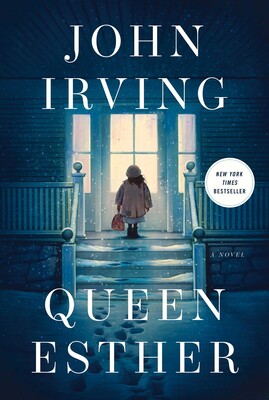
After forty years, John Irving returns to the world of his bestselling classic novel and Academy Award–winning film, The Cider House Rules, revisiting the orphanage in St. Cloud’s, Maine, where Dr. Wilbur Larch takes in Esther—a Viennese-born Jew whose life is shaped by anti-Semitism.
Hardcover
LIST PRICE $30.00
Free shipping when you spend $40. Terms apply.
Buy from Other Retailers
1.
The Townspeople of Pennacook
2.
A Fourth Daughter
Constance was the steadfast matriarch of the Pennacook Winslows. Her maiden name had been Bradford. William Bradford had been onboard the Mayflower. The townspeople of Pennacook imagined Constance was no less steadfast when she’d been a Bradford; becoming a Winslow merely served to steel her moral certainty. The woman was unwavering. Constance was the one responsible for the virtue names bestowed on her first three daughters—Faith, Hope, and Prudence (in that order).
Virtue names appeared to matter less to Thomas Winslow, the little man of the household. Mr. Winslow was the epitome of an English teacher; to the townspeople of Pennacook, the diminutive man was the essence of teacherly. His forebears didn’t matter to him. “You can’t improve your ancestors—you can only improve yourselves and inspire your children,” Thomas Winslow told his Pennacook Academy students on the first day of every English class he taught. He meant he could teach them to read well, beginning with what they would read. “And if you learn to write well, you will speak well, too,” he told those boys. As for what they would read—the poems, the plays, the stories, the novels—“the more make-believe, the better!” the English teacher told his students. What Mr. Winslow further said was the gist of his belief in fiction. “If you can imagine yourself in someone else’s shoes, this might make you a better person,” Thomas Winslow would tell those boys.
What grated on the townspeople of Pennacook was the way Thomas Winslow tried to teach them. The adults of the town didn’t want an English teacher telling them how to improve themselves. It wasn’t Thomas Winslow’s business to tell the townsfolk how to inspire their children. The well-to-do adults of the town were most annoyed at the tiny English teacher. Why would they want to imagine themselves in someone else’s shoes? How did Thomas Winslow dare to make them better people? And Constance, in her own way, could be a busybody; she got under the skin of the townspeople of Pennacook, too. Those two were always pushing what they’d read on you. What they’d read wasn’t all those Winslows were pushing, but the town’s awareness of being pushed began with the books.
Thomas Winslow wasn’t self-conscious about his smallness. It irked the town’s menfolk that Thomas was not a bit bothered by his tiny size. The women felt differently. Thomas Winslow was handsomeness in miniature to them. “Isn’t he a little doll?” the ladies of the town teased one another. Don’t think Constance didn’t know how the women felt. Yet the prevailing impression of Thomas Winslow was teacherly. To the townspeople of Pennacook, the pretty little man did not bring spontaneity to mind. If Constance was the one who named Faith, Hope, and Prudence, the exactness of the two-year span of time between each of the daughters’ births seemed in keeping with the specificity of detail in those plotted nineteenth-century novels the tiny English teacher loved. On the surface, the deliberate difference in the ages of those virtue girls was characteristic of Thomas Winslow, wasn’t it?
After Prudence (the third virtue daughter) was born, the townspeople of Pennacook counted the years. Given their esteem for Thomas as a little doll, the ladies of the town kept the closest count. Two years after Prudence was born, it looked like the Winslows were done having children. Prudence was five when the Winslows let the last of their nannies go. When those virtue daughters were little girls, they had a succession of nannies—three in a row. Constance insisted on calling them “au pair girls.” The au pair designation caused a hullabaloo in town. For one thing, it was inaccurate—they weren’t foreign girls, they spoke English, and (above all) those girls were orphans. To the townspeople of Pennacook, where the Winslows’ nannies came from mattered.
Constance, of course, could not be criticized for her use of language. “I call our girls au pair, from the French—literally, ‘on equal terms.’ Our girls help with housework or childcare in exchange for room and board—they’re part of our family,” Constance said; she would not use the word adopted, nor did she ever say the Winslows were a foster family for those girls. “We don’t give our girls a salary—we give them an allowance, the same as you would give your older children,” Constance told anyone who would listen. “These girls are like our children,” Constance said of those orphans—to the consternation of the townspeople of Pennacook. “We buy their clothes, we help them with their homework—all our children know school is important,” Constance couldn’t stop herself from saying. The Winslows would see to it that their au pair girls got into college; those nannies knew they were expected to do well in college, too.
There had to be something wrong with one of the Winslows’ orphans, or so the townspeople of Pennacook hoped. Not enough was known about where those orphans came from. With orphans, too much is missing; there’s always something you don’t know. The townspeople of Pennacook understood (albeit vaguely) what happened to unadopted orphans; when they were only fourteen or fifteen, they became what was called “wards of the state.” That didn’t sound good. There were ladies in the town who said childcare was too important a job for minors. And you would be asked, or you might think to yourself: Would you let wards of the state look after your children?
Not a speck of dirt could be found on the Winslows’ first three nannies. Those three were model students in the Pennacook public schools; the way they sailed through college (they got into good graduate schools, too), you would have thought they were Winslows. The way those three unadopted orphans came “home” (as they called it) for Christmas or their vacations sorely vexed the townspeople of Pennacook, too. The way those three virtue daughters adored seeing their old au pair girls, you would have thought the Winslow kids were like sisters to those wards of the state.
And those nannies spoke no ill of their treatment in the Winslow household. “I felt accepted from the beginning, like I’d always been part of the family—and now I always will be,” the oldest of those orphans had said. She’d been the nanny for Faith, the firstborn.
“You can’t just give someone a home, not someone like me, who’s never had a home, but that’s what they gave me—they made me feel I was home,” Hope’s nanny, Lucie, told the mothers of her friends at school, the ladies of the town, who (for once) were speechless.
Then there was Denise, the au pair girl for Prudence, the youngest of the virtue daughters. Denise was the taciturn one. Her reticence to speak made the townspeople of Pennacook imagine she might have something to hide. Yet the quietest of those orphans was just a shy girl, reserved in her speech; if she seemed reluctant to join a conversation, she was wise to be wary of the ladies of the town (and their penchant for gossip). “I was treated like one of the kids—we were all treated equally,” the youngest of the Winslows’ three nannies said. “I was just supposed to be one of the more responsible kids, because I was a little older.”
Grasping at straws, the way the ladies of a small town will do, one of the older women inevitably asked: “But what do you call Mr. and Mrs. Winslow—how are you supposed to address those two?”
“Oh, those two are just bigger kids—I call them Tommy and Connie, like they call each other!” the suddenly excited nanny said; she was not so taciturn anymore.
The ladies of the town wouldn’t dream of calling Constance Winslow Connie, no more than the menfolk could imagine Thomas Winslow—the little boss man of the English language—as a Tommy. And the Winslows’ wards of the state even embraced Constance’s maiden name—her Bradford business, her Mayflower lineage. To hear those orphans talk, you would have thought their ancestors—from those families that had given them up or abandoned them—had sailed on the Mayflower. “Poor Dorothy!” those au pair girls exclaimed, bemoaning the fate of William Bradford’s first wife. She was only sixteen when she married Mr. Bradford. They’d left a three-year-old back in Holland with Dorothy’s parents. Dorothy drowned; she fell (or she jumped) overboard when the Mayflower was anchored offshore in Provincetown Harbor. There was no doubt in the minds of the townspeople of Pennacook—Dorothy definitely jumped overboard! She could see from the ship what a wilderness awaited her; she knew she would never see her darling three-year-old again. We would have jumped, the ladies of the town were thinking and nodding their heads to one another.
Not those nannies. They would have gone ashore and faced the wilderness. “William Bradford remarried!” Faith’s au pair girl declared, as if a man’s remarriage were an act of heroism.
“William Bradford became the governor of Plymouth, and he wrote a history of the Plymouth Colony—Of Plymouth Plantation,” Lucie had told the entire town.
“Bradford’s history is still taught in collegiate American-history courses!” Denise would add—still a shy girl, but less reticent over the years.
Even Constance’s first name had some ancestry attached to it. “Constance comes from the French, via Latin,” Faith’s nanny was the first to say, dutifully repeating what she’d been told.
“It’s a medieval form of Constantia—that’s the Latin,” Hope’s au pair girl, Lucie, had reported.
“It was the name of the daughter of William the Conqueror,” Prudence’s ward of the state, Denise, said, not so shyly.
And then, when Prudence was ten, it became apparent that Constance was, once again, pregnant. At four months along, she was starting to show. When she gave birth to a fourth daughter, Prudence was eleven; Faith and Hope were teenagers. The virtue daughters were old enough to rebel against the very idea that they might be called upon to be the new kid’s babysitter, but (true to their names) they were virtuously eager to do it. As for those three nannies who’d moved on, one of them had children of her own, yet they all volunteered to come “home” (as they continued to call it). The old au pair girls were competing with one another; they had a fight over who would be the one to look after the newborn.
“Oh, my dear girls—don’t be silly,” Constance said.
“You have your own lives to lead, dear girls,” Thomas told them. To the townspeople of Pennacook, the fourth daughter didn’t appear to be planned. The ladies of the town questioned the possibly premature impression of Thomas Winslow as teacherly; maybe there was something spontaneous about the little doll. Then along came the cleaning woman; she was the one who told tales about the Winslows’ sleeping arrangements, but not even a small town in New Hampshire could presume to know all there was to know about that. (Not even a cleaning woman knows everything.)
The ladies of the town had long wondered about the Winslows’ sleeping arrangements. When the first three daughters were little girls, Thomas Winslow had dorm duty; the whole family lived in a faculty apartment in a Pennacook Academy dormitory. Imagine one of those underage orphans living in a boys’ dormitory; yet there’d been no fooling around between the academy boys and the au pair girls. Thomas and Constance must have read the riot act to the boys in the dorm. The academy boys—the older boys, especially—knew the nannies were off-limits. Yet the quarters were cramped for a family of five (plus one); faculty housing hadn’t been designed for three small kids (plus an au pair girl). And the townspeople of Pennacook were left to ponder: Did the academy dock Thomas Winslow’s salary because the nanny ate with the family at their faculty table in the school’s dining hall? (It irritated the townspeople of Pennacook that the academy’s business was no business of the town’s.)
The Winslow’s long-suffering cleaning woman would let you know she was sorry she’d left Boston; she’d followed her husband north to New Hampshire, but he hadn’t amounted to a pot to piss in, which she would let you know, too. If you gave her more time, she would tell you why her whole family should have stayed in Kildare. Gertie Eustis was an Irish woman whose first name had been shortened from Gertrude; she may have been angry about that, too. She’d been the Winslows’ cleaning woman from the start—in their first days in faculty housing and after they moved off campus into a house of their own in town.
“Those kids have no sleepin’ rules—those Winslows are a liberal family when it comes to sleepin’ arrangements,” Gertie told the town. “Those kids’ pillows keep movin’ around,” was the way Gertie put it. To the townspeople of Pennacook, the word liberal was sufficient condemnation, before Gertie got to the part about the pillows movin’ around. Changing the bed linens was the cleaning woman’s job; Gertie found all the kids’ pillows in one kid’s bed, or in the nanny’s bed. In the Winslows’ dormitory days, there were never enough bedrooms—there were barely enough beds. The nanny never had her own room there— just her own bed. “The so-called au pair girl always has a kid, or all of ’em, climbin’ into her bed—an orphanage sleepin’ situation,” Gertie Eustis called it.
On the centermost streets of Pennacook, there were white colonial houses—like the one with five bedrooms the Winslows would move into when Thomas had paid his dues as a young teacher, when he was done with dorm duty. Each of the virtue daughters had her own bedroom, although those three shared the same bathroom. The nanny had not only her own bedroom but her own bathroom, too. The au pair girl’s “quarters” (as Constance called the nanny’s bedroom and bathroom) were at one end of the second floor, above the kitchen. The master bedroom and bathroom were at the opposite end of the upstairs. Like the Puritans themselves (befitting Thomas and Constance Winslow), the seventeenth-century colonial displayed scant external ornamentation. There was a steep roof with two chimneys, and a front entry with a portico supported by columns. There were narrow clapboards, painted white, with black shutters on the windows.
Yet the Winslows’ cleaning woman would tell the townspeople of Pennacook that no detail of old New England decorum, or the right number of bedrooms, could persuade those virtue daughters and the teenage ward of the state to stay in their own beds. “Those kids and the orphan are sleepin’ all over the place,” Gertie told the town. The cleaning woman saw herself as the Winslows’ personal housekeeper; Gertie had a managerial mindset. The sheets and pillowcases were in her care; they were her business. It mattered to Gertie where the kids’ pillows ended up—not to mention the nanny’s pillow. Most mornings, all the pillows were in one bed—more often than not, the nanny’s bed. Even after what looked like the last of those orphans went away to college, the virtue daughters piled into the same bed together. “Migrants sharin’ a bunkhouse have better sleepin’ boundaries—I’m just guessin’,” Gertie Eustis would say, to anyone who listened.
As for the Winslows’ young daughters piling into the same bed, the townspeople of Pennacook didn’t give a hoot. What got the town’s attention were the new sleepin’ boundaries of Thomas and Constance. Thomas had moved into the orphan’s vacant quarters. In Pennacook, there surely were other married couples who slept in separate bedrooms; yet the town talked obsessively about the distance between the two bedrooms where Thomas and Constance slept. To get to the master bedroom from the former au pair girl’s quarters, Thomas had to tiptoe past the children’s bedrooms, or he had to traipse downstairs and traipse back upstairs, after he’d trekked through the whole house.
Why this journey between bedrooms mattered so much to the townspeople of Pennacook had something to do with how different the fourth daughter turned out to be. To begin with, the perhaps unplanned (or more spontaneous) daughter didn’t have a virtue name—not exactly. It may have sounded virtuous to the ladies of the town, but Constance made two things clear: Tommy had named her, and Honor was an “expectation” name. “Honor is a name like Chastity—an expectation isn’t necessarily a virtue,” was the way Constance put it. To the townspeople of Pennacook, especially the ladies of the town, Honor nonetheless sounded like a hard name to live up to.
So much for poor Dorothy—the Bradford who went overboard, the young wife who drowned when the Mayflower was anchored in Provincetown Harbor. The Winslows’ fourth daughter wouldn’t be a Dorothy; she would be an Honor, not the easiest cross to bear. Surely the townspeople of Pennacook were wondering: What will Tommy and Connie do? With those two sleeping at opposite ends of their house, who would the Winslows find to look after Honor?
We wouldn’t get another orphan, the ladies of the town were thinking and nodding their heads to one another. In the town’s judgment, those Winslows would be pushing their luck with a fourth ward of the state. In truth, the townspeople of Pennacook didn’t know much about orphanages. But like many folks in small New England towns, the citizens of Pennacook knew only what they had heard, and what they’d heard was good enough for them.
3.
Where the Orphans Came From
Many New Englanders had heard of the New England Home for Little Wanderers. In Pennacook, the most prevalent opinion was that it was created by Boston buisnessmen in 1865 to help children orphaned by the Civil War. It was actually founded in 1799. As few people in Pennacook knew, it was Boston’s first orphanage for young girls—then called the Boston Female Asylum. The smaller orphanages in northern New England weren’t as well known as Little Wanderers.
The first orphan train had left Boston in 1850, carrying homeless children north to New Hampshire and Vermont. Thomas and Constance had seen photographs of the children on the orphan trains. They didn’t look old enough to become wards of the state. Maybe some of those kids had found homes with good parents, but the Winslows had heard stories about the children who were indentured as servants; they were treated as slaves, or they were otherwise abused.
In the beginning, when the Winslows went looking for unadopted orphans who would soon become wards of the state, Thomas Winslow wouldn’t look outside of New Hampshire. They found their first three au pair girls in New Hampshire orphanages. Constance realized sooner than Thomas that they would need to expand their search for a fourth au pair girl. She reminded Tommy that there were orphanages in Maine. The one in St. Cloud’s had been a logging camp for the first half of the nineteenth century—when the woodcutters were doing their damage, before the forest was gone. St. Cloud’s was one of those river towns that remained after the loggers had moved on. The sawmill had stayed (only for a little while), along with the lumberyard (for a little longer); a dying mill town was what the loggers left behind. Their bunkhouses were where the orphans slept; their cookhouse was a kitchen and a dining hall, where the kids ate. From the orphanages they knew in New Hampshire, the Winslows heard mixed messages about the physician who ran the orphanage in St. Cloud’s, Maine.
First of all, the Winslows were impressed that a doctor was in charge, and they’d been told the doctor was a reader. He read aloud to the children; he encouraged the kids to be readers. But the Winslows were also told that the orphanage physician was “prone to tirades.”
“What about?” Thomas Winslow had asked. To an English teacher, a tirade wasn’t necessarily a bad thing—not if it was justified.
The doctor raved about “the rape of the forest”; he said the logging industry and the paper companies had failed to replace the trees that they had cut down. “When the river valley surrounding St. Cloud’s was cleared, and the second growth sprang up everywhere, like swamp weed, what was left behind?” the doctor in charge of the orphanage would ask you. Then he told you: “The sawdust; the scarred bank of the river, where the log drives had gouged out a new shore; the mill with its broken windows with no screens; the whore hotel; the church, which was Catholic, for the French Canadians, and which looked too clean and unused to belong in St. Cloud’s, where it was never half as popular as the whores, who had the good sense to move on with the loggers.” And here the orphanage physician paused, to catch his breath or to contain himself.
“Why did the Catholic Church leave town after the whores and the loggers had left?” the doctor asked, almost innocently. The physician who was prone to tirades answered the question himself. “Because there was no one who had anything to confess—an orphan’s conscience is clear.”
“The doctor does sound a little crazy, Tommy,” Constance said.
The Catholic Church had expressed an interest in participating in the running of the orphanage in St. Cloud’s; the orphanage physician had vetoed the idea. “We’re not an orphanage with a religious affiliation,” was all the doctor said. The Winslows were not churchgoers; they had no religious affiliation. They weren’t knowledgeable about the alleged evils of the logging industry or the paper companies. Maybe the orphanage physician was a little crazy about the rape of the forest, or whose fault it was for failing to plant new trees; the Winslows knew next to nothing about forests or trees.
“I like the sound of the reading—encouraging the kids to be readers doesn’t sound crazy, Connie,” Thomas told his wife. Constance was the librarian at the Pennacook Public Library—a yellow-brick, late-nineteenth-century building bordering the academy campus on Front Street. To the townspeople of Pennacook, Constance Winslow was as much of an annoyance as her husband—those two were always telling you what you should read.
“I like the sound of the reading, too, Tommy—I’ll bet you like the sound of an orphanage with no religious affiliation even better,” Constance said. In addition to hearing her husband say (more times than she could count) that religion was the bane of civilization, she knew he had a grudge against the state of Maine.
“St. Cloud’s is a very hard place to get to—Maine is just too far to go, Connie,” was all Thomas Winslow would say. (St. Cloud’s is nowhere near anywhere, as they say everywhere in New England.) Inland Maine was snowed in during the winter months—nor was there any spring in that part of Maine, a period of time distinguished by thawing mud. The old logging roads were impassable, immobilized by the mud. If you went there in the winter or the spring, you were advised to take the train.
Furthermore, the Winslows were told, your fellow passengers would look down on you if you got on or off the train in St. Cloud’s. The orphanage was all that was there. You were stigmatized for your association with the orphans. This forewarning of the passengers’ contempt only served to confirm Thomas Winslow’s grudge against Maine.
Maine’s Public Laws of 1840 and 1841 included the country’s earliest anti-abortion legislation; it made attempting the abortion procedure on any woman “pregnant with child” an offense, “whether such child be quick or not,” regardless of what methods were used. Performing an abortion was punishable by a year in jail or a one-thousand-dollar fine, or both. If you were a doctor, you could lose your license to practice. Other states followed. By 1910, abortion was illegal throughout the United States; it remained so until 1973, when the Roe v. Wade Supreme Court decision held that a woman had a constitutional right to an abortion.
The Winslows were abortion-rights advocates before the townspeople of Pennacook were thinking much about abortion. If you listened to the town, you would have thought abortion had always been illegal. The history of abortion in America was not well known to most Americans—the townspeople of Pennacook included.
But abortion didn’t inspire the Town Talks—Constance’s contribution to adult education in the town of Pennacook. The Winslows were irritating advocates of trying to improve town-gown relations. The relations between the town of Pennacook and Pennacook Academy were forever strained and in need of improving.
The Town Talks were the librarian’s idea, but the Pennacook Public Library, where silence was the rule, was not an ideal venue for a speakers’ series. Finding a forum for the Town Talks was easy; the academy’s lecture halls were not in use on weekday nights, during the students’ study hours. As for choosing subjects for the Town Talks—topics that were mutually agreeable to the townspeople of Pennacook and the academy faculty—this was harder. “Tommy is the teacher—the subjects are his business,” was all Constance told the town.
The ladies of the town were interested in fiction. For Thomas Winslow’s Town Talks about novels or novelists, the ladies of the town turned out in droves. “Women are the fiction readers—we live in our imaginations more than men do,” Constance Winslow said. (She would have you believe she was speaking strictly as a librarian, oblivious to the fact that the ladies of the town thought her husband was a little doll.)
Thomas gave two Town Talks on Charles Dickens; he had the ladies of the town read Little Dorrit and Great Expectations (in that order), making the case that Great Expectations was the better novel. Thomas Winslow would discover that the ladies of the town (even the ones who were smitten with him) were not as easily persuaded by their teacher as the academy boys were. The ladies loved the prison-to-riches story and the kind-hearted Little Dorrit. There were only three or four men at the Dickens Town Talks. “You’re talking to a bunch of women, Tommy—women are going to like a marriage melodrama more than a boy’s bildungsroman,” Constance said.
“Right you are, Connie,” Thomas told her. He gave two Town Talks on George Eliot’s Middlemarch. There were a surprising number of men in attendance at the first of the Town Talks on the Eliot novel. “I saw seven or eight men, Connie,” Thomas said. But no men attended the second Middlemarch talk. Thomas Winslow was crestfallen.
“Maybe the men who came the first time didn’t know George Eliot was a woman, Tommy,” Constance told him.
“Right you are, Connie,” Thomas said. He gave four Town Talks on the Brontë sisters’ best-known novels—the first two talks were on Emily’s Wuthering Heights, the last two on Charlotte’s Jane Eyre. Constance asked him why he began with Emily. Didn’t Thomas know that Charlotte was the older of the two—not to mention that Jane Eyre was published a little before Wuthering Heights, if only by a month or two? “Right you are, Connie,” was all her husband would say.
Constance knew him so well; she knew he had a reason to begin with Emily, but not why he wouldn’t tell her what the reason was. Thomas was good-humored about the total absence of men at his Town Talks on the Brontë sisters—not one man showed up. “At last we know exactly how smart the townspeople of Pennacook are, Connie—smart enough to know the Brontë sisters were women,” Thomas told her.
Constance was smiling when she whispered to him, wagging her index finger. “Not something you should say publicly,” she chided gently.
It surprised her how her Tommy began the first of his Town Talks on the Brontë sisters. The lecture hall was packed to the topmost (hindmost) tier. Constance admired how her husband stood, with no notes, in front of the lectern; if he’d stood behind it, he was so small that the ladies in the first row of seats could not have seen him. “I wonder if you can tell me whether Emily or Charlotte wrote this,” he began. When he started reciting, from memory, his eyes never strayed from the faces of those women in his audience. Thomas Winslow was quoting what Emily or Charlotte Brontë had written, but Constance could see what her husband was doing; he was reading the expressions on those women’s faces. From where she sat—in a lone chair on the speaker’s platform, to one side of the lectern—Constance could see the women’s faces, too. The ladies of the town were caught off guard by what they were hearing; for once, the artful faces of those women could not conceal what they were feeling. By no means were all the thoughts of the ladies of the town revealed—only the ones who were affronted by what they heard, only those women who felt resistance or hostility to what the English teacher told them.
“Conventionality is not morality,” he recited, noticing the ladies who looked like they’d been slapped. “Self-righteousness is not religion,” Thomas continued. “‘To attack the first is not to assail the last,’” Thomas concluded his recitation in a reprimanding tone of voice.
That was when Constance recognized the churchwomen in the audience, the ladies who’d pursed their lips and narrowed their eyes; the churchwomen were the ones her husband’s recitation had exposed. Constance Winslow had studied the ladies of the town more closely than her husband had. He’d wanted to draw them out, Constance understood—to identify who the churchwomen were. But why did this matter to him? Constance wondered. They were only reading the Brontë sisters. And the passage he’d recited puzzled Constance—only at first, and not for long.
The ladies of the town had been instructed to start reading Emily Brontë. In the first talk, some of the women wouldn’t have finished reading Wuthering Heights—almost no one had dived into Jane Eyre, except those women who might have read the novel when they were in high school or college. And what would they remember from Jane Eyre? Constance was imagining. Maybe that novel’s wonderful first sentence, Constance thought—her lips moving slightly, as she silently repeated it to herself. (“There was no possibility of taking a walk that day.”)
Why would her Tommy quote from Charlotte Brontë’s preface to the second edition of Jane Eyre to a group of ladies who were only starting to read Wuthering Heights? That was when Constance saw why he began with Emily. Thomas Winslow wanted Charlotte’s didactic themes of conventionality and morality, of self-righteousness and religion, to catch all the women in his audience by surprise. Constance knew her husband’s thoughts about the religious ending of Jane Eyre. Constance understood that Thomas was setting the table for what he would say about Jane’s conflicted feelings about Christianity. Jane chooses to be happily married to Rochester, on her own terms, and not to marry St. John, whom she very much admires (in her Christian way). Jane doesn’t choose to join him in India, where St. John is dying—awaiting his dear Lord Jesus. Constance loved what a good teacher her husband was, but she knew her Tommy too well. He wasn’t only setting up his talk on the ending of Jane Eyre—when he hadn’t yet said a word about the beginning of Wuthering Heights. Constance knew Thomas was a planner. He was looking farther ahead than his talk on the ending of Jane Eyre; Constance saw that he was setting up his talk about the history of abortion in America. She knew he was worried about that one; she was worried about it, too.
Constance also saw that not one of the ladies in the lecture hall would venture to guess which Brontë sister wrote what Thomas had recited to them. Those women were dreaming of Heathcliff and Catherine, or they’d read far enough in Wuthering Heights to be having nightmares about that monster of a man. Those women weren’t thinking about Jane Eyre, much less Charlotte Brontë’s preface to the second edition.
“I suppose Connie knows which Brontë it is,” Thomas said, not turning to look at her. (Her Tommy was committing to memory the indignant faces of those churchwomen, Constance could see.)
“It sounds like Charlotte to me, Tommy,” Constance told him.
“Right you are, Connie,” he said, sighing. There were titters from the assembled women, the ones who thought he was a little doll, but Thomas Winslow moved on. “Charlotte will wait her turn,” Thomas told the ladies of the town. “Emily is our Brontë girl today—what a Gothic story she has written!” he suddenly cried, raising his arms above his head. “But don’t dwell on what a monster Heathcliff is,” he exhorted them. “It’s Catherine you should care about—poor Catherine,” he said softly.
Constance saw the ladies’ lips move. Inwardly and involuntarily, without a sound, those women were repeating what he’d told them—poor Catherine. In her heart, Constance could hear Catherine’s own words—when Catherine is ill and remembering the past, when she could freely be with Heathcliff. (“I wish I were a girl again, half savage and hardy, and free,” Catherine says.)
Her empathy for Catherine notwithstanding, Constance willed herself to go against her husband’s teacherly instructions. While she sat unmoving on the speaker’s platform, while Thomas talked on and on, Constance allowed herself to dwell on Heathcliff. Constance knew the most troubling aspect of Heathcliff to dwell on. Heathcliff is an orphan—not a good one, as it turns out.
The more immediate matter of concern in the Winslows’ life was Honor, their fourth daughter; with former au pair girls overrunning the house, offering unasked-for assistance, the back bedroom often had two grown women sleeping in a queen-size bed. Worse, the Winslows were hearing it from Faith and Hope (even from Prudence) that they, their own children, were perfectly capable of looking after a newborn sister. Thomas was once more sleeping in the master bedroom. At night, if Honor cried, you could get trampled rushing to the dear child’s assistance.
If the townspeople of Pennacook imagined the Winslows were pushing their luck with a fourth ward of the state, luck wasn’t what Constance worried about. Constance knew her whole family had benefited from three terrific au pair girls, now three wonderful young women. Yet Constance understood why those orphans hadn’t been adopted. People who were brave enough to adopt an orphan usually wanted one of the newborns. They wanted a kid with a clean slate—not one who’d been abandoned at the orphanage, not a kid who was old enough to remember a previous life (and the people in it).
Weren’t the orphans who remembered being abandoned the ones who might be full of rage? You couldn’t blame one of those orphans if they were angry, Constance couldn’t help thinking; she just didn’t want to bring a bad one into her family, knowing this was the last orphan she and Thomas would endeavor to save.
Oh, Tommy, Constance thought, because she didn’t believe in prayer—please give up the grudge you have against Maine! Her lips weren’t moving; facing the ladies of the town, she sat as still as a stone. Constance wanted to give the orphanage physician in St. Cloud’s a try—the reader, as she thought of the doctor who ran the place. Constance didn’t care how hard it was to get there, or that you had to take the train. She shared her husband’s grudge against religious institutions. The Winslows weren’t believers; they were wary of those people who thought nothing of imposing their religion on you. As for orphanage physician in charge of St. Cloud’s, the nonreligious part surely appealed to the Winslows; only the Maine part stood in their way.