Plus, receive recommendations and exclusive offers on all of your favorite books and authors from Simon & Schuster.
An Excerpt from Mastering Your Own Mental Game
I love the quote from the famous motivational speaker Tony Robbins that leads off this chapter: “Setting goals is the first step in turning the invisible into the visible.” That’s a good way to outline that goal- setting is a part of a process, a process that can lead to realizing our dreams. There must be a commitment to the process, and we must find that process fulfilling. But the smaller goals should also remind us that we can’t skip steps to get to our dreams. If we go to the gym, our goal should be to have a great workout, not to come out looking buff and ripped. The goals should be reachable, not set up to punish ourselves but rather within parameters so we can enjoy the pursuit. We set one goal to do a certain number of reps with a certain amount of weight, or to train on the elliptical machine or the stationary bike for a specific amount of time with a predetermined level of resistance. We set the next goal to return to the gym three or four times a week. We set one more goal to keep that up for a number of months. Before you know it, the invisible is turning into the visible.
I often ask my clients to play a practice round at home and keep score— not on how many strokes they take, but on how committed they are on each shot. The goal is to be engaged in all aspects of the round, and that starts with being deliberate and intentional about each element. They rate every shot on a scale from 1 to 10, 10 being the most committed. So much of what we want out of a round of golf— or while leading a meeting or giving a presentation— is to be present in the moment. Knowing you’re going to rate each shot based on how engaged you are in its execution helps keep your feet where you are. The score we give to each shot shouldn’t be related to where it ends up or how well we strike it; we’re all going to hit bad shots. The score should be tied to whether, when we stood over the ball, we had a clear idea of what we were trying to do. Was I spacing out? Was I thinking about appointments I had later in the day? Was I worried about an upcoming commitment? If so, the score is lower. If not, give yourself a 9 or 10.
This exercise— this tool— helps reward process rather than results. We hear athletes and coaches talk about the difference between the two all the time, so much so that it can sound cliché. But understanding that process leads to results, and then putting that in play, is an important step in fulfilling our mission statements and getting closer to our dreams. It’s why, when I work with players to come up with goals before a round, they’re never, “Make seven birdies,” or, “Shoot in the 60s,” or, “Keep double bogey off the card.” Those are results.
The goals should really be steps in how to deliver the results, but they’re divorced from them. I’ll have players decide their goal for one round is to say “LFG” before each shot. Or to walk tall with their chest out. Or to think, “Confidence,” before they stand over the ball. Again, there’s no one-size-fits-all approach, a theme I’ll hammer home because it’s so important. We tailor goals to the moment and to the player. You must set your own.
One saying I love as a goal before a round is: “Free swings to specific targets.” The focus there is two-fold: The players don’t want to be overly technical in the moment. Thoughts about our golf swings are best left on the range. There’s absolutely a time for them. It’s just not in the middle of competition. The goal of swinging freely allows our instincts and feel to take over. But we don’t want to do that arbitrarily. The second part of the goal— having a specific target— helps us focus on where we’re hitting it. There’s an intentionality to both parts of the statement.
When we’re at our best on the course, we’re really invested in the goals we have over a specific shot or for a given day, not in the score we shoot or the place we finish. I was working with Max Homa in 2023 when he won the PGA Tour event at Torrey Pines in San Diego. Anyone who has watched Max at a tournament has seen him walk down the fairway in between shots mimicking his swing. He can get overly caught up in technical aspects of the game, just as any of us can. Technique in golf is essential. But that week at Torrey, Max explained what was important to his process in a way that could help any of us— with any type of handicap or any type of swing.
“Having a plan each day mentally,” he said. “I didn’t go into a single round this week thinking about a technical goal or a statistical goal. It was, ‘I’m going to learn something today. I’m going to put in place what I’ve been working on.’ And today, that’s what I did. I did a great job of it.”
About the Book
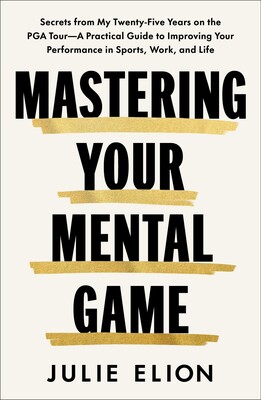
Mastering Your Mental Game
Secrets from My Twenty-Five Years on the PGA Tour—A Practical Guide to Improving Your Performance in Sports, Work, and Life
By Julie Elion
A behind-the-scenes sage of the golf world and renowned mental health coach reveals her methods to achieving elite performance in sports, work, and life, drawing from her experience with top PGA Tour champions.
Hardcover
LIST PRICE $30.00
PRICE MAY VARY BY RETAILER
Get 20% off with code JULY20 plus free shipping on orders of $40 or more. Discount on physical products only. Terms apply.
Buy from Other Retailers
Julie Elion
Julie Elion is the founder of the Center for Athletic Performance Enhancement and has developed one of the premier practices for performance enhancement in golf, sports, and life. She has worked with half of the top ten earners of all time, representing over $500 million in career earnings, 150 PGA Tour wins, and twenty-five major championship wins over the course of her career. As well as working extensively with golfers, Julie provides mental coaching for business executives, athletes, and teams on both the professional and collegiate level, including NBA, NFL, MLB, WNBA, and LPGA athletes.
Get a FREE ebook by joining our mailing list today!
By clicking 'Sign me up' I agree to the Terms of Use and acknowledge the Privacy Policy and Notice of Financial Incentive. Free ebook offer available to NEW US subscribers only. Offer redeemable at Simon & Schuster's ebook fulfillment partner. Must redeem within 90 days. See full terms and conditions and this month's choices.