
Plus, receive recommendations and exclusive offers on all of your favorite books and authors from Simon & Schuster.
0:00 /
LIST PRICE $26.99
PRICE MAY VARY BY RETAILER
Digital products purchased on SimonandSchuster.com must be read on the Simon & Schuster Books app. Learn more.
Get 20% off with code FALL26 plus free shipping on orders of $40 or more. Discount on physical products only. Terms apply.
Buy from Other Retailers
Table of Contents
Listen To An Excerpt
0:00 /
About the Book
Two starred reviews!
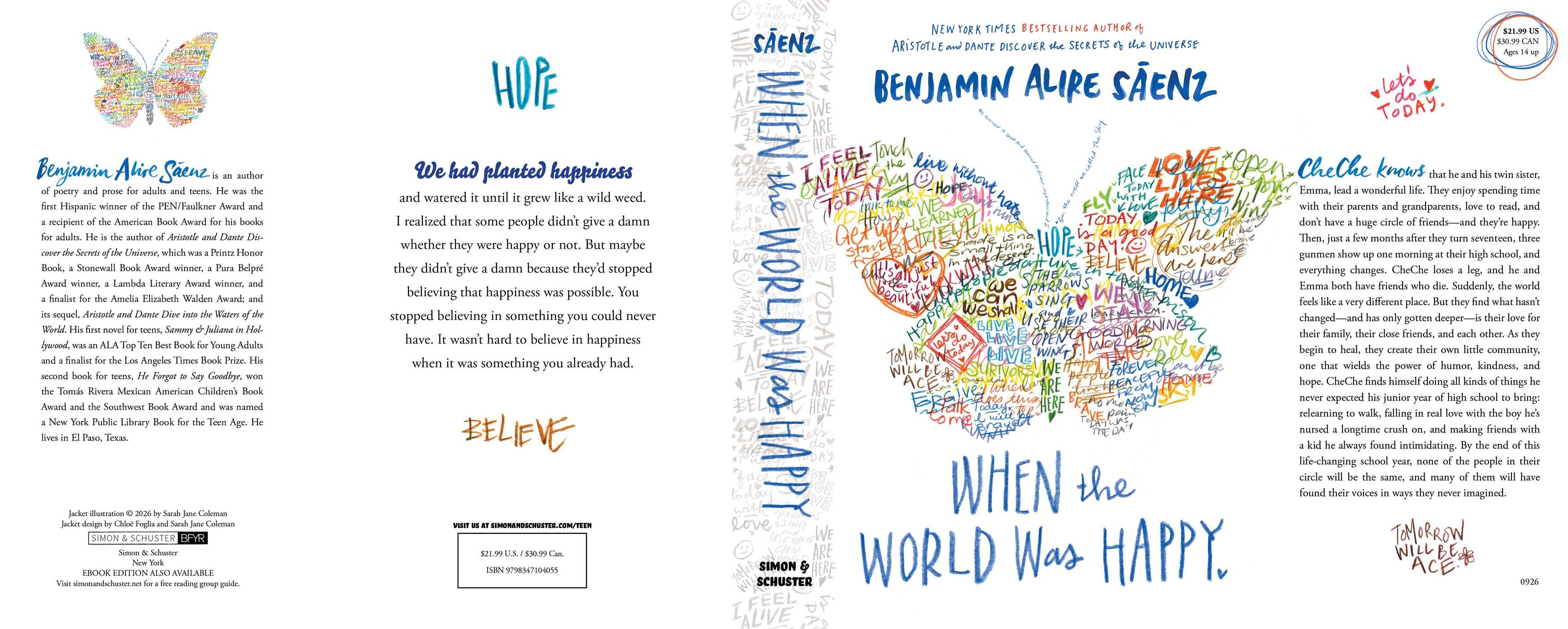
A “heartrending yet beautiful” (School Library Journal, starred review) tale of twins and their group of friends who are forced to navigate life, relationships, and grief after their world is turned upside down from New York Times bestselling and award-winning author Benjamin Alire Sáenz.
CheChe knows that he and his twin sister Emma lead an unusual life. They enjoy spending time with their parents and grandparents, love to read, and don’t have a huge circle of friends—and they’re happy. Then, just a few months after they turn seventeen, three gunmen show up one morning at their El Paso, Texas, high school, and everything changes.
CheChe loses a leg, and both he and Emma have friends who die. Suddenly, the world feels like a very different place. But what they find hasn’t changed—or has only gotten deeper—is their love for their family, their close friends, and one another, and as they begin to heal, they create their own little community, one that wields the power of humor, kindness, and hope.
CheChe finds himself doing all kinds of things he never expected from his junior year: relearning to walk, falling in love with the boy he’s nursed a longtime crush on, making friends with a kid he always found intimidating. By the end of this life-changing school year, none of them will be the same, and many of them will have found their voices in ways they never imagined.
A “heartrending yet beautiful” (School Library Journal, starred review) tale of twins and their group of friends who are forced to navigate life, relationships, and grief after their world is turned upside down from New York Times bestselling and award-winning author Benjamin Alire Sáenz.
CheChe knows that he and his twin sister Emma lead an unusual life. They enjoy spending time with their parents and grandparents, love to read, and don’t have a huge circle of friends—and they’re happy. Then, just a few months after they turn seventeen, three gunmen show up one morning at their El Paso, Texas, high school, and everything changes.
CheChe loses a leg, and both he and Emma have friends who die. Suddenly, the world feels like a very different place. But what they find hasn’t changed—or has only gotten deeper—is their love for their family, their close friends, and one another, and as they begin to heal, they create their own little community, one that wields the power of humor, kindness, and hope.
CheChe finds himself doing all kinds of things he never expected from his junior year: relearning to walk, falling in love with the boy he’s nursed a longtime crush on, making friends with a kid he always found intimidating. By the end of this life-changing school year, none of them will be the same, and many of them will have found their voices in ways they never imagined.
Appearances
OCT 3
1:00PM
In Person
Learn MoreBarnes & Noble - The Fountains at Farah
8889 Gateway Blvd. West, Suite 120
El Paso, TX 79925
Reading Group Guide
Get a FREE audiobook by joining our mailing list today! Plus, receive recommendations for your next Book Club read.
By clicking 'Sign me up' I agree to the Terms of Use and acknowledge the Privacy Policy and Notice of Financial Incentive. Free audiobook offer available to NEW US subscribers only. Offer redeemable at Simon & Schuster's audiobook fulfillment partner. Must redeem within 90 days. See full terms and conditions and this month's choices.
Reading Group Guide
When the World Was Happy
By Benjamin Alire Sáenz
About the Book
Back when the world was happy, CheChe and his twin sister, Emma, lived a charmed life. With an artist father and a librarian mother, they were encouraged to express their creativity, believe in mystery, and celebrate beauty in the world. Above all, their home was one of acceptance and love, for their friends and for themselves. When a mass shooting happens at their high school, shattering their community’s sense of safety and injuring CheChe, he and Emma are forced to confront the reality of hatred and encounter a new landscape of loss, pain, and sadness. The violence touches everyone they know, and they must learn to move beyond their anger and sorrow and find ways to embrace hope, find healing, and live in peace.
Discussion Questions
1. Discuss the author’s choice to capitalize the word “Sad” in the novel’s opening pages. What is the difference between a capitalized word and an uncapitalized word? According to the narrator, what kept “Sad” (with a capital S) away from his family? What helps you prevent sadness?
2. CheChe and Joaquin have a conversation about what is real. Later, CheChe tells his sister, “‘Happy people don’t worry about people who hate them. We don’t live in their prison.’” (p. 11) What do these conversations suggest about the things we choose to give our attention to? Explain his use of a prison as a metaphor. How is worrying what other people think about you like being in a prison?
3. CheChe reflects, “I didn’t think that Emma and I grew up like most children.” (p. 18) How is their family different from other families? How do you think their upbringing impacted them? Reflect on your own childhood. What about the way you were raised are you grateful for? What would you like to do differently if you have your own family one day?
4. What does the expression “my cup runneth over” mean? (p. 74) What makes this an effective image to describe feelings of gratitude? When have you felt the way that CheChe felt after his birthday?
5. When CheChe and Emma are hurt, ill, or sad, their dog Chuy senses they need comfort. Do you agree or disagree with CheChe’s observation that small creatures “‘at times seem to know more about love than we do’”? (p. 80) Explain the reasons for your answer. As an extension, research the role that therapy dogs can play after traumatic events.
6. Paraphrase Nana’s monologue in chapter eighteen of book one. Do you agree with her philosophy that “‘there are things in us that come from someplace outside of us’”? Later, she concludes: “‘There is a reason you are here.’” Do you think everyone has a purpose? Explain your answer.
7. What does CheChe’s mother disagree with the school principal, Mr. Moreno, about? How does she handle this disagreement? What do you think CheChe learns about dealing with conflict from her example?
8. Explain Santiago’s comment, “‘There’s a word that rhymes with mope that we don’t want you to lose. You can live without a right leg, but you can’t live without that one holy word.’” (p. 128) What word is he talking about? Why do you think he says that the word is holy?
9. How do the school and local community respond to the shooting? In particular, what are the rituals of grief they participate in? Do you think any of these rituals are especially helpful? Explain your answer.
10. Why do you think the school board meeting to discuss reopening the school becomes so contentious? If you had been there, what would you have said?
11. Summarize CheChe’s reflections on the word “normalize” (pp. 271–2). Who gets to decide what is normal and what is not? If something has been normalized, does that automatically mean we should accept it? If it has not been normalized, should it be rejected? Explain your answer.
12. What do you think Tata’s riddle means? (p. 282) How does it relate to the themes of the book?
13. After he loses his leg, CheChe must overcome both physical and emotional pain. What helps with his physical pain? What helps with his emotional pain? In your experience, which kind of pain is more difficult to deal with?
14. After all that he has been through, CheChe reflects, “‘In the end, we teach ourselves not to care about other people,’” and then wonders, “‘How do we teach ourselves to care?’” (p. 365) How would you answer his question?
15. What realization does CheChe have at the end of the novel? How do the last words of the book reflect this realization? Did you find the ending satisfying? Explain your answer.
16. Consider the novel’s structure, in particular the way each section begins and ends. How does this help develop the novel’s themes? Pay attention to the patterns of ideas that emerge and build upon one another.
17. After you finish the book, read the author’s note. What does the note reveal about the reason that Benjamin Alire Sáenz wrote this story? What messages do you think he wants the reader to take away from the book? Do you think he accomplished his purpose? Explain your answer.
Extension Activities
1. CheChe says he feels hope again when he watches Spigot and his sister walk together, because their care for each other is beautiful. He reflects, “I felt some hope inside me. I felt hope because I knew there was still so much beauty in the world.” Use his words as a prompt, and create a space similar to Emma and CheChe’s “wall that was the sky” to collect thoughts, poems, and drawings that reveal moments of beauty that you have noticed. If you are doing this with a group, you may want to cover a wall with white paper or use sidewalk chalk to decorate a walkway. Alternatively, you could use a posterboard or even create an online digital space to collect images and words.
2. Emma believes that she can see angels. She tells CheChe, “‘If we stay alert, if we keep our eyes open, we will see things others don’t see. And we’ll doubt ourselves because we have no explanations.’” (p. 23) Have you or one of your family members ever had an experience that you could not explain? If so, write a narrative essay about your experience.
3. During a thunderstorm, CheChe pictures everyone in his family and reflects, “These were the people who I loved and who loved me—and it was their love that kept me safe from the storm even as the storm grew stronger and stronger.” (p. 36) How do his words foreshadow later events? Reflect on the people you love and the people who love you. Write an essay about how they have kept you safe when you faced one of life’s literal or metaphorical storms.
4. Emma, Spigot, and CheChe invent a game called “the game of hard questions” (pp. 38–40). Create your own version of this game by writing different philosophical and open-ended questions on cards and then answering them with a group of friends or classmates.
5. CheChe describes a summer “of discovering who you really were. And who you weren’t,” and then comments, “That was what summers were for, wasn’t it?” (p. 44) Write a narrative about an experience that you had during the summer that helped you discover who you really are (and who you are not). What happened, and what did you learn about yourself as a result?
6. On page 48, CheChe notes, “My mother believed that our politics and the things we believed in (or didn’t believe in) were shaped by the things that happened around us.” Her words reflect a truth about rhetorical strategies: personal narratives and testimonies are among the most effective forms of persuasion. Write a persuasive essay about one of your beliefs using a personal experience you had to bring others to your point of view.
7. Joaquin tells CheChe that “‘Everybody’s a book.’” (p. 74) What does this metaphor suggest about people? Create a visual “Book of You.” Design the cover and include sections on the inside that tell your story; for example, you could include a page of things you love, a playlist of music that reflects who you are, a gratitude list, a section with your dreams or hopes for the future, your beliefs, and your history. Feel free to use illustrations as well as words to tell your story.
8. After the school shooting and loss of his leg, CheChe must work through his grief. Research the stages of grief and analyze how the novel portrays CheChe’s experience of each stage, using textual evidence to illustrate how he moves through each of the five stages.
9. CheChe’s mother reluctantly agrees to an interview about her experience during the shooting at her school and proceeds to share statistics about guns. (pp. 165–167) What do you think should be done to reduce gun violence in schools? Research the issue, and write a persuasive essay that includes details and statistics to support your position.
10. Grief leaves CheChe feeling “like a fragment of a person,” and one of the ways he processes that grief is through poetry, including fragments of poetry. Why poetry? Consider what poetry can do that other forms of language cannot: how it works in images rather than explanations, how it can hold contradiction and incompleteness, how a fragment can sometimes say more than a finished thought. Search the Poetry Foundation website (https://poetryfoundation.org) for a poem on one of these themes: war, loss, grief, or trauma. Write a poetry explication that explores not just what the poem means, but what makes poetry the right medium for this kind of experience.
Note: Page numbers refer to the hardcover edition of this title.
Guide prepared by Amy Jurskis, English Department Chair at Oxbridge Academy.
The websites referenced above are provided for informational purposes only and are not intended as an endorsement or promotion of any website. Simon & Schuster is not responsible for the functionality or content of any external website and expressly disclaims all responsibility and liability in connection therewith.
This guide has been provided by Simon & Schuster for classroom, library, and reading group use. It may be reproduced in its entirety or excerpted for these purposes. For more Simon & Schuster guides and classroom materials, please visit simonandschuster.net/m/prek12-teachers-librarians/teaching-resources.
When the World Was Happy
By Benjamin Alire Sáenz
About the Book
Back when the world was happy, CheChe and his twin sister, Emma, lived a charmed life. With an artist father and a librarian mother, they were encouraged to express their creativity, believe in mystery, and celebrate beauty in the world. Above all, their home was one of acceptance and love, for their friends and for themselves. When a mass shooting happens at their high school, shattering their community’s sense of safety and injuring CheChe, he and Emma are forced to confront the reality of hatred and encounter a new landscape of loss, pain, and sadness. The violence touches everyone they know, and they must learn to move beyond their anger and sorrow and find ways to embrace hope, find healing, and live in peace.
Discussion Questions
1. Discuss the author’s choice to capitalize the word “Sad” in the novel’s opening pages. What is the difference between a capitalized word and an uncapitalized word? According to the narrator, what kept “Sad” (with a capital S) away from his family? What helps you prevent sadness?
2. CheChe and Joaquin have a conversation about what is real. Later, CheChe tells his sister, “‘Happy people don’t worry about people who hate them. We don’t live in their prison.’” (p. 11) What do these conversations suggest about the things we choose to give our attention to? Explain his use of a prison as a metaphor. How is worrying what other people think about you like being in a prison?
3. CheChe reflects, “I didn’t think that Emma and I grew up like most children.” (p. 18) How is their family different from other families? How do you think their upbringing impacted them? Reflect on your own childhood. What about the way you were raised are you grateful for? What would you like to do differently if you have your own family one day?
4. What does the expression “my cup runneth over” mean? (p. 74) What makes this an effective image to describe feelings of gratitude? When have you felt the way that CheChe felt after his birthday?
5. When CheChe and Emma are hurt, ill, or sad, their dog Chuy senses they need comfort. Do you agree or disagree with CheChe’s observation that small creatures “‘at times seem to know more about love than we do’”? (p. 80) Explain the reasons for your answer. As an extension, research the role that therapy dogs can play after traumatic events.
6. Paraphrase Nana’s monologue in chapter eighteen of book one. Do you agree with her philosophy that “‘there are things in us that come from someplace outside of us’”? Later, she concludes: “‘There is a reason you are here.’” Do you think everyone has a purpose? Explain your answer.
7. What does CheChe’s mother disagree with the school principal, Mr. Moreno, about? How does she handle this disagreement? What do you think CheChe learns about dealing with conflict from her example?
8. Explain Santiago’s comment, “‘There’s a word that rhymes with mope that we don’t want you to lose. You can live without a right leg, but you can’t live without that one holy word.’” (p. 128) What word is he talking about? Why do you think he says that the word is holy?
9. How do the school and local community respond to the shooting? In particular, what are the rituals of grief they participate in? Do you think any of these rituals are especially helpful? Explain your answer.
10. Why do you think the school board meeting to discuss reopening the school becomes so contentious? If you had been there, what would you have said?
11. Summarize CheChe’s reflections on the word “normalize” (pp. 271–2). Who gets to decide what is normal and what is not? If something has been normalized, does that automatically mean we should accept it? If it has not been normalized, should it be rejected? Explain your answer.
12. What do you think Tata’s riddle means? (p. 282) How does it relate to the themes of the book?
13. After he loses his leg, CheChe must overcome both physical and emotional pain. What helps with his physical pain? What helps with his emotional pain? In your experience, which kind of pain is more difficult to deal with?
14. After all that he has been through, CheChe reflects, “‘In the end, we teach ourselves not to care about other people,’” and then wonders, “‘How do we teach ourselves to care?’” (p. 365) How would you answer his question?
15. What realization does CheChe have at the end of the novel? How do the last words of the book reflect this realization? Did you find the ending satisfying? Explain your answer.
16. Consider the novel’s structure, in particular the way each section begins and ends. How does this help develop the novel’s themes? Pay attention to the patterns of ideas that emerge and build upon one another.
17. After you finish the book, read the author’s note. What does the note reveal about the reason that Benjamin Alire Sáenz wrote this story? What messages do you think he wants the reader to take away from the book? Do you think he accomplished his purpose? Explain your answer.
Extension Activities
1. CheChe says he feels hope again when he watches Spigot and his sister walk together, because their care for each other is beautiful. He reflects, “I felt some hope inside me. I felt hope because I knew there was still so much beauty in the world.” Use his words as a prompt, and create a space similar to Emma and CheChe’s “wall that was the sky” to collect thoughts, poems, and drawings that reveal moments of beauty that you have noticed. If you are doing this with a group, you may want to cover a wall with white paper or use sidewalk chalk to decorate a walkway. Alternatively, you could use a posterboard or even create an online digital space to collect images and words.
2. Emma believes that she can see angels. She tells CheChe, “‘If we stay alert, if we keep our eyes open, we will see things others don’t see. And we’ll doubt ourselves because we have no explanations.’” (p. 23) Have you or one of your family members ever had an experience that you could not explain? If so, write a narrative essay about your experience.
3. During a thunderstorm, CheChe pictures everyone in his family and reflects, “These were the people who I loved and who loved me—and it was their love that kept me safe from the storm even as the storm grew stronger and stronger.” (p. 36) How do his words foreshadow later events? Reflect on the people you love and the people who love you. Write an essay about how they have kept you safe when you faced one of life’s literal or metaphorical storms.
4. Emma, Spigot, and CheChe invent a game called “the game of hard questions” (pp. 38–40). Create your own version of this game by writing different philosophical and open-ended questions on cards and then answering them with a group of friends or classmates.
5. CheChe describes a summer “of discovering who you really were. And who you weren’t,” and then comments, “That was what summers were for, wasn’t it?” (p. 44) Write a narrative about an experience that you had during the summer that helped you discover who you really are (and who you are not). What happened, and what did you learn about yourself as a result?
6. On page 48, CheChe notes, “My mother believed that our politics and the things we believed in (or didn’t believe in) were shaped by the things that happened around us.” Her words reflect a truth about rhetorical strategies: personal narratives and testimonies are among the most effective forms of persuasion. Write a persuasive essay about one of your beliefs using a personal experience you had to bring others to your point of view.
7. Joaquin tells CheChe that “‘Everybody’s a book.’” (p. 74) What does this metaphor suggest about people? Create a visual “Book of You.” Design the cover and include sections on the inside that tell your story; for example, you could include a page of things you love, a playlist of music that reflects who you are, a gratitude list, a section with your dreams or hopes for the future, your beliefs, and your history. Feel free to use illustrations as well as words to tell your story.
8. After the school shooting and loss of his leg, CheChe must work through his grief. Research the stages of grief and analyze how the novel portrays CheChe’s experience of each stage, using textual evidence to illustrate how he moves through each of the five stages.
9. CheChe’s mother reluctantly agrees to an interview about her experience during the shooting at her school and proceeds to share statistics about guns. (pp. 165–167) What do you think should be done to reduce gun violence in schools? Research the issue, and write a persuasive essay that includes details and statistics to support your position.
10. Grief leaves CheChe feeling “like a fragment of a person,” and one of the ways he processes that grief is through poetry, including fragments of poetry. Why poetry? Consider what poetry can do that other forms of language cannot: how it works in images rather than explanations, how it can hold contradiction and incompleteness, how a fragment can sometimes say more than a finished thought. Search the Poetry Foundation website (https://poetryfoundation.org) for a poem on one of these themes: war, loss, grief, or trauma. Write a poetry explication that explores not just what the poem means, but what makes poetry the right medium for this kind of experience.
Note: Page numbers refer to the hardcover edition of this title.
Guide prepared by Amy Jurskis, English Department Chair at Oxbridge Academy.
The websites referenced above are provided for informational purposes only and are not intended as an endorsement or promotion of any website. Simon & Schuster is not responsible for the functionality or content of any external website and expressly disclaims all responsibility and liability in connection therewith.
This guide has been provided by Simon & Schuster for classroom, library, and reading group use. It may be reproduced in its entirety or excerpted for these purposes. For more Simon & Schuster guides and classroom materials, please visit simonandschuster.net/m/prek12-teachers-librarians/teaching-resources.
About the Author
Photograph by Vantage Point Studios
Benjamin Alire Sáenz (1954–2026) was an author of poetry and prose for adults and teens. He was the first Hispanic winner of the PEN/Faulkner Award and a recipient of the American Book Award for his books for adults. He was the author of Aristotle and Dante Discover the Secrets of the Universe, which was a Printz Honor Book, the Stonewall Award winner, the Pura Belpré Award winner, the Lambda Literary Award winner, and a finalist for the Amelia Elizabeth Walden Award, and its sequel, Aristotle and Dante Dive into the Waters of the World. His first novel for teens, Sammy and Juliana in Hollywood, was an ALA Top Ten Book for Young Adults and a finalist for the Los Angeles Times Book Prize. His second book for teens, He Forgot to Say Goodbye, won the Tomás Rivera Mexican American Children’s Book Award, the Southwest Book Award, and was named a New York Public Library Book for the Teen Age. He lived in El Paso, Texas.
About the Reader
Product Details
- Publisher: Simon & Schuster Audio (September 29, 2026)
- Runtime: 10 hours and 55 minutes
- ISBN13: 9781668185834
- Grades: 9 and up
- Ages: 14 - 99
Browse Related Books
Resources and Downloads
High Resolution Images
-
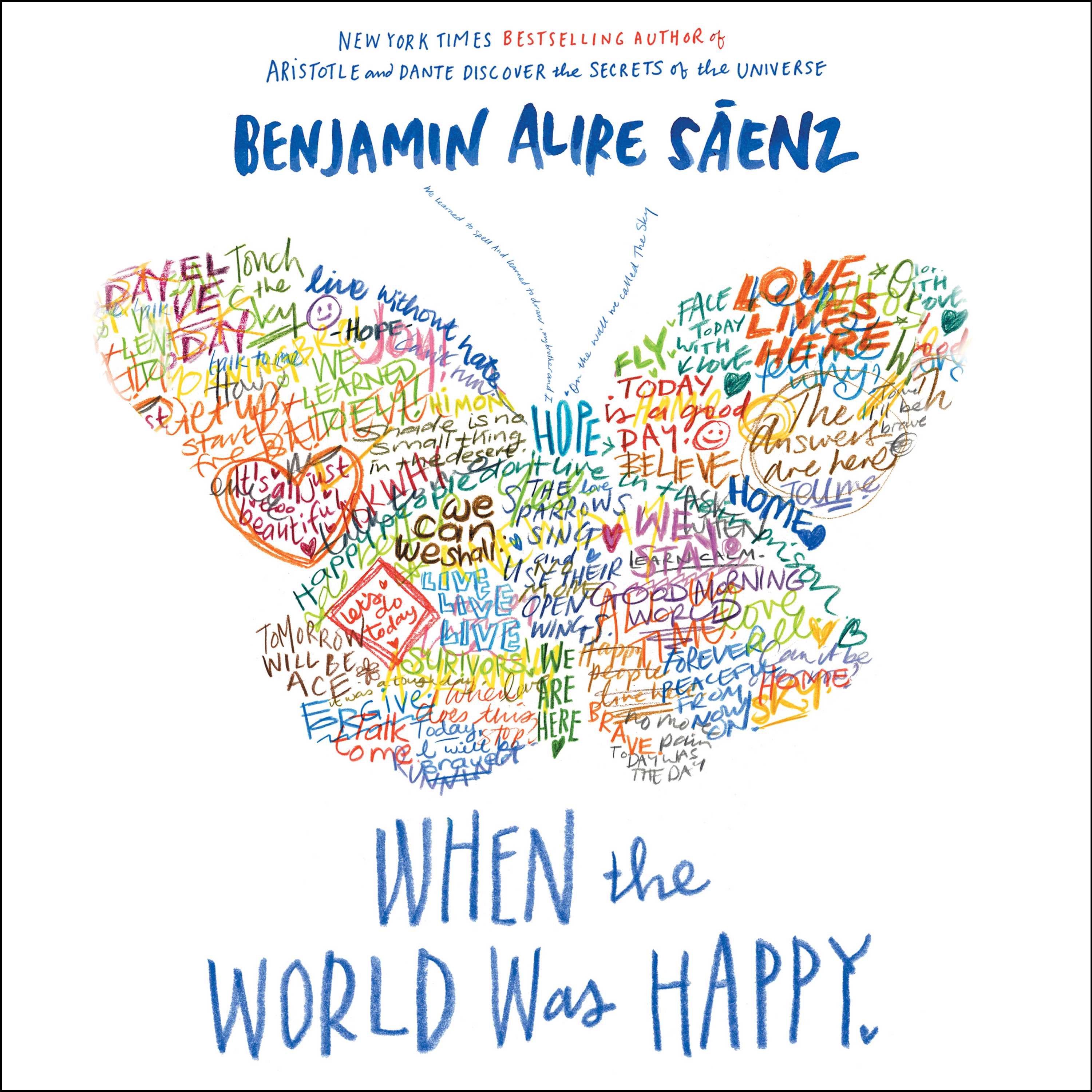
Book Cover Image (jpg): When the World Was Happy
Unabridged Audio Download 9781668185834
-
Author Photo (jpg): Benjamin Alire Sáenz Photograph by Vantage Point Studios(0.1 MB)
Any use of an author photo must include its respective photo credit