

Plus, receive recommendations and exclusive offers on all of your favorite books and authors from Simon & Schuster.
0:00 /
LIST PRICE $20.00
PRICE MAY VARY BY RETAILER
Free shipping when you spend $40. Terms apply.
Buy from Other Retailers
Table of Contents
About the Book
From the coauthor of the New York Times bestseller Notorious RBG and award-winning journalist Irin Carmon, an ambitious and “gripping page-turner” (The Boston Globe) of what’s gone wrong with pregnancy in America, through the lens of history, politics, and the searing experiences of five women.
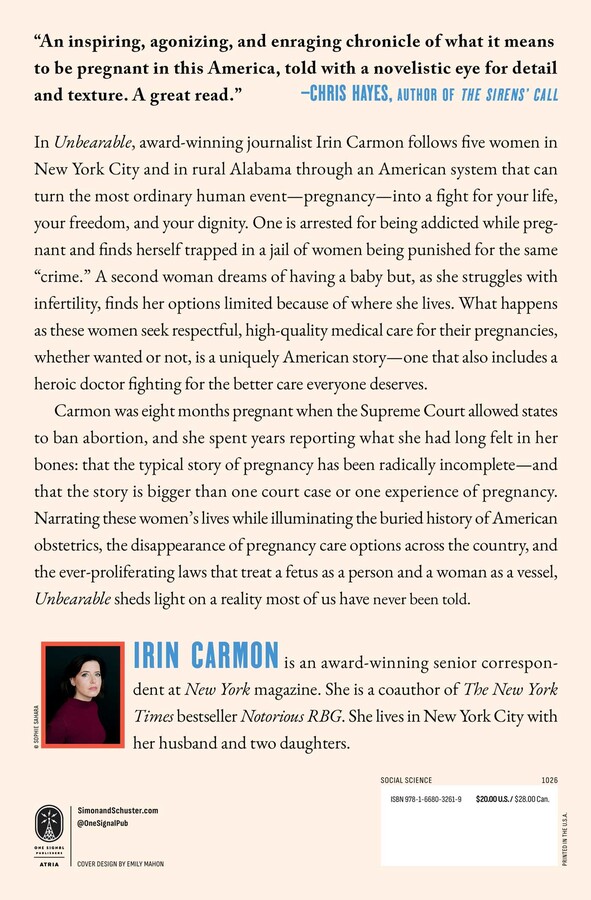
Award-winning journalist Irin Carmon follows five women in New York City and rural Alabama through an American system that can turn the most ordinary human event—pregnancy—into a fight for your life, your freedom, and your dignity. What happens as these women seek respectful, high-quality medical care for their pregnancies, whether wanted or not, is a uniquely American story, one that also includes a heroic doctor fighting for the better reality that everyone deserves.
Eight months pregnant herself when the Supreme Court allowed states to ban abortion, Carmon spent years reporting what she felt in her bones: that the typical story of pregnancy had been radically incomplete—and that the story is bigger than one court case or one experience of pregnancy. Going beyond the headlines and any one experience or choice, Unbearable illuminates the buried history of American obstetrics, the disappearance of pregnancy care options across the country, and the ever-proliferating laws that treat a fetus as a person and a woman as a vessel.
A profound call to action, “Unbearable exposes the devastating reality: that in today’s America becoming pregnant can mean losing your basic human dignity and autonomy. With meticulous reporting, riveting storytelling, and profound compassion, Carmon reveals how our healthcare system fails women at their most vulnerable moments, and why we must do better” (Hillary Rodham Clinton).
Appearances
OCT 21
7:00PM
In Person
Irin Carmon
Irin Carmon will speak to a book club focused on reproductive rights at Picture Book.
Learn MorePicture Book
145 Palisade Street
Suite 200
Dobbs Ferry, NY 10522
Reading Group Guide
Get a FREE ebook by joining our mailing list today! Plus, receive recommendations for your next Book Club read.
By clicking 'Sign me up' I agree to the Terms of Use and acknowledge the Privacy Policy and Notice of Financial Incentive. Free ebook offer available to NEW US subscribers only. Offer redeemable at Simon & Schuster's ebook fulfillment partner. Must redeem within 90 days. See full terms and conditions and this month's choices.
Introduction
One day, at a preschool parents meet and greet for a new school, journalist Irin Carmon was asked politely about the book she was writing, and she replied vaguely that it was about how America treated pregnant women. Then she added, “Like you’re a child.” The mothers around her responded eagerly: “Like an animal,” said one, and another said vehemently, “Like a child-animal.” Carmon didn’t know it yet, but one of these women, Maggie, would be a major character in Unbearable, but it was already clear at that moment that just about everywhere she went, people who had been pregnant — even when they wanted to be — had felt failed and dehumanized by the system that was supposed to care for them. In the wake of the Supreme Court’s Dobbs decision, she sets out to understand why being treated like a “child animal” cuts across so many pregnancy experiences.
In Unbearable, Carmon traces the lives of five women across New York City and Alabama. Maggie, a Canadian stunned by the greed and cruelty of the American healthcare system, is searching for an alternative. Christine, who has worked mightily to create a stable home for her kids that she never got herself, arrives at her neighborhood public hospital with full knowledge of how America treats mothers. Hali, living in the rural Alabama county that leads the nation in pregnancy-related arrests, fears what a failed drug screen will mean. Alison, a queer civil rights lawyer, is desperate to become pregnant even as Alabama is cracking down on fertility care. And Dr. Yashica Robinson, no longer able to provide legal abortions to Alabamians, is fighting for better birth options for the patients left behind.
Unbearable weaves together their stories with the history of American obstetrics, from J. Marion Sims’s experiments on enslaved women to the nineteenth-century physicians’ crusade against abortion and midwives, Carmon shows how deeply linked different experiences of reproduction are, and how the categories of good and bad pregnancies have been used to divide people who share a common cause: safety, health, and autonomy over their own lives. Unbearable is an urgent reckoning with what it means to be pregnant in America, a spotlight on the people fighting for something better, and a call to imagine a country where everyone is treated as a full person before, during, and after a pregnancy.
Topics & Questions for Discussion
Introduction
1. Carmon opens with an ultrasound technician telling her fetus, “You were a person from day one,” and then describes how she answered Justice Alito’s draft opinion in Dobbs with a week-by-week account of what pregnancy was doing to her body. Why do you think she chose to begin this way? How does her “calendar of humanity” change the way you think about pregnancy?
2. In the book, Tressie McMillan Cottom observes that being mistreated in pregnancy and birth can “pierce the class veil” because it humbles even privileged people. Does that phrase resonate with your own experiences or those of people you know? How did different kinds of privilege help or not help the individuals described in the book?
Part One: Life at Conception
3. Carmon describes how the line of when someone is considered pregnant shifted in history with technology and social change, including sociologist Miranda Waggoner’s idea of the “Zero Trimester,” in which even people who aren’t pregnant are supposed to act like they imminently could be. Have you encountered this expectation? Did you find yourself re-evaluating what you might have previously expected of a pregnant person’s behavior?
4. Before we see any of the women pregnant, Carmon shows us who they were: Christine’s warmth and openness despite the harsh realities of her childhood; Yashica trying on the EMT’s stethoscope; Alison’s surprising path to Alabama. Why do you think she begins with these origin stories? Which woman did you feel closest to by the end of Part One, and why?
Part Two: Taking Care
5. What was your reaction to learning more about the history of J. Marion Sims and the enslaved women he experimented on, Anarcha, Lucy, and Betsey, if you weren’t already familiar with it? How do you think these historical facts bear on today’s experience of medicine?
6. Carmon traces how nineteenth-century doctors built their profession at the expense of access to abortion and to midwifery care. She also writes about the irony that Alabama effectively banned midwifery in 1976, just as white, middle-class women were “discovering” it through books like Spiritual Midwifery. How did this history shape the care options available to Maggie, Christine, and Yashica’s patients? Did this account of midwifery resonate with you? Why or why not?
7. Yashica is baffled when patients ask whether she will “let” them move around during labor, or when they’re afraid to ask for their medical records. And Alison feels judged and dismissed by doctors both because of her childhood history and her queer identity. Did you relate to these experiences? Has a medical provider ever made you feel like you didn’t deserve to make a decision for yourself?
8. Helena Grant changed the signs at Woodhull to read Labor & Birth rather than Delivery, and she prefers “cesarean birth” to “C-section.” Does the language of birth matter? Was there a point in your life where how things were named changed how you experienced them?
Part Three: How Pregnancy Ends
10. Legal activist Lynn Paltrow tells Carmon that when women like Hali are arrested and jailed for positive drug tests while pregnant, they’re being targeted because they’re pregnant, not for their behavior. Do you agree? How did Hali’s story make you feel? How did shifting ideas about whether addiction is a “choice” shape your reaction to her experience?
11. Although Hali is white, reproductive justice scholars cited by Carmon note that she was a victim of policies that were, in Dorothy Roberts’s words, “tested on Black mothers first” and then expanded.. By the time of the Alabama Supreme Court’s ruling on “extrauterine children,” which banned IVF and built on legal precedent involving pregnant drug users, how had Roberts’s warning come true even more broadly? Why do you think IVF patients won a legislative fix when women like Hali did not? What is your reaction to the increasing politicization of IVF?
12. In jail, Hali and her cellmates call themselves the “chemical crew,” get matching tattoos, and watch a mother cat lead her kittens across the parking lot. What role does solidarity among women play in this book, from the jail cell to the courtroom to the protests outside Woodhull?
13. Kirsten Clark grew up tabling for anti-abortion groups and ended up training as an abortion doula. What did you make of her changing her mind? Have you changed your mind about an aspect of pregnancy, and what changed it for you?
14. In a courthouse elevator, a lawyer for the state asks Carmon whether she is focusing on “the fetal outcome part of it” or “mainly focusing on the mom.” Carmon replies, “But they’re interconnected, aren’t they?” Why is framing pregnant women and fetuses as opponents so powerful? Where else in the book do you see it at work?
Part Four: After
15. The same surgeon operated on Maggie and on Christine, about four years apart, with strikingly similar errors. Both of their partners screamed for help, but only Christine’s partner Jose had security called on him. Who or what do you hold responsible for what happened to Christine?
16. Maggie calls her abortion at Planned Parenthood “the best prenatal care I’ve had,” and her second birth at a private hospital unfolds very differently than her experience at Woodhull. What do you think accounted for the differences in treatment?
17. After Christine’s death, Jose becomes a community advocate and whistleblower. Several people in this book, including Jose, Yashica and Alison, turn personal experiences into advocacy. What drives them? What does it cost them?
18. Carmon is present throughout the book, both in her personal experiences of pregnancy and postpartum and in her interactions with the characters on the ground. How did her presence affect your reading? What does it add or take away to tell these stories alongside her own?
Conclusion
19. P. Mimi Bhatt tells Carmon that midwifery's outcomes aren't magic, but rather time spent with patients and, as Carmon observes, “time is a value that is given to people who matter to us.” Which people in this book were given time, and which were not? What would it take for everyone to receive it?
20. Carmon writes that “control” means different things to different people, from self-determination to feeling safe and respected, and she lists the policies she believes would make pregnancy better for everyone. What would control mean to you? Which changes do you think matter most? By the end of the book, what does its title mean to you? What do you think is unbearable about pregnancy in America?
Enhance Your Book Club
1. Carmon draws on a rich tradition of writing about reproduction, from Adrienne Rich’s Of Woman Born to Dorothy Roberts’s Killing the Black Body, Deirdre Cooper Owens’s work on the enslaved women who became the “mothers of gynecology,” and Michele Goodwin’s Policing the Womb. Have members each read one of these books, or a selection from it, and share with the group how it deepens or complicates what they learned from Unbearable.
2. In Montgomery, Carmon meets a man born at home with a midwife because the hospital three blocks away wouldn’t take his mother, and a judge who mentions that his grandmother was a midwife. Consider asking the older people in your life about their pregnancy experiences. Who cared for them and how did they feel about that? How has pregnancy care changed across generations, and what has been lost or gained?
3. As a group, research what pregnancy care looks like where you live. What does access to abortion look like now? What about midwifery? Is your community a safe place to give birth, and safe for whom? Discuss what you uncover, and consider inviting a local midwife, doula, or reproductive justice organizer to join your conversation
About the Author
Photograph © Sophie Sahara
Irin Carmon is an award-winning senior correspondent at New York magazine, where she covers gender, law, politics, and more. Previously, she was a CNN contributor, a contributing writer to The Washington Post’s “Outlook”, a national reporter at MSNBC and NBC News, and a staff writer at Salon and Jezebel. She is the author of Unbearable and the coauthor of the New York Times bestseller Notorious RBG. She lives in New York City with her husband and two daughters. Find out more at IrinCarmon.com.
Product Details
- Publisher: Atria/One Signal Publishers (October 20, 2026)
- Length: 320 pages
- ISBN13: 9781668032619
Browse Related Books
Raves and Reviews
“Although her topic is steeped in both joy and anguish, Carmon's writing remains remarkably objective, inspiring a commitment to work for reproductive rights and celebrate those who already do.”
—Cheryl McKeon, Book House of Stuyvesant Plaza, Albany, N.Y., ShelfAwareness
“A magnificent book that I was blown away by—the deep reporting, the incisive political analysis, and most of all the stories that Irin tells that moved me to enraged tears.”
—Kate Mann, author of Unshrinking
“A gripping page-turner: revelatory, horrifying, infuriating, sometimes inspirational, always informative….Required reading.”
—Rebecca Steinitz, The Boston Globe
“This disquieting exposé reveals the inadequacy of maternal healthcare in the U.S….Carmon presents a vision of a healthcare system where ‘no matter who you are, or what privileges you enjoy, nothing can guarantee your personal safety or security.’ A passionate and potent wake up call.”
—Publishers Weekly
“Unbearable exposes the devastating reality: that in today's America becoming pregnant can mean losing your basic human dignity and autonomy. With meticulous reporting, riveting storytelling, and profound compassion, Irin Carmon reveals how our healthcare system fails women at their most vulnerable moments, and why we must do better.”
–Hillary Rodham Clinton
“Carmon's empathetic profiles of the women effortlessly blend in history, politics, and social context, recreating scenarios that jump from New York City to Alabama, urban to rural, poverty to comparative wealth…. Carmon, who was pregnant herself while writing this searing indictment of the absence of autonomy for pregnant women, weaves in her own story with effective poignancy.”
—Kathleen McBroom, Booklist (starred review)
"In Unbearable, Irin Carmon does the urgent work of chronicling the challenges facing America's pregnant people and reproductive healthcare providers as they seek the resources, attention and protections they require. Carmon treats the stories of pregnancy—stories marked by hope, expansion, restriction, grief, fury and love—with tenderness and respect. It shouldn't be so astonishing to read about those laboring to bring forth another generation as fully human and therefore worthy of better policy and more accessible care, but it is. To crib from Carmon's own description of pregnancy itself, Unbearable is by turns euphoric and excruciating, above all a radical call for a brighter and more dignified future for people and their families."
—Rebecca Traister, New York Times bestselling author of Good and Mad
"An inspiring, agonizing, and enraging chronicle of what it means to be pregnant in this America, told with a novelistic eye for detail and texture. A great read."
–Chris Hayes, author of The Sirens’ Call
“In Unbearable, Irin Carmon draws on journalistic rigor, historical insight, and the powerful stories of five women from different walks of life to expose how intensifying fetal protection policies deny women’s autonomy and assault their humanity. With a holistic view of our reproductive lives, she reveals the deep, often overlooked connections between policies that turn pregnant bodies into political battlegrounds. This is essential reading for anyone committed to reproductive justice and building a more humane, compassionate world.”
–Dorothy Roberts, author of Killing the Black Body and Torn Apart
“Every once in a while, a book comes along that shifts the way we see something we thought we already understood. With intellectual rigor, fierce clarity and uncommon empathy, Unbearable, is one of those books. In the process of writing about the lives of five women in America, Irin Carmon reveals the urgency of understanding every pregnancy as a matter of our politics.”
—Soraya Chemaly, author of Rage Becomes Her and All We Want Is Everything
“Pregnancy and childbearing may be the oldest things human beings do, but Carmon tells a new and bracing story of what pregnancies actually cost those who carry them in a nation that values women very little. Wrenching, deeply reported, and particularly urgent in an era of abortion bans, I wish Unbearable was required reading for every lawmaker, every voter, and every person in America.”
–Jill Filipovic, author of OK Boomer
“Irin Carmon has written a deeply nuanced and moving book that is both a painful reality check and a love letter to women left behind and rendered invisible in the wake of the Supreme Court overturning Roe v. Wade. Unbearable breaks the silence on the tragic perils of pregnancy in America.”
—Michele Bratcher Goodwin, author of Policing the Womb
“Irin Carmon brings together powerful and intimate stories of people navigating the spectrum of pregnancy in America. From racial biases and restrictive laws, these narratives describe the deeply fraught system that makes being pregnant anything but easy or safe. Unbearable reminds us that we are not alone and that when we stand up for the pregnant people and their families, we make the world better for all of us.”
—Meera Shah, Chief Medical Officer of Planned Parenthood Hudson Peconic and author of You’re the Only One I’ve Told
Resources and Downloads
High Resolution Images
-
Book Cover Image (jpg): Unbearable
Trade Paperback 9781668032619
-
Author Photo (jpg): Irin Carmon Photograph © Sophie Sahara(0.1 MB)
Any use of an author photo must include its respective photo credit