Plus, receive recommendations and exclusive offers on all of your favorite books and authors from Simon & Schuster.
Published by High Road Books
Distributed by Simon & Schuster
LIST PRICE $27.95
PRICE MAY VARY BY RETAILER
Free shipping when you spend $40. Terms apply.
Buy from Other Retailers
Table of Contents
About the Book
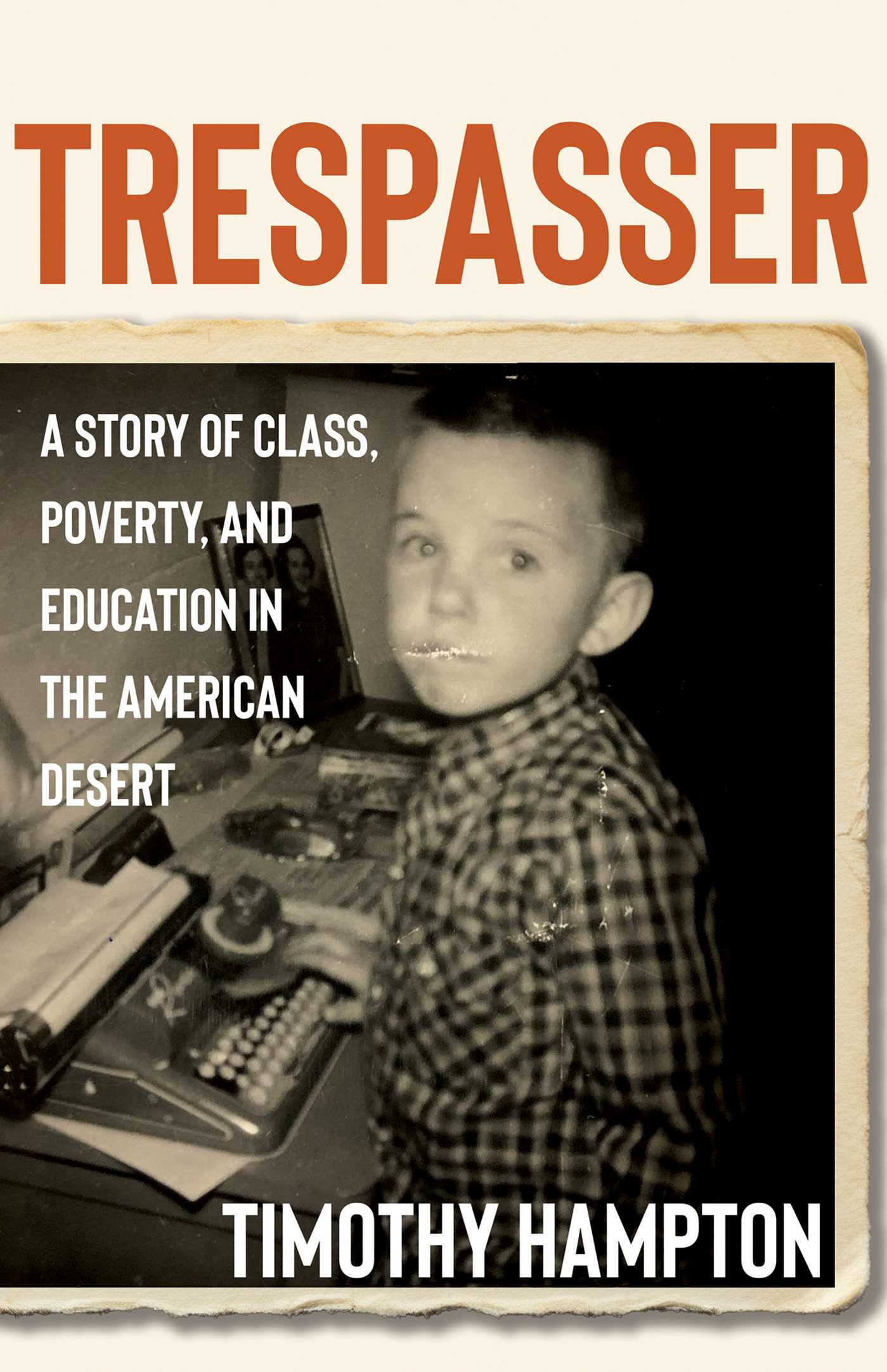
Through the adventures of a poor rural student navigating the world of higher education, Trespasser brings to life the struggles faced by poor folk who rise through the social system—and reveals the hidden barriers faced by working-class students in elite institutions.
Timothy Hampton grew up poor in a small petroleum town in the Four Corners region of the American Southwest, surrounded by the Navajo, Ute, and Jicarilla Apache Nations. The son of a disabled father with deep roots in the region, Hampton came of age in a world shaped by hardship, instability, and life on the “wrong side of the tracks.” Education offered an unexpected way out.
In Trespasser: A Story of Class, Poverty, and Education in the American Desert, Hampton traces his journey from rural New Mexico to the halls of Princeton, Yale, and Berkeley, where he reshaped himself into a distinguished scholar of comparative literature. Blending memoir, cultural history, and sharp social critique, Hampton explores how an education rooted in the humanities bridged the vast divide between the mythologized American West of his childhood and the rarefied world of elite higher education.
But Trespasser is more than a personal story of success against daunting obstacles. A powerful meditation on class in America—an issue often forgotten in contemporary debates about identity—Trespasser moves with wit and precision to argue that class inequality remains a harsh feature of the nation’s unfinished promise of opportunity.
At once intimate and incisive, Trespasser is a deeply American story about the values of a liberal education, economic mobility, and what we lose by leaving behind those whose lives have been shaped by poverty.
Timothy Hampton grew up poor in a small petroleum town in the Four Corners region of the American Southwest, surrounded by the Navajo, Ute, and Jicarilla Apache Nations. The son of a disabled father with deep roots in the region, Hampton came of age in a world shaped by hardship, instability, and life on the “wrong side of the tracks.” Education offered an unexpected way out.
In Trespasser: A Story of Class, Poverty, and Education in the American Desert, Hampton traces his journey from rural New Mexico to the halls of Princeton, Yale, and Berkeley, where he reshaped himself into a distinguished scholar of comparative literature. Blending memoir, cultural history, and sharp social critique, Hampton explores how an education rooted in the humanities bridged the vast divide between the mythologized American West of his childhood and the rarefied world of elite higher education.
But Trespasser is more than a personal story of success against daunting obstacles. A powerful meditation on class in America—an issue often forgotten in contemporary debates about identity—Trespasser moves with wit and precision to argue that class inequality remains a harsh feature of the nation’s unfinished promise of opportunity.
At once intimate and incisive, Trespasser is a deeply American story about the values of a liberal education, economic mobility, and what we lose by leaving behind those whose lives have been shaped by poverty.
Excerpt
Prologue
The Light in My Eyes
A student in a dark jacket and tie ushered me to my place in a folding chair on the stage. I set a notebook next to my feet and looked up. I couldn’t see a thing. I was in a large theater filled with distinguished guests, but they were hidden in darkness behind a row of spots at the edge of the stage. No chance to find a familiar face who could calm my nerves.
I was there, along with two colleagues, to receive an award for teaching at the University of California at Berkeley. The award took me by surprise. Berkeley is a massive university with hundreds of professors and lecturers. In terms of sheer brain power, it’s probably the greatest university in the world. Its scientists birthed the nuclear age and cracked the genome; its engineers helped found Silicon Valley; its scholars revolutionized the study of society and art. The place is full of big shots. You can’t walk across campus without falling over a Nobel Prize winner in something. I had slipped into a job there a few years earlier and had gained tenure by writing a couple of books about literature.
At this high-octane university in a famously liberal town, I felt rootless, like a seasonal ranch hand or a contract worker. Certainly not like a prize winner. And anyway, I was a strange candidate for recognition. I work in an area that is decidedly outside the power centers. I teach literature written in the Romance languages—French, Italian, Spanish, Portuguese, even some Latin. My classes involve me sitting with small groups of young people from beach towns and suburbs, wading through poems written centuries ago. When I was nominated for the prize, the Faculty Senate asked me for a statement about my philosophy of teaching. They wanted something for their Web page, to impress alumni donors. An hour before their deadline I coughed up a few sentences in which I described my teaching as “a form of stumbling.” “My students and I learn best when we are off balance, groping around.” It was all I could offer, given the circumstances, and not very reassuring as a manifesto for higher education.
After a welcome by the chancellor of the university, we were each introduced and asked to speak. I listened with admiration as my two colleagues talked about their own paths, about the inspiring examples of their parents and teachers, or the encouragement they got from their families. Then it was my turn.
I had written two paragraphs on a sheet of paper, pointing out that Berkeley inspires America, and that our students shape the future. But as I looked down at my page, I could see that these were fake words, automatic words, words I had written under duress. They had nothing to do with me. So, I set my paper aside and tried to improvise.
“The only thing I can think to say,” I began, “is that I wouldn’t be here—or anywhere near here—without the gift of public education. I was raised in a tiny town in New Mexico, isolated in the desert. We had basically two streets and one spotlight.” When I said “spotlight” the crowd laughed. I took a breath, blinked the glare out of my eyes. “Excuse me. I meant to say, ‘one stoplight,’ not ‘one spotlight.’” Suddenly, sweat was pouring down my face. I blinked toward the darkness of the crowd and took another stab. “My family was poor, damaged, in a way, and we had little access to what they call higher learning. But after high school I was lucky enough to attend a public university where kids like me were welcome. That’s where I encountered some very important books and some teachers who changed my life. A few of the teachers were even professors.” I paused; no one laughed at the joke about professors. I wiped my right eye with my hand, and reached for another sentence, something wise and inspiring that would illustrate my prize-winning passion for teaching. I came up empty. After an awkward silence I glanced down at my paper and read out a few clichés about Berkeley’s greatness and our bright future. Then I stumbled back to my chair and sat down. The chancellor leaned over and shook my hand.
I was honored by the award and the applause. Yet at my big moment I had been left grasping for words. Truth was, I belonged somewhere else. I had come from too far away to sit comfortably in that fine company. The things I needed to say couldn’t be said from a stage or mumbled into a darkened auditorium. There was no doubt in my mind that I could teach or write as well as anyone in the room. But my skill as a teacher and a scholar was intertwined with the strange journey that had brought me to that stage. Whatever I had to offer came out of that trip. Along the way, I had learned truths about education and the American dream—hidden truths, not noticed by many. To understand how it was all connected, I would need more than a few seconds in the headlights. I would need the time it takes to tell a story.
The Light in My Eyes
A student in a dark jacket and tie ushered me to my place in a folding chair on the stage. I set a notebook next to my feet and looked up. I couldn’t see a thing. I was in a large theater filled with distinguished guests, but they were hidden in darkness behind a row of spots at the edge of the stage. No chance to find a familiar face who could calm my nerves.
I was there, along with two colleagues, to receive an award for teaching at the University of California at Berkeley. The award took me by surprise. Berkeley is a massive university with hundreds of professors and lecturers. In terms of sheer brain power, it’s probably the greatest university in the world. Its scientists birthed the nuclear age and cracked the genome; its engineers helped found Silicon Valley; its scholars revolutionized the study of society and art. The place is full of big shots. You can’t walk across campus without falling over a Nobel Prize winner in something. I had slipped into a job there a few years earlier and had gained tenure by writing a couple of books about literature.
At this high-octane university in a famously liberal town, I felt rootless, like a seasonal ranch hand or a contract worker. Certainly not like a prize winner. And anyway, I was a strange candidate for recognition. I work in an area that is decidedly outside the power centers. I teach literature written in the Romance languages—French, Italian, Spanish, Portuguese, even some Latin. My classes involve me sitting with small groups of young people from beach towns and suburbs, wading through poems written centuries ago. When I was nominated for the prize, the Faculty Senate asked me for a statement about my philosophy of teaching. They wanted something for their Web page, to impress alumni donors. An hour before their deadline I coughed up a few sentences in which I described my teaching as “a form of stumbling.” “My students and I learn best when we are off balance, groping around.” It was all I could offer, given the circumstances, and not very reassuring as a manifesto for higher education.
After a welcome by the chancellor of the university, we were each introduced and asked to speak. I listened with admiration as my two colleagues talked about their own paths, about the inspiring examples of their parents and teachers, or the encouragement they got from their families. Then it was my turn.
I had written two paragraphs on a sheet of paper, pointing out that Berkeley inspires America, and that our students shape the future. But as I looked down at my page, I could see that these were fake words, automatic words, words I had written under duress. They had nothing to do with me. So, I set my paper aside and tried to improvise.
“The only thing I can think to say,” I began, “is that I wouldn’t be here—or anywhere near here—without the gift of public education. I was raised in a tiny town in New Mexico, isolated in the desert. We had basically two streets and one spotlight.” When I said “spotlight” the crowd laughed. I took a breath, blinked the glare out of my eyes. “Excuse me. I meant to say, ‘one stoplight,’ not ‘one spotlight.’” Suddenly, sweat was pouring down my face. I blinked toward the darkness of the crowd and took another stab. “My family was poor, damaged, in a way, and we had little access to what they call higher learning. But after high school I was lucky enough to attend a public university where kids like me were welcome. That’s where I encountered some very important books and some teachers who changed my life. A few of the teachers were even professors.” I paused; no one laughed at the joke about professors. I wiped my right eye with my hand, and reached for another sentence, something wise and inspiring that would illustrate my prize-winning passion for teaching. I came up empty. After an awkward silence I glanced down at my paper and read out a few clichés about Berkeley’s greatness and our bright future. Then I stumbled back to my chair and sat down. The chancellor leaned over and shook my hand.
I was honored by the award and the applause. Yet at my big moment I had been left grasping for words. Truth was, I belonged somewhere else. I had come from too far away to sit comfortably in that fine company. The things I needed to say couldn’t be said from a stage or mumbled into a darkened auditorium. There was no doubt in my mind that I could teach or write as well as anyone in the room. But my skill as a teacher and a scholar was intertwined with the strange journey that had brought me to that stage. Whatever I had to offer came out of that trip. Along the way, I had learned truths about education and the American dream—hidden truths, not noticed by many. To understand how it was all connected, I would need more than a few seconds in the headlights. I would need the time it takes to tell a story.
Product Details
- Publisher: High Road Books (February 9, 2027)
- Length: 280 pages
- ISBN13: 9780826370471
Browse Related Books
Raves and Reviews
“This is a powerful book on several levels. Hampton’s personal story, while indelibly unique, is a deeply American bildungsroman involving West and East, the theme of The Great Gatsby; but the more pertinent and recent antecedents would be Russell Baker, Matthew Desmond, or particularly John Williams’s Stoner, which documents the awakening power of literature for a modestly circumstanced young man who becomes an academic. As a chronicle of an American life of great interest, it should be widely read.”
– Geoffrey Galt Harpham, former director of the National Humanities Center and author of The Humanities and the Dream of America
“Timothy Hampton stubbornly seeks to capture the brass ring of a liberal education only to find it often just beyond his grasp. Like the locked gate that bars him from visiting his family’s homestead, the barriers are multilayered. His own sense of ethics (we do not trespass), the oppressive expressions of ownership, and his outsider’s awkwardness work against him, but in literary study Hampton finds generosity, community, and validation that transcends social class, borders, and time.”
– Nancy Cook, professor emerita of English at Montana State University and former president of the Western Literature Association
“A beautifully written tale of a tumultuous journey from the badlands of southwestern Colorado to the academic peaks of Princeton and Berkeley in which Hampton traces two lives. One is his own—a stumble-ahead coming-of-age story that begins in a grim, closed-off place and moves into a world that felt unobtainable until, through his great love of books, he was living it. The other is that of his armless, bullied, and unkind father, whose own potential brilliance lies buried in a frozen earth. Haunting.”
– Arlie Russell Hochschild, author of Strangers in Their Own Land: Anger and Mourning on the American Right
"If your childhood is marked by poverty or rural isolation, going to college is often seen as a supreme achievement—a victory over all the malignant forces keeping your kind out. Tim Hampton's deeply felt memoir shows us what that achievement can cost, and also what goes wrong in higher ed when class mobility becomes an afterthought."
– Matt Wray, author of White Trash: Race and Class in America
Resources and Downloads
High Resolution Images
-
Book Cover Image (jpg): Trespasser
Hardcover 9780826370471