
Plus, receive recommendations and exclusive offers on all of your favorite books and authors from Simon & Schuster.
0:00 /
LIST PRICE $14.99
PRICE MAY VARY BY RETAILER
Digital products purchased on SimonandSchuster.com must be read on the Simon & Schuster Books app. Learn more.
Get 20% off with code SPOOKY plus free shipping on orders of $40 or more. Discount on physical products only. Terms apply.
Buy from Other Retailers
Table of Contents
About the Book
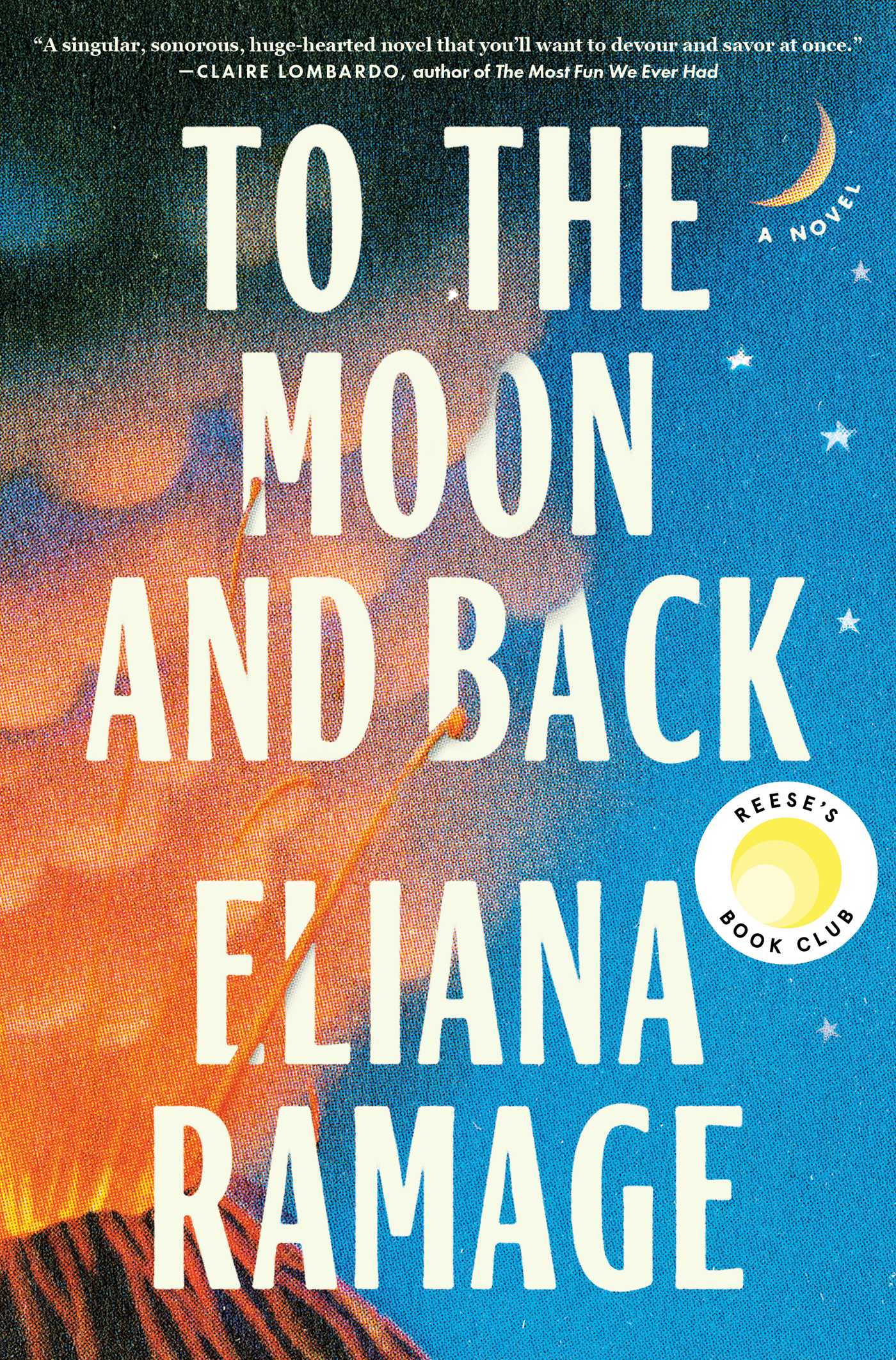
A REESE’S BOOK CLUB PICK: “A breathtaking debut about family, identity, and love across generations.” —Reese Witherspoon
“Eliana Ramage will break your heart and take you to the stars. From painfully accurate depictions of adolescence to effortless jumps through time and space—I loved it all.” —Kiley Reid, New York Times bestselling author of Such a Fun Age
In this dazzlingly powerful coming-of-age story about family, ambition, and belonging, one young woman’s obsessive quest to become the first Cherokee astronaut irrevocably alters the fates of the people she loves most.
Steph Harper is convinced that only space—outer space—can save her. From a childhood of fearful running and alienation; from a family and community that threaten to suffocate her with their reverence for the past. Equal parts tender, funny, and heartbreaking, To the Moon and Back charts the course of Steph’s singular dream: to become the first Cherokee astronaut, no matter who or what she has to leave behind.
But despite her self-prescribed loneliness and reckless ambition, Steph’s story isn’t hers alone. To the Moon and Back also brings to life the vibrant, complex women—a celebrity activist younger sister, an ex-Mormon college girlfriend, and a devoted mother with a crushing secret—who insist on loving her…even when she least deserves them.
From a simulated Mars habitat on a Hawaiian volcano, to a house in the Ozark foothills in Cherokee Nation, to a pressurized research station on the floor of the Atlantic and beyond, Steph will stretch her bonds with each of these women to the point of breaking, driving them to reconsider their own deepest desires in her shadow. An awe-inspiringly epic novel of mothers and daughters, sisters and sacrifice, love and loss, terror and wonder, To the Moon and Back is the “wondrous and deeply moving” (Booklist, starred review) story of one astronaut’s most surprising discovery: how deeply she loves life on earth.
“Eliana Ramage will break your heart and take you to the stars. From painfully accurate depictions of adolescence to effortless jumps through time and space—I loved it all.” —Kiley Reid, New York Times bestselling author of Such a Fun Age
In this dazzlingly powerful coming-of-age story about family, ambition, and belonging, one young woman’s obsessive quest to become the first Cherokee astronaut irrevocably alters the fates of the people she loves most.
Steph Harper is convinced that only space—outer space—can save her. From a childhood of fearful running and alienation; from a family and community that threaten to suffocate her with their reverence for the past. Equal parts tender, funny, and heartbreaking, To the Moon and Back charts the course of Steph’s singular dream: to become the first Cherokee astronaut, no matter who or what she has to leave behind.
But despite her self-prescribed loneliness and reckless ambition, Steph’s story isn’t hers alone. To the Moon and Back also brings to life the vibrant, complex women—a celebrity activist younger sister, an ex-Mormon college girlfriend, and a devoted mother with a crushing secret—who insist on loving her…even when she least deserves them.
From a simulated Mars habitat on a Hawaiian volcano, to a house in the Ozark foothills in Cherokee Nation, to a pressurized research station on the floor of the Atlantic and beyond, Steph will stretch her bonds with each of these women to the point of breaking, driving them to reconsider their own deepest desires in her shadow. An awe-inspiringly epic novel of mothers and daughters, sisters and sacrifice, love and loss, terror and wonder, To the Moon and Back is the “wondrous and deeply moving” (Booklist, starred review) story of one astronaut’s most surprising discovery: how deeply she loves life on earth.
Reading Group Guide
Get a FREE ebook by joining our mailing list today! Plus, receive recommendations for your next Book Club read.
By clicking 'Sign me up' I agree to the Terms of Use and acknowledge the Privacy Policy and Notice of Financial Incentive. Free ebook offer available to NEW US subscribers only. Offer redeemable at Simon & Schuster's ebook fulfillment partner. Must redeem within 90 days. See full terms and conditions and this month's choices.
To the Moon and Back
Eliana Ramage
This reading group guide for To the Moon and Back includes an introduction, discussion questions, ideas for enhancing your book club, and a Q&A with author Eliana Ramage. The suggested questions are intended to help your reading group find new and interesting angles and topics for your discussion. We hope that these ideas will enrich your conversation and increase your enjoyment of the book.
Introduction
Steph Harper is on the run. When she was five, her mother fled an abusive husband—with Steph and her younger sister in tow—to Cherokee Nation, where she hoped they might finally belong. In response, Steph sets her sights as far away from Oklahoma as she can get, vowing that she will let nothing get in the way of pursuing the rigorous physical and academic training she knows she will need to be accepted by NASA and, ultimately, to go to the moon.
Spanning three decades and several continents, To the Moon and Back encompasses Steph’s turbulent journey, along with the multifaceted and intertwined lives of the three women closest to her: her sister, Kayla, an artist who goes on to become an Indigenous social media influencer, and whose determination to appear good takes her life to unexpected places; Steph’s college girlfriend, Della Owens, who strives to reclaim her identity as an adult after being removed from her Cherokee family through a challenge to the Indian Child Welfare Act; and Hannah, Steph and Kayla’s mother, who has held up her family’s tribal history as a beacon of inspiration to her children, all the while keeping her own past a secret.
In Steph’s certainty that only her ambition can save her, she will stretch her bonds with each of these women to the point of breaking, at once betraying their love and generosity, and forcing them to reconsider their own deepest desires in her shadow. Told through an intricately woven tapestry of narrative, To the Moon and Back is an astounding and expansive novel of mothers and daughters, love and sacrifice, alienation and heartbreak, terror and wonder. At its core, it is the story of the extraordinary lengths to which one woman will go to find space for herself.
Topics & Questions for Discussion
1. Brainstorm some adjectives to describe Steph, Kayla, Felicia, and Hannah. What traits do they share? Which traits create the biggest rifts between them? Is there a character who resonates strongly with you?
2. In Part One, Hannah tells Steph and Kayla the story of their ancestors’ experience of Removal; later, Brett tells the Harper sisters about Cherokee Freedmen. How does this information reverberate throughout the novel?
3. During a fight over the historical inaccuracy of a peacock feather cape, Kayla accuses Hannah of not feeling “authentically Indian enough” (page 47). What does that phrase mean to Kayla in that moment, and how does the meaning evolve for her over the course of the novel? What does being “authentically Indian” mean to Steph, Hannah, and Della?
4. Think back to Steph’s loves, including Meredith, Della, the physicist, and Nadia. How would you describe each relationship? Does Steph demonstrate any romantic patterns? What about any signs of growth?
5. Men like Brett, Matthew, and David (or the memory of him) play significant roles in To the Moon and Back. How are Steph, Kayla, and Della affected by their varying approaches to fatherhood?
6. To the Moon and Back features multiple instances of blended families with nontraditional structures or origin stories, including single motherhood and adoption. Compare and contrast the parenting styles Ramage depicts, and the choices that characters like the Ericsons, Kayla, and Della make for their children.
7. In the fall of freshman year, Della thinks about the “shadow-life we carry alongside us, the choices we could have made” (page 144). By the end of the novel, what do you think Della might consider her shadow-life? What about Steph, Hannah, and Kayla?
8. How does Ramage differentiate the various mediums she includes in the book—like texting, Instagram posts, hab logs, and dating profiles—stylistically? How did you feel about this departure from standard prose?
9. How did learning the true circumstances of David’s death affect your reading of the book, specifically of Steph and Hannah as characters? Were you surprised by the twist?
10. What would happen to your experience of the book if Ramage had decided to write the story of Steph’s life from Steph’s perspective only? Are there other characters you would want to know via a first-person point of view?
11. What were your favorite lines or moments from the novel? Did any make you laugh? What about cry?
12. What lessons does Steph learn by the novel’s end, and what will you take away from the experience of reading To the Moon and Back?
Enhance Your Book Club
1. As a group, come up with a list of other novels that you have read by Indigenous American writers about Indigenous American characters, and discuss how these selections differ from or are similar to To the Moon and Back.
2. Refer to Ramage’s “Author’s Note” (page 429) and research the real-life inspiration for the events of the book. What do you discover?
3. Cast the To the Moon and Back movie or miniseries: choose your top picks for the main roles and make a case to the larger group about who would best embody each character.
A Conversation with Eliana Ramage
How did you come up with the general concept for To the Moon and Back? Do you have a personal relationship to space?
I watched Star Trek: The Next Generation with my brothers as a kid, and I took it as a lesson in optimism: to not be so afraid of aliens, and to not assume people will always do terrible things to each other. People do do terrible things to each other, and I feel that particularly in the current political moment. But I refuse the idea that there’s no point in action, or no responsibility to repair the world.
That said, Steph is focused on escape for a reason. She is vulnerable, and we’re vulnerable as humans on this one Earth. For a sometimes scared and laser-focused character like Steph, it can be hard to step back and appreciate the need for other people.
Space exploration, which I see as an extremely long-term group project, carries a lot of weight for a novel that’s interested in who we are and what kind of world we’ll leave behind. When I say “group” I mean humanity, and I also mean specifically Cherokees. I wanted Cherokee people in the novel to grapple with their changing identity across time. What does it mean to be Cherokee? When we’re living on Mars—an inclusive and optimistic “we”—that question will still be there.
The novel is particularly interested in our accountability, to the Earth and to each other. And in which stories we choose to tell and which we don’t, and what that means for the people who come after us.
Could you describe a bit about how your own identity influenced this book?
Hannah, Steph’s mother, finds meaning and inspiration—sometimes too much—in her family’s Cherokee history. A few years into writing this novel, I realized that her history couldn’t be a symbolic idea (e.g., “the ancestors”). Even if they were to exist offstage, in a time the novel doesn’t bring us to, they’d need to be specific individuals and I’d need to know who they were. To know that, in a political and historical Cherokee context that’s very different from the one I know, I knew I’d need some help.
Luckily, one of my brothers is a Cherokee historian! When he was working on his dissertation, he invited me to join him at the Western History Collections through the University of Oklahoma. He taught me how to look at microfiche, and next thing I knew we were reading typed and handwritten letters by Cherokee people who were related to us, which was surreal.
I wanted that for Steph, particularly as she’s detached herself from the past and its people. So I decided that up until the year 1860, my real ancestors would stand in as the basis for Steph’s ancestors. My family has a complicated relationship to assimilation and the Indian Removal Act, so lending Steph a research-based Cherokee history didn’t make for any simple answers. But it raised questions. And, importantly, it added Steph to a conversation that had begun long before her. (And a conversation I’m still having with my brothers!)
What is your approach to writing? Did you have a method for keeping track of all the characters’ voices and perspectives?
The truest answer to this is that it was just hard. It’s hard to learn how to write a novel and it’s hard to figure out how to put different characters and their many needs and voices together. So when I say that I was working on this novel from ages twenty-two to thirty-four, it was far from what I’d imagined. I thought I would write a draft and continue to revise that same draft.
Really, I wrote many drafts of many different stories, but they all fell into this larger project. For example: there was a novel that followed Della into old age, and a novel that let Steph and Della fall in love in the very far future. It wasn’t until March 2020, when I was twenty-nine years old and had pretty much given up on this novel, that I returned to the project and believed in it. Everything since then has been a revision of that early pandemic draft.
That being said, my process has stayed the same! Despite the “throwing spaghetti at the wall” method of landing on this novel’s most basic arc, I have always been a storyboard person. I don’t know that I could have managed these threads without it.
Before, after, and even during every draft, I made outlines and then storyboards using index cards. The index cards for different scenes and chapters indicated whose point of view we’re following (i.e., green cards for Steph), and I’d add stickers to them to note which smaller “threads” or ideas were touched on (i.e., “space,” “history,” “love”). The colors and stickers, lined up on the floor or the wall, helped me to see where I’d lost track of something. If a blue sticker means “space,” and there aren’t any blue stickers for the whole college section, that tells me that I’ve let Steph get too distracted with dating and friends and that crucial “space” part of her is missing for those years. I’d need to go back to the drawing board and figure out how to let all these pieces of her exist simultaneously, without accidentally dropping one.
This was the same process for everyone. The questions were both simple (“Have we heard from Kayla enough lately?”) and complex (“How is this version of Kayla, x years later, similar to and different from Kayla the last time we saw her?”).
Which of the characters did you find easiest to write? Were there any that gave you particular trouble?
The easiest character by far was Della. Part of this might be that I’ve known her the longest, as her character existed before the others. It’s easy to feel close to her and understand her. Part of this might be that I have so much empathy for her, and for everyone who loves her. Steph demands a little extra understanding from me, because she can be selfish and difficult. But with Della, I get it.
The hardest character was Kayla. In early drafts I only understood her from the outside, from Steph’s eyes, which means she was little more than a “cool girl.” It didn’t feel hard to write her, because from Steph’s point of view (for a lot of her life) that was good enough—Steph underestimated Kayla, and sometimes I let myself do that, too.
Kayla really came alive for me after I gained editorial partners in later drafts of the book: first my agent Meredith Kaffel Simonoff, and then my two editors Margo Shickmanter (US) and Bobby Mostyn-Owen (UK). I really needed their perspective, as three people meeting Kayla from the outside for the first time, to understand what was missing!
They helped me realize that of course Kayla didn’t just have something like “being a content creator” happen to her. It took work, a genuine belief in what she was doing, and the spark of having always been an artist at heart. Once I knew that, I understood how strange it must have been, even for Kayla herself, to go from being the child who loved drawing in her sketchpad to the mother at a protest encampment whose family (and “platform”) is going very publicly off the rails. How do our lives take these strange turns? What do you do when you’ve arrived in the wrong place after many years, but your own sense of self is so dependent on how you (and your people) are seen by others?
Did you always know Steph, or a character like her, was going to be the protagonist?
I’ve been working on this novel for more than a decade, and it started out as a group of college students from ten different tribes. Della was one of them. Steph (a version of Steph with no interest in space) was somewhat lost in the crowd of college students.
But Indigenous identity as a whole felt too big! So eventually the question became “What does it mean to be Cherokee now?” And then it became “What will it mean in the future?”
Ultimately, I extrapolated to the stars. Writing this novel led me to consider the far future, and our place in it. What would lead someone like Steph to get interested in space? What would it take to get her there?
In the future, I believe there will be Cherokee people on Mars, and this book asks what our responsibility is to them. What stories will they tell about us? What will it mean to them to be Cherokee?
What was your research process like?
I’d say there were three different approaches I took to research:
1. “Good Enough”:
In writing about space, I was conscious of the fact that I could research so much that I’d just never get around to writing. I was so scared of that (and aware of how important it was to just finish the book—and address problems later), that in early drafts I actively tried not to research too much. I imagined everything I could, and if I had to know more I’d set a timer and tell myself I could only learn what I had to learn to keep going. This of course meant I had to do a lot on the back end, researching more extensively to correct my mistakes.
2. General Background:
While the internet was excellent for specific questions (“Why doesn’t an underwater moon pool fill with water?!”), I got maybe the most out of media that let me understand the people this novel was interested in on a deeper level. I didn’t take notes or look for data, I just let it wash over me for the years I was working on this book. A few examples of the kinds of places this took me: the documentary Dadiwonisi on Cherokee language revitalization, the astronaut memoir Endurance by Scott Kelly, and even novels in conversation with mine like The Love Songs of W.E.B. Du Bois.
3. Other People:
Finally, a lot of the more complicated aspects of the novel came out of ongoing conversation. The ideas in this book are ideas I talked about whenever I could with people who either knew more than I did (like my historian brother) or who knew the same things I did but (as their own people with their own life experiences) took them in different directions. This is a book about five very different Cherokee women, so I really valued any time I spent outside of my own head.
How did you determine when to adhere closely to fact, and when to just take inspiration from it?
My first priority was figuring out what felt ethical to me. After that, I could more easily decide what served the story.
I wanted to draw a clear line between the real past and the fictional present. The book is interested in accountability and stories—which ones we pass down and which we don’t. For that reason, I didn’t want to invent my own spin on the past. I also wasn’t interested in writing about someone else’s real grandmother, or other close relations with no connection to fictional Steph. So when it came to the Cherokee history in the book, I tried to stay as accurate as I could up to a specific point, which meant including direct quotes from real people before 1860 (to be clear: real ancestors of mine).
Similarly, I didn’t want to set any scenes at the real demonstrations at Standing Rock or Mauna Kea because it didn’t feel right and it would have limited my choices around where the story could go. But those protests were and are important, and my own brief time at Standing Rock felt urgent to me. The emotion, particularly the power of standing in the largest crowd of Indigenous people I’d ever before encountered, has stayed with me. It was enough to move even a detached person like Steph, which before my own experience at Standing Rock had felt like an impossible feat. So the emotions around the protest depicted in the novel are real, as are the questions it asks of Steph and Kayla and the reader. But the protest itself is fictional.
As you were developing and writing To the Moon and Back, did you reach for any books or other media for inspiration?
So many! There were astronaut memoirs and history books, and two documentaries I mentioned in the Author’s Note. But mostly, I relied on fiction. Here are only a few of the books that I read and returned to while working on this novel:
LaRose by Louise Erdrich
Girl, Woman, Other by Bernadine Evaristo
Brotherless Night by V.V. Ganeshananthan
The Love Songs of W.E.B. Du Bois by Honorée Fanonne Jeffers
Before the Mango Ripens by Afabwaje Kurian
The Dutch House by Ann Patchett
Great Circle by Maggie Shipstead
Show Don’t Tell by Curtis Sittenfeld
The Safekeep by Yael van der Wouden
Tomorrow, and Tomorrow, and Tomorrow by Gabrielle Zevin
How did you choose the epigraph? What does it mean to you?
The epigraph comes from a poem I love by Heid E. Erdrich, “How It Escaped Our Attention.” The epigraph doesn’t include the first part of the poem, which begins with a child (a “whole being”) born into hands. Though the child’s beauty is “unworldly,” you still see your hands.
The poem goes on (I am begging you to go read the rest online!), and holds so much, in a way that reminds me of how Steph understands her life at the end of the novel. How much it has held, and how impossible it is to make sense of it.
I’m in awe of the poem’s explosive take on the life of a single person, in the same breath as it communicates their smallness in the greater universe. With the arrival of a new life in the universe (a universe of Ojibwe and English words, of moons and comets), there is a shift: in language, in naming, in gender, in identity—and in the child’s place in a broader world.
The poem reminds me of so much in the novel: unnamed generations born into hands, stories of the sky passed on in both families and schools, and Hannah as a young mother—how little she knew then of who her children would become (“How were we to know who?”).
Is there a scene or sentence about which you are especially proud?
I’m happiest for Della. For years, I wasn’t sure where her life would take her. There were so many different versions of her story, because I worried that maybe she was “supposed” to land in a certain place (with a certain person) to have her happy ending.
But the person Della is as the end of the novel wouldn’t want what she wanted as a younger woman, and that’s a strong, good feeling for me. There are many scenes that make me laugh, puzzles that were hard to solve, and lines that are beautiful to me in this book. But when I think of which arc makes me feel proud of another person outside myself, on such a deep level that it’s as if that person were real to me, it’s Della.
Eliana Ramage
This reading group guide for To the Moon and Back includes an introduction, discussion questions, ideas for enhancing your book club, and a Q&A with author Eliana Ramage. The suggested questions are intended to help your reading group find new and interesting angles and topics for your discussion. We hope that these ideas will enrich your conversation and increase your enjoyment of the book.
Introduction
Steph Harper is on the run. When she was five, her mother fled an abusive husband—with Steph and her younger sister in tow—to Cherokee Nation, where she hoped they might finally belong. In response, Steph sets her sights as far away from Oklahoma as she can get, vowing that she will let nothing get in the way of pursuing the rigorous physical and academic training she knows she will need to be accepted by NASA and, ultimately, to go to the moon.
Spanning three decades and several continents, To the Moon and Back encompasses Steph’s turbulent journey, along with the multifaceted and intertwined lives of the three women closest to her: her sister, Kayla, an artist who goes on to become an Indigenous social media influencer, and whose determination to appear good takes her life to unexpected places; Steph’s college girlfriend, Della Owens, who strives to reclaim her identity as an adult after being removed from her Cherokee family through a challenge to the Indian Child Welfare Act; and Hannah, Steph and Kayla’s mother, who has held up her family’s tribal history as a beacon of inspiration to her children, all the while keeping her own past a secret.
In Steph’s certainty that only her ambition can save her, she will stretch her bonds with each of these women to the point of breaking, at once betraying their love and generosity, and forcing them to reconsider their own deepest desires in her shadow. Told through an intricately woven tapestry of narrative, To the Moon and Back is an astounding and expansive novel of mothers and daughters, love and sacrifice, alienation and heartbreak, terror and wonder. At its core, it is the story of the extraordinary lengths to which one woman will go to find space for herself.
Topics & Questions for Discussion
1. Brainstorm some adjectives to describe Steph, Kayla, Felicia, and Hannah. What traits do they share? Which traits create the biggest rifts between them? Is there a character who resonates strongly with you?
2. In Part One, Hannah tells Steph and Kayla the story of their ancestors’ experience of Removal; later, Brett tells the Harper sisters about Cherokee Freedmen. How does this information reverberate throughout the novel?
3. During a fight over the historical inaccuracy of a peacock feather cape, Kayla accuses Hannah of not feeling “authentically Indian enough” (page 47). What does that phrase mean to Kayla in that moment, and how does the meaning evolve for her over the course of the novel? What does being “authentically Indian” mean to Steph, Hannah, and Della?
4. Think back to Steph’s loves, including Meredith, Della, the physicist, and Nadia. How would you describe each relationship? Does Steph demonstrate any romantic patterns? What about any signs of growth?
5. Men like Brett, Matthew, and David (or the memory of him) play significant roles in To the Moon and Back. How are Steph, Kayla, and Della affected by their varying approaches to fatherhood?
6. To the Moon and Back features multiple instances of blended families with nontraditional structures or origin stories, including single motherhood and adoption. Compare and contrast the parenting styles Ramage depicts, and the choices that characters like the Ericsons, Kayla, and Della make for their children.
7. In the fall of freshman year, Della thinks about the “shadow-life we carry alongside us, the choices we could have made” (page 144). By the end of the novel, what do you think Della might consider her shadow-life? What about Steph, Hannah, and Kayla?
8. How does Ramage differentiate the various mediums she includes in the book—like texting, Instagram posts, hab logs, and dating profiles—stylistically? How did you feel about this departure from standard prose?
9. How did learning the true circumstances of David’s death affect your reading of the book, specifically of Steph and Hannah as characters? Were you surprised by the twist?
10. What would happen to your experience of the book if Ramage had decided to write the story of Steph’s life from Steph’s perspective only? Are there other characters you would want to know via a first-person point of view?
11. What were your favorite lines or moments from the novel? Did any make you laugh? What about cry?
12. What lessons does Steph learn by the novel’s end, and what will you take away from the experience of reading To the Moon and Back?
Enhance Your Book Club
1. As a group, come up with a list of other novels that you have read by Indigenous American writers about Indigenous American characters, and discuss how these selections differ from or are similar to To the Moon and Back.
2. Refer to Ramage’s “Author’s Note” (page 429) and research the real-life inspiration for the events of the book. What do you discover?
3. Cast the To the Moon and Back movie or miniseries: choose your top picks for the main roles and make a case to the larger group about who would best embody each character.
A Conversation with Eliana Ramage
How did you come up with the general concept for To the Moon and Back? Do you have a personal relationship to space?
I watched Star Trek: The Next Generation with my brothers as a kid, and I took it as a lesson in optimism: to not be so afraid of aliens, and to not assume people will always do terrible things to each other. People do do terrible things to each other, and I feel that particularly in the current political moment. But I refuse the idea that there’s no point in action, or no responsibility to repair the world.
That said, Steph is focused on escape for a reason. She is vulnerable, and we’re vulnerable as humans on this one Earth. For a sometimes scared and laser-focused character like Steph, it can be hard to step back and appreciate the need for other people.
Space exploration, which I see as an extremely long-term group project, carries a lot of weight for a novel that’s interested in who we are and what kind of world we’ll leave behind. When I say “group” I mean humanity, and I also mean specifically Cherokees. I wanted Cherokee people in the novel to grapple with their changing identity across time. What does it mean to be Cherokee? When we’re living on Mars—an inclusive and optimistic “we”—that question will still be there.
The novel is particularly interested in our accountability, to the Earth and to each other. And in which stories we choose to tell and which we don’t, and what that means for the people who come after us.
Could you describe a bit about how your own identity influenced this book?
Hannah, Steph’s mother, finds meaning and inspiration—sometimes too much—in her family’s Cherokee history. A few years into writing this novel, I realized that her history couldn’t be a symbolic idea (e.g., “the ancestors”). Even if they were to exist offstage, in a time the novel doesn’t bring us to, they’d need to be specific individuals and I’d need to know who they were. To know that, in a political and historical Cherokee context that’s very different from the one I know, I knew I’d need some help.
Luckily, one of my brothers is a Cherokee historian! When he was working on his dissertation, he invited me to join him at the Western History Collections through the University of Oklahoma. He taught me how to look at microfiche, and next thing I knew we were reading typed and handwritten letters by Cherokee people who were related to us, which was surreal.
I wanted that for Steph, particularly as she’s detached herself from the past and its people. So I decided that up until the year 1860, my real ancestors would stand in as the basis for Steph’s ancestors. My family has a complicated relationship to assimilation and the Indian Removal Act, so lending Steph a research-based Cherokee history didn’t make for any simple answers. But it raised questions. And, importantly, it added Steph to a conversation that had begun long before her. (And a conversation I’m still having with my brothers!)
What is your approach to writing? Did you have a method for keeping track of all the characters’ voices and perspectives?
The truest answer to this is that it was just hard. It’s hard to learn how to write a novel and it’s hard to figure out how to put different characters and their many needs and voices together. So when I say that I was working on this novel from ages twenty-two to thirty-four, it was far from what I’d imagined. I thought I would write a draft and continue to revise that same draft.
Really, I wrote many drafts of many different stories, but they all fell into this larger project. For example: there was a novel that followed Della into old age, and a novel that let Steph and Della fall in love in the very far future. It wasn’t until March 2020, when I was twenty-nine years old and had pretty much given up on this novel, that I returned to the project and believed in it. Everything since then has been a revision of that early pandemic draft.
That being said, my process has stayed the same! Despite the “throwing spaghetti at the wall” method of landing on this novel’s most basic arc, I have always been a storyboard person. I don’t know that I could have managed these threads without it.
Before, after, and even during every draft, I made outlines and then storyboards using index cards. The index cards for different scenes and chapters indicated whose point of view we’re following (i.e., green cards for Steph), and I’d add stickers to them to note which smaller “threads” or ideas were touched on (i.e., “space,” “history,” “love”). The colors and stickers, lined up on the floor or the wall, helped me to see where I’d lost track of something. If a blue sticker means “space,” and there aren’t any blue stickers for the whole college section, that tells me that I’ve let Steph get too distracted with dating and friends and that crucial “space” part of her is missing for those years. I’d need to go back to the drawing board and figure out how to let all these pieces of her exist simultaneously, without accidentally dropping one.
This was the same process for everyone. The questions were both simple (“Have we heard from Kayla enough lately?”) and complex (“How is this version of Kayla, x years later, similar to and different from Kayla the last time we saw her?”).
Which of the characters did you find easiest to write? Were there any that gave you particular trouble?
The easiest character by far was Della. Part of this might be that I’ve known her the longest, as her character existed before the others. It’s easy to feel close to her and understand her. Part of this might be that I have so much empathy for her, and for everyone who loves her. Steph demands a little extra understanding from me, because she can be selfish and difficult. But with Della, I get it.
The hardest character was Kayla. In early drafts I only understood her from the outside, from Steph’s eyes, which means she was little more than a “cool girl.” It didn’t feel hard to write her, because from Steph’s point of view (for a lot of her life) that was good enough—Steph underestimated Kayla, and sometimes I let myself do that, too.
Kayla really came alive for me after I gained editorial partners in later drafts of the book: first my agent Meredith Kaffel Simonoff, and then my two editors Margo Shickmanter (US) and Bobby Mostyn-Owen (UK). I really needed their perspective, as three people meeting Kayla from the outside for the first time, to understand what was missing!
They helped me realize that of course Kayla didn’t just have something like “being a content creator” happen to her. It took work, a genuine belief in what she was doing, and the spark of having always been an artist at heart. Once I knew that, I understood how strange it must have been, even for Kayla herself, to go from being the child who loved drawing in her sketchpad to the mother at a protest encampment whose family (and “platform”) is going very publicly off the rails. How do our lives take these strange turns? What do you do when you’ve arrived in the wrong place after many years, but your own sense of self is so dependent on how you (and your people) are seen by others?
Did you always know Steph, or a character like her, was going to be the protagonist?
I’ve been working on this novel for more than a decade, and it started out as a group of college students from ten different tribes. Della was one of them. Steph (a version of Steph with no interest in space) was somewhat lost in the crowd of college students.
But Indigenous identity as a whole felt too big! So eventually the question became “What does it mean to be Cherokee now?” And then it became “What will it mean in the future?”
Ultimately, I extrapolated to the stars. Writing this novel led me to consider the far future, and our place in it. What would lead someone like Steph to get interested in space? What would it take to get her there?
In the future, I believe there will be Cherokee people on Mars, and this book asks what our responsibility is to them. What stories will they tell about us? What will it mean to them to be Cherokee?
What was your research process like?
I’d say there were three different approaches I took to research:
1. “Good Enough”:
In writing about space, I was conscious of the fact that I could research so much that I’d just never get around to writing. I was so scared of that (and aware of how important it was to just finish the book—and address problems later), that in early drafts I actively tried not to research too much. I imagined everything I could, and if I had to know more I’d set a timer and tell myself I could only learn what I had to learn to keep going. This of course meant I had to do a lot on the back end, researching more extensively to correct my mistakes.
2. General Background:
While the internet was excellent for specific questions (“Why doesn’t an underwater moon pool fill with water?!”), I got maybe the most out of media that let me understand the people this novel was interested in on a deeper level. I didn’t take notes or look for data, I just let it wash over me for the years I was working on this book. A few examples of the kinds of places this took me: the documentary Dadiwonisi on Cherokee language revitalization, the astronaut memoir Endurance by Scott Kelly, and even novels in conversation with mine like The Love Songs of W.E.B. Du Bois.
3. Other People:
Finally, a lot of the more complicated aspects of the novel came out of ongoing conversation. The ideas in this book are ideas I talked about whenever I could with people who either knew more than I did (like my historian brother) or who knew the same things I did but (as their own people with their own life experiences) took them in different directions. This is a book about five very different Cherokee women, so I really valued any time I spent outside of my own head.
How did you determine when to adhere closely to fact, and when to just take inspiration from it?
My first priority was figuring out what felt ethical to me. After that, I could more easily decide what served the story.
I wanted to draw a clear line between the real past and the fictional present. The book is interested in accountability and stories—which ones we pass down and which we don’t. For that reason, I didn’t want to invent my own spin on the past. I also wasn’t interested in writing about someone else’s real grandmother, or other close relations with no connection to fictional Steph. So when it came to the Cherokee history in the book, I tried to stay as accurate as I could up to a specific point, which meant including direct quotes from real people before 1860 (to be clear: real ancestors of mine).
Similarly, I didn’t want to set any scenes at the real demonstrations at Standing Rock or Mauna Kea because it didn’t feel right and it would have limited my choices around where the story could go. But those protests were and are important, and my own brief time at Standing Rock felt urgent to me. The emotion, particularly the power of standing in the largest crowd of Indigenous people I’d ever before encountered, has stayed with me. It was enough to move even a detached person like Steph, which before my own experience at Standing Rock had felt like an impossible feat. So the emotions around the protest depicted in the novel are real, as are the questions it asks of Steph and Kayla and the reader. But the protest itself is fictional.
As you were developing and writing To the Moon and Back, did you reach for any books or other media for inspiration?
So many! There were astronaut memoirs and history books, and two documentaries I mentioned in the Author’s Note. But mostly, I relied on fiction. Here are only a few of the books that I read and returned to while working on this novel:
LaRose by Louise Erdrich
Girl, Woman, Other by Bernadine Evaristo
Brotherless Night by V.V. Ganeshananthan
The Love Songs of W.E.B. Du Bois by Honorée Fanonne Jeffers
Before the Mango Ripens by Afabwaje Kurian
The Dutch House by Ann Patchett
Great Circle by Maggie Shipstead
Show Don’t Tell by Curtis Sittenfeld
The Safekeep by Yael van der Wouden
Tomorrow, and Tomorrow, and Tomorrow by Gabrielle Zevin
How did you choose the epigraph? What does it mean to you?
The epigraph comes from a poem I love by Heid E. Erdrich, “How It Escaped Our Attention.” The epigraph doesn’t include the first part of the poem, which begins with a child (a “whole being”) born into hands. Though the child’s beauty is “unworldly,” you still see your hands.
The poem goes on (I am begging you to go read the rest online!), and holds so much, in a way that reminds me of how Steph understands her life at the end of the novel. How much it has held, and how impossible it is to make sense of it.
I’m in awe of the poem’s explosive take on the life of a single person, in the same breath as it communicates their smallness in the greater universe. With the arrival of a new life in the universe (a universe of Ojibwe and English words, of moons and comets), there is a shift: in language, in naming, in gender, in identity—and in the child’s place in a broader world.
The poem reminds me of so much in the novel: unnamed generations born into hands, stories of the sky passed on in both families and schools, and Hannah as a young mother—how little she knew then of who her children would become (“How were we to know who?”).
Is there a scene or sentence about which you are especially proud?
I’m happiest for Della. For years, I wasn’t sure where her life would take her. There were so many different versions of her story, because I worried that maybe she was “supposed” to land in a certain place (with a certain person) to have her happy ending.
But the person Della is as the end of the novel wouldn’t want what she wanted as a younger woman, and that’s a strong, good feeling for me. There are many scenes that make me laugh, puzzles that were hard to solve, and lines that are beautiful to me in this book. But when I think of which arc makes me feel proud of another person outside myself, on such a deep level that it’s as if that person were real to me, it’s Della.
About the Author
Photograph by Leah Margulies
Eliana Ramage holds an MFA in fiction from the Iowa Writers’ Workshop. She has received residencies and fellowships from the Kimmel Harding Nelson Center for the Arts, Lambda Literary, Tin House, and Vermont Studio Center. A citizen of the Cherokee Nation, she lives in Nashville with her family. To the Moon and Back is her first novel.
Product Details
- Publisher: Avid Reader Press/Simon & Schuster (September 2, 2025)
- Length: 448 pages
- ISBN13: 9781668065877
Browse Related Books
Raves and Reviews
"A powerful, resonant debut."—People
"Eliana Ramage’s astral sweep of a tale follows Steph and those in her circle as they navigate ambitions, identities, fears, commitments, and values. It’s a big, bumpy read – and worth it."—Christian Science Monitor
“If ambition is rocket fuel, Steph [Harper] has a full tank.”—Oprah Daily
"Ramage stuffs the book to the brim with big ideas and digressions, from indigenous history to family identity, but it is the eminently human voice of Steph that keeps this maiden voyage feeling grounded and real."—NPR
"A queer coming-of-age story, a Native family drama, Ramage’s tragicomic debut shoots for the stars."—The Boston Globe
"A story of decisions; right, wrong and everything in between, with characters so perfectly rendered that you’ll want to hug them or give them a shake. An immersive and exciting debut."—Amanda Peters, author of The Berry Pickers
"A novel that has the generosity to be many things—bittersweet, thrillingly perceptive, enormously funny. To the Moon and Back is a wonderful reckoning with the true price of an at-any-cost ambition and a powerful story about the mixture of combativeness, compromise and love that forms the heart of a family."—Kaliane Bradley, New York Times bestselling author of The Ministry of Time
"To the Moon and Back is a singular, sonorous, wholehearted novel that you'll want to devour and savor at once. Eliana Ramage is a dynamite writer—every sentence positively shimmers."—Claire Lombardo, New York Times bestselling author of The Most Fun We Ever Had
"An epic, enthralling and deeply humane novel of family bonds, belonging and the relentless pursuit of one's dream, that will make you laugh and cry along the way. Eliana Ramage is a formidable talent, and writes with so much heart and hope: I loved it."—Cecile Pin, author of Wandering Souls (shortlisted for the Women’s Prize)
“To the Moon and Back simply soars. Eliana Ramage has given us a brilliant, faceted, warm-hearted novel, with characters to love and truly root for, and pages that seem to turn themselves.”—Sarah Thankam Matthews, author of All This Could Be Different
"To the Moon and Back is a passionate and compulsively readable novel. Dare I say, a stellar debut."—Margot Livesey, author of The Road to Belhaven
"Eliana Ramage's To the Moon and Back is a captivating debut about family, queer identity, love, career and heritage. This novel has something for everyone."—De'Shawn Charles Winslow, author of In West Mills and Decent People
“A John Irving-esque tragicomic saga… This author is as ambitious as her protagonist: There are three novels worth of material here, all good. The moon or bust!”—Kirkus Review (starred review)
"Wondrous and deeply moving, Ramage's first outing explores ambition, sexuality, and familial bonds with sensitivity and piercing insight. Not to be missed."—Booklist (starred review)
"Exceptional. . . .Ramage nimbly handles this sprawling story, capturing the hearts of these characters in chapters narrated by alternating voices. . . . Readers will enjoy losing themselves in the ongoing drama of To the Moon and Back, full of complex characters, beautiful prose and arresting scenes."—BookPage, (starred review)
"Ramage’s epic debut is absorbing and thought-provoking."—Arlington Magazine
"[To the Moon and Back is] a thought-provoking read about ambition, identity, family, and Indigeneity."—Book Riot
Resources and Downloads
High Resolution Images
-
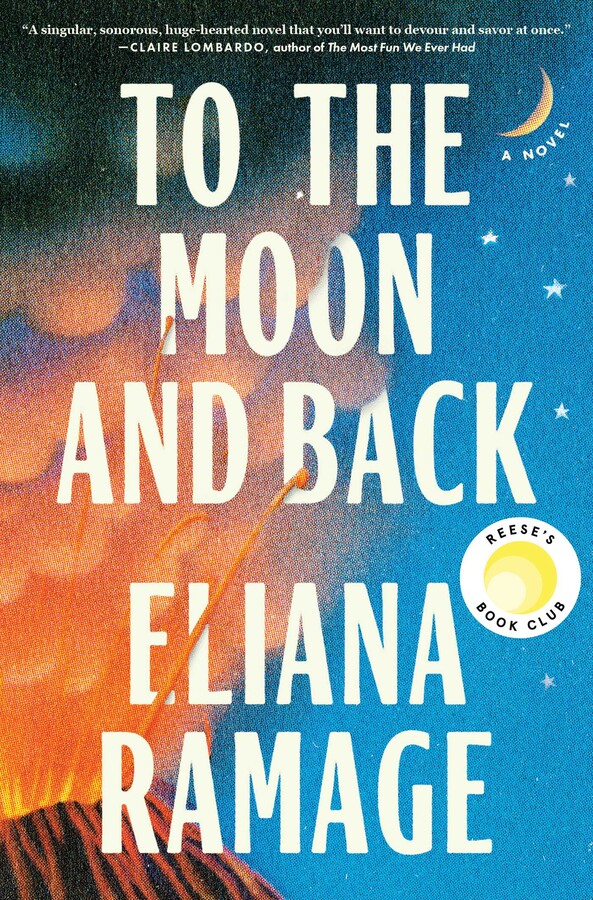
Book Cover Image (jpg): To the Moon and Back (Reese's Book Club)
eBook 9781668065877
-
Author Photo (jpg): Eliana Ramage Photograph by Leah Margulies(0.1 MB)
Any use of an author photo must include its respective photo credit