
Plus, receive recommendations and exclusive offers on all of your favorite books and authors from Simon & Schuster.
0:00 /
LIST PRICE $28.00
PRICE MAY VARY BY RETAILER
Free shipping when you spend $40. Terms apply.
Buy from Other Retailers
Table of Contents
About The Book
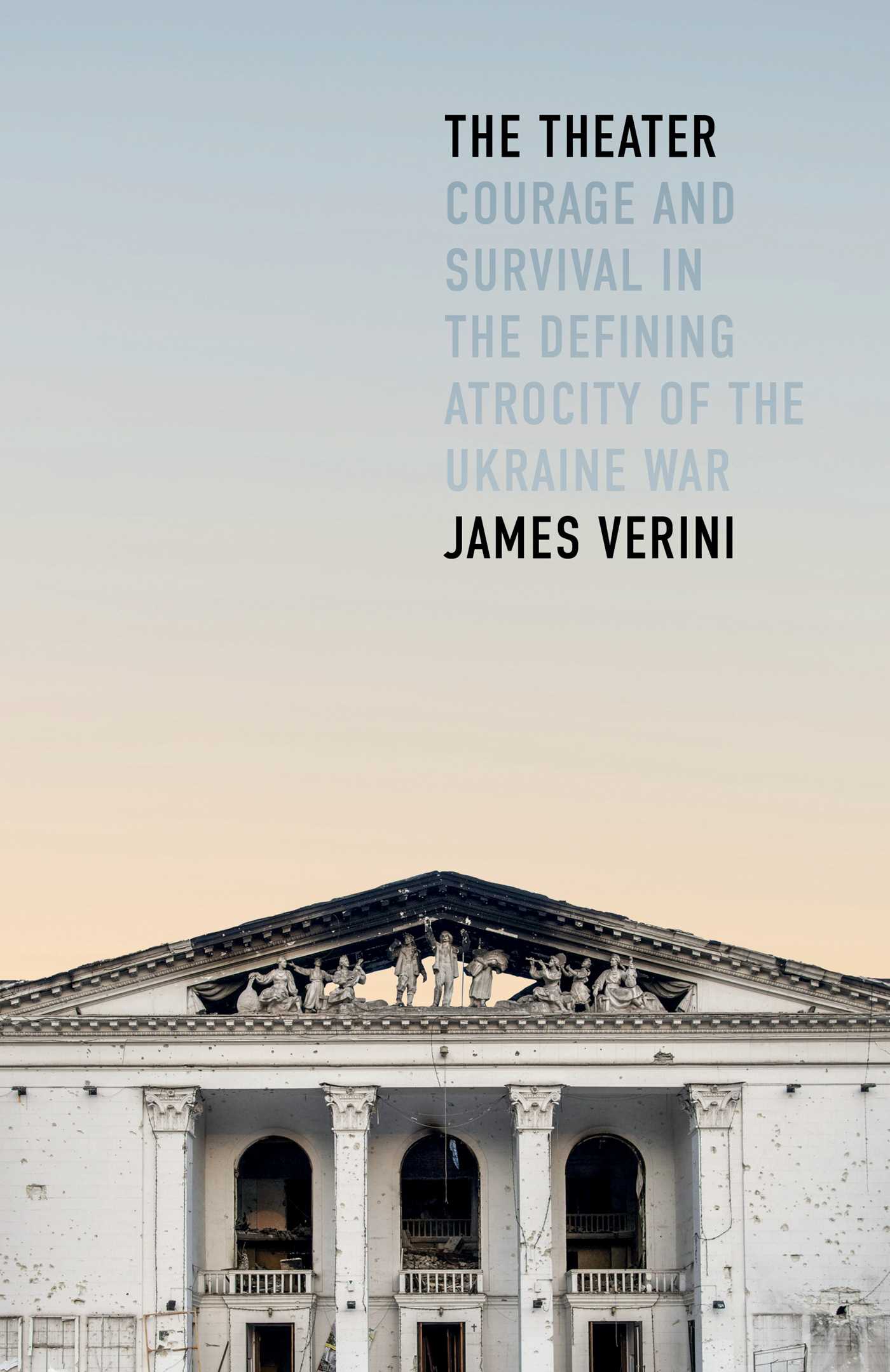
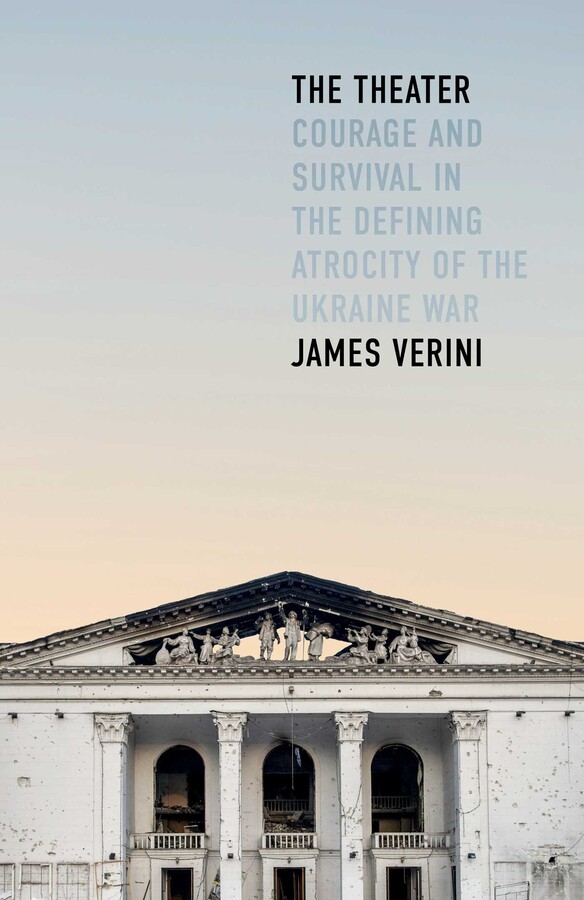
In the tradition of John Hersey’s Hiroshima, a terse and piercing look at a critical episode in the Ukraine War, from the award-winning author of They Will Have to Die Now.
In March of 2022, three weeks after invading Ukraine, Russian forces bombed the shelter housed in the Donetsk Regional Academic Drama Theater, in the city of Mariupol. The bombing stands, to this day, as the single worst act of mass civilian killing of the war. This book tells the story of the group of ordinary Ukrainians—workers, teachers, actors—who built that shelter, giving succor to thousands of their countrypeople, before it was destroyed. Their audacity and humor and humanity in the midst of the siege of Mariupol, against impossible odds, will leave readers inspired, amused, and devastated. Their story is the story of a young republic and its struggle to survive.
In March of 2022, three weeks after invading Ukraine, Russian forces bombed the shelter housed in the Donetsk Regional Academic Drama Theater, in the city of Mariupol. The bombing stands, to this day, as the single worst act of mass civilian killing of the war. This book tells the story of the group of ordinary Ukrainians—workers, teachers, actors—who built that shelter, giving succor to thousands of their countrypeople, before it was destroyed. Their audacity and humor and humanity in the midst of the siege of Mariupol, against impossible odds, will leave readers inspired, amused, and devastated. Their story is the story of a young republic and its struggle to survive.
Excerpt
Chapter One: The Invasion CHAPTER ONE THE INVASION
THE SIEGE OF MARIUPOL had started twenty days before the bombing of the theater. It began as the war began, in the predawn hours of Thursday, February 24th, 2022. Russian heavy artillery and planes bombarded Ukrainian air defense systems, military installations, airports, government buildings, and critical infrastructure. Armored columns carrying roughly a hundred and ninety thousand troops began crossing the Ukrainian borders and moving toward four strategically crucial cities. They made for the capital of Kyiv via Belarus; toward Kharkiv, Ukraine’s second-largest city, from southeastern Russia; and toward Kherson from the Crimean Peninsula.
They moved on Mariupol from the Donetsk People’s Republic, a breakaway statelet which Russia had carved off Ukraine in 2014 after annexing Crimea, and which Moscow had run as a crypto-satrapy ever since, arming one side of a stalemated low-volume shooting war that had dragged on for the previous eight years: the Russo-Ukrainian War, as we now call it. Putin had always denied he controlled the Donetsk People’s Republic, a fable which dissolved once and for all when Russia’s 58th Combined Arms Army and its 150th Motorized Rifle Division linked up with fighters from the DPR’s so-called People’s Militia. This combined force swept in a crescent north of Mariupol, cutting off land routes into the city and setting up firebases. With field guns, tanks, mortars, and the multi-barrel mobile rocket launchers commonly known as Grads, they commenced a barrage of Mariupol’s eastern outskirts that would spread west across the city and continue for eighty-six days. At the same time, Russian jets scrambling from the Millerovo and Primorsko-Akhtarsk bases bombed the railways, power plants, and water pumping stations around Mariupol, and the 810th Separate Naval Infantry Brigade detached from the Black Sea Fleet in Sevastopol and steamed for the Mariupol port. With a rapidity that shocked Ukrainian commanders, and probably the more competent Russian ones, Mariupol was being encircled.
Elizaveta Fatayeva didn’t learn those details when she awoke that first morning to news of the war. Few Ukrainians did. The news was stinting in specifics. The same footage of Russian tanks rolling over the border was replayed again and again on television. Addressing the nation, President Volodymyr Zelensky offered, instead of details about the invasion, attempts at fortitude and solace. “We know for sure that we don’t need the war. Not a cold war, not a hot war, not a hybrid one,” he said. “But if we’ll be attacked by the troops, if they try to take our country away from us, our freedom, our lives, the lives of our children, we will defend ourselves. Not attack, but defend ourselves.”
It was not the most stirring call to arms from Zelensky, who had not yet transformed into the inspiring wartime leader the world would soon come to know, but then Liza, as she went by, a willowy nineteen-year-old with long blond hair and eyes that seemed demure until you realized they were studying your eyes, didn’t require martial stirring, nor solace, not yet. She wasn’t too worried. She thought the impudent bear to the north was merely baring its teeth and growling, just as it had been doing on Ukraine’s eastern border for most of her life. Putin wanted some concession or another from Ukraine or the West, she told her mother, Oksana, with whom she lived in an apartment in Zakhidnyi, a residential district of drab concrete apartment blocks north of the theater. Maybe it was more assurances from NATO that it had no intention of admitting Ukraine, maybe a pledge from Washington to keep long-range missiles out of the country, or something more obscure, but once he got it, Liza told her mother, he’d withdraw. Oksana wanted to believe her daughter, who knew more about these things than she did. If this all sounds tragically complacent in hindsight, it must be remembered that such was the prevailing attitude of most Mariupoltsi, indeed most Ukrainians, including Zelensky, before the war. Few thought Putin, who was known for his risk-averse pragmatism as much as he was for his cruelty, could be reckless enough to try to conquer all Ukraine.
Liza left to go to her job in the bakery department of a supermarket. The shelling to the east of the city was still so distant, it was barely audible as she made her way. While certain stores in Mariupol had already closed, their owners sensing there would be a siege or perhaps knowing there would be—Mariupol’s business class still had close ties with Russia—Liza’s had not. The doors opened and shoppers crowded into the aisles. Liza studied them. Their eyes weren’t desperate or even particularly anxious, she observed, though the arms below them were stuffing more into their baskets than she’d ever seen.
Liza’s boyfriend, the acting student Dima Murantsev, a rangy but not awkward young man with a mop of brown hair and kind, close-set eyes, awoke to the news of war in a very different way. Just twenty years old, Dima had long been an observer and analyst of Ukrainian and Russian politics. A Ukrainian loyalist, which is to say a congenital skeptic when not a full-throated antagonist of Russia, he had watched over the previous year as Russia amassed troops and weapons on Ukraine’s borders. He’d taken note when American officials began warning their Ukrainian counterparts that Putin intended to invade. By February of 2022, countries were evacuating their embassies in Kyiv. On February 23rd, hours before the invasion, President Zelensky called up all military reservists between the ages of eighteen and sixty. Dima was not a reservist—he doubted he could fire a gun. But like Zelensky, who suffered the same failure of imagination, telling foreign leaders he thought Putin was probably just carrying out a menacing training exercise, Dima couldn’t quite make up his mind what to think.
Dima had moved to Mariupol from the Russia-controlled Donetsk People’s Republic. His parents and most of his family still lived there or in its smaller sister in contrived secession, the Luhansk People’s Republic. Together the two “temporarily occupied territories,” as the Ukraine government officially referred to them, made up a goodly portion of the region known by Ukrainians and Russians alike as the Donbas, the lands of the Don River basin that lay along the border of the two countries. Having lived under effective Russian occupation, Dima knew what Putin was capable of. He would put nothing past the Russian. Before the war, when the prospect of an invasion had come up with friends, Dima always reminded them that there already was a war in the Donbas. The frontline between free Ukraine and the DPR hadn’t moved in close to a decade, it was true, but there was still constant shelling and sniping across the line. Thousands of soldiers and civilians had died. There were demolished Ukrainian villages a short drive from downtown Mariupol, and no one knew how many Ukrainian captives still languishing in the network of underground prisons and torture chambers run by Russian intelligence—the basements, as they were known. Some of those basements were very near Mariupol. Dima had not forgotten about them, even if the rest of Europe and the world, and many Ukrainians, including his friends, had. “They would ask me, ‘What do you mean, what war?’?” Dima later told me. “And I would reply that we’d been fighting Russia for eight years.”
Still, he couldn’t see the rationale in a Russian invasion, or as the American Secretary of State Anthony Blinken phrased it when warning Zelensky it was a certainty, a “reinvasion.” What could Putin have to gain by it? Could he possibly think he would overrun Ukraine, with its forty-five million citizens and standing army of seven hundred thousand, its landmass larger than France? If not, was Putin after more of the sort of impoverished, pensioner-infested territory that he already held ten thousand square kilometers of in the Donbas, and that Dima had, like every other young person of sound mind living there, escaped? And if that was what Putin wanted, why be so coy about it until now? “I thought it would make no sense if they were to attack now,” Dima told me. “Then why were they hiding the fact that they were there for eight years in the first place? That’s just dumb.” If there was a war, it would be theatrical and short, a means to some political end for Putin. This is what he’d told Liza, and she’d absorbed his analysis.
Dima’s family, however, viewing the situation from the far side of the looking glass that is the Russian news media, disagreed. On February 22nd, two days before the invasion, Dima had received a distressing phone call from his father. He was already weeping when Dima picked up. He was convinced Russia would invade and that Mariupol would be hard-hit. He begged Dima to get out while he still could.
“Dima, please, figure out a way to go to Lviv,” his father pleaded, referring to the city in far-western Ukraine to which many Mariupoltsi and other Ukrainians were already fleeing, “or return to us.”
Dima sensed he’d been drinking.
“Dad, what are you talking about?” he said. “Are you drunk?”
“Dima, I’m not joking,” his father said. “This is serious.”
“You’re just listening to a lot of crap. Don’t worry. Nothing will happen.”
Crap or no, the next day, February 23rd, Dima sat fastened to his laptop and phone in his dormitory room at the College of Culture and Arts, in Mariupol’s Tsentralnyi district. It was a short walk east to the dramateatr, as Mariupoltsi called the theater. Dima watched the camera feed from the statehouse in Kyiv. A podium stood humanless for hours. “We were waiting, and waiting, and waiting,” he recalls. No one appeared. He switched to a feed at the White House press room, hoping American president Joseph Biden might say something. That didn’t happen. Eventually, Dima fell asleep. At 4 a.m. on February 24th, a friend shook him awake. He told Dima, “It’s begun.”
Dima opened his laptop and watched Putin’s speech announcing a “special military operation” in Ukraine. The previous summer, Putin had published on the Kremlin website—in Russian, Ukrainian, and English—a seven-thousand-word essay, “On the Historical Unity of Russians and Ukrainians.” The essay would turn out to be Putin’s fullest bill of particulars of his casus belli. His argument stretched back eight hundred years. “Russians, Ukrainians, and Belarusians are all descendants of Ancient Rus, which was the largest state in Europe,” he wrote, but after the “harsh and artificial division of Russians and Ukrainians,” in 1991, “step by step, Ukraine was dragged into a dangerous geopolitical game aimed at turning Ukraine into a barrier between Europe and Russia.” Dima had read the essay carefully, and had noticed that while Putin mentioned the ongoing crisis in the Donbas, it wasn’t the central theme. Putin was more aggrieved over what he characterized as the West’s attempts to dismantle and demean Russia since time immemorial. But in his speech on that first morning of the war, Putin was putting the Donbas front and center. He seemed to be claiming it as the main motivation for the invasion. “I consider it necessary today to speak again about the tragic events in Donbas,” he began, “and the key aspects of ensuring the security of Russia.” He went on to blame NATO and Washington and the neo-Nazis in Kyiv for forcing the war on him, but kept returning to the Donbas, finally saying, “The purpose of this operation is to protect people who, for eight years now, have been facing humiliation and genocide perpetrated by the Kyiv regime.”
Dima felt at once vindicated and hoodwinked. His emotions were so contradictory, he started laughing. It was a weird, maniacal laugh, and his friend worried Dima was unraveling. “I felt like I was right all along. I thought, I told you people. You see?” Dima told me later, still trying to make sense of his thoughts that morning. “I didn’t believe that they would attack, but when they attacked, I was happy, because no one would ever doubt anymore that we are fighting Russia.”
After he emerged from his fit of laughter, he went to an automatic teller machine. Every citizen of Mariupol seemed to have had the same idea at the same moment. Already there were blocks-long lines at the banks and ATMs. Though it was an unseasonably warm day in Mariupol, there was snow on the ground and it was raining, and as Dima stood in line, getting wet, his relatives called and texted him one after the other, like there’d been a death in the family. None of them were in Mariupol, yet they informed him it was only a short matter of time before the city was obliterated. Dima replied with pictures of the Ukrainian flags that had been draped from balconies and of the people calmly waiting beside him. “Nothing is happening,” he wrote. “No one has entered Mariupol yet.” When his grandmother video-called him, she said, “That’s it, Dima, this is the end. But at least you will be able to come visit us now.”
When his mother called, he was relieved to find her in a more rational mood than the others. She didn’t care what the Russian news was saying—for it was Russian news that the family was watching; in the occupied territories, they couldn’t get Ukrainian television networks. She wanted to know what Dima thought. “How should I interpret all this?” she asked him. “Everyone around me is saying you’re fucked. Are you fucked?” He assured her he was not fucked. When he explained he was at the bank, she apologized for not being able to send him money. In preparation for the invasion, Moscow had disabled the banks in the DPR from effecting wire transfers to free Ukraine.
After waiting for hours in the line, Dima learned the machine was out of cash. So was every other ATM in the city. He went to a grocery near his dormitory and bought one of the last items left in the freezer section, an extra-large bag of dumplings. Already shopkeepers were price-gouging, and the dumplings cost most of the remaining eight hundred hryvnias, or about twenty-four dollars, he had in his wallet. He dropped the dumplings in his dorm room and then walked to Liza’s supermarket.
NORTHEAST OF DIMA’S DORMITORY was Skhidnyi, a district of single-family homes. Dr. Olena Matiushyn and her husband, Ihor, were at their home there on the night of February 23rd. Olena had put in a typically long day—she worked at two public hospitals and a private clinic—and was asleep in their bedroom. Ihor was in his study, writing a play. A tall, rotund, white-haired man in his sixties, Ihor was a classic Russian type of Gogolian proportions—verbose, voluble, defaming someone when he wasn’t hugging them or bellowing with laughter—except that he would have shouted down anyone who said that, because Ihor loathed no one so much as a Russian. He was a Ukrainian loyalist to his bones, and he had taken up playwriting late in life in part to promote that position. His first play, The Way Home, about the war in the Donbas, had been performed at the theater, where he also served on the board.
That night, Ihor was working on a new play, The Modern World, which had been commissioned by the director of the theater in August of 2021, when Ukraine marked the thirtieth anniversary of its independence, with ceremonies that were celebratory but also a warning to Russia. Putin had just published his essay, and Ukrainian president Volodymyr Zelensky, who had never served in the military and was known to dislike military parades, had nonetheless ordered up a procession of Ukrainian troops and tanks. I was reporting in Kyiv at the time, and watched the soldiers rehearsing the night before. As they marched, they chanted, “Putin Khuilo!”—“Putin Dickhead!” They did not chant this during the parade. They didn’t have to—the sentiment was already thick in the air.
Khuilo was mild compared with what Ihor called Putin. But his anger at Russia’s leader couldn’t conjure dialogue, and The Modern World had stalled. What use was a play when life had suddenly become so dramatic, when Ukraine’s independence, its very existence, might soon be challenged? Though for Ihor, the prospect of war was not sudden. Like Dima, he followed developments in Russia, and with a more knowing eye. He’d watched over the previous years as a choreographed stormhead accumulated, the rhetorical clamor against Ukraine and its supposed puppetmasters in the West rising among Moscow’s politicians and pundits. Ihor knew the clamor wasn’t organic. No utterance in range of Kremlin weather was. This was Putin priming the ground for something. The question was, how serious a something.
Ihor had been a Soviet military officer. He still had many friends in the Ukrainian Armed Forces and the country’s intelligence agencies. He had access to information about the Russian buildup on the borders that the general Ukrainian public did not, and it was obvious to him Putin would not be moving this many divisions and this much matériel for a political ploy. Looking at the map, Ihor could anticipate Russia’s potential battle plan in Mariupol. The city was situated perfectly for a quick strike from land, sea, and air. If Russian troops took Mariupol, they could push west along the seacoast, under the cover of naval artillery, and perhaps with the aid of an amphibious landing force, and then merge with the Russian divisions that would no doubt be pouring up from Crimea toward Kherson. This immense force could then march on Odesa, Ukraine’s third-largest city. Anyway, that’s what Ihor would do if he were commanding the invasion. And if those maneuvers worked, he further reflected, the southern coastline of Ukraine would belong to Russia, whose continent-spanning bulk also sat the other side of Ukraine’s northern and eastern borders and controlled much of Moldova, to Ukraine’s west, via another Kremlin-conceived state-manqué, the so-called Pridnestrovian Moldavian Republic. In other words, Ukraine would be boxed in.
Though a loyalist, Ihor had emphatically not voted for Zelensky when he had run, in 2019. Ihor sensed early on the president had neither the moxie nor the gray matter to stand up to Putin, much less to take back the occupied territories by force, the approach Ihor had been advocating since 2014, when Russia invaded Crimea and the Donbas. Ihor’s son had fought in the Donbas. To Ihor, Zelensky was yet another example of politics as playacting, where Ihor, the former Soviet officer, took it deadly seriously. He still abided by Clausewitz, who had taught the Russian general staff so much of what it knew about war. Politics was war, and vice versa, nowhere so much as in Russia, and Zelensky, the comedian who’d chanced into high office, was not up to it. Ihor’s initial impressions seemed to have borne out: Zelensky had won seventy percent of the vote by running on the promise of negotiating with the Kremlin to restore the occupied territories to Ukraine, yet after more than two years in office, he’d overseen a series of broken ceasefires—his many invitations to Putin to talk personally had all been rebuffed—and a demining operation in the Sea of Azov that left Mariupol open to naval assault. On February 1st, 2022, as Russia was finalizing its invasion plans behind closed doors, Zelensky announced he planned to end mandatory military service in Ukraine. To Ihor, this was an act of madness if not treason. Ihor spoke of the Ukrainian president in only slightly less libelous terms than he did of Putin, and on the eve of the war, he was not alone in his disgust. Zelensky, whose public approval was bottoming out, had come to be known even by onetime supporters as “The Clown,” and not for his comedic talents.
All of which was not putting Ihor in a particularly patriotic nor literary cast of mind. In Ukrainian, “The Modern World” is Suchasnyi Svit. Ihor had taken to calling his new play Suchyi Svit, “The Fucking World.” He finished writing after midnight and, not wanting to disturb Olena, went to sleep on a sofa in a room off his study. At 4:30 a.m., artillery fire entered his slumbering mind. His military training kicked in and instinctively he threw himself to the floor. Ihor awoke there, looking at the ceiling and saying aloud, “Now this is the way I want to buy bread.” He’d been dreaming he was in a bakery whose shelves were groaning with fresh loaves. But he knew the artillery was real. He went to the bedroom and awoke Olena. “The war has started,” he told her.
Ihor took a very long and very hot shower and ate a large breakfast, knowing they might be the last comforts he would enjoy for a while. When Olena joined him, they decided she would go stay at her mother’s apartment, in the Prymorskyi district, near the Mariupol port. Olena asked Ihor what he planned to do, though she already knew. When he was done with breakfast, he called a friend, a commander in the Mariupol police. Ihor was too old to go to the front, much as he may have liked to, but not too old to help keep order in Mariupol if it came under siege. Ihor told him, “I’m volunteering for duty.”
Ihor and Olena arrived at Olena’s mother’s apartment. Olena’s daughter, Olha, met them there. They were joined by her boyfriend, Sasha. The windows of the apartment, where Olena’s mother had lived for forty-two years, faced onto the Mariupol port, the second largest in Ukraine after Odesa’s. The port had been built in the 1880s, under Tsar Nicholas II, to export the coal, metal ores, and grain of the Donbas, one of the few economically productive regions of the Russian Empire. After the Bolsheviks executed the tsar and assumed the empire, constructing the Illich and Azovstal metalworks in their efforts to industrialize the Soviet Union, the port was modernized and expanded. Together, the two plants and the port had seen Mariupol through thick and thin, through the boom years of the Soviet sixties and through the Brezhnev stagnation, through the tumultuous 1980s and the devastating 1990s, and together they comprised the engine of the rejuvenation of Mariupol in the 2010s. Every Mariupol family had some link to one or the other or all three.
Olena’s grandfather was working as a mechanic at the port on the day in October of 1941 when the Nazis arrived, having killed about a hundred and fifty thousand Soviet troops on their way into Mariupol. Olena’s mother was only two years old at the time, but she could vividly remember looking out of another window that day, an attic window in her family’s house, which overlooked Mariupol, then little more than a village made up of small wood-frame houses like hers. She watched as a German motorcycle corps mustered on the soccer pitch and fanned onto the streets, spreading outward, red banners fluttering, like a bloodstain. The Nazis came to the house and expelled her family. She could still recall the sensation of being lifted into a cart, packed with belongings and children, that was hitched to the family’s sole cow. The cart joined the exodus of Mariupoltsi fleeing the city on foot. When the Red Army retook the city, in 1943, her father, who hadn’t fought, was accused of treachery, arrested, and sent to a gulag. She recalled returning home from school one day ten years later to find a strange man sitting in the kitchen. It was her father. He returned to his job at the port, where she joined him. Her sister was a crane operator at Azovstal, where her mother and uncle also worked.
History was repeating itself, as it will, Olena’s mother now thought, looking from the windows. But she would not be prey to its vagaries again. She would not be exiled a second time. Nor would Ihor, Olena, Olha, they all agreed. They would hunker down here, hope for the best, and plan for the worst. Once they’d decided that, Ihor said, “I have to go.” He drove to the police headquarters in Tsentralnyi to meet the commander he’d called that morning. He was given a uniform, a rifle, and a pistol.
ACROSS THE KALMIUS RIVER, which bisects Mariupol into its eastern and western portions, is the Left Bank district of the city. Stray Russian missiles were already landing in the district’s outskirts when Nadia Navka was finishing her night shift at the Azovstal metalworks. Nadia was leaving the plant, just after 4 a.m. on February 24th, when there was an explosion in the distance. It echoed through the plant’s labyrinth of smokestacks, creating a frightful din. Nadia’s house was in the Left Bank, in walking distance of Azovstal. That morning, she didn’t walk home, but ran.
She arrived to find her husband, Igor, awake and watching the news with her mother, Alla. Nadia was in her late thirties, Igor in his early thirties, and though they didn’t look alike, both had the forthright faces and confident carriages of people who’d held blue-collar jobs since youth to survive. Igor had the muscular build that comes of working on a blast furnace crew, which he had done since he was eighteen. He worked at the Illich metalworks, Azovstal’s sister plant and the second-largest employer in Mariupol. Had fortune favored Igor with a different personal history, he might have been whatever he liked in a young and vibrant democracy like Ukraine: he was self-possessed, handsome, tireless, and had a sharp mind. When his coworkers at Illich told him that Mariupol would be better off if it was ruled by Russia—the attitude of much of the city’s industrial working class before the war—he would point out the flaws in their argument. But he was also an orphan, the son of a career criminal who was in and out of prison before dying when Igor was young. Igor had barely set eyes on his mother. When he met Nadia, he was living on his own, unattached to anyone or anything. She recalled, “He moved in with two plastic garbage bags of clothing and a computer, and that was all.” With Nadia and Alla, Igor had finally found a family and a home.
In that home, after Nadia walked in, the three of them discussed what to do. Mariupoltsi were fleeing to the west of Ukraine, but neither Nadia, Alla, nor Igor had family or friends there with whom they could stay, or the money to live in hotels indefinitely, as some wealthier evacuees were doing. Alla and Nadia did have relatives in Moldova, where Alla was from, and in Romania, but it seemed premature to flee the country entirely. What was more, word was abroad that President Zelensky would soon expand the call-up: Igor might be drafted. He wasn’t thrilled at the idea, but he would do his duty. However, he doubted it would come to that, and Nadia and Alla agreed. They held with the prevailing view that after Putin got whatever it was he was after, he would pull his troops back, and life would return to normal. By the afternoon of February 24th, they’d agreed to stay put in the Left Bank.
THOUGH YEVGEN HREBENETSKYI ALSO worked at Azovstal, which employed thousands, he and Nadia did not know one another. His shift on February 24th began several hours after hers ended. Just as Liza’s supermarket wouldn’t close in those first days of the war, nor would Azovstal, even with rockets raining down so near it. Invasion or no, the plant was the economic lifeblood of the city, and its workers were expected at their posts. Azovstal’s owner, an oligarch of fluid political allegiances and the richest man in Ukraine, had not closed the plant during the invasion of 2014, nor during the eight years of fighting since, and he would not close it now, not until he absolutely had to. So Yevgen, who was in his early twenties, of medium build, with short-cropped brown hair and a serious demeanor, went to work that morning as the war commenced. Before he did, he called his parents.
Misha and Natalia Hrebenetskyi lived in Volnovakha, a town fifty kilometers north of Mariupol. Like the playwright Ihor Matiushyn, Misha was a veteran of the Soviet military who had since the collapse of the USSR become a Ukrainian loyalist. He worked as a taxi driver, a job which in sleepy Volnovakha left him much time to read and think, especially about Russian history, his favorite subject, and Misha was even more certain than Ihor that Russia was intent on a war, a major war. A few weeks before the invasion, when Yevgen had gone to Volnovakha to visit his parents, and they all had discussed the possibility of war, Natalia and Yevgen had refused to believe Putin would do it. Natalia, who closely resembles her son, and wears her stark blond hair in a shoulder-length bob, told me, “No one believed that the bloody Russian Empire with that Botox Face”—Putin—“would dare to invade us again.” No one, that was, except Misha. He talked about moving the family to the United States or Canada. But he was in recovery from cancer, and in his condition, and in their financial state, this was a fantasy.
As a former soldier, Misha could anticipate the likely invasion plan as clearly as could Ihor, and he knew Mariupol would be crucial to it. The Russians would throw everything they had at the city. At the end of the weekend visit, he begged Yevgen not to return to Mariupol. Yevgen told him not to worry. “Everything will be fine,” he said. When Misha and Natalia were awoken by the shelling outside Volnovakha on February 24th, Misha didn’t have to say anything. They packed into the trunk of his taxi clothing, food, and their documents, and drove to Mariupol.
After Yevgen finished his shift at Azovstal, he found his parents parked outside the plant. They could hear the shelling as they drove to his apartment building in the Left Bank. As Misha and Natalia settled into Yevgen’s seventh-floor apartment, they discussed what to do. They were in the same fix as the Navka family. They didn’t have any relatives in western Ukraine, or contacts abroad, or the money to hit the road and play it as it came. And even if they had, Misha wasn’t certain how far his taxi would get them; it was not in the best of shape. They knew, too, that Yevgen might be drafted. With no other recourse, they resolved to wait it out in the Left Bank. Yevgen and Natalia agreed the fighting would be over soon. But Misha knew better.
ON THE AFTERNOON OF February 23rd, Evgenia Zabogonska, the theater’s lighting director, and her husband, Serhii, an actor in its repertory company, were rehearsing for their next play, a Ukrainian-language production of Molière’s Scapin the Schemer. Evgenia, who was in her early forties, had delicate downward features that gave her face a tragic cast, and long, naturally red hair that she dyed dark. Since the Russian invasions of 2014, the theater’s repertoire had moved away from the Russian canon and focused on Ukrainian works and Western European classics. That night, the couple returned to their apartment in Tsentralnyi, a short walk north of the theater, the play and not war on their minds.
The next morning, when the war began, the director of the theater called off all rehearsals and productions until further notice. Some of the theater’s staff went in anyway, not knowing what else to do, but finding there was nothing to work on, left. Evgenia and Serhii did not go in. They had spent five to six days a week at the theater nearly every week for two decades, and in his spare hours, Serhii taught acting at the College of Culture and Arts. They were grateful for the day off, if not for its cause.
They watched Putin’s and Zelensky’s speeches. Serhii, who played comedic and dramatic roles with a similar intensity, thanks to his classical Russian stage training, thought Zelensky a serviceable enough light comic actor in his day, but like Ihor, Serhii doubted the president had the fortitude to hold his own against Putin. He would have to wait and watch. Actors could surprise you. Even a mediocrity could turn in a brilliant performance given the right material.
Zelensky did at least impose martial law across Ukraine that day. The government instituted a dusk-to-dawn curfew, took control of the media, and banned the sale and consumption of alcohol, among other measures, none of which alarmed Serhii or Evgenia. Like most everyone they knew, they believed the fighting would only go on for a few days. In any event, they’d technically been living under a form of martial law since 2014. Mariupol was in the Red Zone, meaning it was on the frontline with the occupied territories, and thus under the jurisdiction of the Ukrainian Armed Forces. Guarding the city were a few thousand troops with the UAF’s Eighteenth Operational Regiment, its Thirty-Sixth Marine Brigade, its Seventeenth Heavy Mechanized Brigade, and the National Guard, along with federal police and border guards. Mariupol also had a civilian government, overseen by a mayor, Vadym Boichenko, who had taken office in 2015, in the worst days of the Donbas crisis, and who had proved competent and popular. Evgenia and Serhii assumed that between the mayor and the generals, a plan must surely be in place to protect Mariupoltsi in the event of a siege. They didn’t know what this plan was, but they were confident it existed.
By the late afternoon of February 24th, the reverberations from the shelling on the far side of the city were enough to scare Evgenia and Serhii’s seven-year-old daughter. So before the curfew took effect, Evgenia stuffed blankets and pillows into a shopping bag and took their daughter to the theater, whose basement was the closest thing Evgenia could think of to a bomb shelter.
With them gone, Serhii had nothing to attend to for the first time in he couldn’t remember how long. No performance or rehearsal to get to, no play to mark up, no acting class to teach. In his mid-forties, Serhii looked like an actor. He was wiry and striking and had the high forehead, aquiline nose, and full, emotive lips of a man born to the stage, which he was not. Serhii had been raised in a small city in the Donbas by a Karamazov-caliber inebriate who between his stints working in the local coal mines indulged in monthslong benders. Serhii escaped into acting at age fourteen. It would be another decade before he got his break, when he joined the repertory company of the theater. Nineteen years and hundreds of productions later, acting was still his main addiction, but his predisposed fondness for vodka had, with middle age, swerved in a close second. Serhii’s drinking was straining his marriage to Evgenia, who worried that, in her absence, he would reach for the bottle. He didn’t. Instead, he spent those first days of the war waiting in the hourslong lines at the quickly dwindling list of open shops in Mariupol, and cooking. He brought the food to the theater for his wife and daughter and the growing group of theater staff who joined them.
THAT FIRST DAY OF the war, Olga, the woman whom I would later meet at the hospital in Zaporizhzhia, left her apartment to join her mother at her home near Prymorskyi. In her early thirties, Olga had a cherubic face, long blond hair, and an easy laugh. She had been born in Hungary, the only child of her mother and a former Soviet officer who brought the family back to his hometown of Mariupol. Olga had barely seen him since childhood. She had been raised by her mother and grandmother, and had the classic conflicting traits of an only child: charming and gregarious and affectionate, she was also impatient and difficult and restless. When talking with Olga, I could see the battle playing out in her laughing eyes and dancing brow and hear it in her self-effacing, biting humor.
Seeking adventure out of school, Olga had moved to Kyiv, where, in 2014, she’d participated in the Euromaidan demonstrations, or the Revolution of Dignity, as Ukrainians called it, the movement that would spur Russia’s invasions of Crimea and the Donbas. She moved to Greece and then Tunisia, working as a tour guide, in the process becoming an excellent conversationalist in English and a decent one in Arabic. Olga returned in 2020 to Mariupol, to be near her mother and grandmother. Her language skills landed her at the reception desk of a hotel, a job which didn’t allow her to travel, but did at least allow her to speak with the foreign guests and learn about their countries and their lives. She contemplated moving abroad again, but the next year, during the coronavirus pandemic, she met her boyfriend.
Nazar was visiting friends in Mariupol when he saw Olga in a park and struck up a conversation. They talked for the rest of the day and into the night. Nazar never left. He moved in with Olga, who by that point was working from home. Nazar was also a remote worker, and they spent every day and night together. He was the first man Olga had ever been with who was unbothered by her mood swings. “I can be crazy,” Olga told me, but “we never fought. Can you imagine? Never fought.” Her mother was amazed. She owned her own business, recruiting crews for cargo ships in the Mariupol port, and lived not far from Olga’s one-bedroom apartment. She would cook lunch for her daughter and Nazar and drop it off, and marvel at the sight of the couple working across from one another at a tiny table. She had never seen her daughter so calm and content. Nazar became like a son to Olga’s mother. Knowing they would soon be married and have children, Olga and Nazar bought a three-bedroom apartment, a gift from his parents. They were scheduled to move in on March 1st, 2022. Instead, on the afternoon of February 24th, as the siege commenced, they packed two trolley bags with clothing and moved into Olga’s mother’s apartment.
Olga’s grandmother had been born in Russia. She was eighty-six, and her formative memories were of the German invasion of Russia in 1941 and of the Second World War, or the Great Patriotic War, as Russians call it. Where people of Olga and Nazar’s age considered themselves to be entirely Ukrainian, Olga’s grandmother considered herself both Russian and Ukrainian. In fact, Russian first and Ukrainian second. She would have called herself a Soviet if such as thing existed anymore. Like so many Mariupoltsi her age, like so many former Soviet citizens, including many Ukrainians, Olga’s grandmother had a glandular nostalgia for what she remembered as the stability and purpose she’d felt living in the Soviet Union. This, though her late husband had been orphaned when his parents were executed by the Soviet secret police. So she was conflicted over Putin’s invasion. She thought there must be more to it than naked aggression—those fools in Kyiv or NATO must have provoked it somehow. “Russia and Ukraine are like brothers,” she would say. It was a phrase I heard again and again from Ukrainians during the war, always uttered with more a tone of puzzlement or disappointment than betrayal. What she did know was that she was not leaving Mariupol, whoever ended up controlling it. She was too old for exile. And Olga, her own mother, as well as Nazar, were all of similar mind. They would not evacuate, not because they held out any hope for Russian benevolence, but because, like all Ma-riupoltsi, they’d been assured for years by the government that the city was ready to fend off a Russian attack. They had more options than the Navka or Hrebenetskyi families—they had money, friends, and colleagues in other parts of Ukraine and the world, and experience living abroad—but they would not abandon Mariupol until they were absolutely forced to.
THE SIEGE OF MARIUPOL had started twenty days before the bombing of the theater. It began as the war began, in the predawn hours of Thursday, February 24th, 2022. Russian heavy artillery and planes bombarded Ukrainian air defense systems, military installations, airports, government buildings, and critical infrastructure. Armored columns carrying roughly a hundred and ninety thousand troops began crossing the Ukrainian borders and moving toward four strategically crucial cities. They made for the capital of Kyiv via Belarus; toward Kharkiv, Ukraine’s second-largest city, from southeastern Russia; and toward Kherson from the Crimean Peninsula.
They moved on Mariupol from the Donetsk People’s Republic, a breakaway statelet which Russia had carved off Ukraine in 2014 after annexing Crimea, and which Moscow had run as a crypto-satrapy ever since, arming one side of a stalemated low-volume shooting war that had dragged on for the previous eight years: the Russo-Ukrainian War, as we now call it. Putin had always denied he controlled the Donetsk People’s Republic, a fable which dissolved once and for all when Russia’s 58th Combined Arms Army and its 150th Motorized Rifle Division linked up with fighters from the DPR’s so-called People’s Militia. This combined force swept in a crescent north of Mariupol, cutting off land routes into the city and setting up firebases. With field guns, tanks, mortars, and the multi-barrel mobile rocket launchers commonly known as Grads, they commenced a barrage of Mariupol’s eastern outskirts that would spread west across the city and continue for eighty-six days. At the same time, Russian jets scrambling from the Millerovo and Primorsko-Akhtarsk bases bombed the railways, power plants, and water pumping stations around Mariupol, and the 810th Separate Naval Infantry Brigade detached from the Black Sea Fleet in Sevastopol and steamed for the Mariupol port. With a rapidity that shocked Ukrainian commanders, and probably the more competent Russian ones, Mariupol was being encircled.
Elizaveta Fatayeva didn’t learn those details when she awoke that first morning to news of the war. Few Ukrainians did. The news was stinting in specifics. The same footage of Russian tanks rolling over the border was replayed again and again on television. Addressing the nation, President Volodymyr Zelensky offered, instead of details about the invasion, attempts at fortitude and solace. “We know for sure that we don’t need the war. Not a cold war, not a hot war, not a hybrid one,” he said. “But if we’ll be attacked by the troops, if they try to take our country away from us, our freedom, our lives, the lives of our children, we will defend ourselves. Not attack, but defend ourselves.”
It was not the most stirring call to arms from Zelensky, who had not yet transformed into the inspiring wartime leader the world would soon come to know, but then Liza, as she went by, a willowy nineteen-year-old with long blond hair and eyes that seemed demure until you realized they were studying your eyes, didn’t require martial stirring, nor solace, not yet. She wasn’t too worried. She thought the impudent bear to the north was merely baring its teeth and growling, just as it had been doing on Ukraine’s eastern border for most of her life. Putin wanted some concession or another from Ukraine or the West, she told her mother, Oksana, with whom she lived in an apartment in Zakhidnyi, a residential district of drab concrete apartment blocks north of the theater. Maybe it was more assurances from NATO that it had no intention of admitting Ukraine, maybe a pledge from Washington to keep long-range missiles out of the country, or something more obscure, but once he got it, Liza told her mother, he’d withdraw. Oksana wanted to believe her daughter, who knew more about these things than she did. If this all sounds tragically complacent in hindsight, it must be remembered that such was the prevailing attitude of most Mariupoltsi, indeed most Ukrainians, including Zelensky, before the war. Few thought Putin, who was known for his risk-averse pragmatism as much as he was for his cruelty, could be reckless enough to try to conquer all Ukraine.
Liza left to go to her job in the bakery department of a supermarket. The shelling to the east of the city was still so distant, it was barely audible as she made her way. While certain stores in Mariupol had already closed, their owners sensing there would be a siege or perhaps knowing there would be—Mariupol’s business class still had close ties with Russia—Liza’s had not. The doors opened and shoppers crowded into the aisles. Liza studied them. Their eyes weren’t desperate or even particularly anxious, she observed, though the arms below them were stuffing more into their baskets than she’d ever seen.
Liza’s boyfriend, the acting student Dima Murantsev, a rangy but not awkward young man with a mop of brown hair and kind, close-set eyes, awoke to the news of war in a very different way. Just twenty years old, Dima had long been an observer and analyst of Ukrainian and Russian politics. A Ukrainian loyalist, which is to say a congenital skeptic when not a full-throated antagonist of Russia, he had watched over the previous year as Russia amassed troops and weapons on Ukraine’s borders. He’d taken note when American officials began warning their Ukrainian counterparts that Putin intended to invade. By February of 2022, countries were evacuating their embassies in Kyiv. On February 23rd, hours before the invasion, President Zelensky called up all military reservists between the ages of eighteen and sixty. Dima was not a reservist—he doubted he could fire a gun. But like Zelensky, who suffered the same failure of imagination, telling foreign leaders he thought Putin was probably just carrying out a menacing training exercise, Dima couldn’t quite make up his mind what to think.
Dima had moved to Mariupol from the Russia-controlled Donetsk People’s Republic. His parents and most of his family still lived there or in its smaller sister in contrived secession, the Luhansk People’s Republic. Together the two “temporarily occupied territories,” as the Ukraine government officially referred to them, made up a goodly portion of the region known by Ukrainians and Russians alike as the Donbas, the lands of the Don River basin that lay along the border of the two countries. Having lived under effective Russian occupation, Dima knew what Putin was capable of. He would put nothing past the Russian. Before the war, when the prospect of an invasion had come up with friends, Dima always reminded them that there already was a war in the Donbas. The frontline between free Ukraine and the DPR hadn’t moved in close to a decade, it was true, but there was still constant shelling and sniping across the line. Thousands of soldiers and civilians had died. There were demolished Ukrainian villages a short drive from downtown Mariupol, and no one knew how many Ukrainian captives still languishing in the network of underground prisons and torture chambers run by Russian intelligence—the basements, as they were known. Some of those basements were very near Mariupol. Dima had not forgotten about them, even if the rest of Europe and the world, and many Ukrainians, including his friends, had. “They would ask me, ‘What do you mean, what war?’?” Dima later told me. “And I would reply that we’d been fighting Russia for eight years.”
Still, he couldn’t see the rationale in a Russian invasion, or as the American Secretary of State Anthony Blinken phrased it when warning Zelensky it was a certainty, a “reinvasion.” What could Putin have to gain by it? Could he possibly think he would overrun Ukraine, with its forty-five million citizens and standing army of seven hundred thousand, its landmass larger than France? If not, was Putin after more of the sort of impoverished, pensioner-infested territory that he already held ten thousand square kilometers of in the Donbas, and that Dima had, like every other young person of sound mind living there, escaped? And if that was what Putin wanted, why be so coy about it until now? “I thought it would make no sense if they were to attack now,” Dima told me. “Then why were they hiding the fact that they were there for eight years in the first place? That’s just dumb.” If there was a war, it would be theatrical and short, a means to some political end for Putin. This is what he’d told Liza, and she’d absorbed his analysis.
Dima’s family, however, viewing the situation from the far side of the looking glass that is the Russian news media, disagreed. On February 22nd, two days before the invasion, Dima had received a distressing phone call from his father. He was already weeping when Dima picked up. He was convinced Russia would invade and that Mariupol would be hard-hit. He begged Dima to get out while he still could.
“Dima, please, figure out a way to go to Lviv,” his father pleaded, referring to the city in far-western Ukraine to which many Mariupoltsi and other Ukrainians were already fleeing, “or return to us.”
Dima sensed he’d been drinking.
“Dad, what are you talking about?” he said. “Are you drunk?”
“Dima, I’m not joking,” his father said. “This is serious.”
“You’re just listening to a lot of crap. Don’t worry. Nothing will happen.”
Crap or no, the next day, February 23rd, Dima sat fastened to his laptop and phone in his dormitory room at the College of Culture and Arts, in Mariupol’s Tsentralnyi district. It was a short walk east to the dramateatr, as Mariupoltsi called the theater. Dima watched the camera feed from the statehouse in Kyiv. A podium stood humanless for hours. “We were waiting, and waiting, and waiting,” he recalls. No one appeared. He switched to a feed at the White House press room, hoping American president Joseph Biden might say something. That didn’t happen. Eventually, Dima fell asleep. At 4 a.m. on February 24th, a friend shook him awake. He told Dima, “It’s begun.”
Dima opened his laptop and watched Putin’s speech announcing a “special military operation” in Ukraine. The previous summer, Putin had published on the Kremlin website—in Russian, Ukrainian, and English—a seven-thousand-word essay, “On the Historical Unity of Russians and Ukrainians.” The essay would turn out to be Putin’s fullest bill of particulars of his casus belli. His argument stretched back eight hundred years. “Russians, Ukrainians, and Belarusians are all descendants of Ancient Rus, which was the largest state in Europe,” he wrote, but after the “harsh and artificial division of Russians and Ukrainians,” in 1991, “step by step, Ukraine was dragged into a dangerous geopolitical game aimed at turning Ukraine into a barrier between Europe and Russia.” Dima had read the essay carefully, and had noticed that while Putin mentioned the ongoing crisis in the Donbas, it wasn’t the central theme. Putin was more aggrieved over what he characterized as the West’s attempts to dismantle and demean Russia since time immemorial. But in his speech on that first morning of the war, Putin was putting the Donbas front and center. He seemed to be claiming it as the main motivation for the invasion. “I consider it necessary today to speak again about the tragic events in Donbas,” he began, “and the key aspects of ensuring the security of Russia.” He went on to blame NATO and Washington and the neo-Nazis in Kyiv for forcing the war on him, but kept returning to the Donbas, finally saying, “The purpose of this operation is to protect people who, for eight years now, have been facing humiliation and genocide perpetrated by the Kyiv regime.”
Dima felt at once vindicated and hoodwinked. His emotions were so contradictory, he started laughing. It was a weird, maniacal laugh, and his friend worried Dima was unraveling. “I felt like I was right all along. I thought, I told you people. You see?” Dima told me later, still trying to make sense of his thoughts that morning. “I didn’t believe that they would attack, but when they attacked, I was happy, because no one would ever doubt anymore that we are fighting Russia.”
After he emerged from his fit of laughter, he went to an automatic teller machine. Every citizen of Mariupol seemed to have had the same idea at the same moment. Already there were blocks-long lines at the banks and ATMs. Though it was an unseasonably warm day in Mariupol, there was snow on the ground and it was raining, and as Dima stood in line, getting wet, his relatives called and texted him one after the other, like there’d been a death in the family. None of them were in Mariupol, yet they informed him it was only a short matter of time before the city was obliterated. Dima replied with pictures of the Ukrainian flags that had been draped from balconies and of the people calmly waiting beside him. “Nothing is happening,” he wrote. “No one has entered Mariupol yet.” When his grandmother video-called him, she said, “That’s it, Dima, this is the end. But at least you will be able to come visit us now.”
When his mother called, he was relieved to find her in a more rational mood than the others. She didn’t care what the Russian news was saying—for it was Russian news that the family was watching; in the occupied territories, they couldn’t get Ukrainian television networks. She wanted to know what Dima thought. “How should I interpret all this?” she asked him. “Everyone around me is saying you’re fucked. Are you fucked?” He assured her he was not fucked. When he explained he was at the bank, she apologized for not being able to send him money. In preparation for the invasion, Moscow had disabled the banks in the DPR from effecting wire transfers to free Ukraine.
After waiting for hours in the line, Dima learned the machine was out of cash. So was every other ATM in the city. He went to a grocery near his dormitory and bought one of the last items left in the freezer section, an extra-large bag of dumplings. Already shopkeepers were price-gouging, and the dumplings cost most of the remaining eight hundred hryvnias, or about twenty-four dollars, he had in his wallet. He dropped the dumplings in his dorm room and then walked to Liza’s supermarket.
NORTHEAST OF DIMA’S DORMITORY was Skhidnyi, a district of single-family homes. Dr. Olena Matiushyn and her husband, Ihor, were at their home there on the night of February 23rd. Olena had put in a typically long day—she worked at two public hospitals and a private clinic—and was asleep in their bedroom. Ihor was in his study, writing a play. A tall, rotund, white-haired man in his sixties, Ihor was a classic Russian type of Gogolian proportions—verbose, voluble, defaming someone when he wasn’t hugging them or bellowing with laughter—except that he would have shouted down anyone who said that, because Ihor loathed no one so much as a Russian. He was a Ukrainian loyalist to his bones, and he had taken up playwriting late in life in part to promote that position. His first play, The Way Home, about the war in the Donbas, had been performed at the theater, where he also served on the board.
That night, Ihor was working on a new play, The Modern World, which had been commissioned by the director of the theater in August of 2021, when Ukraine marked the thirtieth anniversary of its independence, with ceremonies that were celebratory but also a warning to Russia. Putin had just published his essay, and Ukrainian president Volodymyr Zelensky, who had never served in the military and was known to dislike military parades, had nonetheless ordered up a procession of Ukrainian troops and tanks. I was reporting in Kyiv at the time, and watched the soldiers rehearsing the night before. As they marched, they chanted, “Putin Khuilo!”—“Putin Dickhead!” They did not chant this during the parade. They didn’t have to—the sentiment was already thick in the air.
Khuilo was mild compared with what Ihor called Putin. But his anger at Russia’s leader couldn’t conjure dialogue, and The Modern World had stalled. What use was a play when life had suddenly become so dramatic, when Ukraine’s independence, its very existence, might soon be challenged? Though for Ihor, the prospect of war was not sudden. Like Dima, he followed developments in Russia, and with a more knowing eye. He’d watched over the previous years as a choreographed stormhead accumulated, the rhetorical clamor against Ukraine and its supposed puppetmasters in the West rising among Moscow’s politicians and pundits. Ihor knew the clamor wasn’t organic. No utterance in range of Kremlin weather was. This was Putin priming the ground for something. The question was, how serious a something.
Ihor had been a Soviet military officer. He still had many friends in the Ukrainian Armed Forces and the country’s intelligence agencies. He had access to information about the Russian buildup on the borders that the general Ukrainian public did not, and it was obvious to him Putin would not be moving this many divisions and this much matériel for a political ploy. Looking at the map, Ihor could anticipate Russia’s potential battle plan in Mariupol. The city was situated perfectly for a quick strike from land, sea, and air. If Russian troops took Mariupol, they could push west along the seacoast, under the cover of naval artillery, and perhaps with the aid of an amphibious landing force, and then merge with the Russian divisions that would no doubt be pouring up from Crimea toward Kherson. This immense force could then march on Odesa, Ukraine’s third-largest city. Anyway, that’s what Ihor would do if he were commanding the invasion. And if those maneuvers worked, he further reflected, the southern coastline of Ukraine would belong to Russia, whose continent-spanning bulk also sat the other side of Ukraine’s northern and eastern borders and controlled much of Moldova, to Ukraine’s west, via another Kremlin-conceived state-manqué, the so-called Pridnestrovian Moldavian Republic. In other words, Ukraine would be boxed in.
Though a loyalist, Ihor had emphatically not voted for Zelensky when he had run, in 2019. Ihor sensed early on the president had neither the moxie nor the gray matter to stand up to Putin, much less to take back the occupied territories by force, the approach Ihor had been advocating since 2014, when Russia invaded Crimea and the Donbas. Ihor’s son had fought in the Donbas. To Ihor, Zelensky was yet another example of politics as playacting, where Ihor, the former Soviet officer, took it deadly seriously. He still abided by Clausewitz, who had taught the Russian general staff so much of what it knew about war. Politics was war, and vice versa, nowhere so much as in Russia, and Zelensky, the comedian who’d chanced into high office, was not up to it. Ihor’s initial impressions seemed to have borne out: Zelensky had won seventy percent of the vote by running on the promise of negotiating with the Kremlin to restore the occupied territories to Ukraine, yet after more than two years in office, he’d overseen a series of broken ceasefires—his many invitations to Putin to talk personally had all been rebuffed—and a demining operation in the Sea of Azov that left Mariupol open to naval assault. On February 1st, 2022, as Russia was finalizing its invasion plans behind closed doors, Zelensky announced he planned to end mandatory military service in Ukraine. To Ihor, this was an act of madness if not treason. Ihor spoke of the Ukrainian president in only slightly less libelous terms than he did of Putin, and on the eve of the war, he was not alone in his disgust. Zelensky, whose public approval was bottoming out, had come to be known even by onetime supporters as “The Clown,” and not for his comedic talents.
All of which was not putting Ihor in a particularly patriotic nor literary cast of mind. In Ukrainian, “The Modern World” is Suchasnyi Svit. Ihor had taken to calling his new play Suchyi Svit, “The Fucking World.” He finished writing after midnight and, not wanting to disturb Olena, went to sleep on a sofa in a room off his study. At 4:30 a.m., artillery fire entered his slumbering mind. His military training kicked in and instinctively he threw himself to the floor. Ihor awoke there, looking at the ceiling and saying aloud, “Now this is the way I want to buy bread.” He’d been dreaming he was in a bakery whose shelves were groaning with fresh loaves. But he knew the artillery was real. He went to the bedroom and awoke Olena. “The war has started,” he told her.
Ihor took a very long and very hot shower and ate a large breakfast, knowing they might be the last comforts he would enjoy for a while. When Olena joined him, they decided she would go stay at her mother’s apartment, in the Prymorskyi district, near the Mariupol port. Olena asked Ihor what he planned to do, though she already knew. When he was done with breakfast, he called a friend, a commander in the Mariupol police. Ihor was too old to go to the front, much as he may have liked to, but not too old to help keep order in Mariupol if it came under siege. Ihor told him, “I’m volunteering for duty.”
Ihor and Olena arrived at Olena’s mother’s apartment. Olena’s daughter, Olha, met them there. They were joined by her boyfriend, Sasha. The windows of the apartment, where Olena’s mother had lived for forty-two years, faced onto the Mariupol port, the second largest in Ukraine after Odesa’s. The port had been built in the 1880s, under Tsar Nicholas II, to export the coal, metal ores, and grain of the Donbas, one of the few economically productive regions of the Russian Empire. After the Bolsheviks executed the tsar and assumed the empire, constructing the Illich and Azovstal metalworks in their efforts to industrialize the Soviet Union, the port was modernized and expanded. Together, the two plants and the port had seen Mariupol through thick and thin, through the boom years of the Soviet sixties and through the Brezhnev stagnation, through the tumultuous 1980s and the devastating 1990s, and together they comprised the engine of the rejuvenation of Mariupol in the 2010s. Every Mariupol family had some link to one or the other or all three.
Olena’s grandfather was working as a mechanic at the port on the day in October of 1941 when the Nazis arrived, having killed about a hundred and fifty thousand Soviet troops on their way into Mariupol. Olena’s mother was only two years old at the time, but she could vividly remember looking out of another window that day, an attic window in her family’s house, which overlooked Mariupol, then little more than a village made up of small wood-frame houses like hers. She watched as a German motorcycle corps mustered on the soccer pitch and fanned onto the streets, spreading outward, red banners fluttering, like a bloodstain. The Nazis came to the house and expelled her family. She could still recall the sensation of being lifted into a cart, packed with belongings and children, that was hitched to the family’s sole cow. The cart joined the exodus of Mariupoltsi fleeing the city on foot. When the Red Army retook the city, in 1943, her father, who hadn’t fought, was accused of treachery, arrested, and sent to a gulag. She recalled returning home from school one day ten years later to find a strange man sitting in the kitchen. It was her father. He returned to his job at the port, where she joined him. Her sister was a crane operator at Azovstal, where her mother and uncle also worked.
History was repeating itself, as it will, Olena’s mother now thought, looking from the windows. But she would not be prey to its vagaries again. She would not be exiled a second time. Nor would Ihor, Olena, Olha, they all agreed. They would hunker down here, hope for the best, and plan for the worst. Once they’d decided that, Ihor said, “I have to go.” He drove to the police headquarters in Tsentralnyi to meet the commander he’d called that morning. He was given a uniform, a rifle, and a pistol.
ACROSS THE KALMIUS RIVER, which bisects Mariupol into its eastern and western portions, is the Left Bank district of the city. Stray Russian missiles were already landing in the district’s outskirts when Nadia Navka was finishing her night shift at the Azovstal metalworks. Nadia was leaving the plant, just after 4 a.m. on February 24th, when there was an explosion in the distance. It echoed through the plant’s labyrinth of smokestacks, creating a frightful din. Nadia’s house was in the Left Bank, in walking distance of Azovstal. That morning, she didn’t walk home, but ran.
She arrived to find her husband, Igor, awake and watching the news with her mother, Alla. Nadia was in her late thirties, Igor in his early thirties, and though they didn’t look alike, both had the forthright faces and confident carriages of people who’d held blue-collar jobs since youth to survive. Igor had the muscular build that comes of working on a blast furnace crew, which he had done since he was eighteen. He worked at the Illich metalworks, Azovstal’s sister plant and the second-largest employer in Mariupol. Had fortune favored Igor with a different personal history, he might have been whatever he liked in a young and vibrant democracy like Ukraine: he was self-possessed, handsome, tireless, and had a sharp mind. When his coworkers at Illich told him that Mariupol would be better off if it was ruled by Russia—the attitude of much of the city’s industrial working class before the war—he would point out the flaws in their argument. But he was also an orphan, the son of a career criminal who was in and out of prison before dying when Igor was young. Igor had barely set eyes on his mother. When he met Nadia, he was living on his own, unattached to anyone or anything. She recalled, “He moved in with two plastic garbage bags of clothing and a computer, and that was all.” With Nadia and Alla, Igor had finally found a family and a home.
In that home, after Nadia walked in, the three of them discussed what to do. Mariupoltsi were fleeing to the west of Ukraine, but neither Nadia, Alla, nor Igor had family or friends there with whom they could stay, or the money to live in hotels indefinitely, as some wealthier evacuees were doing. Alla and Nadia did have relatives in Moldova, where Alla was from, and in Romania, but it seemed premature to flee the country entirely. What was more, word was abroad that President Zelensky would soon expand the call-up: Igor might be drafted. He wasn’t thrilled at the idea, but he would do his duty. However, he doubted it would come to that, and Nadia and Alla agreed. They held with the prevailing view that after Putin got whatever it was he was after, he would pull his troops back, and life would return to normal. By the afternoon of February 24th, they’d agreed to stay put in the Left Bank.
THOUGH YEVGEN HREBENETSKYI ALSO worked at Azovstal, which employed thousands, he and Nadia did not know one another. His shift on February 24th began several hours after hers ended. Just as Liza’s supermarket wouldn’t close in those first days of the war, nor would Azovstal, even with rockets raining down so near it. Invasion or no, the plant was the economic lifeblood of the city, and its workers were expected at their posts. Azovstal’s owner, an oligarch of fluid political allegiances and the richest man in Ukraine, had not closed the plant during the invasion of 2014, nor during the eight years of fighting since, and he would not close it now, not until he absolutely had to. So Yevgen, who was in his early twenties, of medium build, with short-cropped brown hair and a serious demeanor, went to work that morning as the war commenced. Before he did, he called his parents.
Misha and Natalia Hrebenetskyi lived in Volnovakha, a town fifty kilometers north of Mariupol. Like the playwright Ihor Matiushyn, Misha was a veteran of the Soviet military who had since the collapse of the USSR become a Ukrainian loyalist. He worked as a taxi driver, a job which in sleepy Volnovakha left him much time to read and think, especially about Russian history, his favorite subject, and Misha was even more certain than Ihor that Russia was intent on a war, a major war. A few weeks before the invasion, when Yevgen had gone to Volnovakha to visit his parents, and they all had discussed the possibility of war, Natalia and Yevgen had refused to believe Putin would do it. Natalia, who closely resembles her son, and wears her stark blond hair in a shoulder-length bob, told me, “No one believed that the bloody Russian Empire with that Botox Face”—Putin—“would dare to invade us again.” No one, that was, except Misha. He talked about moving the family to the United States or Canada. But he was in recovery from cancer, and in his condition, and in their financial state, this was a fantasy.
As a former soldier, Misha could anticipate the likely invasion plan as clearly as could Ihor, and he knew Mariupol would be crucial to it. The Russians would throw everything they had at the city. At the end of the weekend visit, he begged Yevgen not to return to Mariupol. Yevgen told him not to worry. “Everything will be fine,” he said. When Misha and Natalia were awoken by the shelling outside Volnovakha on February 24th, Misha didn’t have to say anything. They packed into the trunk of his taxi clothing, food, and their documents, and drove to Mariupol.
After Yevgen finished his shift at Azovstal, he found his parents parked outside the plant. They could hear the shelling as they drove to his apartment building in the Left Bank. As Misha and Natalia settled into Yevgen’s seventh-floor apartment, they discussed what to do. They were in the same fix as the Navka family. They didn’t have any relatives in western Ukraine, or contacts abroad, or the money to hit the road and play it as it came. And even if they had, Misha wasn’t certain how far his taxi would get them; it was not in the best of shape. They knew, too, that Yevgen might be drafted. With no other recourse, they resolved to wait it out in the Left Bank. Yevgen and Natalia agreed the fighting would be over soon. But Misha knew better.
ON THE AFTERNOON OF February 23rd, Evgenia Zabogonska, the theater’s lighting director, and her husband, Serhii, an actor in its repertory company, were rehearsing for their next play, a Ukrainian-language production of Molière’s Scapin the Schemer. Evgenia, who was in her early forties, had delicate downward features that gave her face a tragic cast, and long, naturally red hair that she dyed dark. Since the Russian invasions of 2014, the theater’s repertoire had moved away from the Russian canon and focused on Ukrainian works and Western European classics. That night, the couple returned to their apartment in Tsentralnyi, a short walk north of the theater, the play and not war on their minds.
The next morning, when the war began, the director of the theater called off all rehearsals and productions until further notice. Some of the theater’s staff went in anyway, not knowing what else to do, but finding there was nothing to work on, left. Evgenia and Serhii did not go in. They had spent five to six days a week at the theater nearly every week for two decades, and in his spare hours, Serhii taught acting at the College of Culture and Arts. They were grateful for the day off, if not for its cause.
They watched Putin’s and Zelensky’s speeches. Serhii, who played comedic and dramatic roles with a similar intensity, thanks to his classical Russian stage training, thought Zelensky a serviceable enough light comic actor in his day, but like Ihor, Serhii doubted the president had the fortitude to hold his own against Putin. He would have to wait and watch. Actors could surprise you. Even a mediocrity could turn in a brilliant performance given the right material.
Zelensky did at least impose martial law across Ukraine that day. The government instituted a dusk-to-dawn curfew, took control of the media, and banned the sale and consumption of alcohol, among other measures, none of which alarmed Serhii or Evgenia. Like most everyone they knew, they believed the fighting would only go on for a few days. In any event, they’d technically been living under a form of martial law since 2014. Mariupol was in the Red Zone, meaning it was on the frontline with the occupied territories, and thus under the jurisdiction of the Ukrainian Armed Forces. Guarding the city were a few thousand troops with the UAF’s Eighteenth Operational Regiment, its Thirty-Sixth Marine Brigade, its Seventeenth Heavy Mechanized Brigade, and the National Guard, along with federal police and border guards. Mariupol also had a civilian government, overseen by a mayor, Vadym Boichenko, who had taken office in 2015, in the worst days of the Donbas crisis, and who had proved competent and popular. Evgenia and Serhii assumed that between the mayor and the generals, a plan must surely be in place to protect Mariupoltsi in the event of a siege. They didn’t know what this plan was, but they were confident it existed.
By the late afternoon of February 24th, the reverberations from the shelling on the far side of the city were enough to scare Evgenia and Serhii’s seven-year-old daughter. So before the curfew took effect, Evgenia stuffed blankets and pillows into a shopping bag and took their daughter to the theater, whose basement was the closest thing Evgenia could think of to a bomb shelter.
With them gone, Serhii had nothing to attend to for the first time in he couldn’t remember how long. No performance or rehearsal to get to, no play to mark up, no acting class to teach. In his mid-forties, Serhii looked like an actor. He was wiry and striking and had the high forehead, aquiline nose, and full, emotive lips of a man born to the stage, which he was not. Serhii had been raised in a small city in the Donbas by a Karamazov-caliber inebriate who between his stints working in the local coal mines indulged in monthslong benders. Serhii escaped into acting at age fourteen. It would be another decade before he got his break, when he joined the repertory company of the theater. Nineteen years and hundreds of productions later, acting was still his main addiction, but his predisposed fondness for vodka had, with middle age, swerved in a close second. Serhii’s drinking was straining his marriage to Evgenia, who worried that, in her absence, he would reach for the bottle. He didn’t. Instead, he spent those first days of the war waiting in the hourslong lines at the quickly dwindling list of open shops in Mariupol, and cooking. He brought the food to the theater for his wife and daughter and the growing group of theater staff who joined them.
THAT FIRST DAY OF the war, Olga, the woman whom I would later meet at the hospital in Zaporizhzhia, left her apartment to join her mother at her home near Prymorskyi. In her early thirties, Olga had a cherubic face, long blond hair, and an easy laugh. She had been born in Hungary, the only child of her mother and a former Soviet officer who brought the family back to his hometown of Mariupol. Olga had barely seen him since childhood. She had been raised by her mother and grandmother, and had the classic conflicting traits of an only child: charming and gregarious and affectionate, she was also impatient and difficult and restless. When talking with Olga, I could see the battle playing out in her laughing eyes and dancing brow and hear it in her self-effacing, biting humor.
Seeking adventure out of school, Olga had moved to Kyiv, where, in 2014, she’d participated in the Euromaidan demonstrations, or the Revolution of Dignity, as Ukrainians called it, the movement that would spur Russia’s invasions of Crimea and the Donbas. She moved to Greece and then Tunisia, working as a tour guide, in the process becoming an excellent conversationalist in English and a decent one in Arabic. Olga returned in 2020 to Mariupol, to be near her mother and grandmother. Her language skills landed her at the reception desk of a hotel, a job which didn’t allow her to travel, but did at least allow her to speak with the foreign guests and learn about their countries and their lives. She contemplated moving abroad again, but the next year, during the coronavirus pandemic, she met her boyfriend.
Nazar was visiting friends in Mariupol when he saw Olga in a park and struck up a conversation. They talked for the rest of the day and into the night. Nazar never left. He moved in with Olga, who by that point was working from home. Nazar was also a remote worker, and they spent every day and night together. He was the first man Olga had ever been with who was unbothered by her mood swings. “I can be crazy,” Olga told me, but “we never fought. Can you imagine? Never fought.” Her mother was amazed. She owned her own business, recruiting crews for cargo ships in the Mariupol port, and lived not far from Olga’s one-bedroom apartment. She would cook lunch for her daughter and Nazar and drop it off, and marvel at the sight of the couple working across from one another at a tiny table. She had never seen her daughter so calm and content. Nazar became like a son to Olga’s mother. Knowing they would soon be married and have children, Olga and Nazar bought a three-bedroom apartment, a gift from his parents. They were scheduled to move in on March 1st, 2022. Instead, on the afternoon of February 24th, as the siege commenced, they packed two trolley bags with clothing and moved into Olga’s mother’s apartment.
Olga’s grandmother had been born in Russia. She was eighty-six, and her formative memories were of the German invasion of Russia in 1941 and of the Second World War, or the Great Patriotic War, as Russians call it. Where people of Olga and Nazar’s age considered themselves to be entirely Ukrainian, Olga’s grandmother considered herself both Russian and Ukrainian. In fact, Russian first and Ukrainian second. She would have called herself a Soviet if such as thing existed anymore. Like so many Mariupoltsi her age, like so many former Soviet citizens, including many Ukrainians, Olga’s grandmother had a glandular nostalgia for what she remembered as the stability and purpose she’d felt living in the Soviet Union. This, though her late husband had been orphaned when his parents were executed by the Soviet secret police. So she was conflicted over Putin’s invasion. She thought there must be more to it than naked aggression—those fools in Kyiv or NATO must have provoked it somehow. “Russia and Ukraine are like brothers,” she would say. It was a phrase I heard again and again from Ukrainians during the war, always uttered with more a tone of puzzlement or disappointment than betrayal. What she did know was that she was not leaving Mariupol, whoever ended up controlling it. She was too old for exile. And Olga, her own mother, as well as Nazar, were all of similar mind. They would not evacuate, not because they held out any hope for Russian benevolence, but because, like all Ma-riupoltsi, they’d been assured for years by the government that the city was ready to fend off a Russian attack. They had more options than the Navka or Hrebenetskyi families—they had money, friends, and colleagues in other parts of Ukraine and the world, and experience living abroad—but they would not abandon Mariupol until they were absolutely forced to.
About The Author
Photograph © James Verini
James Verini writes for The New Yorker, The New York Times Magazine, and National Geographic, among other publications. His journalism has received a National Magazine Award and a George Polk Award. He is the author of They Will Have to Die Now, about the battle that brought down ISIS.
Product Details
- Publisher: Simon & Schuster (May 19, 2026)
- Length: 208 pages
- ISBN13: 9781668062203
Browse Related Books
Raves and Reviews
"The Theater is a shocking book… It’s the best kind of war reporting: you can't bear to read it but you really can't bear to put it down. Future journalists will study this book for lessons on how to do their jobs.”
—Sebastian Junger, New York Times bestselling author of In My Time of Dying
"Impeccably reported, fantastically detailed, humane. Verini’s book makes you care deeply about these people... He distills the full obscenity of Putin’s invasion down to a single catastrophic moment.”
—William Finnegan, Pulitizer Prize–winning author of Barbarian Days
“An essential read to understand the human cost of the largest war in Europe since 1945.”
—Serhii Plokhy, author of The Gates of Europe
“Essential reporting about a defining atrocity of the Russo-Ukrainian War… Verini’s informative interviews and no-nonsense prose bring us as close as possible to his subjects’ experiences… An authoritative account of Russia’s bombing of a shelter for displaced Ukrainians.”
—Kirkus (starred review)
Resources and Downloads
High Resolution Images
-
Book Cover Image (jpg): The Theater
Hardcover 9781668062203
-
Author Photo (jpg): James Verini Photograph © James Verini(0.1 MB)
Any use of an author photo must include its respective photo credit