Plus, receive recommendations and exclusive offers on all of your favorite books and authors from Simon & Schuster.
Published by Park Street Press
Distributed by Simon & Schuster
LIST PRICE $22.99
PRICE MAY VARY BY RETAILER
Free shipping when you spend $40. Terms apply.
Buy from Other Retailers
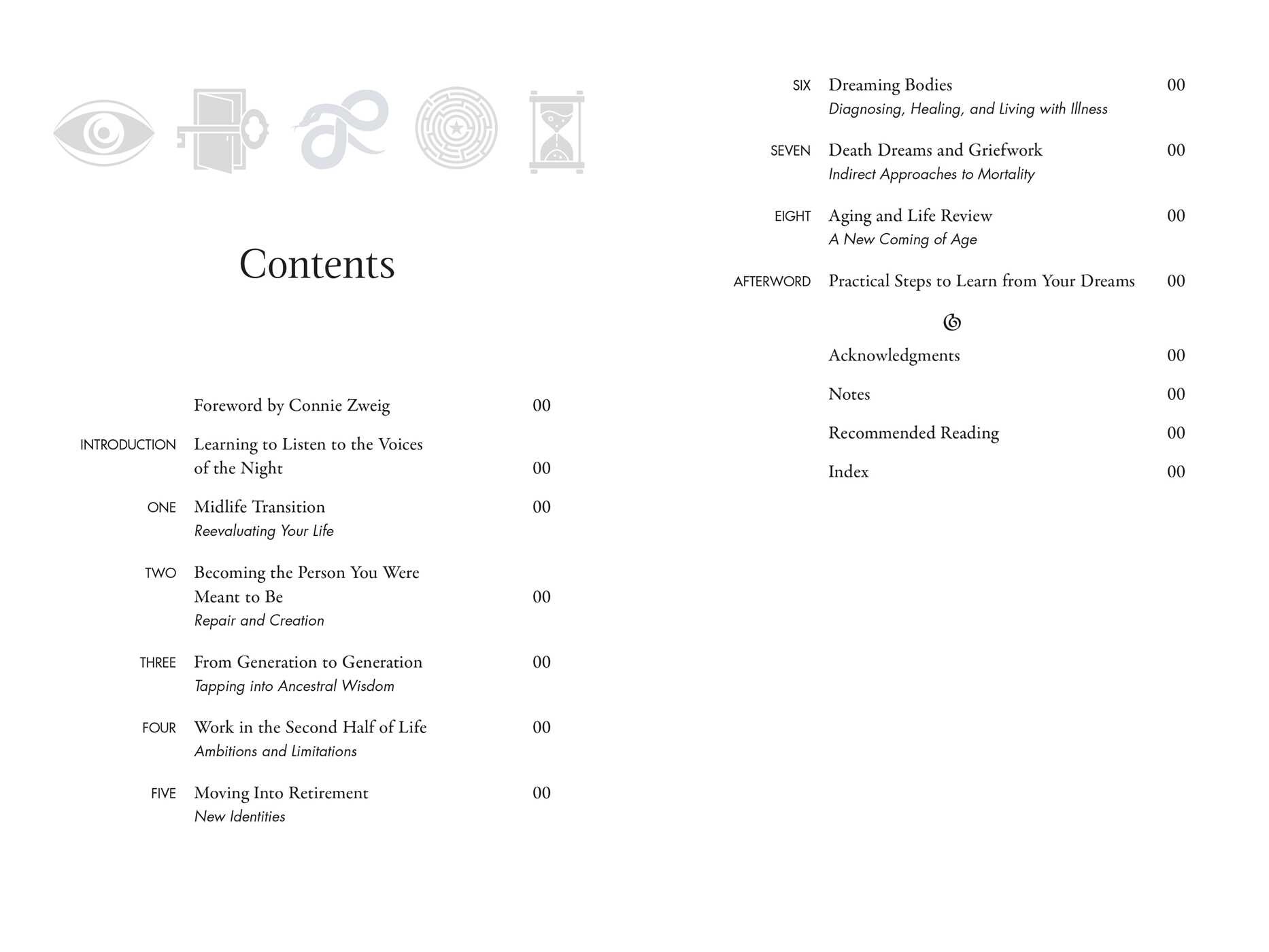
Table of Contents
About the Book
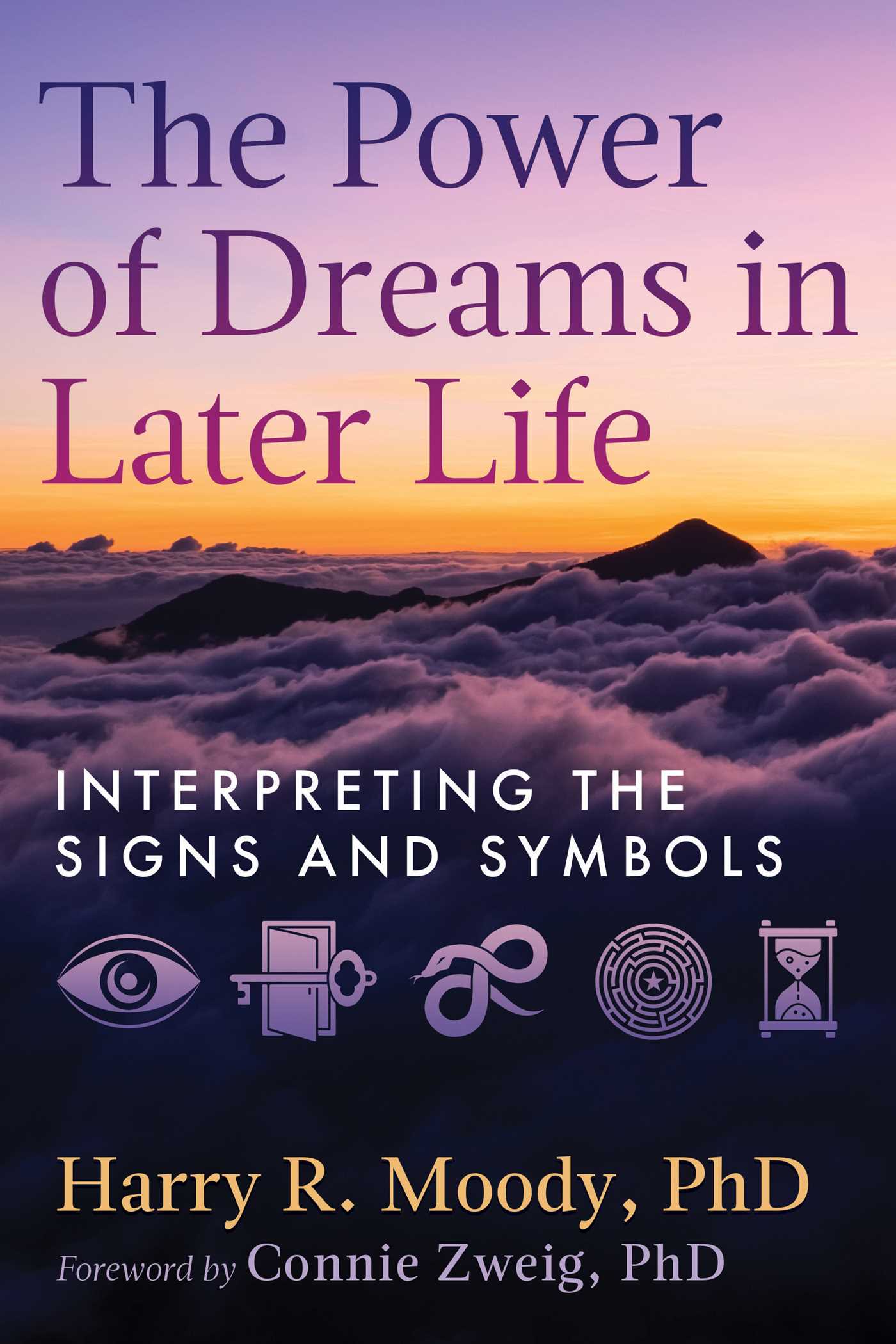
Using dreams as a compass for meaning in later life
• Explains how dreams are a source of guidance during key stages of aging, including midlife transition, retirement, illness, grief, and life review
• Shows how to work with dreams using accessible tools and practices, such as journaling, active imagination, and symbolic reflection
• Offers an approach to growth in the second half of life, drawing on research in gerontology, depth psychology, and spiritual traditions
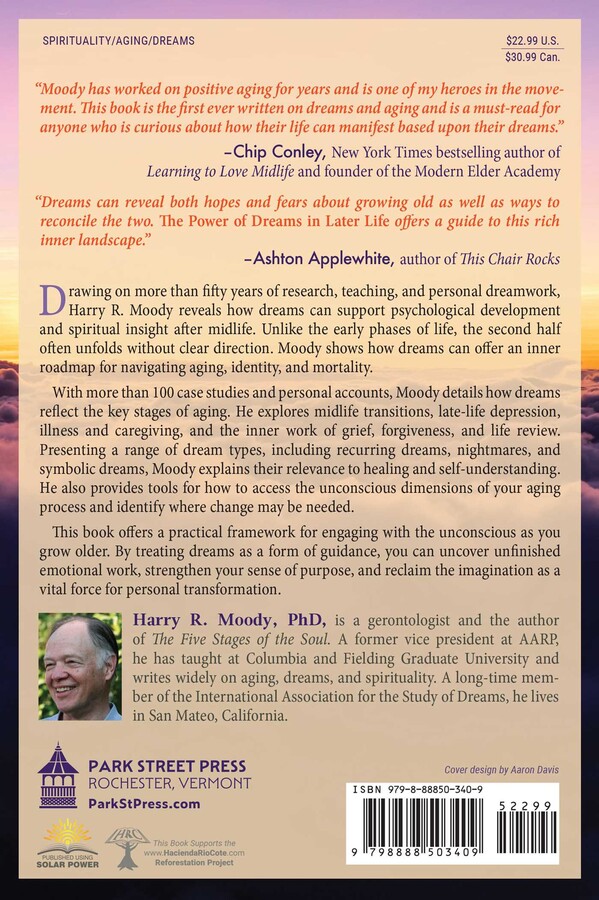
Drawing on more than fifty years of research, teaching, and personal dreamwork, Harry R. Moody reveals how dreams can support psychological development and spiritual insight after midlife. Unlike the early phases of life, the second half often unfolds without clear direction. Moody shows how dreams can offer an inner roadmap for navigating aging, identity, and mortality.
With case studies, Moody details how dreams reflect the key stages of aging. He explores midlife transitions, late-life depression, illness and caregiving, and the inner work of grief, forgiveness, and life review. Presenting a range of dream types, including recurring dreams, nightmares, and symbolic dreams, Moody explains their relevance to healing and self-understanding.
The author introduces tools for recalling and reflecting on dreams and gives guidance on how to approach them with attention rather than analysis. He draws from depth psychology, literature, and spiritual traditions to show how dreams can reveal unacknowledged emotions, inspire creative work, and help reconnect us with forgotten or repressed parts of the self. Over time, you will learn how to access the unconscious dimensions of your aging process and identify where change may be needed.
This book offers a practical framework for engaging with the unconscious during the transitions of growing older. By treating dreams as a form of guidance, you can uncover unfinished emotional work, strengthen your sense of purpose, and reclaim the imagination as a vital force for personal transformation.
• Explains how dreams are a source of guidance during key stages of aging, including midlife transition, retirement, illness, grief, and life review
• Shows how to work with dreams using accessible tools and practices, such as journaling, active imagination, and symbolic reflection
• Offers an approach to growth in the second half of life, drawing on research in gerontology, depth psychology, and spiritual traditions
Drawing on more than fifty years of research, teaching, and personal dreamwork, Harry R. Moody reveals how dreams can support psychological development and spiritual insight after midlife. Unlike the early phases of life, the second half often unfolds without clear direction. Moody shows how dreams can offer an inner roadmap for navigating aging, identity, and mortality.
With case studies, Moody details how dreams reflect the key stages of aging. He explores midlife transitions, late-life depression, illness and caregiving, and the inner work of grief, forgiveness, and life review. Presenting a range of dream types, including recurring dreams, nightmares, and symbolic dreams, Moody explains their relevance to healing and self-understanding.
The author introduces tools for recalling and reflecting on dreams and gives guidance on how to approach them with attention rather than analysis. He draws from depth psychology, literature, and spiritual traditions to show how dreams can reveal unacknowledged emotions, inspire creative work, and help reconnect us with forgotten or repressed parts of the self. Over time, you will learn how to access the unconscious dimensions of your aging process and identify where change may be needed.
This book offers a practical framework for engaging with the unconscious during the transitions of growing older. By treating dreams as a form of guidance, you can uncover unfinished emotional work, strengthen your sense of purpose, and reclaim the imagination as a vital force for personal transformation.
Excerpt
ONE
Midlife Transition
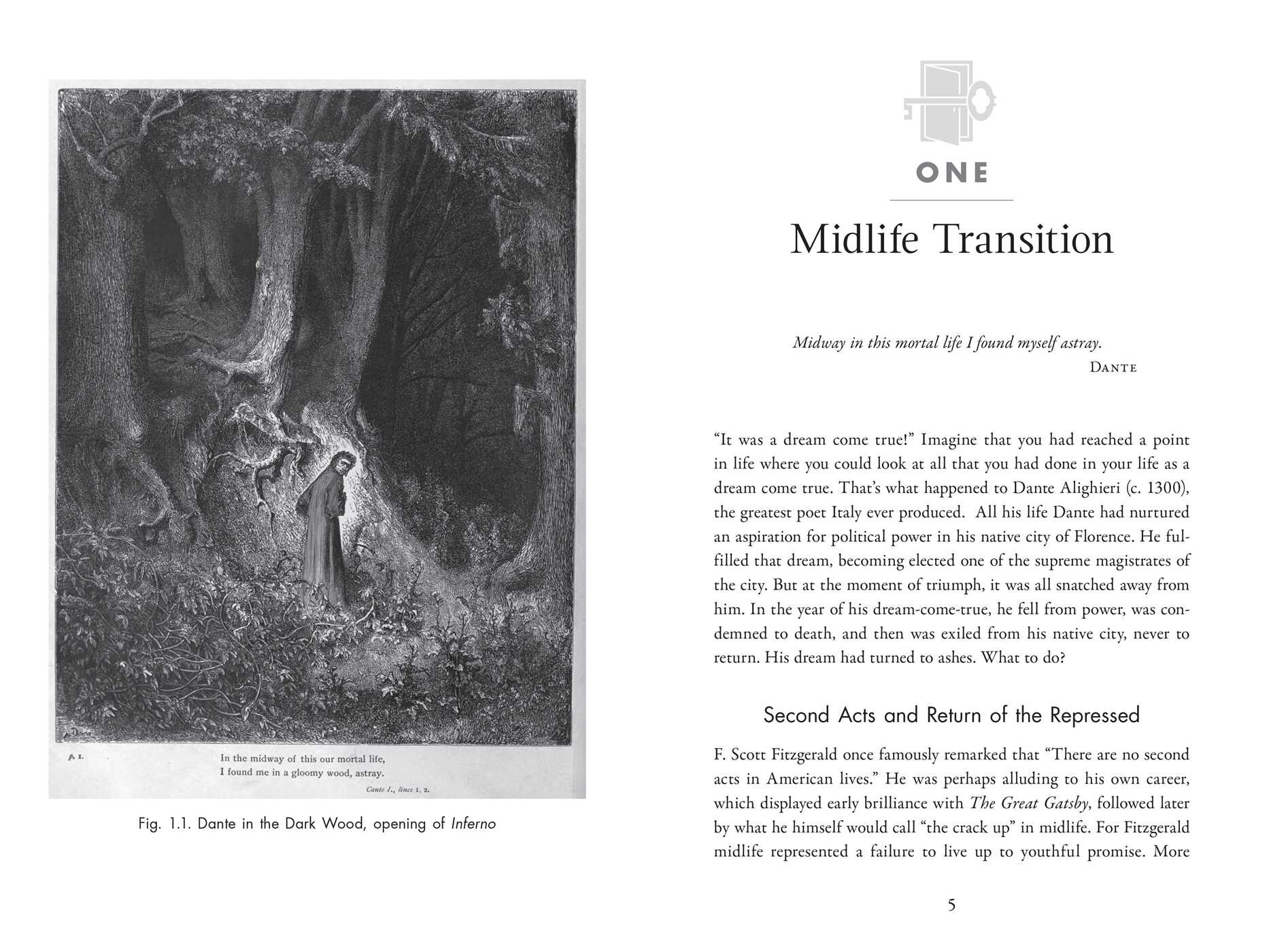
“It was a dream come true!” Imagine that you had reached a point in life where you could look at all that you had done in your life as a dream come true. That’s what happened to Dante Alighieri (circa 1300), the greatest poet Italy ever produced. All his life Dante had nurtured an aspiration for political power in his native city of Florence. He fulfilled that dream, becoming elected one of the supreme magistrates of the city. But at the moment of triumph, it was all snatched away from him. In the year of his dream-come-true, he fell from power, was condemned to death, and then was exiled from his native city, never to return. His dream had turned to ashes. What to do?
Astonishingly, instead of bitterness toward those who had destroyed the dream, Dante turned his gaze inward. He began his greatest work, Divine Comedy, with the famous lines above, realizing that, even before his dream vanished, he himself had been far astray from his true self, as he tells us candidly.
Divine Comedy was written at a time of decisive transition, for both Dante the poet and for the wider culture of Western civilization in the late Middle Ages. In the Comedy, Dante the pilgrim is cast as Everyman, the voyager who makes his way from the depths of hell, through purgatory, into a celestial vision of paradise. In making this spiritual journey Dante frames for us an enduring story for the second half of life as a time when we turn away from the dreams of youth, fulfilled or not, toward a deeper understanding of our place in the universe and toward the ultimate meaning of our lives.
Dante the poet could take for granted a whole framework of common culture embodied in the medieval Church and in traditions of philosophy and literature. By refashioning the epic poems of Homer and Virgil, Dante could recast classical ideas in his own terms, seeing his own life in terms of a larger religious cosmology where the individual found pattern and purpose. Such a framework is rarely available today. By the early twentieth century, when James Joyce would try to frame a similar epic in his own masterpiece, Ulysses, a whole human lifetime was condensed into a single day. Joyce’s hero seeks meaning not in an afterlife, but in everyday activities that display only a distant echo of mythic meanings. A wider “map of life,” which Dante could take for granted, was no longer available to Joyce or his contemporaries.
Today, popular culture has enshrined these questions in the phrase “midlife crisis.” But the term “crisis” will not be used in this book. Instead, we speak of “midlife transition,” viewing the middle years as a period entailing a reevaluation of one’s life. For Dante, that reevaluation was prompted by a very tangible crisis: death sentence and exile from his native Florence. In those circumstances, he couldn’t avoid asking hard questions. For some people asking these questions also comes with a crisis—illness, divorce, loss of job, and so on. But for others, there is no single event, but rather a gnawing sense of the question of meaning. Or, as I described in the opening of my own book, The Five Stages of the Soul, “‘Time is running out,’ a little voice whispers.” “Is this all there is?” the little voice whispers. “A portion of my life is already over. Shouldn’t things be better? Or at least different?”
This is the moment James Hollis has described as the Middle Passage, a time when, “The question of identity returns and one can no longer evade responsibility for it.” Again, the Middle Passage starts when we ask, “Who am I, apart from my history and the roles I have played?” During the Middle Passage that little whispering voice may come in dreams. It is quite possible to ignore the whispering voice of midlife. In the 1981 film On Golden Pond the lead character, played by elder Henry Fonda says “We’re just middle aged.” His wife, played by Katharine Hepburn, replies, “Yes, if you live to be 140.” Years after that film I had the good fortune to meet Jane Fonda, who listened to her own whispering voice. By age eighty-seven Jane Fonda had become not just a celebrity, but a prominent voice about climate change.
The unconscious perception of mortality is often the stimulus to the dreams of midlife transition. The question becomes, what are the stories our dreams are telling us? Consider the following dream from Peter O’Connor’s Dreams and the Search for Meaning:
Steering
My car wouldn’t steer and I tried to go through an old brick tunnel over a road and got stuck against the edge because of no steering. Also I couldn’t see ahead as I was on top of the hill.
And then in a second dream as detailed by O’Connor:
Freeway
I dreamed that the construction of a freeway in a suburb [of the city] is nearing completion. There is a vast expanse of asphalt but no median strips, painted arrows or traffic lights.
Both dreams draw on the image of driving. In “Steering,” the dreamer is driving the car, a perfect symbol of self-management and control. But the dreamer cannot control the car, and this condition reflects his depression and confusion about where he will go next for the rest of his life. There is a tunnel that might be a way out for him, but because he can’t steer the car—and can’t control his life—he cannot find the way. The final lines display a paradox. The dreamer is “on top of the hill,” at the high point of life, just as Dante was before his fall as leader of Florence.
In “Freeway,” the dreamer is evidently driving, but he is confronted with “construction . . . nearing completion.” The “construction” in this dream is the life we have made for ourselves by midlife, the empirical self as reflected in our resume, the family photo album, in our accumulated memories. As the dream of youth is now “nearing completion” the dreamer confronts a problem: the rest of life, the second half of life, is just a “vast expanse” without any guidance and directions.
Both these dreams employ imagery of the automobile, that great twentieth-century instrument that promotes autonomy and control in our movement through the world. Think of the importance of driving for adolescents who are trying to break free and strike out on their own. It is natural that driving a car would represent autonomy. But there may come a point in our lives when the autonomy symbolized by the car no longer works. In the first dream, the dreamer’s car “wouldn’t steer,” and so he gets stuck trying to make his way through “an old brick tunnel.” It is curious that the dreamer “couldn’t see ahead” even though his car was “at the top of a hill.” These contradictory images—a tunnel underground and the dreamer at the top of a hill—suggest opposite poles of the psyche: a path through the underworld and then the high hilltop, a point where we ought to be able to see far ahead. But not for this dreamer. Despite being in a good position he cannot see and so he remains stuck.
The second dream adds imagery of the freeway to that of the automobile. The dreamer is seeking a path that would be free or lead to freedom. But in this dream the road leads only to confusion. In “big” dreams a city may represent the totality of the psyche or the self in its comprehensiveness. In this second dream the city (the self) is “nearing completion” but the dreamer remains on the outskirts, in the suburbs, not in the city itself.
To go into the self is to enter strange territory where we need guidance if we are not to get lost. This dreamer, in the midst of crisis, finds no guidance: no median strips, no arrows, no traffic lights. Here is an image of the self without direction, without any way of finding a “free” way to enter the city of the genuine self, firmly in the “middle passage” when we, in every respect, simply don’t know where we are going.
Midlife Transition
“It was a dream come true!” Imagine that you had reached a point in life where you could look at all that you had done in your life as a dream come true. That’s what happened to Dante Alighieri (circa 1300), the greatest poet Italy ever produced. All his life Dante had nurtured an aspiration for political power in his native city of Florence. He fulfilled that dream, becoming elected one of the supreme magistrates of the city. But at the moment of triumph, it was all snatched away from him. In the year of his dream-come-true, he fell from power, was condemned to death, and then was exiled from his native city, never to return. His dream had turned to ashes. What to do?
Astonishingly, instead of bitterness toward those who had destroyed the dream, Dante turned his gaze inward. He began his greatest work, Divine Comedy, with the famous lines above, realizing that, even before his dream vanished, he himself had been far astray from his true self, as he tells us candidly.
Divine Comedy was written at a time of decisive transition, for both Dante the poet and for the wider culture of Western civilization in the late Middle Ages. In the Comedy, Dante the pilgrim is cast as Everyman, the voyager who makes his way from the depths of hell, through purgatory, into a celestial vision of paradise. In making this spiritual journey Dante frames for us an enduring story for the second half of life as a time when we turn away from the dreams of youth, fulfilled or not, toward a deeper understanding of our place in the universe and toward the ultimate meaning of our lives.
Dante the poet could take for granted a whole framework of common culture embodied in the medieval Church and in traditions of philosophy and literature. By refashioning the epic poems of Homer and Virgil, Dante could recast classical ideas in his own terms, seeing his own life in terms of a larger religious cosmology where the individual found pattern and purpose. Such a framework is rarely available today. By the early twentieth century, when James Joyce would try to frame a similar epic in his own masterpiece, Ulysses, a whole human lifetime was condensed into a single day. Joyce’s hero seeks meaning not in an afterlife, but in everyday activities that display only a distant echo of mythic meanings. A wider “map of life,” which Dante could take for granted, was no longer available to Joyce or his contemporaries.
Today, popular culture has enshrined these questions in the phrase “midlife crisis.” But the term “crisis” will not be used in this book. Instead, we speak of “midlife transition,” viewing the middle years as a period entailing a reevaluation of one’s life. For Dante, that reevaluation was prompted by a very tangible crisis: death sentence and exile from his native Florence. In those circumstances, he couldn’t avoid asking hard questions. For some people asking these questions also comes with a crisis—illness, divorce, loss of job, and so on. But for others, there is no single event, but rather a gnawing sense of the question of meaning. Or, as I described in the opening of my own book, The Five Stages of the Soul, “‘Time is running out,’ a little voice whispers.” “Is this all there is?” the little voice whispers. “A portion of my life is already over. Shouldn’t things be better? Or at least different?”
This is the moment James Hollis has described as the Middle Passage, a time when, “The question of identity returns and one can no longer evade responsibility for it.” Again, the Middle Passage starts when we ask, “Who am I, apart from my history and the roles I have played?” During the Middle Passage that little whispering voice may come in dreams. It is quite possible to ignore the whispering voice of midlife. In the 1981 film On Golden Pond the lead character, played by elder Henry Fonda says “We’re just middle aged.” His wife, played by Katharine Hepburn, replies, “Yes, if you live to be 140.” Years after that film I had the good fortune to meet Jane Fonda, who listened to her own whispering voice. By age eighty-seven Jane Fonda had become not just a celebrity, but a prominent voice about climate change.
The unconscious perception of mortality is often the stimulus to the dreams of midlife transition. The question becomes, what are the stories our dreams are telling us? Consider the following dream from Peter O’Connor’s Dreams and the Search for Meaning:
Steering
My car wouldn’t steer and I tried to go through an old brick tunnel over a road and got stuck against the edge because of no steering. Also I couldn’t see ahead as I was on top of the hill.
And then in a second dream as detailed by O’Connor:
Freeway
I dreamed that the construction of a freeway in a suburb [of the city] is nearing completion. There is a vast expanse of asphalt but no median strips, painted arrows or traffic lights.
Both dreams draw on the image of driving. In “Steering,” the dreamer is driving the car, a perfect symbol of self-management and control. But the dreamer cannot control the car, and this condition reflects his depression and confusion about where he will go next for the rest of his life. There is a tunnel that might be a way out for him, but because he can’t steer the car—and can’t control his life—he cannot find the way. The final lines display a paradox. The dreamer is “on top of the hill,” at the high point of life, just as Dante was before his fall as leader of Florence.
In “Freeway,” the dreamer is evidently driving, but he is confronted with “construction . . . nearing completion.” The “construction” in this dream is the life we have made for ourselves by midlife, the empirical self as reflected in our resume, the family photo album, in our accumulated memories. As the dream of youth is now “nearing completion” the dreamer confronts a problem: the rest of life, the second half of life, is just a “vast expanse” without any guidance and directions.
Both these dreams employ imagery of the automobile, that great twentieth-century instrument that promotes autonomy and control in our movement through the world. Think of the importance of driving for adolescents who are trying to break free and strike out on their own. It is natural that driving a car would represent autonomy. But there may come a point in our lives when the autonomy symbolized by the car no longer works. In the first dream, the dreamer’s car “wouldn’t steer,” and so he gets stuck trying to make his way through “an old brick tunnel.” It is curious that the dreamer “couldn’t see ahead” even though his car was “at the top of a hill.” These contradictory images—a tunnel underground and the dreamer at the top of a hill—suggest opposite poles of the psyche: a path through the underworld and then the high hilltop, a point where we ought to be able to see far ahead. But not for this dreamer. Despite being in a good position he cannot see and so he remains stuck.
The second dream adds imagery of the freeway to that of the automobile. The dreamer is seeking a path that would be free or lead to freedom. But in this dream the road leads only to confusion. In “big” dreams a city may represent the totality of the psyche or the self in its comprehensiveness. In this second dream the city (the self) is “nearing completion” but the dreamer remains on the outskirts, in the suburbs, not in the city itself.
To go into the self is to enter strange territory where we need guidance if we are not to get lost. This dreamer, in the midst of crisis, finds no guidance: no median strips, no arrows, no traffic lights. Here is an image of the self without direction, without any way of finding a “free” way to enter the city of the genuine self, firmly in the “middle passage” when we, in every respect, simply don’t know where we are going.
Product Details
- Publisher: Park Street Press (November 3, 2026)
- Length: 288 pages
- ISBN13: 9798888503409
Browse Related Books
Raves and Reviews
“Moody has worked on positive aging for years and is one of my heroes in the movement. This book is the first ever written on dreams and aging and is a must-read for anyone who is curious about how their life can manifest based upon their dreams.”
– Chip Conley, New York Times bestselling author of Learning to Love Midlife and founder of the Modern
“Dreams can reveal both hopes and fears about growing old as well as ways to reconcile the two. The Power of Dreams in Later Life offers a guide to this rich inner landscape.”
– Ashton Applewhite, author of This Chair Rocks
“In this book, Harry Moody ingeniously shows us how our personal dreams often light the way for the years ahead. This is new territory that no one has ever explored with such depth and dimension. This is the book we’ve been waiting for.”
– Ken Dychtwald, PhD, psychologist, gerontologist, author, and CEO of Age Wave
“One of the world’s foremost experts on aging, Harry R. Moody is a wonderful guide to all aspects of later life. This book will help you tap your dreams as a source of insight, healing, and creativity. If you’re seeking renewed purpose and growth in your later years, start here!”
– Marc Freedman, founder of CoGenerate and author of How to Live Forever
“With this book, Moody proves himself to be a master of three realms: conscious aging, social action, and now the unconscious inner world of our dreams. His thoughtful and revealing new work provides an apt guide to unlocking the mystery of our lives and celebrating aging, not as a problem to be solved—but as a culmination.”
– Carol Orsborn, author of Spiritual Aging and coauthor of The Spirituality of Age
“Recounting gripping reports from diverse people, Moody illustrates how midlife dreams can inspire and guide dramatic development in our lives, where the new challenge becomes grappling with whatever the individual neglected in youth—from forgotten trauma to undeveloped talents. The result is psychological and spiritual flourishing—ultimately, wisdom.”
– Allan B. Chinen, MD, author of In the Ever After, Once Upon a Midlife, Beyond the Hero, and The Muse
“Life can get richer and more meaningful with age. Harry R. Moody shows us how. In his purposeful book, he does what he does best—explores the depth of the human spirit and what it means to live life to the fullest.”
– Richard J. Leider, founder and chairman of The Inventure Group and coauthor of the bestselling books
“Moody draws on decades of wisdom in the field of aging to illuminate the profound role dreams can play in helping us navigate life’s later chapters. I’ve seen firsthand his remarkable gift for helping people uncover meaning and insight through their dreams. This thoughtful and inspiring book is a true labor of love and an important contribution to anyone seeking greater self-understanding, growth, and purpose as they age.”
– Dorian Mintzer, PhD, author, retirement transition coach, and host of the Revolutionize Retirement p
“An important and timely book for those navigating the second half of life. While our culture offers countless instructions on how to stay busy, productive, or youthful, it provides very little guidance for the deeper inner work that aging requires. In this book, Harry opens a doorway to a neglected source of wisdom—the dream life. With compassion, insight, and decades of expertise, he shows how dreams can illuminate life’s transitions, losses, opportunities, and ultimate questions. A valuable companion for anyone seeking meaning, purpose, and self-understanding as they grow older.”
– Dr. Marc B. Cooper, founder of the Contemporary Elder Institute
“Exhibiting the same blend of deep scholarship and personal wisdom as his prior writings, this work demonstrates through multiple examples how to imagine courageously as we approach life transitions, including the last one.”
– Peter Whitehouse, MD, professor of neurology at Case Western Reserve University and author of The My
Resources and Downloads
High Resolution Images
-
Book Cover Image (jpg): The Power of Dreams in Later Life
Trade Paperback 9798888503409