Plus, receive recommendations and exclusive offers on all of your favorite books and authors from Simon & Schuster.
Table of Contents
About the Book
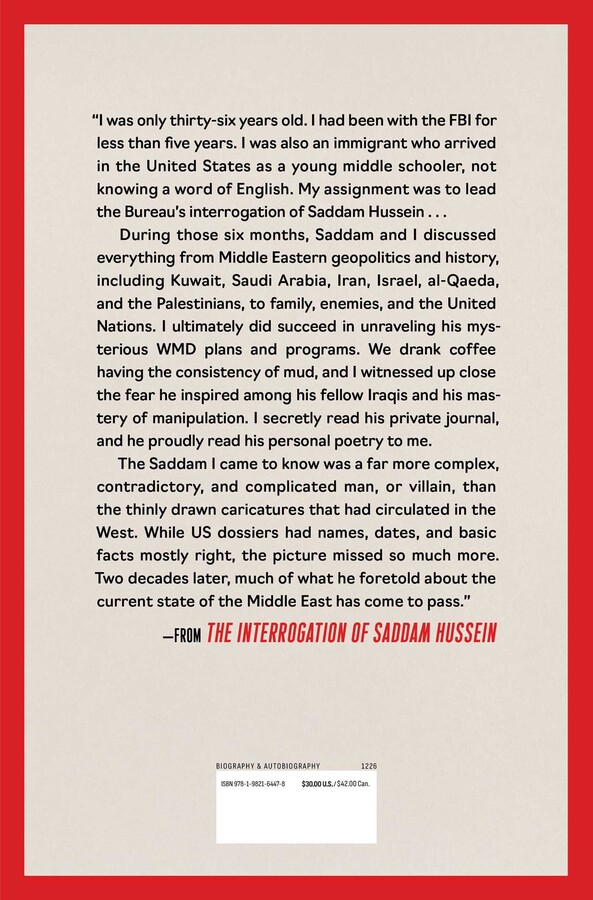
The lead US interrogator of Saddam Hussein FBI agent George Piro delivers a riveting account of his six months with Saddam, in formal interrogations and unguarded conversations, revealing surprising truths about the dictator’s psyche, the complexity of power, and key decisions that shaped today’s Middle East.
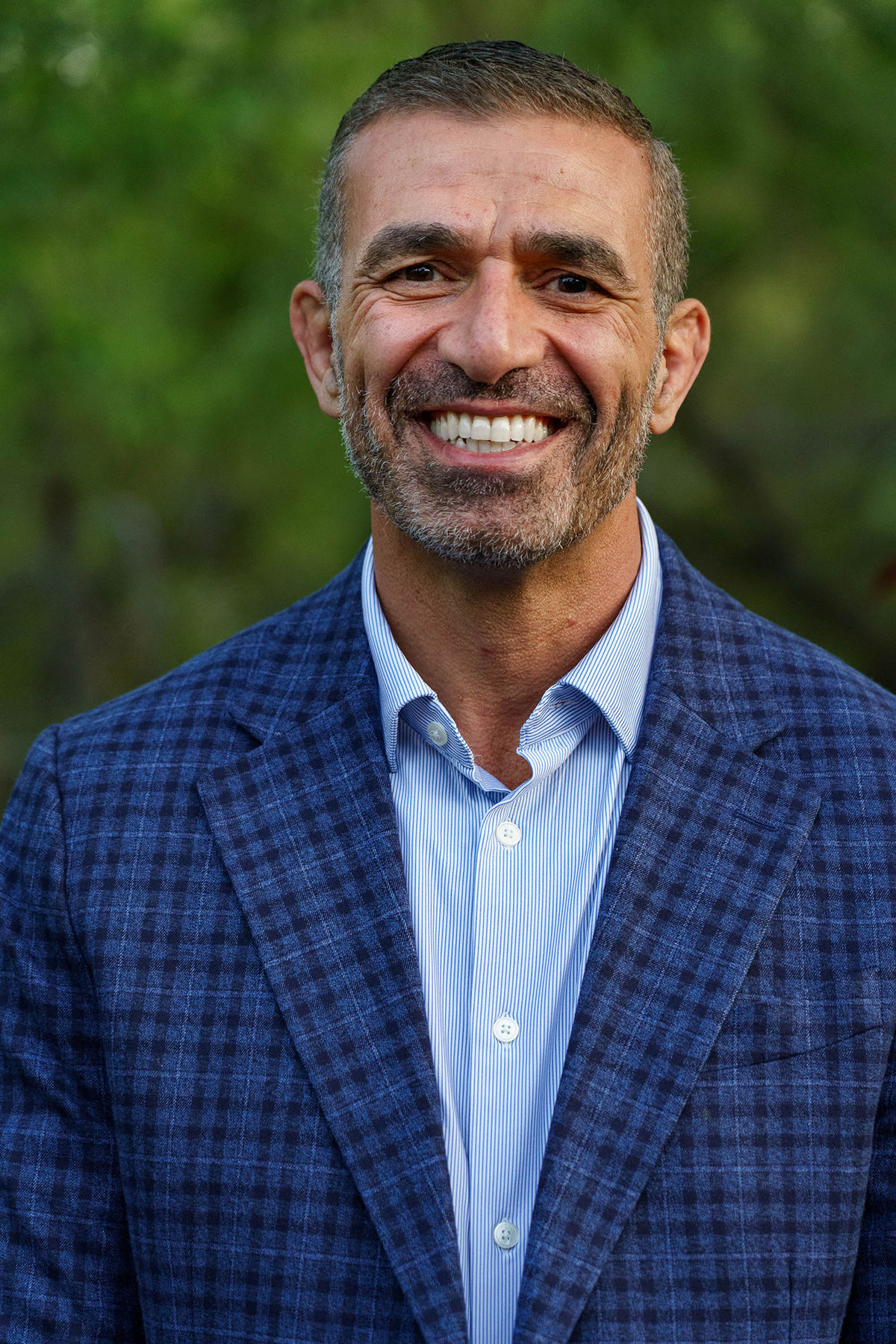
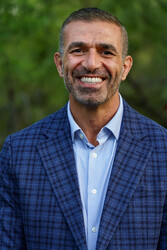
In The Interrogation of Saddam Hussein, George Piro, an Assyrian-American, Arabic-speaking former FBI Special Agent, recounts his extraordinary experiences as the lead interrogator of Saddam Hussein during his US captivity. Over six months, Piro spent more than five hundred hours with the former Iraqi dictator, forging an unprecedented connection with a man defined by his brutal and oppressive rule. Through one-on-one conversations in the exercise yard, during doctors’ visits, and over morning cups of coffee, as well as passages from Saddam’s prison diary, Piro unveils a complex portrait of a war criminal, poet, father, and tyrant.
This gripping narrative offers a rare glimpse into Saddam Hussein’s psyche, his reflections on power, and his role in shaping the Middle East. Piro’s account also sheds light on US actions and perceptions, providing critical insights for future foreign policy decisions. The Interrogation of Saddam Hussein is not just a story of one man’s incredible mission—it’s a profound exploration of leadership, accountability, and the human cost of war.
Appearances
JAN 5
7:00PM
Books & Books
265 Aragon Avenue
Coral Gables, FL 33134
Excerpt
Chapter 1 1
Interrogations are the ultimate mental chess game. In chess, the setup is always the same: one board, sixty-four squares, the same number of pieces always arranged in the same order, and traditionally, white versus black, with white going first. But everything else is up for interpretation. Chess grandmaster Garry Kasparov is known to have assembled a personal database of more than twenty thousand possible openings for each chess match. As with the physical chessboard, much of the mental chess required for conducting a successful interrogation begins with selecting the right opening. My opening began in January 2004 in Camp Cropper, the US prison space for high-value detainees in Baghdad, Iraq.
The C-17 transport plane came in high and tight and fast over Baghdad and then hit a dead stop above the airport runway complex, like slamming on the brakes of a car at more than two hundred miles per hour. Inside the cockpit, the pilot had pulled the throttle back to idle. Strapped into our hastily added seats inside the bay of the retrofitted cargo plane, we could hear the engines die on the wings. Their ear-splitting whir and rattle became a low thump followed by a sharp whine as the heavy jet’s massive fan blades ceased to turn. The start of this descent maneuver, known as “the corkscrew,” was designed to save our lives. An engine in idle automatically begins to cool, making it less of a target for heat-seeking missiles, which were plentiful below.
I stared straight ahead, watching my breath crystallize in the frigid air. The Boeing C-17 Globemaster III was designed to haul equipment—jeeps, tanks, armored personnel carriers, extra flak jackets, and caches of guns. There was no heat. It was also dark.
January 13, 2004, marked almost nine months since what had been called the end of major combat operations in Iraq, and the only way to land safely at Baghdad International Airport was to descend at night in a corkscrew dive. Private commercial planes had stopped flying in late November 2003 after a surface-to-air missile hit the engine on a DHL flight during a 6:30 a.m. takeoff. The only places where an airplane was secure were either aloft at thirty thousand feet or stationary on the tarmac behind the reinforced maze of concrete walls, Hesco barriers, and concertina wire. Neither the pilots nor the passengers wanted to spend any extra moments in the vulnerable envelope in between.
I had a split second to make my choice: brace and fight the spin or lean into the flow as we descended. I leaned in.
The pilot began to turn the plane in an ever-tightening downward spiral, dropping a few thousand feet with each rotation. Spirals keep the airplane moving in three dimensions rather than following a single trajectory on a fixed path, making the plane’s motion less predictable and, thus, more difficult to shoot down with antiaircraft guns or small arms.
Similar to the way a tornado’s funnel cloud rotates in the extreme to pull everything in its path up from the ground, our plane was doing the opposite, fighting its way down through the air, until four or so minutes later, the C-17’s wheels collided with the pockmarked tarmac, and the hard, teeth-rattling jolt told us that we had landed otherwise unscathed.
The descent was an excellent metaphor for Iraq itself: every trip was perilous. As if to emphasize this point, the airport was ringed by concrete barriers and scrappy-looking metal signs that warned in English and Arabic: “This is a kill zone.” “Deadly force authorized.” I grabbed my duffel bag, hoisted my backpack, and began walking toward the terminal as a few heavily armed helicopters thumped in the skies and the generators surrounding the compound droned and shuddered. Modern war runs on engines and electricity, and it is loud.
For years, the terminal building had been named “Saddam International Airport.” After the US and coalition forces arrived, the “Saddam” was ripped down, and only the off-center lettering “International Airport” remained. But Saddam’s presence still loomed large over the compound, which would be my home from now until the brutal heat of July.
Inside, there was no passport control or immigration. The entire interior of the airport was frozen, a time capsule of flights and information from March 2003, when the US and its coalition partners began the aerial assault on Baghdad, with the stated goals of disarming the Iraqi regime, rooting out its weapons of mass destruction (WMDs)—which included chemical, biological, and nuclear weapons—and removing Saddam from power. Now, the international airport was under the control of the US and its coalition partners. The only “foreign” space that I would be entering was a CIA outpost—I worked for the FBI.
I was only thirty-six years old. I had been with the FBI for less than five years and had earned the rank of supervisory special agent, which is below a special agent in charge, and somewhat akin to a police lieutenant. I was also an immigrant who arrived in the United States as a young middle schooler, not knowing a word of English. I began my career as a police officer and detective in Ceres, a small city deep in California’s Central Valley. I attended night school for my college degree. My assignment was to lead the Bureau’s interrogation of Saddam Hussein, the deposed Iraqi president and strongman who had ruled his nation for twenty-four years and driven the US to war not once but twice.
The call came on Christmas Eve of 2003, at around 5 p.m. I was heading to Fair Oaks Mall in sprawling Northern Virginia, outside of Washington, DC, to do my last-minute holiday shopping when my government-issued BlackBerry buzzed. The section chief within the FBI’s counterterrorism division—my boss’s boss—was on the line. His purpose, he said, was to inform me that I had been selected as the FBI’s lead interrogator for Saddam Hussein.
Along with much of the world, I had followed the news of Saddam’s capture outside of Tikrit on December 13, when he was pulled from a hole in the ground by US forces at 8:30 p.m. Within a few days, I heard that the FBI had been asked to assist in Saddam’s interrogation and that the Bureau was trying to build a team—the rationale behind this was driven by the rules of US and international law.
At that moment, Iraq had no domestic government. With Saddam in US custody, there would have to be a trial. He was accused of some of the worst crimes against humanity of the late twentieth century, including using poison gas on parts of his population, torture, political detentions, and murder. No one knew where that trial would take place—possibly in an international tribunal or something akin to the post–World War II Nuremberg Trials of the Nazi German high command—or how the prosecutors would develop their case, but the leadership in Washington believed that prisoner interrogation would be critical. In a court of law, FBI agents could testify and have their notes entered into the trial record. The CIA could not or would not. The Agency likely did not want to be questioned about or discuss any aspects of its information-gathering techniques, which included its “enhanced interrogation” program that utilized stress positions, waterboarding, and sleep deprivation. CIA leadership wanted its memos and papers kept out of view and its officers to avoid the witness box. No one from Langley would be raising his or her right hand.
So, in the finely brokered compromise hatched between the higher-ups at the George Bush Center for Intelligence and the J. Edgar Hoover Federal Bureau of Investigation, the FBI was selected to take the lead, although the CIA never surrendered its overall control of the operation. The CIA had to approve Saddam’s FBI interrogator, and the CIA also set the priorities and objectives.
At the top of the information list was finding out whatever we could about Saddam’s weapons of mass destruction program, the ostensible reason why we went to war, and any ties between Iraq and Osama bin Laden’s al-Qaeda terror network. Human rights violations and prosecutable offenses would be lower down, but still relevant, particularly for a public trial. Perhaps the American leadership was anticipating a repeat of the type of trial conducted for Japan’s prime minister Hideki Tojo after World War II. Unlike the Japanese emperor Hirohito, whom General Douglas MacArthur had excluded from any war crime trials and thus essentially de facto pardoned, Tojo was arrested by US troops, tried by the International Military Tribunal for the Far East (a multinational court of the eleven Allies who had fought against Japan), and sentenced to death by hanging.
But I didn’t think much about the nuances of the interrogation operation until my phone rang. I certainly never thought it would be me.
Of course I said yes. But as I did, a wave of panic washed over me. In most situations, agents rely on instinct and training to modulate their reactions. Overthinking often leads to poor decisions, which is sometimes referred to as paralysis by analysis. Too much time spent ruminating can lead to picking apart what had been a good idea. Or it can lead one to envision too many potential problems. Here, I had a bit too much time to think and to imagine a range of possibilities.
I shut off the car engine, sprinted into the mall, and headed straight for a bookstore. These were the days before smartphones, when internet searching was still somewhat primitive, particularly for the government and anyone using government-issued electronics. Two years earlier, I had watched the passenger manifests for the 9/11 hijacked planes slowly populate line by line on a dot matrix printer, hoping the ink ribbon wouldn’t run out. Books and printed materials were still our primary means of research.
Inside the Barnes & Noble, I scanned the shelves, found two biographies on Saddam, bought them, and then grabbed a few Christmas gifts. These books were my beginning. Inside the FBI’s Washington headquarters, where I had already been detailed on another assignment, I watched the limited recent TV footage: CBS Evening News anchor Dan Rather’s February 2003 interview of Saddam in Baghdad and clips of actor Sean Penn’s December 2002 visit. I pored over the official US government profiles and classified background on Saddam. Once inside Iraq, face-to-face with my subject in a windowless room, I would learn that these profiles, in particular, were woefully incomplete. Our government write-ups relied heavily on human assets or informants who didn’t necessarily have an intimate understanding of Saddam, and in too many cases had never even met him or had only a very superficial engagement with present-day Iraq. Consequently, most of what was written was deeply generic or observed from the periphery. The US had not been able to recruit anyone who could legitimately claim to operate anywhere near Saddam’s inner circle. A lot of our understanding of Saddam was based partly on fact, partly on myth, and partly on assumption. And, as I would learn, much of it was wrong. Even the certainty that Saddam dyed his hair.
I could not know it then, but over the next six months, I would spend more time with Saddam, up to seven hours a day, than either of his two sons did during their entire lives. Not Uday, whom Saddam jailed briefly after he stabbed and killed his father’s valet and food taster, nor Qusay, whom Saddam had been grooming as his successor until the US invasion. Both sons had been killed in the summer of 2003 when a 2nd Brigade Combat Team raided a house at the northern edge of the city of Mosul, following a “walk-up” tip from a tribal leader who was one of Saddam’s distant cousins. After a six-hour gun battle and the use of multiple weapons systems, four bodies were recovered. Uday’s and Qusay’s remains were among them.
During those six months, Saddam and I discussed everything from Middle Eastern geopolitics and history, including Kuwait, Saudi Arabia, Iran, Israel, al-Qaeda, and the Palestinians, to family, enemies, and the United Nations. I ultimately did succeed in unraveling his mysterious WMD plans and programs. We drank coffee having the consistency of mud, and I watched as Saddam flirted, sometimes successfully, with multiple American military women. I witnessed up close the fear he inspired among his fellow Iraqis and his mastery of manipulation. He told me why he relied on women as his informants and why he went to war with Kuwait. I secretly read his private journal, and he proudly read his personal poetry to me.
The Saddam I came to know was a far more complex, contradictory, and complicated man, or villain, than the thinly drawn caricatures that had circulated in the West. While US dossiers had names, dates, and basic facts mostly right, the picture missed so much more. I saw up close how Saddam framed events in his own mind, how he justified aggression against Kuwait, or attacks on Iraqi minorities. He explained to me how he enforced his code of loyalty, and who failed that test and why. He understood how to motivate and also how to terrify, yet he wanted to be known as something of an Arab Renaissance–style ruler. He was determined to become a celebrated novelist, yet he started school quite late, and his handwriting was abysmal. He was ruthless and rapid in dispatching his enemies, but his Arabic and even at times his thoughts meandered with clause piled upon clause. He was a father who had regrets over his sons and still had not given up on having more children. He was fiercely competitive, a keen observer of the most minute details, and the most shrewdly calculating individual I have ever known. Yet, he could be funny and charming and even vulnerable. He even indulged in a bit of philosophizing.
Two decades later, much of what he foretold about the current state of the Middle East has come to pass. And he also set in motion key recent events. He was a major player in the Palestinian cause, including being among the earliest champions and significant financial backers of Hamas, the Palestinian Sunni Islamic militant group, when it first emerged in Gaza in 1987. Even more surprisingly, his ideas are widely echoed today in segments of the American foreign policy debate. His critiques of how Cold War–era nongovernmental organizations, NGOs, operated, as well as the dangers posed by Iran and its regime’s tactics, would make him right at home as a featured guest on The Joe Rogan Experience. His thoughts on the power and corruption of the US military-industrial complex, the American government’s ever-changing friends-and-enemies list, and PR machinations around war today might land him on Pod Save America or on a panel at an Ivy League university.
While he kept a Koran in his room and prayed to Allah, he was not an Islamist, but rather the head of a sweeping, corrupt, and brutal enterprise. He was, ultimately, a puzzle. Every day, without a battlefield to command, he was prepared to battle wits. After being forced to throw out nearly all the official US psychological profiles of Saddam, I set about constructing my own. Our months together also significantly changed my approach to the science of interrogation.
But in the beginning, all I wanted to do was to keep him talking. Because, according to the rules of the Geneva Conventions, an enemy prisoner of war can terminate an interrogation at any time. I half expected that Saddam would refuse to speak, my mission would be shut down, and I would be leaving in a week or two much the same way that I arrived, on a corkscrew flight out. Indeed, from the top of the Bureau down (and almost certainly inside the CIA as well), the expectation was that this mission was set up to fail.
The US Army names everything, and Victory Base Complex, the sprawling compound that swallowed the Baghdad International Airport whole, was no exception. Beyond the reach of the airport terminals were ten different US bases, each with its own name—the biggest being Camp Victory—as well as additional living sectors including Omaha Beach, Freedom Village, and the Dodge Cities.
Saddam Hussein recognized the airport’s utility when he ruled Iraq. He built rows of squat, concrete military barracks, and even one of his many palaces, the Al-Faw Palace, was located within the airport’s larger footprint. Al-Faw had sixty-two rooms and twenty-nine bathrooms and sat on a man-made pond, its stone pillars reflecting in the water below. Likely to please Saddam, the architect who built it seemed to have modeled some of its elements on Versailles, although its main chandelier was partly plastic and the gold leaf was fake. Following in the traditions of ancient Ottoman sultans or the rulers of Spain’s Islamic Nasrid dynasty, Saddam’s initials were etched into the palace’s surface decoration. But where generations of Ottomans and Nasrid rulers had inscribed Koranic verses as decorative elements on their walls, ceilings, and columns, Saddam had his poetry and sayings embedded in Al-Faw’s design. It was one of nearly one hundred presidential palaces and villas, and Saddam probably spent at most eight nights inside its thin interior walls. As Baghdad fell, it was quickly commandeered to serve as the coalition forces’ military headquarters.
I wasn’t heading to Al-Faw. Far from it. My destination was a CIA compound, which had been built within the airport complex. The airport also contained a detention facility for “high-value” detainees. The facility was called Camp Cropper, named for Kenneth Cropper, a member of the Maryland National Guard who had died in March 2002 while detailed to the Pentagon. Someone had hand-painted a sign in neat capital letters with the symbols of the Maryland state flag and the notation “In memory of.” Camp Cropper was the holding place for the top one hundred or so Iraqi captives, including Saddam’s cabinet officers, his ministers, his generals, and intelligence higher-ups. These were the names on the US’s infamous “Iraq Most Wanted” deck of playing cards. Nearly all the other captured Iraqis were confined inside the ruined regime’s former torture chamber, a soon-to-be infamous prison named Abu Ghraib.
Camp Cropper was a grim place: a collection of barracks that had been converted to prison cell buildings, three trailers for interrogations, additional barracks for the soldiers who guarded and administered the place, a gymnasium, a health clinic, and a building for meetings. (The original Camp Cropper had been even more desolate, a vast canvas tent city where each tent held more than one hundred prisoners and there was barely enough water to drink, let alone bathe.) Expansion at the second Camp Cropper was accomplished by adding CONEX boxes, the Army’s ubiquitous portable trailer units, which were modeled after shipping containers. Entry to the camp was through a series of checkpoints and gates with mandatory ID checks. Weapons were not allowed.
The post–World War II Geneva Conventions’ rules covering detainees mandated that all enemy prisoners of war (EPWs—what we used to call POWs) have access to the outside, so Camp Cropper offered what were euphemistically called “courtyards,” open areas with walkways surrounded by a layer of crushed, small white rocks spread over the dirt. (The few shrubs that had survived were cut down after the detainees tried to hide pills and cigarettes in the branches.) The not-so-subtle reminder to everyone that this was not some suburban office park’s employee gathering spot were the courtyards’ edges. They were marked off by engineer tape and jumbles of razor-sharp concertina wire.
For seating, the camp overseers had placed picnic tables on the crushed white rocks, and that’s where the detainees would congregate. I would walk by and see the former Iraqi foreign minister, Tariq Aziz, or Ali Hassan al-Majid, otherwise known as Chemical Ali, sitting on the benches. Before I arrived, someone had dubbed these detainee courtyards “the petting zoo,” and the name stuck.
The camp was not just rough, it literally stank. In some sections, the stench from burning garbage and sewage overflow was pervasive. The entire spot had apparently been built on a landfill. A no-man’s-zone of feces and dead animals covered the expanse between the terminus of Camp Cropper and the main section of Camp Victory. As temperatures rose, it smelled like hell, but the expectation was that everyone who traversed the route would get used to it. I did. In the same way, we were also expected to adapt to the thick dust, the piles of trash that rotted in the rain, the scattered litter, and the hulking debris of war, blown-out tanks and destroyed vehicles, which no one bothered to clean or cart away.
My destination was the rear of Camp Cropper. Here, the rows of buildings and the white-rock petting zoo petered into a nondescript, cracked concrete walkway at least one hundred yards long. It appeared to be a dead end that accumulated blowing bits of trash, but instead, there was a small entrance to a highly secure section with another restrictive gate. The area was partitioned with plywood and became known euphemistically as “the Wood.” The makeshift plywood had been erected to create walls and corridors, so it was both windowless and claustrophobic. Guards stood at each set of doors, unlocking and locking them after each person or small team had passed.
To maximize security and secrecy, the Wood was supervised by a different deployment of National Guard personnel than those keeping watch over the rest of Camp Cropper. National Guard forces oversaw the entire base. The vast majority were trained Guard MP (Military Police) units, which were considered better prepared and more appropriate for guarding the detainees. The Wood was manned by a small component of the Puerto Rico National Guard, selected specifically because they primarily spoke Spanish, not English. They were kept physically separated from the other National Guard soldiers.
Most people assumed the Wood was simply another administrative area. But in fact, one detainee resided in the barracks located inside. His cell was down a small hallway, and behind the second door on the left. The highest-value detainee of them all, the ace of spades on the US’s most wanted card deck: Saddam Hussein. Internally, the FBI also referred to him by his code name, “Desert Spider,” given to Saddam because US forces had pulled him from what resembled a spider hole, while the US military and medical personnel gave him their own impersonal, neutral code name, “Victor,” designed to keep his location secret and to strip the deposed strongman of his previous titles.
The man who reportedly never spent a night in the same place, for whom a single meeting required an elaborate orchestration of physical maneuvering, was now living in a gray cinder block cell, about nine feet by nine feet, without a window. He slept on a cot with a military mattress. In deference to his bad back, someone had placed a piece of plywood between the cot springs and the mattress for extra support. He had a single sheet, a scratchy military blanket, and pillows. There was a plastic washbasin under the bed where he kept his personal hygiene products. (The bathroom and shower were down the hall. He had to summon the guards to use them. Twice a week, he was allowed a fifteen-minute shower.)
For clothing, he had only two pairs of underwear, two sleeveless T-shirts, and two dishdashas, the traditional robe worn by Iraqi men, and he was a bit of a neat freak. He washed his laundry by hand in his plastic basin and made his bed each morning. There was nowhere to sit other than the bed, but Saddam was permitted a small table on which he kept his Koran.
He might have realized that there were other detainees nearby, but I’m not sure he ever knew how close he was. Nor did they fully suspect that the man they had addressed as Mr. President was confined not much more than a strong soccer ball kick away.
At Camp Cropper, there wasn’t a vast difference between the living conditions for the detainees and the conditions for those in charge of them. When my team of five and I arrived, we were initially assigned to a single room with bunk beds. We had to share a bathroom with the National Guard military police detachment assigned to protect the CIA base. We did have access to a gym and a workspace, but little else. Even the computers we used technically were not ours; they belonged to the CIA. Occasionally, as the weeks passed, we ventured into the old international airport for a meal at a reconstituted restaurant, but even that trip required advance preparation. It counted as a major evening out.
Leaving the base was all but out of the question; any expedition beyond the gates required massive planning and entailed significant risk. Among the times I came close to dying in Iraq was while I was riding in the passenger seat of an unmarked US government car. When an American Army MP saw my swarthy skin, he raised and aimed his gun, assuming I was a clear and present danger, if not the outright enemy. Another time, a guard at a checkpoint actually fired on our vehicle.
Main roads into Baghdad proper were routinely shut down. Gunfire and explosions regularly echoed outside our walls. We could hear the whistle and boom of mortar rounds, the screech of planes, and the thump-thump of the massive Black Hawk helicopters as they lifted off. On multiple occasions, we had to don protective gear and race to bunkers as the camp came under direct assault. Postwar chaos had morphed into a postwar insurgency, and it looked and felt as if the US was entering into a prolonged urban guerrilla war.
US troops had captured Baghdad with relative ease in April 2003, but in the weeks and months that followed, widespread looting destabilized the capital. In May, L. Paul Bremer, the US administrator for Iraq, issued two sweeping decrees: The first outlawed the Ba’ath Party, which had ruled Iraq since a joint 1968 military-Ba’athist coup and was the party of Saddam.I The second dissolved Iraq’s 500,000-strong military and intelligence services, immediately leaving half a million Iraqis unemployed.
By August 2003, an insurgency began to coalesce. Car and truck bombings rocked Baghdad, along with the bombing of a major Shiite Muslim shrine. Everyone was on edge. A significant number of Saddam’s vast military and security forces reunited under the banner of al-Qaeda in Iraq and began fighting US troops in street battles and by deploying often lethal roadside IEDs (improvised explosive devices). These low-cost homemade bombs targeted military personnel and civilians alike, were often hidden and detonated remotely or via tripwire, and inflicted horrific casualties. Even armored vehicles were not safe. More than half of all US combat deaths in Iraq were the result of IEDs.
Thus, from the moment my FBI team and I arrived, we were confined—detained among the detainees. There was no FaceTime or Netflix; months later, we got a DVD player for some occasional entertainment. But work consumed the vast majority of my days and nights.
On our first morning at the base, our team started the process of establishing ourselves. We were separated both physically and operationally from the preexisting FBI component already inside Iraq, which was housed at a location we referred to internally as the Baghdad Operations Center, or the BOC. Our small team answered to the CIA.
The decision to turn over the interrogation to the FBI had come from the CIA, but it appeared to have been made high up at the CIA headquarters in Northern Virginia. The CIA officers on the ground in Iraq definitely did not appear to be thrilled at the prospect of handing their interrogations over to another agency, especially to us. I didn’t take it personally. In fact, I would probably have felt much the same if I had been told to hand over something as critical or significant to the CIA. However, the CIA team was professional, and after we worked through the initial tensions, we developed a close, supportive, and collaborative relationship. No one’s worst fears were realized.
I arrived armed with a memo that defined our mission and the selection of the FBI. It laid out our objectives, specifically pertaining to HVD-1, or High Value Detainee #1, the bureaucratic term for Saddam Hussein. Any information we could obtain that would help protect US forces was the first priority, followed by terrorism and counterintelligence information, then answers to WMD, and building a case for a criminal or war crimes prosecution. We were ultimately a team of six—two special agents, a linguist, a behavioral analyst, and two intelligence analysts—who would be supported by the FBI’s Middle East Unit.
As part of the transition to the FBI team, I observed the CIA’s last interrogation of Saddam. The Agency’s approach was very different from ours. They used a different team setup: during an interrogation, they brought the analyst, the linguist, and the interrogator into the room. The questioning took place in a room located next to Saddam’s cell. It had been created by combining two of the nine-foot-by-nine-foot barracks into a single larger space. Everyone, both the CIA team and Saddam, sat in a circle on comfortable, cushioned chairs, and the CIA team served tea.
Per CIA practice at the time, the Agency analyst who was present in the room was a subject matter expert on Iraq. The interrogator knew how to ask questions but was not necessarily an expert on either the topic or the individual being interrogated. These interrogators tended to use prewritten questions, presenting them almost as if they were following a script. In this case, neither the subject matter expert nor the interrogator spoke Arabic, so they required a third person, referred to within the Agency as a linguist, to serve as their translator. This particular linguist was an Air Force lieutenant colonel of Egyptian descent. All three of them were focused on Saddam. This meant that Saddam, in turn, had an audience.
Courtesy of the author
The interview was a brief, pro forma discussion. I wasn’t particularly interested in what they were discussing; my focus was on how Saddam was handling the room. Watching via the camera feed in the other room, I was able to notice Saddam’s mannerisms, the way he carried himself and conducted himself during the interrogation, as I tried to identify his “tells” to determine when he was being truthful and when he was lying. On my list, I wrote:
Observing alongside me were the FBI behavioral analyst and the designated second special agent, both of whom were older than I was. Not too dissimilar from Arab culture, age and longevity also matter within the Bureau. Things might be tough inside the interrogation room, but they could be difficult in other ways outside, especially as time went on.
The FBI behavioral analyst and I requested a meeting with the US Army ReserveII lieutenant colonel responsible for overseeing the camp and its security, along with the senior CIA representative and a representative from the military’s Judge Advocate General. Even the doctor leading the medical team was present. I went over the operational plan that I had established. The first point was “access control.” No one else would have access to Saddam. I had been told that early on, after Saddam’s capture, a general who was passing through Baghdad wanted to see “the prisoner.” Because this man was a general, he was able to show up, gain access to Saddam, and speak to him without any approval. Those were the types of events that undermined interrogation efforts. They reinforced Saddam’s prestige. They removed incentives for him to cooperate. They opened the door for him to play multiple sides against each other.
I wanted to ensure that no one could access Saddam without the FBI team being notified and without first securing our approval. Anything given to Saddam had to be coordinated and done through us. This not only gave us a higher level of direct control, but it also signified that the FBI had the lead role and responsibility. Fortunately, the CIA agreed.
While the FBI team was not primarily responsible for Saddam’s detention, which fell under the military authority, we told the camp leadership how critical it was for the success of the interrogation that we maintain this plan. We weren’t asking them to do anything to help us because that’s not how we operate. But we didn’t want them to do anything that could hurt us either. It wouldn’t be intentional, but in Iraq, many good intentions went astray. I had already seen that the first time I set foot in the country.
In March 2003, I had deployed to Iraq with what was initially called the Counter Terrorism Rapid Deployment Team, which then-FBI director Robert Mueller renamed as the Fly Team for short. The Fly Team was a new FBI initiative, created for a post-9/11 world to deploy elite counterterrorism investigators domestically and internationally to support the Bureau’s counterterrorism mission. It was designed to operate in austere conditions. I had applied to join the Fly Team from the Phoenix, Arizona, field office, where I was stationed. After being accepted, I moved to Washington, DC, for training. Days later, as President George W. Bush prepared to deliver his final ultimatum to Saddam and his sons—leave Iraq or face war—I learned I would be deploying to Iraq for ninety days, along with some members of the Bureau’s elite Hostage Rescue Team and other FBI specialists.
We landed in early April 2003, just as Baghdad fell, arriving in a darkened city. Whether from US bombs or intentional sabotage, the power grid was out. There were no traffic lights, no refrigeration for food, and no communication other than shortwave radios. Water, sewage plants, and gasoline pumps were idle. In the darkness, looters engulfed the city.
A key reason why I was selected for this assignment was that I spoke Arabic. Having spent my childhood in Lebanon, I had a feel for the people, the culture, and the region. And there were very few Arabic speakers in the FBI. Inside Iraq, we had one or two linguists, but I was the only Arabic-speaking special agent. That gave me a vast, unofficial portfolio. I was frequently asked to accompany US troops on tactical operations. I’d arrive alongside US troops at the operation’s site wearing full body armor, and as soon as I started speaking, the Iraqis would say, “Hey, what’s the Lebanese army doing here?” It was unnerving enough that I started wearing a huge American flag patch Velcro-ed across my chest so that I would not be mistaken or misidentified as anyone other than an American.
For the FBI, I had a very specific mission: to collect intelligence and information on the Iraqi Intelligence Service and its efforts to operate in the US and recruit sources, meaning spies. But my mission spread well beyond that assignment. I was also part of a group looking for fugitives, and I supported the CIA. Because I was an Arabic speaker, I also conducted interrogations, particularly of former Iraqi senior intelligence officials, and I observed other interrogations of these detainees.
I was part of the raid that helped capture Saddam’s former personal secretary and senior bodyguard, Abed Hamid Hmoud al-Tikriti, the fourth most wanted man on the US list. The entire mission and capture happened quickly. I was working in our FBI space when the phone rang. A military officer from the special operations command wanted me to assist with a mission. I got permission from my boss, grabbed my heavy tactical gear, and almost immediately found myself embedded with the elite troops heading for Sabat, a town in Saddam’s home area of Tikrit. The US had a shortage of armored vehicles on the ground, so we rode in the back of an open Humvee in the daylight and took up positions at a forward operating base to wait until dark.
The raid was meant to be overwhelming. Helicopters swarmed overhead, churning up dust and debris; I came with the ground element in an armored vehicle. We sped through the compound area and pulled up in front of a ranch-style house. Troops raced to the door and blew it open with explosives. I followed right behind, shouting instructions in Arabic to “get down” and “do not move.”
The troops gathered up all the residents, separated the men and women, and those of us who spoke Arabic began to question them. An Army linguist found and identified Abed Hamid. We exchanged a few words, and he was hustled back to the military base for more questioning. I was not part of the military, so I was returned to the FBI base. A few days later, the phone rang, and it was special operations, asking me to join them on another raid.
Those ninety days were my first look at how, in the fog of war, many things can go wrong. The Iraqi detainees who were selected for interrogation were considered to have valuable intelligence. The problem was that everyone was interested in talking to them, and each person had different objectives and different reasons. Department of Defense examiners wanted to ascertain what the intelligence community calls “requirements”—real-time, actionable intelligence, such as meeting points for insurgents or the locations of bomb-making facilities or the identities of individuals who were involved in planning or carrying out attacks. They had specific goals for the information.
But it didn’t stop there. The CIA had interrogators, the FBI had interrogators, and other nations in the multinational coalition had interrogators, and all of them were literally interviewing the same subjects, operating off their own agendas, seeking different information. It was the Tower of Babel in reverse, a jumble of a thousand questions. Each interrogator had to file a report that was placed in a central control file, and the next person was supposed to review the previous reports to know what the detainee had already discussed, where the holes or contradictions were, and what needed to be followed up on. But too often, those key elements, particularly the detailed review, did not happen.
When it was my turn to review the reports, I quickly realized that many of the detainees were adept at manipulating various interrogation teams. They would say to one team, “Oh, I really like talking to you. The other interrogators are not as good as you.” Or “They are not as friendly as you. I’d rather deal with you.” The detainees were good at playing one interrogator against the other and at parceling out the information they gave to different teams. Rather than have one interrogator in charge of building rapport and controlling the environment, the constant churn provided multiple opportunities for the detainees to work the system.
In part, there was no good alternative. The military had captured these individuals and held them under military control. Also, the military needed different information than the CIA and the FBI needed. No one wanted to cede their turf or allow another branch with other priorities to try to do their job. On top of that, the number of detainees was constantly increasing, and there were never enough interrogators. However, for very high-value detainees, this inability to control the environment led to a clear degradation in the quality of information. It minimized the chances of success and reduced the effectiveness of the interrogators.
For Saddam, I wanted things to be done differently.
“He’s not going to talk to you. He has no reason to.” That’s what the FBI’s assistant director for counterterrorism told me in our five-minute sit-down in Washington before I left. “Your mission,” he explained, was to show “what great team players” the Bureau could be and how “well” we could work with our CIA and military partners.
And, probably, from the point of view of the CIA and the military, because the expectations were low, they were willing to turn things over to the FBI. That may even have been why the military did not push back on my requests. They didn’t argue, they didn’t resist. Why say no when Saddam would likely say no first?
But there was one flaw in that logic: I didn’t believe those orders. I believed I could get Saddam to talk and to keep talking if I crafted the right approach. If I conducted the perfect or near-perfect interrogation.
Interrogations are the ultimate mental chess game. In chess, the setup is always the same: one board, sixty-four squares, the same number of pieces always arranged in the same order, and traditionally, white versus black, with white going first. But everything else is up for interpretation. Chess grandmaster Garry Kasparov is known to have assembled a personal database of more than twenty thousand possible openings for each chess match. As with the physical chessboard, much of the mental chess required for conducting a successful interrogation begins with selecting the right opening. My opening began in January 2004 in Camp Cropper, the US prison space for high-value detainees in Baghdad, Iraq.
The C-17 transport plane came in high and tight and fast over Baghdad and then hit a dead stop above the airport runway complex, like slamming on the brakes of a car at more than two hundred miles per hour. Inside the cockpit, the pilot had pulled the throttle back to idle. Strapped into our hastily added seats inside the bay of the retrofitted cargo plane, we could hear the engines die on the wings. Their ear-splitting whir and rattle became a low thump followed by a sharp whine as the heavy jet’s massive fan blades ceased to turn. The start of this descent maneuver, known as “the corkscrew,” was designed to save our lives. An engine in idle automatically begins to cool, making it less of a target for heat-seeking missiles, which were plentiful below.
I stared straight ahead, watching my breath crystallize in the frigid air. The Boeing C-17 Globemaster III was designed to haul equipment—jeeps, tanks, armored personnel carriers, extra flak jackets, and caches of guns. There was no heat. It was also dark.
January 13, 2004, marked almost nine months since what had been called the end of major combat operations in Iraq, and the only way to land safely at Baghdad International Airport was to descend at night in a corkscrew dive. Private commercial planes had stopped flying in late November 2003 after a surface-to-air missile hit the engine on a DHL flight during a 6:30 a.m. takeoff. The only places where an airplane was secure were either aloft at thirty thousand feet or stationary on the tarmac behind the reinforced maze of concrete walls, Hesco barriers, and concertina wire. Neither the pilots nor the passengers wanted to spend any extra moments in the vulnerable envelope in between.
I had a split second to make my choice: brace and fight the spin or lean into the flow as we descended. I leaned in.
The pilot began to turn the plane in an ever-tightening downward spiral, dropping a few thousand feet with each rotation. Spirals keep the airplane moving in three dimensions rather than following a single trajectory on a fixed path, making the plane’s motion less predictable and, thus, more difficult to shoot down with antiaircraft guns or small arms.
Similar to the way a tornado’s funnel cloud rotates in the extreme to pull everything in its path up from the ground, our plane was doing the opposite, fighting its way down through the air, until four or so minutes later, the C-17’s wheels collided with the pockmarked tarmac, and the hard, teeth-rattling jolt told us that we had landed otherwise unscathed.
The descent was an excellent metaphor for Iraq itself: every trip was perilous. As if to emphasize this point, the airport was ringed by concrete barriers and scrappy-looking metal signs that warned in English and Arabic: “This is a kill zone.” “Deadly force authorized.” I grabbed my duffel bag, hoisted my backpack, and began walking toward the terminal as a few heavily armed helicopters thumped in the skies and the generators surrounding the compound droned and shuddered. Modern war runs on engines and electricity, and it is loud.
For years, the terminal building had been named “Saddam International Airport.” After the US and coalition forces arrived, the “Saddam” was ripped down, and only the off-center lettering “International Airport” remained. But Saddam’s presence still loomed large over the compound, which would be my home from now until the brutal heat of July.
Inside, there was no passport control or immigration. The entire interior of the airport was frozen, a time capsule of flights and information from March 2003, when the US and its coalition partners began the aerial assault on Baghdad, with the stated goals of disarming the Iraqi regime, rooting out its weapons of mass destruction (WMDs)—which included chemical, biological, and nuclear weapons—and removing Saddam from power. Now, the international airport was under the control of the US and its coalition partners. The only “foreign” space that I would be entering was a CIA outpost—I worked for the FBI.
I was only thirty-six years old. I had been with the FBI for less than five years and had earned the rank of supervisory special agent, which is below a special agent in charge, and somewhat akin to a police lieutenant. I was also an immigrant who arrived in the United States as a young middle schooler, not knowing a word of English. I began my career as a police officer and detective in Ceres, a small city deep in California’s Central Valley. I attended night school for my college degree. My assignment was to lead the Bureau’s interrogation of Saddam Hussein, the deposed Iraqi president and strongman who had ruled his nation for twenty-four years and driven the US to war not once but twice.
The call came on Christmas Eve of 2003, at around 5 p.m. I was heading to Fair Oaks Mall in sprawling Northern Virginia, outside of Washington, DC, to do my last-minute holiday shopping when my government-issued BlackBerry buzzed. The section chief within the FBI’s counterterrorism division—my boss’s boss—was on the line. His purpose, he said, was to inform me that I had been selected as the FBI’s lead interrogator for Saddam Hussein.
Along with much of the world, I had followed the news of Saddam’s capture outside of Tikrit on December 13, when he was pulled from a hole in the ground by US forces at 8:30 p.m. Within a few days, I heard that the FBI had been asked to assist in Saddam’s interrogation and that the Bureau was trying to build a team—the rationale behind this was driven by the rules of US and international law.
At that moment, Iraq had no domestic government. With Saddam in US custody, there would have to be a trial. He was accused of some of the worst crimes against humanity of the late twentieth century, including using poison gas on parts of his population, torture, political detentions, and murder. No one knew where that trial would take place—possibly in an international tribunal or something akin to the post–World War II Nuremberg Trials of the Nazi German high command—or how the prosecutors would develop their case, but the leadership in Washington believed that prisoner interrogation would be critical. In a court of law, FBI agents could testify and have their notes entered into the trial record. The CIA could not or would not. The Agency likely did not want to be questioned about or discuss any aspects of its information-gathering techniques, which included its “enhanced interrogation” program that utilized stress positions, waterboarding, and sleep deprivation. CIA leadership wanted its memos and papers kept out of view and its officers to avoid the witness box. No one from Langley would be raising his or her right hand.
So, in the finely brokered compromise hatched between the higher-ups at the George Bush Center for Intelligence and the J. Edgar Hoover Federal Bureau of Investigation, the FBI was selected to take the lead, although the CIA never surrendered its overall control of the operation. The CIA had to approve Saddam’s FBI interrogator, and the CIA also set the priorities and objectives.
At the top of the information list was finding out whatever we could about Saddam’s weapons of mass destruction program, the ostensible reason why we went to war, and any ties between Iraq and Osama bin Laden’s al-Qaeda terror network. Human rights violations and prosecutable offenses would be lower down, but still relevant, particularly for a public trial. Perhaps the American leadership was anticipating a repeat of the type of trial conducted for Japan’s prime minister Hideki Tojo after World War II. Unlike the Japanese emperor Hirohito, whom General Douglas MacArthur had excluded from any war crime trials and thus essentially de facto pardoned, Tojo was arrested by US troops, tried by the International Military Tribunal for the Far East (a multinational court of the eleven Allies who had fought against Japan), and sentenced to death by hanging.
But I didn’t think much about the nuances of the interrogation operation until my phone rang. I certainly never thought it would be me.
Of course I said yes. But as I did, a wave of panic washed over me. In most situations, agents rely on instinct and training to modulate their reactions. Overthinking often leads to poor decisions, which is sometimes referred to as paralysis by analysis. Too much time spent ruminating can lead to picking apart what had been a good idea. Or it can lead one to envision too many potential problems. Here, I had a bit too much time to think and to imagine a range of possibilities.
I shut off the car engine, sprinted into the mall, and headed straight for a bookstore. These were the days before smartphones, when internet searching was still somewhat primitive, particularly for the government and anyone using government-issued electronics. Two years earlier, I had watched the passenger manifests for the 9/11 hijacked planes slowly populate line by line on a dot matrix printer, hoping the ink ribbon wouldn’t run out. Books and printed materials were still our primary means of research.
Inside the Barnes & Noble, I scanned the shelves, found two biographies on Saddam, bought them, and then grabbed a few Christmas gifts. These books were my beginning. Inside the FBI’s Washington headquarters, where I had already been detailed on another assignment, I watched the limited recent TV footage: CBS Evening News anchor Dan Rather’s February 2003 interview of Saddam in Baghdad and clips of actor Sean Penn’s December 2002 visit. I pored over the official US government profiles and classified background on Saddam. Once inside Iraq, face-to-face with my subject in a windowless room, I would learn that these profiles, in particular, were woefully incomplete. Our government write-ups relied heavily on human assets or informants who didn’t necessarily have an intimate understanding of Saddam, and in too many cases had never even met him or had only a very superficial engagement with present-day Iraq. Consequently, most of what was written was deeply generic or observed from the periphery. The US had not been able to recruit anyone who could legitimately claim to operate anywhere near Saddam’s inner circle. A lot of our understanding of Saddam was based partly on fact, partly on myth, and partly on assumption. And, as I would learn, much of it was wrong. Even the certainty that Saddam dyed his hair.
I could not know it then, but over the next six months, I would spend more time with Saddam, up to seven hours a day, than either of his two sons did during their entire lives. Not Uday, whom Saddam jailed briefly after he stabbed and killed his father’s valet and food taster, nor Qusay, whom Saddam had been grooming as his successor until the US invasion. Both sons had been killed in the summer of 2003 when a 2nd Brigade Combat Team raided a house at the northern edge of the city of Mosul, following a “walk-up” tip from a tribal leader who was one of Saddam’s distant cousins. After a six-hour gun battle and the use of multiple weapons systems, four bodies were recovered. Uday’s and Qusay’s remains were among them.
During those six months, Saddam and I discussed everything from Middle Eastern geopolitics and history, including Kuwait, Saudi Arabia, Iran, Israel, al-Qaeda, and the Palestinians, to family, enemies, and the United Nations. I ultimately did succeed in unraveling his mysterious WMD plans and programs. We drank coffee having the consistency of mud, and I watched as Saddam flirted, sometimes successfully, with multiple American military women. I witnessed up close the fear he inspired among his fellow Iraqis and his mastery of manipulation. He told me why he relied on women as his informants and why he went to war with Kuwait. I secretly read his private journal, and he proudly read his personal poetry to me.
The Saddam I came to know was a far more complex, contradictory, and complicated man, or villain, than the thinly drawn caricatures that had circulated in the West. While US dossiers had names, dates, and basic facts mostly right, the picture missed so much more. I saw up close how Saddam framed events in his own mind, how he justified aggression against Kuwait, or attacks on Iraqi minorities. He explained to me how he enforced his code of loyalty, and who failed that test and why. He understood how to motivate and also how to terrify, yet he wanted to be known as something of an Arab Renaissance–style ruler. He was determined to become a celebrated novelist, yet he started school quite late, and his handwriting was abysmal. He was ruthless and rapid in dispatching his enemies, but his Arabic and even at times his thoughts meandered with clause piled upon clause. He was a father who had regrets over his sons and still had not given up on having more children. He was fiercely competitive, a keen observer of the most minute details, and the most shrewdly calculating individual I have ever known. Yet, he could be funny and charming and even vulnerable. He even indulged in a bit of philosophizing.
Two decades later, much of what he foretold about the current state of the Middle East has come to pass. And he also set in motion key recent events. He was a major player in the Palestinian cause, including being among the earliest champions and significant financial backers of Hamas, the Palestinian Sunni Islamic militant group, when it first emerged in Gaza in 1987. Even more surprisingly, his ideas are widely echoed today in segments of the American foreign policy debate. His critiques of how Cold War–era nongovernmental organizations, NGOs, operated, as well as the dangers posed by Iran and its regime’s tactics, would make him right at home as a featured guest on The Joe Rogan Experience. His thoughts on the power and corruption of the US military-industrial complex, the American government’s ever-changing friends-and-enemies list, and PR machinations around war today might land him on Pod Save America or on a panel at an Ivy League university.
While he kept a Koran in his room and prayed to Allah, he was not an Islamist, but rather the head of a sweeping, corrupt, and brutal enterprise. He was, ultimately, a puzzle. Every day, without a battlefield to command, he was prepared to battle wits. After being forced to throw out nearly all the official US psychological profiles of Saddam, I set about constructing my own. Our months together also significantly changed my approach to the science of interrogation.
But in the beginning, all I wanted to do was to keep him talking. Because, according to the rules of the Geneva Conventions, an enemy prisoner of war can terminate an interrogation at any time. I half expected that Saddam would refuse to speak, my mission would be shut down, and I would be leaving in a week or two much the same way that I arrived, on a corkscrew flight out. Indeed, from the top of the Bureau down (and almost certainly inside the CIA as well), the expectation was that this mission was set up to fail.
The US Army names everything, and Victory Base Complex, the sprawling compound that swallowed the Baghdad International Airport whole, was no exception. Beyond the reach of the airport terminals were ten different US bases, each with its own name—the biggest being Camp Victory—as well as additional living sectors including Omaha Beach, Freedom Village, and the Dodge Cities.
Saddam Hussein recognized the airport’s utility when he ruled Iraq. He built rows of squat, concrete military barracks, and even one of his many palaces, the Al-Faw Palace, was located within the airport’s larger footprint. Al-Faw had sixty-two rooms and twenty-nine bathrooms and sat on a man-made pond, its stone pillars reflecting in the water below. Likely to please Saddam, the architect who built it seemed to have modeled some of its elements on Versailles, although its main chandelier was partly plastic and the gold leaf was fake. Following in the traditions of ancient Ottoman sultans or the rulers of Spain’s Islamic Nasrid dynasty, Saddam’s initials were etched into the palace’s surface decoration. But where generations of Ottomans and Nasrid rulers had inscribed Koranic verses as decorative elements on their walls, ceilings, and columns, Saddam had his poetry and sayings embedded in Al-Faw’s design. It was one of nearly one hundred presidential palaces and villas, and Saddam probably spent at most eight nights inside its thin interior walls. As Baghdad fell, it was quickly commandeered to serve as the coalition forces’ military headquarters.
I wasn’t heading to Al-Faw. Far from it. My destination was a CIA compound, which had been built within the airport complex. The airport also contained a detention facility for “high-value” detainees. The facility was called Camp Cropper, named for Kenneth Cropper, a member of the Maryland National Guard who had died in March 2002 while detailed to the Pentagon. Someone had hand-painted a sign in neat capital letters with the symbols of the Maryland state flag and the notation “In memory of.” Camp Cropper was the holding place for the top one hundred or so Iraqi captives, including Saddam’s cabinet officers, his ministers, his generals, and intelligence higher-ups. These were the names on the US’s infamous “Iraq Most Wanted” deck of playing cards. Nearly all the other captured Iraqis were confined inside the ruined regime’s former torture chamber, a soon-to-be infamous prison named Abu Ghraib.
Camp Cropper was a grim place: a collection of barracks that had been converted to prison cell buildings, three trailers for interrogations, additional barracks for the soldiers who guarded and administered the place, a gymnasium, a health clinic, and a building for meetings. (The original Camp Cropper had been even more desolate, a vast canvas tent city where each tent held more than one hundred prisoners and there was barely enough water to drink, let alone bathe.) Expansion at the second Camp Cropper was accomplished by adding CONEX boxes, the Army’s ubiquitous portable trailer units, which were modeled after shipping containers. Entry to the camp was through a series of checkpoints and gates with mandatory ID checks. Weapons were not allowed.
The post–World War II Geneva Conventions’ rules covering detainees mandated that all enemy prisoners of war (EPWs—what we used to call POWs) have access to the outside, so Camp Cropper offered what were euphemistically called “courtyards,” open areas with walkways surrounded by a layer of crushed, small white rocks spread over the dirt. (The few shrubs that had survived were cut down after the detainees tried to hide pills and cigarettes in the branches.) The not-so-subtle reminder to everyone that this was not some suburban office park’s employee gathering spot were the courtyards’ edges. They were marked off by engineer tape and jumbles of razor-sharp concertina wire.
For seating, the camp overseers had placed picnic tables on the crushed white rocks, and that’s where the detainees would congregate. I would walk by and see the former Iraqi foreign minister, Tariq Aziz, or Ali Hassan al-Majid, otherwise known as Chemical Ali, sitting on the benches. Before I arrived, someone had dubbed these detainee courtyards “the petting zoo,” and the name stuck.
The camp was not just rough, it literally stank. In some sections, the stench from burning garbage and sewage overflow was pervasive. The entire spot had apparently been built on a landfill. A no-man’s-zone of feces and dead animals covered the expanse between the terminus of Camp Cropper and the main section of Camp Victory. As temperatures rose, it smelled like hell, but the expectation was that everyone who traversed the route would get used to it. I did. In the same way, we were also expected to adapt to the thick dust, the piles of trash that rotted in the rain, the scattered litter, and the hulking debris of war, blown-out tanks and destroyed vehicles, which no one bothered to clean or cart away.
My destination was the rear of Camp Cropper. Here, the rows of buildings and the white-rock petting zoo petered into a nondescript, cracked concrete walkway at least one hundred yards long. It appeared to be a dead end that accumulated blowing bits of trash, but instead, there was a small entrance to a highly secure section with another restrictive gate. The area was partitioned with plywood and became known euphemistically as “the Wood.” The makeshift plywood had been erected to create walls and corridors, so it was both windowless and claustrophobic. Guards stood at each set of doors, unlocking and locking them after each person or small team had passed.
To maximize security and secrecy, the Wood was supervised by a different deployment of National Guard personnel than those keeping watch over the rest of Camp Cropper. National Guard forces oversaw the entire base. The vast majority were trained Guard MP (Military Police) units, which were considered better prepared and more appropriate for guarding the detainees. The Wood was manned by a small component of the Puerto Rico National Guard, selected specifically because they primarily spoke Spanish, not English. They were kept physically separated from the other National Guard soldiers.
Most people assumed the Wood was simply another administrative area. But in fact, one detainee resided in the barracks located inside. His cell was down a small hallway, and behind the second door on the left. The highest-value detainee of them all, the ace of spades on the US’s most wanted card deck: Saddam Hussein. Internally, the FBI also referred to him by his code name, “Desert Spider,” given to Saddam because US forces had pulled him from what resembled a spider hole, while the US military and medical personnel gave him their own impersonal, neutral code name, “Victor,” designed to keep his location secret and to strip the deposed strongman of his previous titles.
The man who reportedly never spent a night in the same place, for whom a single meeting required an elaborate orchestration of physical maneuvering, was now living in a gray cinder block cell, about nine feet by nine feet, without a window. He slept on a cot with a military mattress. In deference to his bad back, someone had placed a piece of plywood between the cot springs and the mattress for extra support. He had a single sheet, a scratchy military blanket, and pillows. There was a plastic washbasin under the bed where he kept his personal hygiene products. (The bathroom and shower were down the hall. He had to summon the guards to use them. Twice a week, he was allowed a fifteen-minute shower.)
For clothing, he had only two pairs of underwear, two sleeveless T-shirts, and two dishdashas, the traditional robe worn by Iraqi men, and he was a bit of a neat freak. He washed his laundry by hand in his plastic basin and made his bed each morning. There was nowhere to sit other than the bed, but Saddam was permitted a small table on which he kept his Koran.
He might have realized that there were other detainees nearby, but I’m not sure he ever knew how close he was. Nor did they fully suspect that the man they had addressed as Mr. President was confined not much more than a strong soccer ball kick away.
At Camp Cropper, there wasn’t a vast difference between the living conditions for the detainees and the conditions for those in charge of them. When my team of five and I arrived, we were initially assigned to a single room with bunk beds. We had to share a bathroom with the National Guard military police detachment assigned to protect the CIA base. We did have access to a gym and a workspace, but little else. Even the computers we used technically were not ours; they belonged to the CIA. Occasionally, as the weeks passed, we ventured into the old international airport for a meal at a reconstituted restaurant, but even that trip required advance preparation. It counted as a major evening out.
Leaving the base was all but out of the question; any expedition beyond the gates required massive planning and entailed significant risk. Among the times I came close to dying in Iraq was while I was riding in the passenger seat of an unmarked US government car. When an American Army MP saw my swarthy skin, he raised and aimed his gun, assuming I was a clear and present danger, if not the outright enemy. Another time, a guard at a checkpoint actually fired on our vehicle.
Main roads into Baghdad proper were routinely shut down. Gunfire and explosions regularly echoed outside our walls. We could hear the whistle and boom of mortar rounds, the screech of planes, and the thump-thump of the massive Black Hawk helicopters as they lifted off. On multiple occasions, we had to don protective gear and race to bunkers as the camp came under direct assault. Postwar chaos had morphed into a postwar insurgency, and it looked and felt as if the US was entering into a prolonged urban guerrilla war.
US troops had captured Baghdad with relative ease in April 2003, but in the weeks and months that followed, widespread looting destabilized the capital. In May, L. Paul Bremer, the US administrator for Iraq, issued two sweeping decrees: The first outlawed the Ba’ath Party, which had ruled Iraq since a joint 1968 military-Ba’athist coup and was the party of Saddam.I The second dissolved Iraq’s 500,000-strong military and intelligence services, immediately leaving half a million Iraqis unemployed.
By August 2003, an insurgency began to coalesce. Car and truck bombings rocked Baghdad, along with the bombing of a major Shiite Muslim shrine. Everyone was on edge. A significant number of Saddam’s vast military and security forces reunited under the banner of al-Qaeda in Iraq and began fighting US troops in street battles and by deploying often lethal roadside IEDs (improvised explosive devices). These low-cost homemade bombs targeted military personnel and civilians alike, were often hidden and detonated remotely or via tripwire, and inflicted horrific casualties. Even armored vehicles were not safe. More than half of all US combat deaths in Iraq were the result of IEDs.
Thus, from the moment my FBI team and I arrived, we were confined—detained among the detainees. There was no FaceTime or Netflix; months later, we got a DVD player for some occasional entertainment. But work consumed the vast majority of my days and nights.
On our first morning at the base, our team started the process of establishing ourselves. We were separated both physically and operationally from the preexisting FBI component already inside Iraq, which was housed at a location we referred to internally as the Baghdad Operations Center, or the BOC. Our small team answered to the CIA.
The decision to turn over the interrogation to the FBI had come from the CIA, but it appeared to have been made high up at the CIA headquarters in Northern Virginia. The CIA officers on the ground in Iraq definitely did not appear to be thrilled at the prospect of handing their interrogations over to another agency, especially to us. I didn’t take it personally. In fact, I would probably have felt much the same if I had been told to hand over something as critical or significant to the CIA. However, the CIA team was professional, and after we worked through the initial tensions, we developed a close, supportive, and collaborative relationship. No one’s worst fears were realized.
I arrived armed with a memo that defined our mission and the selection of the FBI. It laid out our objectives, specifically pertaining to HVD-1, or High Value Detainee #1, the bureaucratic term for Saddam Hussein. Any information we could obtain that would help protect US forces was the first priority, followed by terrorism and counterintelligence information, then answers to WMD, and building a case for a criminal or war crimes prosecution. We were ultimately a team of six—two special agents, a linguist, a behavioral analyst, and two intelligence analysts—who would be supported by the FBI’s Middle East Unit.
As part of the transition to the FBI team, I observed the CIA’s last interrogation of Saddam. The Agency’s approach was very different from ours. They used a different team setup: during an interrogation, they brought the analyst, the linguist, and the interrogator into the room. The questioning took place in a room located next to Saddam’s cell. It had been created by combining two of the nine-foot-by-nine-foot barracks into a single larger space. Everyone, both the CIA team and Saddam, sat in a circle on comfortable, cushioned chairs, and the CIA team served tea.
Per CIA practice at the time, the Agency analyst who was present in the room was a subject matter expert on Iraq. The interrogator knew how to ask questions but was not necessarily an expert on either the topic or the individual being interrogated. These interrogators tended to use prewritten questions, presenting them almost as if they were following a script. In this case, neither the subject matter expert nor the interrogator spoke Arabic, so they required a third person, referred to within the Agency as a linguist, to serve as their translator. This particular linguist was an Air Force lieutenant colonel of Egyptian descent. All three of them were focused on Saddam. This meant that Saddam, in turn, had an audience.
Courtesy of the author
The interview was a brief, pro forma discussion. I wasn’t particularly interested in what they were discussing; my focus was on how Saddam was handling the room. Watching via the camera feed in the other room, I was able to notice Saddam’s mannerisms, the way he carried himself and conducted himself during the interrogation, as I tried to identify his “tells” to determine when he was being truthful and when he was lying. On my list, I wrote:
- Cleans fingernails constantly
- Limits eye contact
- Uses furniture around him to prop himself or fidgets with them
- Answers questions in a broad general fashion and tone
- Refers to himself in the 3rd person
- When contradicted with facts, he shuts down
- Leans forward to make a point
Observing alongside me were the FBI behavioral analyst and the designated second special agent, both of whom were older than I was. Not too dissimilar from Arab culture, age and longevity also matter within the Bureau. Things might be tough inside the interrogation room, but they could be difficult in other ways outside, especially as time went on.
The FBI behavioral analyst and I requested a meeting with the US Army ReserveII lieutenant colonel responsible for overseeing the camp and its security, along with the senior CIA representative and a representative from the military’s Judge Advocate General. Even the doctor leading the medical team was present. I went over the operational plan that I had established. The first point was “access control.” No one else would have access to Saddam. I had been told that early on, after Saddam’s capture, a general who was passing through Baghdad wanted to see “the prisoner.” Because this man was a general, he was able to show up, gain access to Saddam, and speak to him without any approval. Those were the types of events that undermined interrogation efforts. They reinforced Saddam’s prestige. They removed incentives for him to cooperate. They opened the door for him to play multiple sides against each other.
I wanted to ensure that no one could access Saddam without the FBI team being notified and without first securing our approval. Anything given to Saddam had to be coordinated and done through us. This not only gave us a higher level of direct control, but it also signified that the FBI had the lead role and responsibility. Fortunately, the CIA agreed.
While the FBI team was not primarily responsible for Saddam’s detention, which fell under the military authority, we told the camp leadership how critical it was for the success of the interrogation that we maintain this plan. We weren’t asking them to do anything to help us because that’s not how we operate. But we didn’t want them to do anything that could hurt us either. It wouldn’t be intentional, but in Iraq, many good intentions went astray. I had already seen that the first time I set foot in the country.
In March 2003, I had deployed to Iraq with what was initially called the Counter Terrorism Rapid Deployment Team, which then-FBI director Robert Mueller renamed as the Fly Team for short. The Fly Team was a new FBI initiative, created for a post-9/11 world to deploy elite counterterrorism investigators domestically and internationally to support the Bureau’s counterterrorism mission. It was designed to operate in austere conditions. I had applied to join the Fly Team from the Phoenix, Arizona, field office, where I was stationed. After being accepted, I moved to Washington, DC, for training. Days later, as President George W. Bush prepared to deliver his final ultimatum to Saddam and his sons—leave Iraq or face war—I learned I would be deploying to Iraq for ninety days, along with some members of the Bureau’s elite Hostage Rescue Team and other FBI specialists.
We landed in early April 2003, just as Baghdad fell, arriving in a darkened city. Whether from US bombs or intentional sabotage, the power grid was out. There were no traffic lights, no refrigeration for food, and no communication other than shortwave radios. Water, sewage plants, and gasoline pumps were idle. In the darkness, looters engulfed the city.
A key reason why I was selected for this assignment was that I spoke Arabic. Having spent my childhood in Lebanon, I had a feel for the people, the culture, and the region. And there were very few Arabic speakers in the FBI. Inside Iraq, we had one or two linguists, but I was the only Arabic-speaking special agent. That gave me a vast, unofficial portfolio. I was frequently asked to accompany US troops on tactical operations. I’d arrive alongside US troops at the operation’s site wearing full body armor, and as soon as I started speaking, the Iraqis would say, “Hey, what’s the Lebanese army doing here?” It was unnerving enough that I started wearing a huge American flag patch Velcro-ed across my chest so that I would not be mistaken or misidentified as anyone other than an American.
For the FBI, I had a very specific mission: to collect intelligence and information on the Iraqi Intelligence Service and its efforts to operate in the US and recruit sources, meaning spies. But my mission spread well beyond that assignment. I was also part of a group looking for fugitives, and I supported the CIA. Because I was an Arabic speaker, I also conducted interrogations, particularly of former Iraqi senior intelligence officials, and I observed other interrogations of these detainees.
I was part of the raid that helped capture Saddam’s former personal secretary and senior bodyguard, Abed Hamid Hmoud al-Tikriti, the fourth most wanted man on the US list. The entire mission and capture happened quickly. I was working in our FBI space when the phone rang. A military officer from the special operations command wanted me to assist with a mission. I got permission from my boss, grabbed my heavy tactical gear, and almost immediately found myself embedded with the elite troops heading for Sabat, a town in Saddam’s home area of Tikrit. The US had a shortage of armored vehicles on the ground, so we rode in the back of an open Humvee in the daylight and took up positions at a forward operating base to wait until dark.
The raid was meant to be overwhelming. Helicopters swarmed overhead, churning up dust and debris; I came with the ground element in an armored vehicle. We sped through the compound area and pulled up in front of a ranch-style house. Troops raced to the door and blew it open with explosives. I followed right behind, shouting instructions in Arabic to “get down” and “do not move.”
The troops gathered up all the residents, separated the men and women, and those of us who spoke Arabic began to question them. An Army linguist found and identified Abed Hamid. We exchanged a few words, and he was hustled back to the military base for more questioning. I was not part of the military, so I was returned to the FBI base. A few days later, the phone rang, and it was special operations, asking me to join them on another raid.
Those ninety days were my first look at how, in the fog of war, many things can go wrong. The Iraqi detainees who were selected for interrogation were considered to have valuable intelligence. The problem was that everyone was interested in talking to them, and each person had different objectives and different reasons. Department of Defense examiners wanted to ascertain what the intelligence community calls “requirements”—real-time, actionable intelligence, such as meeting points for insurgents or the locations of bomb-making facilities or the identities of individuals who were involved in planning or carrying out attacks. They had specific goals for the information.
But it didn’t stop there. The CIA had interrogators, the FBI had interrogators, and other nations in the multinational coalition had interrogators, and all of them were literally interviewing the same subjects, operating off their own agendas, seeking different information. It was the Tower of Babel in reverse, a jumble of a thousand questions. Each interrogator had to file a report that was placed in a central control file, and the next person was supposed to review the previous reports to know what the detainee had already discussed, where the holes or contradictions were, and what needed to be followed up on. But too often, those key elements, particularly the detailed review, did not happen.
When it was my turn to review the reports, I quickly realized that many of the detainees were adept at manipulating various interrogation teams. They would say to one team, “Oh, I really like talking to you. The other interrogators are not as good as you.” Or “They are not as friendly as you. I’d rather deal with you.” The detainees were good at playing one interrogator against the other and at parceling out the information they gave to different teams. Rather than have one interrogator in charge of building rapport and controlling the environment, the constant churn provided multiple opportunities for the detainees to work the system.
In part, there was no good alternative. The military had captured these individuals and held them under military control. Also, the military needed different information than the CIA and the FBI needed. No one wanted to cede their turf or allow another branch with other priorities to try to do their job. On top of that, the number of detainees was constantly increasing, and there were never enough interrogators. However, for very high-value detainees, this inability to control the environment led to a clear degradation in the quality of information. It minimized the chances of success and reduced the effectiveness of the interrogators.
For Saddam, I wanted things to be done differently.
“He’s not going to talk to you. He has no reason to.” That’s what the FBI’s assistant director for counterterrorism told me in our five-minute sit-down in Washington before I left. “Your mission,” he explained, was to show “what great team players” the Bureau could be and how “well” we could work with our CIA and military partners.
And, probably, from the point of view of the CIA and the military, because the expectations were low, they were willing to turn things over to the FBI. That may even have been why the military did not push back on my requests. They didn’t argue, they didn’t resist. Why say no when Saddam would likely say no first?
But there was one flaw in that logic: I didn’t believe those orders. I believed I could get Saddam to talk and to keep talking if I crafted the right approach. If I conducted the perfect or near-perfect interrogation.
- I. The Council on Foreign Relations’ 2005 backgrounder Iraq: Debaathification contains a concise explanation of the Ba’ath Party in Iraq. Some two million Iraqis out of a population of twenty-four million belonged to the party. As the CFR explains, “The party, whose name means ‘rebirth,’ was founded in Syria in 1947 and supported a platform of secular pan-Arab nationalism, socialist economics, and opposition to European influence in the region. It solidified its power in a 1968 coup. Under Saddam Hussein’s leadership, the Baath Party became highly militarized. The party functioned somewhat clandestinely, recruiting members for small organizational cells in towns, villages, and cities. These cells would report to regional party committees that, in turn, would report to Saddam Hussein. In exchange for providing information to and otherwise assisting the party, members were rewarded with jobs in state-run companies or institutions, the opportunity to study in a university, housing preferences, or increased pay. Teachers, for example, would receive a bonus equal to 10 times their monthly salary of $5 for becoming full members, according to news reports. Although, theoretically, any Iraqi could join the party, its membership in the final years of the regime was mostly Arab Sunni, as were the party’s top ranks.”
- II. The US Army Reserve is a federal force, designed to provide specialized support, such as medical or military policing, to supplement the regular US Army. Army National Guard units, which were deployed to Camp Cropper, are state-based forces that report to the governor. However, they can be federalized by the president to be deployed overseas. At Camp Cropper, an Army Reserve lieutenant colonel oversaw the state National Guard units.
About the Author
Photograph by Tony Leps
George Piro is an Assyrian-American and a former assistant director of the FBI. He served as special agent in charge at the FBI’s Miami Field Office and was later selected to lead the team interrogating Saddam Hussein.
Product Details
- Publisher: Simon & Schuster (December 1, 2026)
- Length: 336 pages
- ISBN13: 9781982164478
Browse Related Books
Resources and Downloads
High Resolution Images
-
Book Cover Image (jpg): The Interrogation of Saddam Hussein
Hardcover 9781982164478
-
Author Photo (jpg): George Piro Photograph by Tony Leps(0.1 MB)
Any use of an author photo must include its respective photo credit