Plus, receive recommendations and exclusive offers on all of your favorite books and authors from Simon & Schuster.
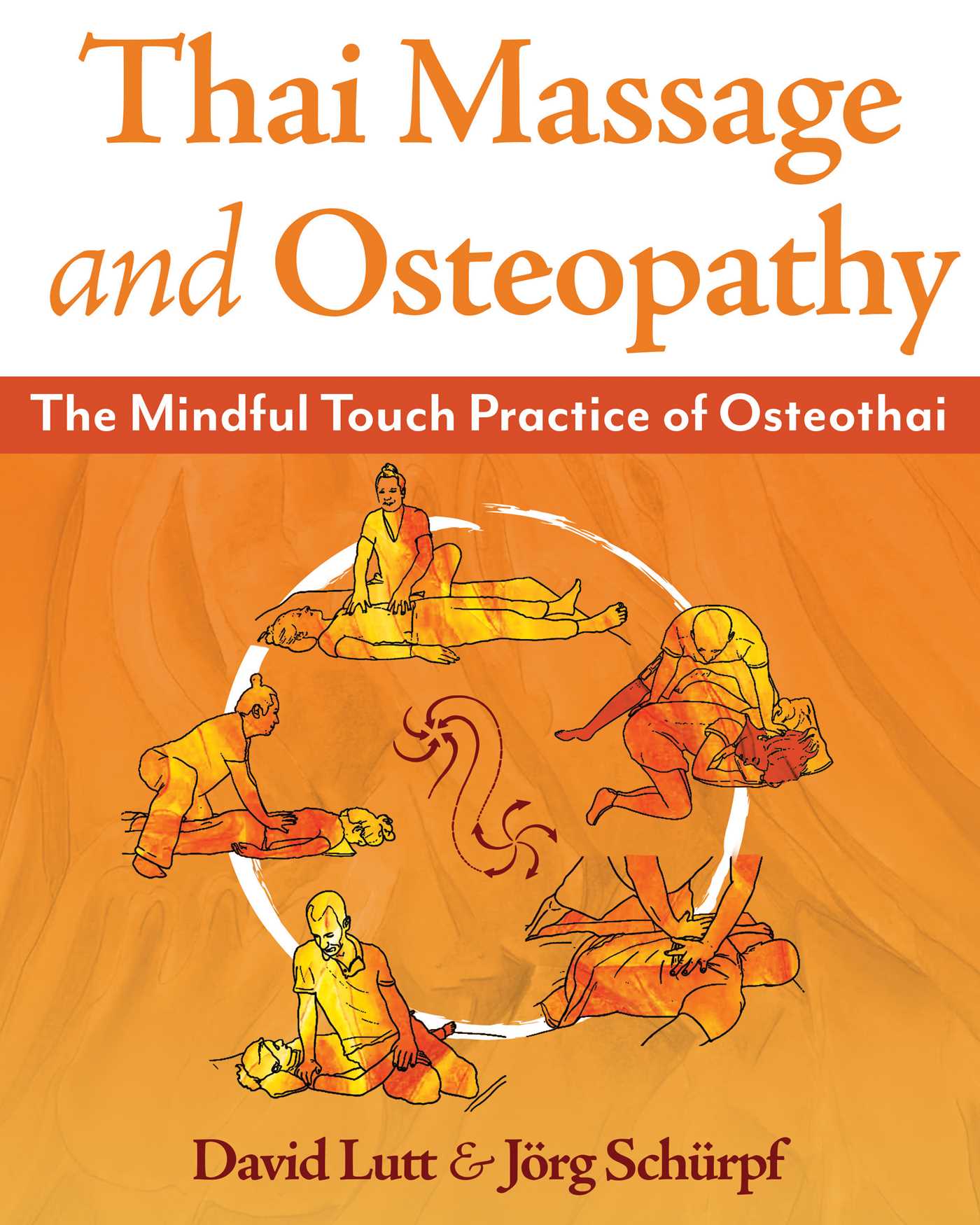
Thai Massage and Osteopathy
The Mindful Touch Practice of Osteothai
By David Lutt and Jörg Schürpf
Foreword by François Laurent and Michael J. Shea
Published by Healing Arts Press
Distributed by Simon & Schuster
LIST PRICE $29.99
PRICE MAY VARY BY RETAILER
Free shipping when you spend $40. Terms apply.
Buy from Other Retailers
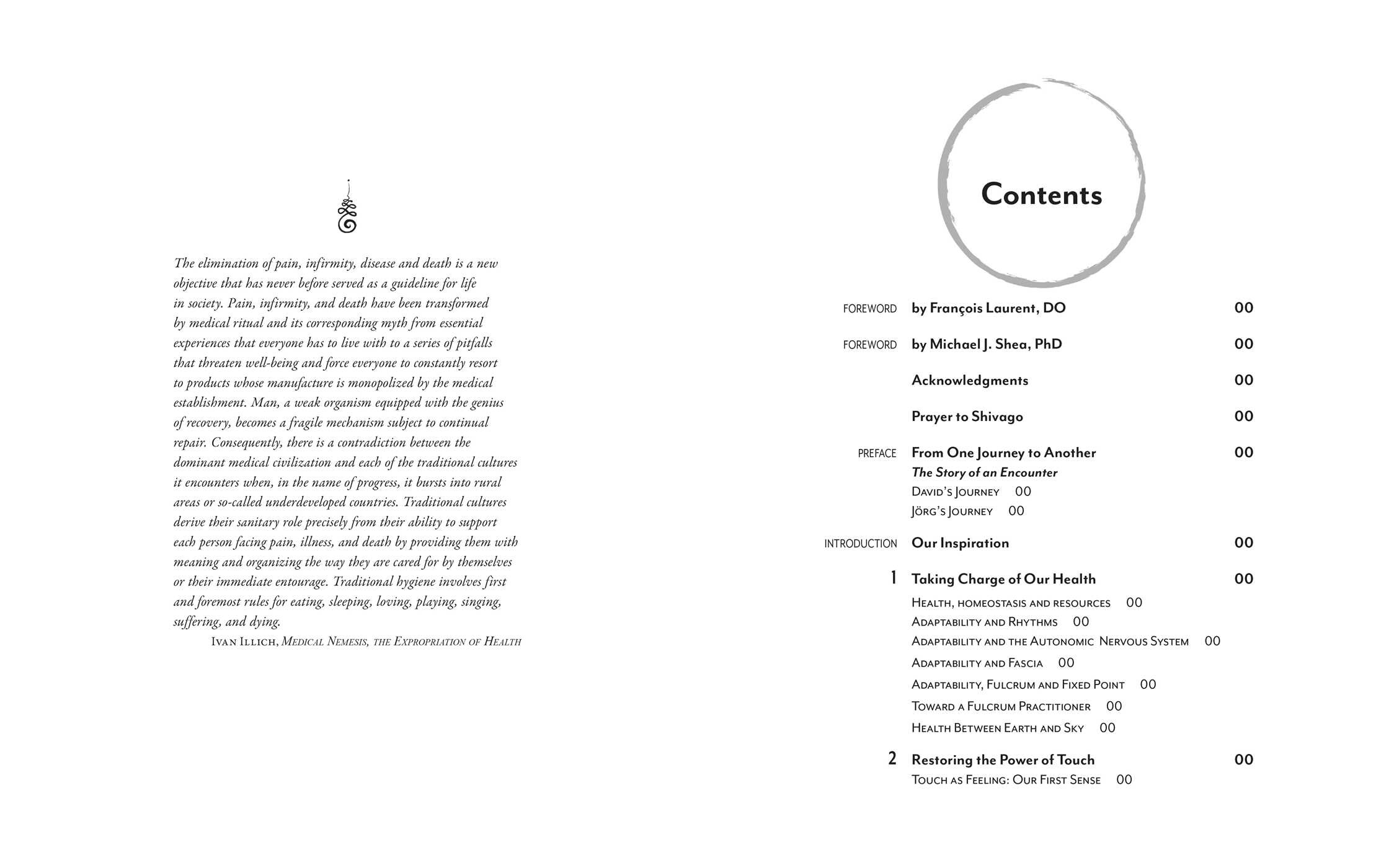
Table of Contents
About the Book
Integrating Thai massage and osteopathy for healing through therapeutic touch
• Combines the meditative, energetic foundations of Thai massage with the anatomical precision and palpation methods of osteopathy
• Provides clear treatment principles, including breathwork, treatment sequencing, and dynamic touch strategies
• Guides practitioners in refining touch, developing body awareness, and ethical presence in practice
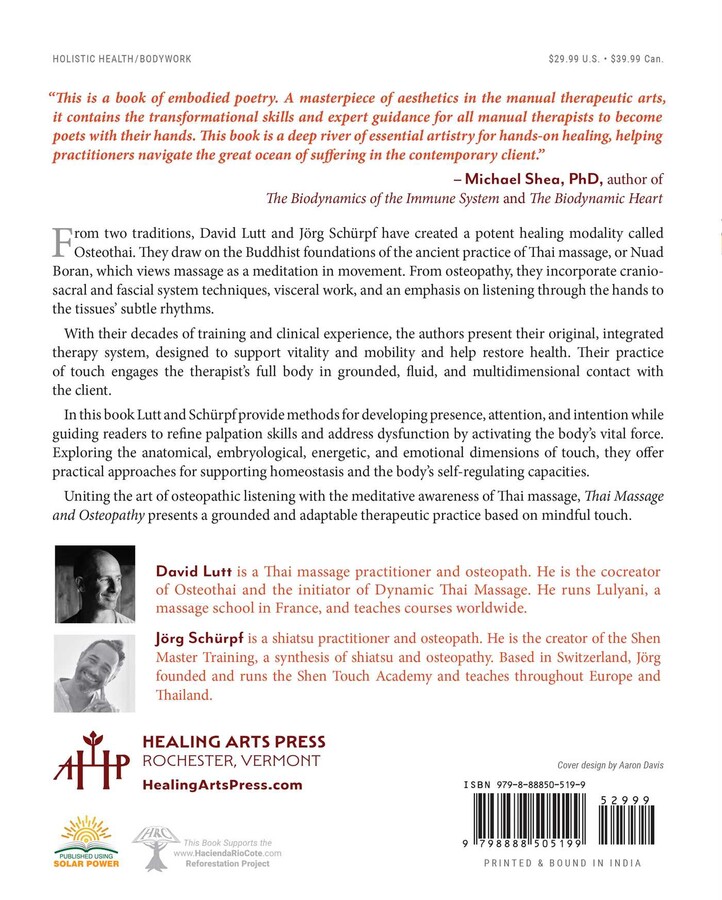
From two traditions, David Lutt and Jörg Schürpf have created a potent healing modality called Osteothai. They draw on the Buddhist foundations of the ancient practice of Thai massage, or Nuad Boran, which views massage as a meditation in movement. From osteopathy, they incorporate craniosacral and fascial system techniques, visceral work, and an emphasis on listening through the hands to the tissues’ subtle rhythms.
With their decades of training and clinical experience, the authors present their original, integrated therapy system, designed to support vitality and mobility and help restore health. Their practice of touch engages the therapist’s full body in grounded, fluid, and multidimensional contact with the client.
In this book Lutt and Schürpf provide methods for developing presence, attention, and intention while guiding readers to refine palpation skills and address dysfunction by activating the body’s vital force. Exploring the anatomical, embryological, energetic, and emotional dimensions of touch, they offer practical approaches for supporting homeostasis and the body’s self-regulating capacities.
Uniting the art of osteopathic listening with the meditative awareness of Thai massage, Thai Massage and Osteopathy presents a grounded and adaptable therapeutic practice based on mindful touch.
• Combines the meditative, energetic foundations of Thai massage with the anatomical precision and palpation methods of osteopathy
• Provides clear treatment principles, including breathwork, treatment sequencing, and dynamic touch strategies
• Guides practitioners in refining touch, developing body awareness, and ethical presence in practice
From two traditions, David Lutt and Jörg Schürpf have created a potent healing modality called Osteothai. They draw on the Buddhist foundations of the ancient practice of Thai massage, or Nuad Boran, which views massage as a meditation in movement. From osteopathy, they incorporate craniosacral and fascial system techniques, visceral work, and an emphasis on listening through the hands to the tissues’ subtle rhythms.
With their decades of training and clinical experience, the authors present their original, integrated therapy system, designed to support vitality and mobility and help restore health. Their practice of touch engages the therapist’s full body in grounded, fluid, and multidimensional contact with the client.
In this book Lutt and Schürpf provide methods for developing presence, attention, and intention while guiding readers to refine palpation skills and address dysfunction by activating the body’s vital force. Exploring the anatomical, embryological, energetic, and emotional dimensions of touch, they offer practical approaches for supporting homeostasis and the body’s self-regulating capacities.
Uniting the art of osteopathic listening with the meditative awareness of Thai massage, Thai Massage and Osteopathy presents a grounded and adaptable therapeutic practice based on mindful touch.
Excerpt
1
Taking Charge of Our Health
We are passionate about health. It is the departure point for our approach and, therefore, for this book. It is central to our lives every day and at all times. It is our most precious asset on Earth and affects each and every one of us. But what is our relationship with our health? Approaches differ. Some have understood that this asset given to us at birth expects only one thing: that we take an interest in it and that we take health into our own hands. Some people are active, responsible stakeholders in this process. By avoiding chemistry as much as possible, they are moving closer to nature, its rhythms and benefits, by observing simple and sound rules of life. Initially, health depends on the quality of a few ingredients: sleep, food, and air. All we need to do is add a minimum of movement and emotional management to build a solid foundation. Others, however, let themselves be led by the hand. In a way, they have outsourced their health, leaving it to their doctor to look after and decide for them.
They are being managed by a medical system in which science dictates the agenda. To be in good health, all you have to do is fit into the norm of mathematical variables and respond to the injunctions of a system that listens very little to the patients’ needs and no longer uses touch to explore the origin of their suffering.
Of course, many people waver between these two extremes. Nevertheless, we realize that the relationship we have with our health is first and foremost a question of positioning, choice, and responsibility.
But how do we define health?
Isn’t it the dynamic balance that enables us to adapt and evolve? Let’s take a look at our body’s relationship with various expressions of life to help us navigate and make responsible choices.
HEALTH, HOMEOSTASIS, AND RESOURCES
We are human beings before we are osteopaths or massage therapists. We are designed to move, feed, rest, relate, reproduce, and perhaps for some of us, evolve on a spiritual journey! As long as we are healthy, everything is fine. The body is silent and we are not even aware of it. As French philosopher and poet Paul Valéry used to say, “Health is the silence of the organs!” On the other hand, when the body manifests itself in pain, imbalance, or illness, we realize how important it is to be in good health. So, how do we define health?
The World Health Organization (WHO) website defines “health” as “a state of complete physical, mental and social well-being and not merely the absence of disease or infirmity.” In practice, as we saw during the COVID crisis, the WHO and governments around the world are not as concerned with health as they are with disease. Between Louis Pasteur and Claude Bernard, medicine has chosen sides. It favors killing germs rather than strengthening the foundations. Whatever the case, the scene is set. The official rhetoric about well-being conceals an extremely powerful pharmaceutical lobby coupled with a capitalist system based on notions of growth and profit. The pharmaceutical industry needs to sell medicines in order to exist and grow.
Unlike conventional medicine, osteopathy and traditional Thai massage work with the body’s vital energies to activate its self-healing potential and restore homeostasis. Homeostasis is the body’s ability to constantly adapt to the changes inside and around us. Health is the ability to dynamically maintain the best possible balance between internal and external environments.
For example, regulating our temperature or blood sugar levels is just as important as our emotional reactions to our social environment. Similarly, does our belief system leave room for open-mindedness, dialogue, and evolution? Or do we remain rigid and locked in our vision of what the truth is?
We believe that health is directly related to the adaptability of our various bodies: physical, energetic, and spiritual. As long as our bodies adapt and self-regulate, we have no reason to fall ill. In fact, we tend to think of illness, dysfunction, and pain as expressions of imbalances between our body, soul, and spirit. These symptoms are an invitation to slow down, take time, tune in, and transform. Let’s not forget that illness is also an integral part of the path to health. It can and should enable us to transform and evolve, both physically and mentally. Isn’t this clearly visible in children?
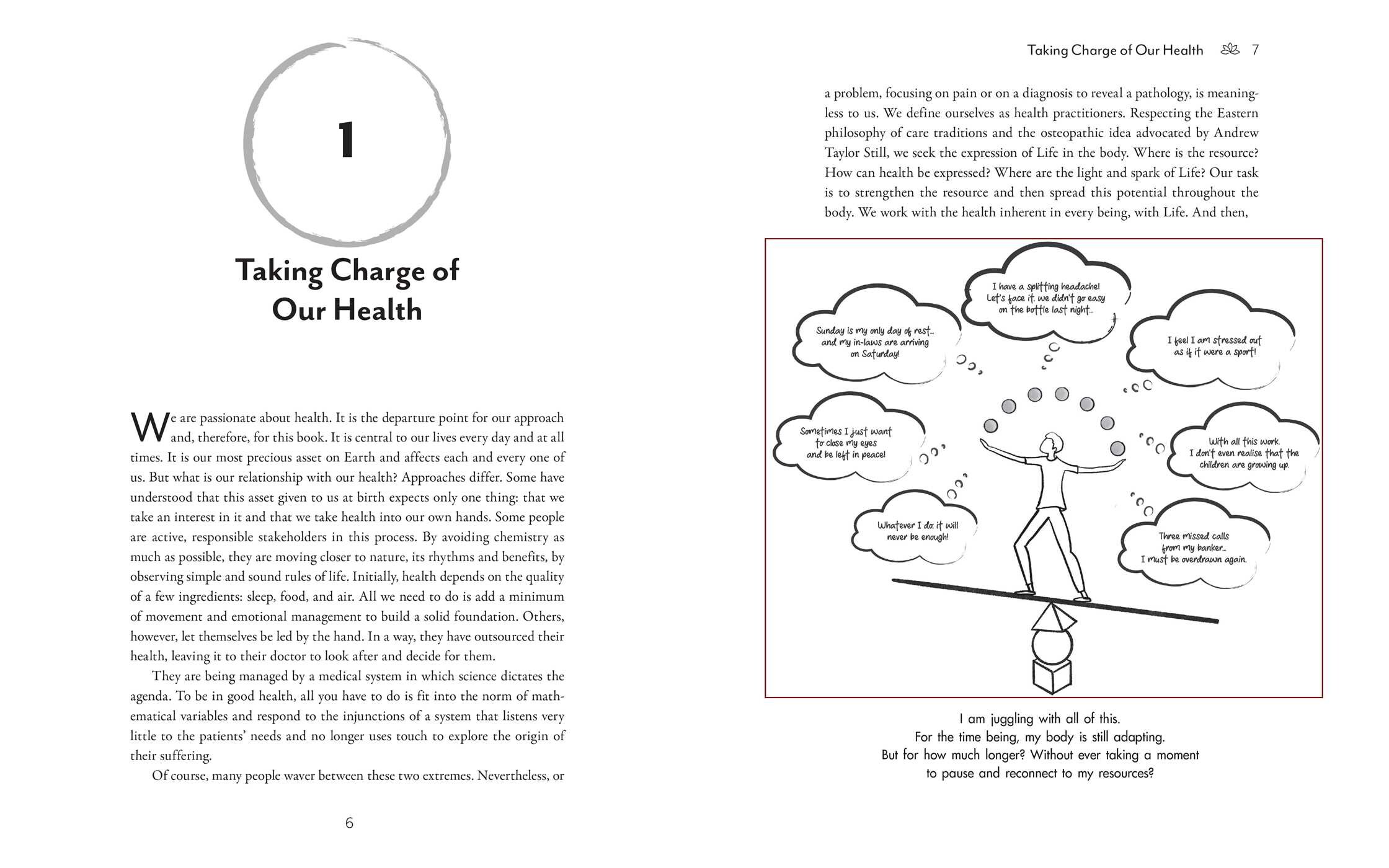
In this respect, approaching and touching a body in search of dysfunction or a problem, focusing on pain or on a diagnosis to reveal a pathology, is meaningless to us. We define ourselves as health practitioners. Respecting the Eastern philosophy of care traditions and the osteopathic idea advocated by Andrew Taylor Still, we seek the expression of Life in the body. Where is the resource? How can health be expressed? Where are the light and spark of Life? Our task is to strengthen the resource and then spread this potential throughout the body. We work with the health inherent in every being, with Life. And then, as French humorist Francis Blanche so wittily put it, “When you are healthy, being ill doesn’t matter!”
ADAPTABILITY AND RHYTHMS
Rhythm is one of the fundamental properties of life. It is all around us, and rhythm enables us to evolve. When One divides, Two appears and with it, rhythm, creating the polarities of life that surround us: rest and movement, expansion and retraction, relaxation and tension. The Universe and nature are governed by these alternating movements: the rhythms of the solar system, the Earth, seasons, day and night, the oscillating vibrations of sound and light. Man is an integral part of this great cosmic clock, even its replica. Our heartbeats, breathing rhythms, peristalsis, menstrual cycles, and the life and death of our cells constantly drive us. We are building ourselves around these rhythms, and we offer thanks to these cycles.
The word “rhythm” comes from the Greek verb rhein, meaning “to flow.” As Heraclitus said, “Panta rhei” or everything flows! Rhythm is etymologically linked to the movement of the element Water. When water is in excess, we are rheumy or have diarrhea. When Water stagnates, we move more slowly, hindered by rheumatism.
In osteopathy, A. T. Still was already talking about the importance of fluid circulation in his 1899 book, Philosophy of Osteopathy, writing, “The law of the artery is supreme.” Wherever arterial blood could circulate freely, the tissue was nourished and could continue to regulate itself. In Eastern traditions, energy circulates along the meridians. But aren’t they the same thing? When the circulation of fluids for some, and energy for others, flows freely without hindrance, the body has the capacity to adapt to its environment. More generally, respecting the rhythms that surround us helps us express our full potential of health. Traditional Chinese medicine is based on this relationship between us and the rhythms of nature, this polarity of Yin toward Yang and vice versa. In the Indian Vedic scriptures, Hatha yoga is about harmonizing the energies of sun and moon, masculine and feminine.
Nowadays, we travel to tropical countries in winter, a season of rejuvenation and rest. We take our holidays in summer, the season when we should be most active. We often eat fruit and vegetables that are neither local nor seasonal. We go back to school in the autumn, just as our bodies begin to withdraw into themselves for the winter rest period. There is no shortage of examples to show how disconnected we are from the laws of nature. Taking charge of our health means reconnecting with these rhythms.
As practitioners, this means that we cannot approach human beings without considering the environment they live in, their relationship with nature, and their respect for the polarities of life that drive them. Their capacity to adapt will depend on their ability to listen to themselves and perceive their own needs. Do they take breaks from activities? Do they live the same way in winter as in summer? Do they eat what nature provides? Do they know how to rest and recharge their batteries? How healthy is their lifestyle? What resources do they have?
Rhythm is the child of time. The world evolves by speeding up. We also need to be able to speed up for blood and energy circulation to adapt automatically. At the same time, in order to respond to the polarities of these rhythms that govern us, our body-soul-spirit unit needs to develop the same capacity for deceleration. If not, we risk burning our wings! Burnout did not exist a few decades ago.
Taking Charge of Our Health
We are passionate about health. It is the departure point for our approach and, therefore, for this book. It is central to our lives every day and at all times. It is our most precious asset on Earth and affects each and every one of us. But what is our relationship with our health? Approaches differ. Some have understood that this asset given to us at birth expects only one thing: that we take an interest in it and that we take health into our own hands. Some people are active, responsible stakeholders in this process. By avoiding chemistry as much as possible, they are moving closer to nature, its rhythms and benefits, by observing simple and sound rules of life. Initially, health depends on the quality of a few ingredients: sleep, food, and air. All we need to do is add a minimum of movement and emotional management to build a solid foundation. Others, however, let themselves be led by the hand. In a way, they have outsourced their health, leaving it to their doctor to look after and decide for them.
They are being managed by a medical system in which science dictates the agenda. To be in good health, all you have to do is fit into the norm of mathematical variables and respond to the injunctions of a system that listens very little to the patients’ needs and no longer uses touch to explore the origin of their suffering.
Of course, many people waver between these two extremes. Nevertheless, we realize that the relationship we have with our health is first and foremost a question of positioning, choice, and responsibility.
But how do we define health?
Isn’t it the dynamic balance that enables us to adapt and evolve? Let’s take a look at our body’s relationship with various expressions of life to help us navigate and make responsible choices.
HEALTH, HOMEOSTASIS, AND RESOURCES
We are human beings before we are osteopaths or massage therapists. We are designed to move, feed, rest, relate, reproduce, and perhaps for some of us, evolve on a spiritual journey! As long as we are healthy, everything is fine. The body is silent and we are not even aware of it. As French philosopher and poet Paul Valéry used to say, “Health is the silence of the organs!” On the other hand, when the body manifests itself in pain, imbalance, or illness, we realize how important it is to be in good health. So, how do we define health?
The World Health Organization (WHO) website defines “health” as “a state of complete physical, mental and social well-being and not merely the absence of disease or infirmity.” In practice, as we saw during the COVID crisis, the WHO and governments around the world are not as concerned with health as they are with disease. Between Louis Pasteur and Claude Bernard, medicine has chosen sides. It favors killing germs rather than strengthening the foundations. Whatever the case, the scene is set. The official rhetoric about well-being conceals an extremely powerful pharmaceutical lobby coupled with a capitalist system based on notions of growth and profit. The pharmaceutical industry needs to sell medicines in order to exist and grow.
Unlike conventional medicine, osteopathy and traditional Thai massage work with the body’s vital energies to activate its self-healing potential and restore homeostasis. Homeostasis is the body’s ability to constantly adapt to the changes inside and around us. Health is the ability to dynamically maintain the best possible balance between internal and external environments.
For example, regulating our temperature or blood sugar levels is just as important as our emotional reactions to our social environment. Similarly, does our belief system leave room for open-mindedness, dialogue, and evolution? Or do we remain rigid and locked in our vision of what the truth is?
We believe that health is directly related to the adaptability of our various bodies: physical, energetic, and spiritual. As long as our bodies adapt and self-regulate, we have no reason to fall ill. In fact, we tend to think of illness, dysfunction, and pain as expressions of imbalances between our body, soul, and spirit. These symptoms are an invitation to slow down, take time, tune in, and transform. Let’s not forget that illness is also an integral part of the path to health. It can and should enable us to transform and evolve, both physically and mentally. Isn’t this clearly visible in children?
In this respect, approaching and touching a body in search of dysfunction or a problem, focusing on pain or on a diagnosis to reveal a pathology, is meaningless to us. We define ourselves as health practitioners. Respecting the Eastern philosophy of care traditions and the osteopathic idea advocated by Andrew Taylor Still, we seek the expression of Life in the body. Where is the resource? How can health be expressed? Where are the light and spark of Life? Our task is to strengthen the resource and then spread this potential throughout the body. We work with the health inherent in every being, with Life. And then, as French humorist Francis Blanche so wittily put it, “When you are healthy, being ill doesn’t matter!”
ADAPTABILITY AND RHYTHMS
Rhythm is one of the fundamental properties of life. It is all around us, and rhythm enables us to evolve. When One divides, Two appears and with it, rhythm, creating the polarities of life that surround us: rest and movement, expansion and retraction, relaxation and tension. The Universe and nature are governed by these alternating movements: the rhythms of the solar system, the Earth, seasons, day and night, the oscillating vibrations of sound and light. Man is an integral part of this great cosmic clock, even its replica. Our heartbeats, breathing rhythms, peristalsis, menstrual cycles, and the life and death of our cells constantly drive us. We are building ourselves around these rhythms, and we offer thanks to these cycles.
The word “rhythm” comes from the Greek verb rhein, meaning “to flow.” As Heraclitus said, “Panta rhei” or everything flows! Rhythm is etymologically linked to the movement of the element Water. When water is in excess, we are rheumy or have diarrhea. When Water stagnates, we move more slowly, hindered by rheumatism.
In osteopathy, A. T. Still was already talking about the importance of fluid circulation in his 1899 book, Philosophy of Osteopathy, writing, “The law of the artery is supreme.” Wherever arterial blood could circulate freely, the tissue was nourished and could continue to regulate itself. In Eastern traditions, energy circulates along the meridians. But aren’t they the same thing? When the circulation of fluids for some, and energy for others, flows freely without hindrance, the body has the capacity to adapt to its environment. More generally, respecting the rhythms that surround us helps us express our full potential of health. Traditional Chinese medicine is based on this relationship between us and the rhythms of nature, this polarity of Yin toward Yang and vice versa. In the Indian Vedic scriptures, Hatha yoga is about harmonizing the energies of sun and moon, masculine and feminine.
Nowadays, we travel to tropical countries in winter, a season of rejuvenation and rest. We take our holidays in summer, the season when we should be most active. We often eat fruit and vegetables that are neither local nor seasonal. We go back to school in the autumn, just as our bodies begin to withdraw into themselves for the winter rest period. There is no shortage of examples to show how disconnected we are from the laws of nature. Taking charge of our health means reconnecting with these rhythms.
As practitioners, this means that we cannot approach human beings without considering the environment they live in, their relationship with nature, and their respect for the polarities of life that drive them. Their capacity to adapt will depend on their ability to listen to themselves and perceive their own needs. Do they take breaks from activities? Do they live the same way in winter as in summer? Do they eat what nature provides? Do they know how to rest and recharge their batteries? How healthy is their lifestyle? What resources do they have?
Rhythm is the child of time. The world evolves by speeding up. We also need to be able to speed up for blood and energy circulation to adapt automatically. At the same time, in order to respond to the polarities of these rhythms that govern us, our body-soul-spirit unit needs to develop the same capacity for deceleration. If not, we risk burning our wings! Burnout did not exist a few decades ago.
Product Details
- Publisher: Healing Arts Press (December 1, 2026)
- Length: 280 pages
- ISBN13: 9798888505199
Browse Related Books
Raves and Reviews
“This is a book of embodied poetry. A masterpiece of aesthetics in the manual therapeutic arts, it contains the transformational skills and expert guidance for all manual therapists to become poets with their hands. This book is a deep river of essential artistry for hands-on healing, helping practitioners navigate the great ocean of suffering in the contemporary client.”
– Michael Shea, PhD, author of The Biodynamics of the Immune System and The Biodynamic Heart
“This book offers a clear and insightful understanding of Osteothai that is very inspiring for a Thai massage practitioner and teacher. It provides valuable guidance on how to apply the principles of this practice effectively. Additionally, it shares a wealth of thought-provoking philosophy, drawing from the founder of Osteopathy, Andrew Taylor Still, as well as Taoism and Buddhism as ways of living."
– Kelly Nichols-Scott, LMT, NCBTMB, MOT, Thai & Osteothai teacher
“David and Jörg are awakeners of consciousness, offering a sensorial journey into the heart of the living—touching the presence to oneself, to others, to nature—on the path toward the One, the Universe!”
– Bruno Ducoux, DO, founder of FROP: Formation and Research in Pediatric Osteopathy
“From the jungle-rooted temples of Thai massage to the infinite space of conscious touch, this book on Osteothai is a real inspiration and offers a clear, superb, and exquisite invitation into the deep potential of healing.”
– Kaline Alayna Kelly, Thai massage senior teacher of Asokananda’s Sunshine Network
“This book connects us to the essential sources of being. The authors bring together Thai massage and osteopathy with a coherent and inspiring approach. Thai Massage and Osteopathy is an enjoyable read.”
– Pierre Tricot, DO, developer of The Tissue Approach
Resources and Downloads
High Resolution Images
-
Book Cover Image (jpg): Thai Massage and Osteopathy
Trade Paperback 9798888505199