Plus, receive recommendations and exclusive offers on all of your favorite books and authors from Simon & Schuster.
Sovereign Menstrual Power
Embodying Cyclical Regeneration with the Goddess Inanna
Foreword by Christine Downing
Published by Destiny Books
Distributed by Simon & Schuster
LIST PRICE $29.99
PRICE MAY VARY BY RETAILER
Free shipping when you spend $40. Terms apply.
Buy from Other Retailers
Table of Contents
About the Book
Reclaim the sacred feminine energies of your menstrual cycle
• Reimagines the ancient Mesopotamian myth of the Descent of Inanna as a ritual rite of passage that aligns with the four phases of the menstrual cycle
• Reveals how Inanna can be experienced as a living, internal presence who can help us consciously embody our own erotic aliveness
• Shares embodied practices—writing prompts, womb visualizations, and ritual enactments—to help you celebrate your body’s powers of regeneration
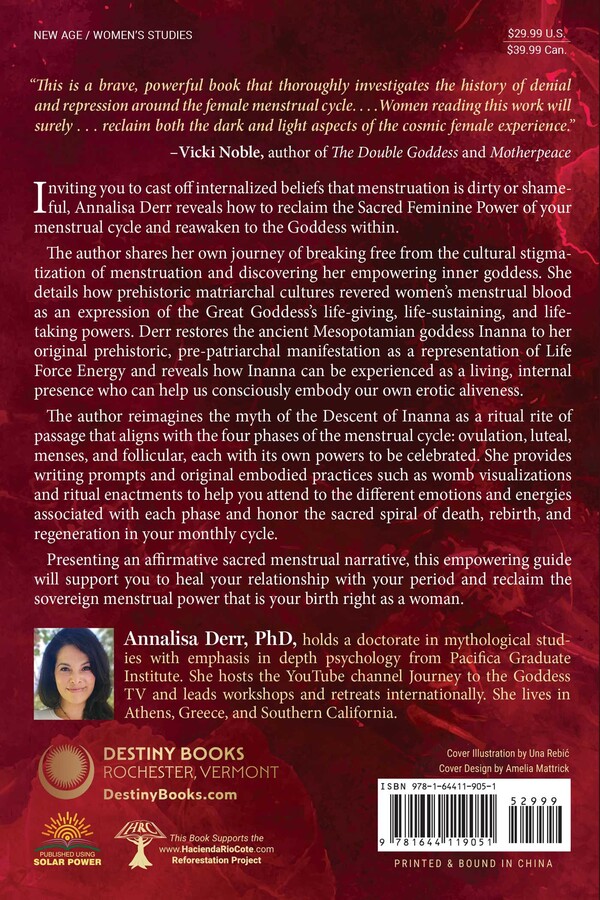
Inviting you to cast off internalized beliefs that menstruation is dirty or shameful, Annalisa Derr reveals how to reclaim the Sacred Feminine Power of your menstrual cycle and reawaken to the Goddess within.
The author shares her own journey of breaking free from the cultural stigmatization of menstruation and discovering her empowering inner goddess. She details how prehistoric matriarchal cultures revered women’s menstrual blood as an expression of the Great Goddess’s life-giving, life-sustaining, and life- taking powers. Derr restores the ancient Mesopotamian goddess Inanna to her original prehistoric, pre-patriarchal manifestation as a representation of Life Force Energy and reveals how Inanna can be experienced as a living, internal presence who can help us consciously embody our own erotic aliveness.
The author reimagines the myth of the Descent of Inanna as a ritual rite of passage that aligns with the four phases of the menstrual cycle: ovulation, luteal, menses, and follicular, each with its own powers to be celebrated. She provides writing prompts and original embodied practices such as womb visualizations and ritual enactments to help you attend to the different emotions and energies associated with each phase and honor the sacred spiral of death, rebirth, and regeneration in your monthly cycle.
Presenting an affirmative sacred menstrual narrative, this empowering guide will support you to heal your relationship with your period and reclaim the sovereign menstrual power that is your birth right as a woman.
Excerpt
INTRODUCTION
Inanna’s Return
Goddess of Sacred Female Power
My Lady looks in sweet wonder from heaven.
The people of Sumer parade before Holy Inanna.
The Lady Who Ascends into the Heavens, Inanna, is radiant.
Mighty, majestic, radiant, and ever youthful—
To you, Inanna, I sing!
“THE JOY OF SUMMER,” PRAISE HYMN FOR INANNA,
TRANSLATED AND RETOLD BY DIANE WOLKSTEIN
AND SAMUEL NOAH KRAMER
INANNA, GODDESS RISING
The Sumerian deity Inanna is becoming one of the goddess zeitgeists of our time. After being buried underground for millennia in what is now modern-day Iraq, her rediscovery and reawakening in the popular imagination foretells of Inanna’s most famous myth becoming reality. The story of her descent to the underworld and eventual rebirth mirrors our current historical moment. I agree with Jungian Sylvia Brinton Perera’s assessment that the timing of Inanna’s return from the literal underground is not a coincidence; her rebirth is part of the rising wave of Sacred Feminine consciousness around the world. For many of us, encountering the living presence of the Divine Feminine for the first time feels like coming home.
There’s a pattern in many ancient myths of powerful goddesses going into hiding because of patriarchal hubris. Goddesses from vastly different traditions—ranging from Demeter, the ancient Greek goddess of the grain; to Oshun, the West African Yoruba goddess of fresh waters; Amaterasu, the Japanese Shinto sun goddess; Corn Woman, the Lenape Nation’s corn spirit; the Hindu goddesses Sita, daughter of Earth, Sati, the first divine consort of Shiva, and Lakshmi, the goddess of abundance and auspiciousness; and Inanna, the Sumerian goddess of eroticism and war, and her Akkadian counterpart, Ištar—all have myths that tell the story of how the Divine Feminine left this world in one way or another and the disastrous effects that resulted.* In each account, an act of disrespect toward her Sacred Feminine Power is to blame.
One story that resonates with me deeply is Sati’s withdrawal from this world as told by Shiva tantric practitioner and teacher Sally Kempton. Sati, meaning “She Who Is,” is a manifestation of Shakti, the Great Goddess, who incarnates as the divine consort of Shiva, the Great Yogi.1 Their union represents the two fundamental, entwined aspects of the absolute reality: Shakti (Power) and Shiva (Universal Mind). Recognizing that there has been a gradual devaluation of women, she stipulates to the man who will be her father that though she is taking a semidivine form as Sati, she must still be honored as the Great Goddess.2 Otherwise, she won’t hesitate to leave the world.
Well, we can imagine how it goes. After many years, Daksha, her father, forgets his promise. He shows irrevocable disrespect toward Sati and the Divine Feminine more broadly by snubbing her husband, Shiva. Sati follows through with her promise. In one version of this story, the goddess self immolates from within; in another version, she jumps into a ritual fire pyre. In both versions, she withdraws her sacred essence from this world. Kempton names patriarchal hubris as the culprit, “[Daksha] embodies patriarchy’s inability to see the primal divinity of the feminine. [Sati] leaves because she knows that if the dignity of the feminine is not recognized, true union of the masculine and the feminine is not possible.”3
But thankfully, many of these stories tell us that the goddesses return, albeit after the male gods learn their lesson and agree to respect the place and power of the Sacred Feminine. For example, Yeye Luisah Teish describes how the Yoruba goddess Oshun leaves the world after the gods disrespect her. But when Oshun withdraws to the moon, she takes the essence of the life-giving “sweet waters” with her. The consequences are dire because “the sweet moisture of the Earth is the essence of Oshun. Nothing can be done on this planet without her.”4 The gods begin to panic and beg her to come back. Oshun agrees upon the condition that they “apologize,” and “[she] tells them, ‘Don’t let it happen again.’”5 She returns, and the world comes back into working balance.6
But Yeye Teish reminds us that this story has an important meaning for humanity: “[Oshun] requires that we apologize for wrong behavior . . . and do the work of repair. And on that she is relentless. . . . One of Oshun’s rules is, that which is not appreciated is taken away.”7
The message of both these myths is clear: Life is not one-sided. The Divine Feminine is not secondary, but intrinsically woven into the fabric of life itself. Harmony, abundance, peace, and flourishing require a respect and reverence for the Sacred Feminine dimensions of life.
In the Western psyche, however, the Divine Feminine was never fully buried. Though broadly depotentiated, she persists in biblical figures like Mother Mary, Mary Magdalene, Lilith, and Eve, to name a few. And in living traditions, such as Hinduism and several Indigenous cultures of the Americas, for example, the Divine Feminine resisted her full erasure, too. But now, after thousands of years of varying degrees of repression, goddesses from all over the world are reemerging from the depths of patriarchal sublimation. The ancient myths tell us that many of these goddesses and sacred beings portray unapologetic strength, primal creativity, eroticism, and self-possession—what a vision to behold!
Inanna is part of the groundswell of the rising Divine Feminine. However, in the myth of her descent to the underworld, the patriarchal impetus behind her journey isn’t immediately apparent—after all, she chooses to descend. But why? When I consider this myth in the broader context of Inanna’s other stories, as well as the royal ideological agendas shaping the period in which these myths were first recorded, her journey can be read as a profound act of reclaiming wholeness as a Great Goddess. Doing so also reinstates the Sacred Feminine back to her proper place in communion with the Sacred Masculine.
The Inanna that’s come down to us today was shaped, in part, by mythic propaganda that served to reinforce patriarchal social, political, and reproductive agendas of an elite class. As I illustrate in chapter 7, Inanna was transformed into a sexual fantasy for powerful men to project their hopes, dreams, and aspirations onto. And in other instances, Inanna’s status, agency, and desires were disrespected and dismissed by male gods who flaunt their positions and power over the goddess.
Inanna’s chosen death in the underworld, then, can be seen as a symbolic unburdening of the identities imposed upon her as Mesopotamian society became increasingly patriarchal. Her subsequent rebirth signals a reemergence of Sacred Feminine Power not only for ancient Mesopotamians but for us today, too. She expresses erotic agency, celebrates her vulvic power, and is also a formidable presence on the battlefield. These character traits make for a dynamically rich, yet paradoxical goddess.
We are now in the time of her total return, as foretold by these myths, and this is evidenced by the ripples happening in the collective for the past century or so that are unsettling the worldwide grip of patriarchy. Thus, her return as a cultural zeitgeist is also critical because she has reawakened as an empowering myth model for contemporary women.
The rediscovery of Inanna’s descent myth occurred within roughly a century of several other findings that are changing humanity’s perception of history. These include the discovery of the gnostic text “The Gospel of Mary (Magdalene),” which revolutionized our understanding of Magdalene’s role in the early Christian movement, and important archaeological discoveries such as Çatalhöyük, a likely matriarchal and goddess-centric Neolithic Anatolian community.8 These findings, among countless others, reveal a history strewn with evidence of female power, authority, and reverence that was simultaneously reinforced by and equally supported the rise of the modern feminist movement.
Like a wave building in strength and momentum in the middle of the ocean, the Divine Feminine is powerfully resurfacing at the individual and collective levels. She is heading for the shore with the force and unrelenting power of a tsunami wave. What will humanity choose to do with her return and the renewal of her power? While we may not yet know the answer, Inanna’s myth is one of a handful of sacred blueprints. Hers provides us clues as to how to move forward with reverence and respect for the feminine aspect of the divine.
Product Details
- Publisher: Destiny Books (December 8, 2026)
- Length: 480 pages
- ISBN13: 9781644119051
Browse Related Books
Raves and Reviews
“This is a brave, powerful book that thoroughly investigates the history of denial and repression around the female menstrual cycle. Annalisa’s work of resacralizing menstruation strikes at the heart of misogyny, including the worldwide violence and discrimination that women face today. Women reading this work will surely begin to come back into their authentic wholeness and, like in the original Inanna story, reclaim both the dark and light aspects of the cosmic female experience.”
– Vicki Noble, author of The Double Goddess and Motherpeace: A Way to the Goddess Through Myth, Art, a
“A compelling and most welcome expression of sacred feminism and goddess philosophy. Annalisa Derr boldly and brilliantly divines the symbolic and sacred meanings of menstruation as a bodily power mirroring cosmic power.”
– Jane Caputi, PhD, professor of Women, Gender, and Sexuality Studies, Florida Atlantic University, an
“Derr has given us a map for transforming our concept of menstrual blood from a waste product into a potent elixir. Under the tutelage of Inanna, we encounter a psycho-magical process that reclaims the permeability of our menstruating bodies as sacred and powerful. A brilliant, deep, and necessary work of practitioner-scholarship.”
– Megan Rose, PhD, transformational psychologist and author of Spirit Marriage
“Annalisa Derr has revealed the four phases of the menstrual cycle as a contemporary embodiment of Inanna’s journey. This empowering mythic model invites us to banish the shame of menstruation and listen to the subtle needs and guidance of our uterine underworld.”
– Maureen Murdock, PhD, author of The Heroine’s Journey
“With both nuance and clarity, this book examines the subtle and overt imprint of patriarchal values on women’s relationships with their bodies and menstrual cycles while also reclaiming the transformative potential of goddess spirituality. The result is a compelling and deeply meaningful bridge between ancient story, embodied knowledge, and contemporary women’s lives.”
– Safron Rossi, PhD, author of The Kore Goddess
“Impeccably researched, Sovereign Menstrual Power is both a love letter to the rejected feminine within all of us and a glorious manifesto for reclaiming the living goddess within our bodies. By weaving myth with the wisdom of the menstrual cycle, Derr offers a compelling paradigm shift—one that transforms how we understand and embody the goddess and her vital presence within us.”
– Joanna Kujawa, PhD, author of Alien Goddess and The Other Goddess
“This book is simply unique and a pleasure to read. Most importantly, it describes a way for women to reconnect with an ancient and living feminine path through the goddess Inanna.”
– Megan McFeely, director of the award-winning film As She Is
“A bold and necessary reimagining of the stories we’ve inherited about the female body, Derr’s work restores a sense of sacred meaning.”
– John Bucher, PhD, executive director of the Joseph Campbell Foundation
Resources and Downloads
High Resolution Images
-
Book Cover Image (jpg): Sovereign Menstrual Power
Trade Paperback 9781644119051