

Plus, receive recommendations and exclusive offers on all of your favorite books and authors from Simon & Schuster.
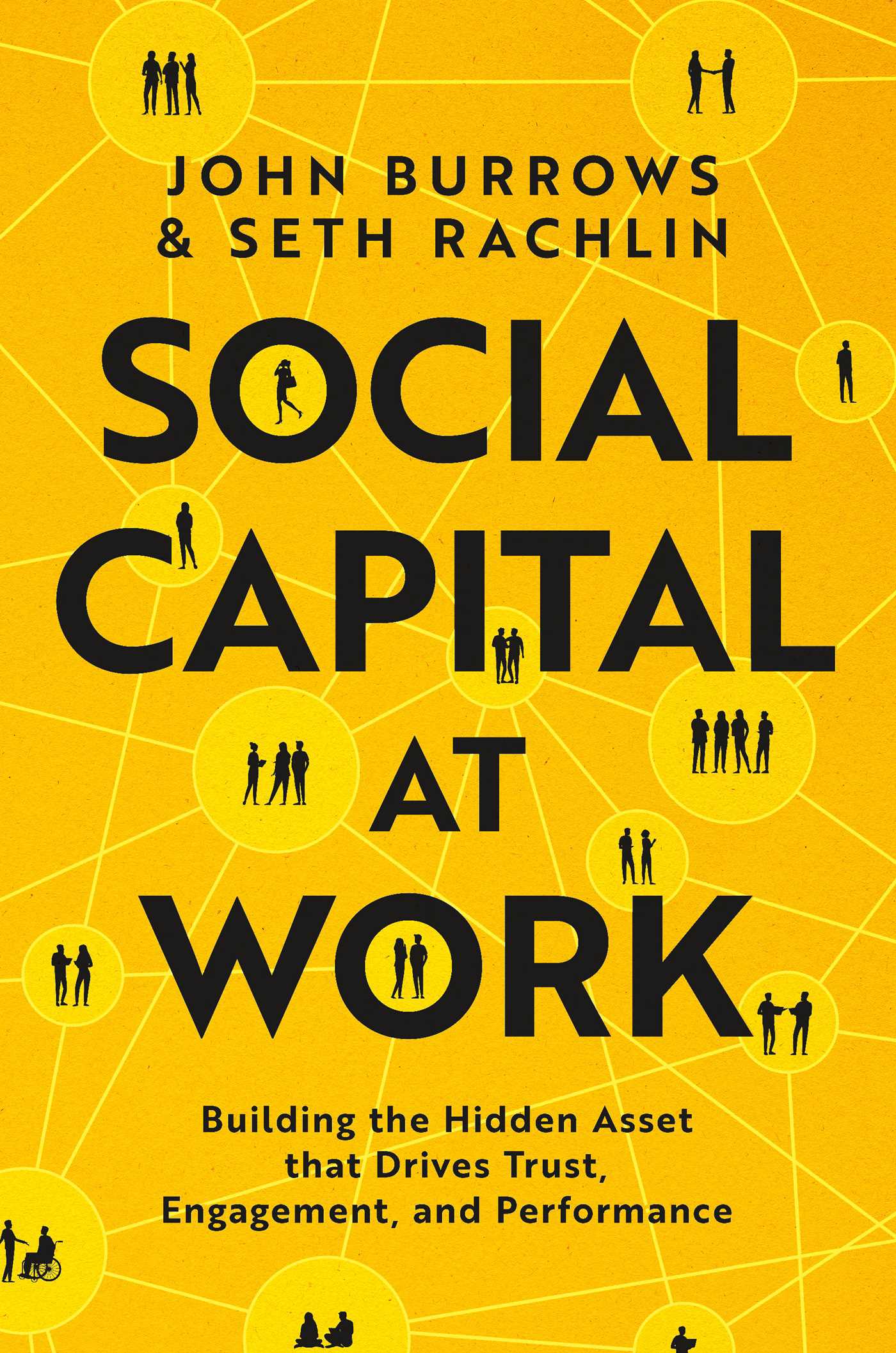
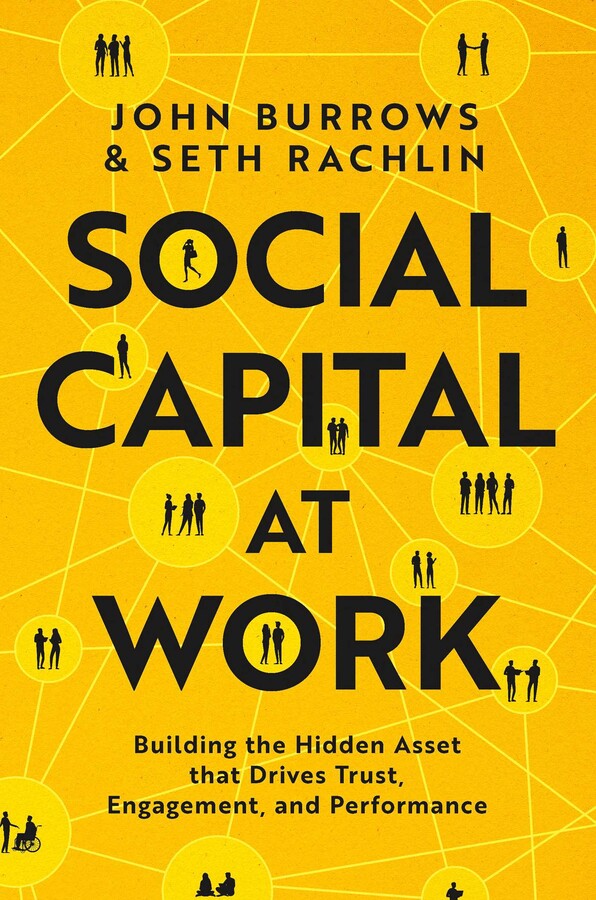
Social Capital at Work
Building the Hidden Asset That Drives Trust, Engagement, and Performance
By John Burrows and Seth Rachlin
LIST PRICE $14.99
PRICE MAY VARY BY RETAILER
Digital products purchased on SimonandSchuster.com must be read on the Simon & Schuster Books app. Learn more.
Free shipping when you spend $40. Terms apply.
Buy from Other Retailers
Table of Contents
About the Book
Unlock your leadership potential and transform your team’s productivity and creativity by harnessing the power of workplace relationships and genuine connection.
Work has never been more connected—or more lonely. Endless pings and virtual meetings create the illusion of collaboration, but these exchanges are fast, incessant, and hollow. With only shallow interaction among colleagues, today’s teams are less engaged, less aligned, and less able to deliver their best.
What we’re missing is social capital: the deep bonds that make it easier to work together, share information, and turn ideas into action.
In Social Capital at Work, organizational social scientists John Burrows and Seth Rachlin explore how top companies set themselves apart by investing in this overlooked asset. When leaders intentionally build social capital, trust grows and results improve; when they don’t, silos harden, progress stalls, and even the strongest strategies fall apart.
Drawing on decades of research and real-world experience, Burrows and Rachlin offer a practical playbook to help you develop the workplace infrastructure that boosts social capital. They explain how to strengthen the networks that drive results, prioritize depth over volume, communicate with purpose, design environments that spark interaction, foster belonging, bridge divides, measure impact, and stay human in an AI-powered world.
Filled with field-tested strategies based on scientific research, Social Capital at Work reveals that relationships are the foundation everything else rests on—and why deliberately cultivating them is the most important thing a leader can do.
Work has never been more connected—or more lonely. Endless pings and virtual meetings create the illusion of collaboration, but these exchanges are fast, incessant, and hollow. With only shallow interaction among colleagues, today’s teams are less engaged, less aligned, and less able to deliver their best.
What we’re missing is social capital: the deep bonds that make it easier to work together, share information, and turn ideas into action.
In Social Capital at Work, organizational social scientists John Burrows and Seth Rachlin explore how top companies set themselves apart by investing in this overlooked asset. When leaders intentionally build social capital, trust grows and results improve; when they don’t, silos harden, progress stalls, and even the strongest strategies fall apart.
Drawing on decades of research and real-world experience, Burrows and Rachlin offer a practical playbook to help you develop the workplace infrastructure that boosts social capital. They explain how to strengthen the networks that drive results, prioritize depth over volume, communicate with purpose, design environments that spark interaction, foster belonging, bridge divides, measure impact, and stay human in an AI-powered world.
Filled with field-tested strategies based on scientific research, Social Capital at Work reveals that relationships are the foundation everything else rests on—and why deliberately cultivating them is the most important thing a leader can do.
About the Authors
Danny Bristoll
John Burrows is senior lecturer in leadership at the University of Chicago’s Harris School of Public Policy, teaches negotiations at Chicago Booth, and is associate fellow at Oxford University’s Saïd Business School. Burrows also educates countless senior executives through custom workshops and executive education programs, often teaching outside the US across Europe, Asia, and the Middle East.
Danny Bristoll
Seth Rachlin is assistant teaching professor in the School of Social and Behavioral Sciences at Arizona State University and advisor to the executive teams of several companies and non-profits. Rachlin turned to teaching and writing after thirty years in technology consulting, both as a successful serial entrepreneur and as a senior executive for global systems integrator, Capgemini.
Product Details
- Publisher: Simon Element/Simon Acumen (November 10, 2026)
- Length: 256 pages
- ISBN13: 9781668099148
Browse Related Books
Raves and Reviews
"This engaging book brings the concept of “social capital” to life and shows how critical it is in explaining how organizations thrive or fail. Superbly fun and erudite." —James Robinson, Winner of the 2024 Nobel Prize in Economics . University Professor, Harris School of Public Policy, Committee on Social Thought and Department of Political Science, University of Chicago. Co-author of Why Nations Fail
"Within the streaking advance of technology and its separating effects on human connection, this book gives us corrective ways to overcome the problem and maximize valuable social capital. Better still, it provides a playbook of research-grounded approaches and action steps for doing so efficiently and effectively. We've needed this book for years, and now we have it." —Robert Cialdini, Regent’s Professor Emeritus, Psychology and Marketing, Arizona State University. Author of Influence and Pre-suasion
"Everyone knows that social connections at work matter, but this is the only book that explains how they matter and when they make organizations succeed. Read it and learn how great workplaces are made."—Mark Granovetter, Joan Butler Ford Professor Emeritus of Sociology, Stanford University. Author of Society and Economy and the “Strength of Weak Ties”
“This is a brilliant introduction to social capital. It covers all the main conceptual bases with engaging examples. Don't let my use of "brilliant" put you off. This is not a pompous, pie-in-the-sky academic work. This is tear off a piece with your teeth, nitty-gritty content. I expect you'll love it.”—Ron Burt, Distinguished Professor, Bocconi University and Charles M. Harper Leadership Professor Emeritus of Sociology and Strategy, University of Chicago. Author of Strong Bridges and Brokerage and Closure
“In an age obsessed with technology and efficiency, this book is a powerful reminder that relationships remain our greatest competitive advantage. Thoughtful, practical, and deeply relevant.” —Herminia Ibarra, Charles Handy Professor of Organizational Behavior, London Business School and author of Act Like a Leader, Think Like a Leader and Working Identity
"Great stories bring compelling data to life. Social connection isn’t just good for your happiness and your health, it’s also essential to your success in life and at work. Social Capital at Work shows you precisely how.” —Nicholas Eppley, John Templeton Keller Distinguished Service Professor of Behavioral Science, University of Chicago Booth School of Business. Author of A Little More Social and Mindwise
“In Social Capital at Work, John Burrows and Seth Rachlin shine a deeply needed light on what many of us suspect is true, but few of us embrace with intentionality: social capital matters to how organizations thrive. Drawing on their own research as well as the insights of others, Burrows and Rachlin provide a practical and compelling guide to leveraging connections and community for success in the workplace. Essential reading — especially in an age of AI agents and transactional work practices, where optimizing for process rather than people potentially risks undermining the very gains such approaches appear to promise.” —Andrew Maynard, Professor of Advanced Technology Transitions and Director of the Future of Being Human Initiative, Arizona State University. Co-author of AI and the Art of Being Human
“A great argument for why a good life depends on good relationships, and why the ties that hold us together are all the more important in a world distracted by technology. Wellbeing, business, and democracy all depend on our ability to nurture our social capital; reading up on it is a good start.”—Carissa Veliz, Associate Professor, Institute for Ethics in AI, University of Oxford. Author of Prophecy and Privacy is Power
Resources and Downloads
High Resolution Images
-
Book Cover Image (jpg): Social Capital at Work
eBook 9781668099148
-
Author Photo (jpg): John Burrows Danny Bristoll(0.1 MB)
Any use of an author photo must include its respective photo credit
-
Author Photo (jpg): Seth Rachlin Danny Bristoll(0.1 MB)
Any use of an author photo must include its respective photo credit