Plus, receive recommendations and exclusive offers on all of your favorite books and authors from Simon & Schuster.
Published by Park Street Press
Distributed by Simon & Schuster
LIST PRICE $19.99
PRICE MAY VARY BY RETAILER
Free shipping when you spend $40. Terms apply.
Buy from Other Retailers
Table of Contents
About The Book
How psychedelics can transform old age into the most meaningful and joyous time of life
• Details the best practices for safe and meaningful journeying in one’s later years
• Shares accounts of older adults finding healing, spiritual deepening, joyous intimacy, and peace with mortality through intentional psychedelic journeying
• Describes how group psychedelic ceremonies can promote communities of mutual support that are essential for thriving in older life
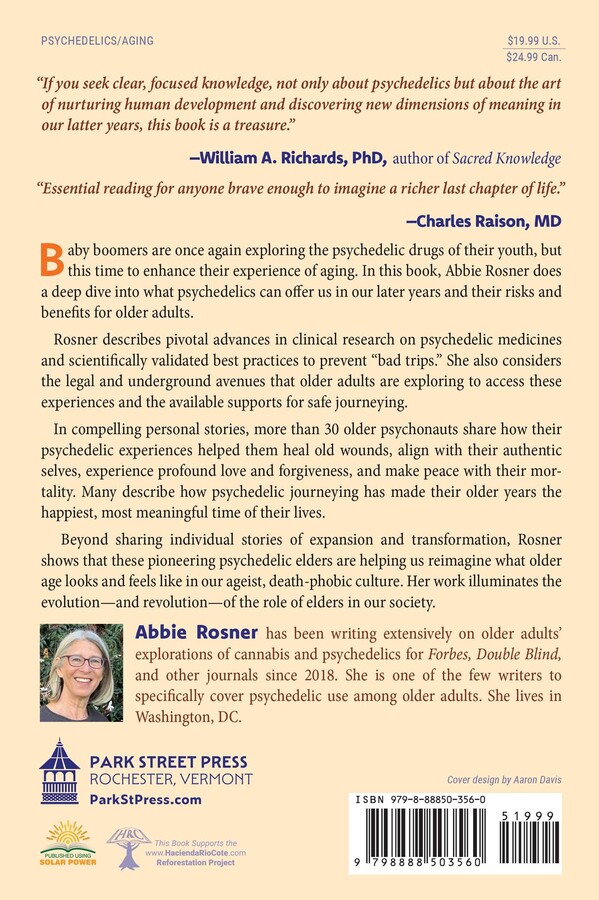
Baby boomers are once again exploring the psychedelic drugs of their youth, but this time to enhance their experience of aging. In this book, Abbie Rosner does a deep dive into what psychedelics can offer us in our later years and their risks and benefits for older adults.
Rosner describes pivotal advances in clinical research on psychedelic medicines and scientifically validated best practices to prevent “bad trips.” She also considers the legal and underground avenues that older adults are exploring to access these experiences and the available supports for safe journeying.
In compelling personal stories, more than 30 older psychonauts share how their psychedelic experiences helped them heal old wounds, align with their authentic selves, experience profound love and forgiveness, and make peace with their mortality. Many describe how psychedelic journeying has made their older years the happiest, most meaningful time of their lives.
Beyond sharing individual stories of expansion and transformation, Rosner shows that these pioneering psychedelic elders are helping us reimagine what older age looks and feels like in our ageist, death-phobic culture. Her work illuminates the evolution—and revolution—of the role of elders in our society.
• Details the best practices for safe and meaningful journeying in one’s later years
• Shares accounts of older adults finding healing, spiritual deepening, joyous intimacy, and peace with mortality through intentional psychedelic journeying
• Describes how group psychedelic ceremonies can promote communities of mutual support that are essential for thriving in older life
Baby boomers are once again exploring the psychedelic drugs of their youth, but this time to enhance their experience of aging. In this book, Abbie Rosner does a deep dive into what psychedelics can offer us in our later years and their risks and benefits for older adults.
Rosner describes pivotal advances in clinical research on psychedelic medicines and scientifically validated best practices to prevent “bad trips.” She also considers the legal and underground avenues that older adults are exploring to access these experiences and the available supports for safe journeying.
In compelling personal stories, more than 30 older psychonauts share how their psychedelic experiences helped them heal old wounds, align with their authentic selves, experience profound love and forgiveness, and make peace with their mortality. Many describe how psychedelic journeying has made their older years the happiest, most meaningful time of their lives.
Beyond sharing individual stories of expansion and transformation, Rosner shows that these pioneering psychedelic elders are helping us reimagine what older age looks and feels like in our ageist, death-phobic culture. Her work illuminates the evolution—and revolution—of the role of elders in our society.
Excerpt
1
Psychedelic Research and the Medical Mainstream
When Albert Hofmann first isolated LSD in 1938 from a bit of ergot fungus, the Swiss chemist had no idea he’d discovered one of the most powerful psychedelics the world had ever known. When initial tests of the study material revealed nothing of obvious medical value, it was shelved in the Sandoz pharmaceutical company archives and forgotten.
Five years later, Hofmann had a “peculiar presentiment” that compelled him to revisit that archived batch, and a specific molecule he’d labelled LSD-25.1 During handling, the scientist inadvertently ingested some of the substance. Then he went home and “sank into a not unpleasant, intoxicated-like condition, characterized by an extremely stimulated imagination.”2
After further self-experimentation, Hofmann knew he’d found an extraordinarily powerful psychoactive drug. Less clear, though, was what it could be used for.
The LSD Conundrum
Hofmann called the new drug a psychotomimetic: something that induced a psychotic-like state. Perhaps it could be helpful for psychiatrists wanting a glimpse into the minds of some of their patients?
Appealing to the scientific hive mind of the day, Sandoz offered to send samples of LSD to any researcher or therapist willing to take a stab at identifying an application for the new drug, either by using it themselves or on their patients. With this act of corporate generosity, the first wave of psychedelic research was launched.
Across Europe and the US, clinicians answered the call. One scientist who took Sandoz up on at least part of that offer was an anesthesiologist and pain researcher named Eric Kast. It was the early 1960s and Kast, an émigré from Vienna working at the University of Chicago, was studying the emotional underpinnings of physical pain. If LSD was able to disrupt the brain’s ability to focus on pain, he reasoned, it might have some kind of lasting analgesic effect. Kast administered LSD to fifty severely ill cancer patients. Many of them reported significant and enduring pain relief. But to his surprise, several of the study subjects also described moments of euphoria and reductions in their depression and fear of death.
Peace in the Face of Death
Meanwhile, in Baltimore, researchers at Spring Grove State Hospital were studying LSD as a potential treatment for alcoholism. Aware of Kast’s work with cancer patients, when a social worker on staff named Gloria was diagnosed with advanced breast cancer, they decided to offer her the experimental drug.
Of her LSD session, Gloria recalled:
. . . in the void, alone without the time-space boundaries.
Life reduced itself over and over again to the least
common denominator . . . I became poignantly aware
that the core of life is love . . . I wept long for the
wasted years, the search for identity in false places, the
neglected opportunities, the emotional energy lost in
basically meaningless pursuits . . .
What has changed for me? I am living now, and
being. I can take it as it comes. I am still me, but more
at peace.3
Inspired by Gloria’s experience, Spring Grove expanded its psychedelic research program to include the existential distress of cancer patients. In 1967, Walter Pahnke, a young psychiatrist with an interest in psychedelics, was recruited to lead the studies.
Pahnke and the Good Friday Experiment
In addition to his medical credentials, Pahnke held advanced degrees in divinity and the history and philosophy of religion, all from Harvard. His PhD dissertation* hypothesized that a psychedelic (in this case, psilocybin) could facilitate a mystical experience similar to those described by religious mystics around the world.
In 1962 Pahnke recruited twenty divinity graduate students and brought them to Harvard’s Marsh Chapel for Good Friday services. Half of the volunteers were given a large dose of psilocybin and the rest a placebo. By administering the drug to subjects who were religiously attuned, in a church on one of the holiest days of the Christian calendar, Pahnke hoped to show that a conducive mindset (Set) and physical setting (Setting) would result in a transcendent religious experience.
After their journeys, Pahnke had the volunteers fill out a questionnaire he devised measuring different characteristics of mystical experience. These included transcendence of time and space, intuitive knowledge, deeply felt positive mood, feelings of sacredness, and a sense that was indescribable in words. From the completed questionnaires, Pahnke concluded that most of the volunteers who received psilocybin did in fact have profound religious experiences (although one manifested acute anxiety requiring medical attention). The volunteers also reported positive changes in well-being that lasted for months afterwards.
Pahnke brought his insights about Set and Setting and the benefits of a mystical experience to the cancer program at Spring Grove. Working alongside him was Bill Richards, a psychologist colleague and friend with a similar background in divinity and shared interest in psychedelics. Together they focused on creating an optimal Set and Setting in their trial designs, increasing the likelihood of a profound experience.
Patients received preparatory therapy sessions before the psychedelic drug was administered. The drug sessions themselves usually took place in a private hospital room decorated with flowers, pictures, and meaningful objects the patient brought from home. Two co-therapists, typically a male doctor and a female psychiatric nurse, were present to support them throughout the session. Afterward, both the patient and family members received follow-up therapy to integrate the experience.*
In 1971, when he was only forty years old, Pahnke died in a diving accident. Stanislav Grof, a psychiatrist and émigré from Czechoslovakia who had studied LSD in Prague, took over the cancer studies. He was joined by his then wife, cultural anthropologist Joan (now Roshi Joan) Halifax.
Grof and Halifax were influenced by Joseph Campbell and fascinated by the similarities between the transcendent experiences of patients during their LSD sessions and the mystical traditions of ancient and preindustrial cultures. They also shared an appreciation of the psychedelic experience as a symbolic rite of passage into death.†
Countering the Counterculture
The War on Drugs
While psychedelic research was underway in hospitals across the country, the peace and love generation was busily conducting its own acid tests. On college campuses, in music and literature, and in the media, psychedelics infused virtually every aspect of the counterculture. Challenging the establishment with long hair was one thing, but when the hippie vision threatened traditional family values and the Viet Nam War effort, the backlash was inevitable.
In 1971, Richard Nixon launched the infamous War on Drugs and created its regulatory strong-arms, the Controlled Substances Act and the Drug Enforcement Agency. LSD, psilocybin, and other psychedelics were bundled with cannabis, heroin, and cocaine and classified under Schedule 1, the most extreme category of highly dangerous drugs with high potential for abuse and no medical value, where, as of this writing, they remain.
The draconian restrictions imposed by the Controlled Substances Act made finding funding and approvals for psychedelic research virtually impossible. In 1973 Grof and Halifax left the East Coast for the more permissive atmosphere of California. In Baltimore, Richards was left to hold down the fort, and in 1977, he administered the last dose of an experimental psychedelic drug to a cancer patient. With that, the first wave of psychedelic research ground to a halt.
The Second Wave
In the late 1980s, research into psychedelics with human subjects quietly resumed. It was clear in the scientific community that working with substances so mired in stigma demanded impeccable research standards. Any study involving humans and a psychedelic drug had to conform to a stringent, placebo-controlled, double-blind study design. Decades worth of findings from the first wave of psychedelic studies conducted under the more lax standards of the times were summarily disqualified.
In this new, second wave of psychedelic research, LSD was largely replaced by psilocybin as the study drug of preference (more about psilocybin in chapter 3). Psilocybin offered brevity—an LSD journey can take ten to twelve hours, but psilocybin’s effects last about half that time, while still opening access to profoundly altered states of consciousness.
For study participants, psilocybin entailed a shorter period of physical and psychic engagement. For researchers, the shift to psilocybin reduced the amount of time and associated costs involved in the studies.
Back to Baltimore
By the early 2000s, Baltimore was once again an epicenter for psychedelic research. At Johns Hopkins University, the psychedelic research program was relaunched by an esteemed psychopharmacologist named Roland Griffiths. Because he had no prior experience studying psychedelics, Griffiths brought in the veteran psychedelic researcher, Bill Richards, to help run the studies. Richards, in turn, hired a social worker named Mary Cosimano.
In 2006, the Johns Hopkins team published the first in a string of landmark studies: “Psilocybin Can Occasion Mystical-Type Experiences Having Substantial and Sustained Personal Meaning and Spiritual Significance,” in the prestigious Journal of Psychopharmacology. 4
The study, which effectively revisited Pahnke’s Good Friday experiment, gave healthy volunteers who regularly participated in some form of religious or spiritual activities a high dose of psilocybin. Once again, a clear majority described their psychedelic experience in terms consistent with naturally occurring mystical experiences. Followed up several months later, most reported enduring positive changes in moods, attitudes, and behaviors, and over half rated the experience as one of the top five most spiritually significant and personally meaningful events of their lives.
Psychedelic Research and the Medical Mainstream
When Albert Hofmann first isolated LSD in 1938 from a bit of ergot fungus, the Swiss chemist had no idea he’d discovered one of the most powerful psychedelics the world had ever known. When initial tests of the study material revealed nothing of obvious medical value, it was shelved in the Sandoz pharmaceutical company archives and forgotten.
Five years later, Hofmann had a “peculiar presentiment” that compelled him to revisit that archived batch, and a specific molecule he’d labelled LSD-25.1 During handling, the scientist inadvertently ingested some of the substance. Then he went home and “sank into a not unpleasant, intoxicated-like condition, characterized by an extremely stimulated imagination.”2
After further self-experimentation, Hofmann knew he’d found an extraordinarily powerful psychoactive drug. Less clear, though, was what it could be used for.
The LSD Conundrum
Hofmann called the new drug a psychotomimetic: something that induced a psychotic-like state. Perhaps it could be helpful for psychiatrists wanting a glimpse into the minds of some of their patients?
Appealing to the scientific hive mind of the day, Sandoz offered to send samples of LSD to any researcher or therapist willing to take a stab at identifying an application for the new drug, either by using it themselves or on their patients. With this act of corporate generosity, the first wave of psychedelic research was launched.
Across Europe and the US, clinicians answered the call. One scientist who took Sandoz up on at least part of that offer was an anesthesiologist and pain researcher named Eric Kast. It was the early 1960s and Kast, an émigré from Vienna working at the University of Chicago, was studying the emotional underpinnings of physical pain. If LSD was able to disrupt the brain’s ability to focus on pain, he reasoned, it might have some kind of lasting analgesic effect. Kast administered LSD to fifty severely ill cancer patients. Many of them reported significant and enduring pain relief. But to his surprise, several of the study subjects also described moments of euphoria and reductions in their depression and fear of death.
Peace in the Face of Death
Meanwhile, in Baltimore, researchers at Spring Grove State Hospital were studying LSD as a potential treatment for alcoholism. Aware of Kast’s work with cancer patients, when a social worker on staff named Gloria was diagnosed with advanced breast cancer, they decided to offer her the experimental drug.
Of her LSD session, Gloria recalled:
. . . in the void, alone without the time-space boundaries.
Life reduced itself over and over again to the least
common denominator . . . I became poignantly aware
that the core of life is love . . . I wept long for the
wasted years, the search for identity in false places, the
neglected opportunities, the emotional energy lost in
basically meaningless pursuits . . .
What has changed for me? I am living now, and
being. I can take it as it comes. I am still me, but more
at peace.3
Inspired by Gloria’s experience, Spring Grove expanded its psychedelic research program to include the existential distress of cancer patients. In 1967, Walter Pahnke, a young psychiatrist with an interest in psychedelics, was recruited to lead the studies.
Pahnke and the Good Friday Experiment
In addition to his medical credentials, Pahnke held advanced degrees in divinity and the history and philosophy of religion, all from Harvard. His PhD dissertation* hypothesized that a psychedelic (in this case, psilocybin) could facilitate a mystical experience similar to those described by religious mystics around the world.
In 1962 Pahnke recruited twenty divinity graduate students and brought them to Harvard’s Marsh Chapel for Good Friday services. Half of the volunteers were given a large dose of psilocybin and the rest a placebo. By administering the drug to subjects who were religiously attuned, in a church on one of the holiest days of the Christian calendar, Pahnke hoped to show that a conducive mindset (Set) and physical setting (Setting) would result in a transcendent religious experience.
After their journeys, Pahnke had the volunteers fill out a questionnaire he devised measuring different characteristics of mystical experience. These included transcendence of time and space, intuitive knowledge, deeply felt positive mood, feelings of sacredness, and a sense that was indescribable in words. From the completed questionnaires, Pahnke concluded that most of the volunteers who received psilocybin did in fact have profound religious experiences (although one manifested acute anxiety requiring medical attention). The volunteers also reported positive changes in well-being that lasted for months afterwards.
Pahnke brought his insights about Set and Setting and the benefits of a mystical experience to the cancer program at Spring Grove. Working alongside him was Bill Richards, a psychologist colleague and friend with a similar background in divinity and shared interest in psychedelics. Together they focused on creating an optimal Set and Setting in their trial designs, increasing the likelihood of a profound experience.
Patients received preparatory therapy sessions before the psychedelic drug was administered. The drug sessions themselves usually took place in a private hospital room decorated with flowers, pictures, and meaningful objects the patient brought from home. Two co-therapists, typically a male doctor and a female psychiatric nurse, were present to support them throughout the session. Afterward, both the patient and family members received follow-up therapy to integrate the experience.*
In 1971, when he was only forty years old, Pahnke died in a diving accident. Stanislav Grof, a psychiatrist and émigré from Czechoslovakia who had studied LSD in Prague, took over the cancer studies. He was joined by his then wife, cultural anthropologist Joan (now Roshi Joan) Halifax.
Grof and Halifax were influenced by Joseph Campbell and fascinated by the similarities between the transcendent experiences of patients during their LSD sessions and the mystical traditions of ancient and preindustrial cultures. They also shared an appreciation of the psychedelic experience as a symbolic rite of passage into death.†
Countering the Counterculture
The War on Drugs
While psychedelic research was underway in hospitals across the country, the peace and love generation was busily conducting its own acid tests. On college campuses, in music and literature, and in the media, psychedelics infused virtually every aspect of the counterculture. Challenging the establishment with long hair was one thing, but when the hippie vision threatened traditional family values and the Viet Nam War effort, the backlash was inevitable.
In 1971, Richard Nixon launched the infamous War on Drugs and created its regulatory strong-arms, the Controlled Substances Act and the Drug Enforcement Agency. LSD, psilocybin, and other psychedelics were bundled with cannabis, heroin, and cocaine and classified under Schedule 1, the most extreme category of highly dangerous drugs with high potential for abuse and no medical value, where, as of this writing, they remain.
The draconian restrictions imposed by the Controlled Substances Act made finding funding and approvals for psychedelic research virtually impossible. In 1973 Grof and Halifax left the East Coast for the more permissive atmosphere of California. In Baltimore, Richards was left to hold down the fort, and in 1977, he administered the last dose of an experimental psychedelic drug to a cancer patient. With that, the first wave of psychedelic research ground to a halt.
The Second Wave
In the late 1980s, research into psychedelics with human subjects quietly resumed. It was clear in the scientific community that working with substances so mired in stigma demanded impeccable research standards. Any study involving humans and a psychedelic drug had to conform to a stringent, placebo-controlled, double-blind study design. Decades worth of findings from the first wave of psychedelic studies conducted under the more lax standards of the times were summarily disqualified.
In this new, second wave of psychedelic research, LSD was largely replaced by psilocybin as the study drug of preference (more about psilocybin in chapter 3). Psilocybin offered brevity—an LSD journey can take ten to twelve hours, but psilocybin’s effects last about half that time, while still opening access to profoundly altered states of consciousness.
For study participants, psilocybin entailed a shorter period of physical and psychic engagement. For researchers, the shift to psilocybin reduced the amount of time and associated costs involved in the studies.
Back to Baltimore
By the early 2000s, Baltimore was once again an epicenter for psychedelic research. At Johns Hopkins University, the psychedelic research program was relaunched by an esteemed psychopharmacologist named Roland Griffiths. Because he had no prior experience studying psychedelics, Griffiths brought in the veteran psychedelic researcher, Bill Richards, to help run the studies. Richards, in turn, hired a social worker named Mary Cosimano.
In 2006, the Johns Hopkins team published the first in a string of landmark studies: “Psilocybin Can Occasion Mystical-Type Experiences Having Substantial and Sustained Personal Meaning and Spiritual Significance,” in the prestigious Journal of Psychopharmacology. 4
The study, which effectively revisited Pahnke’s Good Friday experiment, gave healthy volunteers who regularly participated in some form of religious or spiritual activities a high dose of psilocybin. Once again, a clear majority described their psychedelic experience in terms consistent with naturally occurring mystical experiences. Followed up several months later, most reported enduring positive changes in moods, attitudes, and behaviors, and over half rated the experience as one of the top five most spiritually significant and personally meaningful events of their lives.
Product Details
- Publisher: Park Street Press (July 7, 2026)
- Length: 192 pages
- ISBN13: 9798888503560
Browse Related Books
Raves and Reviews
“If you seek clear, focused knowledge, not only about psychedelics but about the art of nurturing human development and discovering new dimensions of meaning in our latter years, this book is a treasure.”
– William A. Richards, PhD, author of Sacred Knowledge
“Weaving decades of clinical research history together with the vivid, firstperson accounts of a memorable group of older psychonauts, Rosner illuminates what is truly at stake in this work—stories of healing, forgiveness, and spiritual awakening that no journal article can capture. Her nuanced attention to the medical and psychological considerations specific to older bodies and minds—from geroprotection and neuroplasticity to approaches for getting the most out of the psychedelic experience—makes this an invaluable resource for clinicians and researchers alike. And her larger vision of a reimagined culture of elderhood, grounded in authentic self-expression and fearless engagement with mortality, makes it essential reading for anyone brave enough to imagine a richer last chapter of life.”
– Charles Raison, MD, professor of human ecology and psychiatry at the University of Wisconsin-Madison
“For people in their last third of life, this is a great introduction to the current psychedelic renaissance. Filled with personal stories of mature journeys, the book is a reminder of youthful psychedelic trips along with promises of more. For those venturing into new territory, the book provides context for exploration and hope for greater joy in life.”
– Rachel Harris, PhD, author of Listening to Ayahuasca and Swimming in the Sacred
“Rosner moves us beyond the medicalization of the ‘third act’ and into a space of profound possibility. With a physician’s eye for safety and a storyteller’s heart for the human condition, she explores how these ancient tools can help us soften into our limitations and find expansion in the face of the unknown. This isn’t a book about dying well; it’s a rigorous, compassionate guide to living fully—with curiosity, connection, and a sense of wonder—until the very end.”
– BJ Miller, MD, palliative care physician, cofounder of Mettle Health, and coauthor of A Beginner&rsq
“Rosner’s book provides a comprehensive, accessible, insightful, and responsibly cautious review of psychedelics for persons in later stages of life. This text offers robust illustrations of an oft overlooked population in this blossoming field. Inspirational, informative, and vivid narratives are interwoven throughout, guiding the reader to a fuller understanding of elders and their interface with psychedelics.”
– Rev. Caroline Peacock, DMin, LCSW, director of spiritual health for Winship Cancer Institute of Emor
“A groundbreaking invitation to rethink what it means to grow older. With vivid storytelling and rigorous reporting, Rosner reveals how psychedelic experiences can open new pathways to healing, connection, and meaning in later life. This bold and timely book reframes elderhood not as a period of decline but as a frontier of possibility—where emotional renewal, spiritual depth, and purposeful living become not only attainable but transformative.”
– Bill Barnes, creater and co-host of Aging With Power Podcast
“This book speaks to a truth many people over 50 feel but rarely see reflected with honesty and care. Grounded in real stories and responsible insight, it reframes aging as a time of depth, healing, and renewed purpose. A vital read for anyone ready to approach this next chapter with courage, curiosity, and wisdom.”
– Cesar Marin, former CNN producer and the founder of Cultivating Wisdom
“Psychedelics and the Counterculture of Aging provides one of the freshest takes on psychedelic-assisted healing of any book I’ve encountered. Rosner explores what psychedelics can offer elders and what elders can offer society—addressing a collective need around elderhood that has remained largely unspoken.”
– James Moran, founder of DC Friends of Psychedelic Sciences
Resources and Downloads
High Resolution Images
-
Book Cover Image (jpg): Psychedelics and the Counterculture of Aging
Trade Paperback 9798888503560