
Plus, receive recommendations and exclusive offers on all of your favorite books and authors from Simon & Schuster.
0:00 /
LIST PRICE $20.00
PRICE MAY VARY BY RETAILER
Free shipping when you spend $40. Terms apply.
Buy from Other Retailers
Table of Contents
About the Book
INTERNATIONAL BESTSELLER
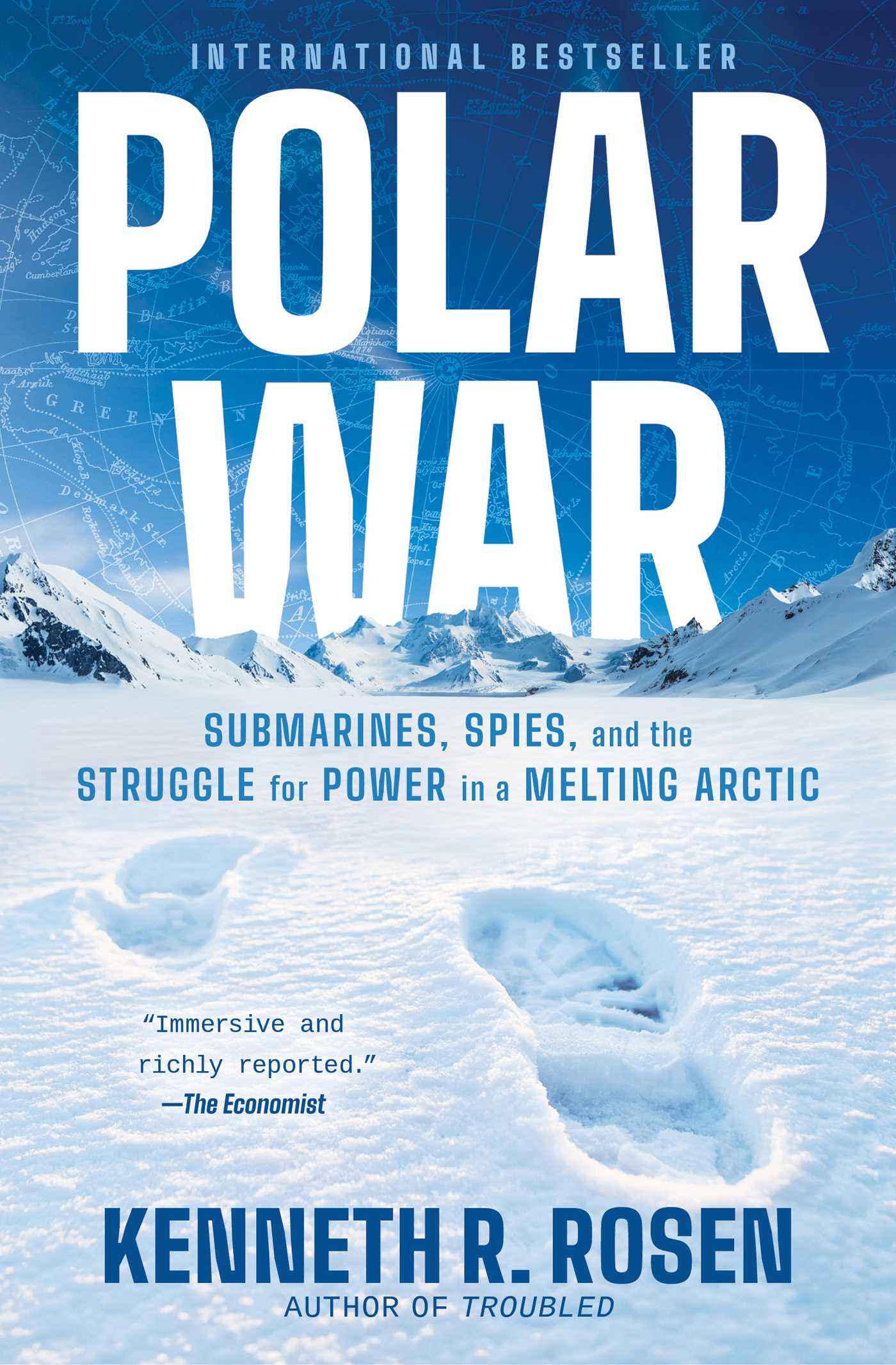
A gripping blend of travelogue and frontline reporting that reveals how climate change, military ambition, and economic opportunity are transforming the Arctic into the epicenter of a new cold war, where a struggle for dominance between the planet’s great powers heralds the next global conflict.
Russian spies. Nuclear submarines. Sabotaged pipelines. Undersea communications severed in the dark of night. The fastest-warming place on earth—where apartment buildings, hospitals, and homes crumble daily as permafrost melts and villages get washed away by rising seas—the Arctic stands at the crossroads of geopolitical ambition and environmental catastrophe. As climate change thaws the northern latitudes, opening once ice-bound shipping lanes and access to natural resources, the world’s military powers are rushing to stake their claims in this increasingly strategic region. We’ve entered a new cold war—and every day it grows hotter.
In Polar War, Kenneth R. Rosen takes readers on an extraordinary journey across the changing face of the far north. Through intimate portraits of scientists, soldiers, and Indigenous community leaders representing the interests of twenty-one countries across four continents, he witnesses firsthand how rising temperatures and growing tensions are reshaping life above and below the Arctic Circle. He finds himself on the trail of Navy SEALs training for arctic warfare, embarks on Coast Guard patrols monitoring Russian incursions, participates in close-quarter-combat training aboard foreign icebreakers in the Arctic sea ice, and visits remote research stations where international cooperation is giving way to espionage and the search for long-frozen biological weapons.
Drawing on hundreds of interviews and three years of reporting from the frontlines of climate change and great power competition, Rosen blends incisive analysis with the vivid immediacy of a travelogue. His deeply researched and personal accounts capture the diverse landscapes, people, and conflicted interests that define this complex northern region. The result is both an elegy for a vanishing landscape and an urgent warning about how the race for Arctic dominance could spark the next global conflict.
A gripping blend of travelogue and frontline reporting that reveals how climate change, military ambition, and economic opportunity are transforming the Arctic into the epicenter of a new cold war, where a struggle for dominance between the planet’s great powers heralds the next global conflict.
Russian spies. Nuclear submarines. Sabotaged pipelines. Undersea communications severed in the dark of night. The fastest-warming place on earth—where apartment buildings, hospitals, and homes crumble daily as permafrost melts and villages get washed away by rising seas—the Arctic stands at the crossroads of geopolitical ambition and environmental catastrophe. As climate change thaws the northern latitudes, opening once ice-bound shipping lanes and access to natural resources, the world’s military powers are rushing to stake their claims in this increasingly strategic region. We’ve entered a new cold war—and every day it grows hotter.
In Polar War, Kenneth R. Rosen takes readers on an extraordinary journey across the changing face of the far north. Through intimate portraits of scientists, soldiers, and Indigenous community leaders representing the interests of twenty-one countries across four continents, he witnesses firsthand how rising temperatures and growing tensions are reshaping life above and below the Arctic Circle. He finds himself on the trail of Navy SEALs training for arctic warfare, embarks on Coast Guard patrols monitoring Russian incursions, participates in close-quarter-combat training aboard foreign icebreakers in the Arctic sea ice, and visits remote research stations where international cooperation is giving way to espionage and the search for long-frozen biological weapons.
Drawing on hundreds of interviews and three years of reporting from the frontlines of climate change and great power competition, Rosen blends incisive analysis with the vivid immediacy of a travelogue. His deeply researched and personal accounts capture the diverse landscapes, people, and conflicted interests that define this complex northern region. The result is both an elegy for a vanishing landscape and an urgent warning about how the race for Arctic dominance could spark the next global conflict.
Excerpt
1. Flags FLAGS
YEARS ACCRUE OVER TWO seasons, never four. Dark days and bright nights are shared experiences in the circumpolar north, the arctic, where time is accounted differently, the midnight sun a warning flare slung into the sky before disappearing into darkness each and every winter. Darkness, then light, then darkness once more, a land of infinite extremes. More than this, though, one is struck by the elastic distances, landscapes over which the radical whims and decisions—of individuals, of nations—vacillate. Geopolitical instability like that occurring in Greenland, or in the North Atlantic, or on the isolated Svalbard archipelago north of mainland Norway and reverberating elsewhere does not necessarily lead to war, but it has happened before, even in a place as strange as this, even in a place where any war might seem improbable. After all, wars take many shapes.
Yawning below the tiny twelve-seater, a histogram of white, an eerie topographic menace. Jagged shapes, shadowy splinters, and ice claws with no end in sight. It is midday in December, in the cockpit of a Dash 8 somewhere over western Greenland, and only a thin line of pale red, evidence of the sun to the south, segments sky from earth. We pass below 75 degrees north and the digital compass display, dormant for the past hour, blinks to life as the pilot switches from manual to computer-assisted navigation.
The experience of transiting the arctic’s vastness has changed dramatically. Once it took courage; today it requires only time and cash. Sparsely populated and not permanently settled until recently, the ice and snow and formidable cold below were once a proving ground. Men and women on missions to chart uncharted land were met not by hostile Indigenous tribes, but by beasts of weather and fur. Some foolishly wanted fame, others glory for their nation, still more were merely curious about what lay north. They were tested. Many failed. Now, to get from Greenland’s northernmost village to its southernmost enclave, a trip of some 990 miles over ice and snow and glaciers in various phases of collapse, takes a few hours by plane; the same historically spectacular views, none of the agony.
The pilot reaches for a knob to recalibrate our position. From the flight deck, he and his co-pilot had been navigating by true north until this moment, never magnetic north at those latitudes. So close to the Magnetic North Pole, and at a lower altitude, the readings cannot be trusted. I shudder at the blinking lights, of what I imagine to be the failure of the plane’s directional bearing. I later speak to Claus Kongsgaard Jensen, who flies the same route. He tells me with the confidence of a military veteran, “You just reset it.” Jensen, by his own count, had flown 50,000 hours across the arctic. He joined the Royal Danish Air Force and began his tour in Greenland in 1988. He was also a veteran of a little-known arctic skirmish known as the Whisky War. Because of that war, and those that would inevitably follow, he knew intimately that the arctic, like the flight deck’s compass, was always in a state of geopolitical and ecological recalibration.
The Whisky War, if you find utility in the kind of declaratives and certainties that the arctic is never sure to grant, began during the polar expedition of Charles Francis Hall in 1871, when he discovered a spit of land—a large rock, really, slightly longer than a half mile—somewhere north of Baffin Bay and south of the Lincoln Sea, between the northern reaches of western Greenland and Canada’s Nunavut territory on a tassel of water stretching into the Arctic Ocean. Hall named the island Hans Island after Hans Hendrik, a Greenlandic guide with the expedition who had skirted the island two decades before with the American explorer Elisha Kent Kane. More than a century and two world wars later, the border between Canada and Greenland was officially drawn in 1973, and the island fell once more into the international spotlight. The low-tide levels on the northern and southern edges of Hans Island marked where one nation ended and the other began, a boulder snug between them.
The matter seemed settled. A provision in this border agreement allowed for future negotiations over the entire island, not just its circumference. Then, a decade later, a Canadian scientist from Dome Petroleum arrived on Hans Island in 1983 to research the impact of multi-year ice in an effort to learn how best to construct oil-drilling rigs in the Beaufort Sea. Learning of this expedition and believing it to be an assertion of Canadian sovereignty over the rock, Tom Høyem, the Kingdom of Denmark’s Minister of Greenlandic Affairs, set out on his own mission to assert his country’s sovereignty over the rock and the adjacent island nation it claims as its own.
Høyem chartered a helicopter from an American military base outside Qaanaaq, 217 miles south of Hans Island, and arrived on the island in 1984 to deposit a Danish flag, a bottle of aquavit, and a note reading: “Welcome to the Danish Island.” Soon the Canadians arrived and replaced the Dannebrog flag with a Maple Leaf flag, the aquavit with Canadian Club whisky. The bottle and flag swapping threatened to become the battle of the bottles. The fusillade carried on for nearly four decades, bottles for bottles, flags for flags. Never mind both nations’ territorial claims were spurious at best. Canadian Indigenous people never used the island; no residents of Denmark’s realm—including Greenland and the Faroe Islands—had ever permanently resided on the island known as Hans. The rock, as with many things in the arctic, stood for something much more. Neither country wanted to appear like it was yielding their stances on arctic sovereignty. But saber rattling and chest thumping were the instruments of those seeking assertion in the arctic, and besides, at least a few transient residents in the region benefited as the liquor bottles went to good use. At least one Danish pilot returned to Hans Island to snatch the bottles and later drink them among friends at the American air base on Greenland’s western shores.
Airmen like Jensen battled over this insignificant and practically useless swath of territory in the north throughout the Cold War, this political spat eclipsed by nuclear threats and missile crises beyond the Iron Curtain. Nevertheless, Jensen flew often within the Arctic Circle while defending that rock, playing a small role in the war fought upon and in the skies above Hans Island. There were no trees, no streams, no landmarks of any kind, not a trace of civilization there save for the flags and bottles. There were no untapped natural resources, not a thing beyond the niggling tenterhooks of national pride. Yet the campaign ensued religiously for nearly fifty years. The arctic has this effect. It is called polar madness.
There was perhaps at one time a reason for the island’s significance to both nations. The Canadians operated a scientific station on Hans Island during the Second World War, ostensibly to gather weather data in support of a secret Allied invasion of France, and the Canadian military occasionally conducted exercises in the region around the island. Though it possesses no usable mineral reserves, and though it is barren and cold and surrounded by impossible currents, Hans Island might someday be an ideal staging ground for offshore oil drilling as the arctic sea ice retreats and disappears more every year. Which is also a trope of the arctic and the war: the very ice the Canadian scientist from Dome Petroleum had first come to study, the research which propelled two nations into conflict, would soon thereafter vanish. In its place were uncertainty, a reexamination of purpose, visions, and both commercial and political calculations.
To finally decide who was entitled to Hans Island, politics ensued in a region where politicking is like nature itself: enduring and untamable. It is here that settling such territorial or inter-governmental disputes requires no less than a joint working group, representatives from Inuit communities in Greenland and Canada’s Nunavut region, environmental organizations, and a wealth of speculations feeding excitable press coverage. The process of deliberation and settlement took roughly five years. The final agreement, reached on June 14, 2022, was celebrated with one last exchange of liquor bottles, resolving a dispute over an island the Inuits unironically call Tartupaluk, or “kidney,” for its shape and not for its mess of liquor bottles. Though the Whisky War may seem absurd, it would be difficult to downplay the undertones of the conflict that persist in the context of today’s changing arctic, a region where Russia frequently exerts pressure on North Atlantic Treaty Organization (NATO) allies’ critical infrastructure, like submarine telecommunication cables. As Rear Admiral Rune Andersen, the commander of the Norwegian Navy, told me, “What happens here impacts everywhere.”
THERE ARE FEW THINGS held in the popular imagination beyond polar bears, snow, ice, and “Eskimos” when calling to mind the arctic. Anyone who has lived in Alaska, as I once did, or anywhere in the far north, knows that there is much more than that when it comes to the vast circumpolar cosmos crowning the Northern Hemisphere.
Each year the planet permanently loses a section of sea ice the size of Nebraska, along with it the reflective properties of that snow and ice, which will no longer return heat to the atmosphere. Every year the Arctic Ocean sees new summer minimum-ice-extent records, advancing a downward trend of 12.5 percent per decade since 1979. When the Arctic Ocean sea ice, which one can imagine as a gyrating glacier at the top of the world, melts, this does not increase sea levels any more than a melting ice cube would cause your drink to overflow. (Greenland’s ice cap is another story.) Yet as the ice melts, more of the ocean is exposed, and more exposed deep blue water acts as a sink into which the excess heat of the sun swirls. The warmer water sets in motion what scientists call a feedback loop. The excess heat dries up coral reefs, alters marine chemistry, and can upend thermohaline circulation, the process by which salt and water temperatures are dispersed throughout the world’s oceans.
This circulation, long predictable and reliable, shapes the earth’s climate. This circulation, when mixed with wind-driven surface currents, is what makes for milder temperatures across Europe relative to the temperatures at the same latitudes in North America. It was what once allowed us in the Northern Hemisphere to safely assume that in September we will need to change our clothes to something warmer, that in late March we once could expect to start doffing our winter layers. But not today. Summers last longer, winters are shorter. A slowing of this circulation, which is sometimes known as the ocean conveyor belt, could have unforeseen consequences for our climate. An increase in warm water from the sun’s heat is just as challenging to the health of the planet as an increase of cold water from the melting of glaciers. The last time a rapid influx of cold water was introduced into that conveyor flowing between the world’s five oceans, global temperatures plunged humanity into an ice age.
Today, similar changes impact animal and human life equally along the shores of the Arctic Ocean. Marine life is being displaced and its biology is changing; humans who rely on that aquatic life are finding those species less accessible. Meanwhile, the heat disrupts the foundations of their homes, thawing the permafrost on which they sit. It changes the physical landscape and how those situated upon it live, work, and play. The most important biosphere known to humanity, from its greatest predator (Homo sapiens) to its smallest, was once an icebox. Now it is an oven.
Nations near and far from the region have seen the warming as an opportunity for expansion and military dominance, and what they have cooked up is a conflict teetering toward full-blown war, even in a place that has largely been historically regarded as inaccessible to geopolitical ambitions. North American and European officials no longer see the arctic as a “zone of peace,” a term coined by Soviet leader Mikhail S. Gorbachev, but rather one of war. This was impossible to see when I lived in Juneau, the capital of Alaska, for what turned into several months of hysteria in 2013. The first thing anyone in the arctic offered me then was a stiff drink. The second was a gun. The broader region was like this—a welcoming place, in extremis, where first you are welcomed and then, rather immediately, alerted to its dangers.
For decades during and after the Cold War, and still today, the complex dovetailing of national interests and disinterests, paired now with the rapid changes to the climate across the arctic, have become more dangerous, and seeing them play out can be as jarring as watching a plane’s compass go dark. At times comedic and at times morose, conflicts like the Whisky War have spurred nations into fighting over, dividing, marking, demarcating, longing for, and pummeling themselves into indifference over their arctic ambitions. There have been serious conflicts and near-conflicts (as when an American nuclear submarine collided with a Russian nuclear submarine off the northern coast of Russia) alongside more innocuous and ridiculous episodes. What has changed in recent years is their frequency and their consequences for those living inside and outside the arctic.
Russian spies. Nuclear submarines. Declarations by Asian countries claiming they are “near-arctic” nations. Undersea communications severed at night. Sabotaged gas pipelines. Apartment buildings, hospitals, and homes crumbling daily or being wiped away by rising seas. The arctic regions today are home to spycraft and nuclear testing, in addition to cruise ships and booming commercial shipping lanes.
Seen through the lens of expanded and cheaper free trade as a boon to commercial investment, the melting of ice caps no longer ushers in well-meaning scientific collaboration but, rather, fighting for new trade routes. A new arctic route would shorten by two weeks the distance traveled by tankers and cargo and passenger ships from East Asia to Western Europe, circumventing the Suez Canal, across a route largely dominated by Russia. This would be good news for consumers and disastrous for the climate as the northern world barrels toward a Cold War reborn.
One of the silent characteristics of the last Cold War was the way Eastern and Western superpowers transplanted their interests onto foreign terrain, ignoring the regions and nations regarded as subordinate and which lay in opposition to their aims. The Cold War became a clash of cultures and traditions marked by exceeding arrogance for lands apart from those superpowers’ own. Throughout the Cold War, the United States put a lot of stake in the arctic, understanding it as a breadbasket of sorts. It could supply sensational natural resources and defensive outposts. Military contractors and scientists wrote reams of studies about Alaska’s significance to the nation’s maritime industries and defense, taking great interest in the finer points of ice science, the cryozone, cold-weather construction, the health of both the planet and this fragile region. After the fall of the Soviet Union, tensions cooled, and the north was once again a place for exploration and excellence on the world stage. It was an arena of partnership and cooperation, where science diplomacy, joint search-and-rescue operations, wildlife preservation, restitutions for Indigenous people, and natural-resource extraction were beneficial to all nations with northern territory, even those without.
“The community and interrelationship of the interests of our entire world is felt in the northern part of the globe, in the arctic, perhaps more than anywhere else,” Gorbachev said in 1987 while in Murmansk, on the Kola Peninsula above the Arctic Circle, today still the location of the bulwark of Russia’s nuclear weapons. The Soviet Union, Gorbachev said, had a “profound and certain interest in preventing the North of the planet, its Polar and sub-Polar regions and all Northern countries from ever again becoming an arena of war, and in forming there a genuine zone of peace and fruitful cooperation.”
But what even is the arctic exactly? There’s little dispute that the arctic is a dark—literal, and figurative—place. But its definition is precisely illusory and even the exact latitude at which the region begins is not agreed upon. The arctic may be divided by latitude into two regions: the arctic proper (population 4 million) and the subarctic (population 13 million). This offers a loose definition of the arctic (there is no formal definition), but it’s far from the only one. The people who live, work, and study there define it differently and for different reasons, resulting in definitions as varied as the land and seas across the circumpolar north.
Some choose to define the arctic as only anything above the Arctic Circle at 66 degrees and 33 minutes north, delineating where you may see the midnight sun during the summer solstice, and twenty-four hours of darkness during the winter solstice. Some may say the arctic begins where the taiga (Russian for “land of the little sticks” and the world’s largest land biome, also known as the boreal forest) ends and where steppes become tundra. But the boreal’s boundaries are moving. Smaller-growth trees creak and creep and crawl northward as the planet warms.
Others may say the arctic begins where there is permafrost, that layer of frozen substrate. Others still may point to median annual, monthly, or daily temperatures. Yet the planet tilts irregularly and impedes the precision of solstices and equinoxes, permafrost is spotty even in areas of the high north, and average temperatures swing like a pendulum. Thermometers across the Canadian Arctic might not reach below minus 51 degrees Fahrenheit, while in Siberia lows of minus 80 degrees are typical. Each arctic nation has its own definition of their territory’s boundaries; Iceland itself is an arctic state, despite being a small island just shy of the Arctic Circle. The word arctic derives from the Greek word for “bear,” and the name Antarctica reminds us that no bears inhabit that southern continent. When the last of the polar bears die, then I suppose the name arctic will merely become an honorific—in memorial, to a world in perpetual flux.
The uncertainty and constant changes have never been more consequential for homeland security: an increase in militarized fishing vessels, nuclear weapons tests, and a reallocation of state funds from regional community-oriented enterprises to natural-resource extraction and defense spending. Military buildup is erasing communities while refueling a race for power dominance in the north, advancing regional tensions that until now were historically subdued. With the climate warming, it seems we have rather silently entered a consequential race for dominance in a region long held as a place of provenance and collaboration.
At the 2021 Defense Threat Reduction Agency’s Strategic Forum, Jill M. Brandenberger, who was the climate security program manager at Pacific Northwest National Laboratory, told a modest crowd of defense and security professionals that increased access, foreign direct investment, and technology innovation were three “mega threads” across the arctic because of climate change. Dr. Brandenberger, a coastal oceanographer, made clear in her forty-five–minute presentation that a storm of strategic jostling was on the horizon. “The convergence of these three mega threads are [sic] really creating specific competition areas… in particular between Russia and China that we, in the defense and national security industry, need to follow.”
WAR IN THE NORTH is wildly unthinkable. Most will say that such a conflict is improbable. It is too cold, too harsh, too inaccessible, too unpredictable. The cost-benefit analysis of conflict here does not add up. What’s more likely, I’ve heard time and again, is that a maritime emergency—a stranded cruise ship, a botched fisheries inspection that ends in a gunfight between the nation being boarded and the nation doing the boarding—will lead to conflict elsewhere, a military phenomenon known as horizontal escalation. Indeed, classified tabletop exercises to prepare officials and those likeliest to respond to these incidents, to gauge preparedness and the potential operational capacities of military and their affiliated government bodies, have become a hallmark of broader, more frequent discussions in Washington about the arctic. This belief that a war would commence only by accident conceals fundamental advantages of military and political operations in the arctic. As Mark Rutte, the NATO Secretary General, suggested in July 2025, nations unfriendly to the alliance could distract from a larger regional conflict elsewhere in, say, Taiwan, by attempting to stake claim to NATO arctic territory. Aside from the diplomatic advantages of maintaining closer ties with northern allies at outposts across these regions, a military can deploy forces quickly by transiting across the North Pole. And if a military is practiced in cold-weather warfare, it can operate virtually anywhere. Militaries have learned over the centuries that a war in the arctic is advantageous only to those who have mastered it.
Viewed through this prism, unity was always a dark horse in the north. In 2007, two twenty-six-foot-long Russian submersibles descended from the ice at the North Pole and planted a small Russian tricolor on the ocean floor. Onboard the submersibles were a Swedish businessman, a sheikh from the United Arab Emirates, an Australian adventurer, and the vice-speaker of Russia’s cosmetic parliament, the Duma. When the explorers came home, they were welcomed like astronauts returning from a trip to a new planet. The reception elsewhere was cooler. “This isn’t the fifteenth century,” Peter MacKay, Canada’s foreign minister, said at the time. “You can’t go around the world and just plant flags.” The Russian president, feted as a Time Person of the Year that same year, tried to diminish international worry. If anything, it was playful brinkmanship, like the Whisky War. “Don’t worry,” Russian President Vladimir V. Putin said. “Everything will be all right.”
SOME YEARS AFTER HE stopped flying reconnaissance missions across Greenland, to and from Hans Island, Jensen wrote his master’s thesis, at the Royal Danish Air Force Academy, on “The Battle of the North Pole.” “My teachers at the academy called it an ‘irrelevant discussion,’?” Jensen told me. “They did not believe there would be any discussion about the North Pole in a military sense. Everything would just be by diplomatic means, like Hans Island.” What Hans Island teaches us, then, after considering the broader history of ambitions and disagreements across the northern regions, is this: Conflicts in the arctic are resolved first by threats of military intervention and then settled, to the detriment of regional stability, after decades of passive reflection and harm wrought on communities and wildlife, with the naive expectation that none of it was necessary. It also exemplifies the most common type of conflict in the arctic. The Whisky War may have ended, but the juvenile “attacks” and the imprudent gamesmanship and antagonism are not missing from the arctic today. Russia upgrades a base on the shore of Kotelny Island in Siberia, and the United States relocates fifth-generation fighter jets to Alaska. China sends a research balloon soaring over the Canadian Arctic, and the North American Aerospace Defense Command (NORAD) shoots it down. One nation sends two submarines under the North Pole; another nation sends three.
In the years since the Hans Island settlement, flags and territorial claims continue to play their role in a region of evermore complexity and competition. In June 2024, the Russian Federation returned to the North Pole. A rather innocuous display of national sovereignty—a flag—was this time replaced by one bearing the letter Z. In the years since Russia’s renewed insurgency in Ukraine, that letter has come to stand for much to many people: fascism, indiscriminate bombing and killing of civilians, the kidnapping and displacement of thousands of children. Now the letter and all it represented had arrived in the north, bearing the markings of a new Cold War, a horizontal conflict, a hastening of preparations for military confrontation. The directional compass of the region’s heading was again being reset.
Jensen’s thesis, it turns out, was prophetic. Discussions of the north’s militarization and potential as a sphere for conflict or competition have grown louder at military academies around the world, perhaps most of all in America. Of the five military academies nationwide—West Point, the Naval Academy, the Air Force Academy, the Coast Guard Academy, and the Merchant Marine Academy—along with a handful of U.S. service academies like the U.S. Marine Corps University, not one is today without a course on the arctic. Only a decade ago such classes would have seemed like gratuitous extracurriculars. Many now offer several courses on the region, as enrollment and interest in the region soars and military leaders seek to establish within the minds of service members, long focused on conflicts in the Middle East, Southeast Asia, the Pacific theater, the Global War on Terror, and quick-reaction expeditionary forces, that the arctic is no longer a sleepy zone of peace. One resident of the European Arctic told me the arctic had become anything but that. For all their years spent living and working there, the arctic was becoming, had become, the exact opposite of Gorbachev’s sentiment. For what are flags if not declarations? They are used at times to possess and repossess, to unify and divide, and eventually, to conquer. “I don’t want to be this alarmist person to say the war is coming,” they told me in confidence, “but the war is fucking coming.”
YEARS ACCRUE OVER TWO seasons, never four. Dark days and bright nights are shared experiences in the circumpolar north, the arctic, where time is accounted differently, the midnight sun a warning flare slung into the sky before disappearing into darkness each and every winter. Darkness, then light, then darkness once more, a land of infinite extremes. More than this, though, one is struck by the elastic distances, landscapes over which the radical whims and decisions—of individuals, of nations—vacillate. Geopolitical instability like that occurring in Greenland, or in the North Atlantic, or on the isolated Svalbard archipelago north of mainland Norway and reverberating elsewhere does not necessarily lead to war, but it has happened before, even in a place as strange as this, even in a place where any war might seem improbable. After all, wars take many shapes.
Yawning below the tiny twelve-seater, a histogram of white, an eerie topographic menace. Jagged shapes, shadowy splinters, and ice claws with no end in sight. It is midday in December, in the cockpit of a Dash 8 somewhere over western Greenland, and only a thin line of pale red, evidence of the sun to the south, segments sky from earth. We pass below 75 degrees north and the digital compass display, dormant for the past hour, blinks to life as the pilot switches from manual to computer-assisted navigation.
The experience of transiting the arctic’s vastness has changed dramatically. Once it took courage; today it requires only time and cash. Sparsely populated and not permanently settled until recently, the ice and snow and formidable cold below were once a proving ground. Men and women on missions to chart uncharted land were met not by hostile Indigenous tribes, but by beasts of weather and fur. Some foolishly wanted fame, others glory for their nation, still more were merely curious about what lay north. They were tested. Many failed. Now, to get from Greenland’s northernmost village to its southernmost enclave, a trip of some 990 miles over ice and snow and glaciers in various phases of collapse, takes a few hours by plane; the same historically spectacular views, none of the agony.
The pilot reaches for a knob to recalibrate our position. From the flight deck, he and his co-pilot had been navigating by true north until this moment, never magnetic north at those latitudes. So close to the Magnetic North Pole, and at a lower altitude, the readings cannot be trusted. I shudder at the blinking lights, of what I imagine to be the failure of the plane’s directional bearing. I later speak to Claus Kongsgaard Jensen, who flies the same route. He tells me with the confidence of a military veteran, “You just reset it.” Jensen, by his own count, had flown 50,000 hours across the arctic. He joined the Royal Danish Air Force and began his tour in Greenland in 1988. He was also a veteran of a little-known arctic skirmish known as the Whisky War. Because of that war, and those that would inevitably follow, he knew intimately that the arctic, like the flight deck’s compass, was always in a state of geopolitical and ecological recalibration.
The Whisky War, if you find utility in the kind of declaratives and certainties that the arctic is never sure to grant, began during the polar expedition of Charles Francis Hall in 1871, when he discovered a spit of land—a large rock, really, slightly longer than a half mile—somewhere north of Baffin Bay and south of the Lincoln Sea, between the northern reaches of western Greenland and Canada’s Nunavut territory on a tassel of water stretching into the Arctic Ocean. Hall named the island Hans Island after Hans Hendrik, a Greenlandic guide with the expedition who had skirted the island two decades before with the American explorer Elisha Kent Kane. More than a century and two world wars later, the border between Canada and Greenland was officially drawn in 1973, and the island fell once more into the international spotlight. The low-tide levels on the northern and southern edges of Hans Island marked where one nation ended and the other began, a boulder snug between them.
The matter seemed settled. A provision in this border agreement allowed for future negotiations over the entire island, not just its circumference. Then, a decade later, a Canadian scientist from Dome Petroleum arrived on Hans Island in 1983 to research the impact of multi-year ice in an effort to learn how best to construct oil-drilling rigs in the Beaufort Sea. Learning of this expedition and believing it to be an assertion of Canadian sovereignty over the rock, Tom Høyem, the Kingdom of Denmark’s Minister of Greenlandic Affairs, set out on his own mission to assert his country’s sovereignty over the rock and the adjacent island nation it claims as its own.
Høyem chartered a helicopter from an American military base outside Qaanaaq, 217 miles south of Hans Island, and arrived on the island in 1984 to deposit a Danish flag, a bottle of aquavit, and a note reading: “Welcome to the Danish Island.” Soon the Canadians arrived and replaced the Dannebrog flag with a Maple Leaf flag, the aquavit with Canadian Club whisky. The bottle and flag swapping threatened to become the battle of the bottles. The fusillade carried on for nearly four decades, bottles for bottles, flags for flags. Never mind both nations’ territorial claims were spurious at best. Canadian Indigenous people never used the island; no residents of Denmark’s realm—including Greenland and the Faroe Islands—had ever permanently resided on the island known as Hans. The rock, as with many things in the arctic, stood for something much more. Neither country wanted to appear like it was yielding their stances on arctic sovereignty. But saber rattling and chest thumping were the instruments of those seeking assertion in the arctic, and besides, at least a few transient residents in the region benefited as the liquor bottles went to good use. At least one Danish pilot returned to Hans Island to snatch the bottles and later drink them among friends at the American air base on Greenland’s western shores.
Airmen like Jensen battled over this insignificant and practically useless swath of territory in the north throughout the Cold War, this political spat eclipsed by nuclear threats and missile crises beyond the Iron Curtain. Nevertheless, Jensen flew often within the Arctic Circle while defending that rock, playing a small role in the war fought upon and in the skies above Hans Island. There were no trees, no streams, no landmarks of any kind, not a trace of civilization there save for the flags and bottles. There were no untapped natural resources, not a thing beyond the niggling tenterhooks of national pride. Yet the campaign ensued religiously for nearly fifty years. The arctic has this effect. It is called polar madness.
There was perhaps at one time a reason for the island’s significance to both nations. The Canadians operated a scientific station on Hans Island during the Second World War, ostensibly to gather weather data in support of a secret Allied invasion of France, and the Canadian military occasionally conducted exercises in the region around the island. Though it possesses no usable mineral reserves, and though it is barren and cold and surrounded by impossible currents, Hans Island might someday be an ideal staging ground for offshore oil drilling as the arctic sea ice retreats and disappears more every year. Which is also a trope of the arctic and the war: the very ice the Canadian scientist from Dome Petroleum had first come to study, the research which propelled two nations into conflict, would soon thereafter vanish. In its place were uncertainty, a reexamination of purpose, visions, and both commercial and political calculations.
To finally decide who was entitled to Hans Island, politics ensued in a region where politicking is like nature itself: enduring and untamable. It is here that settling such territorial or inter-governmental disputes requires no less than a joint working group, representatives from Inuit communities in Greenland and Canada’s Nunavut region, environmental organizations, and a wealth of speculations feeding excitable press coverage. The process of deliberation and settlement took roughly five years. The final agreement, reached on June 14, 2022, was celebrated with one last exchange of liquor bottles, resolving a dispute over an island the Inuits unironically call Tartupaluk, or “kidney,” for its shape and not for its mess of liquor bottles. Though the Whisky War may seem absurd, it would be difficult to downplay the undertones of the conflict that persist in the context of today’s changing arctic, a region where Russia frequently exerts pressure on North Atlantic Treaty Organization (NATO) allies’ critical infrastructure, like submarine telecommunication cables. As Rear Admiral Rune Andersen, the commander of the Norwegian Navy, told me, “What happens here impacts everywhere.”
THERE ARE FEW THINGS held in the popular imagination beyond polar bears, snow, ice, and “Eskimos” when calling to mind the arctic. Anyone who has lived in Alaska, as I once did, or anywhere in the far north, knows that there is much more than that when it comes to the vast circumpolar cosmos crowning the Northern Hemisphere.
Each year the planet permanently loses a section of sea ice the size of Nebraska, along with it the reflective properties of that snow and ice, which will no longer return heat to the atmosphere. Every year the Arctic Ocean sees new summer minimum-ice-extent records, advancing a downward trend of 12.5 percent per decade since 1979. When the Arctic Ocean sea ice, which one can imagine as a gyrating glacier at the top of the world, melts, this does not increase sea levels any more than a melting ice cube would cause your drink to overflow. (Greenland’s ice cap is another story.) Yet as the ice melts, more of the ocean is exposed, and more exposed deep blue water acts as a sink into which the excess heat of the sun swirls. The warmer water sets in motion what scientists call a feedback loop. The excess heat dries up coral reefs, alters marine chemistry, and can upend thermohaline circulation, the process by which salt and water temperatures are dispersed throughout the world’s oceans.
This circulation, long predictable and reliable, shapes the earth’s climate. This circulation, when mixed with wind-driven surface currents, is what makes for milder temperatures across Europe relative to the temperatures at the same latitudes in North America. It was what once allowed us in the Northern Hemisphere to safely assume that in September we will need to change our clothes to something warmer, that in late March we once could expect to start doffing our winter layers. But not today. Summers last longer, winters are shorter. A slowing of this circulation, which is sometimes known as the ocean conveyor belt, could have unforeseen consequences for our climate. An increase in warm water from the sun’s heat is just as challenging to the health of the planet as an increase of cold water from the melting of glaciers. The last time a rapid influx of cold water was introduced into that conveyor flowing between the world’s five oceans, global temperatures plunged humanity into an ice age.
Today, similar changes impact animal and human life equally along the shores of the Arctic Ocean. Marine life is being displaced and its biology is changing; humans who rely on that aquatic life are finding those species less accessible. Meanwhile, the heat disrupts the foundations of their homes, thawing the permafrost on which they sit. It changes the physical landscape and how those situated upon it live, work, and play. The most important biosphere known to humanity, from its greatest predator (Homo sapiens) to its smallest, was once an icebox. Now it is an oven.
Nations near and far from the region have seen the warming as an opportunity for expansion and military dominance, and what they have cooked up is a conflict teetering toward full-blown war, even in a place that has largely been historically regarded as inaccessible to geopolitical ambitions. North American and European officials no longer see the arctic as a “zone of peace,” a term coined by Soviet leader Mikhail S. Gorbachev, but rather one of war. This was impossible to see when I lived in Juneau, the capital of Alaska, for what turned into several months of hysteria in 2013. The first thing anyone in the arctic offered me then was a stiff drink. The second was a gun. The broader region was like this—a welcoming place, in extremis, where first you are welcomed and then, rather immediately, alerted to its dangers.
For decades during and after the Cold War, and still today, the complex dovetailing of national interests and disinterests, paired now with the rapid changes to the climate across the arctic, have become more dangerous, and seeing them play out can be as jarring as watching a plane’s compass go dark. At times comedic and at times morose, conflicts like the Whisky War have spurred nations into fighting over, dividing, marking, demarcating, longing for, and pummeling themselves into indifference over their arctic ambitions. There have been serious conflicts and near-conflicts (as when an American nuclear submarine collided with a Russian nuclear submarine off the northern coast of Russia) alongside more innocuous and ridiculous episodes. What has changed in recent years is their frequency and their consequences for those living inside and outside the arctic.
Russian spies. Nuclear submarines. Declarations by Asian countries claiming they are “near-arctic” nations. Undersea communications severed at night. Sabotaged gas pipelines. Apartment buildings, hospitals, and homes crumbling daily or being wiped away by rising seas. The arctic regions today are home to spycraft and nuclear testing, in addition to cruise ships and booming commercial shipping lanes.
Seen through the lens of expanded and cheaper free trade as a boon to commercial investment, the melting of ice caps no longer ushers in well-meaning scientific collaboration but, rather, fighting for new trade routes. A new arctic route would shorten by two weeks the distance traveled by tankers and cargo and passenger ships from East Asia to Western Europe, circumventing the Suez Canal, across a route largely dominated by Russia. This would be good news for consumers and disastrous for the climate as the northern world barrels toward a Cold War reborn.
One of the silent characteristics of the last Cold War was the way Eastern and Western superpowers transplanted their interests onto foreign terrain, ignoring the regions and nations regarded as subordinate and which lay in opposition to their aims. The Cold War became a clash of cultures and traditions marked by exceeding arrogance for lands apart from those superpowers’ own. Throughout the Cold War, the United States put a lot of stake in the arctic, understanding it as a breadbasket of sorts. It could supply sensational natural resources and defensive outposts. Military contractors and scientists wrote reams of studies about Alaska’s significance to the nation’s maritime industries and defense, taking great interest in the finer points of ice science, the cryozone, cold-weather construction, the health of both the planet and this fragile region. After the fall of the Soviet Union, tensions cooled, and the north was once again a place for exploration and excellence on the world stage. It was an arena of partnership and cooperation, where science diplomacy, joint search-and-rescue operations, wildlife preservation, restitutions for Indigenous people, and natural-resource extraction were beneficial to all nations with northern territory, even those without.
“The community and interrelationship of the interests of our entire world is felt in the northern part of the globe, in the arctic, perhaps more than anywhere else,” Gorbachev said in 1987 while in Murmansk, on the Kola Peninsula above the Arctic Circle, today still the location of the bulwark of Russia’s nuclear weapons. The Soviet Union, Gorbachev said, had a “profound and certain interest in preventing the North of the planet, its Polar and sub-Polar regions and all Northern countries from ever again becoming an arena of war, and in forming there a genuine zone of peace and fruitful cooperation.”
But what even is the arctic exactly? There’s little dispute that the arctic is a dark—literal, and figurative—place. But its definition is precisely illusory and even the exact latitude at which the region begins is not agreed upon. The arctic may be divided by latitude into two regions: the arctic proper (population 4 million) and the subarctic (population 13 million). This offers a loose definition of the arctic (there is no formal definition), but it’s far from the only one. The people who live, work, and study there define it differently and for different reasons, resulting in definitions as varied as the land and seas across the circumpolar north.
Some choose to define the arctic as only anything above the Arctic Circle at 66 degrees and 33 minutes north, delineating where you may see the midnight sun during the summer solstice, and twenty-four hours of darkness during the winter solstice. Some may say the arctic begins where the taiga (Russian for “land of the little sticks” and the world’s largest land biome, also known as the boreal forest) ends and where steppes become tundra. But the boreal’s boundaries are moving. Smaller-growth trees creak and creep and crawl northward as the planet warms.
Others may say the arctic begins where there is permafrost, that layer of frozen substrate. Others still may point to median annual, monthly, or daily temperatures. Yet the planet tilts irregularly and impedes the precision of solstices and equinoxes, permafrost is spotty even in areas of the high north, and average temperatures swing like a pendulum. Thermometers across the Canadian Arctic might not reach below minus 51 degrees Fahrenheit, while in Siberia lows of minus 80 degrees are typical. Each arctic nation has its own definition of their territory’s boundaries; Iceland itself is an arctic state, despite being a small island just shy of the Arctic Circle. The word arctic derives from the Greek word for “bear,” and the name Antarctica reminds us that no bears inhabit that southern continent. When the last of the polar bears die, then I suppose the name arctic will merely become an honorific—in memorial, to a world in perpetual flux.
The uncertainty and constant changes have never been more consequential for homeland security: an increase in militarized fishing vessels, nuclear weapons tests, and a reallocation of state funds from regional community-oriented enterprises to natural-resource extraction and defense spending. Military buildup is erasing communities while refueling a race for power dominance in the north, advancing regional tensions that until now were historically subdued. With the climate warming, it seems we have rather silently entered a consequential race for dominance in a region long held as a place of provenance and collaboration.
At the 2021 Defense Threat Reduction Agency’s Strategic Forum, Jill M. Brandenberger, who was the climate security program manager at Pacific Northwest National Laboratory, told a modest crowd of defense and security professionals that increased access, foreign direct investment, and technology innovation were three “mega threads” across the arctic because of climate change. Dr. Brandenberger, a coastal oceanographer, made clear in her forty-five–minute presentation that a storm of strategic jostling was on the horizon. “The convergence of these three mega threads are [sic] really creating specific competition areas… in particular between Russia and China that we, in the defense and national security industry, need to follow.”
WAR IN THE NORTH is wildly unthinkable. Most will say that such a conflict is improbable. It is too cold, too harsh, too inaccessible, too unpredictable. The cost-benefit analysis of conflict here does not add up. What’s more likely, I’ve heard time and again, is that a maritime emergency—a stranded cruise ship, a botched fisheries inspection that ends in a gunfight between the nation being boarded and the nation doing the boarding—will lead to conflict elsewhere, a military phenomenon known as horizontal escalation. Indeed, classified tabletop exercises to prepare officials and those likeliest to respond to these incidents, to gauge preparedness and the potential operational capacities of military and their affiliated government bodies, have become a hallmark of broader, more frequent discussions in Washington about the arctic. This belief that a war would commence only by accident conceals fundamental advantages of military and political operations in the arctic. As Mark Rutte, the NATO Secretary General, suggested in July 2025, nations unfriendly to the alliance could distract from a larger regional conflict elsewhere in, say, Taiwan, by attempting to stake claim to NATO arctic territory. Aside from the diplomatic advantages of maintaining closer ties with northern allies at outposts across these regions, a military can deploy forces quickly by transiting across the North Pole. And if a military is practiced in cold-weather warfare, it can operate virtually anywhere. Militaries have learned over the centuries that a war in the arctic is advantageous only to those who have mastered it.
Viewed through this prism, unity was always a dark horse in the north. In 2007, two twenty-six-foot-long Russian submersibles descended from the ice at the North Pole and planted a small Russian tricolor on the ocean floor. Onboard the submersibles were a Swedish businessman, a sheikh from the United Arab Emirates, an Australian adventurer, and the vice-speaker of Russia’s cosmetic parliament, the Duma. When the explorers came home, they were welcomed like astronauts returning from a trip to a new planet. The reception elsewhere was cooler. “This isn’t the fifteenth century,” Peter MacKay, Canada’s foreign minister, said at the time. “You can’t go around the world and just plant flags.” The Russian president, feted as a Time Person of the Year that same year, tried to diminish international worry. If anything, it was playful brinkmanship, like the Whisky War. “Don’t worry,” Russian President Vladimir V. Putin said. “Everything will be all right.”
SOME YEARS AFTER HE stopped flying reconnaissance missions across Greenland, to and from Hans Island, Jensen wrote his master’s thesis, at the Royal Danish Air Force Academy, on “The Battle of the North Pole.” “My teachers at the academy called it an ‘irrelevant discussion,’?” Jensen told me. “They did not believe there would be any discussion about the North Pole in a military sense. Everything would just be by diplomatic means, like Hans Island.” What Hans Island teaches us, then, after considering the broader history of ambitions and disagreements across the northern regions, is this: Conflicts in the arctic are resolved first by threats of military intervention and then settled, to the detriment of regional stability, after decades of passive reflection and harm wrought on communities and wildlife, with the naive expectation that none of it was necessary. It also exemplifies the most common type of conflict in the arctic. The Whisky War may have ended, but the juvenile “attacks” and the imprudent gamesmanship and antagonism are not missing from the arctic today. Russia upgrades a base on the shore of Kotelny Island in Siberia, and the United States relocates fifth-generation fighter jets to Alaska. China sends a research balloon soaring over the Canadian Arctic, and the North American Aerospace Defense Command (NORAD) shoots it down. One nation sends two submarines under the North Pole; another nation sends three.
In the years since the Hans Island settlement, flags and territorial claims continue to play their role in a region of evermore complexity and competition. In June 2024, the Russian Federation returned to the North Pole. A rather innocuous display of national sovereignty—a flag—was this time replaced by one bearing the letter Z. In the years since Russia’s renewed insurgency in Ukraine, that letter has come to stand for much to many people: fascism, indiscriminate bombing and killing of civilians, the kidnapping and displacement of thousands of children. Now the letter and all it represented had arrived in the north, bearing the markings of a new Cold War, a horizontal conflict, a hastening of preparations for military confrontation. The directional compass of the region’s heading was again being reset.
Jensen’s thesis, it turns out, was prophetic. Discussions of the north’s militarization and potential as a sphere for conflict or competition have grown louder at military academies around the world, perhaps most of all in America. Of the five military academies nationwide—West Point, the Naval Academy, the Air Force Academy, the Coast Guard Academy, and the Merchant Marine Academy—along with a handful of U.S. service academies like the U.S. Marine Corps University, not one is today without a course on the arctic. Only a decade ago such classes would have seemed like gratuitous extracurriculars. Many now offer several courses on the region, as enrollment and interest in the region soars and military leaders seek to establish within the minds of service members, long focused on conflicts in the Middle East, Southeast Asia, the Pacific theater, the Global War on Terror, and quick-reaction expeditionary forces, that the arctic is no longer a sleepy zone of peace. One resident of the European Arctic told me the arctic had become anything but that. For all their years spent living and working there, the arctic was becoming, had become, the exact opposite of Gorbachev’s sentiment. For what are flags if not declarations? They are used at times to possess and repossess, to unify and divide, and eventually, to conquer. “I don’t want to be this alarmist person to say the war is coming,” they told me in confidence, “but the war is fucking coming.”
About the Author
Fondation Jan Michalski, Tonatiuh Ambrosetti
Kenneth R. Rosen is the recipient of a Kurt Schork Award, a Bayeux-Calvados Award for War Correspondents, and was a two-time finalist for the Livingston Award for his work in Syria and Iraq. His writing has appeared in The New Yorker, The New York Times, The Atlantic, and WIRED. He divides his time between Western Massachusetts and Northern Italy with his wife and their three children.
Product Details
- Publisher: Simon & Schuster (January 5, 2027)
- Length: 320 pages
- ISBN13: 9781668052341
Browse Related Books
Raves and Reviews
"First-class reportage, with a refreshingly high signal-to-noise ratio."—Los Angeles Review of Books
"Immersive and richly reported...the book speaks to the moment."—The Economist
"A worthy read...Rosen is fearless in his travels and perspicacious in his assessments."—The Cipher Brief
"Terrifying, in a good way."—New Scientist
“As Rosen persuasively argues, President Trump’s threats and entreaties to take Greenland outright can also be seen another way. The pursuit of conquest as the only way to avoid conflict is a self-fulfilling prophecy.” —The New York Times
“A series of merciless vignettes … anyone in the White House wanting to understand the context of the US president’s Greenland landgrab should buy Kenneth Rosen’s book Polar War.” —The Times of London
“Troubling and revealing.” —The Independent
“Rosen’s field work was thorough.” —Australian Strategic Policy Institute
“A timely warning of climate change and melting ice paving the way to military-led land-grabs for resources…Such reporting is indispensable in helping readers understand the region.” —Financial Times
"Engaging and accessible...Rosen brings urgency and vivid storytelling to a region undergoing rapid environmental and geopolitical change."—Science
"At once both immensely fascinating and alarming, Rosen’s words culminate in a robust depiction of the Arctic climate, physically and politically. Control of the Arctic has roots in the climate crisis, making this extensively researched and accessible exposé ideal for readers interested in science and politics alike."—Booklist (Starred review)
"Lyrical and deeply reported...Two years of travel to the Arctic regions and hundreds of interviews bolster Rosen’s hypnotic descriptions of the frigid crossroads where nations vie for domination and control."—Publisher's Weekly
"Timely, provocative...Rosen is a talented writer. He deftly distils his research into vignette-like chapters filled with show-stopping adventures and small, intimate moments."—The Spectator
"First-class reportage on an urgent dilemma...Not one to simply explain the problems, Rosen also provides a roadmap toward effective solutions. What might have been a stilted recitation of issues is instead an engrossing, soberly rendered cautionary tale."—Kirkus (Starred Review)
"Engrossing...draws us toward a new strategic frontier, and we can almost feel the bitter cold."—Times Literary Supplement (UK)
"A wake-up call for the West."—Jonathan Beale, BBC Defence Correspondent
“By anchoring the geopolitics in the realities of the region and its human stories, Kenneth R. Rosen makes an essential contribution to understanding what is really at stake at the top of the world.” —Keir Giles, author of Who Will Defend Europe?
"Engrossing...draws us toward a new strategic frontier, and we can almost feel the bitter cold."—Times Literary Supplement (UK)
Resources and Downloads
High Resolution Images
-
Book Cover Image (jpg): Polar War
Trade Paperback 9781668052341
-
Author Photo (jpg): Kenneth R. Rosen Fondation Jan Michalski, Tonatiuh Ambrosetti(0.1 MB)
Any use of an author photo must include its respective photo credit