Plus, receive recommendations and exclusive offers on all of your favorite books and authors from Simon & Schuster.
Published by Destiny Books
Distributed by Simon & Schuster
LIST PRICE $22.99
PRICE MAY VARY BY RETAILER
Free shipping when you spend $40. Terms apply.
Buy from Other Retailers
Table of Contents
About the Book
How to identify inherited ancestral trauma and resolve it for deep healing
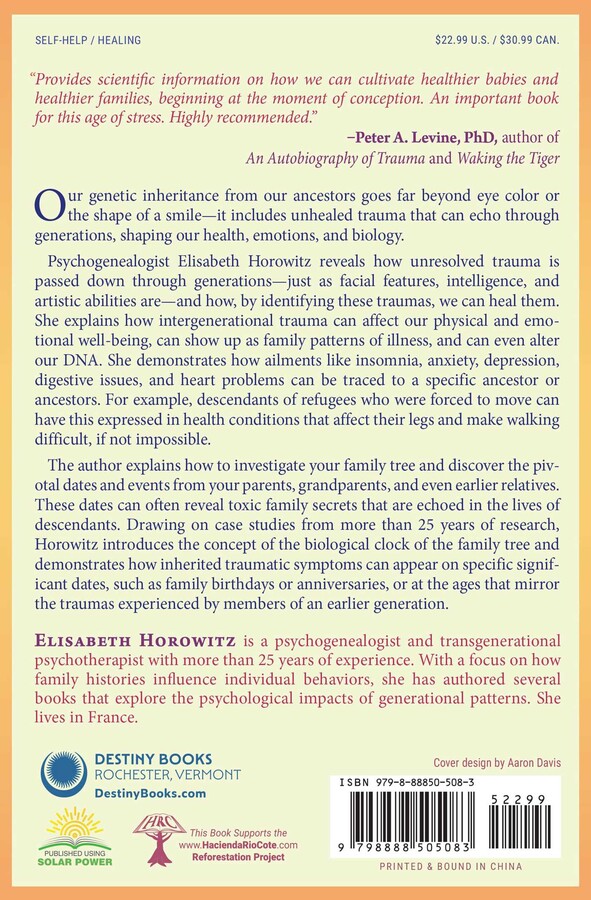
• Demonstrates how insomnia, anxiety, depression, digestive issues, and heart problems can be traced to trauma inherited from an ancestor
• Explains how pivotal dates that are significant to ancestors are repeated in the lives of their descendants
• Shares case studies from over 25 years of research that show successful healing after identifying the sources of ancestral trauma
Our genetic inheritance from our ancestors goes far beyond eye color or the shape of a smile—it includes unhealed trauma that can echo through generations, shaping our health, emotions, and biology.
Psychogenealogist Elisabeth Horowitz reveals how unresolved trauma is passed down through generations—just as facial features, intelligence, and artistic abilities are—and how, by identifying these traumas, we can heal them. She explains how intergenerational trauma can affect our physical and emotional well-being, can show up as family patterns of illness, and can even alter our DNA. She demonstrates how ailments like insomnia, anxiety, depression, digestive issues, and heart problems can be traced to a specific ancestor or ancestors. For example, descendants of refugees who were forced to move can have this expressed in health conditions that affect their legs and make walking difficult, if not impossible.
The author explains how to investigate your family tree and discover the pivotal dates and events from your parents, grandparents, and even earlier relatives. These dates can often reveal toxic family secrets that are echoed in the lives of descendants. Drawing on case studies from more than 25 years of research, Horowitz introduces the concept of the biological clock of the family tree and demonstrates how inherited traumatic symptoms can appear on specific significant dates, such as family birthdays or anniversaries, or at the ages that mirror the traumas experienced by members of an earlier generation.
Excerpt
1
The Story of My Birth
What were our mother’s emotions when she was pregnant? Advances in cellular biology show how love and joy, as well as fear, anger, and sadness, can alter our offspring’s genetic expression biochemically. Thanks to recent scientific research on human cells, we can now understand how cellular memory is transferred from mother to fetus. From the time of conception, our developing body continues to be influenced by the quality of the sperm and the ovum, which in turn bear the effects of the earlier life experiences of the parents.
HOW OUR PARENTS MET
Did they want to conceive us? Did both parents want us? If so, then it’s a good situation, if not ideal. Or was it just one of them? In most cases it’s the mother. And if we travel back in time, how did our parents meet? Where, when, and under what circumstances? Is it possible to learn more by asking each of them, preferably face-to-face, because their versions of events and their feelings might differ? Specifically, where did they first cross paths: in the street, at a mutual friend’s house, at a wedding, in an airport, while on vacation, at a disco, or via an internet site? Did they meet by chance or were they introduced to each other by someone? Do you know who this person is? It could be a family member.
For a romantic relationship to turn serious, sharing some genealogical elements can add to the attraction, complicity, and sense of intimacy. Does your father have a first name that runs in your mother’s family? Is the same thing true for your mother? Does she share a first name with people in your father’s family tree? Do they share any other points in common? If so, which ones?
What was their living, emotional, and professional situation at that time? Are they roughly the same age or is there a large gap? If so, what is it? It is known that an age difference with a spouse can repeat with a sibling. It also can be a reminder of a key age in childhood. Imagine parents with a seven-year difference in age, which may correspond to the same difference with a sibling. Or it could indicate that a key life event took place at the age of seven.
BEFORE THEY MET
Did our parents have an off-and-on passionate relationship or was their relationship stable? Is it still? Ideally, they are living together, pooling their resources, sincerely loving each other, are sexually compatible, and share the same worldview. But it is possible that one or both may still be in love with earlier partners they broke up with, sometimes in a way that was devastating.
Do you know people that your parents dated before the decisive day they met? It may be only a detail, but it’s an important one because their previous spouses or partners also are part of your story! Because an opening was created by leaving or by being left by someone, an opening that allowed our mother and father to become part of the family structure and to give birth to us later. This is so significant because their memory, especially if they were either very loving or greatly loved, can influence our parents’ emotional behavior. For this reason, if your parents were married before they met, it’s crucial to find out more.
JUST BEFORE ME
What took place right before you were conceived? Did your mother have a miscarriage or lose a pregnancy before you? If so, it’s important to know the circumstances. Was it a spontaneous or induced abortion? What was the stage of gestation when it took place? In this regard, I have a story to share. One afternoon when I was shopping in town, I bumped into a friend, Christophe, who told me his latest news. He mentioned that for some time his eldest daughter has been hyperactive and getting little sleep. This was out of character for her, and he was thinking of taking her to see the doctor and, if necessary, have medication prescribed for her (she’s ten). I was surprised and asked him what had taken place in his family over the last few months. “Not much,” he told me. “Except that my wife was pregnant with twins and I wanted to keep them. But she didn’t. She secretly got an abortion, and our other children don’t know . . .” I told him that even though his children were consciously unaware of it, it may be the cause for his daughter’s hyperactivity. Connections have already been made between a secret abortion and the onset of symptoms in the other children of the household. Telling the truth sincerely and empathetically becomes liberating for everyone. When this isn’t the case, a vague sense of unease can become a childhood companion because our parents hid interrupted pregnancies from us.
The drawing of our family tree should include all the children who were conceived but were not born, along with the corresponding dates. It is not a neutral event to be born after or before an aborted child. Although the child was never given a name, it holds a place of its own in the timeline of conceptions. For example, you could be the second child to be born, but the third in fact to be conceived by your parents.
To sum up, several elements are influential: the circumstances in which our parents met, their earlier romantic relationships, and the possibility of a pregnancy that didn’t come to term before or after we were born. Let’s add a fourth essential point: Why were we conceived? In the best-case scenario, the answer is that our parents loved each other. However, genealogical pressure, such as parallel pregnancy among our aunts and uncles, the menopause of our maternal or paternal grandmother, or even the death of a family member, may have played the decisive role. Examine the events that took place in your family before you were conceived. What were they?
AND IF OUR BIRTH SAVED OUR PARENT
Did our birth manage to save one of our parents? That would be a surprise! And yet the arrival of a child can encourage better living conditions and open the door to new opportunities. It’s as if new vitality is brought in with the newborn. Michel describes a wonderful synchronicity: “I’d been unemployed for months and a few weeks before the birth of my daughter, I stumbled by chance on an ad for a job, and it worked—I was hired! My life became so much better after she was born, in every way.”
The birth of a child also can save a parent from a purely genealogical danger. As we will see in chapter 14, there is an internal family clock consisting of key dates and age markers. Meet Valerie, a charming young woman who, alas, lost her mother when she was ten years old. She has a daughter, Nina, who just turned ten. In accordance with the pattern established by the previous generation, when a daughter turns ten, her mother dies. Valerie was therefore in a delicate situation. How can we fix this? This was when she conceived another child. This child will help her escape what has been programmed. Or, at the very least, postpone it until her second child’s tenth birthday.
OUR SENSATIONS IN UTERO
From the moment of conception, our brains are shaped by our experience inside our mother’s womb. We know that during pregnancy the nutrients in her blood feed the fetus through the walls of the placenta. She also releases hormones and signals based on the emotions she feels. This is why a child who has lived in a stressful environment while in utero can feel and be affected by it. Mothers who are under constant stress are more prone to having premature, underweight, hyperactive, and irritable babies. As a rule, the child’s health and development are influenced by the thoughts, attitudes, and behaviors of its parents. The stress felt by the mother and, to a lesser extent, by the father is passed on to the fetus. If the environment is stable, everything works out well, but if due to conflicts and tension it isn’t, it will weaken the child. In short, if the ambiance and the relationship were touchy, it’s likely we felt it when we were in our mother’s womb.
Product Details
- Publisher: Destiny Books (February 2, 2027)
- Length: 240 pages
- ISBN13: 9798888505083
Browse Related Books
Raves and Reviews
“We are just starting to understand the profound effect of our earliest times of life. In this well-thought-out book, Elisabeth Horowitz explores how early maternal stress can affect the development of a fetus and newborn and how this can then affect the development of a baby, child, toddler, adolescent, and adult. And, most importantly, she provides scientific information on how we can cultivate healthier babies and healthier families, beginning at the moment of conception. An important book for this age of stress. Highly recommended.”
– Peter A. Levine, PhD, author of An Autobiography of Trauma and Waking the Tiger
“My Ancestral Body provides a detailed description of the way we carry not only physical similarities to our ancestors but also other characteristics—some obvious and some more subtle. Elisabeth Horowitz brings clarity to how aspects of your ancestors live inside you as well as to how you can heal those unhealed wounds that have found their way through your lineage and landed in you. Once identified, she invites you on a journey to heal those wounds.”
– Dr. Steven Farmer, author of Healing Ancestral Family Patterns
“Strongly recommended: a vitally important work. Elisabeth Horowitz provides a comprehensive guide to undoing the deep familial and ancestral sources of much of our ill health and unhappiness. A clear and practical approach to neutralizing inherited negative patterns.”
– Peter Mark Adams, poet, essayist and author of The Power of the Healing Field
Resources and Downloads
High Resolution Images
-
Book Cover Image (jpg): My Ancestral Body
Trade Paperback 9798888505083