

Plus, receive recommendations and exclusive offers on all of your favorite books and authors from Simon & Schuster.
Meet the 'Million Dollar Women'
Wonder Women of Business
3 Tips for Female Entrepreneurs Who Want to Go Big
0:00 /
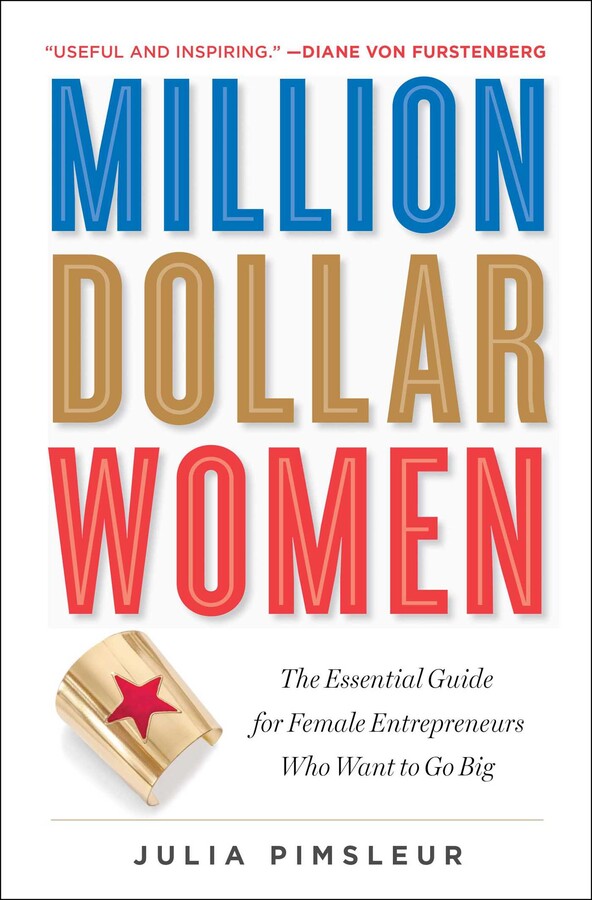
Million Dollar Women
The Essential Guide for Female Entrepreneurs Who Want to Go Big
LIST PRICE $17.99
PRICE MAY VARY BY RETAILER
Free shipping when you spend $40. Terms apply.
Buy from Other Retailers
Table of Contents
About the Book
The “useful and inspiring” (Diane von Furstenberg) guide for female entrepreneurs who want to take their businesses into the big leagues.
“Do you have an ambitious vision for your business, but aren’t sure what to do next? Successful entrepreneur Julia Pimsleur provides an invaluable guide for any woman who wants to make a big jump” (Gretchen Rubin, author of Better Than Before and The Happiness Project).
Over the past twenty years, women in the US have started nearly twice as many businesses as men, but only three percent of all women business owners ever make revenues of one million dollars or more. Most are stuck running kitchen-table businesses, just getting by, or in many cases, running out of cash. Julia Pimsleur aims to change that with Million Dollar Women, which will show you how to take your business to that million-dollar mark and beyond.
Million Dollar Women introduces you to Pimsleur and seven other women who have raised capital, developed powerful networks, and built multimillion-dollar companies from scratch. It teaches you the concepts and the vocabulary you need to secure funding and scale up. It explains how to make the right connections, when to delegate, and when to seek coaching and support. Drawing on her own experience of becoming a CEO, Pimsleur also provides help for overcoming the hurdles you have to clear to leap to that next level. “With thought-provoking interviews of women entrepreneurs and other business experts and important exercises at the end, this resourceful book is rich in ideas and valuable insight” (Booklist).
“Do you have an ambitious vision for your business, but aren’t sure what to do next? Successful entrepreneur Julia Pimsleur provides an invaluable guide for any woman who wants to make a big jump” (Gretchen Rubin, author of Better Than Before and The Happiness Project).
Over the past twenty years, women in the US have started nearly twice as many businesses as men, but only three percent of all women business owners ever make revenues of one million dollars or more. Most are stuck running kitchen-table businesses, just getting by, or in many cases, running out of cash. Julia Pimsleur aims to change that with Million Dollar Women, which will show you how to take your business to that million-dollar mark and beyond.
Million Dollar Women introduces you to Pimsleur and seven other women who have raised capital, developed powerful networks, and built multimillion-dollar companies from scratch. It teaches you the concepts and the vocabulary you need to secure funding and scale up. It explains how to make the right connections, when to delegate, and when to seek coaching and support. Drawing on her own experience of becoming a CEO, Pimsleur also provides help for overcoming the hurdles you have to clear to leap to that next level. “With thought-provoking interviews of women entrepreneurs and other business experts and important exercises at the end, this resourceful book is rich in ideas and valuable insight” (Booklist).
Excerpt
Million Dollar Women
To be successful at running a small business, we need to work hard and keep driving forward. And yet positive traits like perseverance and diligence may turn us into little hamsters, turning the wheel with increasing speed but not getting anywhere. This attitude of “I’ll just work harder” is a very female approach to getting ahead and may be the very thing that prevents us from taking our businesses big.
I myself was on that wheel for four years, running as fast as I could as a small business owner. Until things started falling apart, I didn’t even stop to ask whether that exertion was taking me where I wanted to go. The wake-up call came when one of my advisors told me, “You can be low on cash for a long time, but you can only run out of cash once.” I had bills that were starting to exceed the incoming checks, and we hadn’t found a way to turbocharge our sales.
In the end, I managed to avoid running out of money, and I ultimately went on to raise capital and build a multimillion-dollar company. But before I explain how all that happened, I need to rewind a bit. My entrepreneurial story actually starts way back, in a time that most of us would prefer to forget: middle school.
On the first day of my summer vacation at the end of eighth grade, I rode in the backseat of an Audi with two little boys to the Hamptons, where many well-to-do New York families spend summer vacations.
I was to be a mother’s helper, working for an exasperated Manhattan mom, Marilyn. She was happy just to have help, any help, with her rowdy three- and five-year-old boys, even from a fourteen-year-old girl with little actual experience.
The job entailed living in their unfinished basement and spending endless hours on the floor crashing Matchbox cars while making explosion sound effects. I was at the beck and call of frazzled Marilyn and weathered verbal abuse from her husband, a disgruntled day-trading dad who joined us on weekends. This job wore perilously thin after about two weeks.
On the beach I met up with other indentured servants like myself, teenage girls doing one of the only money-making jobs available to us: diapering for dollars. After the first month, three of the girls had quit, preferring to go back to Manhattan and dodge cockroaches and piles of smelly garbage in the city streets rather than suffer one more day of little Michael’s fits when his chicken wasn’t cut up the right way.
By August it was down to just one other mother’s helper and me, commiserating on beaches over sand-laced French fries. I did feel quite grown up, having two young children in my charge, and I did have my first make-out session on a waterbed, but overall I was pretty miserable. I remember when my last remaining mother’s helper friend decided to bail. I wanted so much to follow her! Even though the boys insisted on playing the soundtrack from Annie on a twenty-four-hour loop and the day-trading dad said inappropriate things to me like “You will probably be fat by the time you are eighteen,” I still stayed. I simply didn’t want to be a quitter.
On my last day Marilyn came down to the basement and handed me a $100 tip. On top of the $85 per week I had made, I had cleared nearly $1,000. It was a heady feeling for a girl of fourteen, and I was hooked right then on financial freedom. I went back to the Hamptons the following two summers and racked up several thousand dollars, which I saved to spend in part on a four-week trip to Italy with my best friend at age seventeen. I managed to pick better and better families each time I went back to the Hamptons, and those summers turned out to be a terrific first business school. On those beaches I learned some of the most important skills I needed to set me up for my career: hard work, patience, and keeping the clients happy.
I had also stumbled on one of the most important ingredients of entrepreneurship, the one that would later allow me to create a company, narrowly avoid bankruptcy, and fire people who had to go: grit. Without grit, of which a key part is resilience, no one has any business going into business. As any entrepreneur will tell you, whatever can go wrong will—and usually within the first year. Those who have grit keep on going and, like water around rocks, find a new way forward. Those who don’t pack up and go back to their cubicle.
Grit got me pretty far in life. I had always prided myself on being a hard worker who cruised down long task lists. Even as a young mother with two kids, I was the one who created the class contact list and ran the parent book club. I loved to think I was the walking example of “Ask a busy person if you want to get something done.”
But over time I realized that grit had also become a liability. I was so good at hunkering down and getting the job done, so focused on taking care of others, that I couldn’t see the bigger picture. Grit wasn’t going to give me the confidence to take the greater risks I needed to take to scale up my business. Grit wasn’t going to convince institutional investors to bet on me. How could I take my $150,000-per-year company and turn it into a $1.5-million and eventually a $15-million-per-year company? Not by buckling down and working eighty hours instead of sixty. I realized I needed to change how I was working, not just how much.
One of my coaches, Gina Mollicone-Long, likes to invoke an old proverb about change: “You can’t cross a twenty-foot chasm in two ten-foot leaps.” Sometimes you have to come up with a totally new plan to catapult yourself to the other side—or risk falling into the abyss after your first big leap.
Fast-forward twenty-something years from middle school. When my first son, Emmett, was born, teaching him French was high on my priorities list. I was raised bilingual in French and English, and this led to what I considered some of my most valuable experiences: scholarships to top schools, the confidence that comes from being effortlessly good at something, living and working in France, and jobs in international film production. I was determined to give Emmett these same advantages in life. Besides, language education runs in our family. My father, Dr. Paul Pimsleur, created a language-learning method that’s still widely used today. He passed away when I was eight, but has left behind a legacy I have always been extremely proud of: the Pimsleur Method. I love meeting people all over the world who have used Pimsleur to become conversational in French, Spanish, or Chinese and can say “Will you have a drink with me at seven o’clock?” in multiple Pimsleur languages!
I was lucky that I became fluent in French at age six and don’t even remember learning. We were living in Paris for my father’s work, and I attended a French public school. My brother and I became bilingual in a matter of three months, and this has paid off over my entire lifetime. How was I going to give this gift to my son Emmett here in the United States? I sang him traditional French lullabies like “Frère Jacques” and spoke to him in French whenever we played, but I knew it would require far more exposure for him to grasp the language. My husband didn’t speak French, and we had plans to hire a full-time sitter when I went back to work. She was great with babies, but she didn’t speak French either.
As I watched Emmett’s fascination with anything involving a screen, whether it was my phone, Sesame Street, or made-for-children DVDs, it dawned on me: Would he know the difference if I put on a French video instead? I wanted to start exposing him to the sounds and accents of the French language but still keep him entertained. I searched the Internet and bookstores for language-teaching materials and found a French DVD made for babies, which I played for him. It had low production values, and even worse, was riddled with translation mistakes.
Still on maternity leave, I had some time on my hands and started researching the impact of learning a second language at an early age. I knew intuitively and from my own experience that young was the best time to learn, but was still surprised when I started finding study after study showing that zero-to-six is a critical window during which we can learn up to three languages with ease. After age six there is a steep drop-off in our ability to learn a second language, and another after age ten. And meanwhile, try as I might, I could not find a language DVD for Emmett that I didn’t want to fling across the room after five minutes.
In the made-for-TV version of my story, I would then have gone out and raised $3 million, created an award-winning series, opened offices with a staff of ten, and grown the company to $15 million in revenues within two years.
What really happened was this: while breast-feeding, going back to my full-time job, and being semi-delirious from lack of sleep, I couldn’t get the idea out of my head that someone should create a better way for kids to learn languages. It should be a video series specifically designed for young children, with a toddler-friendly character and rich content. Someone who cared about languages. Someone who could make high-quality videos. It took a full three months to realize that someone was me.
I had been a documentary filmmaker. I loved languages and spoke several and came from the Pimsleur family, considered language-teaching “royalty” in some circles. Plus, I was a mom. But I was making a significant portion of our family’s income at that time, and my husband, Darren, had just started a demanding new job. How would my starting a business affect our finances and our relationship? Besides, I hadn’t gone to business school. Not to mention, I had a baby at home and didn’t want to detract from being the best mother I could be. And—oh, right—I didn’t have the cash.
But as any entrepreneur will tell you, sometimes an idea takes on a life of its own; it keeps coming around like a stray cat for food until you take it in permanently. I talked to my family about the idea for a language-teaching DVD series, and my husband and mother both agreed that it sounded like a great business opportunity. Darren suggested I create language schools for young children, but that was far less appealing to me. I didn’t like the idea of managing dozens and ultimately hundreds of people or having to deal with finding locations and getting permits to hold classes. Plus, the DVD series called on my background as a filmmaker and felt like something I could start on the side, without quitting my job. I also knew instinctively what I didn’t yet have the business words for: that the media company was more scalable than the schools company. The margins were higher, and making DVDs would be a onetime sunk cost that could then be recouped over time.
My mother came up with the idea that the main teacher of the series should be a panda bear, which seemed like a toddler-friendly and original choice. We liked the idea of a panda in part because babies see black and white better than color, and panda bears come from China, introducing children to the idea of another country. I found an undiscovered illustrator online who created a rotund and delightfully mischievous-looking panda for a nominal fee. We named the character “Little Pim” and our little language teacher was born.
Bit by bit I moved on to other parts of the business: my lawyer friend Dominique Bravo helped me draw up contracts with the illustrator and file for a copyright. A neuroscientist friend of the family, Dr. April Benasich, who is well known for her research on how babies and toddlers learn languages, signed on as an advisor. I recruited two bright Columbia Business School students to help me flesh out a business plan. We began meeting every other Saturday for an hour and a half (they worked for yogurt parfaits at Le Pain Quotidien bakery), and they helped me map out how Little Pim could become a viable business. They used exclusive business databases at Columbia to research the trajectory of successful DVD companies and to find stats on the educational video market.
Still, I did not quit my job or even consider it. My husband was earning a decent salary, but not enough to support all three of us or fund a new business. We had nominal savings. Furthermore I loved my job as a nonprofit fundraiser, working with Echoing Green, an organization that granted fellowships to social change makers. I had good benefits, smart colleagues, meaningful work, and manageable hours. But I couldn’t get Little Pim out of my head. When Emmett was napping or if I couldn’t fall back asleep after an early-morning breast-feeding, I would sketch story-boards of Little Pim the panda and his adventures and pore over children’s books with titles like First Thousand Words in French.
The business research the Columbia grad students did suggested that there was a large and expanding market for kids’ educational videos. The family DVD market alone was $5.3 billion, and language learning worldwide was $85 billion. Rosetta Stone, the market leader in the United States, was making over $250 million per year. But it was harder to estimate how many parents cared about foreign-language learning for kids. I was passionate about it, and I knew other parents in New York and other major cities who felt the same way, but what about parents across the United States? And around the world? We realized we were likely going after a niche market of parents who cared, but I was convinced there was a broader interest in foreign-language teaching for kids that had not yet been tapped. Capitalizing on the Pimsleur brand, with a cute panda teacher and high-quality videos, I felt we could drive demand and expand the market for early-language learning beyond what it had been. I was also passionate about what I saw as “democratizing” early-language learning—why should this incredible benefit be available only to kids of the 1 percent whose parents could afford a foreign-born nanny or expensive language classes? Little Pim would be sold for the same price as other children’s videos and make language learning possible for millions of young children.
I decided to take the Little Pim idea to the publishing company that had bought the rights to the Pimsleur Method from our family some ten years earlier. It made perfect sense to me that a publisher would want to expand its language empire into selling a product for little kids, and I went to my first meeting full of optimism. The Pimsleur Method had become one of the best-selling methods for adults. My mother still received royalties, but otherwise we were no longer involved in the business. I was welcomed by the publishing executives, and that meeting led to more meetings. But six months later I had been through four rounds of meetings and had not yet gotten a real yes or no.
In the midst of the hurry-up-and-wait meetings with the publishing company that winter and spring, Darren and I decided to go to Vietnam for ten days, our first big trip since we had become parents. We left two-year-old Emmett with Darren’s parents in California and set off for Hanoi, the capital. In Vietnam there was widespread poverty; everyone seemed to be working so hard yet earning so little. As we traveled through the lush green countryside crisscrossed with rice fields, I thought about the lives of the young mothers I saw. Entire families were huddled around buckets of water, bathing and cooking. I felt deeply humbled when I thought about my own life and dreams for my son and realized that the greatest hope a young mother had for her son here was that he work in Hanoi as a waiter and escape the $1-per-day wages of the rice fields.
As we traveled south to the coastal town of Hoi An, I began to think seriously about the privileges I had back home (a job, a supportive family, degrees from prestigious institutions) and suddenly felt I had no excuse for not trying to create this new business. So what if the publishing company didn’t want to partner with me? So what if I hadn’t gone to business school? What was the worst thing that could happen? If it didn’t work out, I could always go back to fundraising for nonprofits.
I also thought about my great-grandmother Ada Goldwater, a Russian Jewish immigrant who had opened a cigarette and candy shop on lower Broadway in New York in the early 1900s. Her husband died at thirty-six of appendicitis, leaving her with six young children. Thanks to that shop, she provided for her children all through the Depression and beyond. Her daughter Meira, my maternal grandmother, went on to have an important career in the days when women rarely got past secretary; she was the chief of acquisitions for the law library at Columbia University for fifty years. Meira’s sister, my amazing great-aunt Beatie, who was four feet, ten inches tall and wore signature cat’s-eye glasses, used to always remind me that I come from a long line of enterprising women. “Just remember,” she’d say in her heavy New York accent, “Goldwater girls are smart!”
I finally realized I shouldn’t wait for the big boys in publishing to decide my fate. If Little Pim was going to happen, it was up to me, and me alone, to move ahead. To borrow one of my own metaphors from my nonprofit fundraising days: people like to board a train that is leaving the station. The Little Pim train needed to blow the whistle and get moving.
I decided to produce a pilot of what a Little Pim video would look like, convinced that if people could see what I saw in my head, they would understand its potential to teach and entertain. Through contacts in the film and video world from my film-producing days, I found a freelance producer to manage the project for a small fee. My mother, who had once had her own small documentary company, volunteered to help. We put together a crew, recruited mothers and their kids to be in the pilot, and filmed in Emmett’s preschool and in my lawyer and friend Dominique’s playroom in Brooklyn. Working with the kids was challenging but also really fun, and we captured some adorable moments. We came away with hours of footage and couldn’t wait to get into the editing room.
I also formally incorporated Little Pim. I invested $10,000 and another $15,000 borrowed from my mother. I opened a Little Pim Corporation bank account and got an EIN number, and suddenly it all felt very official.
But we were running through our production money fast and editing took longer than expected, eating up cash to pay the editor. So I asked my close friends Mark and Jason to put in $20,000 as a loan that would convert into stock. They said yes and that infusion of capital really saved the day. With these funds we were able to add one more week of editing, commission music, and get to the end of the pilot production.
Once I had a pilot, things started to fall into place. I showed it over coffee to Rebecca, a friend from college. I had planned to ask her for advice or a small investment and was overjoyed when, after watching the five-minute video, she said, “This is a gold mine! I want to invest.” A few months later Rebecca invested $100,000 through her family’s trust, the first significant money I raised from friends and family.
Rebecca’s reaction helped give me the confidence to approach other people in my extended circle. My first big angel investment came from an unlikely source, via my mother’s yoga retreat buddy. Her friend’s daughter-in-law, Marion, had a four-year-old daughter who had learned sign language from a video series when she was a toddler. As a result Marion was a big believer in educational videos as teaching tools. She and her husband were well off, but Marion was no average wife of a man of means. She had worked as a professional investor and had graduated from a top business school. She wanted not only to invest but to help run the company, drawing on her business acumen and her connections in early education. It was time to get a start-up lawyer. Dominique introduced me to her friend Jonathan, who was willing to give me a favorable rate and had worked with many new companies raising capital. He helped me assess my options for taking in this first investment, understand all the legal terms I needed to know, and “paper” the deal with convertible notes (see glossary).
Marion and her husband and mother-in-law teamed up and invested more than $200,000. They negotiated a deal whereby they would own close to 30 percent of the company and invested through a convertible loan that would turn into stock when we raised our first official round of financing. It was a lot of equity for me to hand over, but it also meant that I could take the train even farther out of the station. I was eager to produce more videos and set up our website rather than spend many more months fundraising. I agonized over it a bit, but I took the deal.
Now that I had a lead funder, we could set the valuation of the company. The “valuation” is what the investor is willing to accept as the company’s worth. With Marion on board, we set the valuation at $3 million. I came up with this number by talking to advisors, my Columbia business students, and my lawyer. Even though we didn’t have a product yet, we knew the Pimsleur name had value and felt that we could also base the company’s potential earnings on the Baby Einstein success story (those DVDs were produced by a mom in her basement, who then went from $1M to $25M in revenues in five years and sold her company to Disney).
Jonathan advised me that while I might be able to find an investor who didn’t ask for as much equity as Marion did, having her investment in place would attract other investors. When I recently asked him whether he still thought that was the right decision, he replied, “Was your original deal with her a good deal? Yes, it was, because you gained a motivated, aggressive champion, and you gained credibility by having raised angel money.”
Jonathan was right that money attracts money. When I went out to raise capital a few months later, we had a lead investor, we had a national distribution deal with Barnes & Noble in the works, and we had revenues. Over the ensuing months I steered conversations with friends and family about Little Pim into conversations about capital and how they could help. I raised money in $10,000 and $20,000 increments until I had over $400,000, the amount I needed to produce the first three DVDs and launch our website. My background as a fundraiser really came in handy, as I felt relatively comfortable having conversations about money and pitching to potential investors. This was the first time I was asking for investments instead of donations, but the skills were transferable.
The people who did become investors included the parents of one of my son’s friends from the playground (both parents worked at major banks), a dear old family friend and his partner who had a family trust, a friend who was legal counsel for a large media company, and the brother-in-law of my friend Rebecca.
In addition to these precious yeses, I pitched to dozens of people who said no for a variety of reasons: they didn’t have enough disposable income, didn’t understand the kids’ video market well enough, or didn’t want to get involved in an early-stage company. I never took offense or made it uncomfortable for them if they said no. In some cases I found other ways to involve them, like asking them to bring their children to a film shoot or loan us their home for filming. As a former filmmaker, I had asked people for these kinds of favors before. I had seen that, far from being irked that I was asking for a favor, people generally enjoyed taking part in a creative endeavor, even if it meant having fifty toddlers and moms traipse in and out of their basement for a film shoot.
Some of the parents who invested had children who were featured in our pilot, so they felt tied to our project. That personal connection definitely helped to seal the deal. I had everyone sign a simple subscription agreement, which gave them a certain number of common stock shares in exchange for their investment.
Part of what gave me confidence to ask so many friends—and friends of friends—for money is that I truly felt, If I see such a big opportunity with Little Pim that I am willing to give up a lucrative career and work like mad to bring this to life, why wouldn’t I give my friends a chance to be part of it? I also took comfort in what my lawyer explained were the regulations about “accredited investors.” Everyone who invested would have to qualify as an accredited investor, which the Securities and Exchange Commission defines as an individual or couple with over $1 million in net worth or who earn over $200,000 in income per year for three consecutive years. In other words, friends who invested couldn’t be risking their nest eggs. The money they invested in Little Pim was part of their investment portfolio. If it wasn’t put to work growing my company, it would sit in their bank account or get invested in someone else’s company.
I did fear that if I took their investments and the company didn’t become the über-success I thought it would be, it could damage these friendships. But I also knew I would work tirelessly to see that my friends’ investments doubled, tripled, or more when the company sold. I was still the one with the most to gain or lose, and had every motivation to make this a big win.
I was also spending the money while I was raising it. I was still working full-time but visited the editing room as often as I could after hours to check in with my producers and approve final cuts of the three videos we were producing in Spanish, French, and Chinese. We hired two language advisors for each of the languages and spent hours poring over scripts and translations, making sure we had every accent and nuance correct. Dr. Benasich, my neuroscientist advisor, helped us ensure the method was effective and age-appropriate. Thank goodness I had free labor in my mother, who had worked closely with my father on the Pimsleur Method, and at home I had a very involved husband and a loving babysitter whom my son adored.
By November 2007 we were ready to go live with our first three language-teaching videos, which we could sell individually or as a bundled set. We also added a plush Little Pim panda so kids could hold Little Pim and the sets would seem more “giftable.” The website was functional, if not very sophisticated. We had a warehouse in California ready to take orders and ship the product.
I was feeling great about making our first few hundred sales, and had growing confidence in my entrepreneurial abilities. It was fantastic to see everything coming together, though I was pulled in what felt like six different directions between my full-time job, my baby, going to my husband’s work functions, and managing Little Pim by email at all times of the day and night. I knew I couldn’t go on like this very long. It required keeping too many balls in the air and getting too little sleep or downtime. I hoped the DVDs would sell well that first holiday season and that soon I could work at Little Pim full time.
In one particularly high high and low low, we found out we were going to be featured on the Today show in December! That would really boost our brand. We expected it would drive hundreds, maybe even thousands of sales. My lead investor, Marion, insisted we spend $80,000 on making additional DVDs so that when the piece aired, we would have enough to fill orders. But as so often happens in television, the story was postponed indefinitely, and we were stuck with the $80,000 bill. Thankfully the DVDs weren’t perishable and we could sell them over the upcoming year. Even without Today (which I did get on eventually) and with no real marketing dollars spent, we made over $55,000 that holiday season. Little Pim was starting to feel like a real business.
Throughout those first months, I continued working full-time fundraising at Echoing Green. Then, just as Little Pim was getting going, I was asked to run the development department of a larger nonprofit. I was torn. I had growing confidence in my fledgling business but didn’t feel ready to join Little Pim full-time and give up that direct deposit into my bank account. We’d already completed the production of the first Little Pim series, had a successful initial “friends and family” fundraising round, and sold thousands of units. But I also knew that Little Pim wasn’t yet going to pay my bills. The new fundraising job offered a substantial pay increase and better benefits. Also, for the first time in my career, I felt I could ask for exactly the package I wanted and get it.
I forwarded a list of requests to Saul, my potential new employer: a $20,000 raise, non-negotiable 10 a.m. to 6 p.m. hours on days there wasn’t an event, a ban on travel beyond the East Coast, Fridays working from home, and a budget to hire new support staff. I also told him that I was starting a business on the side and likely wouldn’t stay more than two years.
Saul wasn’t put off by my requests and, to my relief, was actually grateful for my honesty about my plans. He was focused on his own immediate goal of pleasing an impatient board that wanted a seasoned development director. As long as I could promise him at least a year, he said, he would agree to all my terms. We shook on it.
The next twelve months involved creating the nonprofit’s first major fundraising program, checking on Little Pim every free moment, and still trying to be an attentive mother and wife. I can’t say that I succeeded in doing all those things well. But I did build a successful development department at the nonprofit and made my boss look like gold. I loved the time I spent with Emmett and Darren, and I did my best to save my weekends for the family.
I kept pushing Little Pim forward, though I increasingly wondered, Toward what? I felt sure that Little Pim was my future but couldn’t yet see how it was going to make enough money to pay me a salary anything close to what I was making as a fundraiser. I also knew that this insane life of two jobs and a baby was not something I could pull off for much longer.
My husband was supportive, but also human. When we met, Darren was still in graduate school and I was already working, and he was four years younger to boot. We didn’t have a totally traditional husband-wife model as I was in a way more career-focused than him. I knew he was proud of me and he told friends and family about Little Pim, and yet he was starting to show signs of wear over the long hours I spent on my computer. I was trying to increase our sales of the DVDs by improving the website, doing cross-marketing with other baby-focused companies, and applying for awards. All that took time.
By the time Emmett was two, Little Pim had completed its first year of sales, which had brought in $126,000. We had just one full-time employee, Stacey, a bright young woman I’d found on Craigslist who wore eccentric headbands and wanted to be a writer. She was overqualified to do the administrative tasks I needed, but the job fit with her writing schedule and we liked each other. Stacey sat at a small desk wedged between two documentary film producers in a loft-style office on West 14th Street and oversaw the DVDs being shipped to the warehouse and then to customers. If anything went wrong along that chain, her job was to get it fixed. Marion still helped oversee the business from her home in Connecticut. And I checked in daily at lunch and after work. It was an exciting time, but it was also starting to be untenable. Something had to give.
Darren and I were thinking of having a second baby, and the job at the nonprofit was losing its appeal as I became more excited about Little Pim’s prospects. I stayed up late one night making an Excel spreadsheet of exactly what I thought I would need to launch Little Pim properly: paying myself a salary, making the next set of three DVDs so that there would be six in the series, and paying for online marketing so we could sell more. It came out to about a million dollars in expenses.
I decided it was time to get advice from someone who understood the business world far better than I did. I called up John, the father of my best friend from high school. He had always been a mentor to me, in addition to a kind of second dad, and gave me my first office job at his company when I was in high school. John was a self-made man who came from humble beginnings. I suspected part of our bond was that he saw some of himself in me; I was trying to invent a different future for myself and starting pretty much from scratch, as he had.
John ran a successful hedge fund and was married to one of Little Pim’s advisors, so he had been following our progress from the beginning. Over lunch I told him about my passion for Little Pim and the traction we were getting. He shared that he was “awful at languages” and had always regretted that he hadn’t learned French. Once an Olympic fencer, he had traveled all over the world, and one of his dearest friends had been a French fencer. He loved that I was making it easier for kids to learn a language. He also saw the company’s potential as a business. Then I mustered my courage and told him my dilemma: I thought Little Pim had a real future, a big future, but I couldn’t properly run it while staying in my full-time job. I wanted to know where I could get the capital, and could he point me in the right direction?
I thought John might tell me about loans or government programs, but instead he looked me squarely in the eyes and said, “How much do you need?” I said, “About a million.” Since I had the budget with me, I pulled it out and ran him through it line by line. He asked questions about the market and our distribution plans, and then said calmly and simply, “I can help you get a million dollars.”
That is still one of the most memorable moments of my life. In those eight words John opened up a world of possibility and Little Pim became a real company. Six months later I had left my job and was working full-time at Little Pim. I was also pregnant with our second child.
I had grown up largely with a single mom on a no-frills budget, so living frugally didn’t scare me. Getting ready to go full-time at Little Pim, I made a budget of our home expenses and came up with the bare minimum salary I needed to take from the company. Darren is a minimalist at heart who still fondly remembers calling a VW bus home for six months in his twenties. He didn’t mind the cutbacks and was fully supportive of my plan to go full-time. I gave myself a salary that was $30,000 less than I was making as a fundraiser. The $1 million from John hadn’t come in the form of a single check, as I’d imagined it would. Instead he took me to meet clients and friends of his and let me pitch, dozens of times, until we had raised over $500,000. The valuation of $3 million stuck, in part because I now had Marion and John helping me defend that number. I got many nos but also enough yeses to fill the coffers halfway. The rest of the $1 million came trickling in over a period of ten months.
During that first year of working full-time on the business, I was always fundraising. I made myself available to meet whenever John had someone interested or if I connected with a friend of a friend who did angel investing through my own networks. I would show up with a short presentation about Little Pim and walk them through my plans. I made sure to emphasize my background in the language business through my father and the set of skills that made me uniquely right for this business (filmmaker/teacher/mother). I talked about the revenues that Baby Einstein and Rosetta Stone generated, and how if we captured even just one-tenth of their earnings, we could be a $25 million company. Each investor had his or her own set of questions and suggestions. It was important to stay flexible and be ready to tell the story a little differently depending on the person in front of me.
For instance, for Arthur, a man in his sixties John introduced me to, who lived in Paris part of the year, I emphasized the benefits of making more kids bilingual. For an investor who saw Little Pim as a business opportunity but didn’t have any personal connection to the mission or subject matter, I made sure to give more details about our plans in each sales channel and what the ROI (return on investment) would likely be.
I told people they could expect a 5-times to 10-times return (which meant that when we sold the company they would make five or ten times what they put into it) and that we planned to build up the company to sizable revenues over the upcoming years before selling, unless an opportunity came along sooner. At first all this language felt forced, but John and Marion helped me with it, and after the first few meetings I relaxed a bit. People always seemed to ask the same types of questions, and soon I knew the answers.
The nos I got this time were largely for the same reasons as the last time: people wanted to invest in something with a faster return, didn’t know the children’s media space well enough to make an informed decision, or didn’t care enough about the field to invest in it. Most of the investors who said yes felt some personal connection to our company’s mission of making language learning accessible to young children.
It was during this time of constant pitching that I was introduced to Steve, a friend’s husband. He had just sold his business and was looking for investment opportunities. Over lunch at a restaurant near our office on West 14th Street, he decided to put in $200,000 and become one of our first board members. This was a huge win. Steve was an experienced entrepreneur who had built and sold his own software business, and he came with deep business-building and financial experience, two skills I lacked. He was also a great supporter and helped me through the dark days when we needed to negotiate our way out of unfavorable contracts, threaten accounts that wouldn’t pay, and put together complicated financials for new investors. My lawyer helped me structure our first official board, made up of Marion, Steve, John, and me.
Meanwhile I was still making ample use of the most talented free labor around: my wonderful mother, Beverly. She helped me choose which words to teach as part of the Little Pim core vocabulary, and she sat with the editor for hours on end while he pulled together all the elements for each of our new language videos. We were working on our second set of videos, as parents were delighted with Volume 1 and were now asking for Volume 2. We were making videos as fast as we could and already had back orders.
In February 2008 my second son, Adrian, was born in the middle of a beautiful snowstorm. My mother was in the Little Pim editing room a few blocks away, working on DVDs 4, 5, and 6, when I called her in labor. “Do you want me in the edit room or the delivery room?” she asked with mock seriousness. I told her to keep editing until she heard from Darren. After many hours of labor and a second C-section, my adorable baby boy came into the world. My mother pulled herself away from editing to be the first one to meet him after Darren and me. Those few days in the hospital were among the happiest in my life. I spent them watching the snow-covered city from my window and cradling little Adrian. I experienced an exquisite and rare period of calm and pure joy. Adrian was born on February 12. Two days later Darren and I shared Valentine’s Day hamburgers from a local diner in my hospital room and then took Adrian home.
Life was really good. I felt so fortunate to have that time with my family. Adrian had a delightfully easy personality, and, unlike when Emmett was born and I had to figure everything out on my own (often wishing for CliffsNotes!), our full-time sitter shared looking after the baby. I took three weeks off and then worked part-time from home for another few weeks, managing the business remotely and going into the office around my son’s feeding schedule. I stayed in constant touch with my board members to reassure them that business was still moving forward despite my working from home. They were all very supportive—except, ironically, Marion, the only woman on the board. She told me outright that she was not pleased at all that I had a second child right at the time we were trying to push the business forward. During a tense phone conversation she said she was “very disappointed.” At one point she blurted, “If you were really serious about Little Pim, you would not have had a second child right now!” I was shocked, then irritated, and finally mad. My children were non-negotiable, and besides, they were a big part of what motivated me to make the business successful.
Our relationship never recovered from that conversation, though Marion stayed on the board for five more years. I also became determined to prove her wrong. I believed I could be a good mother and a successful business owner. Though it was tempting to stay angry at her, I ultimately realized her years working in the male-dominated finance world probably had a lot to do with her comments about my family.
Whenever I had these kinds of conflicts or got to feeling low about how hard it was to run a start-up business, I reminded myself that lots of people would love to run their own company. The reason so few did is that it is bloody hard! To keep moving forward I came up with one of my favorite mantras, and it still is the one I pull out on the bad days:
The Spanish, French, and Chinese Volume 2 videos were selling well, and we had more than two hundred accounts at specialty stores across the country, a national distribution deal with Barnes & Noble, and a promising new relationship with PBS Kids Play. Then, in September 2008, the economy crashed. Everything turned upside down, and all nonessential consumer spending ground to a halt. It felt like Armageddon, especially because Darren and I lived next to the Financial District, headquarters of Goldman Sachs, Lehman Brothers, and the New York Stock Exchange. All around us people were losing their jobs and moving out of the city to save money.
At Little Pim, sales slowed but didn’t stop. I felt incredibly lucky. I was grateful I had made the entrepreneurial leap when I did. While leaving the nonprofit world had felt like a very risky decision, I now learned that at my old job they were laying off people in droves, so I actually had more job security, not less. Darren had accepted a position running a community center in downtown New York and, as a huge side benefit, took Emmett to preschool for free where he worked.
While Little Pim was not recession-proof, we knew that one of the last things parents would cut from their budget was their children’s education. The recession also made parents suddenly more aware of the importance of a second language in our increasingly global economy. And because our product was reasonably priced, we were not considered a luxury item. We kept selling, and the company’s revenues were rising nicely, even if not in a rocket ship kind of way.
Each time I met with John, who was still making introductions to potential funders, he was incredibly encouraging and kept saying, “A recession is a great time to build a business! You can find top talent available for less. And investor expectations are lower.”
He was right. We had our pick of many overqualified people to hire. As long as I kept investors informed with my quarterly written updates and phone calls, they seemed not to mind that we hadn’t yet hit our initial projections. Some told me that other companies they invested in had actually folded due to the crash. We certainly suffered a decline in sales, but we still kept growing, even if more modestly than we had projected. In addition to the DVDs, we expanded our offerings to include flash cards and music CDs.
It had been a long haul, but there I was, a full-time business owner selling thousands of units of a product that had been just a hunch two years earlier.
I was also exhausted after two years in which I was constantly opening new accounts, creating and executing new marketing campaigns, traveling to trade shows, and finding new investors, all while mothering our two young children. I raised a Series A and a Series B (see glossary) for approximately $1 million each and invested the dollars in marketing, staff, and new products. The business grew, we made over $500,000 in year two, we won over fifteen consumer awards, and we were featured in BusinessWeek as one of “America’s Most Promising Start Ups.” And yet the sales were not generating enough for us to turn profitable or reinvest earned monies in the business. It didn’t feel like success. I wanted more. So I looked around for someone who might be able to help me figure out what to do next.
There was only one person in my family who knew about business building: my cousin Justin. He and I both grew up in New York City and both still live here. We are about a year apart in age, were both married with two kids, and were both running businesses in the field of education. Despite our similarities, we weren’t in touch very often, except through our mothers’ updates.
In the summer of 2011, I was seriously running out of steam. The kind of hockey-stick growth (a slow initial growth followed by a rapid upswing) I had planned for seemed totally out of reach as I sat in my hot office with two full-time staff members, two interns, and a pile of bills that were starting to exceed what we had in the bank account. I still loved creating our products and helping parents give their kids the wonderful gift of a second language, but I was also bone-tired. One morning I woke up with the chilling realization that I was a forty-something mother of two, running a start-up in a six-hundred-square-foot office, facing an uncertain future. I didn’t like what I saw in the mirror: a person with big circles under her eyes, increasingly envious of college friends who had chosen more traditional career paths.
To add insult to injury, one of our biggest distributors had just declared bankruptcy, taking $120,000 of our income with them down the drain. It was a crushing loss to a small company like ours. Even worse, I had been the one to negotiate the ill-fated contract. In trying to save on legal fees, I hadn’t run it by a lawyer.
That summer I contemplated the benefits of getting out. For the first time, I thought I might have valid reasons to walk away: I wanted to provide for my children, sleep at night, and experience joy at work again. I could sell the company for whatever I could get for it, find a solid job, be able to afford nice vacations again, and escape the mega stress levels that go with being the boss. But in the “You can’t quit!” column were all the friends and family from whom I had raised money, not to mention my pride, my love of helping parents be their kids’ first language teachers, and my family name. Also, as I had established in middle school, I was not a quitter.
Right around that time, my family grapevine was abuzz with big news: Justin had just sold his company for over $400 million to a media conglomerate. He would have to stay on for a few years to ensure a smooth transition, but his entrepreneurial story seemed to have the happy ending that was eluding me. My mother suggested I call him. At first I put it off, not wanting to seem like I was contacting him only because he had just become the Midas of our family tree. Then again, I reasoned, if I was going to lose face with all my friends and family by selling my business, why not have a huge slice of humble pie first?
I wrote Justin an email congratulating him on the sale of his company and asking if he would consider meeting with me to give me advice about Little Pim. I told him I was considering selling the business. Would he be able to help assess its worth and advise me? To my great relief, he was totally gracious and wrote back right away. Within a few weeks, he was sitting across from me in the middle of our one-room office.
It was a hot August day. Five of us Little Pim-ers—only three of whom were actually on salary—were hunkered down in our cramped quarters. I felt embarrassed that we didn’t have a conference room (unless you counted the airless stairwell where I took my private calls) and that the air-conditioning was only half-working. Justin sat across from me in his crisp shirt at our IKEA table with coffee-cup ring marks on it. I asked him to tell me the story of how he had grown and sold his business. The first thing he said was, “You know, it took me ten years to build my business and become an ‘overnight success.’?”
That was the part of the story my family had left out. Ten years? I had been at Little Pim for six years (two creating the product, four selling), and it was starting to feel like an eternity. But maybe four years of selling wasn’t actually that long. In the ten years that Justin had spent building his one business, I had changed careers three times and had two kids. Maybe I wasn’t as much of a failure as I’d thought for not having made it yet.
Justin had many questions: about our revenue channels, our margins, and our strategy. Some of his questions I could answer, and some I couldn’t. I was working with a part-time accountant who was not in that day, and I didn’t know our exact cost of goods for each and every product. Still, Justin got enough out of me to see how it all worked. He was quiet for a few minutes, and then he said in the most matter-of-fact way, “You shouldn’t sell this business. You have a great foundation here. You should go raise venture capital and take this company to scale.”
Venture capital? I pictured grim-faced men in blue dress shirts and pressed khakis somewhere in Connecticut. Yes, I had raised money, but only from friends and family and various angel investors. It had largely happened over lunch and informal meetings John teed up for me and had required only basic budgets and projections. I had a feeling that pitching to VCs was a totally new, much higher hurdle, and not one I felt prepared to clear.
As Justin started talking about his friends who were VCs or investment bankers and how he knew CEOs who had raised millions of dollars this way, I felt a chill run down my spine. The little I knew about the venture capital world left me thinking these guys were the last people who would understand me or my product, which was created by and for parents and their children. I didn’t speak the VC language and feared they would ask me tough financial questions I couldn’t answer. Ones like Justin was asking today. No way.
Justin said raising venture capital wasn’t that different from raising other kinds of capital. He said investors were interested in businesses that had the potential to go to scale (to make a big return from a relatively small initial investment). He could make introductions and help me through it. I thanked him and said I would think about it.
The more Justin’s advice ran through my head, the more I knew he was right. I’d thought there were just two doors: run myself into the ground trying to grow my business with only modest resources, or get out. He had shown me door number three: raising venture capital.
In talking to him, I also realized something critical: I wasn’t tired of my business; I was just tired of running it like a fledgling start-up. When I imagined having money to hire top-level staff and deploy a sizable marketing budget, suddenly I felt reenergized. I wasn’t done. I was just done running a small-scale business where I had to wear eight hats each day and also do the dishes in the office sink. What I didn’t know yet is that opening door number three was going to force me to face every insecurity I had about myself as a business person.
When I presented the idea of raising venture capital to my board, they were very supportive. By then the board had grown to five people: two angel investors (Marion and Steve), an industry expert in sales and marketing who was a Harvard Business School grad, a partner of John’s at his hedge fund, and me. They agreed it was time to get real resources behind the company and offered to help with the documents and budgets we would need to create them.
Around the same time, I learned that a competitor in the kids’ space was planning to launch a children’s foreign language–teaching product. That sealed the deal. When I imagined another company reaping the spoils of the market we had painstakingly created and where we had been the first movers, I was incensed. The phrase that kept running through my head was I will not let them eat my lunch! I realized that one of the only ways to play defense was to raise enough money to play offense.
But I still hated the idea of putting myself into rooms where I had to sell to men whom I doubted would have any real interest in my business. Part of the reason I had become an entrepreneur was to have control over my own work life and choose with whom I worked. To me, VCs were from another planet. I remembered back when I was a nonprofit fundraiser and had to meet with Ed, a top executive in a prestigious growth capital firm. He kept me waiting for over an hour in his glossy reception room in Greenwich, Connecticut. Ed finally ushered me briskly into his office and gestured for me to sit. Then he looked at his watch and said, “You have eleven minutes. Go.”
The idea of going back into rooms where I was going to be judged and evaluated by guys like Ed, my business dissected and possibly rejected, conjured up huge fears about failure and embarrassment. I thought, What if I can’t raise the money? What if I fail? I could lose my entire company, let down my employees, and squander the investments family and friends made in my company—investments they made in me? I realized that to move forward, I needed to find a way to let go of that terror.
• • •
Eventually I found a way forward, and I am going to get to just how I did that. But first, I want to pause here and say I get that not everyone has a cousin Justin. In the following chapters I will help you ask yourself some of the same key questions Justin asked me. I’ll help you assess your business and whether you have considered all the ways you can take it farther faster, with or without raising capital. You can also take my free assessment at juliapimsleur.com. Some of the key questions include:
1. Are you thinking big enough? Where could your business go if you had twice the resources?
2. What part of your business might be scalable?
3. What would more money provide your business? What would running your business “at scale” (at its full potential) look like?
Chantel Waterbury of Chloe + Isabel
COURTESY OF CHANTEL WATERBURY/PHOTO BY TOMMY NORTHCUT
Chantel Waterbury’s company, based in New York City, sells jewelry online across America through hundreds of women micro-entrepreneurs. She created Chloe + Isabel after a carefully plotted fifteen-year career developing jewelry lines for some of the biggest names in the retail world, including Macy’s and Target Corporation, and learning the business from all angles. Her interest in direct selling started early: she paid her way through college selling steak knives. She wrote her business plan while on maternity leave. She initially raised $3 million in seed capital and ultimately over $32 million in four different rounds. Her company is valued at over $100 million today.
How did you prepare for being an entrepreneur—or did you?
I don’t ever like to be comfortable. Starting to feel comfortable means I am not being challenged. You need to understand when you are no longer growing in a role. And take risks. How could I make myself appealing to these companies if I didn’t actually know what they wanted? Once, when I was working for a huge retailer I wanted to take a risk on a new product, and when I asked if it was okay, my CEO said, “Chantel, it is better to ask for forgiveness than permission.” As women, we want to ask for permission. But from then on I didn’t. Multiple times, if I had been wrong, I would probably have been fired. Luckily, the big risks I took always resulted in big rewards. That year I ended up getting Buyer of the Year!
How did you figure out how much money you would need for your own company?
I came from an industry where people play in big dollars. It is almost Monopoly money! I managed businesses that ranged from $50 million to $350 million. So when it came time to launch Chloe + Isabel, I initially thought that I was going to need $10 million. I was planning on getting it from CEOs or retail executives, combined with some strategic partnerships with factories. I had always been very careful on how I left each company—I always tried to do it on a high note, leaving the door open. I developed meaningful relationships with CEOs and with executives and that really paid off when it was time to fundraise.
What made you decide the time was now?
What made me actually, finally make the leap was getting pregnant, and then my mom dying. It was a combination of those two things, where it was like “What are you waiting for? Just get this done.” I wrote a business plan while on maternity leave.
How did you find your investors?
My husband was director of national sales for an Internet start-up and happened to mention to his boss, “My wife is working on this business plan.” To his surprise she said, “I would love to talk to your wife.” Very quickly after we spoke, she offered to introduce me to a friend who was a female VC at a very large firm. And so I went for a meeting. But I was extremely naïve. The venture world was quite foreign to me, so I was quickly given advice to connect with a great lawyer. He ultimately made the introductions where I found the right investment partners. When I was debating between taking venture money versus “strategic” or industry money, he gave me the advice to take “smart money” because it would be able to help in areas—particularly when it came to technology—where the industry money could fall short. And it was the best advice that I ever got.
How did your pitch meetings go?
I went in with a PowerPoint presentation. That was it. I had not designed a single piece of product. And I was still working full-time. Everyone thought I was asking for too much money. I remodeled it a million times to see if I could do it with just $1.8 million in initial funding, and it just wouldn’t work. I tried to explain, “You are setting me up to fail.”
How did you convince them that it was bigger than that?
The way that I pitched it was never about jewelry. It was always about innovating on direct sales. I showed the size of the industry: $167 billion. I wrote the business plan around the opportunities. I was in my mid-thirties; jewelry just wasn’t enough for me anymore. I love jewelry, don’t get me wrong, but am I waking up every single day inspired to go and design a new necklace? No. I wanted something bigger that I could be passionate about. These merchandisers, these women, they drive me every single day. I think about Avon. Avon was founded 125 years ago. Imagine, in the late 1800s, a woman getting the opportunity to be a CEO running a business. She couldn’t even vote.
Is it ever hard being the only woman in the room?
The biggest thing that I had to overcome was finding my voice with investors. Women can be so accommodating! When I started, I was avoiding conflict so much that I was allowing myself to get pushed around to a certain extent. It would be like “Okay, I should just do what they say. I don’t want to disappoint them. I don’t want them to lose their money.” Then I realized, “What matters more: that I am pleasing them or that this company succeeds?” It’s my job to make sure that we don’t run out of money. I need to provide a clear vision and I need to hire the best people and act quickly if it is not working out—and the latter part is easier said than done. Some of my biggest regrets were not letting go of people quickly enough.
How do you find the support you need?
It is important to remove negative people from your life. What you need is to surround yourself with people who believe. You can’t have doubts as a founder. The people who worked really closely with me at my former jobs have told me, “I am so proud of you” and “I knew this was going to happen.” All of my bosses were like “Oh, Chantel, we can’t wait to see what you do.”
To be successful at running a small business, we need to work hard and keep driving forward. And yet positive traits like perseverance and diligence may turn us into little hamsters, turning the wheel with increasing speed but not getting anywhere. This attitude of “I’ll just work harder” is a very female approach to getting ahead and may be the very thing that prevents us from taking our businesses big.
I myself was on that wheel for four years, running as fast as I could as a small business owner. Until things started falling apart, I didn’t even stop to ask whether that exertion was taking me where I wanted to go. The wake-up call came when one of my advisors told me, “You can be low on cash for a long time, but you can only run out of cash once.” I had bills that were starting to exceed the incoming checks, and we hadn’t found a way to turbocharge our sales.
In the end, I managed to avoid running out of money, and I ultimately went on to raise capital and build a multimillion-dollar company. But before I explain how all that happened, I need to rewind a bit. My entrepreneurial story actually starts way back, in a time that most of us would prefer to forget: middle school.
DIAPERING FOR DOLLARS
On the first day of my summer vacation at the end of eighth grade, I rode in the backseat of an Audi with two little boys to the Hamptons, where many well-to-do New York families spend summer vacations.
I was to be a mother’s helper, working for an exasperated Manhattan mom, Marilyn. She was happy just to have help, any help, with her rowdy three- and five-year-old boys, even from a fourteen-year-old girl with little actual experience.
The job entailed living in their unfinished basement and spending endless hours on the floor crashing Matchbox cars while making explosion sound effects. I was at the beck and call of frazzled Marilyn and weathered verbal abuse from her husband, a disgruntled day-trading dad who joined us on weekends. This job wore perilously thin after about two weeks.
On the beach I met up with other indentured servants like myself, teenage girls doing one of the only money-making jobs available to us: diapering for dollars. After the first month, three of the girls had quit, preferring to go back to Manhattan and dodge cockroaches and piles of smelly garbage in the city streets rather than suffer one more day of little Michael’s fits when his chicken wasn’t cut up the right way.
By August it was down to just one other mother’s helper and me, commiserating on beaches over sand-laced French fries. I did feel quite grown up, having two young children in my charge, and I did have my first make-out session on a waterbed, but overall I was pretty miserable. I remember when my last remaining mother’s helper friend decided to bail. I wanted so much to follow her! Even though the boys insisted on playing the soundtrack from Annie on a twenty-four-hour loop and the day-trading dad said inappropriate things to me like “You will probably be fat by the time you are eighteen,” I still stayed. I simply didn’t want to be a quitter.
On my last day Marilyn came down to the basement and handed me a $100 tip. On top of the $85 per week I had made, I had cleared nearly $1,000. It was a heady feeling for a girl of fourteen, and I was hooked right then on financial freedom. I went back to the Hamptons the following two summers and racked up several thousand dollars, which I saved to spend in part on a four-week trip to Italy with my best friend at age seventeen. I managed to pick better and better families each time I went back to the Hamptons, and those summers turned out to be a terrific first business school. On those beaches I learned some of the most important skills I needed to set me up for my career: hard work, patience, and keeping the clients happy.
I had also stumbled on one of the most important ingredients of entrepreneurship, the one that would later allow me to create a company, narrowly avoid bankruptcy, and fire people who had to go: grit. Without grit, of which a key part is resilience, no one has any business going into business. As any entrepreneur will tell you, whatever can go wrong will—and usually within the first year. Those who have grit keep on going and, like water around rocks, find a new way forward. Those who don’t pack up and go back to their cubicle.
Grit got me pretty far in life. I had always prided myself on being a hard worker who cruised down long task lists. Even as a young mother with two kids, I was the one who created the class contact list and ran the parent book club. I loved to think I was the walking example of “Ask a busy person if you want to get something done.”
But over time I realized that grit had also become a liability. I was so good at hunkering down and getting the job done, so focused on taking care of others, that I couldn’t see the bigger picture. Grit wasn’t going to give me the confidence to take the greater risks I needed to take to scale up my business. Grit wasn’t going to convince institutional investors to bet on me. How could I take my $150,000-per-year company and turn it into a $1.5-million and eventually a $15-million-per-year company? Not by buckling down and working eighty hours instead of sixty. I realized I needed to change how I was working, not just how much.
One of my coaches, Gina Mollicone-Long, likes to invoke an old proverb about change: “You can’t cross a twenty-foot chasm in two ten-foot leaps.” Sometimes you have to come up with a totally new plan to catapult yourself to the other side—or risk falling into the abyss after your first big leap.
THE BIRTH OF LITTLE PIM
Fast-forward twenty-something years from middle school. When my first son, Emmett, was born, teaching him French was high on my priorities list. I was raised bilingual in French and English, and this led to what I considered some of my most valuable experiences: scholarships to top schools, the confidence that comes from being effortlessly good at something, living and working in France, and jobs in international film production. I was determined to give Emmett these same advantages in life. Besides, language education runs in our family. My father, Dr. Paul Pimsleur, created a language-learning method that’s still widely used today. He passed away when I was eight, but has left behind a legacy I have always been extremely proud of: the Pimsleur Method. I love meeting people all over the world who have used Pimsleur to become conversational in French, Spanish, or Chinese and can say “Will you have a drink with me at seven o’clock?” in multiple Pimsleur languages!
I was lucky that I became fluent in French at age six and don’t even remember learning. We were living in Paris for my father’s work, and I attended a French public school. My brother and I became bilingual in a matter of three months, and this has paid off over my entire lifetime. How was I going to give this gift to my son Emmett here in the United States? I sang him traditional French lullabies like “Frère Jacques” and spoke to him in French whenever we played, but I knew it would require far more exposure for him to grasp the language. My husband didn’t speak French, and we had plans to hire a full-time sitter when I went back to work. She was great with babies, but she didn’t speak French either.
As I watched Emmett’s fascination with anything involving a screen, whether it was my phone, Sesame Street, or made-for-children DVDs, it dawned on me: Would he know the difference if I put on a French video instead? I wanted to start exposing him to the sounds and accents of the French language but still keep him entertained. I searched the Internet and bookstores for language-teaching materials and found a French DVD made for babies, which I played for him. It had low production values, and even worse, was riddled with translation mistakes.
Still on maternity leave, I had some time on my hands and started researching the impact of learning a second language at an early age. I knew intuitively and from my own experience that young was the best time to learn, but was still surprised when I started finding study after study showing that zero-to-six is a critical window during which we can learn up to three languages with ease. After age six there is a steep drop-off in our ability to learn a second language, and another after age ten. And meanwhile, try as I might, I could not find a language DVD for Emmett that I didn’t want to fling across the room after five minutes.
In the made-for-TV version of my story, I would then have gone out and raised $3 million, created an award-winning series, opened offices with a staff of ten, and grown the company to $15 million in revenues within two years.
What really happened was this: while breast-feeding, going back to my full-time job, and being semi-delirious from lack of sleep, I couldn’t get the idea out of my head that someone should create a better way for kids to learn languages. It should be a video series specifically designed for young children, with a toddler-friendly character and rich content. Someone who cared about languages. Someone who could make high-quality videos. It took a full three months to realize that someone was me.
I had been a documentary filmmaker. I loved languages and spoke several and came from the Pimsleur family, considered language-teaching “royalty” in some circles. Plus, I was a mom. But I was making a significant portion of our family’s income at that time, and my husband, Darren, had just started a demanding new job. How would my starting a business affect our finances and our relationship? Besides, I hadn’t gone to business school. Not to mention, I had a baby at home and didn’t want to detract from being the best mother I could be. And—oh, right—I didn’t have the cash.
But as any entrepreneur will tell you, sometimes an idea takes on a life of its own; it keeps coming around like a stray cat for food until you take it in permanently. I talked to my family about the idea for a language-teaching DVD series, and my husband and mother both agreed that it sounded like a great business opportunity. Darren suggested I create language schools for young children, but that was far less appealing to me. I didn’t like the idea of managing dozens and ultimately hundreds of people or having to deal with finding locations and getting permits to hold classes. Plus, the DVD series called on my background as a filmmaker and felt like something I could start on the side, without quitting my job. I also knew instinctively what I didn’t yet have the business words for: that the media company was more scalable than the schools company. The margins were higher, and making DVDs would be a onetime sunk cost that could then be recouped over time.
My mother came up with the idea that the main teacher of the series should be a panda bear, which seemed like a toddler-friendly and original choice. We liked the idea of a panda in part because babies see black and white better than color, and panda bears come from China, introducing children to the idea of another country. I found an undiscovered illustrator online who created a rotund and delightfully mischievous-looking panda for a nominal fee. We named the character “Little Pim” and our little language teacher was born.
Bit by bit I moved on to other parts of the business: my lawyer friend Dominique Bravo helped me draw up contracts with the illustrator and file for a copyright. A neuroscientist friend of the family, Dr. April Benasich, who is well known for her research on how babies and toddlers learn languages, signed on as an advisor. I recruited two bright Columbia Business School students to help me flesh out a business plan. We began meeting every other Saturday for an hour and a half (they worked for yogurt parfaits at Le Pain Quotidien bakery), and they helped me map out how Little Pim could become a viable business. They used exclusive business databases at Columbia to research the trajectory of successful DVD companies and to find stats on the educational video market.
Still, I did not quit my job or even consider it. My husband was earning a decent salary, but not enough to support all three of us or fund a new business. We had nominal savings. Furthermore I loved my job as a nonprofit fundraiser, working with Echoing Green, an organization that granted fellowships to social change makers. I had good benefits, smart colleagues, meaningful work, and manageable hours. But I couldn’t get Little Pim out of my head. When Emmett was napping or if I couldn’t fall back asleep after an early-morning breast-feeding, I would sketch story-boards of Little Pim the panda and his adventures and pore over children’s books with titles like First Thousand Words in French.
The business research the Columbia grad students did suggested that there was a large and expanding market for kids’ educational videos. The family DVD market alone was $5.3 billion, and language learning worldwide was $85 billion. Rosetta Stone, the market leader in the United States, was making over $250 million per year. But it was harder to estimate how many parents cared about foreign-language learning for kids. I was passionate about it, and I knew other parents in New York and other major cities who felt the same way, but what about parents across the United States? And around the world? We realized we were likely going after a niche market of parents who cared, but I was convinced there was a broader interest in foreign-language teaching for kids that had not yet been tapped. Capitalizing on the Pimsleur brand, with a cute panda teacher and high-quality videos, I felt we could drive demand and expand the market for early-language learning beyond what it had been. I was also passionate about what I saw as “democratizing” early-language learning—why should this incredible benefit be available only to kids of the 1 percent whose parents could afford a foreign-born nanny or expensive language classes? Little Pim would be sold for the same price as other children’s videos and make language learning possible for millions of young children.
I decided to take the Little Pim idea to the publishing company that had bought the rights to the Pimsleur Method from our family some ten years earlier. It made perfect sense to me that a publisher would want to expand its language empire into selling a product for little kids, and I went to my first meeting full of optimism. The Pimsleur Method had become one of the best-selling methods for adults. My mother still received royalties, but otherwise we were no longer involved in the business. I was welcomed by the publishing executives, and that meeting led to more meetings. But six months later I had been through four rounds of meetings and had not yet gotten a real yes or no.
FORGET ABOUT THE BIG BOYS
In the midst of the hurry-up-and-wait meetings with the publishing company that winter and spring, Darren and I decided to go to Vietnam for ten days, our first big trip since we had become parents. We left two-year-old Emmett with Darren’s parents in California and set off for Hanoi, the capital. In Vietnam there was widespread poverty; everyone seemed to be working so hard yet earning so little. As we traveled through the lush green countryside crisscrossed with rice fields, I thought about the lives of the young mothers I saw. Entire families were huddled around buckets of water, bathing and cooking. I felt deeply humbled when I thought about my own life and dreams for my son and realized that the greatest hope a young mother had for her son here was that he work in Hanoi as a waiter and escape the $1-per-day wages of the rice fields.
As we traveled south to the coastal town of Hoi An, I began to think seriously about the privileges I had back home (a job, a supportive family, degrees from prestigious institutions) and suddenly felt I had no excuse for not trying to create this new business. So what if the publishing company didn’t want to partner with me? So what if I hadn’t gone to business school? What was the worst thing that could happen? If it didn’t work out, I could always go back to fundraising for nonprofits.
I also thought about my great-grandmother Ada Goldwater, a Russian Jewish immigrant who had opened a cigarette and candy shop on lower Broadway in New York in the early 1900s. Her husband died at thirty-six of appendicitis, leaving her with six young children. Thanks to that shop, she provided for her children all through the Depression and beyond. Her daughter Meira, my maternal grandmother, went on to have an important career in the days when women rarely got past secretary; she was the chief of acquisitions for the law library at Columbia University for fifty years. Meira’s sister, my amazing great-aunt Beatie, who was four feet, ten inches tall and wore signature cat’s-eye glasses, used to always remind me that I come from a long line of enterprising women. “Just remember,” she’d say in her heavy New York accent, “Goldwater girls are smart!”
I finally realized I shouldn’t wait for the big boys in publishing to decide my fate. If Little Pim was going to happen, it was up to me, and me alone, to move ahead. To borrow one of my own metaphors from my nonprofit fundraising days: people like to board a train that is leaving the station. The Little Pim train needed to blow the whistle and get moving.
OUR FIRST OUTSIDE INVESTORS
I decided to produce a pilot of what a Little Pim video would look like, convinced that if people could see what I saw in my head, they would understand its potential to teach and entertain. Through contacts in the film and video world from my film-producing days, I found a freelance producer to manage the project for a small fee. My mother, who had once had her own small documentary company, volunteered to help. We put together a crew, recruited mothers and their kids to be in the pilot, and filmed in Emmett’s preschool and in my lawyer and friend Dominique’s playroom in Brooklyn. Working with the kids was challenging but also really fun, and we captured some adorable moments. We came away with hours of footage and couldn’t wait to get into the editing room.
I also formally incorporated Little Pim. I invested $10,000 and another $15,000 borrowed from my mother. I opened a Little Pim Corporation bank account and got an EIN number, and suddenly it all felt very official.
But we were running through our production money fast and editing took longer than expected, eating up cash to pay the editor. So I asked my close friends Mark and Jason to put in $20,000 as a loan that would convert into stock. They said yes and that infusion of capital really saved the day. With these funds we were able to add one more week of editing, commission music, and get to the end of the pilot production.
Once I had a pilot, things started to fall into place. I showed it over coffee to Rebecca, a friend from college. I had planned to ask her for advice or a small investment and was overjoyed when, after watching the five-minute video, she said, “This is a gold mine! I want to invest.” A few months later Rebecca invested $100,000 through her family’s trust, the first significant money I raised from friends and family.
Rebecca’s reaction helped give me the confidence to approach other people in my extended circle. My first big angel investment came from an unlikely source, via my mother’s yoga retreat buddy. Her friend’s daughter-in-law, Marion, had a four-year-old daughter who had learned sign language from a video series when she was a toddler. As a result Marion was a big believer in educational videos as teaching tools. She and her husband were well off, but Marion was no average wife of a man of means. She had worked as a professional investor and had graduated from a top business school. She wanted not only to invest but to help run the company, drawing on her business acumen and her connections in early education. It was time to get a start-up lawyer. Dominique introduced me to her friend Jonathan, who was willing to give me a favorable rate and had worked with many new companies raising capital. He helped me assess my options for taking in this first investment, understand all the legal terms I needed to know, and “paper” the deal with convertible notes (see glossary).
Marion and her husband and mother-in-law teamed up and invested more than $200,000. They negotiated a deal whereby they would own close to 30 percent of the company and invested through a convertible loan that would turn into stock when we raised our first official round of financing. It was a lot of equity for me to hand over, but it also meant that I could take the train even farther out of the station. I was eager to produce more videos and set up our website rather than spend many more months fundraising. I agonized over it a bit, but I took the deal.
Now that I had a lead funder, we could set the valuation of the company. The “valuation” is what the investor is willing to accept as the company’s worth. With Marion on board, we set the valuation at $3 million. I came up with this number by talking to advisors, my Columbia business students, and my lawyer. Even though we didn’t have a product yet, we knew the Pimsleur name had value and felt that we could also base the company’s potential earnings on the Baby Einstein success story (those DVDs were produced by a mom in her basement, who then went from $1M to $25M in revenues in five years and sold her company to Disney).
Jonathan advised me that while I might be able to find an investor who didn’t ask for as much equity as Marion did, having her investment in place would attract other investors. When I recently asked him whether he still thought that was the right decision, he replied, “Was your original deal with her a good deal? Yes, it was, because you gained a motivated, aggressive champion, and you gained credibility by having raised angel money.”
Jonathan was right that money attracts money. When I went out to raise capital a few months later, we had a lead investor, we had a national distribution deal with Barnes & Noble in the works, and we had revenues. Over the ensuing months I steered conversations with friends and family about Little Pim into conversations about capital and how they could help. I raised money in $10,000 and $20,000 increments until I had over $400,000, the amount I needed to produce the first three DVDs and launch our website. My background as a fundraiser really came in handy, as I felt relatively comfortable having conversations about money and pitching to potential investors. This was the first time I was asking for investments instead of donations, but the skills were transferable.
The people who did become investors included the parents of one of my son’s friends from the playground (both parents worked at major banks), a dear old family friend and his partner who had a family trust, a friend who was legal counsel for a large media company, and the brother-in-law of my friend Rebecca.
In addition to these precious yeses, I pitched to dozens of people who said no for a variety of reasons: they didn’t have enough disposable income, didn’t understand the kids’ video market well enough, or didn’t want to get involved in an early-stage company. I never took offense or made it uncomfortable for them if they said no. In some cases I found other ways to involve them, like asking them to bring their children to a film shoot or loan us their home for filming. As a former filmmaker, I had asked people for these kinds of favors before. I had seen that, far from being irked that I was asking for a favor, people generally enjoyed taking part in a creative endeavor, even if it meant having fifty toddlers and moms traipse in and out of their basement for a film shoot.
Some of the parents who invested had children who were featured in our pilot, so they felt tied to our project. That personal connection definitely helped to seal the deal. I had everyone sign a simple subscription agreement, which gave them a certain number of common stock shares in exchange for their investment.
Part of what gave me confidence to ask so many friends—and friends of friends—for money is that I truly felt, If I see such a big opportunity with Little Pim that I am willing to give up a lucrative career and work like mad to bring this to life, why wouldn’t I give my friends a chance to be part of it? I also took comfort in what my lawyer explained were the regulations about “accredited investors.” Everyone who invested would have to qualify as an accredited investor, which the Securities and Exchange Commission defines as an individual or couple with over $1 million in net worth or who earn over $200,000 in income per year for three consecutive years. In other words, friends who invested couldn’t be risking their nest eggs. The money they invested in Little Pim was part of their investment portfolio. If it wasn’t put to work growing my company, it would sit in their bank account or get invested in someone else’s company.
I did fear that if I took their investments and the company didn’t become the über-success I thought it would be, it could damage these friendships. But I also knew I would work tirelessly to see that my friends’ investments doubled, tripled, or more when the company sold. I was still the one with the most to gain or lose, and had every motivation to make this a big win.
I was also spending the money while I was raising it. I was still working full-time but visited the editing room as often as I could after hours to check in with my producers and approve final cuts of the three videos we were producing in Spanish, French, and Chinese. We hired two language advisors for each of the languages and spent hours poring over scripts and translations, making sure we had every accent and nuance correct. Dr. Benasich, my neuroscientist advisor, helped us ensure the method was effective and age-appropriate. Thank goodness I had free labor in my mother, who had worked closely with my father on the Pimsleur Method, and at home I had a very involved husband and a loving babysitter whom my son adored.
By November 2007 we were ready to go live with our first three language-teaching videos, which we could sell individually or as a bundled set. We also added a plush Little Pim panda so kids could hold Little Pim and the sets would seem more “giftable.” The website was functional, if not very sophisticated. We had a warehouse in California ready to take orders and ship the product.
I was feeling great about making our first few hundred sales, and had growing confidence in my entrepreneurial abilities. It was fantastic to see everything coming together, though I was pulled in what felt like six different directions between my full-time job, my baby, going to my husband’s work functions, and managing Little Pim by email at all times of the day and night. I knew I couldn’t go on like this very long. It required keeping too many balls in the air and getting too little sleep or downtime. I hoped the DVDs would sell well that first holiday season and that soon I could work at Little Pim full time.
In one particularly high high and low low, we found out we were going to be featured on the Today show in December! That would really boost our brand. We expected it would drive hundreds, maybe even thousands of sales. My lead investor, Marion, insisted we spend $80,000 on making additional DVDs so that when the piece aired, we would have enough to fill orders. But as so often happens in television, the story was postponed indefinitely, and we were stuck with the $80,000 bill. Thankfully the DVDs weren’t perishable and we could sell them over the upcoming year. Even without Today (which I did get on eventually) and with no real marketing dollars spent, we made over $55,000 that holiday season. Little Pim was starting to feel like a real business.
AND STILL THE DAY JOB
Throughout those first months, I continued working full-time fundraising at Echoing Green. Then, just as Little Pim was getting going, I was asked to run the development department of a larger nonprofit. I was torn. I had growing confidence in my fledgling business but didn’t feel ready to join Little Pim full-time and give up that direct deposit into my bank account. We’d already completed the production of the first Little Pim series, had a successful initial “friends and family” fundraising round, and sold thousands of units. But I also knew that Little Pim wasn’t yet going to pay my bills. The new fundraising job offered a substantial pay increase and better benefits. Also, for the first time in my career, I felt I could ask for exactly the package I wanted and get it.
I forwarded a list of requests to Saul, my potential new employer: a $20,000 raise, non-negotiable 10 a.m. to 6 p.m. hours on days there wasn’t an event, a ban on travel beyond the East Coast, Fridays working from home, and a budget to hire new support staff. I also told him that I was starting a business on the side and likely wouldn’t stay more than two years.
Saul wasn’t put off by my requests and, to my relief, was actually grateful for my honesty about my plans. He was focused on his own immediate goal of pleasing an impatient board that wanted a seasoned development director. As long as I could promise him at least a year, he said, he would agree to all my terms. We shook on it.
The next twelve months involved creating the nonprofit’s first major fundraising program, checking on Little Pim every free moment, and still trying to be an attentive mother and wife. I can’t say that I succeeded in doing all those things well. But I did build a successful development department at the nonprofit and made my boss look like gold. I loved the time I spent with Emmett and Darren, and I did my best to save my weekends for the family.
I kept pushing Little Pim forward, though I increasingly wondered, Toward what? I felt sure that Little Pim was my future but couldn’t yet see how it was going to make enough money to pay me a salary anything close to what I was making as a fundraiser. I also knew that this insane life of two jobs and a baby was not something I could pull off for much longer.
My husband was supportive, but also human. When we met, Darren was still in graduate school and I was already working, and he was four years younger to boot. We didn’t have a totally traditional husband-wife model as I was in a way more career-focused than him. I knew he was proud of me and he told friends and family about Little Pim, and yet he was starting to show signs of wear over the long hours I spent on my computer. I was trying to increase our sales of the DVDs by improving the website, doing cross-marketing with other baby-focused companies, and applying for awards. All that took time.
By the time Emmett was two, Little Pim had completed its first year of sales, which had brought in $126,000. We had just one full-time employee, Stacey, a bright young woman I’d found on Craigslist who wore eccentric headbands and wanted to be a writer. She was overqualified to do the administrative tasks I needed, but the job fit with her writing schedule and we liked each other. Stacey sat at a small desk wedged between two documentary film producers in a loft-style office on West 14th Street and oversaw the DVDs being shipped to the warehouse and then to customers. If anything went wrong along that chain, her job was to get it fixed. Marion still helped oversee the business from her home in Connecticut. And I checked in daily at lunch and after work. It was an exciting time, but it was also starting to be untenable. Something had to give.
RAISING MY FIRST MILLION
Darren and I were thinking of having a second baby, and the job at the nonprofit was losing its appeal as I became more excited about Little Pim’s prospects. I stayed up late one night making an Excel spreadsheet of exactly what I thought I would need to launch Little Pim properly: paying myself a salary, making the next set of three DVDs so that there would be six in the series, and paying for online marketing so we could sell more. It came out to about a million dollars in expenses.
I decided it was time to get advice from someone who understood the business world far better than I did. I called up John, the father of my best friend from high school. He had always been a mentor to me, in addition to a kind of second dad, and gave me my first office job at his company when I was in high school. John was a self-made man who came from humble beginnings. I suspected part of our bond was that he saw some of himself in me; I was trying to invent a different future for myself and starting pretty much from scratch, as he had.
John ran a successful hedge fund and was married to one of Little Pim’s advisors, so he had been following our progress from the beginning. Over lunch I told him about my passion for Little Pim and the traction we were getting. He shared that he was “awful at languages” and had always regretted that he hadn’t learned French. Once an Olympic fencer, he had traveled all over the world, and one of his dearest friends had been a French fencer. He loved that I was making it easier for kids to learn a language. He also saw the company’s potential as a business. Then I mustered my courage and told him my dilemma: I thought Little Pim had a real future, a big future, but I couldn’t properly run it while staying in my full-time job. I wanted to know where I could get the capital, and could he point me in the right direction?
I thought John might tell me about loans or government programs, but instead he looked me squarely in the eyes and said, “How much do you need?” I said, “About a million.” Since I had the budget with me, I pulled it out and ran him through it line by line. He asked questions about the market and our distribution plans, and then said calmly and simply, “I can help you get a million dollars.”
That is still one of the most memorable moments of my life. In those eight words John opened up a world of possibility and Little Pim became a real company. Six months later I had left my job and was working full-time at Little Pim. I was also pregnant with our second child.
CUTTING BACK TO GO FORWARD
I had grown up largely with a single mom on a no-frills budget, so living frugally didn’t scare me. Getting ready to go full-time at Little Pim, I made a budget of our home expenses and came up with the bare minimum salary I needed to take from the company. Darren is a minimalist at heart who still fondly remembers calling a VW bus home for six months in his twenties. He didn’t mind the cutbacks and was fully supportive of my plan to go full-time. I gave myself a salary that was $30,000 less than I was making as a fundraiser. The $1 million from John hadn’t come in the form of a single check, as I’d imagined it would. Instead he took me to meet clients and friends of his and let me pitch, dozens of times, until we had raised over $500,000. The valuation of $3 million stuck, in part because I now had Marion and John helping me defend that number. I got many nos but also enough yeses to fill the coffers halfway. The rest of the $1 million came trickling in over a period of ten months.
During that first year of working full-time on the business, I was always fundraising. I made myself available to meet whenever John had someone interested or if I connected with a friend of a friend who did angel investing through my own networks. I would show up with a short presentation about Little Pim and walk them through my plans. I made sure to emphasize my background in the language business through my father and the set of skills that made me uniquely right for this business (filmmaker/teacher/mother). I talked about the revenues that Baby Einstein and Rosetta Stone generated, and how if we captured even just one-tenth of their earnings, we could be a $25 million company. Each investor had his or her own set of questions and suggestions. It was important to stay flexible and be ready to tell the story a little differently depending on the person in front of me.
For instance, for Arthur, a man in his sixties John introduced me to, who lived in Paris part of the year, I emphasized the benefits of making more kids bilingual. For an investor who saw Little Pim as a business opportunity but didn’t have any personal connection to the mission or subject matter, I made sure to give more details about our plans in each sales channel and what the ROI (return on investment) would likely be.
I told people they could expect a 5-times to 10-times return (which meant that when we sold the company they would make five or ten times what they put into it) and that we planned to build up the company to sizable revenues over the upcoming years before selling, unless an opportunity came along sooner. At first all this language felt forced, but John and Marion helped me with it, and after the first few meetings I relaxed a bit. People always seemed to ask the same types of questions, and soon I knew the answers.
The nos I got this time were largely for the same reasons as the last time: people wanted to invest in something with a faster return, didn’t know the children’s media space well enough to make an informed decision, or didn’t care enough about the field to invest in it. Most of the investors who said yes felt some personal connection to our company’s mission of making language learning accessible to young children.
It was during this time of constant pitching that I was introduced to Steve, a friend’s husband. He had just sold his business and was looking for investment opportunities. Over lunch at a restaurant near our office on West 14th Street, he decided to put in $200,000 and become one of our first board members. This was a huge win. Steve was an experienced entrepreneur who had built and sold his own software business, and he came with deep business-building and financial experience, two skills I lacked. He was also a great supporter and helped me through the dark days when we needed to negotiate our way out of unfavorable contracts, threaten accounts that wouldn’t pay, and put together complicated financials for new investors. My lawyer helped me structure our first official board, made up of Marion, Steve, John, and me.
Meanwhile I was still making ample use of the most talented free labor around: my wonderful mother, Beverly. She helped me choose which words to teach as part of the Little Pim core vocabulary, and she sat with the editor for hours on end while he pulled together all the elements for each of our new language videos. We were working on our second set of videos, as parents were delighted with Volume 1 and were now asking for Volume 2. We were making videos as fast as we could and already had back orders.
In February 2008 my second son, Adrian, was born in the middle of a beautiful snowstorm. My mother was in the Little Pim editing room a few blocks away, working on DVDs 4, 5, and 6, when I called her in labor. “Do you want me in the edit room or the delivery room?” she asked with mock seriousness. I told her to keep editing until she heard from Darren. After many hours of labor and a second C-section, my adorable baby boy came into the world. My mother pulled herself away from editing to be the first one to meet him after Darren and me. Those few days in the hospital were among the happiest in my life. I spent them watching the snow-covered city from my window and cradling little Adrian. I experienced an exquisite and rare period of calm and pure joy. Adrian was born on February 12. Two days later Darren and I shared Valentine’s Day hamburgers from a local diner in my hospital room and then took Adrian home.
Life was really good. I felt so fortunate to have that time with my family. Adrian had a delightfully easy personality, and, unlike when Emmett was born and I had to figure everything out on my own (often wishing for CliffsNotes!), our full-time sitter shared looking after the baby. I took three weeks off and then worked part-time from home for another few weeks, managing the business remotely and going into the office around my son’s feeding schedule. I stayed in constant touch with my board members to reassure them that business was still moving forward despite my working from home. They were all very supportive—except, ironically, Marion, the only woman on the board. She told me outright that she was not pleased at all that I had a second child right at the time we were trying to push the business forward. During a tense phone conversation she said she was “very disappointed.” At one point she blurted, “If you were really serious about Little Pim, you would not have had a second child right now!” I was shocked, then irritated, and finally mad. My children were non-negotiable, and besides, they were a big part of what motivated me to make the business successful.
Our relationship never recovered from that conversation, though Marion stayed on the board for five more years. I also became determined to prove her wrong. I believed I could be a good mother and a successful business owner. Though it was tempting to stay angry at her, I ultimately realized her years working in the male-dominated finance world probably had a lot to do with her comments about my family.
Whenever I had these kinds of conflicts or got to feeling low about how hard it was to run a start-up business, I reminded myself that lots of people would love to run their own company. The reason so few did is that it is bloody hard! To keep moving forward I came up with one of my favorite mantras, and it still is the one I pull out on the bad days:
WHITEWATER RAFTING THROUGH THE RECESSION
The Spanish, French, and Chinese Volume 2 videos were selling well, and we had more than two hundred accounts at specialty stores across the country, a national distribution deal with Barnes & Noble, and a promising new relationship with PBS Kids Play. Then, in September 2008, the economy crashed. Everything turned upside down, and all nonessential consumer spending ground to a halt. It felt like Armageddon, especially because Darren and I lived next to the Financial District, headquarters of Goldman Sachs, Lehman Brothers, and the New York Stock Exchange. All around us people were losing their jobs and moving out of the city to save money.
At Little Pim, sales slowed but didn’t stop. I felt incredibly lucky. I was grateful I had made the entrepreneurial leap when I did. While leaving the nonprofit world had felt like a very risky decision, I now learned that at my old job they were laying off people in droves, so I actually had more job security, not less. Darren had accepted a position running a community center in downtown New York and, as a huge side benefit, took Emmett to preschool for free where he worked.
While Little Pim was not recession-proof, we knew that one of the last things parents would cut from their budget was their children’s education. The recession also made parents suddenly more aware of the importance of a second language in our increasingly global economy. And because our product was reasonably priced, we were not considered a luxury item. We kept selling, and the company’s revenues were rising nicely, even if not in a rocket ship kind of way.
Each time I met with John, who was still making introductions to potential funders, he was incredibly encouraging and kept saying, “A recession is a great time to build a business! You can find top talent available for less. And investor expectations are lower.”
He was right. We had our pick of many overqualified people to hire. As long as I kept investors informed with my quarterly written updates and phone calls, they seemed not to mind that we hadn’t yet hit our initial projections. Some told me that other companies they invested in had actually folded due to the crash. We certainly suffered a decline in sales, but we still kept growing, even if more modestly than we had projected. In addition to the DVDs, we expanded our offerings to include flash cards and music CDs.
It had been a long haul, but there I was, a full-time business owner selling thousands of units of a product that had been just a hunch two years earlier.
I was also exhausted after two years in which I was constantly opening new accounts, creating and executing new marketing campaigns, traveling to trade shows, and finding new investors, all while mothering our two young children. I raised a Series A and a Series B (see glossary) for approximately $1 million each and invested the dollars in marketing, staff, and new products. The business grew, we made over $500,000 in year two, we won over fifteen consumer awards, and we were featured in BusinessWeek as one of “America’s Most Promising Start Ups.” And yet the sales were not generating enough for us to turn profitable or reinvest earned monies in the business. It didn’t feel like success. I wanted more. So I looked around for someone who might be able to help me figure out what to do next.
THE MYTH OF OVERNIGHT SUCCESS
There was only one person in my family who knew about business building: my cousin Justin. He and I both grew up in New York City and both still live here. We are about a year apart in age, were both married with two kids, and were both running businesses in the field of education. Despite our similarities, we weren’t in touch very often, except through our mothers’ updates.
In the summer of 2011, I was seriously running out of steam. The kind of hockey-stick growth (a slow initial growth followed by a rapid upswing) I had planned for seemed totally out of reach as I sat in my hot office with two full-time staff members, two interns, and a pile of bills that were starting to exceed what we had in the bank account. I still loved creating our products and helping parents give their kids the wonderful gift of a second language, but I was also bone-tired. One morning I woke up with the chilling realization that I was a forty-something mother of two, running a start-up in a six-hundred-square-foot office, facing an uncertain future. I didn’t like what I saw in the mirror: a person with big circles under her eyes, increasingly envious of college friends who had chosen more traditional career paths.
To add insult to injury, one of our biggest distributors had just declared bankruptcy, taking $120,000 of our income with them down the drain. It was a crushing loss to a small company like ours. Even worse, I had been the one to negotiate the ill-fated contract. In trying to save on legal fees, I hadn’t run it by a lawyer.
That summer I contemplated the benefits of getting out. For the first time, I thought I might have valid reasons to walk away: I wanted to provide for my children, sleep at night, and experience joy at work again. I could sell the company for whatever I could get for it, find a solid job, be able to afford nice vacations again, and escape the mega stress levels that go with being the boss. But in the “You can’t quit!” column were all the friends and family from whom I had raised money, not to mention my pride, my love of helping parents be their kids’ first language teachers, and my family name. Also, as I had established in middle school, I was not a quitter.
Right around that time, my family grapevine was abuzz with big news: Justin had just sold his company for over $400 million to a media conglomerate. He would have to stay on for a few years to ensure a smooth transition, but his entrepreneurial story seemed to have the happy ending that was eluding me. My mother suggested I call him. At first I put it off, not wanting to seem like I was contacting him only because he had just become the Midas of our family tree. Then again, I reasoned, if I was going to lose face with all my friends and family by selling my business, why not have a huge slice of humble pie first?
I wrote Justin an email congratulating him on the sale of his company and asking if he would consider meeting with me to give me advice about Little Pim. I told him I was considering selling the business. Would he be able to help assess its worth and advise me? To my great relief, he was totally gracious and wrote back right away. Within a few weeks, he was sitting across from me in the middle of our one-room office.
It was a hot August day. Five of us Little Pim-ers—only three of whom were actually on salary—were hunkered down in our cramped quarters. I felt embarrassed that we didn’t have a conference room (unless you counted the airless stairwell where I took my private calls) and that the air-conditioning was only half-working. Justin sat across from me in his crisp shirt at our IKEA table with coffee-cup ring marks on it. I asked him to tell me the story of how he had grown and sold his business. The first thing he said was, “You know, it took me ten years to build my business and become an ‘overnight success.’?”
That was the part of the story my family had left out. Ten years? I had been at Little Pim for six years (two creating the product, four selling), and it was starting to feel like an eternity. But maybe four years of selling wasn’t actually that long. In the ten years that Justin had spent building his one business, I had changed careers three times and had two kids. Maybe I wasn’t as much of a failure as I’d thought for not having made it yet.
Justin had many questions: about our revenue channels, our margins, and our strategy. Some of his questions I could answer, and some I couldn’t. I was working with a part-time accountant who was not in that day, and I didn’t know our exact cost of goods for each and every product. Still, Justin got enough out of me to see how it all worked. He was quiet for a few minutes, and then he said in the most matter-of-fact way, “You shouldn’t sell this business. You have a great foundation here. You should go raise venture capital and take this company to scale.”
Venture capital? I pictured grim-faced men in blue dress shirts and pressed khakis somewhere in Connecticut. Yes, I had raised money, but only from friends and family and various angel investors. It had largely happened over lunch and informal meetings John teed up for me and had required only basic budgets and projections. I had a feeling that pitching to VCs was a totally new, much higher hurdle, and not one I felt prepared to clear.
As Justin started talking about his friends who were VCs or investment bankers and how he knew CEOs who had raised millions of dollars this way, I felt a chill run down my spine. The little I knew about the venture capital world left me thinking these guys were the last people who would understand me or my product, which was created by and for parents and their children. I didn’t speak the VC language and feared they would ask me tough financial questions I couldn’t answer. Ones like Justin was asking today. No way.
Justin said raising venture capital wasn’t that different from raising other kinds of capital. He said investors were interested in businesses that had the potential to go to scale (to make a big return from a relatively small initial investment). He could make introductions and help me through it. I thanked him and said I would think about it.
DOOR NUMBER THREE
The more Justin’s advice ran through my head, the more I knew he was right. I’d thought there were just two doors: run myself into the ground trying to grow my business with only modest resources, or get out. He had shown me door number three: raising venture capital.
In talking to him, I also realized something critical: I wasn’t tired of my business; I was just tired of running it like a fledgling start-up. When I imagined having money to hire top-level staff and deploy a sizable marketing budget, suddenly I felt reenergized. I wasn’t done. I was just done running a small-scale business where I had to wear eight hats each day and also do the dishes in the office sink. What I didn’t know yet is that opening door number three was going to force me to face every insecurity I had about myself as a business person.
When I presented the idea of raising venture capital to my board, they were very supportive. By then the board had grown to five people: two angel investors (Marion and Steve), an industry expert in sales and marketing who was a Harvard Business School grad, a partner of John’s at his hedge fund, and me. They agreed it was time to get real resources behind the company and offered to help with the documents and budgets we would need to create them.
Around the same time, I learned that a competitor in the kids’ space was planning to launch a children’s foreign language–teaching product. That sealed the deal. When I imagined another company reaping the spoils of the market we had painstakingly created and where we had been the first movers, I was incensed. The phrase that kept running through my head was I will not let them eat my lunch! I realized that one of the only ways to play defense was to raise enough money to play offense.
But I still hated the idea of putting myself into rooms where I had to sell to men whom I doubted would have any real interest in my business. Part of the reason I had become an entrepreneur was to have control over my own work life and choose with whom I worked. To me, VCs were from another planet. I remembered back when I was a nonprofit fundraiser and had to meet with Ed, a top executive in a prestigious growth capital firm. He kept me waiting for over an hour in his glossy reception room in Greenwich, Connecticut. Ed finally ushered me briskly into his office and gestured for me to sit. Then he looked at his watch and said, “You have eleven minutes. Go.”
The idea of going back into rooms where I was going to be judged and evaluated by guys like Ed, my business dissected and possibly rejected, conjured up huge fears about failure and embarrassment. I thought, What if I can’t raise the money? What if I fail? I could lose my entire company, let down my employees, and squander the investments family and friends made in my company—investments they made in me? I realized that to move forward, I needed to find a way to let go of that terror.
• • •
Eventually I found a way forward, and I am going to get to just how I did that. But first, I want to pause here and say I get that not everyone has a cousin Justin. In the following chapters I will help you ask yourself some of the same key questions Justin asked me. I’ll help you assess your business and whether you have considered all the ways you can take it farther faster, with or without raising capital. You can also take my free assessment at juliapimsleur.com. Some of the key questions include:
1. Are you thinking big enough? Where could your business go if you had twice the resources?
2. What part of your business might be scalable?
3. What would more money provide your business? What would running your business “at scale” (at its full potential) look like?
Chantel Waterbury of Chloe + Isabel
COURTESY OF CHANTEL WATERBURY/PHOTO BY TOMMY NORTHCUT
Chantel Waterbury’s company, based in New York City, sells jewelry online across America through hundreds of women micro-entrepreneurs. She created Chloe + Isabel after a carefully plotted fifteen-year career developing jewelry lines for some of the biggest names in the retail world, including Macy’s and Target Corporation, and learning the business from all angles. Her interest in direct selling started early: she paid her way through college selling steak knives. She wrote her business plan while on maternity leave. She initially raised $3 million in seed capital and ultimately over $32 million in four different rounds. Her company is valued at over $100 million today.
How did you prepare for being an entrepreneur—or did you?
I don’t ever like to be comfortable. Starting to feel comfortable means I am not being challenged. You need to understand when you are no longer growing in a role. And take risks. How could I make myself appealing to these companies if I didn’t actually know what they wanted? Once, when I was working for a huge retailer I wanted to take a risk on a new product, and when I asked if it was okay, my CEO said, “Chantel, it is better to ask for forgiveness than permission.” As women, we want to ask for permission. But from then on I didn’t. Multiple times, if I had been wrong, I would probably have been fired. Luckily, the big risks I took always resulted in big rewards. That year I ended up getting Buyer of the Year!
How did you figure out how much money you would need for your own company?
I came from an industry where people play in big dollars. It is almost Monopoly money! I managed businesses that ranged from $50 million to $350 million. So when it came time to launch Chloe + Isabel, I initially thought that I was going to need $10 million. I was planning on getting it from CEOs or retail executives, combined with some strategic partnerships with factories. I had always been very careful on how I left each company—I always tried to do it on a high note, leaving the door open. I developed meaningful relationships with CEOs and with executives and that really paid off when it was time to fundraise.
What made you decide the time was now?
What made me actually, finally make the leap was getting pregnant, and then my mom dying. It was a combination of those two things, where it was like “What are you waiting for? Just get this done.” I wrote a business plan while on maternity leave.
How did you find your investors?
My husband was director of national sales for an Internet start-up and happened to mention to his boss, “My wife is working on this business plan.” To his surprise she said, “I would love to talk to your wife.” Very quickly after we spoke, she offered to introduce me to a friend who was a female VC at a very large firm. And so I went for a meeting. But I was extremely naïve. The venture world was quite foreign to me, so I was quickly given advice to connect with a great lawyer. He ultimately made the introductions where I found the right investment partners. When I was debating between taking venture money versus “strategic” or industry money, he gave me the advice to take “smart money” because it would be able to help in areas—particularly when it came to technology—where the industry money could fall short. And it was the best advice that I ever got.
How did your pitch meetings go?
I went in with a PowerPoint presentation. That was it. I had not designed a single piece of product. And I was still working full-time. Everyone thought I was asking for too much money. I remodeled it a million times to see if I could do it with just $1.8 million in initial funding, and it just wouldn’t work. I tried to explain, “You are setting me up to fail.”
How did you convince them that it was bigger than that?
The way that I pitched it was never about jewelry. It was always about innovating on direct sales. I showed the size of the industry: $167 billion. I wrote the business plan around the opportunities. I was in my mid-thirties; jewelry just wasn’t enough for me anymore. I love jewelry, don’t get me wrong, but am I waking up every single day inspired to go and design a new necklace? No. I wanted something bigger that I could be passionate about. These merchandisers, these women, they drive me every single day. I think about Avon. Avon was founded 125 years ago. Imagine, in the late 1800s, a woman getting the opportunity to be a CEO running a business. She couldn’t even vote.
Is it ever hard being the only woman in the room?
The biggest thing that I had to overcome was finding my voice with investors. Women can be so accommodating! When I started, I was avoiding conflict so much that I was allowing myself to get pushed around to a certain extent. It would be like “Okay, I should just do what they say. I don’t want to disappoint them. I don’t want them to lose their money.” Then I realized, “What matters more: that I am pleasing them or that this company succeeds?” It’s my job to make sure that we don’t run out of money. I need to provide a clear vision and I need to hire the best people and act quickly if it is not working out—and the latter part is easier said than done. Some of my biggest regrets were not letting go of people quickly enough.
How do you find the support you need?
It is important to remove negative people from your life. What you need is to surround yourself with people who believe. You can’t have doubts as a founder. The people who worked really closely with me at my former jobs have told me, “I am so proud of you” and “I knew this was going to happen.” All of my bosses were like “Oh, Chantel, we can’t wait to see what you do.”
About the Author
Jean-Luc Mege
Julia Pimsleur is the author of the book Million Dollar Women and creator of the Million Dollar Women Masterclass, an online course for female entrepreneurs who want to go big. Pimsleur founded Little Pim, the leading system for introducing young children to a second language, which won twenty-five awards for its proprietary Entertainment Immersion Method® and sells in twenty-two countries. After raising millions in angel and venture capital for Little Pim, Pimsleur started teaching fundraising bootcamps to help other women do the same, and their stories inspired her to write Million Dollar Women. Pimsleur blogs about entrepreneurship for Forbes.com; has been featured on Today, NBC Weekend Today, and Fox News; and has spoken about entrepreneurship at Yale, Stanford, and NYU. Pimsleur and her company have been highlighted in Business Week, CNBC, The Wall Street Journal, and The New York Times, and she won the Smart CEO Brava! Award for women entrepreneurs. Pimsleur lives in New York City and can be found at JuliaPimsleur.com.
Product Details
- Publisher: Simon & Schuster (October 18, 2016)
- Length: 256 pages
- ISBN13: 9781476790305
Browse Related Books
Raves and Reviews
“Useful and inspiring.”
– Diane von Furstenberg
"Do you have an ambitious vision for your business, but aren’t sure what to do next? Million Dollar Women is both encouraging and realistic—it’s packed with insights, practical advice, and real-life examples. Successful entrepreneur Julia Pimsleur provides an invaluable guide for any woman who wants to make a big jump."
– Gretchen Rubin, author of Better Than Before and The Happiness Project
"Million Dollar Women gives women a roadmap to getting over the million dollar mark with their businesses. Julia Pimsleur speaks from having been in the trenches herself and has a genuine mission to help other women make it into the million dollar women club. A must read for women who care about their financial futures."
– David Bach, author of Smart Women Finish Rich and Start Late, Finish Rich
“Building your million dollar business often requires finding, convincing and working with outside investors. And those angels and venture capitalists are mostly all men. Million Dollar Women provides the map, compass and inspiration to enable female entrepreneurs to enter that world and emerge victorious!”
– Adam Quinton, Investor, CEO of Lucas Point Ventures
“Through the experiences of eight women (including the author herself) who have built multimillion-dollar companies, entrepreneur and CEO Julia Pimsleur explains how women can take their businesses to the next level. But it’s not just the stories themselves that are valuable; it’s the humorous and pragmatic way in which Million Dollar Women is told.”
– Creator.com
“A comprehensive, how-to guide for female founders to scale their businesses. From launching and fundraising to delegating and networking, Julia meets her readers as an ally sharing a step-by-step narrative of her journey."
– 33voices.com
"Pimsleur, CEO of a multimillion-dollar company, shares her inspiring story to help other women reach that goal. . . . With thought-provoking interviews of women entrepreneurs and other business experts and important exercises at the end, this resourceful book is rich in ideas and valuable insight."
– Booklist
"Packed with case studies and stories of Pimsleur’s own history and rise, this enthusiastic, encouraging guide is a great Business 101 for entrepreneurial women."
– Publishers Weekly
"Fantastic. . . . While Julia focuses on teaching women how to raise angel and venture capital, she is also passionate about women having the right mindset to succeed in a challenging business world."
– Startup Savant
Resources and Downloads
High Resolution Images
-
Book Cover Image (jpg): Million Dollar Women
Trade Paperback 9781476790305
-
Author Photo (jpg): Julia Pimsleur Jean-Luc Mege(0.1 MB)
Any use of an author photo must include its respective photo credit