

Plus, receive recommendations and exclusive offers on all of your favorite books and authors from Simon & Schuster.
0:00 /
LIST PRICE $23.00
PRICE MAY VARY BY RETAILER
Get 20% off with code SPOOKY plus free shipping on orders of $40 or more. Discount on physical products only. Terms apply.
Buy from Other Retailers
Table of Contents
About the Book
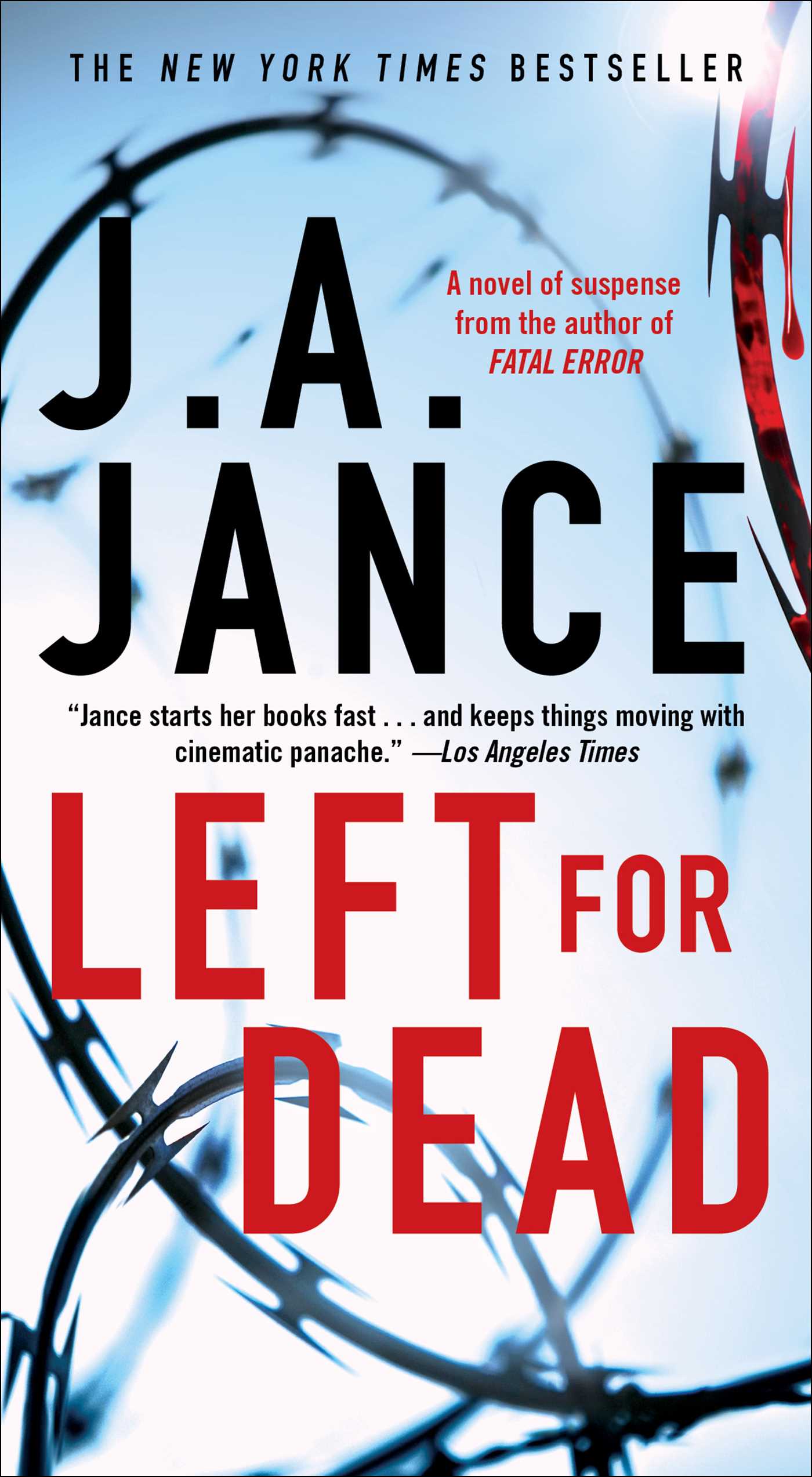
When violence from the drug wars with the Mexican cartels crosses the border into Arizona, and an old friend is murdered, Ali Reynolds steps in to investigate in New York Times bestselling author J.A. Jance’s fast-paced mystery.
When Santa Cruz county deputy sheriff Jose Reyes, one of Ali Reynolds’s classmates from the Arizona Police Academy, is gunned down and left to die, he is at first assumed to be an innocent victim of the drug wars escalating across the border. But the crime scene investigation shows there’s much more to it than that, and soon he and his pregnant wife, Teresa, are both under suspicion.
Ali owes Reyes a debt of gratitude for the help he gave her years earlier. When she’s summoned to his bedside at Mercy Medical Center in Tucson, it’s impossible for Ali to turn away. Upon arriving at the hospital, Ali finds her good friend, Sister Anselm, is there as well, working as a patient advocate on behalf of another seriously injured victim, an unidentified border crosser who was raped and savagely beaten.
As more bodies begin to pile up, Ali becomes determined to seek justice, even when it becomes impossible to know where the danger is coming from. Fast-paced, tension-filled, and intriguingly complex, Left for Dead is J.A. Jance at her riveting best.
When Santa Cruz county deputy sheriff Jose Reyes, one of Ali Reynolds’s classmates from the Arizona Police Academy, is gunned down and left to die, he is at first assumed to be an innocent victim of the drug wars escalating across the border. But the crime scene investigation shows there’s much more to it than that, and soon he and his pregnant wife, Teresa, are both under suspicion.
Ali owes Reyes a debt of gratitude for the help he gave her years earlier. When she’s summoned to his bedside at Mercy Medical Center in Tucson, it’s impossible for Ali to turn away. Upon arriving at the hospital, Ali finds her good friend, Sister Anselm, is there as well, working as a patient advocate on behalf of another seriously injured victim, an unidentified border crosser who was raped and savagely beaten.
As more bodies begin to pile up, Ali becomes determined to seek justice, even when it becomes impossible to know where the danger is coming from. Fast-paced, tension-filled, and intriguingly complex, Left for Dead is J.A. Jance at her riveting best.
Excerpt
Left for Dead 1
10:00 A.M., Friday, April 9
Sedona, Arizona
In the late morning, on a cold but bright Friday in early April, Ali Reynolds sat outside on her patio in Sedona, Arizona, ninety miles north of Phoenix. An outdoor heater hissed nearby, keeping the chill at bay. Around her, Sedona’s iconic red cliffs glowed in the distance, but on this particular morning, Ali was immune to the view. Instead, she tried desperately to focus on the table in front of her, spread with a dozen paper-filled folders. Ali had been scrutinizing each of the files one at a time for the past hour and was more than ready for a break. She just couldn’t concentrate.
How had she, intrepid reporter turned L.A. anchorwoman, then murder suspect, widow, and police academy graduate, wound up administering a private charitable fund as her primary duty in life? Surely she was too young to be put out to pasture.
“I’m going in to check on Sister Anselm’s cassoulet,” Leland Brooks said, stopping in front of the table on his way past. “While I’m there, would you care for some coffee?”
Leland was Ali’s majordomo, her butler, her right hand, and her elderly but spry man Friday. Since Ali’s return to Sedona, Sister Anselm, a Sister of Providence who lived in nearby Jerome, had become one of Ali’s dearest friends. In the process Sister Anselm and Leland Brooks had become friends as well.
Sister Anselm served on the board of an organization that helped people dealing with substance abuse issues in several northern Arizona counties. On the second Saturday of each month, after a regularly scheduled board meeting in Flagstaff, she would often stop off in Sedona to enjoy one of Leland’s signature meals. Cassoulet, a savory stew that the good sister had loved during her childhood in France, was one of her personal favorites. Even though it took Leland the better part of two days to make the stuff, he was always eager to serve it to such an appreciative guest. Sister Anselm had told him that eating it “transported” her back home.
All morning long, enticing aromas had leaked out of the kitchen and blown across the patio, setting Ali’s mouth watering.
Looking up, she smiled. “The cassoulet smells delicious, even out here,” she told him. “And coffee would be great.”
Leland Brooks and Ali's newly remodeled house on Sedona’s Manzanita Hills Road had come into her life as a package deal. Leland, a displaced Brit and a Korean War veteran, had managed the place for decades for its former owner, Arabella Ashcroft, and for Arabella’s mother, Anne Marie Ashcroft, before that. When Ali purchased the property with the intention of restoring it, she had kept Leland on, supposedly for the duration of the restoration process.
The remodeling project was long since over. The house, a gem of midcentury-modern architecture, had been returned to its original glory but updated to twenty-first-century building codes and fully stocked with modern-day appliances and computer-driven convenience. In the meantime, what Ali and Leland had both envisioned as a temporary employment situation had become more or less permanent.
During the Ashcroft years, Leland had occupied the servants’ quarters just off the kitchen. Now he lived in his own place, a fifth-wheel trailer parked on the far side of the garage, while Ali had the remodeled house to herself. Leland did the cooking and oversaw the cleaning. He had finally admitted that, at his stage of life, he could perhaps use a little help with the more rigorous chores. Nonetheless, he demanded perfection of all visiting crews of cleaners, window washers, and yard people, and having them available had allowed him to dive headfirst into a long-postponed project of creating a lush English garden in Ali’s front yard.
When Ali had mentioned Leland’s proposal to her parents, Bob and Edie Larson, her father immediately voiced his adamant disapproval. As far as he was concerned, putting a garden like that in the high desert of Arizona would be a colossal waste of time, effort, money, and water, but Ali was determined, and so was Leland; Ali because she’d always dreamed of having her very own “Enchanted Garden,” and Leland because he’d promised the house’s original owner that he’d complete her beloved project. During the “Arabella years,” when Anne Marie’s daughter had inherited the house and the butler, plans for the garden had been scrapped due to Arabella’s lack of interest. Now, with Ali in charge, Leland was determined to bring Anne Marie’s ambitious vision to fruition.
As far as gardening was concerned, Ali was well aware of her own personal limitations, one of which was having a perpetually black thumb. She had killed more indoor ficus plants than she cared to count. Initially, she’d been wary of such an undertaking, but it soon became clear that Leland was prepared to take the entire project in hand.
Leland had looked after Anne Marie’s troubled daughter for years after Anne Marie’s death, though his primary loyalty had always been to the family matriarch. When Leland first showed Ali the original garden plans, hand-sketched by Anne Marie on what was now wrinkled, yellowed sketch-pad paper, Ali knew what they needed to do.
She agreed to the project but on the condition that Leland’s role would be strictly supervisory. That was why, for the better part of the past week, a crew of strapping young men had been busily digging trenches and turning the soil, first to install the irrigation system and then to prepare the garden plot for planting. After that would come the pouring of the foundation for the garden’s centerpiece, a statue of a bighorn sheep created by Ali’s son, Christopher. Only when the statue was in place would it be time to plant the colorful array of growing things that Ali and Leland had selected while trudging through what had seemed like miles of aisles at Gardeners World in Phoenix.
Once Leland disappeared into the house, Ali turned her attention back to the folders on the table in front of her. The materials included both printed and handwritten (often barely decipherable) letters of recommendation from various teachers, employers, and friends stating why one particular girl or another should be the recipient of this year’s Amelia Dougherty Askins Scholarship.
Almost thirty years earlier, when Ali had received her own invitation from Anne Marie Ashcroft to come to tea at this very house, she’d had no idea that the scholarship program even existed, much less that she was a candidate. She had been quietly nominated by her high school English teacher, and receiving that unexpected scholarship had enabled Ali to attend college when she couldn’t have done so otherwise. Now, through a twist of fate, she was in charge of doling out those same scholarships to a new generation of deserving girls, and although it was a job she loved, it was hardly enough to keep her busy full-time.
That morning Ali had started with a field of twelve semifinalists. She stacked ten of the folders on one side of the table and put those of the two finalists on the other.
Rubbing her eyes and stretching her shoulders, Ali looked off across a valley punctuated with Sedona’s striking red-rock cliffs as Leland emerged from the house carrying a tray laden with coffee and a plate of freshly baked shortbread cookies.
“How’s the selection process coming along?” he asked, unloading the tray and depressing the plunger in the French press. Leland came from a class-conscious English background. It had taken more than a little persuading on Ali’s part to convince him to join her for an occasional cup of morning coffee. Leland was of the opinion that “familiarity” constituted a serious breach of employee/employer etiquette, but as Ali had pointed out, he wasn’t in Kansas anymore, and he wasn’t in Kensington Gardens, either.
Ali pushed the two finalists’ folders over toward the spot where Leland had deposited his cup and saucer.
“I’ve narrowed it down to these two,” Ali said. “Olivia McFarland and Autumn Rusk.”
Leland nodded. “Excellent choices,” he said. “They would have been mine, too.”
During the previous months, as the nominations arrived, Ali had deputized Leland to be her “feet on the ground” and to discreetly gather “intel” on the nominees. Leland had been an unobtrusive presence in Verde Valley communities for many years, and his sleuthing had unearthed quite a few things about the various girls’ backgrounds and family situations that were absent from the official school records.
For instance, Olivia’s 3.5 GPA at Mingus Mountain High School was solid enough, but it might have been much higher if Olivia hadn’t been charged with caring for her three younger siblings—two brothers and a baby sister—while their widowed mother worked two jobs to keep a roof over their heads and food on the table.
Ali also couldn’t help but wonder what would happen to the younger children if Olivia were given a scholarship that took her away from home. Would receiving the award, a positive for Olivia, turn into a negative in the lives of her younger siblings? For that matter, would she even accept it?
Autumn Rusk also came from a single-parent home. In the economic downturn, her once prosperous family life had disappeared right along with her father’s job. After the job was gone, the house went next, and after the house, the marriage. Autumn and her mother had moved from their upscale home in Sedona to a modest rental in Cornville, where Autumn’s mother had resumed her long-abandoned career as a hairdresser.
The chaos in their lives had impacted Autumn’s schoolwork, especially during her junior year, when she moved from Sedona High to Mingus. As a senior, she was back hitting the books and making headway in raising her GPA to its former level, but it was a tough road.
Three years before, faced with two equally deserving girls, Ali had opted to choose them both. Those two girls, Marissa Dvorak and Haley Marsh, were now juniors, attending the University of Arizona in Tucson and doing well academically and personally. In Ali’s wallet, right along with photos of her own twin grandkids, she carried a school picture of Haley’s bright-eyed son, Liam, grinning a five-year-old grin that was already minus one front tooth.
Giving someone an Askins scholarship meant a multiyear commitment from the endowment. The economic downturn that had cost Anthony Rusk his job had adversely affected the scholarship fund as well. And though it had received two recent generous donations that made up some of the investment shortfall, Ali wasn’t sure she could justify giving two scholarships this year.
Leland poured the coffee and took a seat. “I don’t envy your having to make the decision,” he said, as though reading her mind. “But if you’re thinking of awarding two scholarships, perhaps it’s time to consider doing some kind of fund-raising effort.”
“Long-term, you’re probably right,” Ali agreed, “but for right now I need to settle this so the girls and their families can make plans of their own.”
When coffee was over, Ali returned to the file folders. By lunchtime she had made up her mind. She would invite both girls to the traditional tea but would meet with them separately. The scholarship for Autumn, who was interested in nursing, would be to any four-year institution of higher learning within the state of Arizona, renewable annually provided she maintained an acceptable GPA.
Olivia’s, on the other hand, would pay in-state tuition, books, and some living expenses for her to attend Yavapai College in Sedona and in Prescott. It would also include a small stipend for child care for her siblings during study or school hours. Upon graduation, assuming she had maintained a suitable GPA, her scholarship could be extended for two more years if she transferred to a BA program at a school inside Arizona. That meant that Olivia’s family would benefit from having her at home with them during those first two years of college, but she’d also be getting a start on her education.
Having made her decision, Ali set about writing the required notes with a happy heart. She was confident that those seemingly trivial invitations to tea would change the course of at least two young lives, just as Anne Marie Ashcroft’s much earlier invitation had transformed the future for Alison Larson Reynolds.
As she sat there on her sunlit patio, Ali took pleasure in a life that seemed placid and orderly, and she relished every moment of it.
10:00 A.M., Friday, April 9
Sedona, Arizona
In the late morning, on a cold but bright Friday in early April, Ali Reynolds sat outside on her patio in Sedona, Arizona, ninety miles north of Phoenix. An outdoor heater hissed nearby, keeping the chill at bay. Around her, Sedona’s iconic red cliffs glowed in the distance, but on this particular morning, Ali was immune to the view. Instead, she tried desperately to focus on the table in front of her, spread with a dozen paper-filled folders. Ali had been scrutinizing each of the files one at a time for the past hour and was more than ready for a break. She just couldn’t concentrate.
How had she, intrepid reporter turned L.A. anchorwoman, then murder suspect, widow, and police academy graduate, wound up administering a private charitable fund as her primary duty in life? Surely she was too young to be put out to pasture.
“I’m going in to check on Sister Anselm’s cassoulet,” Leland Brooks said, stopping in front of the table on his way past. “While I’m there, would you care for some coffee?”
Leland was Ali’s majordomo, her butler, her right hand, and her elderly but spry man Friday. Since Ali’s return to Sedona, Sister Anselm, a Sister of Providence who lived in nearby Jerome, had become one of Ali’s dearest friends. In the process Sister Anselm and Leland Brooks had become friends as well.
Sister Anselm served on the board of an organization that helped people dealing with substance abuse issues in several northern Arizona counties. On the second Saturday of each month, after a regularly scheduled board meeting in Flagstaff, she would often stop off in Sedona to enjoy one of Leland’s signature meals. Cassoulet, a savory stew that the good sister had loved during her childhood in France, was one of her personal favorites. Even though it took Leland the better part of two days to make the stuff, he was always eager to serve it to such an appreciative guest. Sister Anselm had told him that eating it “transported” her back home.
All morning long, enticing aromas had leaked out of the kitchen and blown across the patio, setting Ali’s mouth watering.
Looking up, she smiled. “The cassoulet smells delicious, even out here,” she told him. “And coffee would be great.”
Leland Brooks and Ali's newly remodeled house on Sedona’s Manzanita Hills Road had come into her life as a package deal. Leland, a displaced Brit and a Korean War veteran, had managed the place for decades for its former owner, Arabella Ashcroft, and for Arabella’s mother, Anne Marie Ashcroft, before that. When Ali purchased the property with the intention of restoring it, she had kept Leland on, supposedly for the duration of the restoration process.
The remodeling project was long since over. The house, a gem of midcentury-modern architecture, had been returned to its original glory but updated to twenty-first-century building codes and fully stocked with modern-day appliances and computer-driven convenience. In the meantime, what Ali and Leland had both envisioned as a temporary employment situation had become more or less permanent.
During the Ashcroft years, Leland had occupied the servants’ quarters just off the kitchen. Now he lived in his own place, a fifth-wheel trailer parked on the far side of the garage, while Ali had the remodeled house to herself. Leland did the cooking and oversaw the cleaning. He had finally admitted that, at his stage of life, he could perhaps use a little help with the more rigorous chores. Nonetheless, he demanded perfection of all visiting crews of cleaners, window washers, and yard people, and having them available had allowed him to dive headfirst into a long-postponed project of creating a lush English garden in Ali’s front yard.
When Ali had mentioned Leland’s proposal to her parents, Bob and Edie Larson, her father immediately voiced his adamant disapproval. As far as he was concerned, putting a garden like that in the high desert of Arizona would be a colossal waste of time, effort, money, and water, but Ali was determined, and so was Leland; Ali because she’d always dreamed of having her very own “Enchanted Garden,” and Leland because he’d promised the house’s original owner that he’d complete her beloved project. During the “Arabella years,” when Anne Marie’s daughter had inherited the house and the butler, plans for the garden had been scrapped due to Arabella’s lack of interest. Now, with Ali in charge, Leland was determined to bring Anne Marie’s ambitious vision to fruition.
As far as gardening was concerned, Ali was well aware of her own personal limitations, one of which was having a perpetually black thumb. She had killed more indoor ficus plants than she cared to count. Initially, she’d been wary of such an undertaking, but it soon became clear that Leland was prepared to take the entire project in hand.
Leland had looked after Anne Marie’s troubled daughter for years after Anne Marie’s death, though his primary loyalty had always been to the family matriarch. When Leland first showed Ali the original garden plans, hand-sketched by Anne Marie on what was now wrinkled, yellowed sketch-pad paper, Ali knew what they needed to do.
She agreed to the project but on the condition that Leland’s role would be strictly supervisory. That was why, for the better part of the past week, a crew of strapping young men had been busily digging trenches and turning the soil, first to install the irrigation system and then to prepare the garden plot for planting. After that would come the pouring of the foundation for the garden’s centerpiece, a statue of a bighorn sheep created by Ali’s son, Christopher. Only when the statue was in place would it be time to plant the colorful array of growing things that Ali and Leland had selected while trudging through what had seemed like miles of aisles at Gardeners World in Phoenix.
Once Leland disappeared into the house, Ali turned her attention back to the folders on the table in front of her. The materials included both printed and handwritten (often barely decipherable) letters of recommendation from various teachers, employers, and friends stating why one particular girl or another should be the recipient of this year’s Amelia Dougherty Askins Scholarship.
Almost thirty years earlier, when Ali had received her own invitation from Anne Marie Ashcroft to come to tea at this very house, she’d had no idea that the scholarship program even existed, much less that she was a candidate. She had been quietly nominated by her high school English teacher, and receiving that unexpected scholarship had enabled Ali to attend college when she couldn’t have done so otherwise. Now, through a twist of fate, she was in charge of doling out those same scholarships to a new generation of deserving girls, and although it was a job she loved, it was hardly enough to keep her busy full-time.
That morning Ali had started with a field of twelve semifinalists. She stacked ten of the folders on one side of the table and put those of the two finalists on the other.
Rubbing her eyes and stretching her shoulders, Ali looked off across a valley punctuated with Sedona’s striking red-rock cliffs as Leland emerged from the house carrying a tray laden with coffee and a plate of freshly baked shortbread cookies.
“How’s the selection process coming along?” he asked, unloading the tray and depressing the plunger in the French press. Leland came from a class-conscious English background. It had taken more than a little persuading on Ali’s part to convince him to join her for an occasional cup of morning coffee. Leland was of the opinion that “familiarity” constituted a serious breach of employee/employer etiquette, but as Ali had pointed out, he wasn’t in Kansas anymore, and he wasn’t in Kensington Gardens, either.
Ali pushed the two finalists’ folders over toward the spot where Leland had deposited his cup and saucer.
“I’ve narrowed it down to these two,” Ali said. “Olivia McFarland and Autumn Rusk.”
Leland nodded. “Excellent choices,” he said. “They would have been mine, too.”
During the previous months, as the nominations arrived, Ali had deputized Leland to be her “feet on the ground” and to discreetly gather “intel” on the nominees. Leland had been an unobtrusive presence in Verde Valley communities for many years, and his sleuthing had unearthed quite a few things about the various girls’ backgrounds and family situations that were absent from the official school records.
For instance, Olivia’s 3.5 GPA at Mingus Mountain High School was solid enough, but it might have been much higher if Olivia hadn’t been charged with caring for her three younger siblings—two brothers and a baby sister—while their widowed mother worked two jobs to keep a roof over their heads and food on the table.
Ali also couldn’t help but wonder what would happen to the younger children if Olivia were given a scholarship that took her away from home. Would receiving the award, a positive for Olivia, turn into a negative in the lives of her younger siblings? For that matter, would she even accept it?
Autumn Rusk also came from a single-parent home. In the economic downturn, her once prosperous family life had disappeared right along with her father’s job. After the job was gone, the house went next, and after the house, the marriage. Autumn and her mother had moved from their upscale home in Sedona to a modest rental in Cornville, where Autumn’s mother had resumed her long-abandoned career as a hairdresser.
The chaos in their lives had impacted Autumn’s schoolwork, especially during her junior year, when she moved from Sedona High to Mingus. As a senior, she was back hitting the books and making headway in raising her GPA to its former level, but it was a tough road.
Three years before, faced with two equally deserving girls, Ali had opted to choose them both. Those two girls, Marissa Dvorak and Haley Marsh, were now juniors, attending the University of Arizona in Tucson and doing well academically and personally. In Ali’s wallet, right along with photos of her own twin grandkids, she carried a school picture of Haley’s bright-eyed son, Liam, grinning a five-year-old grin that was already minus one front tooth.
Giving someone an Askins scholarship meant a multiyear commitment from the endowment. The economic downturn that had cost Anthony Rusk his job had adversely affected the scholarship fund as well. And though it had received two recent generous donations that made up some of the investment shortfall, Ali wasn’t sure she could justify giving two scholarships this year.
Leland poured the coffee and took a seat. “I don’t envy your having to make the decision,” he said, as though reading her mind. “But if you’re thinking of awarding two scholarships, perhaps it’s time to consider doing some kind of fund-raising effort.”
“Long-term, you’re probably right,” Ali agreed, “but for right now I need to settle this so the girls and their families can make plans of their own.”
When coffee was over, Ali returned to the file folders. By lunchtime she had made up her mind. She would invite both girls to the traditional tea but would meet with them separately. The scholarship for Autumn, who was interested in nursing, would be to any four-year institution of higher learning within the state of Arizona, renewable annually provided she maintained an acceptable GPA.
Olivia’s, on the other hand, would pay in-state tuition, books, and some living expenses for her to attend Yavapai College in Sedona and in Prescott. It would also include a small stipend for child care for her siblings during study or school hours. Upon graduation, assuming she had maintained a suitable GPA, her scholarship could be extended for two more years if she transferred to a BA program at a school inside Arizona. That meant that Olivia’s family would benefit from having her at home with them during those first two years of college, but she’d also be getting a start on her education.
Having made her decision, Ali set about writing the required notes with a happy heart. She was confident that those seemingly trivial invitations to tea would change the course of at least two young lives, just as Anne Marie Ashcroft’s much earlier invitation had transformed the future for Alison Larson Reynolds.
As she sat there on her sunlit patio, Ali took pleasure in a life that seemed placid and orderly, and she relished every moment of it.
Reading Group Guide
Get a FREE ebook by joining our mailing list today! Plus, receive recommendations for your next Book Club read.
By clicking 'Sign me up' I agree to the Terms of Use and acknowledge the Privacy Policy and Notice of Financial Incentive. Free ebook offer available to NEW US subscribers only. Offer redeemable at Simon & Schuster's ebook fulfillment partner. Must redeem within 90 days. See full terms and conditions and this month's choices.
This reading group guide for Left for Dead includes an introduction, discussion questions, ideas for enhancing your book club, and a Q&A with author J.A. Jance. The suggested questions are intended to help your reading group find new and interesting angles and topics for your discussion. We hope that these ideas will enrich your conversation and increase your enjoyment of the book.
Introduction
Left for Dead is a complex, twisting narrative about the devastating violence from the Mexican drug wars in Arizona. When several attempted murders occur within miles of each other, and two of the suspects are drug dealers, Ali Reynolds steps in to help protect the victims and prove their innocence. As more bodies pile up, Ali must confront the evil of the drug cartels across the border head-on, with no way of knowing who the next victim will be.
Topics & Questions for Discussion
1. The novel opens with Breeze Domingo, a.k.a Rose Ventana, sleeping on a “sagging leather couch in a filthy apartment.” (p. 1) How does this initial introduction to Rose set the tone for the book? Do you feel sympathy for Rose’s situation? Do you like her? How much agency do you think she has in determining her situation?
2. “But if life on the street had taught her any lessons at all, the most basic was not to ask questions, especially when you don’t want to hear answers.” (p. 7) Discuss Breeze’s advice in light of her own situation. Should she have followed her own advice, or should she have asked Chico questions? Would questioning have saved her from the abuse she was about to receive? Do other characters follow this principle? Consider Al, Ali, and Sheriff Renteria in your response.
3. Discuss Ali and B.’s relationship. Are they in love? Do you think Ali is fully committed? Is B. fully committed? What specific actions or conversations showcase this?
4. Why does Olga Sanchez blame Teresa for her son’s death? Do you think there is any truth to her accusations? Why or why not?
5. What symbolism do you identify in the title Left for Dead? Which characters are “left for dead” physically? Which characters are “left for dead” emotionally? Do you think there is any particular character to whom the title refers?
6. Revisit the scene when Phil describes Cassidy’s death. Do you think Phil’s guilt about his daughter’s death is well founded? In your opinion, is Christine angry with Phil, or did she simply lose her mind? Do you blame Phil for falling in love with Olga? Do you think Olga really cared about Phil? Why or why not?
7. There are arguably many characters who could be considered the “hero” of the novel. Who would you name as the hero? Ali? Al? Sister Anselm? In your opinion, what defines a hero?
8. When Al decides to take flowers to Rose, he decides to purchase Easter lilies because, “after all, Easter was all about the resurrection. Wasn’t this the same thing?” (p. 147) In what other ways does Judeo-Christian imagery appear throughout the novel? What kind of role does spirituality play in Left for Dead?
9. On page 164, Juanita Cisco questions Ali’s motives for wanting to assist Jose and Teresa, implying that Ali has less than noble reasons for helping out the Reyes family. What do you think of Juanita’s line of questioning? Do you agree that behind every good deed is a selfish motive?
10. On page 247, Sister Anselm refers to the parable of the prodigal son in the Bible as a way to explain that perhaps not every member of Rose’s family would be happy to discover she is still alive. Read this parable aloud to your book club (Luke 15:11-32). Compare and contrast Rose’s situation with the son in the parable. How are they similar? How are they different? Were Sister Anselm’s fears justified?
11. Discuss Rose Ventana and the Fox family. Why do you think Rose ran away? Do you think her fears that her family would not accept her were logical? Ultimately, do you consider it lucky that Al told the Fox family about finding their long lost daughter? Do you think that Rose would have tried to contact her family without other characters’ intervention?
12. Discuss the role of friendship in Left for Dead. Are these characters unusual in their loyalty? What about, as in Al’s case, their devotion to complete strangers? Consider Ali, Sister Anselm, Al, Patty, Donnatelle, and Sheriff Renteria in your response. Do these characters value friendship above all else? Explain.
13. “Olga Sanchez dropped the slat of blind and turned back to Ali. Then in one fluid motion, she raised the gun to her head and fired.” (p. 383) Did this ending surprise you? What is the emotional impact of this ending? Is it sad? Happy? Bittersweet? Why?
Enhance Your Book Club
1. Left for Dead is part of the Ali Reynolds series by J.A. Jance. Read an earlier book in the series, Web of Evil. Compare and contrast the novels. What characters overlap, and how have they developed? Which characters are new in Left for Dead, and what function do they serve? How has Ali herself developed as a character from Web of Evil to Left for Dead? Which book did your group prefer?
2. Leland Brooks, Ali’s employee and friend, is described as being a wonderful chef. His signature dish, the cassoulet, is described in the novel with great detail and is a favorite dish of both Ali and Sister Anselm. Re-create Leland’s meal with your book club. A recipe can be found here: http://www.epicurious.com/recipes/food/views/Cassoulet-233971. Over dinner, discuss Leland’s character. Why does Ali keep him as her employee? How does he figure into the story? Do you like him?
3. Left for Dead is set against the backdrop of violent drug wars on the U.S. and Mexico border. Research this current event and share a few facts with your book club members. Do you think that Jance captured the complexity of this issue?
A Conversation with J.A. Jance
In your opinion, what makes Ali so likeable? Did any of your previous characters influence the creation of Ali’s character?
I think Ali's concern for others is part of her appeal. Long ago an editor told me, and not in a good way, “Judy, the problem with your characters is that they all do what they do because of the way they were raised.” I couldn't then and can't now see what that was a problem. And Ali is a chip off both the old blocks in her family.
Your characters are drawn from all walks of life, from taser-wielding nuns to vulnerable teenaged runaways. Where do you draw your inspiration for your complex characters? Were any of the characters in Left for Dead inspired by real people?
Years ago while on a Rick Steves “Europe through the Back Door” trip, I encountered a woman whose World War II childhood experiences are mirrored in Sister Anselm's story. Of course, I write fiction, and what happened to Sister Anselm after World War II is entirely of my creation. As for Ali herself, she grew out of the fact that a local Tucson TV station fired my favorite female news broadcaster for being beyond her “pull” date.
Describe the journey you took while writing this book. Is writing the Ali Reynolds series a different experience from writing your other novels? Why or why not?
Writing this book really was a journey—it took months longer to write Left for Dead than it usually takes. I believe the problem was that there were two trains of story moving forward in this book and I needed to get both trains to pull into the station at approximately the same time in a way both I and my readers would find believable. Ali remains my most recent character, and I'm still getting to know her.
Booklist has referred to your writing style as “an entertaining mix of sleuthing and human relationships.” Do you think this is an accurate description of your novels? Do you tend to focus more energy on one aspect of your story than another?
I actually agree with that statement. Yes, the mystery is a required ingredient, but the relationships of the people involved are an important aspect of my stories. When I was doing the galley proofs of this book, there were still a couple of paragraphs that gave me goosebumps. If the story can do that for the writer, it can do it for the reader.
What made you decide to set this story in Arizona? What effect did the setting has on the book or its tone?
I use Arizona as a setting because it's a part of the world I know well. I know the distances from one place to another; I know the weather; I know the towns; I know the people. It goes back to that old writing rule: Write what you know. As for tone, I believe all my books have that in common. They are set in the West. The modern West. They are not Westerns per se, but the characters react to situations in a Western fashion.
You mention on your website that after reading Frank Baum’s Wizard of Oz series in the second grade, you knew you wanted to be a writer. What other influences have guided you as a writer? What author(s) do you look to for inspiration?
Like many of my current female mystery writers, I ventured into mysteries with Nancy Drew and the Hardy Boys. I read Mickey Spillane and Travis Magee. What I liked about all those books was dealing with familiar people each time I opened a new book—Nancy Drew's father, the housekeeper, her pals. It's what I like about my books, too.
You were born in South Dakota and raised in Bisbee, Arizona. Now you split time between Seattle, Washington and Tucson, Arizona. Explain how the place(s) you call home have helped shape you as a novelist, a poet, and a person.
My parents were Midwest farm people who had the courage to pull up stakes, move to someplace new, and start over. After my divorce, I had to do that, too. I started over in a new place with selling insurance and I started a new career of writing. I think my parents were part of the inspiration that made my making those necessary changes possible. I've always felt at home in Arizona because it was home. But Washington State is the place that gave me my new life. As for splitting my time? Looking out at the gray wet weather of a Washington October, there's good reason to long for Arizona sunshine. So yes, I'm an unapologetic Snowbird.
Do you have a favorite writing spot? If so, where is it?
Where I am right now—in a chair in my family room with the kitchen and the coffee machine directly behind me, with my dog Bella in her chair right next door, and with a wall filled with a collection of my framed book covers to my left. Seeing all those covers hanging there together is a reminder that I've been doing this job for a long time, and that I really have created a body of work.
Certainly, you favor strong female characters in your novels, and Ali is no different. She is seemingly unafraid to stand up to evil and fight for justice. Do you feel a kindred spirit with Ali?
When I was a senior in high school one of the school officials sent a letter to one of my classmates saying that, because Linda was pregnant, she wouldn't be allowed to graduate with our class or participate in class night or the baccalaureate services. Since her husband, also a classmate, received no such letter, this struck me as a terrible injustice. A friend and I began passing a petition asking that Linda be allowed to graduate with our class. Two of our teachers took us aside and told us that we needed to stop passing the petition. Finally, the school official called my father and told him that I was scheduled to receive a scholarship at class night and I would—as long as I stopped passing the petition. There were seven kids in our family. That scholarship was the ONLY way I would be able to go on to college. And so I stopped passing the petition. Linda didn't graduate with our class, and I always felt as though I had achieved my success by grinding Linda into the dust. She died of cancer while we were still in our twenties. A few years ago, after the first Ali book came out, Linda's brother came to a signing. Afterwards, he took me aside and said, “Our whole family knew what you tried to do back then. Thank you.”
As you can see, the scholarship part of Ali's life comes from a real place for me, and yes, we both know a little about standing up to injustice—both large and small.
What is next for you as a writer? What is next for Ali Reynolds?
Right now I'm working on Judgment Call, the next Joanna Brady book. I have a hint of an idea about what will be in the next Ali book, but I haven't started writing it yet. That will happen soon.
Introduction
Left for Dead is a complex, twisting narrative about the devastating violence from the Mexican drug wars in Arizona. When several attempted murders occur within miles of each other, and two of the suspects are drug dealers, Ali Reynolds steps in to help protect the victims and prove their innocence. As more bodies pile up, Ali must confront the evil of the drug cartels across the border head-on, with no way of knowing who the next victim will be.
Topics & Questions for Discussion
1. The novel opens with Breeze Domingo, a.k.a Rose Ventana, sleeping on a “sagging leather couch in a filthy apartment.” (p. 1) How does this initial introduction to Rose set the tone for the book? Do you feel sympathy for Rose’s situation? Do you like her? How much agency do you think she has in determining her situation?
2. “But if life on the street had taught her any lessons at all, the most basic was not to ask questions, especially when you don’t want to hear answers.” (p. 7) Discuss Breeze’s advice in light of her own situation. Should she have followed her own advice, or should she have asked Chico questions? Would questioning have saved her from the abuse she was about to receive? Do other characters follow this principle? Consider Al, Ali, and Sheriff Renteria in your response.
3. Discuss Ali and B.’s relationship. Are they in love? Do you think Ali is fully committed? Is B. fully committed? What specific actions or conversations showcase this?
4. Why does Olga Sanchez blame Teresa for her son’s death? Do you think there is any truth to her accusations? Why or why not?
5. What symbolism do you identify in the title Left for Dead? Which characters are “left for dead” physically? Which characters are “left for dead” emotionally? Do you think there is any particular character to whom the title refers?
6. Revisit the scene when Phil describes Cassidy’s death. Do you think Phil’s guilt about his daughter’s death is well founded? In your opinion, is Christine angry with Phil, or did she simply lose her mind? Do you blame Phil for falling in love with Olga? Do you think Olga really cared about Phil? Why or why not?
7. There are arguably many characters who could be considered the “hero” of the novel. Who would you name as the hero? Ali? Al? Sister Anselm? In your opinion, what defines a hero?
8. When Al decides to take flowers to Rose, he decides to purchase Easter lilies because, “after all, Easter was all about the resurrection. Wasn’t this the same thing?” (p. 147) In what other ways does Judeo-Christian imagery appear throughout the novel? What kind of role does spirituality play in Left for Dead?
9. On page 164, Juanita Cisco questions Ali’s motives for wanting to assist Jose and Teresa, implying that Ali has less than noble reasons for helping out the Reyes family. What do you think of Juanita’s line of questioning? Do you agree that behind every good deed is a selfish motive?
10. On page 247, Sister Anselm refers to the parable of the prodigal son in the Bible as a way to explain that perhaps not every member of Rose’s family would be happy to discover she is still alive. Read this parable aloud to your book club (Luke 15:11-32). Compare and contrast Rose’s situation with the son in the parable. How are they similar? How are they different? Were Sister Anselm’s fears justified?
11. Discuss Rose Ventana and the Fox family. Why do you think Rose ran away? Do you think her fears that her family would not accept her were logical? Ultimately, do you consider it lucky that Al told the Fox family about finding their long lost daughter? Do you think that Rose would have tried to contact her family without other characters’ intervention?
12. Discuss the role of friendship in Left for Dead. Are these characters unusual in their loyalty? What about, as in Al’s case, their devotion to complete strangers? Consider Ali, Sister Anselm, Al, Patty, Donnatelle, and Sheriff Renteria in your response. Do these characters value friendship above all else? Explain.
13. “Olga Sanchez dropped the slat of blind and turned back to Ali. Then in one fluid motion, she raised the gun to her head and fired.” (p. 383) Did this ending surprise you? What is the emotional impact of this ending? Is it sad? Happy? Bittersweet? Why?
Enhance Your Book Club
1. Left for Dead is part of the Ali Reynolds series by J.A. Jance. Read an earlier book in the series, Web of Evil. Compare and contrast the novels. What characters overlap, and how have they developed? Which characters are new in Left for Dead, and what function do they serve? How has Ali herself developed as a character from Web of Evil to Left for Dead? Which book did your group prefer?
2. Leland Brooks, Ali’s employee and friend, is described as being a wonderful chef. His signature dish, the cassoulet, is described in the novel with great detail and is a favorite dish of both Ali and Sister Anselm. Re-create Leland’s meal with your book club. A recipe can be found here: http://www.epicurious.com/recipes/food/views/Cassoulet-233971. Over dinner, discuss Leland’s character. Why does Ali keep him as her employee? How does he figure into the story? Do you like him?
3. Left for Dead is set against the backdrop of violent drug wars on the U.S. and Mexico border. Research this current event and share a few facts with your book club members. Do you think that Jance captured the complexity of this issue?
A Conversation with J.A. Jance
In your opinion, what makes Ali so likeable? Did any of your previous characters influence the creation of Ali’s character?
I think Ali's concern for others is part of her appeal. Long ago an editor told me, and not in a good way, “Judy, the problem with your characters is that they all do what they do because of the way they were raised.” I couldn't then and can't now see what that was a problem. And Ali is a chip off both the old blocks in her family.
Your characters are drawn from all walks of life, from taser-wielding nuns to vulnerable teenaged runaways. Where do you draw your inspiration for your complex characters? Were any of the characters in Left for Dead inspired by real people?
Years ago while on a Rick Steves “Europe through the Back Door” trip, I encountered a woman whose World War II childhood experiences are mirrored in Sister Anselm's story. Of course, I write fiction, and what happened to Sister Anselm after World War II is entirely of my creation. As for Ali herself, she grew out of the fact that a local Tucson TV station fired my favorite female news broadcaster for being beyond her “pull” date.
Describe the journey you took while writing this book. Is writing the Ali Reynolds series a different experience from writing your other novels? Why or why not?
Writing this book really was a journey—it took months longer to write Left for Dead than it usually takes. I believe the problem was that there were two trains of story moving forward in this book and I needed to get both trains to pull into the station at approximately the same time in a way both I and my readers would find believable. Ali remains my most recent character, and I'm still getting to know her.
Booklist has referred to your writing style as “an entertaining mix of sleuthing and human relationships.” Do you think this is an accurate description of your novels? Do you tend to focus more energy on one aspect of your story than another?
I actually agree with that statement. Yes, the mystery is a required ingredient, but the relationships of the people involved are an important aspect of my stories. When I was doing the galley proofs of this book, there were still a couple of paragraphs that gave me goosebumps. If the story can do that for the writer, it can do it for the reader.
What made you decide to set this story in Arizona? What effect did the setting has on the book or its tone?
I use Arizona as a setting because it's a part of the world I know well. I know the distances from one place to another; I know the weather; I know the towns; I know the people. It goes back to that old writing rule: Write what you know. As for tone, I believe all my books have that in common. They are set in the West. The modern West. They are not Westerns per se, but the characters react to situations in a Western fashion.
You mention on your website that after reading Frank Baum’s Wizard of Oz series in the second grade, you knew you wanted to be a writer. What other influences have guided you as a writer? What author(s) do you look to for inspiration?
Like many of my current female mystery writers, I ventured into mysteries with Nancy Drew and the Hardy Boys. I read Mickey Spillane and Travis Magee. What I liked about all those books was dealing with familiar people each time I opened a new book—Nancy Drew's father, the housekeeper, her pals. It's what I like about my books, too.
You were born in South Dakota and raised in Bisbee, Arizona. Now you split time between Seattle, Washington and Tucson, Arizona. Explain how the place(s) you call home have helped shape you as a novelist, a poet, and a person.
My parents were Midwest farm people who had the courage to pull up stakes, move to someplace new, and start over. After my divorce, I had to do that, too. I started over in a new place with selling insurance and I started a new career of writing. I think my parents were part of the inspiration that made my making those necessary changes possible. I've always felt at home in Arizona because it was home. But Washington State is the place that gave me my new life. As for splitting my time? Looking out at the gray wet weather of a Washington October, there's good reason to long for Arizona sunshine. So yes, I'm an unapologetic Snowbird.
Do you have a favorite writing spot? If so, where is it?
Where I am right now—in a chair in my family room with the kitchen and the coffee machine directly behind me, with my dog Bella in her chair right next door, and with a wall filled with a collection of my framed book covers to my left. Seeing all those covers hanging there together is a reminder that I've been doing this job for a long time, and that I really have created a body of work.
Certainly, you favor strong female characters in your novels, and Ali is no different. She is seemingly unafraid to stand up to evil and fight for justice. Do you feel a kindred spirit with Ali?
When I was a senior in high school one of the school officials sent a letter to one of my classmates saying that, because Linda was pregnant, she wouldn't be allowed to graduate with our class or participate in class night or the baccalaureate services. Since her husband, also a classmate, received no such letter, this struck me as a terrible injustice. A friend and I began passing a petition asking that Linda be allowed to graduate with our class. Two of our teachers took us aside and told us that we needed to stop passing the petition. Finally, the school official called my father and told him that I was scheduled to receive a scholarship at class night and I would—as long as I stopped passing the petition. There were seven kids in our family. That scholarship was the ONLY way I would be able to go on to college. And so I stopped passing the petition. Linda didn't graduate with our class, and I always felt as though I had achieved my success by grinding Linda into the dust. She died of cancer while we were still in our twenties. A few years ago, after the first Ali book came out, Linda's brother came to a signing. Afterwards, he took me aside and said, “Our whole family knew what you tried to do back then. Thank you.”
As you can see, the scholarship part of Ali's life comes from a real place for me, and yes, we both know a little about standing up to injustice—both large and small.
What is next for you as a writer? What is next for Ali Reynolds?
Right now I'm working on Judgment Call, the next Joanna Brady book. I have a hint of an idea about what will be in the next Ali book, but I haven't started writing it yet. That will happen soon.
About the Author
Photograph by Mary Ann Halpin Studios
J.A. Jance is the New York Times bestselling author of the Ali Reynolds series, the J.P. Beaumont series, the Joanna Brady series, and the Walker Family series. Born in South Dakota and raised in Bisbee, Arizona, Jance lives with her husband in Seattle, Washington. Visit her online at JAJance.com.
Product Details
- Publisher: Gallery Books (August 8, 2026)
- Length: 448 pages
- ISBN13: 9781668282144
Browse Related Books
Resources and Downloads
High Resolution Images
-
Book Cover Image (jpg): Left for Dead
Trade Paperback 9781668282144
-
Author Photo (jpg): J.A. Jance Photograph by Mary Ann Halpin Studios(0.1 MB)
Any use of an author photo must include its respective photo credit