Plus, receive recommendations and exclusive offers on all of your favorite books and authors from Simon & Schuster.
0:00 /
LIST PRICE $29.99
PRICE MAY VARY BY RETAILER
Free shipping when you spend $40. Terms apply.
Buy from Other Retailers
Table of Contents
About the Book
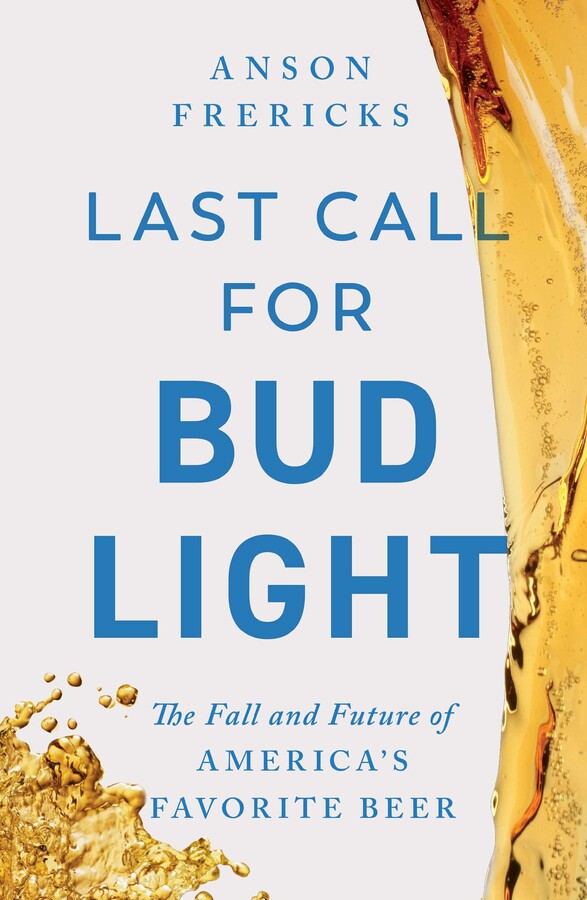
The astonishing inside story of how Bud Light lost its position as the most popular beer in the United States from a longtime Anheuser-Busch executive.
Anson Frericks, a former president at Anheuser-Busch—formerly the home of America’s most popular brewery—watched as the company unraveled at the hands of globe-trotting financiers and progressive middle management.
Rather than pursue shareholder profits, Anheuser-Busch suddenly became focused on stakeholder capitalism and the vague mandates of environment, social, and governance (ESG). This ill-advised change cumulated in the shocking evaporation of $30 billion in market cap after releasing an advertising campaign starring political activist Dylan Mulvaney.
Now, Anheuser-Busch’s evolution and its subsequent fallout is brought to light as never before with this ultimate insider’s look. Compelling, candid, and eye-opening, Last Call for Bud Light is the unforgettable story of the downfall and future of an American icon.
Excerpt
Prologue Prologue
The wait for the seven-floor elevator ride was taking longer than usual. Anheuser-Busch had recently moved its sales and marketing team from St. Louis to New York City, and more and more people were crammed into the glitzy new office. One of the elevators was broken, and a mob was waiting in the lobby. I decided to take the stairs.
I was on my way to meet Brendan Whitworth, the North American CEO of Anheuser-Busch. The meeting was critical. We had an opportunity for a partnership that could breathe new life into a company that had entered something of a midlife crisis. I’d crunched the numbers. The capital outlay would be negligible, but the profits could be immense. Anheuser-Busch, where I was President of U.S. Sales & Distribution, could make millions.
As I rounded the corner from the stairwell to Brendan’s desk, the office décor suddenly struck me with new meaning. A turn-of-the-century advertisement hawking Anheuser-Busch’s 10-cent Faust beers hung on an iron-textured wall. The rare visual indulgence among what was otherwise an efficient, modern, glass-walled space. Nearby, an oil painting of a bottle of Budweiser rested in an oversized gilded frame, just barely missing the exposed pipes in the ceiling above. It was the perfect juxtaposition of the old and new. The vintage and modern. Even the lighting was marked by contrast. Naked industrial Edison bulbs hung from the ceiling aside sculptures made from dangling Bud Light bottles that looked like they might have been enjoyed at a backyard barbecue the weekend before. The ways of the old guard and the new.
The company had gone through many big transitions. From generations of ownership by the famed Busch family to the takeover by the unstoppable global beer conglomerate InBev. From opulence and Clydesdales to efficiency and zero-based budgeting. From Saint Louis to New York. Somehow, all of it was captured on my way to Brendan’s desk. This could be a turning point, too: Anheuser-Busch could go from a storied brewery whose brands were getting a little flat to something modern, something of-the-moment, something more.
The partnership wasn’t without its risks, of course. The proposed partner was controversial—polarizing even—in some quarters. Some of our customers might be turned off. There might even be boycotts, though I thought the risk was extremely low.
But the upside was huge. It was an expansion opportunity, a chance to introduce ourselves to a new community. To make an impact, in a way that aligned with our mission to create a future with more cheers. We could start out small, see how it went, and hopefully grow our relationship over time. Our partner’s existing fans would grow to become our fans, and vice versa. A partnership to expand our audience, to appeal to a younger, more contemporary crowd.
I made my pitch. The CEO wasn’t convinced. Neither was Legal.
“Denied,” Anheuser-Busch’s Legal & External Affairs Chief, Cesar Vargas, decried. “The reputational risks are simply too high.” Brendan didn’t push back. The partnership was killed on the spot.
You might think I’m describing a conversation in which Bud Light decided not to pursue its ill-fated marketing partnership with transgender activist Dylan Mulvaney. But I’m not. I’m describing a very real conversation about a different partnership: a proposed distribution partnership with Black Rifle Coffee Company in 2022.
If you haven’t heard, Black Rifle Coffee’s mission is to serve coffee and culture to people who love America. For many customers, it’s the American heartland alternative to Starbucks. Its founder, a former U.S. Army Green Beret, was fed up with the way that Starbucks seemingly caters to the coastal, latte-loving elites. How it pledges to hire refugees over American citizens and promotes progressive politics. Black Rifle would be different. It would be pro-veteran, pro–first responder, pro-America. Its name is a reference to the black training rifle issued to troops at boot camp. It hires veterans and military spouses. It hosts archery tournaments for disabled vets. For a time, the founder let one of his down-on-his-luck former military colleagues crash in a trailer on the office grounds. It is a brand for someone who wants a drink that respects freedom and the people who fight for it, that doesn’t hold rural and blue-collar workers in contempt.
The company’s coffee, by the way, is also quite good.
The combination of strong product and targeted marketing was proving explosive. In 2019, Black Rifle sold $82 million worth of coffee. By year end 2021, that figure had ballooned to $233 million. The company had opened a handful of brick-and-mortar coffee shops where baristas slung handcrafted drinks with colorful names like a “camo latte” with Irish cream and mint and what I presume must be a highly caffeinated beverage called only “jet fuel.” But the real growth potential was in selling ready-to-drink cans and bagged coffee through retail channels. In certain markets, Black Rifle was already on the shelves at Walmart, Publix, 7-Eleven, Sam’s Club, and more. But it wanted to expand.
That’s where Anheuser-Busch could come in. Since the end of Prohibition, Anheuser-Busch has invested hundreds of millions of dollars building out a world-class distribution network. Hundreds of wholesalers already managed routes to deliver Budweiser, Bud Light, Busch, Michelob Ultra, Stella Artois, and other Anheuser-Busch brands to these very same grocers, convenience stores, and retail outlets. They also distributed non–Anheuser-Busch brands like energy drinks, waters, and teas.
It would be a match made in heaven: Anheuser-Busch could distribute Black Rifle Coffee’s coffee cans on the same trucks that carried Bud Light. Black Rifle Coffee wouldn’t have to set up its own logistics chain, and Anheuser-Busch could grow its revenue.
But in January 2022, Anheuser-Busch’s top brass didn’t see it that way. Black Rifle Coffee may have been beloved by veterans and the Fox News crowd, but what would the New York City illuminati think of Brendan when news of the partnership spread at cocktail hours and dinner parties? Of course, they didn’t frame it that way. Instead, they invoked the mantra of “reputational risk” as though Anheuser-Busch’s customers would suddenly revolt if they knew that the truck that carried their beer to the store had also carried Black Rifle Coffee.
If that proposition doesn’t seem unlikely enough, consider for a moment the fact that Walmart, Publix, Sam’s Club, 7-Eleven, Circle K, and many, many other retailers were already selling Black Rifle Coffee at their stores. No one cared. Literally no one. No one was protesting outside Walmart because a helicopter mom with toddlers in tow noticed that Black Rifle Coffee was selling bagged coffee called “silencer smooth”; peace-loving dads weren’t avoiding Slurpees with their kids after softball practice because 7-Eleven also sold “vanilla bomb” coffee in a can. It was a nonissue. People understand that big companies—Walmart and 7-Eleven and, yes, even Anheuser-Busch—sell lots of different products under many different brands to many different customers.
But I was supposed to believe that our consumers were suddenly going to switch to Chardonnay (or, more realistically, Coors Light) if someone took to Instagram with a Change.org petition armed with photos of Black Rifle Coffee being unloaded from an Anheuser-Busch truck. Come on.
At that moment, I knew that the company where I had spent eleven years had changed. And not for the better. Anheuser-Busch’s executives weren’t evaluating a partnership that could reach new customers and increase shareholder value, they were concerned because Black Rifle Coffee didn’t jive with their personal values and those held by their progressive stakeholders. They had lost touch with Anheuser-Busch’s brand. With its mission. With its consumers. And that’s what set the company up for a much bigger, much more public failure nearly a year later.
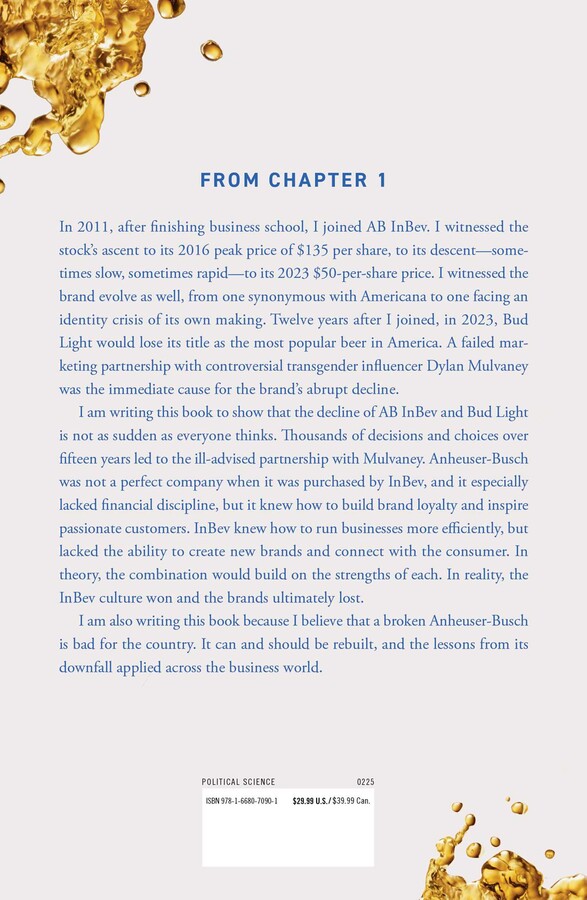
That’s the one you’ve heard about: Where the world’s largest beer brand, Bud Light, teamed up with a controversial transgender activist, Dylan Mulvaney, to celebrate Dylan’s first 100 days of “girlhood,” alienating customers everywhere and leading to the company’s precipitous decline. Billions of dollars in shareholder value were erased. Overnight. All because the company’s executives were blinded by their own biases and lost sight of Bud Light’s historic branding of being “easy to drink, easy to enjoy.”
That part you know. But there’s so much more to tell. About a humble, nineteenth-century brewery with grand ambitions and charisma to spare. About an equally ambitious Brazilian trio, who did the unthinkable: mount a successful hostile takeover of the largest beer company in the world, using American shareholder capitalism as its spear. About the subsequent missteps of foreign executives trying to understand American consumers. About many companies, including Anheuser-Busch, adopting European Stakeholder Capitalism and its increasingly controversial tenants of Environmental, Social, and Governance (ESG) and Diversity, Equity, and Inclusion (DEI) as guiding principles. About a company getting lost in a culture war that was, and remains, bigger than even Anheuser-Busch itself. And about competing visions for the future. One that says corporate America should focus on delivering value to shareholders and consumers, the other that says companies should be judged by political activism on behalf of “stakeholders.” And finally, about a possible redemption arc that both Anheuser-Busch and corporate America as a whole have the power to write, if only they’re willing to pick up the pen.
This is that story.
Product Details
- Publisher: Threshold Editions (February 4, 2025)
- Length: 304 pages
- ISBN13: 9781668070901
Browse Related Books
Resources and Downloads
High Resolution Images
-
Book Cover Image (jpg): Last Call for Bud Light
Hardcover 9781668070901