
Plus, receive recommendations and exclusive offers on all of your favorite books and authors from Simon & Schuster.
0:00 /
LIST PRICE $16.99
PRICE MAY VARY BY RETAILER
Digital products purchased on SimonandSchuster.com must be read on the Simon & Schuster Books app. Learn more.
Get 20% off with code SPOOKY plus free shipping on orders of $40 or more. Discount on physical products only. Terms apply.
Buy from Other Retailers
Table of Contents
About the Book
NATIONAL BESTSELLER
NAMED A BEST BOOK OF THE YEAR BY NPR, TIME, OPRAH DAILY, GOODREADS, AND MORE
“Brilliant…A high-spirited, exhilarating memoir.” —The Wall Street Journal • “In Joyride, the takeaway often has as much to do with the art of living as the art of writing.” —Elle • “Wise and exuberant…It’s funny, as well. Just masterful.” —David Sedaris • “Superbly good…Ebullient, frank, moving, and inspiring.” —Booklist (starred review)
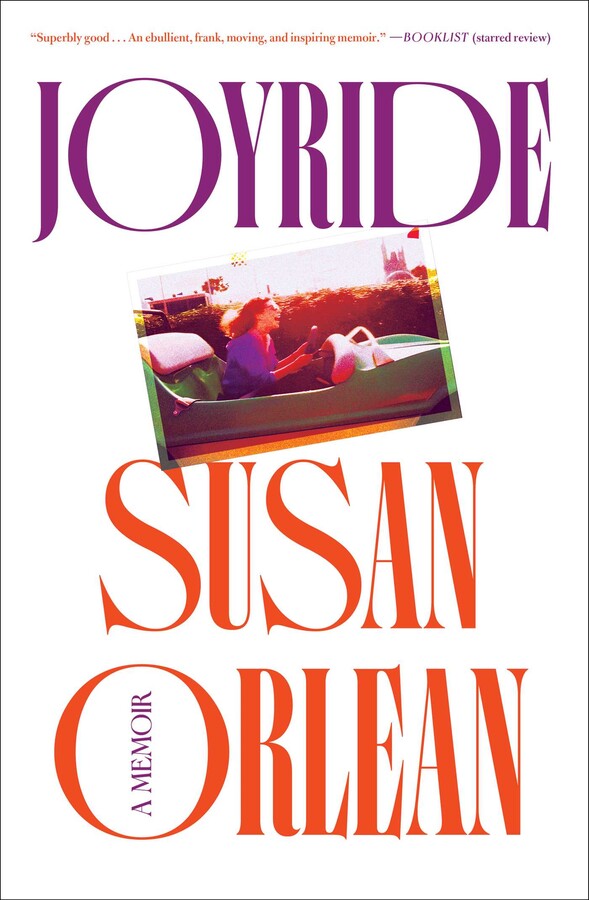
From Susan Orlean, the beloved New Yorker writer and bestselling author of The Orchid Thief and The Library Book who has been hailed as “a national treasure” by The Washington Post, comes a masterful memoir of finding her creative calling and purpose that invites us to approach life with wonder, curiosity, and an irrepressible sense of delight.
“The story of my life is the story of my stories,” writes Susan Orlean in this extraordinary, era-defining memoir from one of the greatest practitioners of narrative nonfiction of our time. Joyride is a magic carpet ride through Orlean’s life and career, where every day is an opportunity for discovery and every moment holds the potential for wonder. Throughout her storied career, her curiosity has drawn her to explore the most ordinary and extraordinary of places, from going deep inside the head of a regular ten-year-old boy for a legendary profile (“The American Man Age Ten”) to reporting on a woman who owns twenty-seven tigers, from capturing the routine magic of Saturday night to climbing Mt. Fuji.
Not only does Orlean’s account of a writing life offer a trove of indispensable gleanings for writers, it’s also an essential and practical “master class” (The New York Times) to embracing any creative path. She takes us through her process of dreaming up ideas, managing deadlines, connecting with sources, chasing every possible lead, confronting writer’s block and self-doubt, and crafting the perfect lede—a Susan specialty.
While Orlean has always written her way into other people’s lives in order to understand the human experience, Joyride is her most personal book ever—a searching journey through finding her feet as a journalist, recovering from the excruciating collapse of her first marriage, falling head-over-heels in love again, becoming a mother while mourning the decline of her own mother, sojourning to Hollywood for films based on her work including Adaptation and Blue Crush, and confronting mortality. Joyride is also a time machine to a bygone era of journalism, from Orlean’s bright start in the golden age of alt-weeklies to her career-making days working alongside icons such as Robert Gottlieb, Tina Brown, David Remnick, Anna Wintour, Sonny Mehta, and Jonathan Karp—forces who shaped the media industry as we know it today.
Infused with Orlean’s signature warmth and wit, Joyride is a must-read for anyone who hungers to start, build, and sustain a creative life. Orlean inspires us to seek out daily inspiration and rediscover the marvels that surround us.
NAMED A BEST BOOK OF THE YEAR BY NPR, TIME, OPRAH DAILY, GOODREADS, AND MORE
“Brilliant…A high-spirited, exhilarating memoir.” —The Wall Street Journal • “In Joyride, the takeaway often has as much to do with the art of living as the art of writing.” —Elle • “Wise and exuberant…It’s funny, as well. Just masterful.” —David Sedaris • “Superbly good…Ebullient, frank, moving, and inspiring.” —Booklist (starred review)
From Susan Orlean, the beloved New Yorker writer and bestselling author of The Orchid Thief and The Library Book who has been hailed as “a national treasure” by The Washington Post, comes a masterful memoir of finding her creative calling and purpose that invites us to approach life with wonder, curiosity, and an irrepressible sense of delight.
“The story of my life is the story of my stories,” writes Susan Orlean in this extraordinary, era-defining memoir from one of the greatest practitioners of narrative nonfiction of our time. Joyride is a magic carpet ride through Orlean’s life and career, where every day is an opportunity for discovery and every moment holds the potential for wonder. Throughout her storied career, her curiosity has drawn her to explore the most ordinary and extraordinary of places, from going deep inside the head of a regular ten-year-old boy for a legendary profile (“The American Man Age Ten”) to reporting on a woman who owns twenty-seven tigers, from capturing the routine magic of Saturday night to climbing Mt. Fuji.
Not only does Orlean’s account of a writing life offer a trove of indispensable gleanings for writers, it’s also an essential and practical “master class” (The New York Times) to embracing any creative path. She takes us through her process of dreaming up ideas, managing deadlines, connecting with sources, chasing every possible lead, confronting writer’s block and self-doubt, and crafting the perfect lede—a Susan specialty.
While Orlean has always written her way into other people’s lives in order to understand the human experience, Joyride is her most personal book ever—a searching journey through finding her feet as a journalist, recovering from the excruciating collapse of her first marriage, falling head-over-heels in love again, becoming a mother while mourning the decline of her own mother, sojourning to Hollywood for films based on her work including Adaptation and Blue Crush, and confronting mortality. Joyride is also a time machine to a bygone era of journalism, from Orlean’s bright start in the golden age of alt-weeklies to her career-making days working alongside icons such as Robert Gottlieb, Tina Brown, David Remnick, Anna Wintour, Sonny Mehta, and Jonathan Karp—forces who shaped the media industry as we know it today.
Infused with Orlean’s signature warmth and wit, Joyride is a must-read for anyone who hungers to start, build, and sustain a creative life. Orlean inspires us to seek out daily inspiration and rediscover the marvels that surround us.
Appearances
OCT 21
7:30PM
92nd Street Y
1395 Lexington Avenue
Buttenwieser Hall at the Arnhold Center
New York, NY 10128
NOV 4
12:00AM
Diesel: A Bookstore
225 26th St
Suite 33
Santa Monica, CA 90402
Reading Group Guide
Get a FREE ebook by joining our mailing list today! Plus, receive recommendations for your next Book Club read.
By clicking 'Sign me up' I agree to the Terms of Use and acknowledge the Privacy Policy and Notice of Financial Incentive. Free ebook offer available to NEW US subscribers only. Offer redeemable at Simon & Schuster's ebook fulfillment partner. Must redeem within 90 days. See full terms and conditions and this month's choices.
Joyride by Susan Orlean
This reading group guide for Joyride includes an introduction, discussion questions, ideas for enhancing your book club, and a Q&A with author Susan Orlean. The suggested questions are intended to help your reading group find new and interesting angles and topics for your discussion. We hope that these ideas will enrich your conversation and increase your enjoyment of the book.
Introduction
“The story of my life is the story of my stories,” writes Susan Orlean in this exhilarating , era-defining memoir from one of the greatest practitioners of narrative nonfiction of our time. Joyride is a magic carpet ride through Orlean’s life and career, where every day is an opportunity for discovery and every moment holds the potential for wonder. Throughout her storied career, her curiosity draws her to explore the most ordinary and extraordinary of places, from going deep inside the head of a regular ten-year-old boy for a legendary profile (“The American Man, Age Ten”) to reporting on a woman who owns twenty-seven tigers; from capturing the routine magic of Saturday night to climbing Mount. Fuji. While Orlean has always written her way into other people’s lives in order to understand the human experience, Joyride is her most personal book ever—a searching journey through finding her feet as a journalist, recovering from the excruciating collapse of her first marriage, falling head over- heels in love again, becoming a mother while mourning the decline of her own mother, sojourning to Hollywood for films based on her work, and confronting mortality. Infused with Orlean’s signature warmth and wit, Joyride is a must-read for anyone who hungers to start, build, and sustain a creative life.
Topics & Questions for Discussion
1. In the introduction, Orlean says she has had “the most wonderful life, a joyride of a life ” (page 5). She has built an inimitable body of work and a wonderful life for herself, but she’s also experienced disappointments and betrayals. Does a life well-lived include the tough moments? Can a “joyride” include both joy and pain?
2. Orlean’s approach to interviewing is one without preparation, preferring to jump in blind rather than study a subject or individual at length prior to engaging with them. How did this tactic work to her advantage?
3. What does a typical Saturday night look like for you? How do you think your experiences fit Orlean’s concept—that Saturday nights are significant and mean something different to everyone?
4. Orlean has roamed across the country and around the world interviewing thrilling subjects. However, she has also played in her own backyard and spent time investigating the lives of “ordinary” people. Which of these kinds of stories appeal more to you? Are you drawn more to digging into the everyday, or to the unusual, striking, and extraordinary?
5. What experiences that Orlean had as a journalist in the field sound most exciting or fulfilling to you? Any that you could imagine yourself taking part in?
6. What did you learn about the writing process from Orlean?
7. As a journalist, Orlean was “always positioned . . . as the narrator, a few steps offstage, rather than being the subject” (294). Are there ways in your own life where you find yourself to be a guide rather than an actor, and do you find it as satisfying as Orlean does? Can you relate to her initial discomfort about positioning herself as the main character of this book?
8. Orlean gives a behind-the-scenes look at what it’s like to work for large publications like The New Yorker, as well as what it’s like to publish a book. Did anything about the writer’s life or the publishing world surprise you?
9. Orlean refers to a Senegalese expression used when someone has died, expressing that through their death, their library has burned. She reflects that “the way our mind and memory function is library-like, a storehouse of individual volumes, each containing a thought or a dream or a memory or a sliver of knowledge” (265). What stories are in your library? Which ones are in your core collection?
10. How would you characterize Orlean’s storytelling? What tactics does she use to draw the reader in?
11. Orlean has lived all around the U.S., from Ohio to Oregon, New York to California. How did each of these places shape her as both a person and a writer?
12. In her conclusion, Orlean shares a piece of editing advice she got at The New Yorker, that asks her to abandon a final summary at the end and leave the reader “to complete the piece in his or her own head” (296–97). Do you think that’s an effective way to end a story? What do you find to be the most satisfying endings? Is an ending being satisfying the most important thing?
Enhance Your Book Club
1. Consider the film Adaptation, which fictionalized and dramatized the events of Orlean’s book The Orchid Thief. Is there a story in your own life that you could fictionalize in this way? Who would you cast to play yourself? Who would you cast to play supporting roles?
2. Over the course of her career, Orlean has traveled all over the world, interviewing strangers and going on life-changing journeys. What corner of the world would you like to explore if you had the chance? Who would you want to interview?
3. As a group, brainstorm other memoirs written by journalists and creative nonfiction writers. What do these selections share with Joyride, and how do they differ? What specifically did you appreciate about Orlean’s story and approach?
A Conversation with Susan Orlean
You begin the book by quoting E. B. White’s Here in New York, which discusses how it feels to walk among “giants.” Why did you choose to feature this quote in particular? Does this book hold significance in your life?
E. B. White is one of my favorite writers, and in this passage, he captures perfectly the way it feels to be young and eager and inspired; it felt natural to use at the start of my book. It also gave me a chance to tip my hat to the great legacy of nonfiction writers that energized me at the start of my career. That sense of gazing up at these towering figures is so much a part of what it feels like to begin a career.
Are there any books or pieces of media that you turned toward for inspiration as you were writing Joyride?
I looked at a range of books to guide me. Maggie Smith’s You Could Make This Place Beautiful and Ann Patchett’s Truth and Beauty were models for how to write eloquently and artfully about personal matters. John McPhee’s Draft No. 4 taught me how writing about writing can be done masterfully. And for tone and clarity, I returned to Joan Didion, but especially The Year of Magical Thinking.
Was it difficult to choose which of your stories you’d focus on?
Yes! Every one of my stories has involved an adventure, a challenge, or a tale worth telling. But I knew I couldn’t write about all of them, so I focused on a few favorites that were especially meaningful to my career or that represented something important about being a writer—such as how to remain impartial, how to keep a balance in your relationship with your subjects, how to be comfortable as an outsider.
Is there anything that you found yourself wanting to keep private, but you didn’t? Has your relationship to privacy evolved over the course of your life, especially as it pertains to sharing your life in writing?
This is not the Age of Privacy, for sure. Our culture has shared and overshared more than anyone in the past could have ever imagined. We make public our romances, our breakups, our kids’ college acceptances, our plastic surgery . . . There’s barely anything that someone somewhere doesn’t make public. But I’m a more discreet creature. I’m not obsessively private, but I definitely see a boundary between my private and public lives. It was challenging for me to write about topics like my first marriage that were extremely personal, but I made that decision to be open when I chose to do the book.
Was there a particular story or period of time that was especially pleasurable to reflect on?
My early days at The New Yorker were so thrilling—even seeing my words in The New Yorker’s typeface made me ecstatic. It was really fun to reflect on that time and remember how exhilarating it was.
Did you use the index card method for this book? If so, how do you think it translated to memoir writing? If not, what made this book possible to write without them?
This is the only book I’ve written where index cards weren’t essential. I wasn’t dealing with the mountains of material I usually have for a reported project, so it was easier to manage my notes in a simpler way. Also, this is the only book I’ve written that mostly follows a chronological structure, so I had a timeline to guide me from section to section. My other books have moved back and forth in time and required a lot of choreography, which is where the index cards become indispensable.
After going back through your entire body of work, are there any places or communities that you think a different version of you could have stayed in long-term ?
I always fall in love with every place I travel to for a story, and for that moment I’m convinced that I could stay. That’s the effect of immersion journalism: You see the world differently for the moment, and you are entranced by it, but once you step away, you realize it’s not somewhere you’d ever feel at home. I did love Japan so much that I yearned to stay and could actually imagine doing it—for a while. But I always end up at home.
Since becoming a mother, have your stories felt infused with a different sense of purpose or perspective? Or do you find it has, more simply, confirmed your belief of the extraordinary within the ordinary?
Motherhood is the ultimate experience of finding the extraordinary in the ordinary. There is no act more “ordinary” than having a child—it’s the foundational act of continuing humankind. And yet, anyone who has had a child instantly sees how remarkable, marvelous, and even strange it can be, and how every moment is distinct and complex. So within this utterly basic biological act, you encounter the most astonishing experience. I think becoming a parent confirmed to me that even the most common thing can be truly remarkable.
You write: “I was asked several times to write about being pregnant, but I didn’t want to. I thought having a baby was both the most ordinary and most extraordinary thing in the world, done by billions of people throughout history, but now, privately mine. I had nothing and everything to say about it.” (213). Do you find that there is undue pressure upon women to make their motherhood public facing?
Absolutely. Motherhood has become performative; if you don’t post your “baby bump,” it’s as if you aren’t truly pregnant. I’ve seen people post pictures of themselves in labor. If that’s your thing, that’s fine, but the pressure to do it, and to compare yourself to some idealized public image of motherhood, is what I dislike.
You discuss in the conclusion how the challenge of this particular book was shifting from narrator to main character. What made you want to take on that challenge?
During COVID, I—like most of us—spent a lot of time reflecting on my life and what was important to me and what I’ve done that was meaningful. I took stock, especially of my writing life, and realized how many wonderful stories I wanted to tell about my work. Approaching a big birthday, and also realizing that a quarter- century had passed since I wrote The Orchid Thief, made me comfortable with the idea of telling my own story. I put aside all my discomfort about being the center of attention and began to enjoy spinning the yarn. I’ve had a pretty interesting life!
Did you feel inspired to capture your own personal “library” after writing The Library Book?
I have never shaken off that image of one’s internal library, all the memories and stories and knowledge that we carry, like little volumes. Once I visualized it that way, I began appreciating it as a place to wander and learn and reflect. In many ways, Joyride is my expression of that.
Do you have any upcoming writing projects that you’re excited to dig into?
I’m working on a television adaptation of The Library Book, which is very exciting, and I’m toying with a new book idea, something that’s incredibly interesting and different from anything else I’ve written. I’ll tell you if I decide to pursue it!
This reading group guide for Joyride includes an introduction, discussion questions, ideas for enhancing your book club, and a Q&A with author Susan Orlean. The suggested questions are intended to help your reading group find new and interesting angles and topics for your discussion. We hope that these ideas will enrich your conversation and increase your enjoyment of the book.
Introduction
“The story of my life is the story of my stories,” writes Susan Orlean in this exhilarating , era-defining memoir from one of the greatest practitioners of narrative nonfiction of our time. Joyride is a magic carpet ride through Orlean’s life and career, where every day is an opportunity for discovery and every moment holds the potential for wonder. Throughout her storied career, her curiosity draws her to explore the most ordinary and extraordinary of places, from going deep inside the head of a regular ten-year-old boy for a legendary profile (“The American Man, Age Ten”) to reporting on a woman who owns twenty-seven tigers; from capturing the routine magic of Saturday night to climbing Mount. Fuji. While Orlean has always written her way into other people’s lives in order to understand the human experience, Joyride is her most personal book ever—a searching journey through finding her feet as a journalist, recovering from the excruciating collapse of her first marriage, falling head over- heels in love again, becoming a mother while mourning the decline of her own mother, sojourning to Hollywood for films based on her work, and confronting mortality. Infused with Orlean’s signature warmth and wit, Joyride is a must-read for anyone who hungers to start, build, and sustain a creative life.
Topics & Questions for Discussion
1. In the introduction, Orlean says she has had “the most wonderful life, a joyride of a life ” (page 5). She has built an inimitable body of work and a wonderful life for herself, but she’s also experienced disappointments and betrayals. Does a life well-lived include the tough moments? Can a “joyride” include both joy and pain?
2. Orlean’s approach to interviewing is one without preparation, preferring to jump in blind rather than study a subject or individual at length prior to engaging with them. How did this tactic work to her advantage?
3. What does a typical Saturday night look like for you? How do you think your experiences fit Orlean’s concept—that Saturday nights are significant and mean something different to everyone?
4. Orlean has roamed across the country and around the world interviewing thrilling subjects. However, she has also played in her own backyard and spent time investigating the lives of “ordinary” people. Which of these kinds of stories appeal more to you? Are you drawn more to digging into the everyday, or to the unusual, striking, and extraordinary?
5. What experiences that Orlean had as a journalist in the field sound most exciting or fulfilling to you? Any that you could imagine yourself taking part in?
6. What did you learn about the writing process from Orlean?
7. As a journalist, Orlean was “always positioned . . . as the narrator, a few steps offstage, rather than being the subject” (294). Are there ways in your own life where you find yourself to be a guide rather than an actor, and do you find it as satisfying as Orlean does? Can you relate to her initial discomfort about positioning herself as the main character of this book?
8. Orlean gives a behind-the-scenes look at what it’s like to work for large publications like The New Yorker, as well as what it’s like to publish a book. Did anything about the writer’s life or the publishing world surprise you?
9. Orlean refers to a Senegalese expression used when someone has died, expressing that through their death, their library has burned. She reflects that “the way our mind and memory function is library-like, a storehouse of individual volumes, each containing a thought or a dream or a memory or a sliver of knowledge” (265). What stories are in your library? Which ones are in your core collection?
10. How would you characterize Orlean’s storytelling? What tactics does she use to draw the reader in?
11. Orlean has lived all around the U.S., from Ohio to Oregon, New York to California. How did each of these places shape her as both a person and a writer?
12. In her conclusion, Orlean shares a piece of editing advice she got at The New Yorker, that asks her to abandon a final summary at the end and leave the reader “to complete the piece in his or her own head” (296–97). Do you think that’s an effective way to end a story? What do you find to be the most satisfying endings? Is an ending being satisfying the most important thing?
Enhance Your Book Club
1. Consider the film Adaptation, which fictionalized and dramatized the events of Orlean’s book The Orchid Thief. Is there a story in your own life that you could fictionalize in this way? Who would you cast to play yourself? Who would you cast to play supporting roles?
2. Over the course of her career, Orlean has traveled all over the world, interviewing strangers and going on life-changing journeys. What corner of the world would you like to explore if you had the chance? Who would you want to interview?
3. As a group, brainstorm other memoirs written by journalists and creative nonfiction writers. What do these selections share with Joyride, and how do they differ? What specifically did you appreciate about Orlean’s story and approach?
A Conversation with Susan Orlean
You begin the book by quoting E. B. White’s Here in New York, which discusses how it feels to walk among “giants.” Why did you choose to feature this quote in particular? Does this book hold significance in your life?
E. B. White is one of my favorite writers, and in this passage, he captures perfectly the way it feels to be young and eager and inspired; it felt natural to use at the start of my book. It also gave me a chance to tip my hat to the great legacy of nonfiction writers that energized me at the start of my career. That sense of gazing up at these towering figures is so much a part of what it feels like to begin a career.
Are there any books or pieces of media that you turned toward for inspiration as you were writing Joyride?
I looked at a range of books to guide me. Maggie Smith’s You Could Make This Place Beautiful and Ann Patchett’s Truth and Beauty were models for how to write eloquently and artfully about personal matters. John McPhee’s Draft No. 4 taught me how writing about writing can be done masterfully. And for tone and clarity, I returned to Joan Didion, but especially The Year of Magical Thinking.
Was it difficult to choose which of your stories you’d focus on?
Yes! Every one of my stories has involved an adventure, a challenge, or a tale worth telling. But I knew I couldn’t write about all of them, so I focused on a few favorites that were especially meaningful to my career or that represented something important about being a writer—such as how to remain impartial, how to keep a balance in your relationship with your subjects, how to be comfortable as an outsider.
Is there anything that you found yourself wanting to keep private, but you didn’t? Has your relationship to privacy evolved over the course of your life, especially as it pertains to sharing your life in writing?
This is not the Age of Privacy, for sure. Our culture has shared and overshared more than anyone in the past could have ever imagined. We make public our romances, our breakups, our kids’ college acceptances, our plastic surgery . . . There’s barely anything that someone somewhere doesn’t make public. But I’m a more discreet creature. I’m not obsessively private, but I definitely see a boundary between my private and public lives. It was challenging for me to write about topics like my first marriage that were extremely personal, but I made that decision to be open when I chose to do the book.
Was there a particular story or period of time that was especially pleasurable to reflect on?
My early days at The New Yorker were so thrilling—even seeing my words in The New Yorker’s typeface made me ecstatic. It was really fun to reflect on that time and remember how exhilarating it was.
Did you use the index card method for this book? If so, how do you think it translated to memoir writing? If not, what made this book possible to write without them?
This is the only book I’ve written where index cards weren’t essential. I wasn’t dealing with the mountains of material I usually have for a reported project, so it was easier to manage my notes in a simpler way. Also, this is the only book I’ve written that mostly follows a chronological structure, so I had a timeline to guide me from section to section. My other books have moved back and forth in time and required a lot of choreography, which is where the index cards become indispensable.
After going back through your entire body of work, are there any places or communities that you think a different version of you could have stayed in long-term ?
I always fall in love with every place I travel to for a story, and for that moment I’m convinced that I could stay. That’s the effect of immersion journalism: You see the world differently for the moment, and you are entranced by it, but once you step away, you realize it’s not somewhere you’d ever feel at home. I did love Japan so much that I yearned to stay and could actually imagine doing it—for a while. But I always end up at home.
Since becoming a mother, have your stories felt infused with a different sense of purpose or perspective? Or do you find it has, more simply, confirmed your belief of the extraordinary within the ordinary?
Motherhood is the ultimate experience of finding the extraordinary in the ordinary. There is no act more “ordinary” than having a child—it’s the foundational act of continuing humankind. And yet, anyone who has had a child instantly sees how remarkable, marvelous, and even strange it can be, and how every moment is distinct and complex. So within this utterly basic biological act, you encounter the most astonishing experience. I think becoming a parent confirmed to me that even the most common thing can be truly remarkable.
You write: “I was asked several times to write about being pregnant, but I didn’t want to. I thought having a baby was both the most ordinary and most extraordinary thing in the world, done by billions of people throughout history, but now, privately mine. I had nothing and everything to say about it.” (213). Do you find that there is undue pressure upon women to make their motherhood public facing?
Absolutely. Motherhood has become performative; if you don’t post your “baby bump,” it’s as if you aren’t truly pregnant. I’ve seen people post pictures of themselves in labor. If that’s your thing, that’s fine, but the pressure to do it, and to compare yourself to some idealized public image of motherhood, is what I dislike.
You discuss in the conclusion how the challenge of this particular book was shifting from narrator to main character. What made you want to take on that challenge?
During COVID, I—like most of us—spent a lot of time reflecting on my life and what was important to me and what I’ve done that was meaningful. I took stock, especially of my writing life, and realized how many wonderful stories I wanted to tell about my work. Approaching a big birthday, and also realizing that a quarter- century had passed since I wrote The Orchid Thief, made me comfortable with the idea of telling my own story. I put aside all my discomfort about being the center of attention and began to enjoy spinning the yarn. I’ve had a pretty interesting life!
Did you feel inspired to capture your own personal “library” after writing The Library Book?
I have never shaken off that image of one’s internal library, all the memories and stories and knowledge that we carry, like little volumes. Once I visualized it that way, I began appreciating it as a place to wander and learn and reflect. In many ways, Joyride is my expression of that.
Do you have any upcoming writing projects that you’re excited to dig into?
I’m working on a television adaptation of The Library Book, which is very exciting, and I’m toying with a new book idea, something that’s incredibly interesting and different from anything else I’ve written. I’ll tell you if I decide to pursue it!
About the Author
Corey Hendrickson
Susan Orlean has been a staff writer at The New Yorker since 1992. She is the New York Times bestselling author of seven books, including The Library Book, Rin Tin Tin, Saturday Night, and The Orchid Thief, which was made into the Academy Award–winning film Adaptation. She lives with her family and her animals in Los Angeles and may be reached at SusanOrlean.com and on Substack at SusanOrlean.Substack.com.
Product Details
- Publisher: Avid Reader Press/Simon & Schuster (October 14, 2025)
- Length: 368 pages
- ISBN13: 9781982135188
Browse Related Books
Raves and Reviews
“Brilliant . . . A high-spirited, exhilarating memoir.”
—Moira Hodgson, The Wall Street Journal
“Marked by incredible skill, preternatural intuition, and extraordinary fortune . . . Joyride reads not just like a memoir, but a snapshot of a media landscape of a particular time.”
—Sky Davis, The Christian Science Monitor
“Readers will love it; writers will learn from it . . . Orlean’s anecdotes sing with the pleasure of a person born to her passion and purpose.”
—Carolyn Kellogg, Los Angeles Times
“In Joyride, the takeaway often has as much to do with the art of living as the art of writing. . . . It’s Orlean's sense of mission that propels the reader along.”
—Lauren Puckett-Pope, Elle
“An era-defining memoir . . . Joyride is a must-read for anyone who hungers to start, build, and sustain a creative life.”
—The Everygirl
“Joyride will speak to any reader with any inkling toward creativity, wonder, and craft.”
—Harper’s Bazaar
“For anyone who’s asked—and haven’t we all—‘How does she write like that?,’ this wise and exuberant book is the answer. It’s funny, as well. Just masterful.”
—David Sedaris
“Joyride might be the best craft book on writing you will ever read.”
—Boston Globe
“A writer’s guide, creative manifesto and intimate self-portrait.”
—Los Angeles Magazine
“A celebration of a supremely accomplished writing life . . . The great value of this book is the MFA in nonfiction writing that Orlean packs into it, full of some of the most useful advice on craft that any budding (or long-practicing, for that matter) writer could ask for. . . . A spry, entertaining memoir/writing workshop by a nonfiction artist at the top of her game.”
—Kirkus Reviews (starred review)
“An ebullient, frank, moving, and inspiring memoir. . . Orlean is always superbly good literary company, and here she deepens the intimacy, welcoming readers into the thoughts, feelings, and experiences of an exemplary and empathetic writer."
—Booklist (starred review)
Resources and Downloads
High Resolution Images
-
Book Cover Image (jpg): Joyride
eBook 9781982135188
-
Author Photo (jpg): Susan Orlean Corey Hendrickson(0.1 MB)
Any use of an author photo must include its respective photo credit