
Plus, receive recommendations and exclusive offers on all of your favorite books and authors from Simon & Schuster.
0:00 /
LIST PRICE $14.99
PRICE MAY VARY BY RETAILER
Digital products purchased on SimonandSchuster.com must be read on the Simon & Schuster Books app. Learn more.
Get 20% off with code FALL26 plus free shipping on orders of $40 or more. Discount on physical products only. Terms apply.
Buy from Other Retailers
Table of Contents
About the Book
NATIONAL BESTSELLER
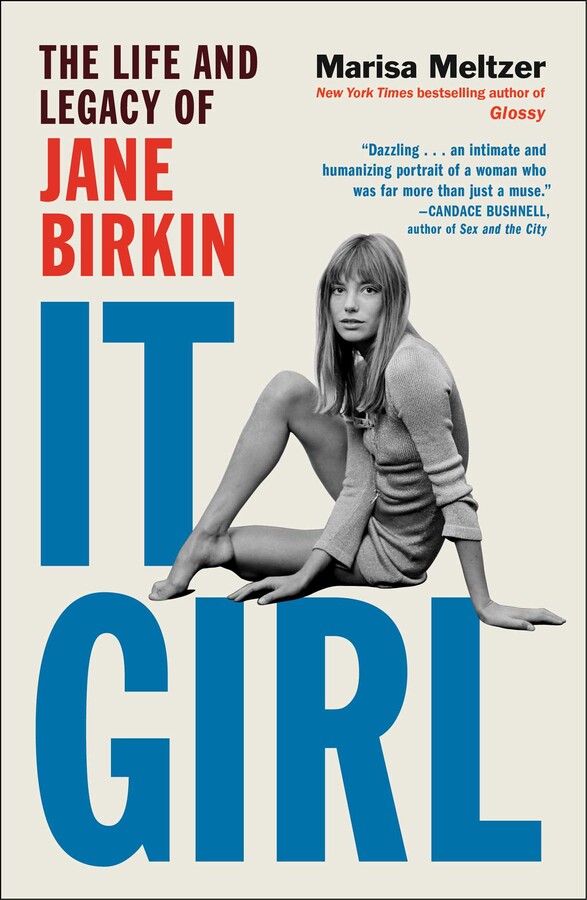
The first comprehensive biography of Jane Birkin—actress, singer, and legendary style icon—and her profound cultural impact, from the “acerbic, culturally astute, and genuine” (The New York Times) author of the instant New York Times bestseller Glossy.
Jane Birkin was synonymous with chic. Her effortless style and artistic legacy have been immortalized through her music and film career. And, of course, she was the inspiration behind one of the world’s most coveted bags, the Hermès Birkin. But who was the real woman behind the it girl?
Now, New York Times bestselling author Marisa Meltzer presents a fresh, “intimate, and humanizing portrait of a woman who was far more than just a muse” (Candace Bushnell, New York Times bestselling author) and explores her profound influence on generations in a rigorously reported biography unlike any other. It Girl paints a “deeply researched portrait” (Bustle) of Birkin and her legacy, from her early years in 1960s London to her rise as a beloved celebrity in France, detailing personal challenges, her relationships with creative powerhouses, and the duality of her public and private selves.
Based on interviews and deep archival research, Meltzer reveals the nuances of Birkin’s character: her famously tempestuous romantic relationships, life with her three famous daughters, and the creative energy that drove her. “Compelling and charming” (Town & Country), It Girl tells the story of her indelible impact on femininity and style, and at last, gives Birkin her well-deserved due.
The first comprehensive biography of Jane Birkin—actress, singer, and legendary style icon—and her profound cultural impact, from the “acerbic, culturally astute, and genuine” (The New York Times) author of the instant New York Times bestseller Glossy.
Jane Birkin was synonymous with chic. Her effortless style and artistic legacy have been immortalized through her music and film career. And, of course, she was the inspiration behind one of the world’s most coveted bags, the Hermès Birkin. But who was the real woman behind the it girl?
Now, New York Times bestselling author Marisa Meltzer presents a fresh, “intimate, and humanizing portrait of a woman who was far more than just a muse” (Candace Bushnell, New York Times bestselling author) and explores her profound influence on generations in a rigorously reported biography unlike any other. It Girl paints a “deeply researched portrait” (Bustle) of Birkin and her legacy, from her early years in 1960s London to her rise as a beloved celebrity in France, detailing personal challenges, her relationships with creative powerhouses, and the duality of her public and private selves.
Based on interviews and deep archival research, Meltzer reveals the nuances of Birkin’s character: her famously tempestuous romantic relationships, life with her three famous daughters, and the creative energy that drove her. “Compelling and charming” (Town & Country), It Girl tells the story of her indelible impact on femininity and style, and at last, gives Birkin her well-deserved due.
Excerpt
Chapter One: Eccentric, Glamorous, and All Quite Brilliant CHAPTER ONE Eccentric, Glamorous, and All Quite Brilliant
Before she was French, she was English.
Jane Birkin was born during a particularly bleak postwar time in British history, when rations were common and luxury was not. After she was delivered on December 14, 1946—premature at seven and a half months—at the London Clinic in Marylebone, she was kept in a little box on the radiator with another baby, both covered in a damp cloth because the clinic lacked an incubator. England had one of its worst winters in recorded history, with heavy snow, coal shortages, and blackouts.
It may not have been the most auspicious start to her life, but ultimately the Birkin children—Jane, the middle child, was raised along with older brother Andrew and younger sister Linda—were largely insulated from the hardships that others of their era faced. Birkin’s father, David, was from a Nottingham family that owned Birkin Lace, which had manufactured the fabric since 1825. Their curtains were wildly popular in the Victorian era and had made the family business successful and generationally wealthy. There was some nobility in the family line, too, as David Birkin was related to the Duke of Bedford on his maternal side. They weren’t landed gentry—there were no aristocratic titles or castles—and while they weren’t the richest or grandest family by any means, they lived among and were well-connected to the upper classes. (Jane Birkin even once met Queen Elizabeth II as a child at the lace factory and presented her with flowers.)
Birkin’s mother, Judy Campbell, was a well-known stage actress who had made her debut as a teenager. She was beautiful in a Golden Age of Hollywood way, with dark curls, pale skin, and an elegant jawline. She became muse to the celebrated playwright Noël Coward, touring in his productions of Present Laughter, This Happy Breed, and Blithe Spirit. Campbell’s parents—Jane’s grandparents—were also actors. They never had a great deal of money but made up for that with their social capital. When Campbell was single, she lived in a flat with two actress friends: Winston Churchill’s daughter Sarah Churchill, who would later become Birkin’s godmother, and David Birkin’s cousin Penelope Dudley-Ward (who had the odd-sounding but affectionate nickname of “Pemple”).
David Birkin was a military man and a secret agent during World War II whose missions were even the subject of a book by Tim Spicer called A Dangerous Enterprise. Pemple adored her cousin and thought Campbell was a ravishing young woman. She introduced them at her daughter Tracy Reed’s christening ceremony in 1942, where Birkin and Campbell were both present as the child’s godparents. Their first date was to see the movie Dr. Jekyll and Mr. Hyde.
David Birkin and Judy Campbell married on November 12, 1943, in the same church where they had met at the christening. The wedding wasn’t lavish but not exactly wartime austere either. A newsreel called Movietone News covered the ceremony, showing them as a dashing and stylish couple, even when filmed in black-and- white. Campbell wore a white lace gown with long sleeves and a matching pillbox hat, carrying a branch blooming with white flowers. Her very tall, very thin new husband looked somehow all the more handsome while sporting an eye patch with his formal suit and slicked-back hair. (He had been through dozens of operations for eye and lung issues following a sinus operation that had gone wrong when he was a teenager.) They did not have a proper honeymoon, as both were busy: He was still fighting in the war on a gunboat, and she was on tour as Noël Coward’s leading lady.
The children came shortly thereafter. Andrew was born in December 1945, Jane almost exactly a year later, and Linda in 1950. After a few early years spent on a farm in rural Berkshire, they were raised in the London borough of Chelsea, in a big Victorian home on Cheyne Gardens. The parents weren’t really hands-on types—the feeding, the changing of diapers, the nap times, all the hallmarks of life with a newborn, were outsourced to a series of nannies. Nor were they very affectionate—her mother, Birkin said, was too glamorous for that. Their parenting style was in that respect reminiscent of an earlier Edwardian era, with children staying in their own domains and remaining better seen than heard.
Birkin and her brother behaved like twins; they were inseparable and would be for their entire lives. Linda often complained about being left out. Later on, if those two thought about their childhoods, they didn’t think of Linda at all. Andrew called her “an intruder, disguised as our sister.” The two Birkin daughters had forced proximity, sharing a bedroom on the top floor of their Chelsea house, where they moved in 1956. But there was an emotional distance between them, with Linda claiming that Jane was always the one to seek out attention. “She had a taste for drama. A very strong taste,” Linda wrote in 2024. “Even when we were little, if her lips were chapped by the cold, she would squeeze them together with all her strength until they bled, then she would show her wound. She needed an audience.”
In that sense, Birkin took after her mother. Campbell was never a star but rather a respected working actress. However, she put her steady stage career aside while she raised children. In the postwar baby boom period, when wifely domesticity was fetishized, there was little precedent for women to try to pursue their own lives along with parenting. And in Britain’s upper classes, it was not the norm for a woman to have a job outside the home. David Birkin loved his wife but did not care for show business, thinking it a silly career. At home, Judy Campbell remained a diva, with strong opinions and a raging intellect. For as long as she could remember, Jane found it hard to be the gangly daughter of a professionally beautiful person. Next to her mother, she felt downright mousy. “She said I was lucky to be like a mouse, because people would take care of me. She used to say that if you’re dark and six foot and glamorous like she was that no one asks if you’re all right, but with me they’re always concerned I’m about to faint, so they look after me. I suppose I am lucky like that,” Birkin remembered.
Despite a certain chilliness in the emotional register of the family home, Birkin later said David and Judy were great parents for encouraging curiosity and intellectual interests: Richard III, poetry, P. G. Wodehouse, Proust, drawing. They went to the cinema to see big MGM movies and British kitchen sink dramas, a film movement showing all the realism and grit of postwar British life. Creativity was a Birkin family pursuit, and Jane and her siblings were given free rein to concentrate on it. One summer, the three children created their own club, the Cat Club, brainstorming whimsical ways to make money: collecting wildflowers to sell them in bunches; gathering blackberries and raspberries; foraging mushrooms. There was a freedom and old-fashioned playfulness in which the Birkin siblings were allowed to fully indulge.
Acting, in particular, was an artistic pastime they all enjoyed together. Judy Campbell likened the Birkins to another famous family of performers, the Redgraves. It wasn’t uncommon for the entire household to put on a show. On Boxing Day when Birkin was fourteen, they staged an original holiday play. The plot was abstract, seemingly something to do with a bird being mistaken for a turkey, although the general merriment was more the point than anything else. Jane’s mother did her father’s makeup, Andrew directed the scenes, and a family friend was on lighting. This was perhaps Birkin’s earliest acting performance. She had a single line—“It’s beginning to snow”—which she delivered with a serious intonation as someone threw confetti in the air to emulate snowflakes.
The family had a cottage on the Isle of Wight in the English Channel, with a small, slightly rocky strip of beach bordered by lush, tall grasses. Birkin in particular loved spending time there; she collected shells by day and hosted moonlit evening picnics. More creativity bloomed in that environment. Her parents, sister, brother, and she all made a home movie in the early 1960s called The Pirate, in which her father played a pirate who kidnapped Jane and Linda, subsequently saved by Andrew. Andrew later used the setting to make a home movie of his own, filmed on his 8mm camera with a teen-centered plot that involved a beautiful young girl who eventually dies of leukemia. He had wanted to cast his friend Hayley Mills, the star of The Parent Trap, whose actor father John Mills had briefly met Judy Campbell during the war. She was out of town filming an actual movie for Disney and couldn’t do it, so Andrew cast Jane as a love interest of his best friend.
While the Isle of Wight was her most beloved place, it also ended up being where Birkin felt most isolated. For primary school, she was educated at Miss Ironside’s School in Kensington in London, then at age twelve was sent to the all-girls Upper Chine School on the Isle of Wight. Birkin said it had been her idea to go away to boarding school because all her friends were also doing so, but to say she disliked the experience was an understatement. “I spent three miserable, cowardly, sad, ordinary years at school on the Isle of Wight,” she wrote in her journal, later published under the name Munkey Diaries, which she began writing in 1957 at age ten. (The “Munkey” in question was a soft stuffed monkey dressed like a jockey, which she carried with her everywhere, even into adulthood.) “I dared neither to laugh, nor to be revolutionary, nor individual, nor original, I conformed exactly to my state of a child who wants to please the teacher.” She spent a lot of time crying in the bathroom and writing maudlin poems with titles like “Jealousy.” The same-sex environment heightened her insecurities. “I suffered a lot because of my physique,” she said. “The others said I was half boy, half girl. I had no breasts, not even a developing bosom.” She was kicked by a horse named Nugget and had to wear a cast for several weeks, and she was bullied for that too.
Immersed in misery and unable to leave campus without permission, Birkin tried to run away on two different occasions. She was caught both times. Another time she tried making herself sick by eating gravel on the tennis court to see if she could get sent home. All her efforts were fruitless. Boarding school only emphasized the worst part about her home life—coldness—and lacked the creativity and artistic freedom in which her parents did excel. She was ambivalent at best about studying and grades. After two or three years she left to go back to London in 1961, and moved into her old bedroom.
At that age, her diaries were filled with musings that wouldn’t be out of place in any young-adult novel about a gangly girl wanting to feel grown-up: feeling excited after buying her first lipstick; admonishing herself to do “I must increase my bust” exercises a hundred times per day; wearing a bra even though she didn’t have much need for one; her relief when she finally got her period. “I’m the same as everyone else,” she wrote. She wondered a great deal about fitting in, speculating in her diary whether she should try to be more overtly sexy by wearing tight skirts and stockings like the older girls. This phase was potent but short-lived. Later in life, she would embrace being a tomboy, saying, “I’ve never really seen myself as a girl. I see myself in roles of girls disguised as boys.”
While she was growing up, even her mother told her she looked boyish. “When people said to me, ‘Are you Judy Campbell’s daughter?’ and I said, ‘Yes,’ they said, ‘Oh, well you don’t really look like her,’?” Birkin said in an interview, sounding like she had a good sense of humor about having a gorgeous mother whom she did not resemble. Pop culture loves a story of a siren of a daughter whose beauty outshines the woman who birthed her, but there is a particularly fraught dynamic for the daughters who are deemed more homely than their moms, even if this problem was arguably in Birkin’s head. In truth, she was never some ugly duckling who later would turn into a swan; her naturally thin body type simply did not reflect the curvaceous sexiness that was the beauty standard of that time.
As a young teenager, Birkin was slowly figuring out her own version of femininity. The way she dressed during that era was the prototype of what would become her signature style: striped sailor shirts worn with jeans, gingham bikinis, navy peacoats, oversize black sunglasses, scarves or bows tied in her hair. And she began exploring in other ways too. She began to experiment with a few sips of cider, maybe an occasional hit off a joint, and talking to boys, usually friends of friends, at parties. But her budding sexuality was hesitant and innocent at first.
By the time she was fifteen and living back at home, there was a neighbor who lived in an apartment overlooking her room across the street. She found him artsy and cute, and her sister Linda invented a code—“It’s raining”—if he was out on his balcony. Birkin would practice ballet in his view to try to get his attention. One day Linda said it was raining, so Birkin went outside to pretend to draw. She heard his voice for the first time—realizing he had a New Zealand accent—and when he turned, she could see he was not her age, but rather an adult, maybe even forty years old. Despite that age difference, she asked her father if she could go to his place, and he said yes because he reasoned he could see her from the house. He must have known he was a fully grown if not middle-aged man who had some romantic intention with his adolescent daughter. The ease with which he allowed Jane to go over to this man’s home is unsettling, but it does set the stage for her blithe view on age-gap relationships later on. Her neighbor poured her wine and kissed her behind the front door where her father couldn’t see them. She was a hopeless romantic and smitten. “I really do love him; I think about him day and night, it is such a marvelous thing to love someone so much. He told me he feels the same,” she wrote in her diary.
By the next year, her neighbor had moved to a basement apartment in a different neighborhood, but she would still visit. One evening they ate ratatouille. He drank whiskey and she drank too much red wine. She lay down, and he tried to get on top of her. She said she was on her period and he responded that it didn’t matter to him, which she found disgusting. “I ran away,” she wrote in her diary, failing to add whether he had responded with aggression or she was able to just leave. She reached home only to be greeted by her father, who was angry at her for coming home so late and said an apology was not sufficient. Jane went upstairs and swallowed as much children’s aspirin as she could find. At four in the morning, Linda found her sister deathly pale and called to her mother. They took her to the hospital, where her stomach was pumped. Afterward, her mother slapped her. Later, at home, she wrote a poem called “Suicide Lost” (“I cried for something I would never have”). Jane Birkin never described the incident with her neighbor as assault, and she mentioned offhandedly in later interviews that her first love was from New Zealand. But what transpired that night was enough to make a dramatic and lasting impression on the young girl and perhaps foreshadow further romantic hardships.
Before she was French, she was English.
Jane Birkin was born during a particularly bleak postwar time in British history, when rations were common and luxury was not. After she was delivered on December 14, 1946—premature at seven and a half months—at the London Clinic in Marylebone, she was kept in a little box on the radiator with another baby, both covered in a damp cloth because the clinic lacked an incubator. England had one of its worst winters in recorded history, with heavy snow, coal shortages, and blackouts.
It may not have been the most auspicious start to her life, but ultimately the Birkin children—Jane, the middle child, was raised along with older brother Andrew and younger sister Linda—were largely insulated from the hardships that others of their era faced. Birkin’s father, David, was from a Nottingham family that owned Birkin Lace, which had manufactured the fabric since 1825. Their curtains were wildly popular in the Victorian era and had made the family business successful and generationally wealthy. There was some nobility in the family line, too, as David Birkin was related to the Duke of Bedford on his maternal side. They weren’t landed gentry—there were no aristocratic titles or castles—and while they weren’t the richest or grandest family by any means, they lived among and were well-connected to the upper classes. (Jane Birkin even once met Queen Elizabeth II as a child at the lace factory and presented her with flowers.)
Birkin’s mother, Judy Campbell, was a well-known stage actress who had made her debut as a teenager. She was beautiful in a Golden Age of Hollywood way, with dark curls, pale skin, and an elegant jawline. She became muse to the celebrated playwright Noël Coward, touring in his productions of Present Laughter, This Happy Breed, and Blithe Spirit. Campbell’s parents—Jane’s grandparents—were also actors. They never had a great deal of money but made up for that with their social capital. When Campbell was single, she lived in a flat with two actress friends: Winston Churchill’s daughter Sarah Churchill, who would later become Birkin’s godmother, and David Birkin’s cousin Penelope Dudley-Ward (who had the odd-sounding but affectionate nickname of “Pemple”).
David Birkin was a military man and a secret agent during World War II whose missions were even the subject of a book by Tim Spicer called A Dangerous Enterprise. Pemple adored her cousin and thought Campbell was a ravishing young woman. She introduced them at her daughter Tracy Reed’s christening ceremony in 1942, where Birkin and Campbell were both present as the child’s godparents. Their first date was to see the movie Dr. Jekyll and Mr. Hyde.
David Birkin and Judy Campbell married on November 12, 1943, in the same church where they had met at the christening. The wedding wasn’t lavish but not exactly wartime austere either. A newsreel called Movietone News covered the ceremony, showing them as a dashing and stylish couple, even when filmed in black-and- white. Campbell wore a white lace gown with long sleeves and a matching pillbox hat, carrying a branch blooming with white flowers. Her very tall, very thin new husband looked somehow all the more handsome while sporting an eye patch with his formal suit and slicked-back hair. (He had been through dozens of operations for eye and lung issues following a sinus operation that had gone wrong when he was a teenager.) They did not have a proper honeymoon, as both were busy: He was still fighting in the war on a gunboat, and she was on tour as Noël Coward’s leading lady.
The children came shortly thereafter. Andrew was born in December 1945, Jane almost exactly a year later, and Linda in 1950. After a few early years spent on a farm in rural Berkshire, they were raised in the London borough of Chelsea, in a big Victorian home on Cheyne Gardens. The parents weren’t really hands-on types—the feeding, the changing of diapers, the nap times, all the hallmarks of life with a newborn, were outsourced to a series of nannies. Nor were they very affectionate—her mother, Birkin said, was too glamorous for that. Their parenting style was in that respect reminiscent of an earlier Edwardian era, with children staying in their own domains and remaining better seen than heard.
Birkin and her brother behaved like twins; they were inseparable and would be for their entire lives. Linda often complained about being left out. Later on, if those two thought about their childhoods, they didn’t think of Linda at all. Andrew called her “an intruder, disguised as our sister.” The two Birkin daughters had forced proximity, sharing a bedroom on the top floor of their Chelsea house, where they moved in 1956. But there was an emotional distance between them, with Linda claiming that Jane was always the one to seek out attention. “She had a taste for drama. A very strong taste,” Linda wrote in 2024. “Even when we were little, if her lips were chapped by the cold, she would squeeze them together with all her strength until they bled, then she would show her wound. She needed an audience.”
In that sense, Birkin took after her mother. Campbell was never a star but rather a respected working actress. However, she put her steady stage career aside while she raised children. In the postwar baby boom period, when wifely domesticity was fetishized, there was little precedent for women to try to pursue their own lives along with parenting. And in Britain’s upper classes, it was not the norm for a woman to have a job outside the home. David Birkin loved his wife but did not care for show business, thinking it a silly career. At home, Judy Campbell remained a diva, with strong opinions and a raging intellect. For as long as she could remember, Jane found it hard to be the gangly daughter of a professionally beautiful person. Next to her mother, she felt downright mousy. “She said I was lucky to be like a mouse, because people would take care of me. She used to say that if you’re dark and six foot and glamorous like she was that no one asks if you’re all right, but with me they’re always concerned I’m about to faint, so they look after me. I suppose I am lucky like that,” Birkin remembered.
Despite a certain chilliness in the emotional register of the family home, Birkin later said David and Judy were great parents for encouraging curiosity and intellectual interests: Richard III, poetry, P. G. Wodehouse, Proust, drawing. They went to the cinema to see big MGM movies and British kitchen sink dramas, a film movement showing all the realism and grit of postwar British life. Creativity was a Birkin family pursuit, and Jane and her siblings were given free rein to concentrate on it. One summer, the three children created their own club, the Cat Club, brainstorming whimsical ways to make money: collecting wildflowers to sell them in bunches; gathering blackberries and raspberries; foraging mushrooms. There was a freedom and old-fashioned playfulness in which the Birkin siblings were allowed to fully indulge.
Acting, in particular, was an artistic pastime they all enjoyed together. Judy Campbell likened the Birkins to another famous family of performers, the Redgraves. It wasn’t uncommon for the entire household to put on a show. On Boxing Day when Birkin was fourteen, they staged an original holiday play. The plot was abstract, seemingly something to do with a bird being mistaken for a turkey, although the general merriment was more the point than anything else. Jane’s mother did her father’s makeup, Andrew directed the scenes, and a family friend was on lighting. This was perhaps Birkin’s earliest acting performance. She had a single line—“It’s beginning to snow”—which she delivered with a serious intonation as someone threw confetti in the air to emulate snowflakes.
The family had a cottage on the Isle of Wight in the English Channel, with a small, slightly rocky strip of beach bordered by lush, tall grasses. Birkin in particular loved spending time there; she collected shells by day and hosted moonlit evening picnics. More creativity bloomed in that environment. Her parents, sister, brother, and she all made a home movie in the early 1960s called The Pirate, in which her father played a pirate who kidnapped Jane and Linda, subsequently saved by Andrew. Andrew later used the setting to make a home movie of his own, filmed on his 8mm camera with a teen-centered plot that involved a beautiful young girl who eventually dies of leukemia. He had wanted to cast his friend Hayley Mills, the star of The Parent Trap, whose actor father John Mills had briefly met Judy Campbell during the war. She was out of town filming an actual movie for Disney and couldn’t do it, so Andrew cast Jane as a love interest of his best friend.
While the Isle of Wight was her most beloved place, it also ended up being where Birkin felt most isolated. For primary school, she was educated at Miss Ironside’s School in Kensington in London, then at age twelve was sent to the all-girls Upper Chine School on the Isle of Wight. Birkin said it had been her idea to go away to boarding school because all her friends were also doing so, but to say she disliked the experience was an understatement. “I spent three miserable, cowardly, sad, ordinary years at school on the Isle of Wight,” she wrote in her journal, later published under the name Munkey Diaries, which she began writing in 1957 at age ten. (The “Munkey” in question was a soft stuffed monkey dressed like a jockey, which she carried with her everywhere, even into adulthood.) “I dared neither to laugh, nor to be revolutionary, nor individual, nor original, I conformed exactly to my state of a child who wants to please the teacher.” She spent a lot of time crying in the bathroom and writing maudlin poems with titles like “Jealousy.” The same-sex environment heightened her insecurities. “I suffered a lot because of my physique,” she said. “The others said I was half boy, half girl. I had no breasts, not even a developing bosom.” She was kicked by a horse named Nugget and had to wear a cast for several weeks, and she was bullied for that too.
Immersed in misery and unable to leave campus without permission, Birkin tried to run away on two different occasions. She was caught both times. Another time she tried making herself sick by eating gravel on the tennis court to see if she could get sent home. All her efforts were fruitless. Boarding school only emphasized the worst part about her home life—coldness—and lacked the creativity and artistic freedom in which her parents did excel. She was ambivalent at best about studying and grades. After two or three years she left to go back to London in 1961, and moved into her old bedroom.
At that age, her diaries were filled with musings that wouldn’t be out of place in any young-adult novel about a gangly girl wanting to feel grown-up: feeling excited after buying her first lipstick; admonishing herself to do “I must increase my bust” exercises a hundred times per day; wearing a bra even though she didn’t have much need for one; her relief when she finally got her period. “I’m the same as everyone else,” she wrote. She wondered a great deal about fitting in, speculating in her diary whether she should try to be more overtly sexy by wearing tight skirts and stockings like the older girls. This phase was potent but short-lived. Later in life, she would embrace being a tomboy, saying, “I’ve never really seen myself as a girl. I see myself in roles of girls disguised as boys.”
While she was growing up, even her mother told her she looked boyish. “When people said to me, ‘Are you Judy Campbell’s daughter?’ and I said, ‘Yes,’ they said, ‘Oh, well you don’t really look like her,’?” Birkin said in an interview, sounding like she had a good sense of humor about having a gorgeous mother whom she did not resemble. Pop culture loves a story of a siren of a daughter whose beauty outshines the woman who birthed her, but there is a particularly fraught dynamic for the daughters who are deemed more homely than their moms, even if this problem was arguably in Birkin’s head. In truth, she was never some ugly duckling who later would turn into a swan; her naturally thin body type simply did not reflect the curvaceous sexiness that was the beauty standard of that time.
As a young teenager, Birkin was slowly figuring out her own version of femininity. The way she dressed during that era was the prototype of what would become her signature style: striped sailor shirts worn with jeans, gingham bikinis, navy peacoats, oversize black sunglasses, scarves or bows tied in her hair. And she began exploring in other ways too. She began to experiment with a few sips of cider, maybe an occasional hit off a joint, and talking to boys, usually friends of friends, at parties. But her budding sexuality was hesitant and innocent at first.
By the time she was fifteen and living back at home, there was a neighbor who lived in an apartment overlooking her room across the street. She found him artsy and cute, and her sister Linda invented a code—“It’s raining”—if he was out on his balcony. Birkin would practice ballet in his view to try to get his attention. One day Linda said it was raining, so Birkin went outside to pretend to draw. She heard his voice for the first time—realizing he had a New Zealand accent—and when he turned, she could see he was not her age, but rather an adult, maybe even forty years old. Despite that age difference, she asked her father if she could go to his place, and he said yes because he reasoned he could see her from the house. He must have known he was a fully grown if not middle-aged man who had some romantic intention with his adolescent daughter. The ease with which he allowed Jane to go over to this man’s home is unsettling, but it does set the stage for her blithe view on age-gap relationships later on. Her neighbor poured her wine and kissed her behind the front door where her father couldn’t see them. She was a hopeless romantic and smitten. “I really do love him; I think about him day and night, it is such a marvelous thing to love someone so much. He told me he feels the same,” she wrote in her diary.
By the next year, her neighbor had moved to a basement apartment in a different neighborhood, but she would still visit. One evening they ate ratatouille. He drank whiskey and she drank too much red wine. She lay down, and he tried to get on top of her. She said she was on her period and he responded that it didn’t matter to him, which she found disgusting. “I ran away,” she wrote in her diary, failing to add whether he had responded with aggression or she was able to just leave. She reached home only to be greeted by her father, who was angry at her for coming home so late and said an apology was not sufficient. Jane went upstairs and swallowed as much children’s aspirin as she could find. At four in the morning, Linda found her sister deathly pale and called to her mother. They took her to the hospital, where her stomach was pumped. Afterward, her mother slapped her. Later, at home, she wrote a poem called “Suicide Lost” (“I cried for something I would never have”). Jane Birkin never described the incident with her neighbor as assault, and she mentioned offhandedly in later interviews that her first love was from New Zealand. But what transpired that night was enough to make a dramatic and lasting impression on the young girl and perhaps foreshadow further romantic hardships.
About the Author
Jamie Magnifico
Marisa Meltzer is a journalist based in New York who for over two decades has covered beauty, fashion, wellness, and celebrity for top national publications such as The New York Times, The New Yorker, The Guardian, The Wall Street Journal, Vogue, and Vanity Fair. She is the author of the New York Times bestseller It Girl, Glossy, This Is Big, How Sassy Changed My Life, and Girl Power, and lives in Manhattan.
Product Details
- Publisher: Atria Books (October 7, 2025)
- Length: 224 pages
- ISBN13: 9781668060308
Browse Related Books
Raves and Reviews
“In It Girl: The Life and Legacy of Jane Birkin, the actress emerges as a glamorous, self-interrogating personality, both like and unlike her public image.” —The New Yorker
“Intimate . . . Meltzer captures the sense of carelessness — intentional and benign — that marked Birkin’s life.” —The Washington Post
“Was Jane Birkin more than a muse? Meltzer (Glossy) makes the case that the gimlet-eyed 1960s style star — an English rose whose youth-quake beauty and decade-plus romance with Serge Gainsbourg led to a long if mercurial career in music, acting and activism — deserves a closer and more generous look.” —The New York Times
“Meltzer's new book It Girl charts Birkin's path from her precocious London childhood to her successful French film career, famous partners, late-in-life activism, and the bag that threatened to overshadow it all.” —The Rolling Stone
“Sympathetic [and] dutiful.” —The Wall Street Journal
“[It Girl] captures the rawness of Birkin’s life and the contradictions of a woman who was making things up as she went along.” —W Magazine
“These days, the term ‘it girl’ gets thrown around easily, but back in the ’60s, that label belonged to Jane Birkin. In the first comprehensive biography about the star of film, fashion and music, journalist Marisa Meltzer paints a portrait of the human behind the legacy. Meltzer uses thorough interviews and archival research to show sides of Birkin that the public has never seen before.” —Harper's Bazaar (Best of Fall 2025)
“The myth of Jane Birkin has so ballooned that her humanity has gotten obscured in the process—at least, outside the French-speaking world. Author Marisa Meltzer hopes to ground that folklore in fact with her new book.” —InStyle
“In this deeply researched portrait of Jane Birkin’s life, Glossy author Meltzer takes readers far beyond her much-mythologized fashion and aesthetic. (Yes, the Hermès bag is named for her.) What emerges is a portrayal of a woman who reinvented what it meant to be an it girl — through her music, films, love affairs, and indelible influence on culture.” —Bustle
“There was a Birkin before the bag. In this compelling and charming new biography, Meltzer delves into the life of the British-born Birkin—an actress and musician born into English aristocracy who found her true calling among Paris’s louche 1970s scene.” —Town & Country (Best Books of Fall 2025)
“[Meltzer is] back with in-depth reporting on the original influencer and 'it girl,' Jane Birkin. She covers everything from Birkin’s early life to her up-and-down relationship with actor Serge Gainsbourg, along with the story behind how she became tied to one of the most iconic handbags in fashion history. If you’re looking for a history book that won’t put you to sleep, try this one.” —The Skimm
“Dazzling… an intimate and humanizing portrait of a woman who was far more than just a muse.” —Candace Bushnell, New York Times bestselling author of Sex and the City
“A remarkable portrait of an iconic figure.” —Booklist
“Savvy. . . . Meltzer exults in Birkin's free-spiritedness [and] shows how her fuss-free personal style (the Birkin bag gets its own chapter) helped jettison some of the era's more onerous beauty standards for women.” —Shelf Awareness
“An affectionate and appealing account of the young Englishwoman who became a French icon.” —Kirkus Reviews
“In It Girl, Marisa Meltzer turns her incisive eye to the mystique of Jane Birkin, most remembered today for her namesake Hermes bag, revealing how an insecure British teen transformed into a darling of the French New Wave, and a nuanced portrait of a young mother navigating tumultuous and often imbalanced love affairs and artistic collaborations, and her refusal to let them define her.” —Julie Satow, New York Times bestselling author of When Women Ran Fifth Avenue
Resources and Downloads
High Resolution Images
-
Book Cover Image (jpg): It Girl
eBook 9781668060308
-
Author Photo (jpg): Marisa Meltzer Jamie Magnifico(0.1 MB)
Any use of an author photo must include its respective photo credit