Plus, receive recommendations and exclusive offers on all of your favorite books and authors from Simon & Schuster.
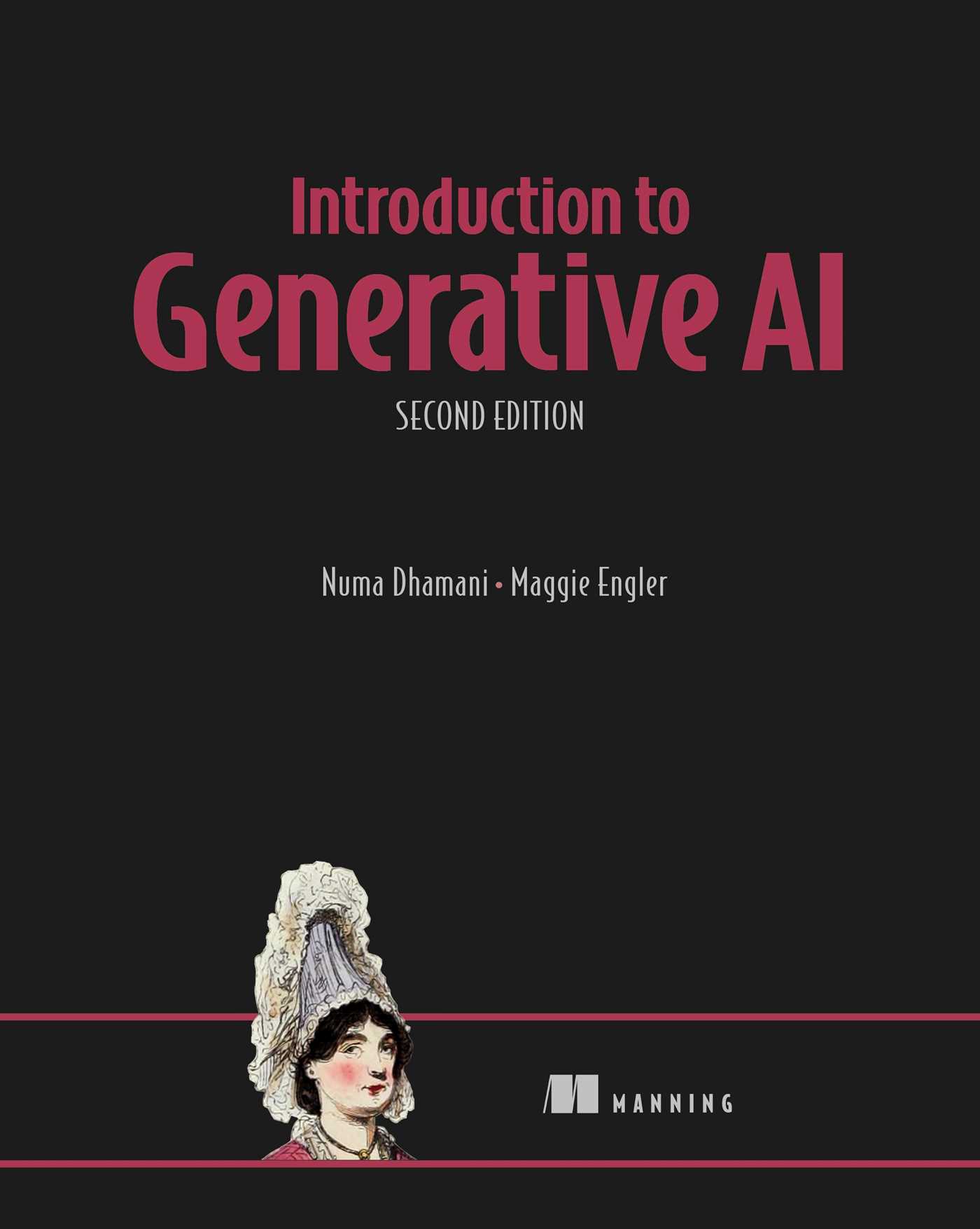
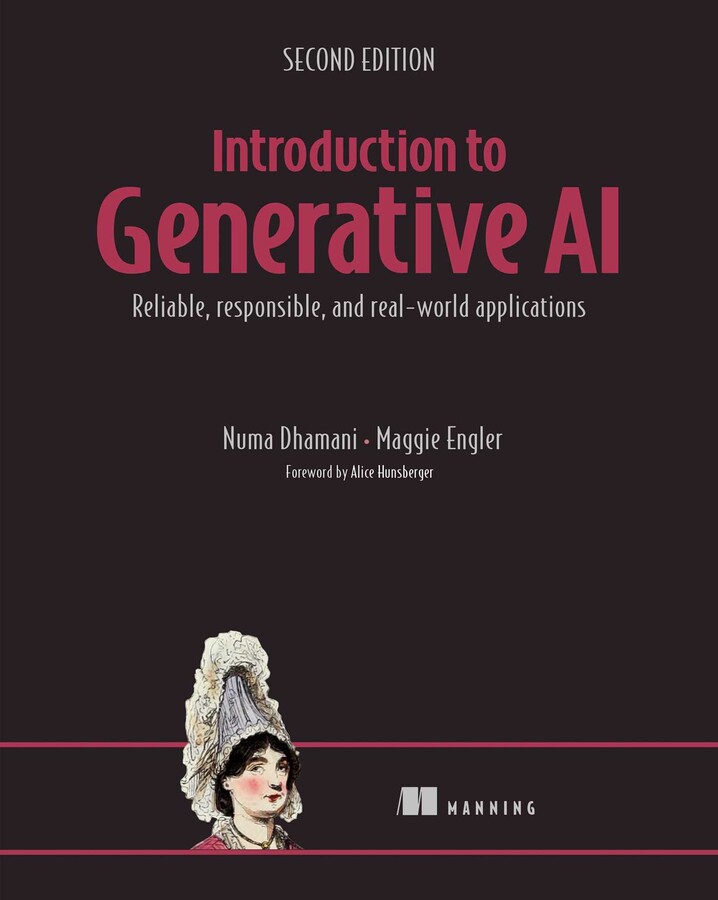
Introduction to Generative AI, Second Edition
Reliable, responsible, and real-world applications
By Numa Dhamani and Maggie Engler
Published by Manning
Distributed by Simon & Schuster
LIST PRICE $69.99
PRICE MAY VARY BY RETAILER
Free shipping when you spend $40. Terms apply.
Buy from Other Retailers
Table of Contents
About the Book
Get a free eBook (PDF or ePub) from Manning as well as access to the online liveBook format (and its AI assistant that will answer your questions in any language) when you purchase the print book.
AI tools like ChatGPT and Gemini, automated coding tools like Cursor and Copilot, and countless LLM-powered agents have become a part of daily life. They’ve also spawned a storm of misinformation, hype, and doomsaying that makes it tough to understand exactly what Generative AI actually is and what it can really do. This book delivers a clear, well-written survey of generative AI fundamentals along with the techniques and strategies you need to use AI safely and effectively.
It guides you from your first eye-opening interaction with tools like ChatGPT to how AI tools can transform your personal and professional life safely and responsibly. AI moves fast—and so this second edition has been completely revised to reflect the latest developments in the field.
In this easy-to-read introduction, you’ll learn:
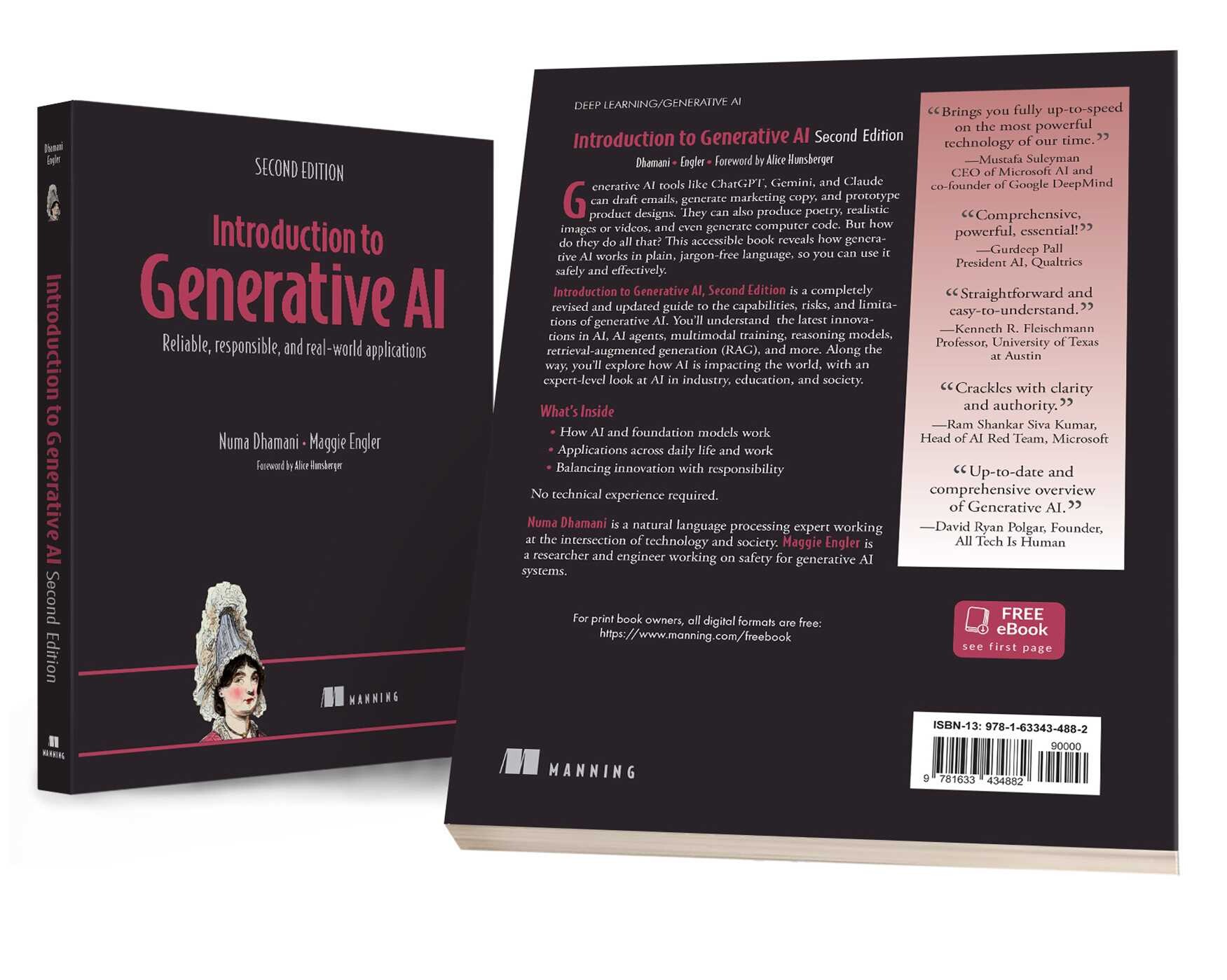
Generative AI tools like ChatGPT, Gemini, and Claude can draft emails, generate marketing copy, and prototype product designs. They can also produce poetry, realistic images or videos, and even generate computer code. But how do they do all that? This accessible book reveals how generative AI works in plain, jargon-free language, so you can use it safely and effectively.
About the book
Introduction to Generative AI, Second Edition is a completely revised and updated guide to the capabilities, risks, and limitations of generative AI. You’ll understand the latest innovations in AI, AI agents, multimodal training, reasoning models, retrieval-augmented generation (RAG), and more. Along the way, you’ll explore how AI is impacting the world, with an expert-level look at AI in industry, education, and society.
What's inside
No technical experience required.
About the author
Numa Dhamani is a natural language processing expert working at the intersection of technology and society. Maggie Engler is a researcher and engineer working on safety for generative AI systems.
Table of Contents
1 Large language models: The foundation of generative AI
2 Training large language models: Learning at scale
3 Data privacy and safety: Technical and legal controls
4 AI and the creative economy: Innovation and intellectual property
5 Misuse and adversarial attacks: Challenges and responsible testing
6 Machine-augmented work: Productivity, education, and economy
7 Prompt engineering: Strategies for guiding and evaluating LLMs
8 AI agents: The rise of autonomous AI systems
9 Human connections: The social role of chatbots
10 The future of responsible AI: Risks, practices, and policy
11 Frontiers of AI: Open questions and global trends
AI tools like ChatGPT and Gemini, automated coding tools like Cursor and Copilot, and countless LLM-powered agents have become a part of daily life. They’ve also spawned a storm of misinformation, hype, and doomsaying that makes it tough to understand exactly what Generative AI actually is and what it can really do. This book delivers a clear, well-written survey of generative AI fundamentals along with the techniques and strategies you need to use AI safely and effectively.
It guides you from your first eye-opening interaction with tools like ChatGPT to how AI tools can transform your personal and professional life safely and responsibly. AI moves fast—and so this second edition has been completely revised to reflect the latest developments in the field.
In this easy-to-read introduction, you’ll learn:
- How large language models (LLMs) work
- How to apply AI across personal and professional work
- The social, legal, and policy landscape around generative AI
- Emerging trends like reasoning models and vibe coding
Generative AI tools like ChatGPT, Gemini, and Claude can draft emails, generate marketing copy, and prototype product designs. They can also produce poetry, realistic images or videos, and even generate computer code. But how do they do all that? This accessible book reveals how generative AI works in plain, jargon-free language, so you can use it safely and effectively.
About the book
Introduction to Generative AI, Second Edition is a completely revised and updated guide to the capabilities, risks, and limitations of generative AI. You’ll understand the latest innovations in AI, AI agents, multimodal training, reasoning models, retrieval-augmented generation (RAG), and more. Along the way, you’ll explore how AI is impacting the world, with an expert-level look at AI in industry, education, and society.
What's inside
- How AI and foundation models work
- Applications across daily life and work
- Balancing innovation with responsibility
No technical experience required.
About the author
Numa Dhamani is a natural language processing expert working at the intersection of technology and society. Maggie Engler is a researcher and engineer working on safety for generative AI systems.
Table of Contents
1 Large language models: The foundation of generative AI
2 Training large language models: Learning at scale
3 Data privacy and safety: Technical and legal controls
4 AI and the creative economy: Innovation and intellectual property
5 Misuse and adversarial attacks: Challenges and responsible testing
6 Machine-augmented work: Productivity, education, and economy
7 Prompt engineering: Strategies for guiding and evaluating LLMs
8 AI agents: The rise of autonomous AI systems
9 Human connections: The social role of chatbots
10 The future of responsible AI: Risks, practices, and policy
11 Frontiers of AI: Open questions and global trends
Product Details
- Publisher: Manning (January 20, 2026)
- Length: 480 pages
- ISBN13: 9781633434882
Browse Related Books
Resources and Downloads
High Resolution Images
-
Book Cover Image (jpg): Introduction to Generative AI, Second Edition
Trade Paperback 9781633434882