
Plus, receive recommendations and exclusive offers on all of your favorite books and authors from Simon & Schuster.
LIST PRICE $30.00
Get 20% off with code FALL26 plus free shipping on orders of $40 or more. Discount on physical products only. Terms apply.
Buy from Other Retailers
Table of Contents
About the Book
Named a Best Book of the Year So Far by: The New Yorker • NPR • The Financial Times
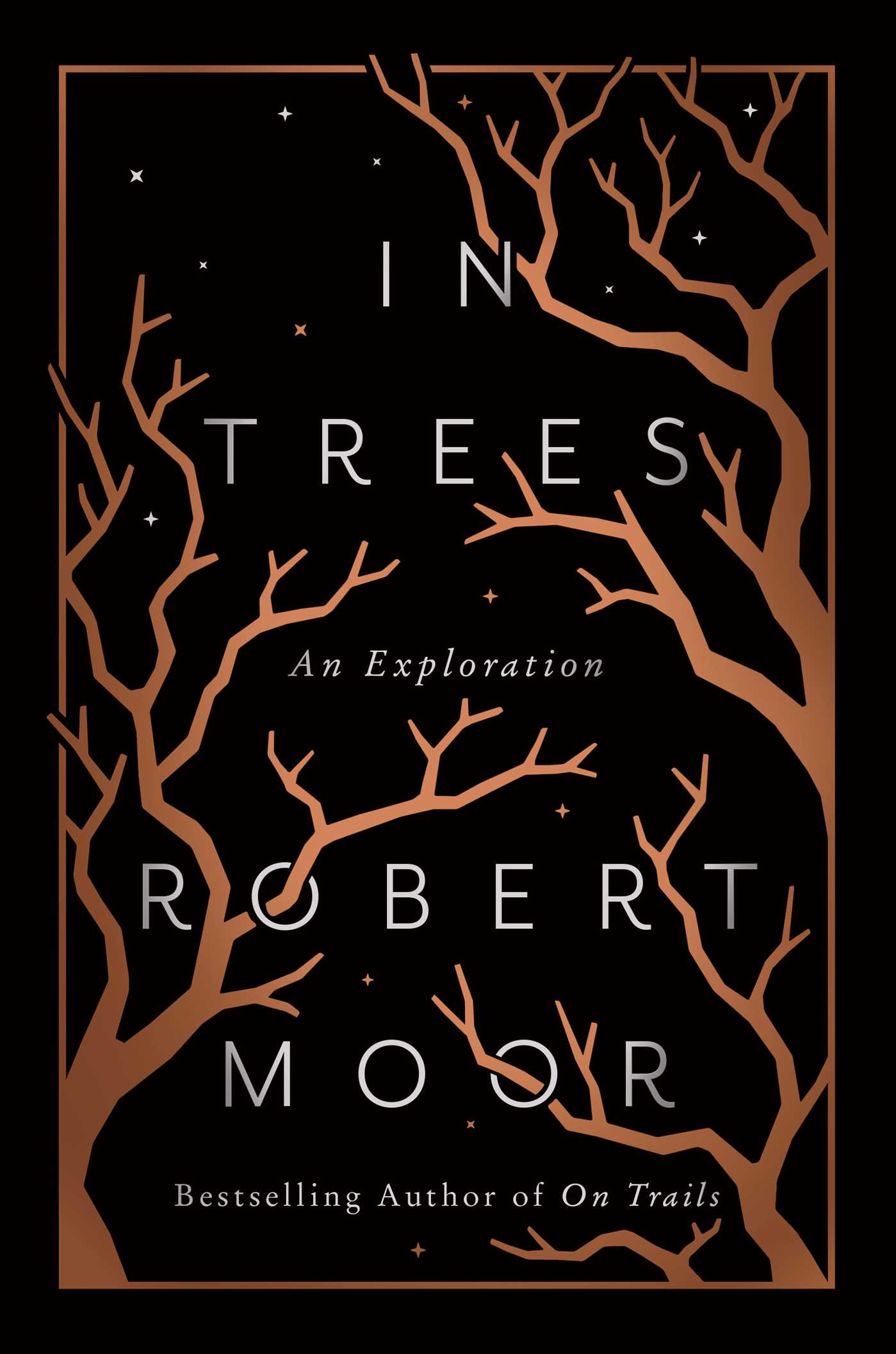
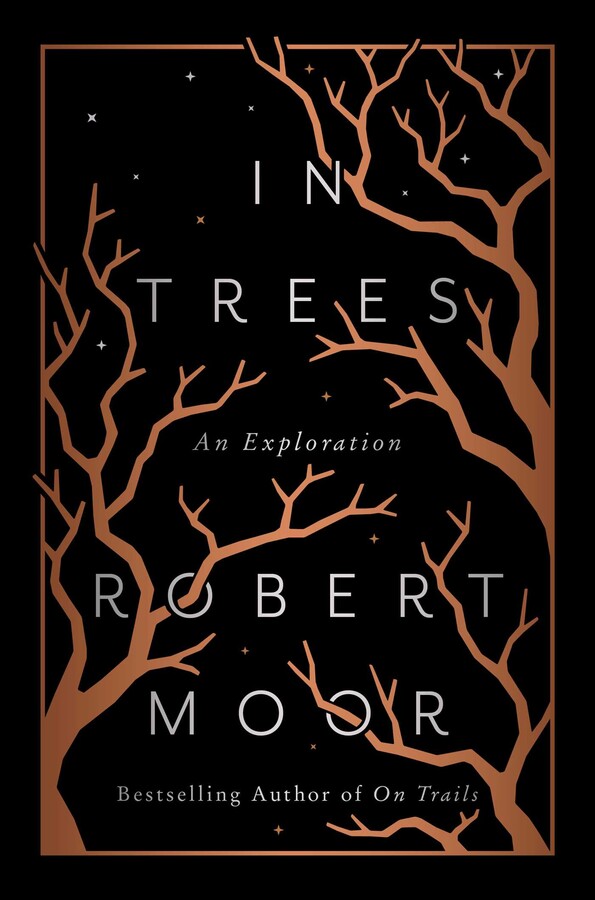
From the acclaimed author of the New York Times bestseller On Trails comes a wondrous new journey through the wilds of nature and the gnarls of history, exploring how trees—from the mightiest sequoia to the tiniest bonsai—can teach us to grow wise.
One day, on a whim, Robert Moor set out to climb a tree near his home—unwittingly embarking on what would become a decade-long adventure of intellectual and spiritual transformation.
Pursuing the hidden wisdom of trees, he digs through forgotten archives, scales to the top of a giant sequoia with Sir David Attenborough, trudges through swamps in Papua to reach a treehouse-dwelling tribe of hunter-gatherers, and travels to a remote research camp in Tanzania, where he spends one very uncomfortable night sleeping in a chimpanzee nest. Galvanized by a radical new outlook on both our gnarled past and our ever-branching future, he ultimately falls in with a ragtag clan of climate activists risking everything to halt construction of an oil pipeline and save an old-growth forest.
Along the way, Moor learns the art of “treethinking,” which, he discovers, has the power to break open some of humanity’s oldest questions: What is the secret to truly growing old? How do we set down roots in an increasingly chaotic world? Can we ever learn to pursue our future in the farsighted, deeply entangled manner of an ancient forest?
A witty, relentlessly curious excursion through philosophy, history, and science, what begins as an ode to the miracle of trees blossoms into a joyous, daring, and fiercely hopeful effort to “arborize humanity.”
Appearances
Munros Books
In Person
Learn MoreDungeness River Nature Center
In Person
Learn MoreJackson Hole Book Festival at Trailborn Jackson Ho
In Person
FESTIVAL - Kingston Writers Festival, In Conversation with Andrew Westoll. Moderated by Gregory McCormick.
Learn MoreKingston Writers Festival
In Person
Learn MoreHaystack Book Festival at Norfolk Library
In Person
FESTIVAL - Vancouver Writers Festival, In Conversation with Jason Dove Mark and John Vaillant. Hosted by Arno Kopecky
Learn MoreVancouver Writers Festival
Toronto International Festival of Authors
Excerpt
PROLOGUE:
Sky
Think of a tree.
Now, let your thoughts expand.
First, consider all of the trees that are not “trees.” Consider your family tree. Consider the evolutionary tree of life. Consider a branch of science, its sub-branches and sub-sub-branches. Consider a lightning bolt, a river system, the blue veins in your forearms, the red threads in the whites of your eyes. Consider the billions of neurons strung through the pink-gray meat of your own brain, a tangled forest of cells flickering with electricity even as you read this sentence.
A tree is not just a thing made up of bark and leaves and sap and wood. At its core, a tree is not even really a noun. It is more like a verb. A tree is what a tree does. It is hard for us to perceive this fact, however, because most of the time, a tree does what it does so slowly. A mature oak tree, which might live for one thousand years, appears to be as unchanging as a mountain. But if we could watch the full life cycle of an oak play out in a few seconds, it would look as violent as a fireworks display: A single green tendril slithers up from the shell of an acorn and thrusts itself through the soil; it unfurls tiny leaves, then it sprouts branches; and then those branches branch, and branch, and branch again. Some branches starve away or are torn off—pruned by wind, rain, ice, fire, pests, disease, and the gravitational pull of the earth itself—while others thicken and strengthen. Upward this thing (this process) erupts, until, in its final days, just before it comes crashing back down to earth, a keen botanist would be able to read it like a book, gleaning its entire history from its shape alone.
A tree, in other words, is not only a living being. It is also a way of being. Put very simply, that way of being—what philosophers call arborescence—consists of three simultaneous processes: branching, pruning, and gnarling. The result is something inventive, exacting, and long-lasting. Something wise.
+
I began writing this book not long after moving to the woods. In 2013, the man who would later become my husband and I relocated from an apartment in New York City to a cabin in a provincial forest in British Columbia. Our new home was surrounded by trees, like a toy castle submerged in an aquarium—a swaying green mass of cedars, Douglas firs, maples, alders, and yews. In New York, trees had resided in the blurry periphery of my daily life, mere ornamentation for the cityscape, but in the forest, they suddenly leapt into focus. There was one tree in particular, a monstrous big-leaf maple growing stubbornly on the side of a cliff that I once spent the better part of an hour lying beneath, gazing up into its branches in a state of soft, lucent awe.
It reminded me a bit of another grand tree I’d once known. In my early twenties, I had lived for a few months in a monastery that was a short walk from the Bodhi tree, beneath which the Buddha is said to have attained enlightenment. The tree—in truth, a descendant of the original Bodhi tree, which died millennia ago—was a huge ficus with low crooked pale arms propped up by metal crutches, like some kind of decrepit extraterrestrial. Each day dozens, sometimes hundreds, of pilgrims gathered around it. I loved to sit and watch them perform their various rituals of respect. When approaching, some pilgrims got down on their knees and touched their foreheads to the ground three times. Others laid offerings of marigolds and buffalo milk at its base. A few performed a grueling ritual known in Tibetan as chag-tsel—stretching themselves out face down on the hot marble paving stones, rising to their feet, and then lying flat again, repeating this act for days or even weeks on end. The Buddha apparently wanted it this way. Don’t worship a statue of me, he’d told his followers. If you must worship anything, worship a tree.
Trees seem to naturally absorb devotion, just as they draw water from the soil. Holy trees, fiercely guarded from harm, can be found on every continent except Antarctica. The authors of the Bible and the Quran portrayed trees as celestial symbols, as have Hindus, Jains, and the thousands of diverse cultures we rather crudely lump together as “animist.” In Cambodia, during the nightmarish rule of the Khmer Rouge, religious practices of any kind were banned, under pain of death. Nevertheless, one man who grew up outside Siem Reap told me that his parents would regularly sneak out to the forest behind their home and pray to the ancestral spirits that were believed to dwell in certain old trees. This form of animist worship has been taking place there for an unfathomably long time. It survived the arrival of Hinduism, and then Buddhism, and then communism, and it persists to this day.
Even nonbelievers sacralize trees. My mother, a lapsed Episcopalian, never forced me to go to church, but she took me for long Sunday walks through the patches of relict forest in our “leafy” little suburb in Illinois, and she packed me off to a summer camp called Pine Island each June. Nearly all the kids I knew were raised like this. The explosion of nature worship in the late 1960s had diffused over the decades into a kind of cosmic background radiation. Instead of illustrated copies of the Bible, our parents read us The Lorax and The Giving Tree. In this new natural theology, trees were our saints: We were taught that they selflessly sucked up the poisons we pumped into the sky and gave us back food and lumber and shade and sweet air to breathe. To my young mind, the felling of an old-growth forest was a greater tragedy than the destruction of a cathedral. (A church, after all, can be rebuilt, whereas, per the old poem, “only God can make a tree.”)
Why, I wondered, do trees maintain this mythic hold over our collective imagination? Where, ultimately, does their power lie? It’s odd, when one stops to think about it. In one sense, they are nothing more than very big plants. And yet they affect us as no other plant does.
After a few years living in the forest, I set out to write a book about our cultural entanglement with trees. Much had already been published about how humans have altered trees over the millennia, transforming them into houses and food, battleships and books, medicines and poisons. Instead, what I wanted to write about was how trees transform us: how they have shaped our sense of nature and time, self and other, life and nonlife. This relationship predates the very dawn of our species. Our apelike ancestors once spent their entire lives scampering around in the canopy; they were fed by trees, housed by trees, and, occasionally—with the slip of a hand or the shedding of a branch—killed by trees. Perhaps, I thought, this is why from time to time we still find ourselves regarding these vast, silent beings in our midst with a curious mix of awe and confusion, as if gazing up at ancient gods whose names we’d long ago forgotten.
As I delved deeper into the history and biology of trees, an odd thing happened: The halo around them gradually faded, and something more complicated emerged. Some trees share food and messages beneath the soil, but others emit poison to kill off their neighbors. One species in the Panamanian rainforest, known as the choibá, appears to have evolved an unusually tall crown so it can attract lightning bolts, which it absorbs and then channels to other nearby trees; in the aftermath of a thunderstorm, the surrounding trees eventually die off, but the choibá thrives. The Bodhi tree, that great symbol of peace, is especially murderous: Ficuses begin their lives as parasitic seeds in the crowns of other trees, then they send their roots downward, slowly ripping their host apart. The Quran speaks of an Edenic tree of life, but also of the tree of Zaqqum, which stands at the center of hell. In the Deep South, where generation after generation of my ancestors lived and died, an old oak provides cool summer shade, but it also recalls a sinister history of lynchings.
One day in the course of my research I ran across a study showing that Canada’s trees—especially the fast-growing conifer plantations that had largely replaced diverse old-growth forests—had taken a cruel turn. As they burned in wildfires and rotted due to pest outbreaks, they were releasing more carbon into the atmosphere than they absorbed. A few years later, it was found that large swathes of the Amazon basin, due to increasing wildfires and deforestation, had become a net carbon source, rather than a carbon sink. We had transformed the “lungs of the earth” into smokestacks.
The human world, too, seemed to be poised on the brink of catastrophic change. While I read book after book about trees, my attention was pulled away from my work by news of the pandemic, of wars, of political upheavals. In the summer and fall, as ever larger wildfires swept through the forests of Canada and tear gas filled the streets of far-off cities, I would occasionally glance up from my desk to take in the weird Venusian atmosphere—the clouds a nicotine yellow, the sun a droplet of fresh blood—and think: What the hell am I even doing?
Before the Second World War, the German playwright Bertolt Brecht wrote that, when one is living through a turbulent moment in history, it is “almost a crime” to “talk about trees” for in doing so “we maintain our silence about so much wrongdoing.” As I wrote this book—as bombs fell and delusions spread and the fires continued to grow—I felt the acid truth of these words eating away at my resolve. Spending all day thinking about trees, secluded in my quiet little patch of forest, sometimes felt like averting my gaze from a world I’d rather not see. As Brecht knew all too well, it is far easier to go for a walk in the woods than it is to stop monsters from marching to power.
Eventually, the book I thought I was writing crumbled to loam. Then, in one of those quiet miracles common to the creative process, it regrew in a new form. I came to see trees as something more than plants; I recognized them as a source of wisdom, a pattern of flourishing, an answer to chaos, which extends from mossy glades to the hard corners of the metropolis.
Brecht was right: In times like these, we should not just talk about trees. We should listen to them.
+
My first inkling that a tree might be wiser than it seems began with a single crooked neuron—a mysterious little squiggle no more than a few thousandths of an inch long.
It was a spring afternoon, and I was in the office of a neuroscientist named Jeff Lichtman at Harvard. He was renowned for creating finely detailed maps of the brain’s “connectome”—the way that one brain cell links to the next, and the next, and the next, and how that all joins up to form the human intellect.
One of the most surprising findings of his research, Lichtman told me, was how inelegant the mammalian brain is, structurally speaking. Scientists had assumed that, for the sake of efficiency, neurons would find the shortest distance between two points. However, when Lichtman began measuring the length of the axons in the brain of a mouse, he found that some were as much as 25 percent longer than they needed to be—a startling waste of precious space.
He tilted his computer monitor toward me and pulled up a digital image of one tiny sector of a mouse brain. With his finger, he traced the course of a neural branch as it took a wide, loopy detour on the way to its destination.
I wondered: Does my brain also look like that?
Lichtman assured me it did. Indeed, in scanning human brains, he would later discover even more inefficient brain cells—called “whorls”—that circle back on themselves, growing in tangled knots.
“But why would a neuron take a less efficient route?” I asked.
He explained that it was a product of pure chance. When the brain is forming, neurons grow blindly, seeking to connect to other neurons, and then over time, the connections that aren’t used wither away. “There’s a survival of some branches and a loss of others,” he said. “And the ones that survive are not necessarily the most direct route.” Once the brain has finished growing, the neurons are locked in place by the other brain cells that have grown around them.
I stared at the crooked neuron on his screen. I found myself feeling repulsed by the sight of it. Back then I was working on a book about trails, and I pointed out to Lichtman that if that neural pathway were a footpath, by walking it, we would gradually shave away and straighten out that curve.
With an air of detached amusement, Lichtman acknowledged that the shape of the brain was “a little irrational.” It was important to remember, he said, that a “neural pathway” is not really a pathway. It’s a living thing. And life, as a rule, doesn’t need to be perfect. It only needs to be good enough to survive.
Part of me knew that the meandering shape of our neural pathways was a problem so tiny that it was almost beneath consideration. But it disturbed me nonetheless, because it gestured to something much larger. I had always assumed that life has a tendency to self-optimize, a will to elegance. Raised in that golden lull after the thawing of the Cold War and before the melting of the ice caps, I had taken it on faith that the arc of the moral universe bent toward justice, that technology naturally grew sleeker and quicker, that the world’s rough edges would be steadily sanded away until everything fit smoothly into place. These axioms helped shape my (generally, optimistic) worldview. So it was a shock to find—here, in the most powerful organ the earth has ever produced—something so stubbornly inelegant. Life, I was beginning to realize, contains something ugly, something hard and arthritic and irremediably flawed, in its very nature.
The memory of that crooked neuron returned, terrifyingly, years later, when one December morning, my husband, Remi, awoke to find he was unable to get out of bed. In his sleep, a blood clot had slipped through a hole in his heart and into the branching network of vessels in his brain, blocking one up. Starved of fresh blood, millions of neurons had died off. We rushed him to the hospital, but by the time we arrived, scans showed that the clot had already dissolved. It was as if a ghost had lightly traced a finger across the surface of his sleeping brain, withering everything it touched, and then vanished into the gray morning light.
The results were surreal. The whole right side of his body, from his shoulder down to his toes, was completely numb. As he dozed in the hospital bed, waiting for test after test, he would occasionally wake up in alarm because he felt a stranger’s hand brushing against his face, only to realize that it was his own. Language, too, had become phantasmal. Words would recede from his grasp, or else they would leap to mind, only to magically change shape; when asked what month it was, he said, with total certainty, “Tomato.” Thoughts, atomized and evanescent, floated tracelessly through his head, less a stream of consciousness than a wave of photons.
Each time we spoke with the doctors, we found reasons for hope and reasons for despair. The brain, they explained, is a wonderfully flexible organ, capable of reprogramming itself endlessly, but it has its limitations. One of these limitations is that, past a relatively young age, damaged neurons never grow back. This thought is what vexed Remi most. An injury is ultimately harmless so long as it is temporary; pain, no matter how intense, soon fades into hazy memory. But a wound that refuses to heal threatens to become a little piece of death that dwells forever within one’s life.
Thankfully, in Remi’s case, this fear was largely misplaced. His brain started to rewire itself, using its remaining neurons, and slowly, the abilities he’d lost began to return. It has now been more than five years since the stroke, and Remi has made what the doctors say is a miraculous recovery. To me, he seems no different than he was before that awful night. But he still suffers from a haunting sense that something has been taken from him that he can never get back. Once, while clearing a plot of forest in order to build us a vegetable garden, Remi held up a dense brown clump of rootlets and fungal threads and said to me, “This is exactly the way it feels. Like someone has reached in and ripped out a bunch of the roots in my brain.”
+
As part of our new garden, Remi planted five wild blueberry bushes, and then he fenced them off with nylon netting to keep out pests. One day we discovered a small bird, a dark-eyed junco, tangled up in the netting. In its attempt to escape, it was thrashing around, ensnaring itself further. Remi gently held it down while I used a pair of scissors to cut away the netting, first from its feet, then from its wings. But when I peered closer, I discovered that beneath the bird’s feathers, the black threads had bitten into its flesh. After an agonizing few minutes, we finally managed to free the junco, but we weren’t able to extract all of the cord. The bird hobbled off into the underbrush, fluttering its wings ineffectively. We guiltily assumed it would soon meet its death at the claws of an owl.[1]
A week later, to our surprise, we saw the junco again. It had somehow regained its power of flight (and resumed raiding our garden) with a length of black string dangling from behind its wings. It appeared to be unharmed, even though it now had a piece of polyester fiber woven into its being.
Looking at it, I began to think about how what maims us also makes us: Our wounds, rather than healing entirely and disappearing with time, tend to leave behind traces, contorting our growth. I had often noticed this in the people closest to me: a neighbor, walking funny to accommodate a back injury he suffered in his twenties; a close friend, left forever wary of dark alleys. People all over the world seemed to be coming to a similar realization all at once. “Trauma,” a word I seldom heard growing up outside of televised medical dramas, was suddenly on everyone’s mind. A wave of previously straight-laced people had begun turning to psychedelics in an attempt to loosen up mental scar tissue. At the same time, the public seemed to be awakening en masse to the ways that history intrudes upon the present. In the shadow play of politics, sinister echoes of ideas and events from prior centuries kept reverberating. Efforts were made to rectify the past—statues were taken down, places renamed, history books updated—but the underlying systems proved stubbornly (even violently) resistant to reform. Power, over time, produces its own architectures, as rigidly unchanging and snugly self-serving as an oyster shell, within which the powerless, human and nonhuman alike, are required to spend our lives.
Looming above it all was the grim intractability of climate change. As affluent countries continued to fuel their growth by burning the corpses of long-dead plants and animals, the earth began locking itself into deadly new thermal patterns. The ice caps melted, and then the seas absorbed more heat, melting more ice. Time bombs, made of methane, began detonating in the permafrost of the Russian snow forests. Farther south, forest fires burned hotter each year, releasing more greenhouse gases, which fueled even bigger, hotter fires. The architects of this world-historic shift were the executives of fossil fuel companies, men who were now well on their way to being fossils themselves. But in the meantime, the world had hardened around ideas they once jotted down on monogrammed notepads. By the time I began writing this book, most people had come to understand that we needed to quickly replace oil and coal with sun and wind and water. The trouble was that, by then, carbon capitalism had already insinuated itself into every aspect of our lives. A black nylon thread running through our flesh: It seemed impossible to cut out.
In studying trees, I finally found language to make sense of this phenomenon. What I was seeing was life’s tendency to grow gnarled. Though “gnarls” originally referred to “knurls,” or large bumps on a tree trunk, I tend to think of the word in its broader sense. A gnarl is part deformation, part adaptation. It is formed when a tree experiences some calamity—when it loses a branch, or suffers an injury, or gets an infection, or develops a genetic mutation—and then it grows around that old wound, which deforms the otherwise smooth flow of its grain. A tree’s refusal to let go of its past might seem like a flaw, and in some cases it is; arborists warn that gnarled maples and willows are often more brittle than uninjured ones. But gnarling is also vital to the beauty and brilliance of very old trees. It is striking—and, to me, moving—that the oldest trees on earth, the bristlecone pines, are also among the world’s most contorted.
This is hard wisdom, the kind we don’t usually want to hear. Brains, bodies, branches, the winding course of our lives, the arc of our collective histories: all are forced to hold on to their gnarls. These things aren’t perfect, but they don’t need to be. They only need to find a bit of light, hold it, and pass it along.
+
Over the course of my research, I eventually came to understand that there are many reasons why trees inspire such powerful feelings of reverence in us. Trees outlive us, expanding our sense of time; they tower over us, putting our lives into perspective; they provide for us, inspiring a sense of gratitude; and they trouble us, challenging us to embrace what John Fowles calls the “green chaos” of the more-than-human world. But there is something else, which, in our tendency to focus solely on the sunny side of arborescence, we too often overlook: A tree is a way of persisting in a world of wounds.
Each tree begins its life with a number of limitations: It is born rooted to one spot, its flesh is hard, and its insides are mostly dead. All day long the sun moves through the sky, and the rain falls in a diffuse scattering across the soil. If trees were animals, they would simply turn their heads to eat the sunlight and wriggle around their roots to suck up the rainwater wherever they could find it. They would duck lightning bolts, crush pests, and flee from fires. But they cannot. They must stay put. With all of these innate weaknesses, it seems incredible that trees have managed to survive at all. And yet, certain old trees have remained standing for millennia, while empires crest and crash in their shade.
A tree overcomes its limitations by doing what trees do: It arboresces. It begins by branching outward in all directions, growing upward to explore the bright, dry air and downward into the dark, wet soil. It eventually prunes back the limbs that snag too much wind or fail to reach the light. What remains grows stronger over time, as each new layer of wood wraps around the old, locking those curves into place. Branch, prune, gnarl. In this way, a tree learns to live with, and then outgrow, its imperfections.
Our brains work in much the same way. As an infant’s brain is developing, it forms a lush profusion of neural connections, far in excess of what it needs. Then, as we age, we begin deleting the neural links we don’t use. Neuroscientists have a lovely term for this process: “blossoming and pruning.” Though it should more accurately be called a process of “blossoming, pruning, and gnarling,” since what is retained is gradually strengthened, crooked though it may be.
This strategy repeats itself in every realm of life, through the mechanism of Darwinian evolution. Species evolve by gradually branching apart from one another, but certain traits tend to become fixed in place. Many land-dwelling animals, for example, are descended from a slimy, four-legged, fishlike creature, informally known as a fishapod, that crawled out of the sea some 375 million years ago. Clumsy as it may have been, the fishapod eventually gave rise to a vast array of new body types. Its blunt arms and legs hardened into the hooves of horses; they sharpened into the claws of iguanas; they swelled into the legs of elephants; they splayed into the wings of birds; and they tightened to form the precision grip of the human hand. However, as Charles Darwin once noted, if you examine the skeletons of these various species, you’ll tend to find a remarkably similar structure lying hidden within all their fins and wings and hands: four (or more) long digits, often with a shorter thumb-like digit at the end—just like the ancient fishapod once had. My head swims just thinking about it. When I was prying that junco loose from its netting, one hand of our primordial ancestor was, in effect, freeing the other.
It is little wonder that, when the time came for Darwin to select an overarching metaphor for his model of evolution, he chose a tree. Life arboresces: Death pares us back, and vestigial flaws persist, but new growth continually blossoms atop the old.
+
When Darwin returned home from his voyage around the globe on board the HMS Beagle, having just seen the world’s prismatic diversity of animals and plants and human cultures, a family member remarked that the shape of his skull appeared to have changed. “If it wasn’t true phrenologically, it was apt as metaphor,” notes the science writer David Quammen. “The shape of his thinking had changed.”
The standard worldview of Darwin’s intellectual milieu was linear, reductive, and hierarchical: All species were believed to be arranged one atop the next, like bureaucrats in a vast universal office tower, with wealthy white men occupying the floor just beneath the angels. But on his voyage aboard the Beagle, Darwin began to understand how mushrooms and beetles and elephants and sparrows and bacteria and bare-chested Patagonian fishermen and bald-headed Oxford dons were all just the outer tips of branches on a single, planetary process of growth. The shape of his mind had started to change.
Darwin’s grand theory—what he called the evolutionary “Tree of Life”—unsettled, and then reshaped, the world. It remains so disturbing that many people still either fail to or refuse to properly understand it. This, argues the evolutionary biologist Robert J. O’Hara, is because it demands what he calls “tree thinking.” Many people are still beholden to what might be called “tower thinking,” which assumes that we humans are the natural apex of evolution. But tree thinking forces us to reject that comforting belief. There is no one pinnacle of evolution; there is a broad crown, and every living being is a part of it. Thinking in this arborescent manner also helped scholars pry themselves away from the oppressive belief that people are arranged in a strict racial hierarchy; instead, all humans are now widely understood to be part of a single (very complicated) family tree. Much of the social progress of the past century has been founded upon this basic shift in thought—from kinds to kin, from a tower to a tree.
Tree thinking begins when you learn to see the world as the result of an ongoing pattern of growth. This perceptual shift is somewhat hard to make. But, I’ve found, it is worth the effort, because, when it takes place, a cosmos of cold objects and abstract ideas is suddenly revealed to be a forest: entangled, ever-evolving, and eternally wild.
Life, in short, is fundamentally arborescent. In order to make sense of it, it helps to think in trees.
+
In the decade it took me to write this book, I, too, felt the shape of my mind change. It was a slow but thrilling (even, at times, terrifying) process. I began by reading everything I could get my hands on about the science, history, and philosophy of trees. Then I put down the books and went outside. I fell in with a clan of tree-climbing arborists and scientists; eventually, I made my way all the way to the top of a giant sequoia, the largest species of tree on earth. In addition to the very largest, I studied the very smallest: While in Japan, I became enchanted with bonsai, the magical art of growing “nature in miniature.” I traveled to Papua so I could spend time learning from a tribe of people who live in treehouses high above the jungle floor, and I traveled to East Africa so that I could study our arboreal cousins, the great apes, in the wild. I traced my family tree to haunting places, and I traced my evolutionary tree to wondrous ones. In the end, I found myself sitting in a treetop blockade with a stockpile of canned food, staring down at a tactical team of police intent on dragging me away in handcuffs. On each of these journeys, I explored a range of intellectual mysteries, but no matter where these various explorations brought me, I found myself returning to a central question, one so ancient and all-encompassing that it felt hubristic to even consider it: How should we—as individuals, as communities, as denizens and stewards of the earth—live?
“Learn good sense from a tree, O mind.” This line is taken from a Hindi bhajan, or hymn, that Mahatma Gandhi and his followers used to sing. When I ask myself how a person should live, this is the advice I now turn to: Learn to branch out like a tree, to let go like a tree, to weather hardship like a tree, to rise above like a tree, to set down roots like a tree. In a scarred and storm-battered world, we couldn’t hope to find wiser teachers.
Before we embark on this exploration, I have one last gnomic piece of wisdom to pass along. “A tree is a tree,” writes Roland Barthes. This phrase, simple as it may seem, is surprisingly powerful. A tree differs from a human in profound ways; by eliding these differences, we diminish our understanding of what trees are and we impoverish our own imagination of what they might be. In looking to trees for wisdom, my aim has never been to anthropomorphize them. Quite the opposite: I hope to arborize humanity.
Product Details
- Publisher: Simon & Schuster (April 7, 2026)
- Length: 384 pages
- ISBN13: 9781476739250
Browse Related Books
Raves and Reviews
“A beautiful book... impossible to put down.... I’ve been recommending it to everyone I know.”
—David Wallace-Wells, on The New York Times' "The Opinions" podcast
“Gorgeous, honest, and soulful.”
—Bryan Stevenson, New York Times bestselling author of Just Mercy
"Earnest and passionate."
—NPR
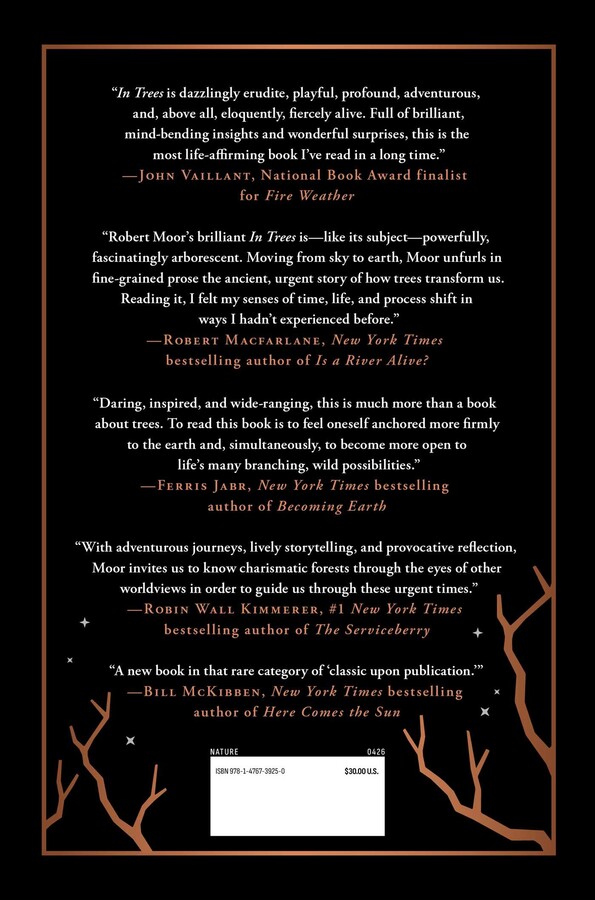
“Daring, inspired, and wide-ranging, this is much more than a book about trees. To read this book is to feel oneself anchored more firmly to the earth and, simultaneously, to become more open to life’s many branching, wild possibilities.”
—Ferris Jabr, New York Times bestselling author of Becoming Earth
“Robert Moor’s brilliant In Trees is—like its subject—powerfully, fascinatingly arborescent. Moving from sky to earth, Moor unfurls in fine-grained prose the ancient, urgent story of how trees transform us. Reading it, I felt my senses of time, life, and process shift in ways I hadn’t experienced before.”
—Robert Macfarlane, New York Times bestselling author of Is a River Alive?
“A new book in that rare category of ‘classic upon publication.’”
—Bill McKibben, New York Times bestselling author of Here Comes the Sun
“In Trees is dazzlingly erudite, playful, profound, adventurous and, above all, eloquently, fiercely alive. Full of brilliant, mind-bending insights and wonderful surprises, this is the most life-affirming book I’ve read in a long time.”
—John Vaillant, National Book Award finalist for Fire Weather
“With adventurous journeys, lively storytelling, and provocative reflection, Moor invites us to know charismatic forests through the eyes of other worldviews in order to guide us through these urgent times.”
—Robin Wall Kimmerer, #1 New York Times bestselling author of The Serviceberry
“In the course of his explorations, the author has been transformed. After reading this book, you may be, too.”
—Earth Island Journal
Resources and Downloads
High Resolution Images
-
Book Cover Image (jpg): In Trees
Hardcover 9781476739250
-
Author Photo (jpg): Robert Moor Photograph by Remi Morawski(0.1 MB)
Any use of an author photo must include its respective photo credit