
Plus, receive recommendations and exclusive offers on all of your favorite books and authors from Simon & Schuster.
0:00 /
LIST PRICE $27.00
PRICE MAY VARY BY RETAILER
Free shipping when you spend $40. Terms apply.
Buy from Other Retailers
Table of Contents
About the Book
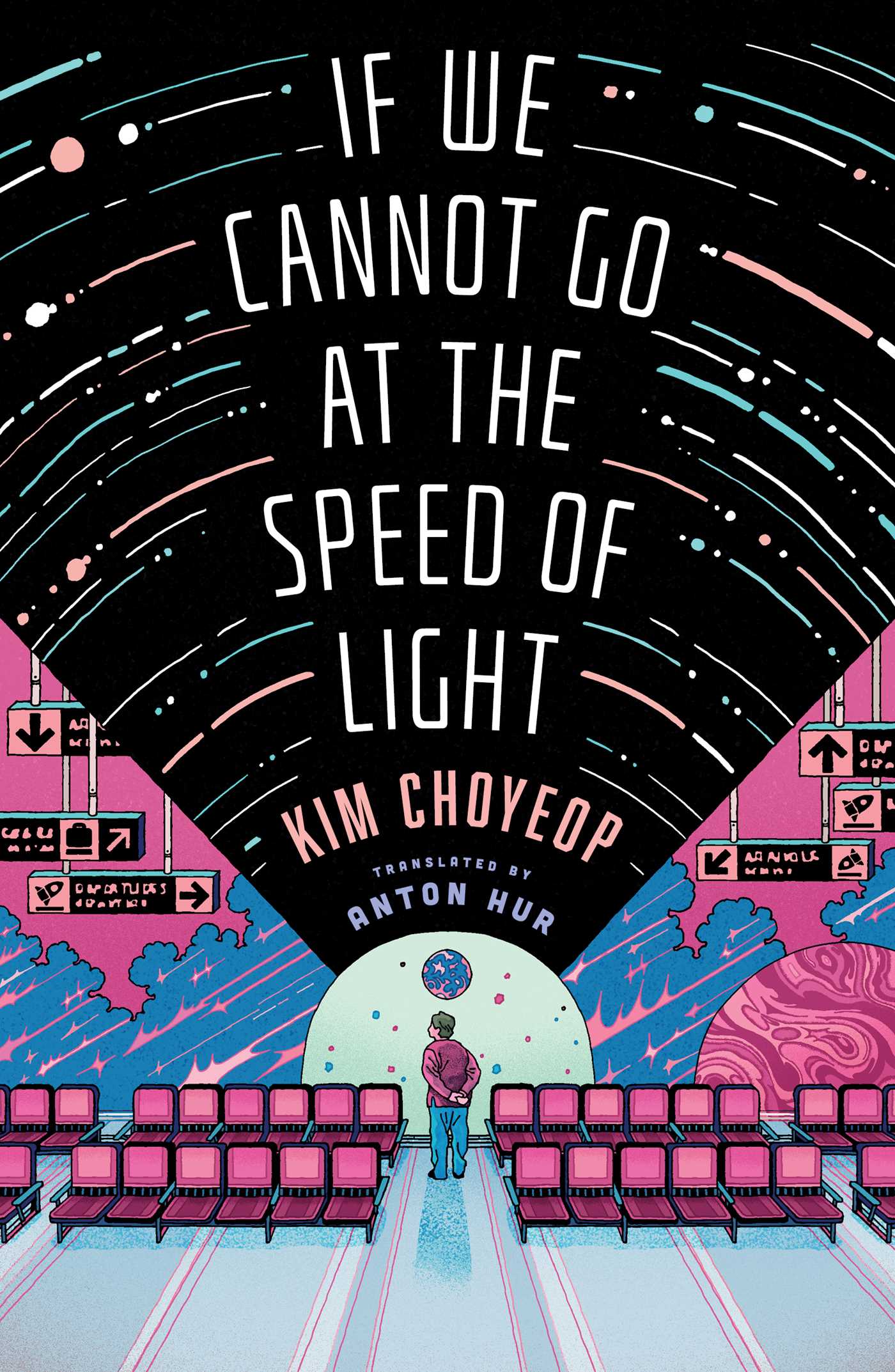
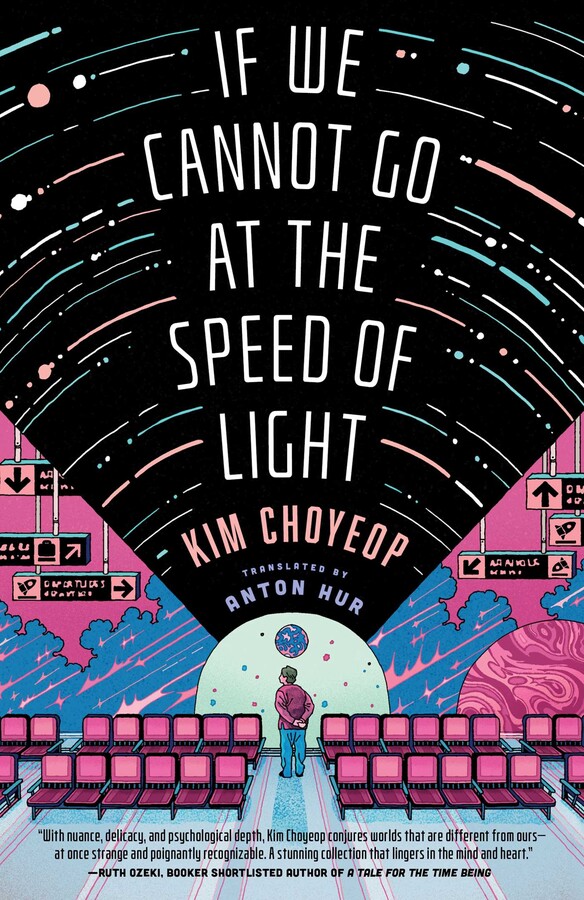
From Korean science fiction author Kim Cho-yeop, a stunning and poignant collection of literary speculative fiction stories that explore the complexities of identity, love, death, and the search for life’s meaning, perfect for fans of Exhalation and The Paper Menagerie.
In If We Cannot Go at the Speed of Light, Korean science fiction superstar Kim Cho-yeop leads us to places we never thought we’d reach, imagining worlds galaxies away and unfamiliar lifeforms with near-dizzying humanity.
An elderly woman stranded in a defunct space station recounts her life story to a visitor as she waits for a vessel that may never arrive. A man comes across a company called Emotional Solids that sells emotions as material products—love as a piece of chocolate, sadness as a smooth stone, anger as a glass paperweight—and tries to understand why people would want to purchase any negative emotions. When an enigmatic artist reveals long-forgotten messages from beyond through her wildly original paintings portraying a planet from a time long before humanity formed, a team of researchers investigate if this planet truly existed and if so, how did this artist know of it? After a pregnant woman’s estranged mother dies suddenly, her avatar disappears from the library of lost souls where the digital minds of the deceased are stored—and the woman is forced, for the first time, to endeavor to understand her mother. In a future utopian society where gene selection has been made uniform and all those with imperfections are cast aside, one woman seeks the truth about the history of her isolated world. And when a young woman undertakes a never-before-accomplished journey through a wormhole, she must reckon with the legacy of her aunt, who vanished mysteriously days before she was meant to begin the same pilgrimage.
Traversing the bounds of imagination with an ethereal incisiveness, Kim Cho-yeop’s stories dismantle the borders between normal and abnormal, material and abstract, earthly and otherworldly. With unforgettable inventiveness and pathos, If We Cannot Go at the Speed of Light heralds the arrival of an essential voice in contemporary fiction.
In If We Cannot Go at the Speed of Light, Korean science fiction superstar Kim Cho-yeop leads us to places we never thought we’d reach, imagining worlds galaxies away and unfamiliar lifeforms with near-dizzying humanity.
An elderly woman stranded in a defunct space station recounts her life story to a visitor as she waits for a vessel that may never arrive. A man comes across a company called Emotional Solids that sells emotions as material products—love as a piece of chocolate, sadness as a smooth stone, anger as a glass paperweight—and tries to understand why people would want to purchase any negative emotions. When an enigmatic artist reveals long-forgotten messages from beyond through her wildly original paintings portraying a planet from a time long before humanity formed, a team of researchers investigate if this planet truly existed and if so, how did this artist know of it? After a pregnant woman’s estranged mother dies suddenly, her avatar disappears from the library of lost souls where the digital minds of the deceased are stored—and the woman is forced, for the first time, to endeavor to understand her mother. In a future utopian society where gene selection has been made uniform and all those with imperfections are cast aside, one woman seeks the truth about the history of her isolated world. And when a young woman undertakes a never-before-accomplished journey through a wormhole, she must reckon with the legacy of her aunt, who vanished mysteriously days before she was meant to begin the same pilgrimage.
Traversing the bounds of imagination with an ethereal incisiveness, Kim Cho-yeop’s stories dismantle the borders between normal and abnormal, material and abstract, earthly and otherworldly. With unforgettable inventiveness and pathos, If We Cannot Go at the Speed of Light heralds the arrival of an essential voice in contemporary fiction.
Excerpt
1. Symbiosis Theory SYMBIOSIS THEORY
Ludmilla Markov had memories of a place she had never been to.
It’s uncertain when they were created. A teacher at the orphanage Ludmilla was raised in later wrote:
The child was convinced since the age of five that she was from that place. We didn’t think too much of it. Children have fantasies all the time, it’s all a part of the growing-up process. Except Ludmilla had a particular attachment to this fantasy. If she caught a hint of any of the teachers not taking her seriously, she became very sad and anxious. Our unspoken rule was that we would not let on how we didn’t believe her stories. There were fewer troubles then. And everyone assumed she would outgrow them eventually.
But despite her teachers’ expectations, Ludmilla never did.
Her artistic talents were apparent from a young age. According to the orphanage’s teachers, she could draw her dreamy and ethereal world on paper as soon as she could grasp a crayon. But these drawings, considered mere juvenilia, were thrown away when Ludmilla left the orphanage, and not a trace of them remain. This institution, after all, was a place that needed more bread and cookies than colored pencils. And Ludmilla spent much more time rapt in daydreams than drawing.
When Ludmilla was about ten, a transnational conglomerate selected her for their gifted and talented scholarship program, and she moved to a boarding school in London. After that, she never had to go to bed hungry or sleep in a room where insects crawled out at night.
Ludmilla began showing her drawings of the place to others. She made her public debut in a small gallery her school rented to exhibit their students’ work, and Ludmilla’s drawings attracted attention immediately. From the very first day, people stopped in front of them and cried. Everyone wanted to know more about the artist of these extraordinary works.
Her awed teachers kept asking her, “How did you imagine such a landscape?”
Ludmilla was still a little rough in the technical sense and had much to learn. But her landscapes were always arresting, and the sure and deliberate way she drew them gave her not a moment of thought in the process. She drew without hesitation. Channeled.
Her memories of the place were, from her childhood to her death, the images that dominated her life. A world that seemed to exist somewhere, but at the same time nowhere at all. For her whole life, Ludmilla drew this landscape as if it were fully formed inside her mind, the different viewpoints perfectly continuous with each other.
Reporters insisted on asking her time and again, “Ludmilla, what is the name of this place?”
She always seemed perturbed by the question. “It has a name in my head, but I don’t know what to call it out loud.” The first few times she was asked, she said a word that did not exist in any language on Earth. But after multiple reporters expressed their annoyance at having to write down a name that didn’t fit into their languages, Ludmilla began calling it “the Planet.”
The fact that its name couldn’t be spoken added to its mystique. Some people called it Ludmilla’s Planet. A figment of the imagination to be sure, but at least it had a name now. A place Ludmilla visited in her dreams, that Ludmilla created, and Ludmilla continued to draw.
The first depictions of the Planet in Ludmilla’s early work were abstract. A palette of mostly purples and blues, some vaguely shaped life-forms roaming about. It was mostly covered in ocean, and single-celled bioluminescent organisms floated in the water, lighting up everything. Other, complex life-forms lived in the ocean and the air. There were short days and long nights where the rising and setting sun added strange colors to the scenery.
As Ludmilla grew older, the Planet became more defined. She came up with quantitative data about it as an actual place and produced detailed notes on its characteristics. The way she described its life-forms was like that of a naturalist.
She went beyond the canvases and drawings of her early works and eventually moved into simulations, easily hitching a ride on the Simulation Art movement gathering momentum at the time. Her works attained critical and commercial acclaim, praised for breathing artistic life into what was otherwise often derided as a soulless, gimmicky medium.
Ludmilla’s response to her accolades was always the same.
“I just re-create what I see.”
Audiences loved Ludmilla’s Planet. Accessible from anywhere on Earth, the simulation made people feel like the Planet actually existed and wasn’t a mere figment of the imagination. It wasn’t just Ludmilla’s original depictions that were popular; there were also movies and plays based on her paintings. Audiences could access centuries of art from around the world, but it was Ludmilla’s work that took a significant share of their attention. The influence of the Planet spread.
It was its pan-geographic aspect that was central to the appeal of her work, which might have been a result of having spent her childhood in Moscow, her young adulthood in London, and her subsequent life around the world. Ludmilla’s Planet resembled nowhere on Earth and looked as if it would exist very, very far away. And yet, her depictions stirred an unmistakable stab of nostalgia in her audience, who felt they were gazing upon something from a very long time ago that they had no choice but to leave behind. Some, not understanding why, were moved to tears. Meanwhile, critics claimed the nowhere-ness of Ludmilla’s Planet was precisely why the works brought out a place that existed in the souls of all people.
There was another series by Ludmilla that wasn’t as well known, one she had worked on her whole life. These works, titled Never Leave Me, had not been shown in her lifetime. Unlike the Planet series, Never Leave Me featured the abstractions of strong feelings but none of the figurative detail of her more famous work. They had a mournful, pleading air about them.
Ludmilla did not mention them in any interview she gave. Scores of these works were discovered in the attic only after her death, all under the same title. Art historians posited that they were expressions of her longing for a lover she had kept secret. But there was no evidence from her personal life to corroborate this, and the theory faded into obscurity.
Before she died, Ludmilla authorized the free use of all her work by anyone in any way they saw fit. Many simulations and games appeared based on Ludmilla’s Planet. Audiences immersed themselves in the nostalgia of the Planet and talked about it as their utopia, a world that could never be, but the imagining of which was solace enough. Ludmilla may have passed away, but the world she had created would surely live on forever in everyone’s hearts.
And then one day, Ludmilla’s Planet was found.
A space telescope traveling in deep space had sent back a telemetric dataset about a small planet that seemed to have an odd orbit around a multiple star system. The data suggested conditions that would make life possible, but because the planet was so far away and the technology to take an exploratory vessel there didn’t exist yet, it would take a long time to learn more.
The telescope’s operators discussed this planet for days. If the data was accurate and there was no noise from the transmission process, its implications were beyond fascinating. Other data from deep space might suggest, vaguely, the possibility of life, but never was the evidence so clear. The planet had a perfect balance of ammonia and methane in the atmosphere, gases that were easily broken down by UV rays, and therefore it was widely understood that their presence meant the existence of carbon-based life-forms. The signal captured by the telescope and turned into visible light was a promising shade of blue. It was like discovering another Earth somewhere else in the galaxy, an even more fantastical version of Earth at that.
One of the operators, in the midst of quietly eating her lunch, suddenly piped up, “Doesn’t that data remind you of Ludmilla’s Planet?”
“Oh yeah, no kidding.”
“Seriously. Haven’t you been to the simulation? She based it on very specific data, and the data we received here is weirdly close to Ludmilla’s fictional data. It’s a little too close to be coincidental…”
The other operators put down their forks, lost in thought.
None of them could sleep that night. They checked again and again, and it was true every time: all the data was congruent with that of Ludmilla’s Planet. The volume, mass, rotation, orbit, average temperatures—they aligned perfectly with Ludmilla’s supposedly made-up dataset.
Had they really found Ludmilla’s Planet?
Then how did Ludmilla know the planet had existed in the first place?
Even stranger discoveries followed. Evidently, the planet had already been extinguished in a solar flare event, and the data the space telescope had captured happened to be from its final days.
The operator who discovered the planet held a press conference. Cameras flashed endlessly as she made her way through the control center’s statement for the large gathering of journalists.
“We are looking at a planet that is already gone. A planet that is for all intents and purposes Ludmilla’s, which has now vanished.”
Did Ludmilla have some kind of ability to see the future—or the very distant past? Or was this all just a very improbable coincidence, that a world and its characteristics described with fine-grained accuracy might actually, somewhere in the universe, exist exactly as depicted?
Everyone wanted to know the answer, but the only person who could possibly provide one was no longer of this earth.
AROUND THE TIME THIS press conference was going live around the world, the lights still burned at the Institute for Neurointerpretation by a lake in the Gwangjin District of Seoul.
It was two a.m., but the researchers were all present and all the more haggard for it. The air was tense with the atmosphere of any lab on a deadline. In the lounge, someone had turned on the television to create some white noise, and the press conference about Ludmilla’s Planet was in full swing on the screen. The scientists in the lounge, however, were oblivious to it.
Yun Subin, head of her research team, had been staring at a piece of paper in front of her for the past hour, occasionally sighing. She was so tired her head was about to fall off her neck. She was due to give a progress report at a scheduled lab meeting, but the machines kept coming up with the most ridiculous results. No one was going to believe her, that a baby, born only two months ago, would think, The idea of life makes me feel lonely and afraid. I miss my companions.
“What happened here? The results were fine until a month ago.”
Hannah, who had been looking at another set of data nearby, mumbled, “We were neurointerpreting cats a month ago. These are human babies.”
“Well, cats or babies, what difference should it make? They cry because they’re hungry or sleepy or scared. They’re the same thing.”
Hannah grinned. “Sure. But who knows? Maybe babies are a lot more philosophical than cats.”
The philosophical leanings of cats aside, Subin’s focus now was on babies and interpreting this weird data.
Their neurointerpreting research group, which utilized brain-machine interface methodologies, used molecular-level imaging to read the patterns of activated neurons and translate them into language or, going in the other direction, derive activation patterns from verbal expressions to discern what these utterances meant.
Neurointerpretation had a long and varied history. Humans have always wanted to read the minds of others, and whenever a new tool for studying the brain came into vogue, it was eventually applied to the detection of unexpressed thoughts, which paved the way for decades of neuroscience funding since the early twenty-first century. But until neuronal activation patterns could be imaged at a certain granularity, the efforts were primitive. The best that could be done was, say, to tell whether the brain was viewing a landscape or food.
But a paradigm shift occurred two years ago with the advent of a new, molecular-level imaging technology, able to capture the activation of individual neurons. The neurointerpreting research group used the resulting data to analyze their patterns, which were referred to as thinking language or “pure thoughts” that had not yet been processed into language. They were now at a point where they could translate thinking language into human language. They still needed large scanners, and the analysis took days to process even a few minutes of thinking, but their techniques received a lot of attention because of what they promised for the future.
Early research used dogs and cats, and the results were extremely successful. The subjects’ intentions were read with ninety-five percent accuracy and made for many happy dogs that found their desire for chew toys or petting immediately understood. This part of the technology was already commercialized thanks to rich clients who wanted to have at least one conversation with their pets before they died. Even when conversation was perhaps not the best term to describe what was possible, there were high hopes these efforts would lead to interspecies interpreting sometime in the not-too-distant future.
The neurointerpreter group soon switched to humans, which was sure to benefit those who had lost the ability to speak, as well as researchers of minority languages. They hoped that while the expressions would be different, human brain patterns for pure thoughts would be similar enough across cultures.
Their excitement only grew when they began working on adult subjects. They expected human language and thought to be more complex than animal companions and this reality would strain the boundaries of the technology, and while indeed results were not exactly translations but simple interpretations of the images that human subjects held in their minds, the accuracy was still at a satisfying eighty percent. While the neurointerpreter continued to deal with issues of higher-language processing for the time being, there was a general consensus that this was not a forever insurmountable issue.
Using the data, they created a pattern model that they applied to newborns as well. There were high expectations regarding this phase of the research. If they could match the babies’ brain patterns to their cries as successfully as they had with their other subjects, nanny robots could be developed that would instantly understand the needs of their charges and relieve parents of much hardship. If they could just get a glimpse into the psyche of babies, they could change the face of child rearing forever.
But here they ran into a problem.
When Hannah walked into the lab with the data chip containing the first analysis of baby language, everyone looked at her with expectant faces. She sighed, deeply.
“The results are too weird. These are… not the thoughts of a baby.”
She beamed the results onto the researchers’ screens. They balked. According to the neurointerpreter, this was the thinking language of babies:
How can we imbue more morality into this?
Is everyone doing all right over there?
No, this is the place where we need to live out our lives.
Everyone was struck silent. The results were completely nonsensical.
Subin cleared her throat. “I think the data is contaminated?”
Data contamination was a likely enough explanation, given how the imaging system worked. The neurointerpreter was sensitive to noise, and noise was inevitable. Most of the analysis time was spent cleaning up noise, in fact, no matter how much effort was expended in minimizing it in the data collection process. It had been a significant issue collecting data from adults, and they really should’ve expected it to be worse with babies.
Babies began picking up language at around fourteen months in reaction to simple gestures, and their language abilities continued to advance in tandem with their brain development. Therefore, logically, a baby’s language ability could not exceed their level of brain development. This was an absolute restraint on their language—or it should’ve been.
“It has to be noise. At best, whatever language they come up with should amount to I’m hungry or I’m uncomfortable, that kind of thing. Feelings like agony, not words or concepts.”
Hannah nodded. “Sure. But there’s something else here that makes me reluctant to just chalk it up to noise. The problem is that the thought patterns don’t match even with the speech of the older babies that can talk a little bit. The data implies that a baby saying, Mama, give me that, is actually thinking they’re saying, I want to feel like I’m connected to the world. It makes no sense.”
“Maybe the discrepancies stem from the fact that the brain patterns of babies are extremely different from that of adults?”
“Possibly.” Hannah looked grim. “Which would mean we need to start from the beginning.”
This put everyone gathered at the meeting in a glum mood. But at least they had a plan of action now.
Subin and Hannah sorted the pattern-expression data according to age and made a separate set for babies that hadn’t developed their language skills too much. There was a lot of data, and it took countless phone calls to partner institutions to get recordings. Still, it was better than announcing the discovery of the philosophical inner life of babies to great public derision.
Except the results came out the same, devastatingly enough—if anything, the babies’ brain patterns were even more complex than the initial results had suggested. It would’ve actually been easier to analyze the brain patterns of adults, which was being done on schedule and to great success by another team. They had collected a large amount of data from adults who had no problems with language expression and applied the patterns to adults who for whatever reason were not able to express themselves, entering a new and exciting phase in neurointerpretation. Subin’s team, on the other hand, was still trying to parse the fact that babies were having philosophical discussions. No matter how much data they collected and analyzed, the results were the same.
“These goddamn babies,” said Subin.
“You mean these deep, existential goddamn babies,” chided Hannah.
Subin and Hannah sat on the sofa in the lounge, their heads in their hands. Had they underestimated the problem to begin with? It was Subin’s turn to have an existential crisis. Unlike dogs or cats, maybe humans were simply too complex and always changing—the human brain was a universe in itself that wouldn’t give up its secrets so easily.
For a while, the two scientists debated whether to stop the research altogether or change their approach. They were at a dead end, and everyone on their team was exhausted from their repeated failure to find an explanation for the ridiculous results.
But a week later, just when there was a half-hearted consensus around the need to come up with a new project, things took an unexpected turn.
“Subin unni, can you come take a look at this?”
Hannah’s expression was inscrutable as she handed Subin a file with printouts.
Subin flipped it open. It was like something out of a ridiculous novel.
“What is this? What does it mean?”
“Exactly as written. Remember when we analyzed the babies’ mumbling? This is the data. It’s from when Ludmilla’s Planet was discovered. All the data we recorded then are like this.”
Of course Subin remembered. It was the same day they almost abandoned their research. As she tried desperately to find something, anything, that could save them in the refined data, Hannah had gone mucking about in the raw data. And found something unbelievable.
“What in…”
Subin read the words again.
It’s where we began.
I want to see our planet.
Ludmilla.
Ludmilla.
Ludmilla.
Ludmilla drew it exactly as it is.
Exactly as it used to be.
Hannah informed Subin that she had verified her analysis several times over.
“I couldn’t believe it myself. That’s why it’s taken this long to show it to you. All the babies were thinking this on the same day.”
Hannah showed her analysis of tens of thousands of datasets, material the research team had previously thought of as just noise. Hannah had processed them under the assumption that they weren’t mere noise and extracted the patterns as they formed, using the very model they had developed for babies, which they were about to throw away.
The results showed the babies were talking to each other. Or perhaps like a panoply of independent minds within the brains, in conversation with one another.
Are you all right? There was a strange sound.
They moved badly. They knocked over a chair.
Too distracted by what they were showing us just now, I imagine.
You’re already interested in the ocean?
I hope I get to go to the ocean later.
“This is data from one baby at the same time. As you can see”—she turned a page—“it looks like there are several personalities in the baby’s mind. No, wait, don’t look at me like that, listen to me. I extracted the meanings that appear and put them all here. I knew you wouldn’t believe me, so I’ve got the verification tests, too. All in this file.”
The voices sounded like they were raising the baby. They talked of morality. They talked of human life. They spoke to each other like observers, as if they were also taking care of the baby.
Subin could barely understand Hannah’s words. Her mind raced toward a conclusion that was even more complex.
“Something is inside the babies’ brains,” said Hannah. “Something not human. Nothing else can explain it, unless we consider outside factors.”
“It has to be noise.”
“That theory breaks down immediately. What kind of noise has coherent conversations like this? Does noise talk about ethics and morals and altruism? Wouldn’t a noise hypothesis be even less scientific?”
“But how… Our data came from thousands of babies. They’re all different individuals. How can they all have some kind of thing that’s pretending to be watching over them?”
“What else can they be?”
Hannah was wont to come up with the most outrageous ideas from time to time, which earned her the ire of her coworkers. But it really was too much this time.
“Look, I…” Subin took a deep breath and tried again. “You’re saying there’s an… alien… intelligence inside the babies’ brains?”
“It’s much more scientific to assume so.”
Subin decided not to share this theory with any of the other researchers. Sentient beings living in the minds of multiple babies! It was too absurd.
But once she took in Hannah’s report, she began to notice things she hadn’t initially paid much attention to.
There was a consistent tendency in the data for the subjects between the newborn stage and the language-development stage to show crying and mumbling patterns at odds with their neural patterns. The children’s neuro-meanings were of high-level thinking that was not in line with the subjects’ ages, and like Hannah had said, it took the form of several personalities conversing in their heads.
Subin and Hannah decided to call these personalities “Them.”
And Them looked like they were trying to teach the babies something.
The two researchers also began collecting data from the subject group that was beginning to acquire human language, dividing them into age subgroups, trying to determine if besides the utterances of “Mommy,” “Daddy,” and “Give me,” there was activity by Them. The results were as expected: Them’s language patterns were indeed hiding beneath the surface utterances of the children, but only up to age seven. The alien brain patterns began to rapidly decline from age three, and while there were variations among individuals, the patterns disappeared around age seven when the children began to articulate their own thoughts clearly. At that point, all traces of Them would vanish.
Subin couldn’t sleep at the thought of Them. The more they went through the raw and neglected data, the more evidence they found. The only two people who knew of the theory were herself and Hannah, and their colleagues worried that the two of them looked extremely exhausted, going so far as to reassure them that failures happened, that progress in scientific research was through trial and error and they shouldn’t feel so bad about it.
Meanwhile, Subin tried to remember that it could all be an interpreting error. But the more data she looked at, the more it converged into a single conclusion, that the analysis was accurate. “Them” lived, in the babies’ minds.
But where were they coming from? How could they live where they lived and leave when they did? What definitive proof did they have that they existed?
“Babies in boxes,” said Subin one day as she sat up on the lounge couch.
Hannah had been nodding off. “What?”
“Remember how they did an experiment a few years ago to see if a caretaker’s touch was essential to babies?”
Hannah’s eyes grew wide. “Right, they used the, uh, nanny robot—”
“We might be able to use that data.”
“In what way?”
The Babies in a Box experiment was undertaken to see if children could be raised only by robots. Newborns were completely isolated from the outside world and taken care of only through childcare robots, with every other aspect of the environment controlled for comfort and safety. It was like keeping a baby in an incubator for a longer period. The researchers promised that no harm would come to the subjects, and they had government authorization, but there was still controversy around the ethics of it. When the results were published, it was an international fiasco.
“The results were a complete mess,” recalled Subin.
Hannah nodded. “I remember. The babies raised by the robots acted only according to their urges, and they had not a shred of humanity or kindness develop in them. Thankfully, the effects weren’t permanent, and they became normal once they were taken out of the box.”
“Right. They never should’ve conducted such an experiment in the first place. But there was always something else odd about it.” Subin’s gaze turned to the ceiling. “The nanny robots mimic humans perfectly. How could babies turn out to be so completely different based on whether the insides of the caretakers were flesh and blood or nuts and bolts? It’s human caretakers who are imperfect and always being influenced by their emotions and their environment. But what if— I mean, suppose there was a reason why those babies ended up the way they ended up…”
What if Them weren’t something that existed congenitally in the babies’ brains but were something given to them from the outside, like a parasite spreading from person to person? Or they floated around in the air like viruses in wait for the contact that made contagion possible?
What if the children in the box hadn’t had the opportunity to make contact with Them until they were taken out of the box?
Hannah bolted upright.
“They’ve got to have video, at least. We can analyze their cries.”
It wasn’t hard finding videos online. The comments section was strewn with criticism: How could you leave babies to the care of robots, how awful! Children need the warm touch of human love! Of course these babies grew up to be cruel and completely emotionless!
What if the essential human role wasn’t played by humans at all—what if it was Them who made the babies grow up to be human? What if the most important human characteristic came from beyond humanity?
Subin needed proof.
She extracted the sound data from the videos and plugged it into the converter. The cries were the same as that of other babies, but if the presence of Them really had an effect, they would have different results here. They would find only the desires and urges of the babies. The two researchers waited with bated breath.
The analysis program began. The first results, abstractions, began to come in. Trembling, Hannah placed her hands on the machine and pressed the buttons that would turn the abstractions into words and sentences. The results lit up the screen.
These were the sentences the babies were uttering:
Hungry
Sleepy
Scared
Subin and Hannah looked at each other, excited. Should they be happy? Or horrified?
What the babies in the box were thinking weren’t thoughts but pure urges, exactly as they had initially expected from babies. These subjects, who had never had contact with the world outside their boxes, who had probably never accepted Them into their minds, showed the patterns they had expected to see, the patterns of survival and desire of those who have not learned language, who have not yet learned how to think about the world.
And that, Subin knew, was what had happened as the babies grew, and why they hadn’t developed into the people their experimenters had expected.
These children had never acquired a sense of empathy.
LET’S PROPOSE AN ODD sort of theory.
Just as mitochondria are a single-celled life-form with their own DNA living within our cells, the natural world is replete with examples of different species joining as one in mutually beneficial symbiosis. Within us humans is a myriad of microorganisms that live with us. While they come from outside us, we consider them a part of us, a part of what it is to be human.
But what if the symbiotic life-form was not from Earth? What if They came from a planet far beyond ours from tens of thousands of years ago? What if Them settled in our brains, dominated our infancy, and taught us morality? What if every characteristic that makes humans unique came from outside of us?
“So what we consider humanity is actually… alienity?” said the director of the research center when Subin proposed her theory.
The reactions of the other researchers were varied. Some still gawped at the babies’ neurointerpreted dialogue, and others said it was an amusing situation but completely implausible.
“It’s a little too radical,” said the director. “I don’t think anyone is going to accept it.”
“We could barely believe it ourselves,” said Hannah. “But you can’t just dismiss the data.”
Subin longed to be able to look directly into the minds of the babies. If these sentient beings truly existed, shouldn’t they be observable? Would they have some sort of physical form we could recognize? What molecules did they consist of? Were they even carbon-based creatures like humans were? It was impossible to know right away, as they were talking about living human brains here, and how would they even know what to look for? If it had been something physical, the medical sciences would’ve discovered it centuries ago, this symbiont that lived in the brains of babies.
“I suppose it’s obvious we couldn’t physically observe them,” mused the director, almost reading her thoughts. “If we could, anatomists would’ve discovered them by now.”
Subin herself would’ve loved to stare into any available brain sample in the attempt, but knowing this was impossible, she simply nodded.
There was still much to consider. Symbiosis was often beneficial to both sides, but sometimes, it was beneficial to only one side or even shaded into parasitism. What about humans and Them? What could Them possibly gain from being inside the minds of babies? And if they indeed taught humans ethics and altruism, what did they take from them in return? Was there a reason they existed in human brains and not in other life-forms?
“I think it has something to do with Ludmilla’s Planet,” said Hannah. “They said the Planet was their home, but we know it went extinct a long time ago. What if they wandered through space and found a home here?”
Ludmilla’s Planet had been the key piece of evidence that enabled the discovery of Them. A planet that used to exist somewhere in the universe but no longer did, a planet described in detail by an artist named Ludmilla. A planet that had been their home.
If they were an intelligence sophisticated enough to teach humanity, they may have predicted the end of their planet beforehand, left their planet before the catastrophe, and wandered through space until finding Earth—that was the beginning of our symbiosis.
Subin said, “Their speech suggests a life-form of highly developed intelligence, to the point where translating their words into ours feels like we’re simplifying their speech by a lot. Maybe they even surpass us. But at the same time, they are using our neural activation patterns, which implies they need a host in order to think. Maybe this is why they needed our brains and not those of other animals. If they really had come to Earth tens of thousands of years ago… Maybe their arrival was a catalyst for the development of our own intelligence. Even if they hadn’t the intention to teach humans in the first place, their intelligence may have transferred to ours in the symbiotic process.”
A silence descended. If this symbiosis had existed for that long a time, wouldn’t this very lab be able to determine proof of it? Subin wondered if proof of the symbiotic theory existed in every civilization on the planet.
“What if we asked Them directly?” someone suggested.
Subin was about to say the same thing, and she probably hadn’t been the only one. But there was a reluctance. The researchers were using live children in their experiments. Collecting data from them was one thing, trying to talk through them was another, especially when they didn’t know what such attempts at conversation would result in. What if it set them off? Would they welcome a call from humanity after all this time of living inside them? What if the symbionts tried to harm the subject in the process?
“They aren’t in our brains right now, are they?” said yet another person who had the same thought as Subin.
Subin proposed an alternative approach to talking to Them directly. If they truly did come from Ludmilla’s Planet, they would show the babies Ludmilla’s drawings and simulations and see if this elicited a response. That their first piece of evidence came from the babies watching the news report of the Planet’s discovery suggested it was probably safe enough for the subjects as well. And the data they collected from this might teach them something about the symbionts.
“It’s even better than expected… incredible, a truly incredible magnitude of response, almost too much to process.”
It was just as Hannah said. The babies, upon sight of Ludmilla’s Planet, became quieter, and they could hardly look away from the simulated landscape. According to the patterns, it wasn’t the babies but Them who were in full reverie. Their conversations in the brains were explosive, faster and more complex with lots of complicated meanings. There was so much information that analysis wasn’t easy, but the thoughts and feelings clearly had something to do with Ludmilla’s Planet.
The researchers debated whether they should publish these results.
“Even if we hide Them,” said Hannah, “people will eventually find out about their existence. Everyone wants to develop a universal translator, and we can’t be the only ones who are trying it out on babies. And as horrified as people might become by the prospect of alien puppeteers, would it even be possible to banish them from our brains?”
“According to these results,” said Subin, “it looks like it’s we who should be begging them to be symbionts. Because if they disappeared, we would lose everything it means to be human.”
“I’m wondering if humanity can take that kind of hit to our pride.”
“Well,” said another researcher, “the thing that’s still hard to believe about these results is that we feel like we are separate and independent entities from them. If such an intelligence truly did exist in our brains, shouldn’t some of them remain in adult brains as well?”
This was an important point. If the symbionts truly were as influential as they seemed, surely their effects would’ve left a trace? But not a hint of them could be found in adult brains, not a single neural pattern that resembled their conversations.
“I’m just guessing,” said the director carefully, “but maybe staying inside our brains for too long past infancy makes them uncomfortable? There are a few lines that go something like, I don’t want to leave but I must now.”
Subin, who was looking at a chart of the data, placed her fingertip on a particular spot.
“This is the point where it happens. If they really do leave us completely, it’s because of something that occurs around the age of seven. The data is very uniform. Only the children under seven exhibit their patterns, even if very faintly. There’s no trace of them after that.”
All children over the age of seven had speech that was congruent with their thoughts, like adults. The symbionts completely vanished. Sometimes with something resembling a goodbye.
Hannah said, “Do you think our loss of memory in our infancy is related to that? Lots of children lose big chunks of their memory around age seven. The accepted neuroscience is that the hippocampus is responsible for long-term memory and the loss of childhood memory has to do with its development. That our rapidly growing neural system overwrites our memories.”
Most autobiographical memory indeed vanished around age seven. No one remembered their newborn years, and no adult remembered the incidents from when they were three. If they thought they did, it was mostly an implanted memory, invented from an old photograph or someone else’s story.
“And then there’s that new article,” continued Hannah, “that I read in a neuroscience journal. The research completely turned the hippocampus theory around. That when children who had experienced this memory loss were put through the new neuroimaging techniques, their level of neural development was not on par with their level of memory loss. That statistically, the two had no significant correlation.”
The other researchers were already searching for this paper as Hannah spoke.
“The authors said very vaguely that maybe there was another reason for the loss of memory, and their vagueness really belied their disconcertion. It was a very controversial study. The journal was flooded with rebuttals. But if it really isn’t a matter of neural development, that we lose our memories as children because of some external factor, then, how do I say this, it’s like the memories of children are being taken away by—”
“Them,” said Subin. “They leave us. They leave us when our memories do.”
LUDMILLA HERSELF WAS THE surprise twist in this story.
She was the only person who had maintained her contact with Them past her infancy. She had started her Planet series after she had grown past it, and they had continued to exert their influence throughout her life. The fact that she could accurately draw their world and even know the specific quantitative details about it meant that she could either still remember Them after they were gone or they had successfully cleaved themselves completely to her brain.
“They were in all of us,” said Subin, “but they stayed only in her.”
They did some research into Ludmilla Markov. There wasn’t much to go on despite her fame, but one thing was clear: she was a very lonely person.
“Ludmilla had been a talented artist since she was a child, she was likely very sensitive and observant, she would’ve listened hard for any voice within her. Maybe she knew Them were separate beings from her very early on. Note how neglected she was in her infancy… The symbionts might’ve realized that and taken extra care with her.”
Ludmilla would’ve drawn the landscapes that they had described to her, their memories of their homeworld now Ludmilla’s memories. The artist had never lied in her life—she really had seen another planet, through the symbionts in her brain.
Subin continued, “Ludmilla’s art may have allowed Them to remember where they came from even more clearly. And this created a feedback loop between Ludmilla’s memories and the symbiont’s memories. The two memories are separate but highly connected.”
“Considering how they leave our brains once we leave infancy,” said the director, “do you think they’re reluctant to make themselves known to us? Then why wouldn’t they stop Ludmilla from making her art?”
“According to the conversations we’ve captured, I think it’s fairly easy to surmise that they missed their homeworld very much.”
The researchers fell silent again.
If Them had to leave their beloved homeworld tens of thousands of years ago and never stopped longing for it, they would’ve wanted at least one person, among the billions they found on Earth, to remember their planet in some fashion, and that person turned out to be Ludmilla. The one person who was successful in re-creating their world in such vivid detail.
A planet that existed tens of thousands of years ago…
The research team now came to their last question. Why had humans responded so viscerally to the extended artwork based on Ludmilla’s Planet? Why had they found themselves in tears in front of a painting of a world they had never been to? So many imaginary worlds had been created, but what made Ludmilla’s Planet leave such a mark on the collective imagination of humanity?
“Well,” said Hannah, “that’s because they lingered in us.”
Subin thought this might be the crucial bit of evidence for their existence. A trace that was left in our brains, a memory, no matter how vague and abstract, that could not be erased. A longing for the beings that had once taught us and taken care of us.
Maybe what people longed for when they beheld Ludmilla’s Planet wasn’t a lost homeworld but the beings that had once been with us and were now gone.
Subin said, “You know that other series Ludmilla made? The other one that wasn’t about the Planet?”
“Don’t Leave Me,” said the director. “I really liked that series. It wasn’t as popular as her Planet?”
“Yes. Interesting title.” Perhaps this mysterious group of paintings, for which no satisfying interpretation existed, was the most important piece of evidence of all. “Maybe that was Ludmilla’s message.”
“Her message?”
“She was the only human being who had directly sensed their presence.” Her heart began to swell. “And she was talking to Them. Think of the title. And the longing and sadness and loneliness in the canvases. Ludmilla was alone her whole life; they were her only companions. They were her only friends or parents.”
Don’t leave me, she was saying to Them. Don’t take this beautiful world away from me. Stay with me even after I’m grown.
“And they didn’t leave her. They were with her until the end.”
The researchers all thought of the same landscape, the planet Ludmilla had re-created her whole life. A blue planet of ethereal iridescence, the lost homeworld of a people who had chosen thousands of years of symbiosis with humans.
Subin was swept up in an unfamiliar feeling. A longing, for something she had never laid eyes on, for something she could barely name or imagine.
Ludmilla Markov had memories of a place she had never been to.
It’s uncertain when they were created. A teacher at the orphanage Ludmilla was raised in later wrote:
The child was convinced since the age of five that she was from that place. We didn’t think too much of it. Children have fantasies all the time, it’s all a part of the growing-up process. Except Ludmilla had a particular attachment to this fantasy. If she caught a hint of any of the teachers not taking her seriously, she became very sad and anxious. Our unspoken rule was that we would not let on how we didn’t believe her stories. There were fewer troubles then. And everyone assumed she would outgrow them eventually.
But despite her teachers’ expectations, Ludmilla never did.
Her artistic talents were apparent from a young age. According to the orphanage’s teachers, she could draw her dreamy and ethereal world on paper as soon as she could grasp a crayon. But these drawings, considered mere juvenilia, were thrown away when Ludmilla left the orphanage, and not a trace of them remain. This institution, after all, was a place that needed more bread and cookies than colored pencils. And Ludmilla spent much more time rapt in daydreams than drawing.
When Ludmilla was about ten, a transnational conglomerate selected her for their gifted and talented scholarship program, and she moved to a boarding school in London. After that, she never had to go to bed hungry or sleep in a room where insects crawled out at night.
Ludmilla began showing her drawings of the place to others. She made her public debut in a small gallery her school rented to exhibit their students’ work, and Ludmilla’s drawings attracted attention immediately. From the very first day, people stopped in front of them and cried. Everyone wanted to know more about the artist of these extraordinary works.
Her awed teachers kept asking her, “How did you imagine such a landscape?”
Ludmilla was still a little rough in the technical sense and had much to learn. But her landscapes were always arresting, and the sure and deliberate way she drew them gave her not a moment of thought in the process. She drew without hesitation. Channeled.
Her memories of the place were, from her childhood to her death, the images that dominated her life. A world that seemed to exist somewhere, but at the same time nowhere at all. For her whole life, Ludmilla drew this landscape as if it were fully formed inside her mind, the different viewpoints perfectly continuous with each other.
Reporters insisted on asking her time and again, “Ludmilla, what is the name of this place?”
She always seemed perturbed by the question. “It has a name in my head, but I don’t know what to call it out loud.” The first few times she was asked, she said a word that did not exist in any language on Earth. But after multiple reporters expressed their annoyance at having to write down a name that didn’t fit into their languages, Ludmilla began calling it “the Planet.”
The fact that its name couldn’t be spoken added to its mystique. Some people called it Ludmilla’s Planet. A figment of the imagination to be sure, but at least it had a name now. A place Ludmilla visited in her dreams, that Ludmilla created, and Ludmilla continued to draw.
The first depictions of the Planet in Ludmilla’s early work were abstract. A palette of mostly purples and blues, some vaguely shaped life-forms roaming about. It was mostly covered in ocean, and single-celled bioluminescent organisms floated in the water, lighting up everything. Other, complex life-forms lived in the ocean and the air. There were short days and long nights where the rising and setting sun added strange colors to the scenery.
As Ludmilla grew older, the Planet became more defined. She came up with quantitative data about it as an actual place and produced detailed notes on its characteristics. The way she described its life-forms was like that of a naturalist.
She went beyond the canvases and drawings of her early works and eventually moved into simulations, easily hitching a ride on the Simulation Art movement gathering momentum at the time. Her works attained critical and commercial acclaim, praised for breathing artistic life into what was otherwise often derided as a soulless, gimmicky medium.
Ludmilla’s response to her accolades was always the same.
“I just re-create what I see.”
Audiences loved Ludmilla’s Planet. Accessible from anywhere on Earth, the simulation made people feel like the Planet actually existed and wasn’t a mere figment of the imagination. It wasn’t just Ludmilla’s original depictions that were popular; there were also movies and plays based on her paintings. Audiences could access centuries of art from around the world, but it was Ludmilla’s work that took a significant share of their attention. The influence of the Planet spread.
It was its pan-geographic aspect that was central to the appeal of her work, which might have been a result of having spent her childhood in Moscow, her young adulthood in London, and her subsequent life around the world. Ludmilla’s Planet resembled nowhere on Earth and looked as if it would exist very, very far away. And yet, her depictions stirred an unmistakable stab of nostalgia in her audience, who felt they were gazing upon something from a very long time ago that they had no choice but to leave behind. Some, not understanding why, were moved to tears. Meanwhile, critics claimed the nowhere-ness of Ludmilla’s Planet was precisely why the works brought out a place that existed in the souls of all people.
There was another series by Ludmilla that wasn’t as well known, one she had worked on her whole life. These works, titled Never Leave Me, had not been shown in her lifetime. Unlike the Planet series, Never Leave Me featured the abstractions of strong feelings but none of the figurative detail of her more famous work. They had a mournful, pleading air about them.
Ludmilla did not mention them in any interview she gave. Scores of these works were discovered in the attic only after her death, all under the same title. Art historians posited that they were expressions of her longing for a lover she had kept secret. But there was no evidence from her personal life to corroborate this, and the theory faded into obscurity.
Before she died, Ludmilla authorized the free use of all her work by anyone in any way they saw fit. Many simulations and games appeared based on Ludmilla’s Planet. Audiences immersed themselves in the nostalgia of the Planet and talked about it as their utopia, a world that could never be, but the imagining of which was solace enough. Ludmilla may have passed away, but the world she had created would surely live on forever in everyone’s hearts.
And then one day, Ludmilla’s Planet was found.
A space telescope traveling in deep space had sent back a telemetric dataset about a small planet that seemed to have an odd orbit around a multiple star system. The data suggested conditions that would make life possible, but because the planet was so far away and the technology to take an exploratory vessel there didn’t exist yet, it would take a long time to learn more.
The telescope’s operators discussed this planet for days. If the data was accurate and there was no noise from the transmission process, its implications were beyond fascinating. Other data from deep space might suggest, vaguely, the possibility of life, but never was the evidence so clear. The planet had a perfect balance of ammonia and methane in the atmosphere, gases that were easily broken down by UV rays, and therefore it was widely understood that their presence meant the existence of carbon-based life-forms. The signal captured by the telescope and turned into visible light was a promising shade of blue. It was like discovering another Earth somewhere else in the galaxy, an even more fantastical version of Earth at that.
One of the operators, in the midst of quietly eating her lunch, suddenly piped up, “Doesn’t that data remind you of Ludmilla’s Planet?”
“Oh yeah, no kidding.”
“Seriously. Haven’t you been to the simulation? She based it on very specific data, and the data we received here is weirdly close to Ludmilla’s fictional data. It’s a little too close to be coincidental…”
The other operators put down their forks, lost in thought.
None of them could sleep that night. They checked again and again, and it was true every time: all the data was congruent with that of Ludmilla’s Planet. The volume, mass, rotation, orbit, average temperatures—they aligned perfectly with Ludmilla’s supposedly made-up dataset.
Had they really found Ludmilla’s Planet?
Then how did Ludmilla know the planet had existed in the first place?
Even stranger discoveries followed. Evidently, the planet had already been extinguished in a solar flare event, and the data the space telescope had captured happened to be from its final days.
The operator who discovered the planet held a press conference. Cameras flashed endlessly as she made her way through the control center’s statement for the large gathering of journalists.
“We are looking at a planet that is already gone. A planet that is for all intents and purposes Ludmilla’s, which has now vanished.”
Did Ludmilla have some kind of ability to see the future—or the very distant past? Or was this all just a very improbable coincidence, that a world and its characteristics described with fine-grained accuracy might actually, somewhere in the universe, exist exactly as depicted?
Everyone wanted to know the answer, but the only person who could possibly provide one was no longer of this earth.
AROUND THE TIME THIS press conference was going live around the world, the lights still burned at the Institute for Neurointerpretation by a lake in the Gwangjin District of Seoul.
It was two a.m., but the researchers were all present and all the more haggard for it. The air was tense with the atmosphere of any lab on a deadline. In the lounge, someone had turned on the television to create some white noise, and the press conference about Ludmilla’s Planet was in full swing on the screen. The scientists in the lounge, however, were oblivious to it.
Yun Subin, head of her research team, had been staring at a piece of paper in front of her for the past hour, occasionally sighing. She was so tired her head was about to fall off her neck. She was due to give a progress report at a scheduled lab meeting, but the machines kept coming up with the most ridiculous results. No one was going to believe her, that a baby, born only two months ago, would think, The idea of life makes me feel lonely and afraid. I miss my companions.
“What happened here? The results were fine until a month ago.”
Hannah, who had been looking at another set of data nearby, mumbled, “We were neurointerpreting cats a month ago. These are human babies.”
“Well, cats or babies, what difference should it make? They cry because they’re hungry or sleepy or scared. They’re the same thing.”
Hannah grinned. “Sure. But who knows? Maybe babies are a lot more philosophical than cats.”
The philosophical leanings of cats aside, Subin’s focus now was on babies and interpreting this weird data.
Their neurointerpreting research group, which utilized brain-machine interface methodologies, used molecular-level imaging to read the patterns of activated neurons and translate them into language or, going in the other direction, derive activation patterns from verbal expressions to discern what these utterances meant.
Neurointerpretation had a long and varied history. Humans have always wanted to read the minds of others, and whenever a new tool for studying the brain came into vogue, it was eventually applied to the detection of unexpressed thoughts, which paved the way for decades of neuroscience funding since the early twenty-first century. But until neuronal activation patterns could be imaged at a certain granularity, the efforts were primitive. The best that could be done was, say, to tell whether the brain was viewing a landscape or food.
But a paradigm shift occurred two years ago with the advent of a new, molecular-level imaging technology, able to capture the activation of individual neurons. The neurointerpreting research group used the resulting data to analyze their patterns, which were referred to as thinking language or “pure thoughts” that had not yet been processed into language. They were now at a point where they could translate thinking language into human language. They still needed large scanners, and the analysis took days to process even a few minutes of thinking, but their techniques received a lot of attention because of what they promised for the future.
Early research used dogs and cats, and the results were extremely successful. The subjects’ intentions were read with ninety-five percent accuracy and made for many happy dogs that found their desire for chew toys or petting immediately understood. This part of the technology was already commercialized thanks to rich clients who wanted to have at least one conversation with their pets before they died. Even when conversation was perhaps not the best term to describe what was possible, there were high hopes these efforts would lead to interspecies interpreting sometime in the not-too-distant future.
The neurointerpreter group soon switched to humans, which was sure to benefit those who had lost the ability to speak, as well as researchers of minority languages. They hoped that while the expressions would be different, human brain patterns for pure thoughts would be similar enough across cultures.
Their excitement only grew when they began working on adult subjects. They expected human language and thought to be more complex than animal companions and this reality would strain the boundaries of the technology, and while indeed results were not exactly translations but simple interpretations of the images that human subjects held in their minds, the accuracy was still at a satisfying eighty percent. While the neurointerpreter continued to deal with issues of higher-language processing for the time being, there was a general consensus that this was not a forever insurmountable issue.
Using the data, they created a pattern model that they applied to newborns as well. There were high expectations regarding this phase of the research. If they could match the babies’ brain patterns to their cries as successfully as they had with their other subjects, nanny robots could be developed that would instantly understand the needs of their charges and relieve parents of much hardship. If they could just get a glimpse into the psyche of babies, they could change the face of child rearing forever.
But here they ran into a problem.
When Hannah walked into the lab with the data chip containing the first analysis of baby language, everyone looked at her with expectant faces. She sighed, deeply.
“The results are too weird. These are… not the thoughts of a baby.”
She beamed the results onto the researchers’ screens. They balked. According to the neurointerpreter, this was the thinking language of babies:
How can we imbue more morality into this?
Is everyone doing all right over there?
No, this is the place where we need to live out our lives.
Everyone was struck silent. The results were completely nonsensical.
Subin cleared her throat. “I think the data is contaminated?”
Data contamination was a likely enough explanation, given how the imaging system worked. The neurointerpreter was sensitive to noise, and noise was inevitable. Most of the analysis time was spent cleaning up noise, in fact, no matter how much effort was expended in minimizing it in the data collection process. It had been a significant issue collecting data from adults, and they really should’ve expected it to be worse with babies.
Babies began picking up language at around fourteen months in reaction to simple gestures, and their language abilities continued to advance in tandem with their brain development. Therefore, logically, a baby’s language ability could not exceed their level of brain development. This was an absolute restraint on their language—or it should’ve been.
“It has to be noise. At best, whatever language they come up with should amount to I’m hungry or I’m uncomfortable, that kind of thing. Feelings like agony, not words or concepts.”
Hannah nodded. “Sure. But there’s something else here that makes me reluctant to just chalk it up to noise. The problem is that the thought patterns don’t match even with the speech of the older babies that can talk a little bit. The data implies that a baby saying, Mama, give me that, is actually thinking they’re saying, I want to feel like I’m connected to the world. It makes no sense.”
“Maybe the discrepancies stem from the fact that the brain patterns of babies are extremely different from that of adults?”
“Possibly.” Hannah looked grim. “Which would mean we need to start from the beginning.”
This put everyone gathered at the meeting in a glum mood. But at least they had a plan of action now.
Subin and Hannah sorted the pattern-expression data according to age and made a separate set for babies that hadn’t developed their language skills too much. There was a lot of data, and it took countless phone calls to partner institutions to get recordings. Still, it was better than announcing the discovery of the philosophical inner life of babies to great public derision.
Except the results came out the same, devastatingly enough—if anything, the babies’ brain patterns were even more complex than the initial results had suggested. It would’ve actually been easier to analyze the brain patterns of adults, which was being done on schedule and to great success by another team. They had collected a large amount of data from adults who had no problems with language expression and applied the patterns to adults who for whatever reason were not able to express themselves, entering a new and exciting phase in neurointerpretation. Subin’s team, on the other hand, was still trying to parse the fact that babies were having philosophical discussions. No matter how much data they collected and analyzed, the results were the same.
“These goddamn babies,” said Subin.
“You mean these deep, existential goddamn babies,” chided Hannah.
Subin and Hannah sat on the sofa in the lounge, their heads in their hands. Had they underestimated the problem to begin with? It was Subin’s turn to have an existential crisis. Unlike dogs or cats, maybe humans were simply too complex and always changing—the human brain was a universe in itself that wouldn’t give up its secrets so easily.
For a while, the two scientists debated whether to stop the research altogether or change their approach. They were at a dead end, and everyone on their team was exhausted from their repeated failure to find an explanation for the ridiculous results.
But a week later, just when there was a half-hearted consensus around the need to come up with a new project, things took an unexpected turn.
“Subin unni, can you come take a look at this?”
Hannah’s expression was inscrutable as she handed Subin a file with printouts.
Subin flipped it open. It was like something out of a ridiculous novel.
“What is this? What does it mean?”
“Exactly as written. Remember when we analyzed the babies’ mumbling? This is the data. It’s from when Ludmilla’s Planet was discovered. All the data we recorded then are like this.”
Of course Subin remembered. It was the same day they almost abandoned their research. As she tried desperately to find something, anything, that could save them in the refined data, Hannah had gone mucking about in the raw data. And found something unbelievable.
“What in…”
Subin read the words again.
It’s where we began.
I want to see our planet.
Ludmilla.
Ludmilla.
Ludmilla.
Ludmilla drew it exactly as it is.
Exactly as it used to be.
Hannah informed Subin that she had verified her analysis several times over.
“I couldn’t believe it myself. That’s why it’s taken this long to show it to you. All the babies were thinking this on the same day.”
Hannah showed her analysis of tens of thousands of datasets, material the research team had previously thought of as just noise. Hannah had processed them under the assumption that they weren’t mere noise and extracted the patterns as they formed, using the very model they had developed for babies, which they were about to throw away.
The results showed the babies were talking to each other. Or perhaps like a panoply of independent minds within the brains, in conversation with one another.
Are you all right? There was a strange sound.
They moved badly. They knocked over a chair.
Too distracted by what they were showing us just now, I imagine.
You’re already interested in the ocean?
I hope I get to go to the ocean later.
“This is data from one baby at the same time. As you can see”—she turned a page—“it looks like there are several personalities in the baby’s mind. No, wait, don’t look at me like that, listen to me. I extracted the meanings that appear and put them all here. I knew you wouldn’t believe me, so I’ve got the verification tests, too. All in this file.”
The voices sounded like they were raising the baby. They talked of morality. They talked of human life. They spoke to each other like observers, as if they were also taking care of the baby.
Subin could barely understand Hannah’s words. Her mind raced toward a conclusion that was even more complex.
“Something is inside the babies’ brains,” said Hannah. “Something not human. Nothing else can explain it, unless we consider outside factors.”
“It has to be noise.”
“That theory breaks down immediately. What kind of noise has coherent conversations like this? Does noise talk about ethics and morals and altruism? Wouldn’t a noise hypothesis be even less scientific?”
“But how… Our data came from thousands of babies. They’re all different individuals. How can they all have some kind of thing that’s pretending to be watching over them?”
“What else can they be?”
Hannah was wont to come up with the most outrageous ideas from time to time, which earned her the ire of her coworkers. But it really was too much this time.
“Look, I…” Subin took a deep breath and tried again. “You’re saying there’s an… alien… intelligence inside the babies’ brains?”
“It’s much more scientific to assume so.”
Subin decided not to share this theory with any of the other researchers. Sentient beings living in the minds of multiple babies! It was too absurd.
But once she took in Hannah’s report, she began to notice things she hadn’t initially paid much attention to.
There was a consistent tendency in the data for the subjects between the newborn stage and the language-development stage to show crying and mumbling patterns at odds with their neural patterns. The children’s neuro-meanings were of high-level thinking that was not in line with the subjects’ ages, and like Hannah had said, it took the form of several personalities conversing in their heads.
Subin and Hannah decided to call these personalities “Them.”
And Them looked like they were trying to teach the babies something.
The two researchers also began collecting data from the subject group that was beginning to acquire human language, dividing them into age subgroups, trying to determine if besides the utterances of “Mommy,” “Daddy,” and “Give me,” there was activity by Them. The results were as expected: Them’s language patterns were indeed hiding beneath the surface utterances of the children, but only up to age seven. The alien brain patterns began to rapidly decline from age three, and while there were variations among individuals, the patterns disappeared around age seven when the children began to articulate their own thoughts clearly. At that point, all traces of Them would vanish.
Subin couldn’t sleep at the thought of Them. The more they went through the raw and neglected data, the more evidence they found. The only two people who knew of the theory were herself and Hannah, and their colleagues worried that the two of them looked extremely exhausted, going so far as to reassure them that failures happened, that progress in scientific research was through trial and error and they shouldn’t feel so bad about it.
Meanwhile, Subin tried to remember that it could all be an interpreting error. But the more data she looked at, the more it converged into a single conclusion, that the analysis was accurate. “Them” lived, in the babies’ minds.
But where were they coming from? How could they live where they lived and leave when they did? What definitive proof did they have that they existed?
“Babies in boxes,” said Subin one day as she sat up on the lounge couch.
Hannah had been nodding off. “What?”
“Remember how they did an experiment a few years ago to see if a caretaker’s touch was essential to babies?”
Hannah’s eyes grew wide. “Right, they used the, uh, nanny robot—”
“We might be able to use that data.”
“In what way?”
The Babies in a Box experiment was undertaken to see if children could be raised only by robots. Newborns were completely isolated from the outside world and taken care of only through childcare robots, with every other aspect of the environment controlled for comfort and safety. It was like keeping a baby in an incubator for a longer period. The researchers promised that no harm would come to the subjects, and they had government authorization, but there was still controversy around the ethics of it. When the results were published, it was an international fiasco.
“The results were a complete mess,” recalled Subin.
Hannah nodded. “I remember. The babies raised by the robots acted only according to their urges, and they had not a shred of humanity or kindness develop in them. Thankfully, the effects weren’t permanent, and they became normal once they were taken out of the box.”
“Right. They never should’ve conducted such an experiment in the first place. But there was always something else odd about it.” Subin’s gaze turned to the ceiling. “The nanny robots mimic humans perfectly. How could babies turn out to be so completely different based on whether the insides of the caretakers were flesh and blood or nuts and bolts? It’s human caretakers who are imperfect and always being influenced by their emotions and their environment. But what if— I mean, suppose there was a reason why those babies ended up the way they ended up…”
What if Them weren’t something that existed congenitally in the babies’ brains but were something given to them from the outside, like a parasite spreading from person to person? Or they floated around in the air like viruses in wait for the contact that made contagion possible?
What if the children in the box hadn’t had the opportunity to make contact with Them until they were taken out of the box?
Hannah bolted upright.
“They’ve got to have video, at least. We can analyze their cries.”
It wasn’t hard finding videos online. The comments section was strewn with criticism: How could you leave babies to the care of robots, how awful! Children need the warm touch of human love! Of course these babies grew up to be cruel and completely emotionless!
What if the essential human role wasn’t played by humans at all—what if it was Them who made the babies grow up to be human? What if the most important human characteristic came from beyond humanity?
Subin needed proof.
She extracted the sound data from the videos and plugged it into the converter. The cries were the same as that of other babies, but if the presence of Them really had an effect, they would have different results here. They would find only the desires and urges of the babies. The two researchers waited with bated breath.
The analysis program began. The first results, abstractions, began to come in. Trembling, Hannah placed her hands on the machine and pressed the buttons that would turn the abstractions into words and sentences. The results lit up the screen.
These were the sentences the babies were uttering:
Hungry
Sleepy
Scared
Subin and Hannah looked at each other, excited. Should they be happy? Or horrified?
What the babies in the box were thinking weren’t thoughts but pure urges, exactly as they had initially expected from babies. These subjects, who had never had contact with the world outside their boxes, who had probably never accepted Them into their minds, showed the patterns they had expected to see, the patterns of survival and desire of those who have not learned language, who have not yet learned how to think about the world.
And that, Subin knew, was what had happened as the babies grew, and why they hadn’t developed into the people their experimenters had expected.
These children had never acquired a sense of empathy.
LET’S PROPOSE AN ODD sort of theory.
Just as mitochondria are a single-celled life-form with their own DNA living within our cells, the natural world is replete with examples of different species joining as one in mutually beneficial symbiosis. Within us humans is a myriad of microorganisms that live with us. While they come from outside us, we consider them a part of us, a part of what it is to be human.
But what if the symbiotic life-form was not from Earth? What if They came from a planet far beyond ours from tens of thousands of years ago? What if Them settled in our brains, dominated our infancy, and taught us morality? What if every characteristic that makes humans unique came from outside of us?
“So what we consider humanity is actually… alienity?” said the director of the research center when Subin proposed her theory.
The reactions of the other researchers were varied. Some still gawped at the babies’ neurointerpreted dialogue, and others said it was an amusing situation but completely implausible.
“It’s a little too radical,” said the director. “I don’t think anyone is going to accept it.”
“We could barely believe it ourselves,” said Hannah. “But you can’t just dismiss the data.”
Subin longed to be able to look directly into the minds of the babies. If these sentient beings truly existed, shouldn’t they be observable? Would they have some sort of physical form we could recognize? What molecules did they consist of? Were they even carbon-based creatures like humans were? It was impossible to know right away, as they were talking about living human brains here, and how would they even know what to look for? If it had been something physical, the medical sciences would’ve discovered it centuries ago, this symbiont that lived in the brains of babies.
“I suppose it’s obvious we couldn’t physically observe them,” mused the director, almost reading her thoughts. “If we could, anatomists would’ve discovered them by now.”
Subin herself would’ve loved to stare into any available brain sample in the attempt, but knowing this was impossible, she simply nodded.
There was still much to consider. Symbiosis was often beneficial to both sides, but sometimes, it was beneficial to only one side or even shaded into parasitism. What about humans and Them? What could Them possibly gain from being inside the minds of babies? And if they indeed taught humans ethics and altruism, what did they take from them in return? Was there a reason they existed in human brains and not in other life-forms?
“I think it has something to do with Ludmilla’s Planet,” said Hannah. “They said the Planet was their home, but we know it went extinct a long time ago. What if they wandered through space and found a home here?”
Ludmilla’s Planet had been the key piece of evidence that enabled the discovery of Them. A planet that used to exist somewhere in the universe but no longer did, a planet described in detail by an artist named Ludmilla. A planet that had been their home.
If they were an intelligence sophisticated enough to teach humanity, they may have predicted the end of their planet beforehand, left their planet before the catastrophe, and wandered through space until finding Earth—that was the beginning of our symbiosis.
Subin said, “Their speech suggests a life-form of highly developed intelligence, to the point where translating their words into ours feels like we’re simplifying their speech by a lot. Maybe they even surpass us. But at the same time, they are using our neural activation patterns, which implies they need a host in order to think. Maybe this is why they needed our brains and not those of other animals. If they really had come to Earth tens of thousands of years ago… Maybe their arrival was a catalyst for the development of our own intelligence. Even if they hadn’t the intention to teach humans in the first place, their intelligence may have transferred to ours in the symbiotic process.”
A silence descended. If this symbiosis had existed for that long a time, wouldn’t this very lab be able to determine proof of it? Subin wondered if proof of the symbiotic theory existed in every civilization on the planet.
“What if we asked Them directly?” someone suggested.
Subin was about to say the same thing, and she probably hadn’t been the only one. But there was a reluctance. The researchers were using live children in their experiments. Collecting data from them was one thing, trying to talk through them was another, especially when they didn’t know what such attempts at conversation would result in. What if it set them off? Would they welcome a call from humanity after all this time of living inside them? What if the symbionts tried to harm the subject in the process?
“They aren’t in our brains right now, are they?” said yet another person who had the same thought as Subin.
Subin proposed an alternative approach to talking to Them directly. If they truly did come from Ludmilla’s Planet, they would show the babies Ludmilla’s drawings and simulations and see if this elicited a response. That their first piece of evidence came from the babies watching the news report of the Planet’s discovery suggested it was probably safe enough for the subjects as well. And the data they collected from this might teach them something about the symbionts.
“It’s even better than expected… incredible, a truly incredible magnitude of response, almost too much to process.”
It was just as Hannah said. The babies, upon sight of Ludmilla’s Planet, became quieter, and they could hardly look away from the simulated landscape. According to the patterns, it wasn’t the babies but Them who were in full reverie. Their conversations in the brains were explosive, faster and more complex with lots of complicated meanings. There was so much information that analysis wasn’t easy, but the thoughts and feelings clearly had something to do with Ludmilla’s Planet.
The researchers debated whether they should publish these results.
“Even if we hide Them,” said Hannah, “people will eventually find out about their existence. Everyone wants to develop a universal translator, and we can’t be the only ones who are trying it out on babies. And as horrified as people might become by the prospect of alien puppeteers, would it even be possible to banish them from our brains?”
“According to these results,” said Subin, “it looks like it’s we who should be begging them to be symbionts. Because if they disappeared, we would lose everything it means to be human.”
“I’m wondering if humanity can take that kind of hit to our pride.”
“Well,” said another researcher, “the thing that’s still hard to believe about these results is that we feel like we are separate and independent entities from them. If such an intelligence truly did exist in our brains, shouldn’t some of them remain in adult brains as well?”
This was an important point. If the symbionts truly were as influential as they seemed, surely their effects would’ve left a trace? But not a hint of them could be found in adult brains, not a single neural pattern that resembled their conversations.
“I’m just guessing,” said the director carefully, “but maybe staying inside our brains for too long past infancy makes them uncomfortable? There are a few lines that go something like, I don’t want to leave but I must now.”
Subin, who was looking at a chart of the data, placed her fingertip on a particular spot.
“This is the point where it happens. If they really do leave us completely, it’s because of something that occurs around the age of seven. The data is very uniform. Only the children under seven exhibit their patterns, even if very faintly. There’s no trace of them after that.”
All children over the age of seven had speech that was congruent with their thoughts, like adults. The symbionts completely vanished. Sometimes with something resembling a goodbye.
Hannah said, “Do you think our loss of memory in our infancy is related to that? Lots of children lose big chunks of their memory around age seven. The accepted neuroscience is that the hippocampus is responsible for long-term memory and the loss of childhood memory has to do with its development. That our rapidly growing neural system overwrites our memories.”
Most autobiographical memory indeed vanished around age seven. No one remembered their newborn years, and no adult remembered the incidents from when they were three. If they thought they did, it was mostly an implanted memory, invented from an old photograph or someone else’s story.
“And then there’s that new article,” continued Hannah, “that I read in a neuroscience journal. The research completely turned the hippocampus theory around. That when children who had experienced this memory loss were put through the new neuroimaging techniques, their level of neural development was not on par with their level of memory loss. That statistically, the two had no significant correlation.”
The other researchers were already searching for this paper as Hannah spoke.
“The authors said very vaguely that maybe there was another reason for the loss of memory, and their vagueness really belied their disconcertion. It was a very controversial study. The journal was flooded with rebuttals. But if it really isn’t a matter of neural development, that we lose our memories as children because of some external factor, then, how do I say this, it’s like the memories of children are being taken away by—”
“Them,” said Subin. “They leave us. They leave us when our memories do.”
LUDMILLA HERSELF WAS THE surprise twist in this story.
She was the only person who had maintained her contact with Them past her infancy. She had started her Planet series after she had grown past it, and they had continued to exert their influence throughout her life. The fact that she could accurately draw their world and even know the specific quantitative details about it meant that she could either still remember Them after they were gone or they had successfully cleaved themselves completely to her brain.
“They were in all of us,” said Subin, “but they stayed only in her.”
They did some research into Ludmilla Markov. There wasn’t much to go on despite her fame, but one thing was clear: she was a very lonely person.
“Ludmilla had been a talented artist since she was a child, she was likely very sensitive and observant, she would’ve listened hard for any voice within her. Maybe she knew Them were separate beings from her very early on. Note how neglected she was in her infancy… The symbionts might’ve realized that and taken extra care with her.”
Ludmilla would’ve drawn the landscapes that they had described to her, their memories of their homeworld now Ludmilla’s memories. The artist had never lied in her life—she really had seen another planet, through the symbionts in her brain.
Subin continued, “Ludmilla’s art may have allowed Them to remember where they came from even more clearly. And this created a feedback loop between Ludmilla’s memories and the symbiont’s memories. The two memories are separate but highly connected.”
“Considering how they leave our brains once we leave infancy,” said the director, “do you think they’re reluctant to make themselves known to us? Then why wouldn’t they stop Ludmilla from making her art?”
“According to the conversations we’ve captured, I think it’s fairly easy to surmise that they missed their homeworld very much.”
The researchers fell silent again.
If Them had to leave their beloved homeworld tens of thousands of years ago and never stopped longing for it, they would’ve wanted at least one person, among the billions they found on Earth, to remember their planet in some fashion, and that person turned out to be Ludmilla. The one person who was successful in re-creating their world in such vivid detail.
A planet that existed tens of thousands of years ago…
The research team now came to their last question. Why had humans responded so viscerally to the extended artwork based on Ludmilla’s Planet? Why had they found themselves in tears in front of a painting of a world they had never been to? So many imaginary worlds had been created, but what made Ludmilla’s Planet leave such a mark on the collective imagination of humanity?
“Well,” said Hannah, “that’s because they lingered in us.”
Subin thought this might be the crucial bit of evidence for their existence. A trace that was left in our brains, a memory, no matter how vague and abstract, that could not be erased. A longing for the beings that had once taught us and taken care of us.
Maybe what people longed for when they beheld Ludmilla’s Planet wasn’t a lost homeworld but the beings that had once been with us and were now gone.
Subin said, “You know that other series Ludmilla made? The other one that wasn’t about the Planet?”
“Don’t Leave Me,” said the director. “I really liked that series. It wasn’t as popular as her Planet?”
“Yes. Interesting title.” Perhaps this mysterious group of paintings, for which no satisfying interpretation existed, was the most important piece of evidence of all. “Maybe that was Ludmilla’s message.”
“Her message?”
“She was the only human being who had directly sensed their presence.” Her heart began to swell. “And she was talking to Them. Think of the title. And the longing and sadness and loneliness in the canvases. Ludmilla was alone her whole life; they were her only companions. They were her only friends or parents.”
Don’t leave me, she was saying to Them. Don’t take this beautiful world away from me. Stay with me even after I’m grown.
“And they didn’t leave her. They were with her until the end.”
The researchers all thought of the same landscape, the planet Ludmilla had re-created her whole life. A blue planet of ethereal iridescence, the lost homeworld of a people who had chosen thousands of years of symbiosis with humans.
Subin was swept up in an unfamiliar feeling. A longing, for something she had never laid eyes on, for something she could barely name or imagine.
About the Author
Photograph by Melmel Chung
Kim Cho-yeop has a master’s degree in biochemistry from Pohang University of Science and Technology. When she burst onto the Korean literary scene, her short story “Lost on Premises” received immediate recognition at the 2017 Korean Science Fiction Awards. She is also the recipient of the Minumsa Writer of the Year Award and the Munhak Dongne Young Writer Award. Her first short story collection If We Can’t Travel at the Speed of Light has sold over two hundred thousand copies in Korea alone. She is also the author of two more short story collections, The World I Just Left Behind and The Bookstore of Planetary Languages. Kim Cho-yeop’s first novel, Greenhouse At the End of the Earth, became an instant bestseller in South Korea.
Product Details
- Publisher: S&S/Saga Press (April 28, 2026)
- Length: 192 pages
- ISBN13: 9781668049457
Browse Related Books
Raves and Reviews
"With nuance, delicacy, and psychological depth, Kim Choyeop conjures worlds that are different from ours—at once strange and poignantly recognizable. A stunning collection that lingers in the mind and heart."
– Ruth Ozeki, Booker Shortlisted author of The Book of Form and Emptiness
“I’ve been yearning for the whole world to read Kim Choyeop and fall in love with her as I did.”
– Bora Chung, National Book Award finalist and author of Midnight Timetable
“An astonishing and beautiful living thing—a line that I’ve stolen from this collection that captures it fully. Scientifically precise and endlessly curious, yet bursting with a love for humanity.”
– Silvia Park, author of Luminous
*"With its profound concern for humanity and masterful command of craft, this is a stunner."
– Publishers Weekly, starred review
Resources and Downloads
High Resolution Images
-
Book Cover Image (jpg): If We Cannot Go at the Speed of Light
Hardcover 9781668049457
-
Author Photo (jpg): Kim Choyeop Photograph by Melmel Chung(0.1 MB)
Any use of an author photo must include its respective photo credit