Plus, receive recommendations and exclusive offers on all of your favorite books and authors from Simon & Schuster.
Published by Wisdom Publications
Distributed by Simon & Schuster
LIST PRICE $75.00
PRICE MAY VARY BY RETAILER
Get 25% off with code GIFT26 plus free shipping on orders of $40 or more. Discount on physical products only. Terms apply.
Buy from Other Retailers
Table of Contents
About the Book
An oversized, beautifully laid out celebration of Ganden Monastery and the monks who called it home.
Ganden Monastery was founded in 1409 in Tibet by Je Tsongkhapa, the great philosopher-saint of the Gelug school, and for more than five hundred years it served as a center of learning and thought. It could house as many as five thousand monks and was the site of Tsongkhapa’s tomb. And in 1959, it was completely destroyed by the Chinese army.
Ganden: A Joyful Land offers an intimate look at the lives of the last remaining generation of monks to have studied at Ganden: the joyful routines of their lives of study and devotion, the heartbreaking decision to flee their home in the face of an invading army, and their strength and resolution as they rebuild Ganden anew in India. Included are scenes from when the young Dalai Lama traveled to Ganden to debate the monks there as his final exam for his geshe degree—just before the Chinese invasion.
This is a tribute to a lost world—and the indomitable spirit of its people.
Excerpt
In 1409, then in his fifties, Je Tsongkhapa was carefully scouting for a place to continue practicing his teachings. One of Tibetan Buddhism’s greatest masters, Je Tsongkhapa was also an innovator and a reformer. Instead of following a specific Tibetan Buddhist lineage, he studied all of them, eventually creating his own lineage called the Gelug, where monks could learn meditation, tantric practices, and Buddhist philosophy from one teacher in one place. He ended up choosing a secluded location a few hours from Lhasa, Tibet, between Gogpa and Wangkur Hill, to establish Ganden Monastery, meaning “Joyful Land.”
Ganden Monastery was like a hidden gem; you couldn't see it from a distance unless you walked up the mountain for a few hours. When you saw it for the first time, its sacredness and beauty had a gravitational pull. Nestled in tranquility, Ganden eventually became the premier place to study Buddhist teachings, and one of the largest monasteries in the world. It was where Tibetan monks practiced one of the purest forms of monastic discipline while mastering Buddhist philosophy. Many of those monks achieved enlightenment.
Ganden was known not only for its diligent monks and rigorous studies but also for the reverence Tibetans had for it as one of the most sacred and holy places in Tibet. In those days, Tibetan pilgrims to Ganden would drink monks’ urine and take it back to their homes as a sacred offering for their farms. Ganden's purity of practice led the monks there to believe that Tushita, a heavenly realm, was right above the monastery.
However, as Tibetans say, “Wherever there are good people, there is the devil.” The Chinese invaded Tibet in the 1950s, halting all aspects of Tibetan culture as if someone had blown out a lamp. The Chinese army told Tibetans that they had come to Tibet to help turn it into a modern country and would return to China afterwards. The reality was that once China invaded, it never left. It razed hundreds of monasteries, killed hundreds of thousands of monks, nuns, and laypeople, melted down the gold and silver statues and ritual items into bullion, and used the sacred Buddhist texts for toilet paper. The bucolic Tibetan way of life that embraced religion and expressed compassion for all sentient beings was suddenly at its end—including for the monks of Ganden. Darkness has remained in Tibet ever since.
The Dalai Lama, along with many Tibetan Buddhist masters, escaped to India in 1959. The news that His Holiness had left Tibet reached Ganden monastery in the middle of one of its largest festivals. Instantly, Ganden turned chaotic. Rumors that the Chinese were going to attack Ganden unless the monks vacated it began to wind their way around the festival, and everybody left at once. Most of the monks departed around midnight in a chaos of emotions, headed toward India to follow His Holiness out of Tibet.
It took the monks of Ganden more than four months to reach the Indian border. They arrived with a stream of thousands of other Tibetan refugees and were sent all over the country to live. A few years after their relocation, the Ganden monks received news that their home had been razed to the ground. When they lived in Ganden, they had revered the monastery's walls, barely daring to touch them due to their sanctity. The news was so shocking that many monks refused to believe it until they saw pictures and videos showing nothing but the ruins of Ganden.
Driven by steadfast determination and a profound faith in the Buddhadharma, these monks were resolved to revive their identity at any cost. In the 1960s, with the pledged support of the Indian government, a small group of refugee monks forged a new home in the forests of south India. Many of them were still traumatized by everything they had witnessed escaping from the communist Chinese war machine. But they continued their studies in India, and eventually established a new Ganden in Mundgod, a small town in southern India two hours from the ocean. And that’s where my path crossed with theirs.
About the Author
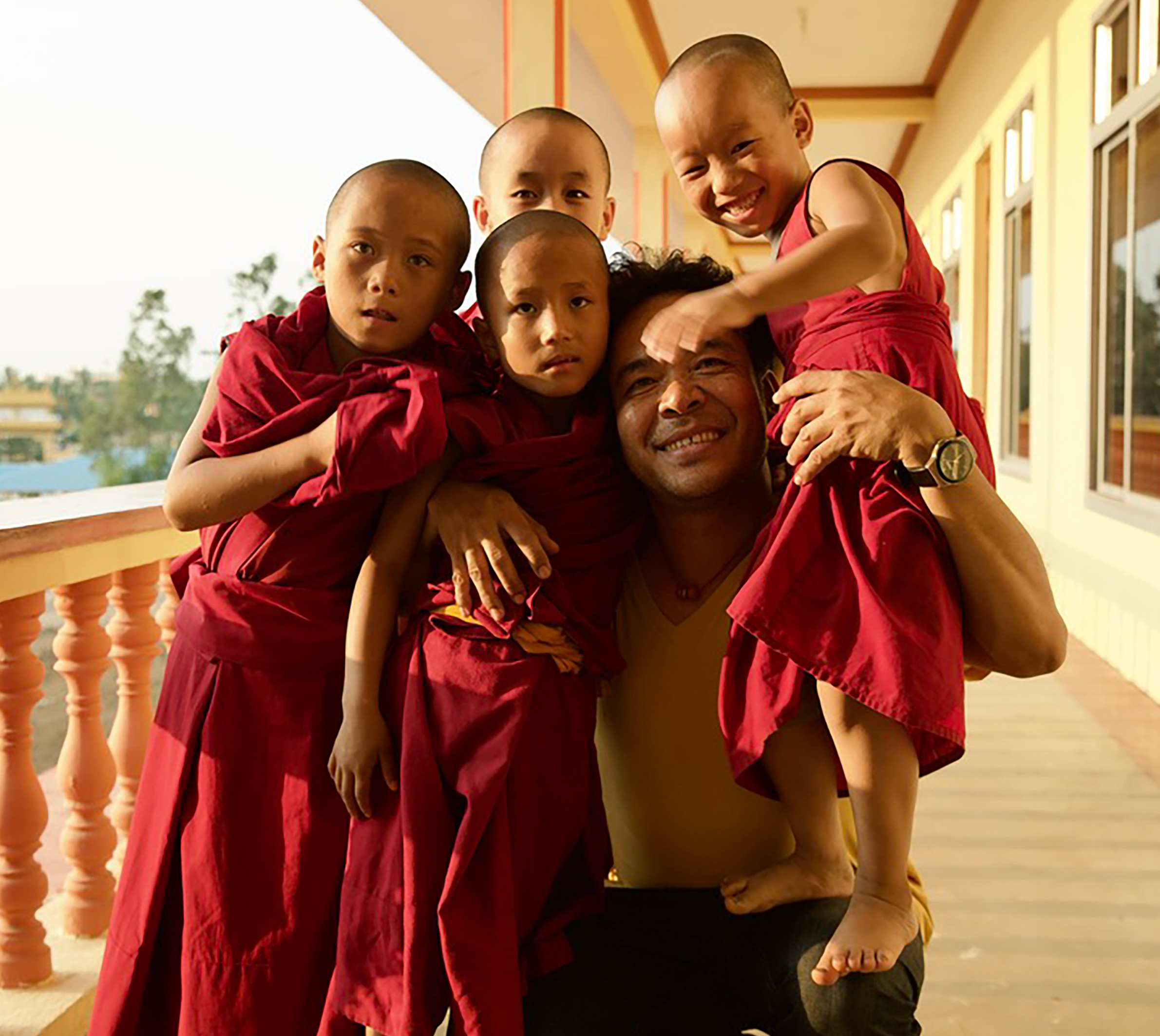
Ngawang Choephel was born in Dawa, a small county in western Tibet. During the height of the Cultural Revolution, at the age of two, Ngawang and his family escaped to India. He grew up in a vibrant Tibetan refugee community in Southern India. Because of his lifelong passion for Tibetan music, he has devoted himself to its preservation and dissemination. Discovering his talent at an early age, he pursued and received a degree in Tibetan music from the Tibetan Institute of Performing Arts in Dharamsala, India. Arriving in the West in 1994, he became a Fulbright Fellow at Middlebury College in Vermont and continued studies in video production and international music in preparation for the production of his award-winning film, Tibet in Song. After being arrested by Chinese authorities in Tibet during filming, and his subsequent six and a half years in prison in Tibet, showing resilience in the face of adversity earned him the Courage of Conscience Award from Peace Abbey, which he received in 2002. Upon his release from prison that same year, he was awarded an Honorary Doctor of Arts Degree from Middlebury College, as well as a “Best Act in Exile” award from Lobsang Wangyal Productions for his outstanding musical talent.
Why We Love It
It’s an essential, intimate look at the destruction of a sacred Tibetan institution—and the resilient monks who rebuilt it from the ashes as refugees in India.
Product Details
- Publisher: Wisdom Publications (July 6, 2027)
- Length: 272 pages
- ISBN13: 9798890700698
Browse Related Books
Raves and Reviews
"A wonderful photographic tribute to Ganden Monastery, the Joyful Land—as it was and as it is—including poignant comments from some of its most senior monastics."
– Guy Newland, president, Unitarian Universalist Fellowship of Central Michigan, and professor emeritus, Central Michigan University
“This precious book relates the story of Ganden Monastery—one of the great monasteries of Tibet—told by the monks who lived there before the Chinese communist occupation of Tibet. The photos of old Tibet, the young Dalai Lama, and the new Ganden Monastery in India are magnificent, as are the photos of the monks that accompany their reflections on their fortune of living and learning there.”
– Thubten Chodron, founder of Sravasti Abbey, co-author of the Library of Wisdom and Compassion book series with His Holiness the Dalai Lama
“Ganden is among the most famous monasteries in the Buddhist world, founded by Je Tsongkhapa, where he wrote some of his most important works, where he passed into nirvana, where his stupa was erected. In this beautifully illustrated volume, Ngawang Choephel tells the story of the birth, the life, and the rebirth of Ganden, the joyous home of the Dharma."
– Donald S. Lopez, Arthur E. Link Distinguished University Professor of Buddhist and Tibetan Studies, Arthur F. Thurnau Professor, Department of Asian Languages and Cultures, University of Michigan
Resources and Downloads
High Resolution Images
-
Book Cover Image (jpg): Ganden
Hardcover 9798890700698
-
Author Photo (jpg): Ngawang Choephel
(0.1 MB)
Any use of an author photo must include its respective photo credit