

Plus, receive recommendations and exclusive offers on all of your favorite books and authors from Simon & Schuster.
Table of Contents
About the Book
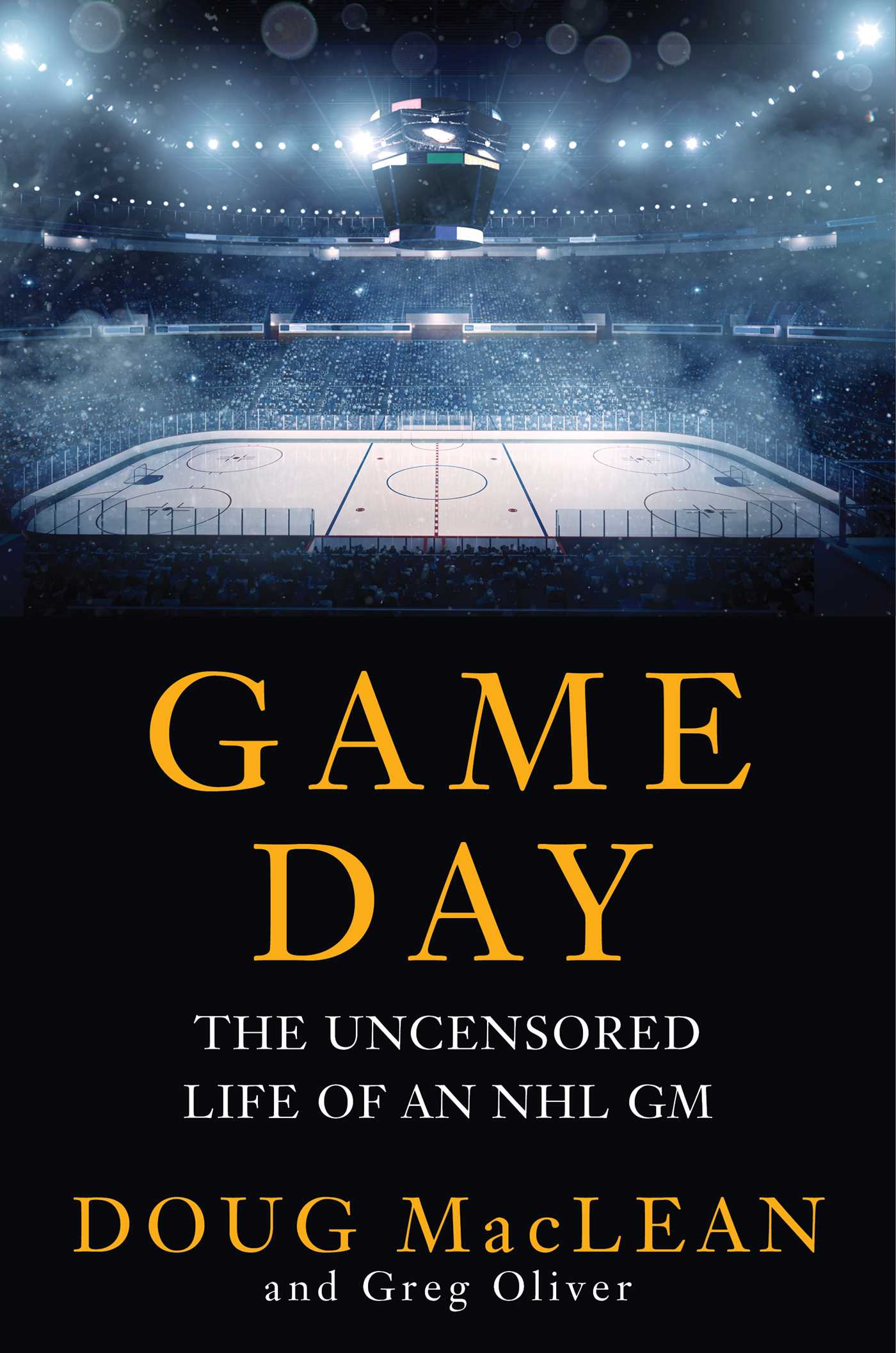
From former NHL general manager and bestselling author of Draft Day comes an insider’s look at the toughest job in sports.
There is no other job in professional sports more dynamic than that of a general manager in the NHL. Every day—all day—a GM deals with the team's owner and financial staff; the coaching staff; the players, their families, and their agents; the office staff; the sponsors; and the luxury-box holders, season-ticket holders, and corporate boxes. And then there’s the media: news-hungry no matter where the team is based, from Toronto and Montreal to Miami and Los Angeles. GMs are responsible for free agency and salary caps, as well as their number one job: team construction. GMs make the final decisions on all hires, fires, trades, and buyouts—after, that is, they have cleared all this with the owner. Through it all, GMs need a thick skin, and they make for easy targets. Keeping the entire fanbase happy is impossible, and their job—while they may enjoy every minute of the experience—is always at risk.
In Game Day, MacLean shares insights from GMs current and past, finding out what makes these hockey executives tick. What trades do they regret making? Which player(s) do they wish they’d drafted? What coaching hire seemed wrong from the first practice? What’s it like to hoist the Stanley Cup or, conversely, miss the playoffs and head for the links? Game Day is a must-read for anyone who wants to know the secret moves made behind closed boardroom and locker-room doors.
There is no other job in professional sports more dynamic than that of a general manager in the NHL. Every day—all day—a GM deals with the team's owner and financial staff; the coaching staff; the players, their families, and their agents; the office staff; the sponsors; and the luxury-box holders, season-ticket holders, and corporate boxes. And then there’s the media: news-hungry no matter where the team is based, from Toronto and Montreal to Miami and Los Angeles. GMs are responsible for free agency and salary caps, as well as their number one job: team construction. GMs make the final decisions on all hires, fires, trades, and buyouts—after, that is, they have cleared all this with the owner. Through it all, GMs need a thick skin, and they make for easy targets. Keeping the entire fanbase happy is impossible, and their job—while they may enjoy every minute of the experience—is always at risk.
In Game Day, MacLean shares insights from GMs current and past, finding out what makes these hockey executives tick. What trades do they regret making? Which player(s) do they wish they’d drafted? What coaching hire seemed wrong from the first practice? What’s it like to hoist the Stanley Cup or, conversely, miss the playoffs and head for the links? Game Day is a must-read for anyone who wants to know the secret moves made behind closed boardroom and locker-room doors.
Excerpt
Chapter One: A Day in the Life of a GM CHAPTER ONE A DAY IN THE LIFE OF A GM
WHEN CALLING AROUND TO TALK with people about this book, we often asked, “What do you want to know about what a general manager does?”
Well, Steve “Dangle” Glynn, one of the top hockey podcasters and YouTubers out there, wasn’t afraid to ask the tough question in return: “Obviously I’m an emotional, irrational fan, and I’m like, ‘Okay, but what do you do all day?’ ”
Here’s your answer.
There is no typical day in the life of a general manager. It’s not a routine job, and the run of a day can vary dramatically. There can be a pattern to it, though, and I thought it important to share from the outset what kind of shape a day could take while at home or on the road. Of course, mine was complicated by also being the team president—and, for a time, coach—but I’m also basing this on what I saw as an assistant coach, a head coach, and an assistant GM.
8:30–9:00 A.M.: ARRIVE AT THE OFFICE
The first thing I would do was fire up my computer and read every report that had come in from the night before. Now, there may be three reports, there might be ten—from NHL, minor pro, amateur, even European games featuring our pros. I had to keep up; when the scouts would bring up a player’s name, at least I had read reports on them. I found it a great way to stay in touch with pro and amateur hockey without being out in the field, though there was lots of that, too. If our American Hockey League (AHL) affiliate, the Syracuse Crunch, played and I didn’t get to see the game, I paid extra attention to that report and usually called the coach, Gary Agnew, too.
The goal was to be aware of the players on all the rosters and who was playing well, who was playing poorly, who had injuries, and who had been scratched by certain teams. It was just an excellent way to keep up with the players in the league from a distance.
As a GM, you essentially know every player in the league. Do you know them well? No, but you know some talking points. If a name comes up as a possible addition, through a trade or waivers, that’s when you go into real depth and you look at the analytics, you look at the reports, you talk to your amateur staff: What was he like in junior? What was he like in the AHL? You really do a back check. Then you’d look at video of the player.
In Columbus, we had a one-to-seven rating for players:
A one was simply a player we didn’t want. A two was a depth player who was a veteran minor leaguer and a leader at that level, but who could also fill in at the NHL level in the short term. A three would be a role player; he may be a fourth-line guy, maybe he’s a tough guy, maybe he’s a penalty killer, maybe he’s a face-off guy.
A four was an NHL regular. A five was a player who was a step above an NHL regular, a more complete package. He had a special skill that made him unique, like being great on the penalty kill or the power play, or even one of the elite tough guys. A six was an impact player. I would put Auston Matthews, William Nylander, and Mitch Marner at this level, not quite to the next tier yet. A seven was a franchise player. It’s easy to debate the names, but Connor McDavid, Leon Draisaitl, Alex Ovechkin, and Sidney Crosby are all franchise players. Someone can drop or rise, too: John Tavares was once a franchise player and is now a five or six depending on who you ask.
At the end of the report, we had to rate them: What level are they, and do we want them?
Then there’s a proprietary rating system done on all the skills: skating, passing, shooting, puck handling, character, grit. Is he competitive? The biggie was hockey IQ, or hockey sense, which is an assessment of how he sees the game—his smarts. All those separate traits are rated in reports.
I’d also get a package of stories about the team and the NHL from both our PR rep, Todd Sharrock, and the league itself. As time went on during my stay in Columbus, I read the Dispatch newspaper less and less, because the hockey writers were always ripping on me. You often had to react to what you’d read—in my case, often from the owner. I’d call him up. “Mr. Mac, why are you saying that in the paper? Do you know what aggravation that puts on my plate today?” It would just be an off-the-cuff remark he’d made, something he did with regularity, never fully grasping that comments about the team would be reported far differently than talking about his company, Worthington Industries, a major manufacturer based in Columbus.
10:30 A.M.: PRACTICE
After poring over the notes and pouring some coffee, I would go down to the dressing room, aiming to be there just before practice started. It was a chance to talk with the coaches briefly and update them on a couple of things, and they might share something I didn’t know yet. We’d talk again after practice, often bringing in the medical trainer to update us on nagging injuries, or chat with the assistant GM about who might be ready from the AHL squad. The coaches worked day to day with the players, so they knew about impending births or stresses at home, things that might affect the team.
You’re on a first-name basis with everybody in the dressing room: the equipment managers, the athletic trainers, the masseuses, the strength team.
Most days, I’d watch practice, which I found enjoyable because I’d been a coach, and I just wanted to see the lines they were trying out, what they were working on. Did I watch every one? No, but at least three or four days a week, I’d watch the practice.
If it was game day and we were on the road, I would watch our game-day skate. I didn’t usually go to the opposition skates when we were in Columbus, since I had so much else to do; with the practice facility right next door, I knew someone from our staff would be there anyway, should the opposition choose to practice because they were in town an extra day.
You didn’t necessarily learn a lot, but it was a chance to BS with the other team’s personnel. Maybe their GM would come over and sit with you. It was more a social situation than a learning thing.
12:00 NOON: MEETINGS AND CALLS
At our meeting with the assistant GM and the hockey ops staff, we’d talk about all hockey-related issues. That could mean scouting assignments, the minor pro teams, our European prospects, and kids in junior or college. At least once a week, we tried to have one in-person meeting with everyone there.
We had a big whiteboard with the team’s roster written on it, and all the other teams would be listed by position so you could see their depth. When I started in Detroit, in July 1990, it was a ton of work for a young staffer or intern, because you had to create it by hand with individual letters. In Columbus, we were able to write names on with marker, and erase and rewrite them after trades. It was the job of Chris MacFarland (who was later a Cup-winning assistant general manager in Colorado before assuming the top job) and his hockey ops department to keep it updated. I loved it, because you would sit in your office and look at teams, the formation of it, because you’d have it down as left wing, center, right wing, left defense, right defense, goaltending, and just think. There was constant debate about who played well, who didn’t, what we needed, who was out there. I had a cellphone in Columbus, but it wasn’t a smartphone, of course, so it didn’t require my attention all the time. Instead, the office phone was the place to reach me.
My assistant was key here, helping with a list of people to call back. There was no rhyme or reason to returning calls, but they’d come from many of the other GMs in the league, and from our staff. If Mr. Mac called, that was one to return right away. I’d talk to our assistant GM multiple times a day.
The president and GM hats weren’t mutually exclusive, as the needs of one side of the business bled into the other. There wasn’t anyone else in the league who had to deal with all the headaches that I did, everything from building ops issues to HR nightmares.
You were aware of where all other teams were, what time zones. Brian Burke, when he was GM in Anaheim, would go into his office at five in the morning, which was eight o’clock for the East Coast teams; of course, he could start watching games at four o’clock, whereas I would start watching them at seven. Having a time zone advantage went both ways.
2:00 P.M.: EXERCISE
After the players left the building for their naps on game day, many afternoons I’d go down to the gym or go for a jog. It was a great stress reliever. The massage therapist would give me a treatment for my neck pain—maybe not every day, but a few times a month. Or I’d go home for a nap myself, try to de-stress, and come back for dinner at the arena, meeting with out-of-town scouts or the media.
3:00 P.M.: OFFICE
On non–game days, the couple of hours before you went home were often the most unpredictable, and it was really more about the manager aspect of being a GM.
5:00 P.M.: HOME
There were many blessings to living in Columbus, such as having the practice facility next door to the arena, but the biggest was how close we lived to the rink. I could be home in fifteen or twenty minutes, and I had a Porsche at the time, so it was a nice ride.
Unless it was something unbelievably important, I would not get calls after work, but I might make a couple, at most. That would be a relaxing time at home. You’re always going hard, with lots of stress and travel, so this was magic time.
While my wife, Jill, took the brunt of it all—managing the household, cooking the meals, raising the kids—I was able to chip in more than many GMs. It’s not like I had to fight New York City or Toronto traffic daily. When I was in town, I’d see the kids off to school. Clark was in fifth grade when we started in Columbus, and MacKenzie was in second. As they progressed over the next decade, I did my best to be there when I could for hockey and lacrosse games. I was often the only parent in a suit at a soccer game.
Plenty of times while on the road, I’d fly home early to catch one of my kids’ big games. I wanted to do it, and I think guys who don’t do it are losing out. Did I miss things? Yeah, I missed things.
7:00 P.M.: GAME TIME
I had a parking spot right by the main door of the garage, with my name on the parking sign, right beside spots for Mr. Mac and his son, J. P. Making my way to the private box included a lot of chitchat, saying hi to people, some interactions with fans.
My box was at one end of the press box, next to the radio and TV boxes and the NHL officials and scorekeepers. I’d get some food at the buffet set up for media, and usually eat with our radio or TV people.
There usually weren’t more than one or two other people watching with me. It was usually Chris MacFarland, who was always available, since he didn’t go out on the road. But if Jim Clark, our assistant GM, was around, he’d be there, or maybe it was our chief scout or someone else important.
It’s hard to describe exactly how you’re watching, but it’s different than it is for fans, for sure. You’re taking in the game, but you’re analyzing at the same time, as to how we’re playing, who’s performing, who isn’t. And, of course, you’re up and down with the game, living on the edge every shift. The TV is on for replays, but you’re always scoreboard watching, too. It’s really a pressure-packed situation. Playoff positions are often decided by only a couple of points, so every game is critical.
Though I knew where our other box was—the eyes-in-the-sky assistant coaches and video people who were in consultation with the bench via headphones—I almost never went in there to interfere. I’d been put in that position, and it wasn’t fun. Once when I was an assistant coach in St. Louis to head coach Jacques Martin, I was in the assistant coaching box and Ron Caron, our GM, came storming in. After the first period, he demanded, “Go down and tell Jacques that if he plays Herbie Raglan one more shift tonight, I’m going to fire you after the game, and I’m going to fire Jacques.”
I did what I was told, telling Jacques and Bobby Plager, another assistant, that Herbie was really struggling—I couldn’t say it like Ron wanted. Jacques looked to me and said, “I think he’s playing well.” I said, “Jacques, he’s really struggling.” I didn’t want to say “We’re going to get fired.” As I left, I begged, “Jacques, if you never do me another favor for the rest of your life, do me this one. Do not put Herbie Raglan back on the ice tonight.” For the next two periods, I was a nervous wreck, my armpits soaked, watching to make sure Herbie didn’t come over the boards. He never did.
In Columbus, if I was really upset about something, I’d mention it to the assistant coach when he was walking by my box, heading down to the dressing room, but I certainly didn’t threaten to fire anybody!
After the game, generally I’d go down and meet with the coaches and just talk over what had happened. I’d absorbed lessons from Bryan Murray. When I was coach in Florida and he was the GM, Bryan wouldn’t say anything between periods. But after the game, he always had tips to give me. He’d been in the game for decades by that point and would start off every post-game pointer with “Maybe I don’t know anything about the game, but this is what I’m seeing…”
7:00 P.M.: NON–GAME DAYS
I’d go into my home office, which was set up more like a den, with multiple TVs to watch the various games on. (Jill and the kids had a separate TV.) Some nights I’d zero in on certain teams. But it wasn’t a scouting thing as much as you were keeping up on the league. Depending on the matchups—and my stamina—the late games weren’t always on the agenda.
During the games, I would take notes, because you’re always thinking about trading players, you’re considering sending guys to the minors. You’re watching who’s playing well on other teams who might be available.
ROAD GAMES
Setting aside the grind of travel itself—yeah, it’s a private jet these days, and Columbus was one of the first teams to have its own, but it’s still air travel—there was a bit of relief (for me, at least) being on the road. It’s a more relaxed atmosphere, not just because you don’t have to go home to a spouse who feels neglected, kids who miss you, and a dog that needs to be walked. Winning at home is critical, but winning on the road is hard to do, and since I ran an expansion team, it was tough sledding when we were away from Nationwide Arena.
The GM and the head coach got a suite at the hotel, and those were usually comped, since we’d already booked however many rooms for the team—it’s really just the rookies and call-ups who are required to share rooms, so you’re talking forty or more rooms. Now, those times I didn’t head out on the road, I’d have a lineup of assistant coaches or others trying to convince me to give them the suite. The Mayflower Hotel in Washington is a beautiful old place in downtown DC, and one of its calling cards was a pillow embroidered with your initials. Once, I gave the room to the travel secretary, who brought his girlfriend. I asked team services to get the hotel to change the initials on the pillow from D.M. to J.L., which amazed her to no end.
As far as the routine went, I’d head to the morning skate with the team, and probably watch the other team, too. The other GM typically would come over to say hello if he was in town. The radio or TV personnel for both teams would ask for a few minutes of my time. The team meal was around one o’clock for an evening game, and it was meant for the team, meaning no coaches or management. I’d often give my assistant coaches shit when I caught them sneaking in to get a free meal in order to pocket the per diem they were given—a hundred dollars or whatever it was.
I took my staff—coaches, TV, and radio—out for dinner on the road once a month or so. Another takeaway from my time with “the Professor” Ron Caron in St. Louis was his rule that “whoever has the biggest title when you go out to dinner picks up the tab.” I really admired Ron, because we were making very little money in those days and he would always treat the coaches and assistant coaches, and he was a generous guy. I did the same. It was a team credit card I was using, obviously. Each team is different; I’ve heard from friends who can only remember management taking them out for a meal once or twice over a couple of seasons. When on the road, the visiting team was provided a suite or box. You’d mix with the media in the press box—ponying up the ten bucks for the buffet just like them—and then head to watch the game. Unlike at home, you’re in a tighter space, and the assistant coach is typically in the box with you, headset on, talking to the bench and telling the other coaches what he sees.
SLEEP
After games on the road, whether it was California or Texas or New York, you always flew to the next city or home the same night. On trips home, you would get in early in the morning, somewhere between 2:00 and 4:00 a.m., and you would do your best not to wake your spouse. One time when I was coaching, the power play had been terrible, going 0 for 7. As I crawled into bed, Jill rolled over and said, “Nice power play, Coach.”
You get accustomed to sleeping on the plane, but it’s never a deep sleep. As GM, at least I got an extra seat to spread out on.
Every GM and coach will attest that you sleep better after a win than a loss. Turning it off was not easy.
But a quote I gave to The Hockey News sums it up best: “I sleep like a baby. I sleep for two hours and then I wake up and cry for two hours.”
WHEN CALLING AROUND TO TALK with people about this book, we often asked, “What do you want to know about what a general manager does?”
Well, Steve “Dangle” Glynn, one of the top hockey podcasters and YouTubers out there, wasn’t afraid to ask the tough question in return: “Obviously I’m an emotional, irrational fan, and I’m like, ‘Okay, but what do you do all day?’ ”
Here’s your answer.
There is no typical day in the life of a general manager. It’s not a routine job, and the run of a day can vary dramatically. There can be a pattern to it, though, and I thought it important to share from the outset what kind of shape a day could take while at home or on the road. Of course, mine was complicated by also being the team president—and, for a time, coach—but I’m also basing this on what I saw as an assistant coach, a head coach, and an assistant GM.
8:30–9:00 A.M.: ARRIVE AT THE OFFICE
The first thing I would do was fire up my computer and read every report that had come in from the night before. Now, there may be three reports, there might be ten—from NHL, minor pro, amateur, even European games featuring our pros. I had to keep up; when the scouts would bring up a player’s name, at least I had read reports on them. I found it a great way to stay in touch with pro and amateur hockey without being out in the field, though there was lots of that, too. If our American Hockey League (AHL) affiliate, the Syracuse Crunch, played and I didn’t get to see the game, I paid extra attention to that report and usually called the coach, Gary Agnew, too.
The goal was to be aware of the players on all the rosters and who was playing well, who was playing poorly, who had injuries, and who had been scratched by certain teams. It was just an excellent way to keep up with the players in the league from a distance.
As a GM, you essentially know every player in the league. Do you know them well? No, but you know some talking points. If a name comes up as a possible addition, through a trade or waivers, that’s when you go into real depth and you look at the analytics, you look at the reports, you talk to your amateur staff: What was he like in junior? What was he like in the AHL? You really do a back check. Then you’d look at video of the player.
In Columbus, we had a one-to-seven rating for players:
A one was simply a player we didn’t want. A two was a depth player who was a veteran minor leaguer and a leader at that level, but who could also fill in at the NHL level in the short term. A three would be a role player; he may be a fourth-line guy, maybe he’s a tough guy, maybe he’s a penalty killer, maybe he’s a face-off guy.
A four was an NHL regular. A five was a player who was a step above an NHL regular, a more complete package. He had a special skill that made him unique, like being great on the penalty kill or the power play, or even one of the elite tough guys. A six was an impact player. I would put Auston Matthews, William Nylander, and Mitch Marner at this level, not quite to the next tier yet. A seven was a franchise player. It’s easy to debate the names, but Connor McDavid, Leon Draisaitl, Alex Ovechkin, and Sidney Crosby are all franchise players. Someone can drop or rise, too: John Tavares was once a franchise player and is now a five or six depending on who you ask.
At the end of the report, we had to rate them: What level are they, and do we want them?
Then there’s a proprietary rating system done on all the skills: skating, passing, shooting, puck handling, character, grit. Is he competitive? The biggie was hockey IQ, or hockey sense, which is an assessment of how he sees the game—his smarts. All those separate traits are rated in reports.
I’d also get a package of stories about the team and the NHL from both our PR rep, Todd Sharrock, and the league itself. As time went on during my stay in Columbus, I read the Dispatch newspaper less and less, because the hockey writers were always ripping on me. You often had to react to what you’d read—in my case, often from the owner. I’d call him up. “Mr. Mac, why are you saying that in the paper? Do you know what aggravation that puts on my plate today?” It would just be an off-the-cuff remark he’d made, something he did with regularity, never fully grasping that comments about the team would be reported far differently than talking about his company, Worthington Industries, a major manufacturer based in Columbus.
10:30 A.M.: PRACTICE
After poring over the notes and pouring some coffee, I would go down to the dressing room, aiming to be there just before practice started. It was a chance to talk with the coaches briefly and update them on a couple of things, and they might share something I didn’t know yet. We’d talk again after practice, often bringing in the medical trainer to update us on nagging injuries, or chat with the assistant GM about who might be ready from the AHL squad. The coaches worked day to day with the players, so they knew about impending births or stresses at home, things that might affect the team.
You’re on a first-name basis with everybody in the dressing room: the equipment managers, the athletic trainers, the masseuses, the strength team.
Most days, I’d watch practice, which I found enjoyable because I’d been a coach, and I just wanted to see the lines they were trying out, what they were working on. Did I watch every one? No, but at least three or four days a week, I’d watch the practice.
If it was game day and we were on the road, I would watch our game-day skate. I didn’t usually go to the opposition skates when we were in Columbus, since I had so much else to do; with the practice facility right next door, I knew someone from our staff would be there anyway, should the opposition choose to practice because they were in town an extra day.
You didn’t necessarily learn a lot, but it was a chance to BS with the other team’s personnel. Maybe their GM would come over and sit with you. It was more a social situation than a learning thing.
12:00 NOON: MEETINGS AND CALLS
At our meeting with the assistant GM and the hockey ops staff, we’d talk about all hockey-related issues. That could mean scouting assignments, the minor pro teams, our European prospects, and kids in junior or college. At least once a week, we tried to have one in-person meeting with everyone there.
We had a big whiteboard with the team’s roster written on it, and all the other teams would be listed by position so you could see their depth. When I started in Detroit, in July 1990, it was a ton of work for a young staffer or intern, because you had to create it by hand with individual letters. In Columbus, we were able to write names on with marker, and erase and rewrite them after trades. It was the job of Chris MacFarland (who was later a Cup-winning assistant general manager in Colorado before assuming the top job) and his hockey ops department to keep it updated. I loved it, because you would sit in your office and look at teams, the formation of it, because you’d have it down as left wing, center, right wing, left defense, right defense, goaltending, and just think. There was constant debate about who played well, who didn’t, what we needed, who was out there. I had a cellphone in Columbus, but it wasn’t a smartphone, of course, so it didn’t require my attention all the time. Instead, the office phone was the place to reach me.
My assistant was key here, helping with a list of people to call back. There was no rhyme or reason to returning calls, but they’d come from many of the other GMs in the league, and from our staff. If Mr. Mac called, that was one to return right away. I’d talk to our assistant GM multiple times a day.
The president and GM hats weren’t mutually exclusive, as the needs of one side of the business bled into the other. There wasn’t anyone else in the league who had to deal with all the headaches that I did, everything from building ops issues to HR nightmares.
You were aware of where all other teams were, what time zones. Brian Burke, when he was GM in Anaheim, would go into his office at five in the morning, which was eight o’clock for the East Coast teams; of course, he could start watching games at four o’clock, whereas I would start watching them at seven. Having a time zone advantage went both ways.
2:00 P.M.: EXERCISE
After the players left the building for their naps on game day, many afternoons I’d go down to the gym or go for a jog. It was a great stress reliever. The massage therapist would give me a treatment for my neck pain—maybe not every day, but a few times a month. Or I’d go home for a nap myself, try to de-stress, and come back for dinner at the arena, meeting with out-of-town scouts or the media.
3:00 P.M.: OFFICE
On non–game days, the couple of hours before you went home were often the most unpredictable, and it was really more about the manager aspect of being a GM.
5:00 P.M.: HOME
There were many blessings to living in Columbus, such as having the practice facility next door to the arena, but the biggest was how close we lived to the rink. I could be home in fifteen or twenty minutes, and I had a Porsche at the time, so it was a nice ride.
Unless it was something unbelievably important, I would not get calls after work, but I might make a couple, at most. That would be a relaxing time at home. You’re always going hard, with lots of stress and travel, so this was magic time.
While my wife, Jill, took the brunt of it all—managing the household, cooking the meals, raising the kids—I was able to chip in more than many GMs. It’s not like I had to fight New York City or Toronto traffic daily. When I was in town, I’d see the kids off to school. Clark was in fifth grade when we started in Columbus, and MacKenzie was in second. As they progressed over the next decade, I did my best to be there when I could for hockey and lacrosse games. I was often the only parent in a suit at a soccer game.
Plenty of times while on the road, I’d fly home early to catch one of my kids’ big games. I wanted to do it, and I think guys who don’t do it are losing out. Did I miss things? Yeah, I missed things.
7:00 P.M.: GAME TIME
I had a parking spot right by the main door of the garage, with my name on the parking sign, right beside spots for Mr. Mac and his son, J. P. Making my way to the private box included a lot of chitchat, saying hi to people, some interactions with fans.
My box was at one end of the press box, next to the radio and TV boxes and the NHL officials and scorekeepers. I’d get some food at the buffet set up for media, and usually eat with our radio or TV people.
There usually weren’t more than one or two other people watching with me. It was usually Chris MacFarland, who was always available, since he didn’t go out on the road. But if Jim Clark, our assistant GM, was around, he’d be there, or maybe it was our chief scout or someone else important.
It’s hard to describe exactly how you’re watching, but it’s different than it is for fans, for sure. You’re taking in the game, but you’re analyzing at the same time, as to how we’re playing, who’s performing, who isn’t. And, of course, you’re up and down with the game, living on the edge every shift. The TV is on for replays, but you’re always scoreboard watching, too. It’s really a pressure-packed situation. Playoff positions are often decided by only a couple of points, so every game is critical.
Though I knew where our other box was—the eyes-in-the-sky assistant coaches and video people who were in consultation with the bench via headphones—I almost never went in there to interfere. I’d been put in that position, and it wasn’t fun. Once when I was an assistant coach in St. Louis to head coach Jacques Martin, I was in the assistant coaching box and Ron Caron, our GM, came storming in. After the first period, he demanded, “Go down and tell Jacques that if he plays Herbie Raglan one more shift tonight, I’m going to fire you after the game, and I’m going to fire Jacques.”
I did what I was told, telling Jacques and Bobby Plager, another assistant, that Herbie was really struggling—I couldn’t say it like Ron wanted. Jacques looked to me and said, “I think he’s playing well.” I said, “Jacques, he’s really struggling.” I didn’t want to say “We’re going to get fired.” As I left, I begged, “Jacques, if you never do me another favor for the rest of your life, do me this one. Do not put Herbie Raglan back on the ice tonight.” For the next two periods, I was a nervous wreck, my armpits soaked, watching to make sure Herbie didn’t come over the boards. He never did.
In Columbus, if I was really upset about something, I’d mention it to the assistant coach when he was walking by my box, heading down to the dressing room, but I certainly didn’t threaten to fire anybody!
After the game, generally I’d go down and meet with the coaches and just talk over what had happened. I’d absorbed lessons from Bryan Murray. When I was coach in Florida and he was the GM, Bryan wouldn’t say anything between periods. But after the game, he always had tips to give me. He’d been in the game for decades by that point and would start off every post-game pointer with “Maybe I don’t know anything about the game, but this is what I’m seeing…”
7:00 P.M.: NON–GAME DAYS
I’d go into my home office, which was set up more like a den, with multiple TVs to watch the various games on. (Jill and the kids had a separate TV.) Some nights I’d zero in on certain teams. But it wasn’t a scouting thing as much as you were keeping up on the league. Depending on the matchups—and my stamina—the late games weren’t always on the agenda.
During the games, I would take notes, because you’re always thinking about trading players, you’re considering sending guys to the minors. You’re watching who’s playing well on other teams who might be available.
ROAD GAMES
Setting aside the grind of travel itself—yeah, it’s a private jet these days, and Columbus was one of the first teams to have its own, but it’s still air travel—there was a bit of relief (for me, at least) being on the road. It’s a more relaxed atmosphere, not just because you don’t have to go home to a spouse who feels neglected, kids who miss you, and a dog that needs to be walked. Winning at home is critical, but winning on the road is hard to do, and since I ran an expansion team, it was tough sledding when we were away from Nationwide Arena.
The GM and the head coach got a suite at the hotel, and those were usually comped, since we’d already booked however many rooms for the team—it’s really just the rookies and call-ups who are required to share rooms, so you’re talking forty or more rooms. Now, those times I didn’t head out on the road, I’d have a lineup of assistant coaches or others trying to convince me to give them the suite. The Mayflower Hotel in Washington is a beautiful old place in downtown DC, and one of its calling cards was a pillow embroidered with your initials. Once, I gave the room to the travel secretary, who brought his girlfriend. I asked team services to get the hotel to change the initials on the pillow from D.M. to J.L., which amazed her to no end.
As far as the routine went, I’d head to the morning skate with the team, and probably watch the other team, too. The other GM typically would come over to say hello if he was in town. The radio or TV personnel for both teams would ask for a few minutes of my time. The team meal was around one o’clock for an evening game, and it was meant for the team, meaning no coaches or management. I’d often give my assistant coaches shit when I caught them sneaking in to get a free meal in order to pocket the per diem they were given—a hundred dollars or whatever it was.
I took my staff—coaches, TV, and radio—out for dinner on the road once a month or so. Another takeaway from my time with “the Professor” Ron Caron in St. Louis was his rule that “whoever has the biggest title when you go out to dinner picks up the tab.” I really admired Ron, because we were making very little money in those days and he would always treat the coaches and assistant coaches, and he was a generous guy. I did the same. It was a team credit card I was using, obviously. Each team is different; I’ve heard from friends who can only remember management taking them out for a meal once or twice over a couple of seasons. When on the road, the visiting team was provided a suite or box. You’d mix with the media in the press box—ponying up the ten bucks for the buffet just like them—and then head to watch the game. Unlike at home, you’re in a tighter space, and the assistant coach is typically in the box with you, headset on, talking to the bench and telling the other coaches what he sees.
SLEEP
After games on the road, whether it was California or Texas or New York, you always flew to the next city or home the same night. On trips home, you would get in early in the morning, somewhere between 2:00 and 4:00 a.m., and you would do your best not to wake your spouse. One time when I was coaching, the power play had been terrible, going 0 for 7. As I crawled into bed, Jill rolled over and said, “Nice power play, Coach.”
You get accustomed to sleeping on the plane, but it’s never a deep sleep. As GM, at least I got an extra seat to spread out on.
Every GM and coach will attest that you sleep better after a win than a loss. Turning it off was not easy.
But a quote I gave to The Hockey News sums it up best: “I sleep like a baby. I sleep for two hours and then I wake up and cry for two hours.”
About the Authors
Photograph © Sportsnet / Rogers Sports & Media
Doug MacLean is a former professional hockey coach, general manager, and team executive. He was the president and general manager of the NHL Columbus Blue Jackets and was also the head coach of the Florida Panthers. He became a sportscaster for Sportsnet, eventually cohosting the popular Hockey Central at Noon radio show and regularly appearing as a panelist on Hockey Central television. He splits his time between PEI and Florida.
Geoffrey Cole/Shooting the Indies
Greg Oliver is the author of twenty-one books, including the bestselling Gibby: Tales of a Baseball Lifer, with former Toronto Blue Jays manager John Gibbons. Oliver's Don't Call Me Goon: Hockey's Greatest Enforcers, Gunslingers, and Bad Boys was also a bestseller. The Society for International Hockey Research presented him with its 2021 Bill Fitsell President's Award, in part for his popular blog about hockey books. His Pro Wrestling Hall of Fame series of books have raised the bar for professional wrestling journalism and he has been rewarded with two James C. Melby historian awards. He lives in Toronto with his wife, Meredith. For more, see OliverBooks.ca.
Product Details
- Publisher: Simon & Schuster (October 20, 2026)
- Length: 320 pages
- ISBN13: 9781668214046
Browse Related Books
Raves and Reviews
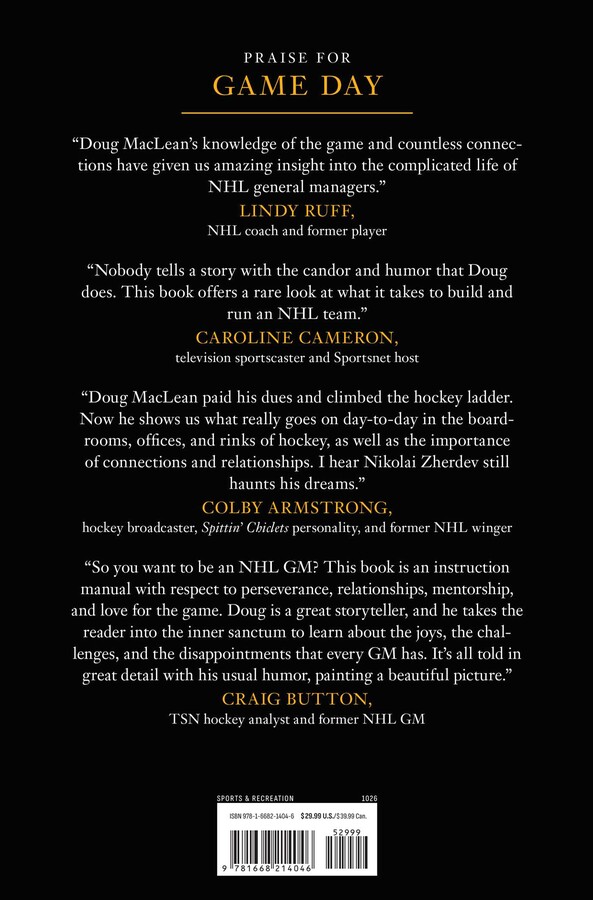
“So you want to be an NHL GM? This book is an instruction manual with respect to perseverance, relationships, mentorship, and love for the game. Doug is a great storyteller, and he takes the reader into the inner-sanctum to learn about the joys, the challenges, and the disappointments that every GM has. It’s all told in great detail with his usual humour, painting a beautiful picture.”
— CRAIG BUTTON, TSN hockey analyst and former NHL GM
“Doug MacLean paid his dues and climbed the hockey ladder. Now he shows us what really goes on day-to-day in the boardrooms, offices, and rinks of hockey, as well as the importance of connections and relationships. I hear Nikolai Zherdev still haunts his dreams.”
— COLBY ARMSTRONG, hockey broadcaster, Spittin’ Chiclets personality, and former NHL winger
“Nobody tells a story with the candour and humour that Doug does. This book offers a rare look at what it takes to build and run an NHL team.”
— CAROLINE CAMERON, television sportscaster and Sportsnet host
“Doug MacLean’s knowledge of the game and countless connections has given us amazing insight into the complicated life of NHL general managers.”
— LINDY RUFF, NHL coach and former player
Resources and Downloads
High Resolution Images
-
Book Cover Image (jpg): Game Day
Hardcover 9781668214046
-
Author Photo (jpg): Doug MacLean Photograph © Sportsnet / Rogers Sports & Media(0.1 MB)
Any use of an author photo must include its respective photo credit
-
Author Photo (jpg): Greg Oliver Geoffrey Cole/Shooting the Indies(0.1 MB)
Any use of an author photo must include its respective photo credit