
Plus, receive recommendations and exclusive offers on all of your favorite books and authors from Simon & Schuster.
0:00 /
LIST PRICE $30.00
PRICE MAY VARY BY RETAILER
Free shipping when you spend $40. Terms apply.
Buy from Other Retailers
Table of Contents
About the Book
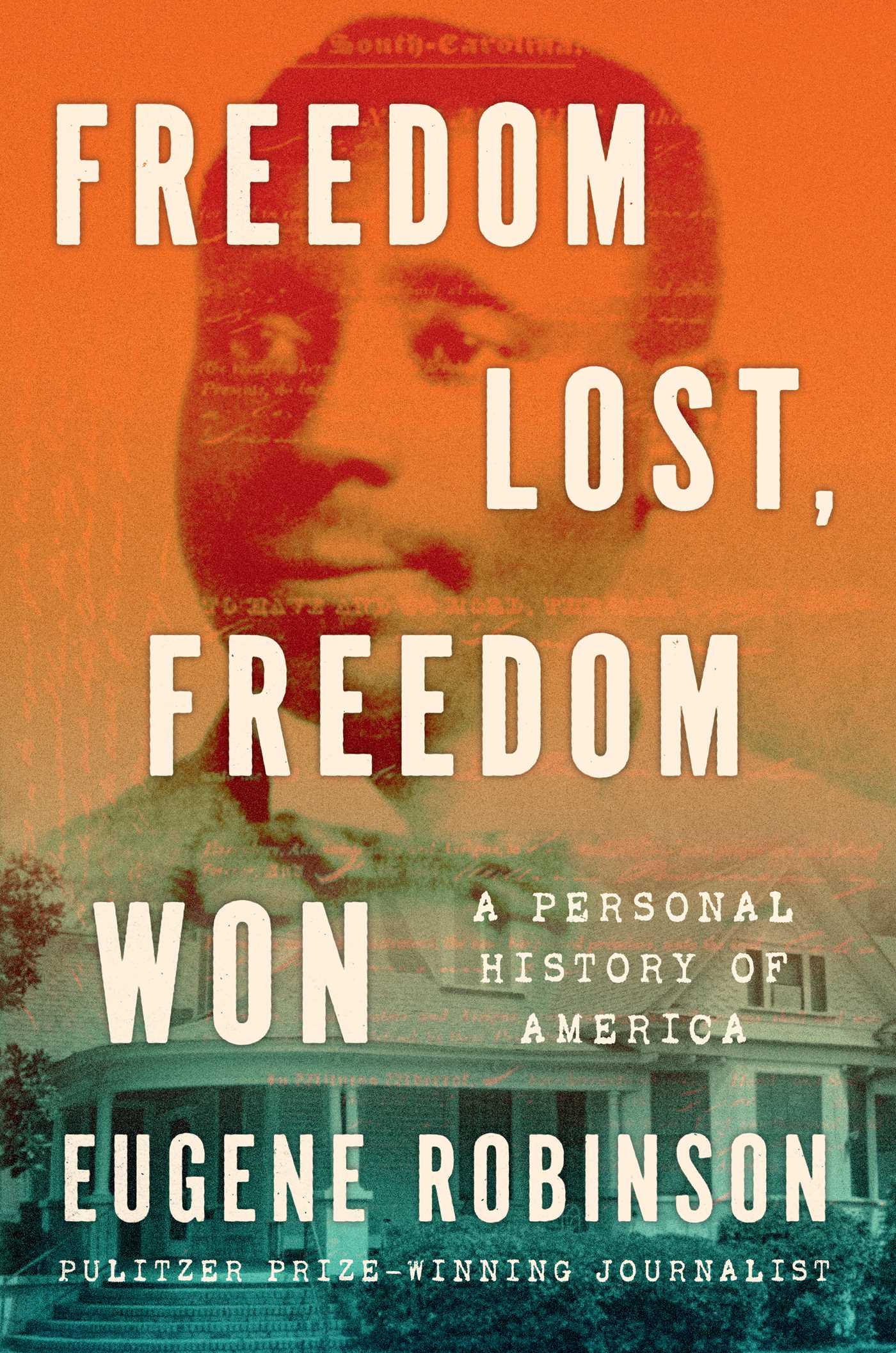
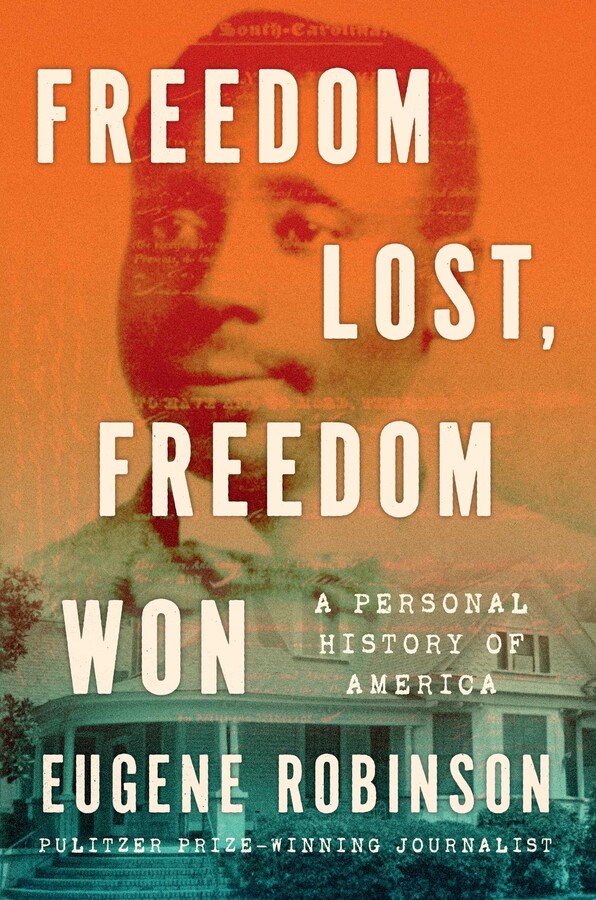
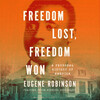
Pulitzer Prize–winning former Washington Post columnist Eugene Robinson tells our nation’s torturous racial history through his own family’s story, starting with his great-grandfather’s freedom from slavery and threading his way to his own narrative and reaching today’s Black Lives Matter movement, asking whether this time will be different.
On March 27, 1829, a wealthy white planter and entrepreneur named Richard Fordham purchased four enslaved African Americans from a woman named Isabella Perman. One of them was journalist Eugene Robinson’s great-great-grandfather, a boy called Harry.
Starting from this transaction, which took place in Charleston, South Carolina, Freedom Lost, Freedom Won brings to life two hundred years of our nation’s history through the eyes of the remarkable family that Harry founded. Assigned a formal name—Henry Fordham—and put to work as a blacksmith, he achieved his own freedom a decade before the Civil War. He was there when victorious Union troops marched into Charleston in 1865, ending slavery and guaranteeing liberty for Black people—only on paper, though, and only for a time.
Robinson traces the arc of his familial lineage through the repeated cycles in which African Americans have fought their way upward toward freedom and opportunity, been forced back down again, and renewed their determined climb.
From his great-great-grandfather’s achievement in becoming a “free person of color” before emancipation to his great-grandfather’s Reconstruction-era success, from his father’s odyssey of the Great Migration to his own coming-of-age during the civil rights movement, Robinson delves into a rich archive of Black narratives, arguing that we still have a long way to go before it is possible to speak of a “post-racial America.”
Setting his extensive research within the larger historical context, Robinson provides both an indictment of structural racism and an illustration of how it has been fought and, at times, courageously overcome. Freedom Lost, Freedom Won tells our country’s tortuous racial history through Robinson’s family’s story of struggle and survival, pushing us to consider how far the nation has come—willingly or not—and how far it still has to go.
On March 27, 1829, a wealthy white planter and entrepreneur named Richard Fordham purchased four enslaved African Americans from a woman named Isabella Perman. One of them was journalist Eugene Robinson’s great-great-grandfather, a boy called Harry.
Starting from this transaction, which took place in Charleston, South Carolina, Freedom Lost, Freedom Won brings to life two hundred years of our nation’s history through the eyes of the remarkable family that Harry founded. Assigned a formal name—Henry Fordham—and put to work as a blacksmith, he achieved his own freedom a decade before the Civil War. He was there when victorious Union troops marched into Charleston in 1865, ending slavery and guaranteeing liberty for Black people—only on paper, though, and only for a time.
Robinson traces the arc of his familial lineage through the repeated cycles in which African Americans have fought their way upward toward freedom and opportunity, been forced back down again, and renewed their determined climb.
From his great-great-grandfather’s achievement in becoming a “free person of color” before emancipation to his great-grandfather’s Reconstruction-era success, from his father’s odyssey of the Great Migration to his own coming-of-age during the civil rights movement, Robinson delves into a rich archive of Black narratives, arguing that we still have a long way to go before it is possible to speak of a “post-racial America.”
Setting his extensive research within the larger historical context, Robinson provides both an indictment of structural racism and an illustration of how it has been fought and, at times, courageously overcome. Freedom Lost, Freedom Won tells our country’s tortuous racial history through Robinson’s family’s story of struggle and survival, pushing us to consider how far the nation has come—willingly or not—and how far it still has to go.
Excerpt
Chapter One: A Boy Called Harry Chapter One A BOY CALLED HARRY
On March 27, 1829, a wealthy white planter and entrepreneur named Richard Fordham purchased four enslaved African Americans from a woman named Isabella Perman. One of them was my great-great-grandfather, a boy called Harry.
This transaction in human flesh, as with many thousands of other such sales over nearly two centuries, took place in Charleston, the metropolis in the Low Country of South Carolina that was the port of entry for an estimated 40 percent of all enslaved Africans brought to toil in this country. A document recording the sale was filed with the South Carolina secretary of state several days later, on April 7. It does not say where in Charleston the sale took place—on the steps of the Old Exchange and Provost Dungeon perhaps, or at the Cooper River docks, or in one of the thriving markets where people were bought and sold. The individuals bought by Fordham are listed as “a Negro boy named Harry and a Negro woman named Jenny and her two children named Hager and Margaret.” For the lot, Fordham paid $1,080.
Founded in 1670 as Charles Towne by English colonists from Bermuda, Charleston occupies a narrow peninsula flanked by two navigable rivers, the Ashley and the Cooper. The rivers meet at the city’s southern tip, which is protected by a wide and deep natural harbor; Charleston could not have been better situated to become a center of seafaring commerce. In 1829 it was a bustling place with a population of nearly thirty thousand, the most important Atlantic port in the South and the sixth-largest city in the nation, behind only New York, Baltimore, Philadelphia, Boston, and New Orleans.
Richard Fordham was the owner of Moonham Plantation and Shipyard, a large landholding on flat and fertile Daniel Island, just across the Cooper River from the city. Excavations there have found remnants of a pre-colonial Native American settlement believed to have been occupied by a clan called the Ittiwan; they were gone well before Fordham arrived, having been displaced by European settlers and unpaid Black workers. At his plantation, Fordham used enslaved African Americans to grow two of South Carolina’s most lucrative cash crops, indigo and Sea Island cotton. An ambitious and busy man, Fordham also used the people he held in bondage to build watercraft (small cargo vessels that he sold for use in the maze of shallow Low Country waterways) and to work at the blacksmith’s forge he and a partner owned in the heart of the city, on Chalmers Street, near the end of the peninsula.
Not far from the forge, on that same street, a man named Thomas Ryan and a major slave trader named Ziba B. Oakes operated a huge establishment, Ryan’s Mart, where Black human beings were bought and sold. The business was colloquially known as “Ryan’s nigger-jail.” Buyers entered through a wide stone archway into premises that stretched the full width of a city block. Across an expansive yard stood a four-story dormitory-style prison, or barracoon, where African Americans were warehoused pending their sale; the cells were outfitted with shackles to prevent escape. To the right was a low building that housed a busy kitchen; the enslaved were fed relatively well in the days before their sale, so they would look as strong and healthy as possible. To the left was a small morgue—as with any trade in livestock, a certain percentage of inventory loss was factored in as an inevitable cost of doing business. And at the front of the yard, near the entrance, was the part of Ryan’s Mart that customers were meant to see: the auction gallery, where men, women, and children were presented for purchase. That was the showroom where husbands and wives were separated, where sons and daughters were taken from their mothers, and where fathers were led away in chains to a future of servitude, abuse, and punishment—a life they could realistically expect to escape only through death.
Harry, whose proper name was Henry, spent nineteen years as Richard Fordham’s chattel. The young man proved to be quick of mind and good with his hands: He mastered the art of blacksmithing. At the Chalmers Street forge, his skills eventually made him Fordham’s de facto right-hand man. He had a talent for making unyielding iron bend to his will.
On July 10, 1848, Fordham sold “a Negro man named Henry” to Otis Mills and Co., a grain wholesaling business with multiple warehouses near the Cooper River docks. The sale was recorded with the secretary of state seven days later. The Mills company’s eponymous founder, one of Charleston’s richest men, went on to build the city’s grandest and most luxurious hotel, the Mills House. The price Mills paid for my great-great-grandfather was $2,000, which was a lot of money for a single Black man. Henry was now Henry Fordham—he had taken Richard’s surname as his own—and he clearly had attributes that made him worth nearly three times the going local price of $725 for a field hand. It was the kind of money that a wealthy Charleston tycoon would pay for an experienced and gifted blacksmith in his prime. According to family lore, Henry had somehow circumvented the state’s strict law against educating the enslaved and become literate. And he had become deeply religious. He had not only learned to read the Gospel of Jesus Christ but also heard the call to preach it.
This extraordinary Henry Fordham is my Henry Fordham, my direct ancestor on my mother’s side. Three years after being acquired by Otis Mills, he was purchased one final time—by himself: Sometime in 1851, he bought his own freedom.
I’ve always known through my family’s rich oral history that my great-great-grandfather obtained his liberty at some point before the Civil War. For a long time, however, attempts to find out exactly when and how he cast off his chains ran into dead ends. In Charleston, there was no systematic collection of manumission records, legal documents marking an enslaved person’s freedom, and by 1841, the state of South Carolina had passed laws that effectively made manumission illegal. That did not entirely end the practice, but it did mean there would be no official document recording the moment of Henry Fordham’s freedom in the archives of the secretary of state.
I knew about his 1848 sale to Otis Mills from research that my “Aunt” Grace—actually one of my mother’s many first cousins—painstakingly conducted years ago, though she never laid eyes on the actual document. And I knew that Henry indeed was free before the Civil War and Emancipation, because I found his name in the 1861 Charleston city census, appended with the notation “f.p.c.”—“free person of color.” By then, I reasoned, he must have been a free man for some time, because the census showed that he already owned two wood-frame houses in the city, one on Desportes Court and the other on Washington Street; it must have taken him at least a few years to accumulate such assets, starting from zero. But exactly when, in that thirteen-year gap between his final sale and his first appearance in the census, had he become free? I pored through real estate records, scoured the family Bible, searched archives in reading rooms and digital databases online, looked everywhere I could think of—and didn’t find a hint, much less a clue.
The South Carolina Historical Society, a private institution founded in 1855, has long been the biggest and richest repository of historical documents in the state. It is the mandatory first stop for researchers seeking information about the antebellum period. I visited the society’s grand neoclassical headquarters on Charleston’s main thoroughfare, Meeting Street, several times over the years to look for traces of Henry Fordham’s manumission, or for records pertaining to Otis Mills or his company, or anything about my great-great-grandfather that might pin down even the year of his freedom. No luck.
In 2014, the society’s collection was moved across town to the College of Charleston so that the archive’s original home, a landmark 1822 structure known as the Fireproof Building, could be turned into a museum. Slowly but surely, more records were digitized or at least preserved on microfilm. In February 2023, I visited the collection at its present location, a hushed sanctum on the second floor of the college’s Addlestone Library, in the hope that more of the hit-or-miss manumission records from Henry Fordham’s time might have been found, catalogued, and made accessible. I was overjoyed when the helpful librarians at the desk found that the stacks held a folder labeled with Henry Fordham’s name—but then immediately deflated when they brought it out, because I saw that it contained only a long, speculative, and largely inaccurate account of Henry’s life compiled by a distant relative whom I’d never met. I was already familiar with that document, and I knew it said nothing about when he had liberated himself.
Finally, one of the librarians at the historical society suggested I look through editions of Charleston’s “Free Negro Book.” I had no idea such a thing existed: a yearly list of free African Americans residing in the city who had paid a required poll tax. It was an exercise in data collection born of paranoia. The fact that Blacks outnumbered whites in South Carolina during the decades before the Civil War meant that white officials lived in constant fear of a Haiti-style Black uprising, which they assumed would be led by free African Americans. The free were a tiny minority—roughly 95 percent of Black people in the state were enslaved—but it seemed to make sense that any rebellion would be led by conspirators with independent resources and the liberty of unsupervised movement. Whites took great pains to keep track of men and women like Henry Fordham.
The helpful librarian sat me in front of a microfilm reader and brought out roll after roll of film. I sat there for hours, squinting to decipher the records’ graceful archaic handwriting. It was actually called the “Free Negro Book.” The names in each year’s edition were alphabetized, but only roughly, by first letter—all the surnames starting with A came before all the surnames starting with B, but the name Agee might come before the name Anderson or it might come after. I began with the edition from 1848, the year of my great-great-grandfather’s sale to Otis Mills, but there was no listing for a Henry Fordham. The same was true of the book for 1849. Same for 1850. But as I slowly made my way through the F section of the 1851 edition, I let out a shout that shattered the library’s decorous hush: “Yesssss!” Then quickly, to the startled patrons and librarians: “I’m so sorry, excuse me, I’m so sorry.” And then, more softly, “Yes.”
I had found him.
Henry Fordham was recorded as a free Black man for the first time in 1851. I doubt I will ever be able to pin down the month and the day, but finally I knew the year. I can be quite sure my great-great-grandfather was still enslaved when free African Americans were counted in 1850—and that he had become a free man, a proud free Black man, by the time the Free Negro Book was compiled in 1851.
WHEN I WAS GROWING up, it never occurred to me to go looking for my family’s history. It was already right there, all around me. My younger sister, Ellen, and I were surrounded by the material objects of our heritage and immersed in family lore. Our history was beneath our feet and above our heads; it crammed every cabinet, rested on every surface, and hung from every wall. We were raised in a world of legacy.
I was born and raised in the town of Orangeburg, seventy-five miles northwest of Charleston, in the house that Henry Fordham’s son, a formidable man named Major John Hammond Fordham, built for his family in 1903. There were six of us in the household. Our grandmother Sadie Fordham Smith and our great-aunt Florella Fordham were two of Major Fordham’s daughters; they had lived in the house since it was brand-new, when Sadie was seventeen and Florella was twenty-three. Our mother, Louisa Smith Robinson, had been born in the house and lived there her entire long life, except for two years when she was away studying for master’s degrees and one year when she was a newlywed. Our father, Harold Irwin Robinson, had moved into the house after marrying Louisa in 1952 and trying briefly, and unsuccessfully, to convince her to settle in the Detroit area where he’d grown up. I came along in 1954, Ellen in 1959, and today the Fordham home, with all its history and all its ghosts, belongs to the two of us.
Anchoring the corner of Boulevard and Oak Streets, the house is a characteristically southern structure—one and a half stories, with white wooden siding, two graceful bay windows, four dormers poking through the roof, and a wide, curving wraparound front porch that serves as an auxiliary living room during the hot months. I marvel at the integrity and durability of the building materials they used back then. After my father died and my mother had no one living in the house with her, I decided to install some motion-sensor lights for added security. What I thought would be maybe a two-hour job took all day, and not just because of my lack of aptitude as a handyman. I had to make a couple of trips to the hardware store to find a power drill with sufficient torque and a sharp-enough bit to make more than a dent in the wood siding, which is only slightly more yielding than granite.
When I was young, the porch was always furnished with rocking chairs, a wooden swing big enough for two people, and a piece of furniture that still remains. We called it a “glider”—a wide metal seat, painted white, that gently swayed back and forth in a floor-mounted frame instead of being suspended from the ceiling. While Ellen and I spent long summer nights in the swing, straining to touch the ceiling with our toes, the adults sat in the rockers and the glider moving softly to the quiet rhythms of conversation.
Above the glider is a narrow little window too high to look through without straining on tiptoes. Inside, on the other side of that wall, Major Fordham installed a massive black upright piano, which was still there when I was young, after half a century. The window was designed into the house, my grandmother once told me, because of the belief at the time that pianos needed to “breathe” fresh air. The piano had a textured, ebonized finish that was fashionable around the turn of the twentieth century, and I recall its being slightly out of tune. My grandmother once had been such a talented pianist that she taught music and played at church on Sundays, and my mother also knew how to play. Neither of them sat down at the black piano often, though. For me, it was an object of fascination. I liked to open the front panel and explore how the mechanism worked—the keys activating the felt-tipped hammers that struck the metal strings to make all the different notes. When I was in my teens, my family bought a new, much smaller spinet piano, mostly for Ellen to learn on, and they put it in a different room. They donated the old piano to Trinity Methodist Church, our family’s church, three blocks away down Boulevard Street. The instrument sat there for years, breathless, in the basement activity room.
On our family room wall, near the old piano’s window, there is a large photographic portrait of Louisa Fordham, my great-grandmother, Major Fordham’s beloved wife. Surrounded by an oval frame of polished wood, it shows her wearing a high-collared blouse and the kind of searching, romantic look associated with Victorian heroines. Her eyes gaze into the room with emotion and what looks like a touch of sadness.
On another wall in the same room—the first wall you see when you enter the house—is a similarly formal, slightly larger portrait of Major Fordham. It is an artifact that defines the house, at least for me, and in many ways our family. The frame ringing his image is circular and also of polished wood. Welcoming visitors to his domain, or perhaps judging them, Major Fordham projects no romance. His eyes are as dark as pieces of coal, his skin just a shade lighter. He looks self-possessed, confident, proud, uncompromising. He was all those things, and this powerful image of him is as much an integral, structural element of our family home as any brick or timber.
When Ellen and I were growing up, those portraits always seemed to be taking our measure. Their gaze was unrelenting and scrutinizing—his, impatient and stern; hers, more generous but still formidable. The images constantly reminded us that the Fordhams’ hard work and remarkable achievements were never to be forgotten, never to be dishonored.
We knew that important family talismans lay in a big black safe that Major Fordham kept in the main bedroom. It looks like a cartoon safe, the kind the Road Runner used to drop on Wile E. Coyote’s head; and it is incredibly heavy, which is probably why it still sits today where the Major left it. When he died in 1922, he took the combination to his grave in Orangeburg Cemetery. A locksmith had to be called.
When I was growing up, the safe was always closed but never locked. That bedroom was my grandmother’s; and because the safe had belonged to her father, I had the sense that it now belonged to her. The contents, therefore, seemed private. At the same time, though, I was curious about everything, and so, sometimes, while my grandmother was busy in the kitchen, I would peek inside. The old, yellowed papers I found didn’t mean anything special to me; there were papers and photographs stashed away everywhere throughout the house—boxed under beds, loose in desk and dresser drawers, long forgotten in the attics or in the backyard shed. The safe was just one of many places where my mother or grandmother would search for a document, picture, or keepsake when she wanted to tell us something about the family.
I knew that my mother’s side of the family was from Charleston. I knew that Major Fordham was the patriarch who had built our house. I knew that he had been a Reconstruction-era success story, that he had been a prominent man, that he had been a loving but demanding father to his six children. I knew he had been a character. I knew, vaguely, that his father, Henry Fordham, had been a free man before the Civil War. I knew myriad discrete facts about our family, I thought I had grasped the broad outlines of our history, and I had met more Fordham relatives than I could count. But I had no sense of how it all fit together, no sense of what it all meant.
That was the state of my knowledge for a long time—through high school, college at the University of Michigan, and my first journalism job, at the San Francisco Chronicle. In 1980, I was hired by The Washington Post and moved back east—with my Baltimore-born wife, Avis Collins Robinson, whom I’d met at a coffee shop near Golden Gate Park.
Being so much closer meant that I saw my family more often. Avis and I had been married for a couple of years, and my mother kept asking when we’d start presenting her with grandkids; my grandmother Sadie was ninety-four, and her health was finally beginning to fail. On one of our frequent trips to Orangeburg, I finally took another look at the papers in Major Fordham’s safe and found some items that intrigued me: the construction contract for the house, a letter to Major Fordham from Theodore Roosevelt, the Major’s handwritten draft of a powerful speech he gave in 1908. These facts and papers and pictures and stories began to coalesce into a narrative, and that narrative wanted to be written down.
The Post had a Sunday section called Outlook, and as a break from ponderous arguments about public policy and foreign affairs written by éminences grises, the section’s editors welcomed extended essays by staff members that observed the world through a wider lens. In 1981, I wrote a long Outlook piece in which our house in Orangeburg was the main character. I traced the outlines of Major John Hammond Fordham’s life, related some of the stories Sadie had told about her illustrious father, recounted what I knew of our family’s history, and ended with a tragic episode from the civil rights struggle, the Orangeburg Massacre, which happened a few hundred yards from our house when I was a sophomore in high school. The focus, the “so what” of the piece, was the house itself—its longevity, its profound connection with my family, its lessons in the value of permanence.
The essay was well received, both by my Post colleagues and, to my surprise, by readers who wrote to offer their reflections. In those days, of course, reacting to something one read in the newspaper involved more than scrolling down to the comments section and batting out a few quick sentences; it required taking out a sheet of paper, typing one’s thoughts or writing them out in longhand, folding the paper neatly and putting it into an envelope, addressing the envelope, affixing a postage stamp, and dropping the letter into a mailbox. None of that felt as onerous in 1981 as it sounds today; still, it took time and effort—and letters about my house and its history continued to arrive for weeks.
Within the family, meanwhile, the piece entered the annals of family lore. It was sent out by the Post’s syndicate, the Washington Post Writers Group, and far-flung family members sent me copies of the article as it had appeared in newspapers across the country. When I reread the piece now, I wince at the details I got wrong. But I take pride in the fact that those mistakes are few. It was the first time anyone had tried to assemble and organize the fragments of our family’s story, and I got the big things right.
For me, that essay had two big, lasting impacts. First, it inspired my mother’s first cousin Grace Manggrum, who lived in Cincinnati, to embark on a decade-long quest to unearth and chronicle everything she possibly could find about our genealogy. At a time when most of her research had to be done through correspondence with librarians and heritage buffs, Aunt Grace did extraordinary work that holds up as remarkably accurate. For years, she wrote back and forth with my mother, cross-checking her own findings against whatever my mother knew, suspected, or might once have heard. In 1990, Aunt Grace assembled all her discoveries into a seventy-page report. She made copies, put them neatly into binders, and sent one to every household in the family.
The other impact of the Outlook piece was that seeing the way it resonated for others made me realize that my family’s house, documents, photographs, and oral history constituted an extremely rare and precious gift and also imposed a responsibility. All that material told a bigger and more important story. I didn’t know what that larger story was, but I had the sense that I was destined to find it and share it. I remember that feeling because it was so odd. I was a journalist; I dealt in facts, events, accidents, misdeeds, consequences. I knew how a random encounter or a missed connection could change a life, and I didn’t believe in destiny. Yet there was a disconnect between what I believed and what I felt.
In any event, I didn’t return to the subject for nearly forty years. Life and career have a way of intervening: Avis and I had a son. I became an editor at the Post. We spent a year at Harvard, where Avis earned a master’s degree and I was a Nieman Fellow. We spent four years in Buenos Aires, where I was the Post’s South America correspondent, and two years in London, where I was the Post’s bureau chief. We had another son. We came home, and I spent five years as the number two editor on the foreign desk and six years running the Style section. I started writing a column, won a Pulitzer Prize, became a talking head. I wrote two books plus a third, Disintegration, in 2010.
I did want to return to the family story in earnest, but there was always something that took priority—the insatiable maw of my Washington Post column, a new election cycle to write about, a second job as a television commentator, another new election cycle, nine years of enormously gratifying but time-devouring service as a member of the Pulitzer Prize Board. I simply didn’t have the bandwidth for anything else. It was never the right time to take a deep, immersive dive into my history—until, finally, that moment came.
The first push toward family and the past was the Covid-19 pandemic. In March 2020, when workplaces suddenly shut down and we all got sent home, I was like a lot of people: I went inside and stayed there for months, both physically and psychologically. Isolation bred reflection, and I found myself thinking more about heritage and history. Over the years, I had taken a few items from Major Fordham’s safe, brought them to my house, and tucked them away in a cabinet in my study. One day, I pulled them out for the first time in years—an old Orangeburg city directory, with the Major and his adult children listed; a powerful and heartbreaking speech the Major gave in 1908; a little leather-bound notebook in which he kept his accounts. I came across a faded copy of the Outlook section with my essay about the house on the front page, and I pulled that out, too. At the time, I didn’t quite know why, but I needed to think about our past.
Then came the second big shove: the murder of George Floyd. The excruciating, infuriating cell phone video of a white police officer kneeling on the neck of an unarmed Black man for nine and a half endless minutes, slowly choking the life out of him, set off massive protests across the nation. Huge multiracial crowds marched in every major city; Senator Mitt Romney of Utah, of all people—a conservative Republican and a lifelong member of the Mormon Church—joined demonstrators as they marched in Washington, D.C. On Sixteenth Street, visible from the White House just across Lafayette Square, D.C. mayor Muriel Bowser blocked off traffic and had city workers paint “BLACK LIVES MATTER” in fifty-foot letters on the pavement. The country’s political, cultural, and intellectual leaders—with the glaring exception of President Donald Trump—all spoke of the need for a national reckoning on the issue of racial justice.
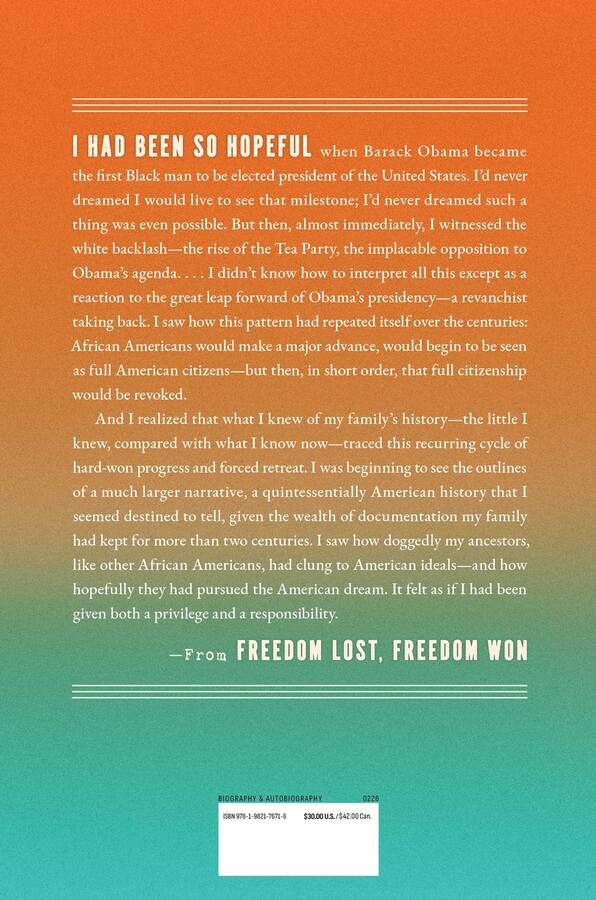
I allowed myself to hope that we would finally have that reckoning. But a voice in the back of my head kept saying, “We’ve been here before. We’ve been here before. We’ve been here before…” Just twelve years earlier, in 2008, I had been so hopeful when Barack Obama became the first Black man to be elected president of the United States. I’d never dreamed I would live to see that milestone; I’d never dreamed such a thing was even possible. But then, almost immediately, I witnessed the white backlash—the rise of the Tea Party, the implacable opposition to Obama’s agenda, and finally the election of Trump. I didn’t know how to interpret all this except as a reaction to the great leap forward of Obama’s presidency—a revanchist taking back. I saw how this pattern had repeated itself over the centuries: African Americans would make a major advance, would begin to be seen as full American citizens—but then, in short order, that full citizenship would be revoked.
And I realized that what I knew of my family’s history—the little I knew, compared with what I know now—traced this recurring cycle of hard-won progress and forced retreat. I was beginning to see the outlines of a much larger narrative, a quintessentially American history that I seemed destined to tell, given the wealth of documentation my family had kept for more than two centuries. I saw how doggedly my ancestors, like other African Americans, had clung to American ideals—and how hopefully they had pursued the American dream. It felt as if I had been given both a privilege and a responsibility. I had the outlines of a story that I wanted to tell and that I felt I had an obligation to tell.
I NEVER STOPPED WONDERING about my deeper history—before the time of Major Fordham, before the time of his father, Henry. I wondered about my first African ancestor to set shackled foot on this continent. He or she had a name. He or she came from somewhere—not “Africa” in general but a specific place, a community that was situated in its own particular landscape, strung alongside a river or hugging a coastline or nestled amid dry interior hills. He or she had a mother, a father, grandparents, siblings, cousins, friends. He or she had a clan, a language, a culture, a faith. All this history had been obliterated by one act of violent separation followed by many acts of deliberate erasure, and it is forever gone.
That missing part of my heritage—that missing part of me—had not been lost. It had not somehow been mislaid like a set of housekeys or absentmindedly left in an Uber like a cell phone. It had not been accidentally wiped when someone clicked Delete instead of Save. There had been nothing at all inadvertent about its disappearance. It had been stolen.
Enslavers in the English colonies of the New World went to great lengths to sever any ties their captives had with the past and with one another. They wanted us to be empty vessels they could label with new names and fill with new words, new deities, new Commandments, new rituals, and a new, false, diminished sense of our worth and our place in the world. From the white captors’ point of view, this was done not so much out of contempt or animus as out of necessity. Their fortunes and their lives depended on being able to control large numbers of able-bodied Black men, women, boys, and girls who locally outnumbered them—twenty, forty, sixty Black bodies crammed into drafty, leaky slave shacks versus maybe a dozen white family members in the big house, aided and abetted by a few white overseers. Firearms gave whites some protection, but they were no guarantee that a plantation owner wouldn’t be awakened in the middle of the night by the point of a sharp knife against his throat. Our captors could not allow us to feel confident in the strength of our numbers. They wanted us to feel small, weak, powerless, overwhelmed, ungrounded, disconnected, and thus easier to control.
I feel the absence of my deep, pre-American history. I feel it the way an amputee suffers phantom pain in a missing limb. I keep looking for what was stolen from me. And occasionally, I glimpse what might be fragments of it.
Family legend says that Henry Fordham’s lineage may have arrived in Charleston from Barbados, one of the British islands in the Caribbean where some Africans were “seasoned” (conditioned to the lash) in the sugarcane fields. When Avis and I went on vacation to Barbados in 1996, I decided to look for traces of my family in the Barbados National Archives. We drove around for quite a while (on the wrong side of the road) until we found the place, which I remember as a graceful old building filled with natural light. In a big reading room, we sat at a long table while helpful staff members, accustomed to visits from Americans seeking their roots, brought out materials they thought might help us with the search. A day of poring through records, however, gave up nothing more than hints and shadows.
Discouraged, we went back to our hotel, and I called Aunt Grace, who by then was firmly established as the family’s chief genealogist. I had been looking for records of slave owners named Fordham. But on that phone call, she made me understand for the first time that the Fordham name hadn’t attached itself to our family until after Henry’s 1829 sale to Richard Fordham. Instead, she said, I should look for a Black woman named Jenny, the “Negro woman” who was sold at the same time as Henry. Jenny had been owned by Isabella Perman, whose maiden name had been Isabella Fell. So, I should look for a woman named Jenny who had some connection with those two surnames.
We returned to the archives, and a senior researcher named Shirley “Archer” Griffith helped us renew the quest, bringing out reels of microfilm and precious old ledger books recording births, baptisms, and deaths. We finally did find a family named Fell who lived in Barbados around the right time, in Saint Philip Parish. We also found a family in the same parish named Perreman—pretty close to Perman. And we found that on November 27, 1793, an enslaved adult named Kitty Fell was baptized at Saint Philip’s Church; she would have been the right age, I thought, to be Jenny’s mother. We could find no definitive records linking Kitty Fell to the Fell family, although it was no great stretch to infer some connection. We also found no record of Kitty having a daughter, and no record of Kitty being sold away to Charleston. We had bits and pieces that might fit together, but we couldn’t figure out how.
The English kept meticulous records of the sires and dams of the Thoroughbred horses they bred and raced, but they couldn’t be bothered to keep even rudimentary family histories of the human beings they claimed to own. Yet it’s not as if they were admitting that they were ashamed of slavery; they knew in their hearts that it was wrong, but they rationalized it to themselves by claiming it was somehow divinely ordained, or at least divinely permitted, and thus was no sin that had to be hidden. Perhaps they just saw the enslaved as more interchangeable, and infinitely more disposable, than their prized stallions and mares. Or maybe they thought that if they kept no records, future generations would have the option of pretending the centuries-long holocaust had never happened.
My family’s story, like any epic narrative, had to start at the beginning. And I had no idea when that beginning was.
Not specifically, I mean. I am a descendant of enslaved African Americans, so, obviously my deepest roots lie in Africa. But saying that is almost as vague and unsatisfying as saying that my ancestors lived on planet Earth. Africa is the world’s second-biggest continent, home to fifty-four sovereign nation-states, hundreds of ethnicities and languages, and a vast, kaleidoscopic array of diverse cultures. It is safe to narrow the range of possibilities to West Africa because that is where the transatlantic slave trade primarily operated, but this is roughly like saying one’s ancestors came from “Europe” or “Latin America.” Somewhere on that continent, there is a city, town, or village where Henry Fordham’s progenitors lived and died for hundreds or thousands of years, where they were grounded and rooted, where distant relatives walk the streets today. That place exists, and I know I will never find it. I might be able to get closer than was possible even a few years ago, though, because today there are powerful research tools that no one could have dreamed of when I wrote that Outlook piece in 1981.
The most revolutionary new resource is DNA testing. I mailed away my saliva sample and waited, impatiently, with no real expectation of an aha moment. When the results came back, they offered no surprises, but they did confirm my general assumptions. According to the lab I used—and I know that results can vary—34 percent of my DNA comes from what is now Nigeria, 20 percent comes from what is now Mali, and another 26 percent comes from other places up and down the west coast of Africa. That doesn’t depart from what I’d have predicted, and it doesn’t narrow things down meaningfully.
The remaining 20 percent of my DNA comes mostly from Germany, with a small contribution from the British Isles—again, no surprise: I knew I had white ancestors as well as Black. Someday, perhaps, the collective human genome will be sufficiently catalogued to trace my DNA to some specific Nigerian village or English hamlet. Until then, science tells me what I always knew: I am an amalgam of the enslaved and the enslaver. I am an African American.
So, I had confirmed—as I had suspected—that modern science could tell me next to nothing definitive about my deepest history. Genetics could pin down no specifics about the lives my West African ancestors led before being kidnapped, chained, and brought to the New World. All I had were possibilities and probabilities based on the places in West Africa my genes came from. But that was better than nothing. Over the years, I had come across what I imagined were hints of my possible past—when I was a child in Orangeburg, when I was a foreign correspondent in Latin America. The DNA test couldn’t rule in any of these histories, but it made clear that I should not rule them out.
One example: When I was little, among the out-of-town visitors who would occasionally drop by to visit my grandmother and great-aunt were two women from Charleston. These ladies were friends of my grandmother’s relatives, I think, or maybe there was some Methodist Church connection. I don’t remember their names. What got my attention was that when they spoke to each other, they fell into an incomprehensible, rapid-fire patois. It definitely wasn’t English. As far as I was concerned, they might as well have been speaking ancient Greek.
They had been speaking Gullah (also called Geechee), a creole language based on English but laden with a hodgepodge of West African vocabulary, grammar, and syntax. “Gullah” is possibly a corruption of “Angola,” a region and culture from which many Africans were seized; or it might refer to the Gola people, an ethnic group living on land that is now in Liberia and Sierra Leone. If you have ever referred to peanuts as “goobers,” you are using a Gullah word that comes from the Kongo term for peanut, nguba. On the islands around Charleston—including Daniel Island, where Richard Fordham had his plantation and where my great-great-grandfather grew into manhood—something of Africa survived three long centuries after the first Africans worked those abundant fields.
Gullah evolved as a lingua franca that allowed enslaved Africans from different cultures and language groups to communicate with one another. Linguists have been able to make definitive linkages between Gullah and African languages such as Ewe, Efik, Ga, Twi, and Yoruba. Henry Fordham almost surely would have understood every word those women who visited from Charleston were saying. So would have other ancestors whose names I do not know: At least two other branches of my family tree on my mother’s side and one on my father’s side lead back to the Charleston area.
Researching the Gullah linguistic survival, I learned that a pioneering African American scholar named Lorenzo Dow Turner, working in the 1930s, concluded that a traditional Gullah religious dance called the “ring shout”—in which worshipers form a ring and circle counterclockwise while singing and clapping—was brought to the islands by enslaved Muslims. Turner wrote that the dance mimics the way pilgrims on the hajj circumambulate the sacred Kaaba in the Grand Mosque of Mecca.
As many as one-third of the Africans brought here in chains were taken from lands that were predominately Muslim. Both my mother and my father gave me genes from Mali, according to the DNA test I took, and Islam arrived in Mali in the ninth century, long before the transatlantic slave trade began. So, one or more of my distant ancestors could have been Muslim.
Or not. It was, as I said, a glimpse. Of a possibility.
I had more hints during the years I spent working as The Washington Post’s correspondent in South America, from 1988 to 1992, and later researching the book I wrote about Cuba. What I saw then was the vibrancy of syncretic religions that melded the traditional beliefs of enslaved Yoruba men and women, kidnapped from what is now Nigeria, with the Roman Catholicism imposed by their captors. In Brazil, the faith is known as Candomblé or macumba; in Cuba, as Regla de Ocha or Lucumí; in Haiti, as vodou. The American lexicon reduces the last religion to two terms I never once heard from the lips of actual practitioners, “Santería” and “voodoo.”
I spent a good deal of time and effort (and a decent amount of the Post’s money) trying to understand as much as I could about this worldview, and I knew at the time that I was doing so mostly for personal reasons. I wasn’t really looking for news stories; I was looking for heritage and connection. The idea of a fully elaborated African theology having endured and prospered despite centuries of slavery and oppression seemed to me nothing short of a miracle. Spending time with a holy man or woman versed in the Yoruba faith never made me believe. But it always made me feel.
I thought back to these experiences decades later, when I got those DNA results and saw that one-third of my DNA came from Nigeria, where the Yoruba deities would have been present and active in most people’s lives. I knew that this might be as close as I would ever get to the very beginning of my African American history. I looked up at a small figurine from Cuba that I keep in my study, a stylized representation of one of the orishas, or demigods—Eleguá, the gatekeeper who opens the doors to the spirit world. And I felt again.
THE FACT THAT 20 percent of my genetic inheritance comes from Europe makes me like most Black Americans: According to the National Human Genome Research Institute at the National Institutes of Health, “an African American individual in the United States has, on average, about 75–80 percent West African ancestry and about 20–25 percent European ancestry.” I am right at the midpoint of the bell curve. Toward the extremes, I know Black Americans who have been told by DNA testing that they have few European genes, if any; and I also know African Americans who have been surprised to learn that they are well under 50 percent African.
I am also like most African Americans in that it is difficult to trace my white ancestry. A couple of distinctive names that came down through oral history on my mother’s side—DesVerney, Vanderhorst, Chisolm—have been impossible to pin down, and I have had to conclude that they are dead ends. My mother’s maternal grandmother and paternal grandfather were so light-skinned that they obviously had recent European ancestry, but they both happened to have been born with the all-too-common surname of Smith. Efforts to trace them back, and to tease out connections with white slave-owning families that can only be imputed, get lost in a vast sea of Smiths. On my father’s side of the family, I have met relatives who could pass for white at a Klan rally; again, though, I run into brick walls when I try to identify white forebears.
The DNA test did find that I have a handful of distant white relatives, fourth to sixth cousins with whom I share less than 1 percent of my genetic inheritance, just enough to establish the relationship. But we have been unable to identify any common ancestors—or, for that matter, common geography that would put our progenitors in the same place at the same time. These links do exist, as DNA does not lie, but they are lost—at least for now: As more people decide to get tested and make their results open to possible matches, I may someday find a white lineage I can trace.
The most important thing that DNA reveals is that all of us, all living humans, are related. We all descend from a small group of common ancestors, no matter how much melanin we have in our skin or how tightly curled our hair might be. Aside from infinitesimal blips in the genome, like the sickle cell trait or susceptibility to skin cancer, we are all the same. Race has never been a biological fact of any import. It has always been a social construct, a relatively recent invention that allowed the powerful to justify exploitation of the powerless.
In 1776, Thomas Jefferson, famously an enslaver of human beings, wrote that “all men are created equal.” Just a few years later, in Notes on the State of Virginia, Jefferson invented a pseudoscientific justification for his hypocrisy:
I advance it therefore as a suspicion only, that the blacks, whether originally a distinct race, or made distinct by time and circumstances, are inferior to the whites in the endowments both of body and mind. It is not against experience to suppose, that different species of the same genus, or varieties of the same species, may possess different qualifications. Will not a lover of natural history then, one who views the gradations in all the races of animals with the eye of philosophy, excuse an effort to keep those in the department of man as distinct as nature has formed them? This unfortunate difference of color, and perhaps of faculty, is a powerful obstacle to the emancipation of these people.
If he was being honest, Jefferson would have admitted that a far greater obstacle to emancipation was that the unpaid labor of African Americans—and the license to summon at least one of them, Sally Hemings, to his bedchamber—made his life more prosperous, comfortable, and enjoyable than it otherwise would have been.
It was race as a social construct, an elaborate fiction, that gave Richard Fordham the “right” to purchase my great-great-grandfather in 1829. It was race, a manufactured distinction, that required Henry Fordham to purchase his own freedom in 1851. And it is race, a weaponized fairy tale, that so far has kept me from knowing with any certainty even the names, let alone the hopes and dreams, of Henry’s predecessors in my American history.
So, I begin with him. Henry’s self-liberation staked a claim on the rights and freedoms that Jefferson—and most white Americans—wanted to deny him. The partial citizenship he was able to seize allowed him to build a good life for himself and his family. But over the next decade, as the city and the nation spiraled toward war, America steadily and remorselessly took that freedom back.
On March 27, 1829, a wealthy white planter and entrepreneur named Richard Fordham purchased four enslaved African Americans from a woman named Isabella Perman. One of them was my great-great-grandfather, a boy called Harry.
This transaction in human flesh, as with many thousands of other such sales over nearly two centuries, took place in Charleston, the metropolis in the Low Country of South Carolina that was the port of entry for an estimated 40 percent of all enslaved Africans brought to toil in this country. A document recording the sale was filed with the South Carolina secretary of state several days later, on April 7. It does not say where in Charleston the sale took place—on the steps of the Old Exchange and Provost Dungeon perhaps, or at the Cooper River docks, or in one of the thriving markets where people were bought and sold. The individuals bought by Fordham are listed as “a Negro boy named Harry and a Negro woman named Jenny and her two children named Hager and Margaret.” For the lot, Fordham paid $1,080.
Founded in 1670 as Charles Towne by English colonists from Bermuda, Charleston occupies a narrow peninsula flanked by two navigable rivers, the Ashley and the Cooper. The rivers meet at the city’s southern tip, which is protected by a wide and deep natural harbor; Charleston could not have been better situated to become a center of seafaring commerce. In 1829 it was a bustling place with a population of nearly thirty thousand, the most important Atlantic port in the South and the sixth-largest city in the nation, behind only New York, Baltimore, Philadelphia, Boston, and New Orleans.
Richard Fordham was the owner of Moonham Plantation and Shipyard, a large landholding on flat and fertile Daniel Island, just across the Cooper River from the city. Excavations there have found remnants of a pre-colonial Native American settlement believed to have been occupied by a clan called the Ittiwan; they were gone well before Fordham arrived, having been displaced by European settlers and unpaid Black workers. At his plantation, Fordham used enslaved African Americans to grow two of South Carolina’s most lucrative cash crops, indigo and Sea Island cotton. An ambitious and busy man, Fordham also used the people he held in bondage to build watercraft (small cargo vessels that he sold for use in the maze of shallow Low Country waterways) and to work at the blacksmith’s forge he and a partner owned in the heart of the city, on Chalmers Street, near the end of the peninsula.
Not far from the forge, on that same street, a man named Thomas Ryan and a major slave trader named Ziba B. Oakes operated a huge establishment, Ryan’s Mart, where Black human beings were bought and sold. The business was colloquially known as “Ryan’s nigger-jail.” Buyers entered through a wide stone archway into premises that stretched the full width of a city block. Across an expansive yard stood a four-story dormitory-style prison, or barracoon, where African Americans were warehoused pending their sale; the cells were outfitted with shackles to prevent escape. To the right was a low building that housed a busy kitchen; the enslaved were fed relatively well in the days before their sale, so they would look as strong and healthy as possible. To the left was a small morgue—as with any trade in livestock, a certain percentage of inventory loss was factored in as an inevitable cost of doing business. And at the front of the yard, near the entrance, was the part of Ryan’s Mart that customers were meant to see: the auction gallery, where men, women, and children were presented for purchase. That was the showroom where husbands and wives were separated, where sons and daughters were taken from their mothers, and where fathers were led away in chains to a future of servitude, abuse, and punishment—a life they could realistically expect to escape only through death.
Harry, whose proper name was Henry, spent nineteen years as Richard Fordham’s chattel. The young man proved to be quick of mind and good with his hands: He mastered the art of blacksmithing. At the Chalmers Street forge, his skills eventually made him Fordham’s de facto right-hand man. He had a talent for making unyielding iron bend to his will.
On July 10, 1848, Fordham sold “a Negro man named Henry” to Otis Mills and Co., a grain wholesaling business with multiple warehouses near the Cooper River docks. The sale was recorded with the secretary of state seven days later. The Mills company’s eponymous founder, one of Charleston’s richest men, went on to build the city’s grandest and most luxurious hotel, the Mills House. The price Mills paid for my great-great-grandfather was $2,000, which was a lot of money for a single Black man. Henry was now Henry Fordham—he had taken Richard’s surname as his own—and he clearly had attributes that made him worth nearly three times the going local price of $725 for a field hand. It was the kind of money that a wealthy Charleston tycoon would pay for an experienced and gifted blacksmith in his prime. According to family lore, Henry had somehow circumvented the state’s strict law against educating the enslaved and become literate. And he had become deeply religious. He had not only learned to read the Gospel of Jesus Christ but also heard the call to preach it.
This extraordinary Henry Fordham is my Henry Fordham, my direct ancestor on my mother’s side. Three years after being acquired by Otis Mills, he was purchased one final time—by himself: Sometime in 1851, he bought his own freedom.
I’ve always known through my family’s rich oral history that my great-great-grandfather obtained his liberty at some point before the Civil War. For a long time, however, attempts to find out exactly when and how he cast off his chains ran into dead ends. In Charleston, there was no systematic collection of manumission records, legal documents marking an enslaved person’s freedom, and by 1841, the state of South Carolina had passed laws that effectively made manumission illegal. That did not entirely end the practice, but it did mean there would be no official document recording the moment of Henry Fordham’s freedom in the archives of the secretary of state.
I knew about his 1848 sale to Otis Mills from research that my “Aunt” Grace—actually one of my mother’s many first cousins—painstakingly conducted years ago, though she never laid eyes on the actual document. And I knew that Henry indeed was free before the Civil War and Emancipation, because I found his name in the 1861 Charleston city census, appended with the notation “f.p.c.”—“free person of color.” By then, I reasoned, he must have been a free man for some time, because the census showed that he already owned two wood-frame houses in the city, one on Desportes Court and the other on Washington Street; it must have taken him at least a few years to accumulate such assets, starting from zero. But exactly when, in that thirteen-year gap between his final sale and his first appearance in the census, had he become free? I pored through real estate records, scoured the family Bible, searched archives in reading rooms and digital databases online, looked everywhere I could think of—and didn’t find a hint, much less a clue.
The South Carolina Historical Society, a private institution founded in 1855, has long been the biggest and richest repository of historical documents in the state. It is the mandatory first stop for researchers seeking information about the antebellum period. I visited the society’s grand neoclassical headquarters on Charleston’s main thoroughfare, Meeting Street, several times over the years to look for traces of Henry Fordham’s manumission, or for records pertaining to Otis Mills or his company, or anything about my great-great-grandfather that might pin down even the year of his freedom. No luck.
In 2014, the society’s collection was moved across town to the College of Charleston so that the archive’s original home, a landmark 1822 structure known as the Fireproof Building, could be turned into a museum. Slowly but surely, more records were digitized or at least preserved on microfilm. In February 2023, I visited the collection at its present location, a hushed sanctum on the second floor of the college’s Addlestone Library, in the hope that more of the hit-or-miss manumission records from Henry Fordham’s time might have been found, catalogued, and made accessible. I was overjoyed when the helpful librarians at the desk found that the stacks held a folder labeled with Henry Fordham’s name—but then immediately deflated when they brought it out, because I saw that it contained only a long, speculative, and largely inaccurate account of Henry’s life compiled by a distant relative whom I’d never met. I was already familiar with that document, and I knew it said nothing about when he had liberated himself.
Finally, one of the librarians at the historical society suggested I look through editions of Charleston’s “Free Negro Book.” I had no idea such a thing existed: a yearly list of free African Americans residing in the city who had paid a required poll tax. It was an exercise in data collection born of paranoia. The fact that Blacks outnumbered whites in South Carolina during the decades before the Civil War meant that white officials lived in constant fear of a Haiti-style Black uprising, which they assumed would be led by free African Americans. The free were a tiny minority—roughly 95 percent of Black people in the state were enslaved—but it seemed to make sense that any rebellion would be led by conspirators with independent resources and the liberty of unsupervised movement. Whites took great pains to keep track of men and women like Henry Fordham.
The helpful librarian sat me in front of a microfilm reader and brought out roll after roll of film. I sat there for hours, squinting to decipher the records’ graceful archaic handwriting. It was actually called the “Free Negro Book.” The names in each year’s edition were alphabetized, but only roughly, by first letter—all the surnames starting with A came before all the surnames starting with B, but the name Agee might come before the name Anderson or it might come after. I began with the edition from 1848, the year of my great-great-grandfather’s sale to Otis Mills, but there was no listing for a Henry Fordham. The same was true of the book for 1849. Same for 1850. But as I slowly made my way through the F section of the 1851 edition, I let out a shout that shattered the library’s decorous hush: “Yesssss!” Then quickly, to the startled patrons and librarians: “I’m so sorry, excuse me, I’m so sorry.” And then, more softly, “Yes.”
I had found him.
Henry Fordham was recorded as a free Black man for the first time in 1851. I doubt I will ever be able to pin down the month and the day, but finally I knew the year. I can be quite sure my great-great-grandfather was still enslaved when free African Americans were counted in 1850—and that he had become a free man, a proud free Black man, by the time the Free Negro Book was compiled in 1851.
WHEN I WAS GROWING up, it never occurred to me to go looking for my family’s history. It was already right there, all around me. My younger sister, Ellen, and I were surrounded by the material objects of our heritage and immersed in family lore. Our history was beneath our feet and above our heads; it crammed every cabinet, rested on every surface, and hung from every wall. We were raised in a world of legacy.
I was born and raised in the town of Orangeburg, seventy-five miles northwest of Charleston, in the house that Henry Fordham’s son, a formidable man named Major John Hammond Fordham, built for his family in 1903. There were six of us in the household. Our grandmother Sadie Fordham Smith and our great-aunt Florella Fordham were two of Major Fordham’s daughters; they had lived in the house since it was brand-new, when Sadie was seventeen and Florella was twenty-three. Our mother, Louisa Smith Robinson, had been born in the house and lived there her entire long life, except for two years when she was away studying for master’s degrees and one year when she was a newlywed. Our father, Harold Irwin Robinson, had moved into the house after marrying Louisa in 1952 and trying briefly, and unsuccessfully, to convince her to settle in the Detroit area where he’d grown up. I came along in 1954, Ellen in 1959, and today the Fordham home, with all its history and all its ghosts, belongs to the two of us.
Anchoring the corner of Boulevard and Oak Streets, the house is a characteristically southern structure—one and a half stories, with white wooden siding, two graceful bay windows, four dormers poking through the roof, and a wide, curving wraparound front porch that serves as an auxiliary living room during the hot months. I marvel at the integrity and durability of the building materials they used back then. After my father died and my mother had no one living in the house with her, I decided to install some motion-sensor lights for added security. What I thought would be maybe a two-hour job took all day, and not just because of my lack of aptitude as a handyman. I had to make a couple of trips to the hardware store to find a power drill with sufficient torque and a sharp-enough bit to make more than a dent in the wood siding, which is only slightly more yielding than granite.
When I was young, the porch was always furnished with rocking chairs, a wooden swing big enough for two people, and a piece of furniture that still remains. We called it a “glider”—a wide metal seat, painted white, that gently swayed back and forth in a floor-mounted frame instead of being suspended from the ceiling. While Ellen and I spent long summer nights in the swing, straining to touch the ceiling with our toes, the adults sat in the rockers and the glider moving softly to the quiet rhythms of conversation.
Above the glider is a narrow little window too high to look through without straining on tiptoes. Inside, on the other side of that wall, Major Fordham installed a massive black upright piano, which was still there when I was young, after half a century. The window was designed into the house, my grandmother once told me, because of the belief at the time that pianos needed to “breathe” fresh air. The piano had a textured, ebonized finish that was fashionable around the turn of the twentieth century, and I recall its being slightly out of tune. My grandmother once had been such a talented pianist that she taught music and played at church on Sundays, and my mother also knew how to play. Neither of them sat down at the black piano often, though. For me, it was an object of fascination. I liked to open the front panel and explore how the mechanism worked—the keys activating the felt-tipped hammers that struck the metal strings to make all the different notes. When I was in my teens, my family bought a new, much smaller spinet piano, mostly for Ellen to learn on, and they put it in a different room. They donated the old piano to Trinity Methodist Church, our family’s church, three blocks away down Boulevard Street. The instrument sat there for years, breathless, in the basement activity room.
On our family room wall, near the old piano’s window, there is a large photographic portrait of Louisa Fordham, my great-grandmother, Major Fordham’s beloved wife. Surrounded by an oval frame of polished wood, it shows her wearing a high-collared blouse and the kind of searching, romantic look associated with Victorian heroines. Her eyes gaze into the room with emotion and what looks like a touch of sadness.
On another wall in the same room—the first wall you see when you enter the house—is a similarly formal, slightly larger portrait of Major Fordham. It is an artifact that defines the house, at least for me, and in many ways our family. The frame ringing his image is circular and also of polished wood. Welcoming visitors to his domain, or perhaps judging them, Major Fordham projects no romance. His eyes are as dark as pieces of coal, his skin just a shade lighter. He looks self-possessed, confident, proud, uncompromising. He was all those things, and this powerful image of him is as much an integral, structural element of our family home as any brick or timber.
When Ellen and I were growing up, those portraits always seemed to be taking our measure. Their gaze was unrelenting and scrutinizing—his, impatient and stern; hers, more generous but still formidable. The images constantly reminded us that the Fordhams’ hard work and remarkable achievements were never to be forgotten, never to be dishonored.
We knew that important family talismans lay in a big black safe that Major Fordham kept in the main bedroom. It looks like a cartoon safe, the kind the Road Runner used to drop on Wile E. Coyote’s head; and it is incredibly heavy, which is probably why it still sits today where the Major left it. When he died in 1922, he took the combination to his grave in Orangeburg Cemetery. A locksmith had to be called.
When I was growing up, the safe was always closed but never locked. That bedroom was my grandmother’s; and because the safe had belonged to her father, I had the sense that it now belonged to her. The contents, therefore, seemed private. At the same time, though, I was curious about everything, and so, sometimes, while my grandmother was busy in the kitchen, I would peek inside. The old, yellowed papers I found didn’t mean anything special to me; there were papers and photographs stashed away everywhere throughout the house—boxed under beds, loose in desk and dresser drawers, long forgotten in the attics or in the backyard shed. The safe was just one of many places where my mother or grandmother would search for a document, picture, or keepsake when she wanted to tell us something about the family.
I knew that my mother’s side of the family was from Charleston. I knew that Major Fordham was the patriarch who had built our house. I knew that he had been a Reconstruction-era success story, that he had been a prominent man, that he had been a loving but demanding father to his six children. I knew he had been a character. I knew, vaguely, that his father, Henry Fordham, had been a free man before the Civil War. I knew myriad discrete facts about our family, I thought I had grasped the broad outlines of our history, and I had met more Fordham relatives than I could count. But I had no sense of how it all fit together, no sense of what it all meant.
That was the state of my knowledge for a long time—through high school, college at the University of Michigan, and my first journalism job, at the San Francisco Chronicle. In 1980, I was hired by The Washington Post and moved back east—with my Baltimore-born wife, Avis Collins Robinson, whom I’d met at a coffee shop near Golden Gate Park.
Being so much closer meant that I saw my family more often. Avis and I had been married for a couple of years, and my mother kept asking when we’d start presenting her with grandkids; my grandmother Sadie was ninety-four, and her health was finally beginning to fail. On one of our frequent trips to Orangeburg, I finally took another look at the papers in Major Fordham’s safe and found some items that intrigued me: the construction contract for the house, a letter to Major Fordham from Theodore Roosevelt, the Major’s handwritten draft of a powerful speech he gave in 1908. These facts and papers and pictures and stories began to coalesce into a narrative, and that narrative wanted to be written down.
The Post had a Sunday section called Outlook, and as a break from ponderous arguments about public policy and foreign affairs written by éminences grises, the section’s editors welcomed extended essays by staff members that observed the world through a wider lens. In 1981, I wrote a long Outlook piece in which our house in Orangeburg was the main character. I traced the outlines of Major John Hammond Fordham’s life, related some of the stories Sadie had told about her illustrious father, recounted what I knew of our family’s history, and ended with a tragic episode from the civil rights struggle, the Orangeburg Massacre, which happened a few hundred yards from our house when I was a sophomore in high school. The focus, the “so what” of the piece, was the house itself—its longevity, its profound connection with my family, its lessons in the value of permanence.
The essay was well received, both by my Post colleagues and, to my surprise, by readers who wrote to offer their reflections. In those days, of course, reacting to something one read in the newspaper involved more than scrolling down to the comments section and batting out a few quick sentences; it required taking out a sheet of paper, typing one’s thoughts or writing them out in longhand, folding the paper neatly and putting it into an envelope, addressing the envelope, affixing a postage stamp, and dropping the letter into a mailbox. None of that felt as onerous in 1981 as it sounds today; still, it took time and effort—and letters about my house and its history continued to arrive for weeks.
Within the family, meanwhile, the piece entered the annals of family lore. It was sent out by the Post’s syndicate, the Washington Post Writers Group, and far-flung family members sent me copies of the article as it had appeared in newspapers across the country. When I reread the piece now, I wince at the details I got wrong. But I take pride in the fact that those mistakes are few. It was the first time anyone had tried to assemble and organize the fragments of our family’s story, and I got the big things right.
For me, that essay had two big, lasting impacts. First, it inspired my mother’s first cousin Grace Manggrum, who lived in Cincinnati, to embark on a decade-long quest to unearth and chronicle everything she possibly could find about our genealogy. At a time when most of her research had to be done through correspondence with librarians and heritage buffs, Aunt Grace did extraordinary work that holds up as remarkably accurate. For years, she wrote back and forth with my mother, cross-checking her own findings against whatever my mother knew, suspected, or might once have heard. In 1990, Aunt Grace assembled all her discoveries into a seventy-page report. She made copies, put them neatly into binders, and sent one to every household in the family.
The other impact of the Outlook piece was that seeing the way it resonated for others made me realize that my family’s house, documents, photographs, and oral history constituted an extremely rare and precious gift and also imposed a responsibility. All that material told a bigger and more important story. I didn’t know what that larger story was, but I had the sense that I was destined to find it and share it. I remember that feeling because it was so odd. I was a journalist; I dealt in facts, events, accidents, misdeeds, consequences. I knew how a random encounter or a missed connection could change a life, and I didn’t believe in destiny. Yet there was a disconnect between what I believed and what I felt.
In any event, I didn’t return to the subject for nearly forty years. Life and career have a way of intervening: Avis and I had a son. I became an editor at the Post. We spent a year at Harvard, where Avis earned a master’s degree and I was a Nieman Fellow. We spent four years in Buenos Aires, where I was the Post’s South America correspondent, and two years in London, where I was the Post’s bureau chief. We had another son. We came home, and I spent five years as the number two editor on the foreign desk and six years running the Style section. I started writing a column, won a Pulitzer Prize, became a talking head. I wrote two books plus a third, Disintegration, in 2010.
I did want to return to the family story in earnest, but there was always something that took priority—the insatiable maw of my Washington Post column, a new election cycle to write about, a second job as a television commentator, another new election cycle, nine years of enormously gratifying but time-devouring service as a member of the Pulitzer Prize Board. I simply didn’t have the bandwidth for anything else. It was never the right time to take a deep, immersive dive into my history—until, finally, that moment came.
The first push toward family and the past was the Covid-19 pandemic. In March 2020, when workplaces suddenly shut down and we all got sent home, I was like a lot of people: I went inside and stayed there for months, both physically and psychologically. Isolation bred reflection, and I found myself thinking more about heritage and history. Over the years, I had taken a few items from Major Fordham’s safe, brought them to my house, and tucked them away in a cabinet in my study. One day, I pulled them out for the first time in years—an old Orangeburg city directory, with the Major and his adult children listed; a powerful and heartbreaking speech the Major gave in 1908; a little leather-bound notebook in which he kept his accounts. I came across a faded copy of the Outlook section with my essay about the house on the front page, and I pulled that out, too. At the time, I didn’t quite know why, but I needed to think about our past.
Then came the second big shove: the murder of George Floyd. The excruciating, infuriating cell phone video of a white police officer kneeling on the neck of an unarmed Black man for nine and a half endless minutes, slowly choking the life out of him, set off massive protests across the nation. Huge multiracial crowds marched in every major city; Senator Mitt Romney of Utah, of all people—a conservative Republican and a lifelong member of the Mormon Church—joined demonstrators as they marched in Washington, D.C. On Sixteenth Street, visible from the White House just across Lafayette Square, D.C. mayor Muriel Bowser blocked off traffic and had city workers paint “BLACK LIVES MATTER” in fifty-foot letters on the pavement. The country’s political, cultural, and intellectual leaders—with the glaring exception of President Donald Trump—all spoke of the need for a national reckoning on the issue of racial justice.
I allowed myself to hope that we would finally have that reckoning. But a voice in the back of my head kept saying, “We’ve been here before. We’ve been here before. We’ve been here before…” Just twelve years earlier, in 2008, I had been so hopeful when Barack Obama became the first Black man to be elected president of the United States. I’d never dreamed I would live to see that milestone; I’d never dreamed such a thing was even possible. But then, almost immediately, I witnessed the white backlash—the rise of the Tea Party, the implacable opposition to Obama’s agenda, and finally the election of Trump. I didn’t know how to interpret all this except as a reaction to the great leap forward of Obama’s presidency—a revanchist taking back. I saw how this pattern had repeated itself over the centuries: African Americans would make a major advance, would begin to be seen as full American citizens—but then, in short order, that full citizenship would be revoked.
And I realized that what I knew of my family’s history—the little I knew, compared with what I know now—traced this recurring cycle of hard-won progress and forced retreat. I was beginning to see the outlines of a much larger narrative, a quintessentially American history that I seemed destined to tell, given the wealth of documentation my family had kept for more than two centuries. I saw how doggedly my ancestors, like other African Americans, had clung to American ideals—and how hopefully they had pursued the American dream. It felt as if I had been given both a privilege and a responsibility. I had the outlines of a story that I wanted to tell and that I felt I had an obligation to tell.
I NEVER STOPPED WONDERING about my deeper history—before the time of Major Fordham, before the time of his father, Henry. I wondered about my first African ancestor to set shackled foot on this continent. He or she had a name. He or she came from somewhere—not “Africa” in general but a specific place, a community that was situated in its own particular landscape, strung alongside a river or hugging a coastline or nestled amid dry interior hills. He or she had a mother, a father, grandparents, siblings, cousins, friends. He or she had a clan, a language, a culture, a faith. All this history had been obliterated by one act of violent separation followed by many acts of deliberate erasure, and it is forever gone.
That missing part of my heritage—that missing part of me—had not been lost. It had not somehow been mislaid like a set of housekeys or absentmindedly left in an Uber like a cell phone. It had not been accidentally wiped when someone clicked Delete instead of Save. There had been nothing at all inadvertent about its disappearance. It had been stolen.
Enslavers in the English colonies of the New World went to great lengths to sever any ties their captives had with the past and with one another. They wanted us to be empty vessels they could label with new names and fill with new words, new deities, new Commandments, new rituals, and a new, false, diminished sense of our worth and our place in the world. From the white captors’ point of view, this was done not so much out of contempt or animus as out of necessity. Their fortunes and their lives depended on being able to control large numbers of able-bodied Black men, women, boys, and girls who locally outnumbered them—twenty, forty, sixty Black bodies crammed into drafty, leaky slave shacks versus maybe a dozen white family members in the big house, aided and abetted by a few white overseers. Firearms gave whites some protection, but they were no guarantee that a plantation owner wouldn’t be awakened in the middle of the night by the point of a sharp knife against his throat. Our captors could not allow us to feel confident in the strength of our numbers. They wanted us to feel small, weak, powerless, overwhelmed, ungrounded, disconnected, and thus easier to control.
I feel the absence of my deep, pre-American history. I feel it the way an amputee suffers phantom pain in a missing limb. I keep looking for what was stolen from me. And occasionally, I glimpse what might be fragments of it.
Family legend says that Henry Fordham’s lineage may have arrived in Charleston from Barbados, one of the British islands in the Caribbean where some Africans were “seasoned” (conditioned to the lash) in the sugarcane fields. When Avis and I went on vacation to Barbados in 1996, I decided to look for traces of my family in the Barbados National Archives. We drove around for quite a while (on the wrong side of the road) until we found the place, which I remember as a graceful old building filled with natural light. In a big reading room, we sat at a long table while helpful staff members, accustomed to visits from Americans seeking their roots, brought out materials they thought might help us with the search. A day of poring through records, however, gave up nothing more than hints and shadows.
Discouraged, we went back to our hotel, and I called Aunt Grace, who by then was firmly established as the family’s chief genealogist. I had been looking for records of slave owners named Fordham. But on that phone call, she made me understand for the first time that the Fordham name hadn’t attached itself to our family until after Henry’s 1829 sale to Richard Fordham. Instead, she said, I should look for a Black woman named Jenny, the “Negro woman” who was sold at the same time as Henry. Jenny had been owned by Isabella Perman, whose maiden name had been Isabella Fell. So, I should look for a woman named Jenny who had some connection with those two surnames.
We returned to the archives, and a senior researcher named Shirley “Archer” Griffith helped us renew the quest, bringing out reels of microfilm and precious old ledger books recording births, baptisms, and deaths. We finally did find a family named Fell who lived in Barbados around the right time, in Saint Philip Parish. We also found a family in the same parish named Perreman—pretty close to Perman. And we found that on November 27, 1793, an enslaved adult named Kitty Fell was baptized at Saint Philip’s Church; she would have been the right age, I thought, to be Jenny’s mother. We could find no definitive records linking Kitty Fell to the Fell family, although it was no great stretch to infer some connection. We also found no record of Kitty having a daughter, and no record of Kitty being sold away to Charleston. We had bits and pieces that might fit together, but we couldn’t figure out how.
The English kept meticulous records of the sires and dams of the Thoroughbred horses they bred and raced, but they couldn’t be bothered to keep even rudimentary family histories of the human beings they claimed to own. Yet it’s not as if they were admitting that they were ashamed of slavery; they knew in their hearts that it was wrong, but they rationalized it to themselves by claiming it was somehow divinely ordained, or at least divinely permitted, and thus was no sin that had to be hidden. Perhaps they just saw the enslaved as more interchangeable, and infinitely more disposable, than their prized stallions and mares. Or maybe they thought that if they kept no records, future generations would have the option of pretending the centuries-long holocaust had never happened.
My family’s story, like any epic narrative, had to start at the beginning. And I had no idea when that beginning was.
Not specifically, I mean. I am a descendant of enslaved African Americans, so, obviously my deepest roots lie in Africa. But saying that is almost as vague and unsatisfying as saying that my ancestors lived on planet Earth. Africa is the world’s second-biggest continent, home to fifty-four sovereign nation-states, hundreds of ethnicities and languages, and a vast, kaleidoscopic array of diverse cultures. It is safe to narrow the range of possibilities to West Africa because that is where the transatlantic slave trade primarily operated, but this is roughly like saying one’s ancestors came from “Europe” or “Latin America.” Somewhere on that continent, there is a city, town, or village where Henry Fordham’s progenitors lived and died for hundreds or thousands of years, where they were grounded and rooted, where distant relatives walk the streets today. That place exists, and I know I will never find it. I might be able to get closer than was possible even a few years ago, though, because today there are powerful research tools that no one could have dreamed of when I wrote that Outlook piece in 1981.
The most revolutionary new resource is DNA testing. I mailed away my saliva sample and waited, impatiently, with no real expectation of an aha moment. When the results came back, they offered no surprises, but they did confirm my general assumptions. According to the lab I used—and I know that results can vary—34 percent of my DNA comes from what is now Nigeria, 20 percent comes from what is now Mali, and another 26 percent comes from other places up and down the west coast of Africa. That doesn’t depart from what I’d have predicted, and it doesn’t narrow things down meaningfully.
The remaining 20 percent of my DNA comes mostly from Germany, with a small contribution from the British Isles—again, no surprise: I knew I had white ancestors as well as Black. Someday, perhaps, the collective human genome will be sufficiently catalogued to trace my DNA to some specific Nigerian village or English hamlet. Until then, science tells me what I always knew: I am an amalgam of the enslaved and the enslaver. I am an African American.
So, I had confirmed—as I had suspected—that modern science could tell me next to nothing definitive about my deepest history. Genetics could pin down no specifics about the lives my West African ancestors led before being kidnapped, chained, and brought to the New World. All I had were possibilities and probabilities based on the places in West Africa my genes came from. But that was better than nothing. Over the years, I had come across what I imagined were hints of my possible past—when I was a child in Orangeburg, when I was a foreign correspondent in Latin America. The DNA test couldn’t rule in any of these histories, but it made clear that I should not rule them out.
One example: When I was little, among the out-of-town visitors who would occasionally drop by to visit my grandmother and great-aunt were two women from Charleston. These ladies were friends of my grandmother’s relatives, I think, or maybe there was some Methodist Church connection. I don’t remember their names. What got my attention was that when they spoke to each other, they fell into an incomprehensible, rapid-fire patois. It definitely wasn’t English. As far as I was concerned, they might as well have been speaking ancient Greek.
They had been speaking Gullah (also called Geechee), a creole language based on English but laden with a hodgepodge of West African vocabulary, grammar, and syntax. “Gullah” is possibly a corruption of “Angola,” a region and culture from which many Africans were seized; or it might refer to the Gola people, an ethnic group living on land that is now in Liberia and Sierra Leone. If you have ever referred to peanuts as “goobers,” you are using a Gullah word that comes from the Kongo term for peanut, nguba. On the islands around Charleston—including Daniel Island, where Richard Fordham had his plantation and where my great-great-grandfather grew into manhood—something of Africa survived three long centuries after the first Africans worked those abundant fields.
Gullah evolved as a lingua franca that allowed enslaved Africans from different cultures and language groups to communicate with one another. Linguists have been able to make definitive linkages between Gullah and African languages such as Ewe, Efik, Ga, Twi, and Yoruba. Henry Fordham almost surely would have understood every word those women who visited from Charleston were saying. So would have other ancestors whose names I do not know: At least two other branches of my family tree on my mother’s side and one on my father’s side lead back to the Charleston area.
Researching the Gullah linguistic survival, I learned that a pioneering African American scholar named Lorenzo Dow Turner, working in the 1930s, concluded that a traditional Gullah religious dance called the “ring shout”—in which worshipers form a ring and circle counterclockwise while singing and clapping—was brought to the islands by enslaved Muslims. Turner wrote that the dance mimics the way pilgrims on the hajj circumambulate the sacred Kaaba in the Grand Mosque of Mecca.
As many as one-third of the Africans brought here in chains were taken from lands that were predominately Muslim. Both my mother and my father gave me genes from Mali, according to the DNA test I took, and Islam arrived in Mali in the ninth century, long before the transatlantic slave trade began. So, one or more of my distant ancestors could have been Muslim.
Or not. It was, as I said, a glimpse. Of a possibility.
I had more hints during the years I spent working as The Washington Post’s correspondent in South America, from 1988 to 1992, and later researching the book I wrote about Cuba. What I saw then was the vibrancy of syncretic religions that melded the traditional beliefs of enslaved Yoruba men and women, kidnapped from what is now Nigeria, with the Roman Catholicism imposed by their captors. In Brazil, the faith is known as Candomblé or macumba; in Cuba, as Regla de Ocha or Lucumí; in Haiti, as vodou. The American lexicon reduces the last religion to two terms I never once heard from the lips of actual practitioners, “Santería” and “voodoo.”
I spent a good deal of time and effort (and a decent amount of the Post’s money) trying to understand as much as I could about this worldview, and I knew at the time that I was doing so mostly for personal reasons. I wasn’t really looking for news stories; I was looking for heritage and connection. The idea of a fully elaborated African theology having endured and prospered despite centuries of slavery and oppression seemed to me nothing short of a miracle. Spending time with a holy man or woman versed in the Yoruba faith never made me believe. But it always made me feel.
I thought back to these experiences decades later, when I got those DNA results and saw that one-third of my DNA came from Nigeria, where the Yoruba deities would have been present and active in most people’s lives. I knew that this might be as close as I would ever get to the very beginning of my African American history. I looked up at a small figurine from Cuba that I keep in my study, a stylized representation of one of the orishas, or demigods—Eleguá, the gatekeeper who opens the doors to the spirit world. And I felt again.
THE FACT THAT 20 percent of my genetic inheritance comes from Europe makes me like most Black Americans: According to the National Human Genome Research Institute at the National Institutes of Health, “an African American individual in the United States has, on average, about 75–80 percent West African ancestry and about 20–25 percent European ancestry.” I am right at the midpoint of the bell curve. Toward the extremes, I know Black Americans who have been told by DNA testing that they have few European genes, if any; and I also know African Americans who have been surprised to learn that they are well under 50 percent African.
I am also like most African Americans in that it is difficult to trace my white ancestry. A couple of distinctive names that came down through oral history on my mother’s side—DesVerney, Vanderhorst, Chisolm—have been impossible to pin down, and I have had to conclude that they are dead ends. My mother’s maternal grandmother and paternal grandfather were so light-skinned that they obviously had recent European ancestry, but they both happened to have been born with the all-too-common surname of Smith. Efforts to trace them back, and to tease out connections with white slave-owning families that can only be imputed, get lost in a vast sea of Smiths. On my father’s side of the family, I have met relatives who could pass for white at a Klan rally; again, though, I run into brick walls when I try to identify white forebears.
The DNA test did find that I have a handful of distant white relatives, fourth to sixth cousins with whom I share less than 1 percent of my genetic inheritance, just enough to establish the relationship. But we have been unable to identify any common ancestors—or, for that matter, common geography that would put our progenitors in the same place at the same time. These links do exist, as DNA does not lie, but they are lost—at least for now: As more people decide to get tested and make their results open to possible matches, I may someday find a white lineage I can trace.
The most important thing that DNA reveals is that all of us, all living humans, are related. We all descend from a small group of common ancestors, no matter how much melanin we have in our skin or how tightly curled our hair might be. Aside from infinitesimal blips in the genome, like the sickle cell trait or susceptibility to skin cancer, we are all the same. Race has never been a biological fact of any import. It has always been a social construct, a relatively recent invention that allowed the powerful to justify exploitation of the powerless.
In 1776, Thomas Jefferson, famously an enslaver of human beings, wrote that “all men are created equal.” Just a few years later, in Notes on the State of Virginia, Jefferson invented a pseudoscientific justification for his hypocrisy:
I advance it therefore as a suspicion only, that the blacks, whether originally a distinct race, or made distinct by time and circumstances, are inferior to the whites in the endowments both of body and mind. It is not against experience to suppose, that different species of the same genus, or varieties of the same species, may possess different qualifications. Will not a lover of natural history then, one who views the gradations in all the races of animals with the eye of philosophy, excuse an effort to keep those in the department of man as distinct as nature has formed them? This unfortunate difference of color, and perhaps of faculty, is a powerful obstacle to the emancipation of these people.
If he was being honest, Jefferson would have admitted that a far greater obstacle to emancipation was that the unpaid labor of African Americans—and the license to summon at least one of them, Sally Hemings, to his bedchamber—made his life more prosperous, comfortable, and enjoyable than it otherwise would have been.
It was race as a social construct, an elaborate fiction, that gave Richard Fordham the “right” to purchase my great-great-grandfather in 1829. It was race, a manufactured distinction, that required Henry Fordham to purchase his own freedom in 1851. And it is race, a weaponized fairy tale, that so far has kept me from knowing with any certainty even the names, let alone the hopes and dreams, of Henry’s predecessors in my American history.
So, I begin with him. Henry’s self-liberation staked a claim on the rights and freedoms that Jefferson—and most white Americans—wanted to deny him. The partial citizenship he was able to seize allowed him to build a good life for himself and his family. But over the next decade, as the city and the nation spiraled toward war, America steadily and remorselessly took that freedom back.
About the Author
Bill O'Leary
Eugene Robinson is a Pulitzer Prize–winning American journalist, former columnist, and associate editor of The Washington Post, author, and political analyst. His prior positions included foreign editor, London correspondent, and South American correspondent. Born in Orangeburg, South Carolina, he graduated from the University of Michigan and worked at the San Francisco Chronicle before joining The Washington Post.
Product Details
- Publisher: Simon & Schuster (February 3, 2026)
- Length: 336 pages
- ISBN13: 9781982176716
Browse Related Books
Raves and Reviews
"All too often when reckoning with the sheer scale of American slavery—its depravities, its systematized cruelties—one can lose sight of individual stories... Which is why Pulitzer Prize-winning columnist Eugene Robinson’s historical journey is so important... A true—and important—American story."
—Lit Hub
"A skillfully narrated journey into the past."
—Kirkus Reviews, Starred Review
Resources and Downloads
High Resolution Images
-
Book Cover Image (jpg): Freedom Lost, Freedom Won
Hardcover 9781982176716
-
Author Photo (jpg): Eugene Robinson Bill O'Leary(0.1 MB)
Any use of an author photo must include its respective photo credit