Plus, receive recommendations and exclusive offers on all of your favorite books and authors from Simon & Schuster.
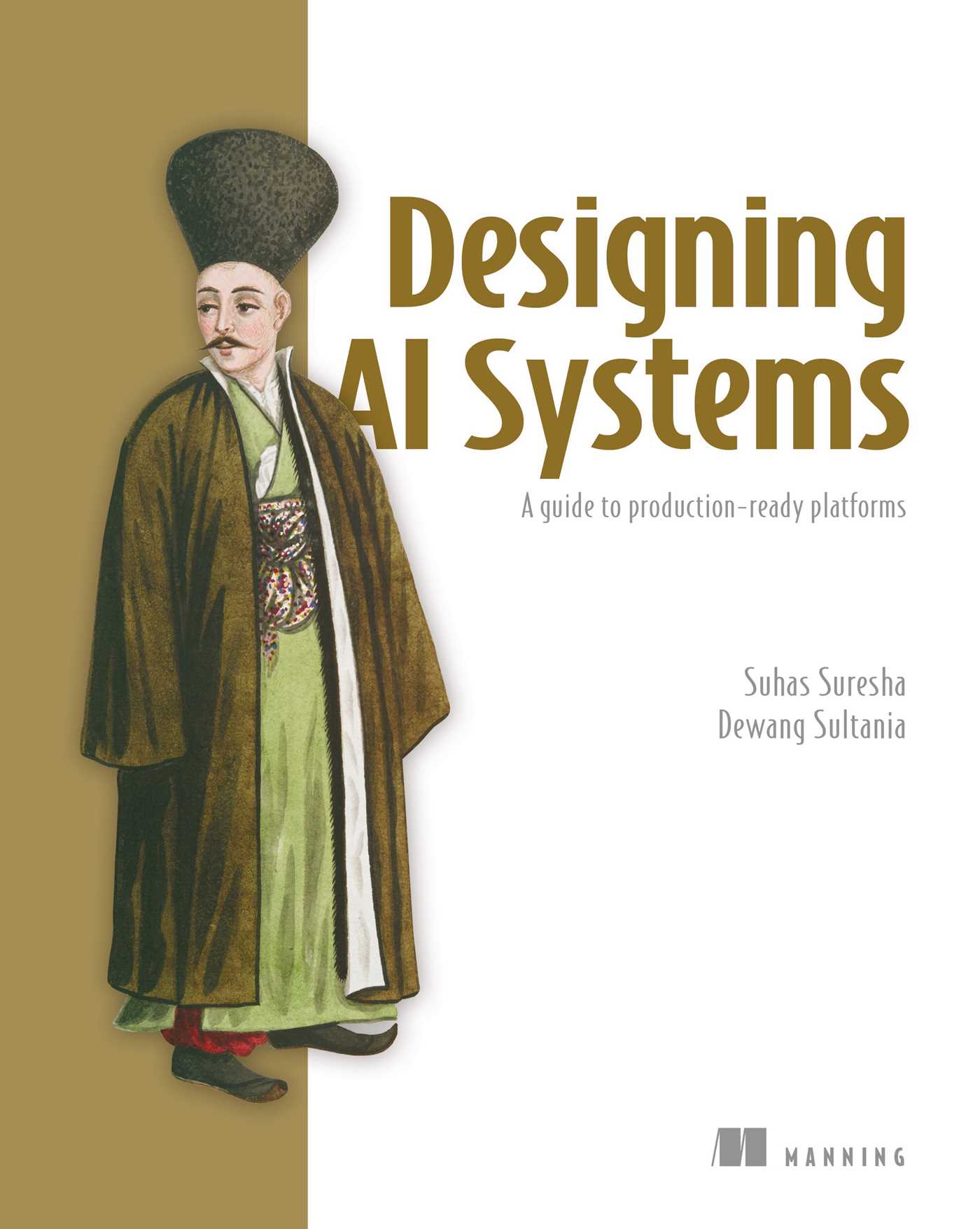
Designing AI Systems
A guide to production-ready platforms
Part of Bookcamp
By Suhas Suresha and Dewang Sultania
Published by Manning
Distributed by Simon & Schuster
LIST PRICE $59.99
PRICE MAY VARY BY RETAILER
Free shipping when you spend $40. Terms apply.
Buy from Other Retailers
Table of Contents
About the Book
Get the eBook free when you register your print book at Manning.
AI applications need much more than a connection to a model. To work well in the real world, they need memory, access to company knowledge, safe ways to take action, clear rules, and reliable operations behind the scenes. Rather than rebuilding those pieces for every project, organizations can create a shared AI platform that supports all their AI applications.
Designing AI Systems shows you how to build that platform. Starting from scratch, you’ll create the core services that real AI applications depend on: a way to connect to different AI providers, a way to remember earlier interactions, a way to bring in your organization’s own data, and a way to let AI systems use tools and act safely within company rules. By the end, you’ll understand not just how to call an AI model but how to build the full system around it.
This book focuses on the part of AI development that usually gets overlooked: everything required to make an AI system reliable, manageable, and ready for production. With complete Python code in every chapter, you’ll build a working reference implementation you can adapt to your own needs. You’ll also learn the practical operational skills that matter in production, including managing costs, routing requests, enforcing safety controls, and evaluating system quality.
The result is a solid foundation for AI applications that can use company knowledge, carry out multi-step work, connect to outside tools, and remain trustworthy and governable as they scale.
What's inside
For software engineers, platform engineers, and technical architects building and scaling AI systems. You should be comfortable with Python and basic software architecture.
About the author
Suhas Suresha is a Senior Machine Learning Engineer at Adobe, where he builds large-scale generative AI platforms across the full machine learning lifecycle. He previously co-founded QALY, where he helped deploy real-time ECG analysis models to more than 100,000 users. He holds a master’s degree in computational and applied mathematics from Stanford University.
Dewang Sultania is a Senior Machine Learning Engineer at Netflix, where he designs scalable systems for multimodal generative AI, diffusion models, and video processing. Previously at Adobe, he built production systems for large language models, including data pipelines, fine-tuning, retrieval-based systems, and prompt engineering. He also helped design the platform infrastructure used to deploy large language models across Adobe’s product suite.
AI applications need much more than a connection to a model. To work well in the real world, they need memory, access to company knowledge, safe ways to take action, clear rules, and reliable operations behind the scenes. Rather than rebuilding those pieces for every project, organizations can create a shared AI platform that supports all their AI applications.
Designing AI Systems shows you how to build that platform. Starting from scratch, you’ll create the core services that real AI applications depend on: a way to connect to different AI providers, a way to remember earlier interactions, a way to bring in your organization’s own data, and a way to let AI systems use tools and act safely within company rules. By the end, you’ll understand not just how to call an AI model but how to build the full system around it.
This book focuses on the part of AI development that usually gets overlooked: everything required to make an AI system reliable, manageable, and ready for production. With complete Python code in every chapter, you’ll build a working reference implementation you can adapt to your own needs. You’ll also learn the practical operational skills that matter in production, including managing costs, routing requests, enforcing safety controls, and evaluating system quality.
The result is a solid foundation for AI applications that can use company knowledge, carry out multi-step work, connect to outside tools, and remain trustworthy and governable as they scale.
What's inside
- How to design and build an AI platform from the ground up
- The core services that AI applications need in order to work reliably
- A flexible way to work with different AI providers
- Memory across conversations and strategies for handling long context
- Methods for connecting AI to company data and documents
- Safe, controlled ways for AI systems to use tools and take action
- Production-ready communication patterns and request routing
- Operational practices for monitoring, cost control, and quality evaluation
For software engineers, platform engineers, and technical architects building and scaling AI systems. You should be comfortable with Python and basic software architecture.
About the author
Suhas Suresha is a Senior Machine Learning Engineer at Adobe, where he builds large-scale generative AI platforms across the full machine learning lifecycle. He previously co-founded QALY, where he helped deploy real-time ECG analysis models to more than 100,000 users. He holds a master’s degree in computational and applied mathematics from Stanford University.
Dewang Sultania is a Senior Machine Learning Engineer at Netflix, where he designs scalable systems for multimodal generative AI, diffusion models, and video processing. Previously at Adobe, he built production systems for large language models, including data pipelines, fine-tuning, retrieval-based systems, and prompt engineering. He also helped design the platform infrastructure used to deploy large language models across Adobe’s product suite.
Product Details
- Publisher: Manning (October 27, 2026)
- Length: 422 pages
- ISBN13: 9781633434523
Browse Related Books
Resources and Downloads
High Resolution Images
-
Book Cover Image (jpg): Designing AI Systems
Trade Paperback 9781633434523