Plus, receive recommendations and exclusive offers on all of your favorite books and authors from Simon & Schuster.
Published by UNM Press
Distributed by Simon & Schuster
LIST PRICE $19.95
PRICE MAY VARY BY RETAILER
Get 25% off with code GIFT26 plus free shipping on orders of $40 or more. Discount on physical products only. Terms apply.
Buy from Other Retailers
Table of Contents
About the Book
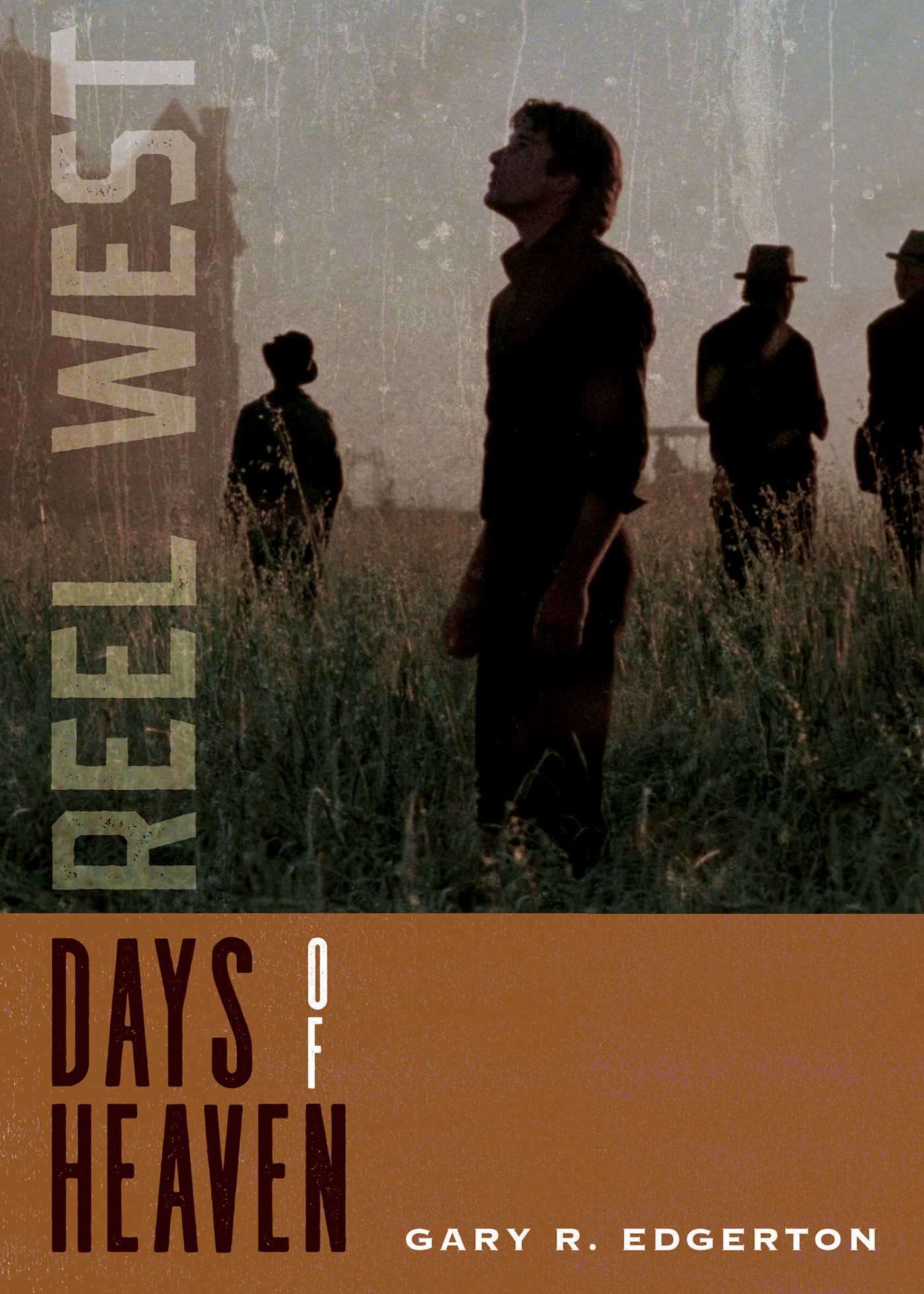
A comprehensive account of the making and legacy of Terrence Malick’s elegiac 1978 Western, Days of Heaven, starring Richard Gere, Brooke Adams, and Sam Shepard.
Director Terrence Malick’s 1978 Western, Days of Heaven, stands out for its dreamlike cinematography and sparse, haunting plot. Malick’s writing and direction animate the usual Western tropes with a uniquely personal style and sensibility. Set in 1916, the threadbare plot resembles a biblical parable more than a traditional Western, as the main characters grapple with their fortunes and face tremendous social change at this pivotal juncture in American history.
In this gripping new addition to the Reel West series, Gary Edgerton offers a comprehensive portrait of Malick’s early career, the making of Days of Heaven, its reception by audiences and critics, and its contributions to Western film. Edgerton’s holistic treatment of Days of Heaven firmly positions it as one of the most skillfully produced, artistically innovative, and culturally resonant Westerns in the long history of the genre.
Excerpt
Introduction
Terrence Malick’s New-Wave Western
Wilderness is the place where everything seems possible. . . . In the region where I grew up, everyone felt it in a very strong way. This sense of space disappearing, we nevertheless can find it in cinema, which will pass it on to us. . . . For an hour, or for two days, or longer, these films can enable small changes of heart, changes that mean the same thing: to live better and to love more.
—Malick interviewed in Le Monde, May 17, 1979
Terrence Malick’s improbable rise in 1970s Hollywood speaks to both the era’s receptivity to new auteur voices and his own unique perspective. I first became aware of him when reading rave reviews of Badlands following its 1973 New York Film Festival premiere. As an undergraduate student and avid member of the film generation, I was then watching up to two hundred movies a year. I finally got the opportunity to see Malick’s first feature film later in the spring of 1974, when Warner Bros. released it in an odd pairing with Mel Brooks’s Blazing Saddles (1974). It was not what I expected. Although critics likened Badlands to Arthur Penn’s Bonnie and Clyde (1967), it was neither action-packed nor glamorous; rather, it was dreamy, detached, and evoked the unpolished, on-location feel of a European film. Malick was emerging as a new-wave Hollywood writer-director with a distinctive regionalist sensibility. Five years later, his lyrical, elegiac Western, Days of Heaven, fully realized his deeply personal pastoral aesthetic.
Terrence Malick was born on November 30, 1943, in Ottawa, Illinois, his mother’s hometown. As a baby, his family relocated to Waco, Texas, before moving for good when he was seven to the small city of Bartlesville, Oklahoma, on reservation land of the Cherokee Nation. Malick’s father, Emil, was a geologist and oil executive at Phillips Petroleum, which is still based in Bartlesville. Emil was the son of Lebanese Assyrian Christians who immigrated to the United States in 1917 for political and religious reasons from Urmia in West Azerbaijan, now a province of Iran. Terrence’s mother, Irene (née Thompson), was an Irish Catholic homemaker. Emil and Irene provided Terrence with a solid upper-middle-class upbringing, sending him to the private coeducational St. Stephen’s Episcopal School, a boarding school, in Austin, Texas, for grades eight through twelve. His formative years therefore were spent living on the southern plains of Oklahoma and Texas.
Terrence Malick graduated from Harvard in 1965 with a bachelor’s degree in philosophy, summa cum laude, earning a Rhodes scholarship to Magdalen College, Oxford University. He left before completing his degree, however, when he clashed with his advisor, the noted philosopher Gilbert Ryle, over his desire to write his thesis exploring Martin Heidegger’s contributions to phenomenology. Malick was especially drawn to Heidegger’s emphasis on immediate experience as the way in which people create meaning and best come to know the world by immersing fully and interacting directly with nature, other living beings, and hand- and machine-made things. This perspective will eventually underpin Malick’s distinctive and individualistic filmmaking style, providing a useful framework through which to understand why Days of Heaven and his other films look and sound the way they do.
Terrence Malick returned to the United States in 1967, worked intermittently as a freelance journalist for Life, Newsweek, and The New Yorker, before accepting a one-year teaching position in philosophy at MIT in 1968 as a sabbatical replacement while also translating Martin Heidegger’s The Essence of Reasons (Vom Wesen des Grundes), which was published by Northwestern University Press in 1969. Malick made a career shift that year, becoming one of the eighteen inaugural fellows at the newly launched American Film Institute (AFI) Conservatory’s MFA production program along with Paul Schrader and Caleb Deschanel. “I was not a good teacher, so I decided to do something else,” explains Malick. “I had always liked movies in a kind of naïve way. They seemed no less an improbable career than anything else.”1 Malick graduated from AFI in 1971 alongside David Lynch, who had entered the MFA program with its second cohort in 1970.
Malick’s move to the West Coast in 1969 resulted in his making numerous movie industry connections and several lifelong friendships with other aspiring filmmakers living in the Los Angeles area at the time. He juggled occasional script doctoring jobs on such features as Drive, He Said (1971) for Jack Nicholson and Dirty Harry (1971) for Irvin Kershner along with completing his experiential studies at the AFI Conservatory. He reached beyond his AFI connections to recruit Harry Dean Stanton, Warren Oates, and Tony Bill to star in his short seventeen-minute thesis film, Lanton Mills (1969), a Western spoof. Immediately after graduation, Malick secured representation from the up-and-coming agent and future studio executive Mike Medavoy, who specialized in managing young Hollywood talent around his own age, such as clients Francis Ford Coppola, George Lucas, and Steven Spielberg. Medavoy believed in Malick’s talent despite his highly idiosyncratic and introverted, albeit determined, personality.
Mike Medavoy thus functioned as Malick’s go-between by finding him a series of opportunities that developed into credited screenwriting assignments, starting with Pocket Money (1972) for First Artists (a production company newly formed by Paul Newman, Barbra Streisand, and Sidney Poitier), Deadhead Miles (1973) for Paramount, and The Gravy Train (aka The Dion Brothers) (1974) for Columbia. Frustrated by unwanted changes made to his scripts during filming—especially on Deadhead Miles—Malick decided to direct a more personal screenplay he had begun years earlier and now was refining during his second year in the AFI MFA program. The script was based on a ripped-from-the-headlines murder spree by nineteen-year-old Charles Starkweather and his fourteen-year-old girlfriend, Caril Ann Fugate, across Nebraska and Wyoming in 1957–58. He renamed his protagonists Kit (Martin Sheen) and Holly (Sissy Spacek) and changed the setting to South Dakota, Montana, and Saskatchewan, although actual filming occurred in southeastern Colorado.
Badlands was an independent movie made on a shoestring budget of approximately $350,000 that was eventually picked up for distribution by Warner Bros. Fueled by Malick’s inherent shyness, his press wariness grew even stronger in response to a smattering of criticisms that followed Badlands’ release. A few reviewers called Badlands’ depiction of the young narrator, Holly, patronizing, and its portrayal of the social environment in which she and Kit live condescending. Malick characterized these judgments as “foolishness” in a 1975 interview: “I grew up around people like Kit and Holly. I see no gulf between them and myself.” He further recalled how “critics talked about influences on the picture and in most cases referred to films I had never seen. My influences were books like The Hardy Boys, Swiss Family Robinson, Tom Sawyer, Huck Finn—all involving an innocent in a drama over his or her head.”2
By and large, Badlands was heralded by the vast majority of critics and audiences as an auspicious debut film for the twenty-nine-year-old producer-writer-director Terrence Malick. It was selected for the prestigious closing night slot at the eleventh annual New York Film Festival on October 13, 1973. Badlands was also one of two highly personal breakout movies by film school–educated, European-influenced exemplars of a new emerging wave in American cinema. The other film was Mean Streets (1973), written and directed by thirty-year-old Martin Scorsese. The response to the homegrown Mean Streets was so positive that its October 2 premiere was followed up with a second festival screening on October 3. Still, the then chief New York Times film critic, Vincent Canby, christened Badlands “the movie that made the festival memorable” in his recap published a week after the two-week proceedings ended.3
The shared 1973 New York Film Festival coming-out experience moreover cemented what would become more than a half-century friendship between Scorsese and Malick. A changing of the guard was well underway in Hollywood whereby an increasing number of promising and ambitious filmmakers, most notably the slightly older Francis Ford Coppola and Brian De Palma, along with Scorsese and Malick’s immediate peers, Steven Spielberg, George Lucas, and John Milius, achieved insider status within the movie industry over the next decade. Together they and their contemporaries transformed Hollywood by occasionally collaborating but always actively advising and supporting each other and their latest movies. Scorsese and Malick were unique in being both part of and somewhat outside this select group, separated by their home bases—New York City and Austin, Texas, respectively—along with the strong and consistent sense of place that is evident in both of their films.
Bartlesville, Oklahoma, turned out to be the center of operations and one of the primary filming locations for Martin Scorsese’s hybrid Western, Killers of the Flower Moon (2023). Knowing it was also Terrence Malick’s boyhood hometown, Scorsese observes that he now understands how his friend’s filmmaking style emerges out of and is intimately reflective of these local surroundings.4 The physical, biological, and cultural environment of the Great Plains is endemic to Days of Heaven as well as Malick’s other directorial efforts. Lewis and Clark misnamed this middle expanse of the Louisiana Territory the Great American Desert; later cartographers renamed this vast interior region of North America the Great Plains. The naturalistic, Dreiser-like narrative of Days of Heaven unfolds in the imaginary landscape of the Texas Panhandle in the southern plains although it was shot in the northernmost reaches of the Great Plains in the border region of Alberta, Canada.
Historian Walter Prescott Webb pointed out in his classic work, The Great Plains (1931), that as pioneers moved West and settled the area, they had to reinvent everything. The laws of the East did not work out West. Likewise, tried-and-true agricultural practices failed on the arid plains. The lack of trees had a major impact on vernacular architecture; and then there was that big sky and vast expanse of space where personal initiative and ingenuity were needed daily to survive and prosper. In the Texas Panhandle, specifically, the environment was often unforgiving—the possibility of tornadoes, thunderstorms, and lightning—the summer heat was oppressive and the winds of winter were relentless and bitter cold. Indigenous people and Euro-Americans alike grew to be keen observers of their surroundings; they learned survival techniques by watching the animals, insects, and plants. That is the kind of instinctual approach and intimate, up-close camera eye that Terrence Malick and cinematographer Néstor Almendros bring to the overall style and especially the mise-en-scène of Days of Heaven.
Product Details
- Publisher: UNM Press (April 6, 2027)
- Length: 168 pages
- ISBN13: 9780826370815
Browse Related Books
Raves and Reviews
“A welcome and arresting addition to the body of literature on the Western. Gary Edgerton adroitly illuminates the film’s enduring spirit and essence in the Western genre, blazing his own trails with a voice and view that are fresh and fulfilling.”
– George Plasketes, professor of media studies at Auburn University
“Edgerton’s manuscript grounds Days of Heaven in time and place while offering erudite understanding for one of America’s most eccentric filmmakers who has broken into the mainstream time and again.”
– Chris Yogerst, author of The Man Who Shot Liberty Valance, The Warner Brothers, and Hollywood Hates Hitler
Resources and Downloads
High Resolution Images
-
Book Cover Image (jpg): Days of Heaven
Trade Paperback 9780826370815