Plus, receive recommendations and exclusive offers on all of your favorite books and authors from Simon & Schuster.
Published by UNM Press
Distributed by Simon & Schuster
LIST PRICE $19.95
PRICE MAY VARY BY RETAILER
Free shipping when you spend $40. Terms apply.
Buy from Other Retailers
Table of Contents
About the Book
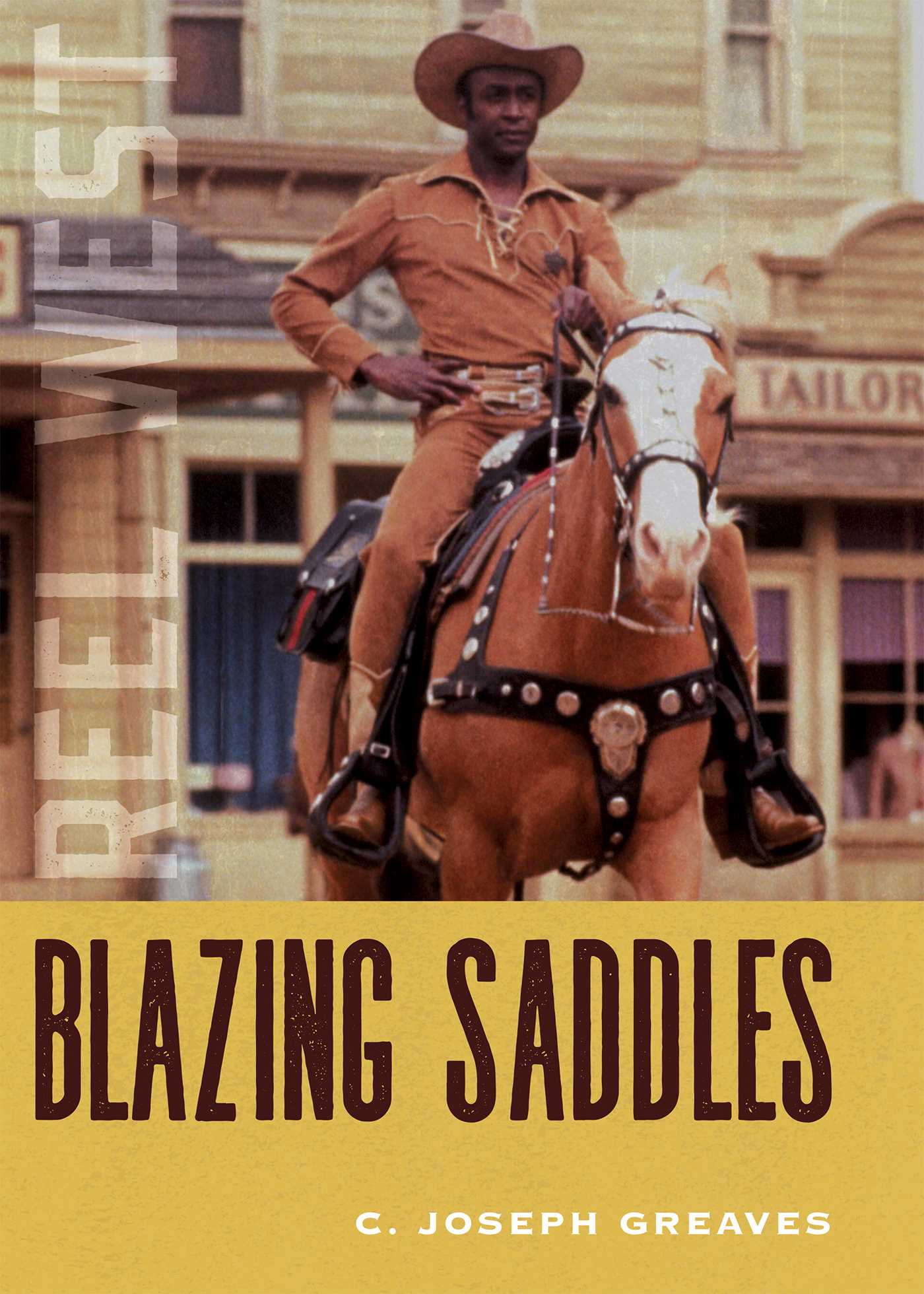
An engaging and often hilarious account of the history, impact, and legacy of Mel Brooks’s iconic Western send-up Blazing Saddles, based on original screenwriter interviews and featuring insightful modern commentary.
Mel Brooks’s Blazing Saddles shocked and delighted audiences upon its release in 1974. An homage to the West and the Western, this riotous parody also took to task the mythological idea of the West created by Hollywood over the course of the twentieth century, especially its portrayal of whiteness, racial stereotypes, and the whitewashing of Western life. Starring Cleavon Little, Gene Wilder, and Madeline Kahn, the film was a turning point in Mel Brooks’s career and for the Western film writ large.
In this hilarious and insightful Reel West volume, C. Joseph Greaves offers interviews with screenwriters Andrew Bergman and Norman Steinberg, as well as original research that sheds new light on Blazing Saddles. He traces the film’s colorful backstory from the writing room where the screenplay first took shape to the film’s triumphant success and its eventual place in the comedic pantheon. Greaves will have you on the edge of your seat as he brings to life the serendipitous moment that inspired the concept for the film—and the moment when Brooks almost called the whole thing off. Greaves’s quick wit, meticulous research, and love of the Western result in a complex and engaging study of what is undeniably one of the iconic films of the twentieth century.
Excerpt
Introduction
During my first visit to Richard Pryor’s home, in the fall of 1994, I found him in bed watching a film on television. That film was Blazing Saddles.
“Great flick,” I said.
“Yeah,” he replied. “I wrote it.”
I hadn’t known that. What I did know was that Richard had multiple sclerosis and that I, as his newly retained attorney, had a number of pressing matters to resolve on his behalf before his health deteriorated to the point that my services would no longer be useful. In the decade that followed I had the pleasure of working closely with Richard, and with his ex-wife Jennifer Lee (who cared for him, and would later remarry him), and of witnessing firsthand his extraordinary courage in the face of a relentlessly debilitating illness.
Fast-forward 25 years, to April of 2019. I’m lecturing on “Writing the Novel” at the University of New Mexico’s annual Writers Conference in Albuquerque, having retired from my LA law practice in 2006, a year after Richard’s death, and having moved to Santa Fe to pursue a second career in letters. Over dinner with some of the other conference faculty—I’d published five novels at that point, with a sixth on the way—I meet Stephen Hull, the newly minted director of the University of New Mexico Press. Joined by biographer James McGrath Morris, we three proceed to discuss everything and nothing, including an intriguing debut novel written by Dennis McCarthy, the brother of author Cormac McCarthy, portions of which I’d recently read in manuscript. Might the University of New Mexico Press be interested in acquiring it for publication? As it turned out they were, and they did, and so I’d helped a fellow writer—himself a recovering lawyer—get published, which is always a gratifying experience.
Fast-forward once again to November of that year, to when an e-mail arrives from Stephen describing the University of New Mexico Press’s plans for its “Reel West” series on classic Western film, his message including the tantalizing invitation, “Is there a movie you’ve always wanted to write about?” My answer is immediate, and reflexive, and it takes me back to 1994, and to Richard Pryor’s sickbed in Encino, California.
“Heck, yes,” I reply. “How about Blazing Saddles?”
But wait a minute. Is Blazing Saddles even a Western? And for that matter, what is it, exactly, that makes a movie a Western?
In the decades before 1960, the consensus answer to the latter question would likely have involved some combination of cowboys and Indians, horses and six-shooters, sheriffs and outlaws. The traditional or “classical” Western melded these and other familiar tropes into a kind of morality play in which, more often than not, a rugged individual, perhaps dogged by a dark or mysterious past, overcomes his personal demons and finds redemption through some singular act of bravery performed in a harsh and lawless frontier environment.
Western heroes were square-jawed and rugged. They tipped their hats to women and took no guff from men. They lived by a code of honor that reflected the ideals and aspirations of their audience and, by extension, of society at large. With few exceptions they were white and male, heterosexual and handsome, and the women in their lives played but accessory roles as damsels in distress, schoolmarms to be courted, or fallen angels with hearts of gold. And of course, their hero’s journey toward redemption usually culminated in a gunfight.
Sound familiar?
Then came the Vietnam War, and a sea change in American norms and mores marked by the sexual revolution, the civil rights movement, and women’s liberation. The Summer of Love and Woodstock. Kent State and Watergate. As the twin pillars of patriotism and patriarchy cracked and crumbled, a new kind of Western—the so-called “revisionist” Western—was born. These were films in which, as in the social and political context of their creation, the once bright line between good guys and bad guys began to blur, and countercultural themes like racism, sexism, and the oppression of Native Americans began finding expression on the silver screen even as the screen itself began shrinking, eventually to the size of a plasma monitor on a wall in the family den or the cellular telephone in your pocket.
We speak here, of course, in generalities. The truth is that plenty of nontraditional Westerns were produced in the first half of the twentieth century, and as many classical Westerns thereafter. Are films like Sam Peckinpah’s The Wild Bunch (1969) and Robert Altman’s McCabe and Mrs. Miller (1971), frequently cited as bellwethers of the revisionist canon, really more radical a departure from the traditional Western formula than, say, William Wellman’s The Ox-Bow Incident (1943) or Delmer Daves’s Broken Arrow (1950)?
Like Darwins of the O.K. Corral, academics, cinema scholars, and Western film historians revel in dissecting and debating these sorts of nuanced questions while advancing overarching theories of cultural and cinematic evolution. As for the rest of us, well, we just like to be entertained, and when it comes to cinematic entertainment, few filmic genres are more enjoyable and enduring than the comedic parody.
Parody, the academic might persist, is itself the product of a taxonomic hierarchy in which the classical Western, bowing to the pressures of a changing society, begat the revisionist Western which, by dint of its introspective nature, eventually and invariably begat satire. And while it’s true that satirical Westerns have been around since the days of Buster Keaton, the sub-genre entered a kind of golden age in parallel with the revisionist movement, thanks to films like Elliot Silverstein’s Cat Ballou (1965), Burt Kennedy’s Support Your Local Sheriff! (1969), and John Huston’s The Life and Times of Judge Roy Bean (1972).
So we can see that the Western tent is a capacious one, but the question remains, is it large enough to accommodate a film like Blazing Saddles?
One angle from which to approach this question is to pose another: Is Young Frankenstein, another enduring Mel Brooks comedy, also a great horror film? The answer, I think all would agree, is that it’s not. Horror, as a cinematic genre, is principally defined by its visceral and psychological effect on its audience. A horror movie should horrify, or at least frighten, and Young Frankenstein aims to do neither.
Louis L’Amour, the prolific and popular author of classic Western fiction, once lamented that, “if a novel was written about the 19th century and set west of the Mississippi, it was labeled a Western and deemed inconsequential by the critics, yet if it was set east of the Mississippi, it might be thought of as a historical novel, and be taken more seriously.” His point being that the Western genre, be it literary or cinematic, is defined not so much by plot or characters, dialogue or effect, as by the time and place in which the story is set. And by those lights, Blazing Saddles—its serial anachronisms notwithstanding—is indisputably a Western.
Which is not to say that plot and characters and dialogue are in any sense incidental to a Western film. In fact, it’s in the recursive nature of Western plots, characters, and dialogue that the germ of satire lies, and Mel Brooks, recognizing as much, sought to incorporate all these familiar elements into his third directorial outing.
You may be relieved to know that I’m neither a film historian nor a cinema scholar, and that what follows is no dry academic treatise. It is, rather, the exploration of a single Western film by a single (occasionally) Western author who happens to believe nobody did satire in twentieth-century American cinema with more enthusiasm or less restraint than writer-director Mel Brooks, just as no Mel Brooks film so fully embodies the madcap spirit of that enterprise than his hilarious, subversive, and ultimately iconic 1974 Western parody, Blazing Saddles.
In the pages that follow, employing the techniques of oral history and contemporary analysis, we’ll profile the film’s principals and trace its colorful backstory, from its unlikely inception through its triumphant commercial success to its exalted place in both the comedic and, occasionally, Western pantheons. Having interviewed screenwriters Norman Steinberg and Andrew Bergman for this project, along with Richard’s widow Jennifer Lee Pryor, I’ll dissect the film’s screenplay and together we’ll debunk a few persistent myths before considering the cultural and temporal significance of Blazing Saddles, its filmic merits, and the magic something that makes it one of the best-loved comedies—and Westerns—of the twentieth century. And best of all, I hope we’ll have some fun doing it.
So heat up some popcorn, or a plate of fireside beans if you’d prefer, and get ready to saddle up.
We’re in for a heck of a ride.
Product Details
- Publisher: UNM Press (February 9, 2027)
- Length: 128 pages
- ISBN13: 9780826370754
Browse Related Books
Raves and Reviews
"This smart and humorous cultural history...[is a] shrewd assessment of a groundbreaking comedy, campfire humor and all."
– Kirkus Reviews
“C. Joseph Greaves’s witty, erudite, and sharply written appreciation of Blazing Saddles is laugh-out-loud funny and a worthy companion to the film, which he brings to vivid, vibrant, and hilarious life.”
– Thomas Doherty, author of True Grit and Hollywood and Hitler, 1933–1939
“Greaves is one helluva good storyteller.”
– The Wall Street Journal
Resources and Downloads
High Resolution Images
-
Book Cover Image (jpg): Blazing Saddles
Trade Paperback 9780826370754