Plus, receive recommendations and exclusive offers on all of your favorite books and authors from Simon & Schuster.
Ayurveda for Raising Healthy Children
A Holistic Guide for Families from Preconception to Adolescence
Foreword by Prerana Manohar / Illustrated by Deepa Kannan
Published by Healing Arts Press
Distributed by Simon & Schuster
LIST PRICE $24.99
PRICE MAY VARY BY RETAILER
Free shipping when you spend $40. Terms apply.
Buy from Other Retailers
Table of Contents
About the Book
Ayurvedic principles and practices for fertility, pregnancy, and raising healthy children
• Explains how to restore balance to the doshas and gut microbiome to support fertility, pregnancy, and childhood health
• Details step-by-step Ayurvedic protocols for detoxification, nutrition, and herbal therapies tailored to each stage of a child’s life
• Provides practical guidance for addressing modern childhood challenges, including autism, ADHD, allergies, and immune resilience
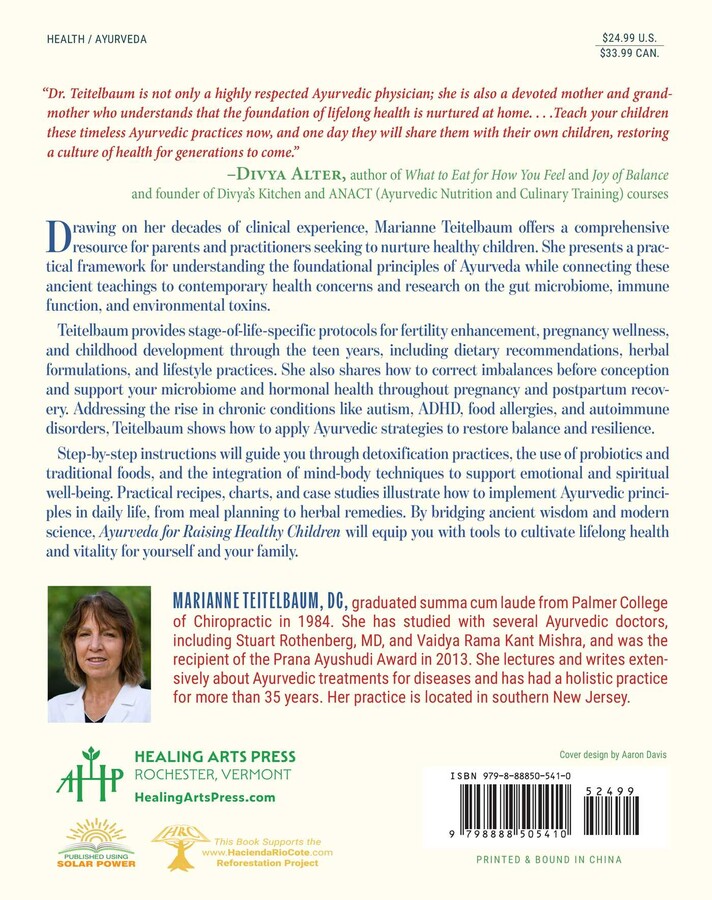
Drawing on her decades of clinical experience, Marianne Teitelbaum offers a comprehensive resource for parents and practitioners seeking to nurture healthy children. She presents a practical framework for understanding the foundational principles of Ayurveda while connecting these ancient teachings to contemporary health concerns and research on the gut microbiome, immune function, and environmental toxins.
Teitelbaum provides stage-of-life-specific protocols for fertility enhancement, pregnancy wellness, and childhood development through the teen years, including dietary recommendations, herbal formulations, and lifestyle practices. She also shares how to correct imbalances before conception and support your microbiome and hormonal health throughout pregnancy and postpartum recovery. Addressing the rise in chronic conditions like autism, ADHD, food allergies, and autoimmune disorders, Teitelbaum shows how to apply Ayurvedic strategies to restore balance and resilience.
Step-by-step instructions will guide you through detoxification practices, the use of probiotics and traditional foods, and the integration of mind-body techniques to support emotional and spiritual well-being. Practical recipes, charts, and case studies illustrate how to implement Ayurvedic principles in daily life, from meal planning to herbal remedies. By bridging ancient wisdom and modern science, Ayurveda for Raising Healthy Children will equip you with tools to cultivate lifelong health and vitality for yourself and your family.
Excerpt
1
Fundamental Principles of Ayurveda
Ayurveda is the science that describes what is appropriate or inappropriate, what brings happiness or sorrow, and what is beneficial or harmful for life; it is the measure of life itself.
Charaka Samhita
This book covers Ayurvedic treatment for preconception up to about age 40. But before you delve into the upcoming chapters to look up specific pathologies you want to learn how to treat, it is best to understand some fundamental principles that will be applied to each health problem. Reading this chapter will make it easy for you to plug in these concepts as you learn about the treatments.
WHAT IS AYURVEDA?
In Sanskrit, the term veda means “knowledge.” In this case, it refers to the most eternally pure, unchanging, and sound knowledge.
Ayu means “life.” In this case, it refers to everything that gives life, including the flow of prana in your body. Ayu is a combination of the physical body, the senses, the soul, and the light of the soul, working together to keep you alive while also keeping prana flowing in a continuous and coordinated fashion.
Ayurveda, thus, can be defined as “knowledge of life,” meaning what is good for your life and what is bad for your life, and its practice requires knowledge of disease, etiological factors, diagnosis, treatment protocols, pacification of imbalances, and purification techniques. Ayurveda is concerned not just with herbs and diet but with anything and everything that interacts with your life, which either enhances or disturbs the flow of prana.
Ayurvedic Philosophy
Ayurveda is designed for keeping the healthy person healthy but also focuses on helping people who are unhealthy. Modern medicine’s aim is generally to treat a sick person once they have been diagnosed with a disease. Which means that not much attempt is made to identify and treat the earliest stages of a disease process so that you don’t get the disease. Instead, you are allowed to go down the long prickly path to ill health, while the medical system superficially patches up symptoms along the way, until you develop full-blown disease. Then the system jumps in and gives treatment, which again consists of patching up the symptoms of that disease.
One thing that I love about Ayurveda is the principle that before a practitioner writes any prescription, they must first see what has gone wrong for each particular patient and correct that, so that the treatment—the herbs, dietary changes, and so on—will work. Sounds like common sense, right?
But all too often I see that modern medicine relies on one-size-fits-all treatment. People diagnosed with an autoimmune disease, for example, such as multiple sclerosis (MS), are immediately prescribed medication to shut down the immune system. No questions are asked to see what has happened in each person’s life to allow their immune system to go out of control in the first place.
But if we take the time to look deeper, we find that there are numerous causes for MS, and they are different in each person.
MS arises from a breakdown of the protective myelin sheath that covers nerve fibers. One person with MS might have consumed excessive amounts of aspartame, an artificial sweetener, over the years, which burned holes in their myelin sheath. Another person might have picked up a parasite that is eating holes in the myelin sheath, while someone else may have followed a low-fat diet for years, depriving their nerve cells and myelin sheath of much-needed cholesterol and causing the sheath to shrivel up and die. Another person may have absorbed too much mercury, which is infamous for burning the myelin sheath and causing MS. In all these cases, and many others, these hot toxins, which have the capability of burning the myelin sheath, also upset the normal functioning of the immune system, allowing it to misfire and attack this delicate sheath in the first place. So in addition to pulling these hot and burning toxins and infections off the sheath, we also need to recalibrate the immune system so it stops launching these attacks (in the many ways mentioned throughout this book).
In the first case, we need to clean and heal the myelin sheath. In the second case, we need to administer herbs to kill the parasite and then give the herbs to heal the nerve tissue and the myelin sheath. In the third patient, we need to introduce good forms of cholesterol and nourish the nerve tissue back to health. And in the fourth case, we need to chelate out the mercury and then give herbs to heal the nerve tissue and the myelin sheath (both of which were burned by the mercury).
This is why the knowledge of Ayurveda is invaluable. Every day people call me to ask me what herb(s) I use to treat this or that particular disease. But it doesn’t work that way! Giving herbs to help resolve the disease is the step we’ll take last. First we have to spend some time figuring out what has gone wrong for the patient, now or in the past, in order to write up a treatment protocol. We don’t just give out herbs according to the symptoms.
Again, it sounds logical, but I can assure you, it is seldom done. We don’t want to make that same mistake in Ayurveda, for example by reflexively giving shilajit or ashwagandha to a thyroid patient without identifying all the reasons why their thyroid is weak in the first place, addressing all those reasons (sometimes it’s twenty reasons!), and then giving the herb(s) for strengthening the thyroid.
How Does Ayurveda Define Health?
According to the ancient Ayurvedic texts, in a person who is healthy:
All doshas are in balance. (Doshas, you’ll recall, are the manifestations of prana in the body; we’ll discuss them later in this chapter.)
All agnis are in balance. Agni, “fire,” refers to the body’s capacity for transforming material into the component parts of the body, from the tissues to the cells. We have the metabolic fire of the stomach, the five flames of the liver, and the seven flames of the tissues. We also have the cellular agnis, which promote transformation at the cellular level.
All the waste products of sweat, urine, and stool are eliminated in a timely manner.
The mind is balanced.
And the ancient texts tell us, that person is healthy who is happy, with excellent coordination between the senses, the light of the soul, the mind, and consciousness.
Ayurveda thus defines health as balance and disease as imbalance. For a person with disease, the goal of treatment is to correct the imbalance by identifying and removing the underlying cause(s).
A Little Background on Ayurveda
Ayurveda is a 5,000-year-old tradition of holistic medicine from India. It is an eternal body of knowledge that was cognized by rishis, or seers, who imbued themselves in the eternal source of life, in Brahma consciousness, the highest state of awareness inherent in each and every one of us. It has been said that the ancient rishis brought this knowledge “down” to human awareness as a gift and that the mythical origins of Ayurveda were practiced in heaven before descending to earth.
This divine legacy was handed down from Brahma to Daksha Prajapati, known as Prajapati, a primordial progenitor entrusted with creation and order in the universe. He is considered the son of Brahma and the son-in-law of Shiva. It was then entrusted to the twin gods known as the Ashvin Kumaras. These were the divine twins, known as the physicians of the gods (Deva Vaidyas) and associated with health, rejuvenation, rescue, and transitions. They are often depicted riding a golden chariot that appears at dawn. The Ashvins were famous for miraculous healings, such as restoring sight to the blind, replacing lost limbs, rejuvenating the aged, and saving people from death or disaster. Because of this, they’re considered the earliest divine physicians, long before later medical gods such as Dhanvantari, the god of medicine and healing and the divine originator of Ayurveda. Symbolically the twins represent balance, duality (body and spirit, night and day, illness and healing), and harmony between opposites. While the Ashvins were considered emergency healers/rescuers, Dhanvantari was the physician, surgeon, and system builder, churning the ocean of milk and carrying a pot of amrita (the nectar of immortality) in addition to the Ayurvedic texts and healing herbs. Both formed the (probable) mythical foundations of Ayurveda.
The Ashvins are said to have had full access to the integral knowledge of Ayurveda, covering all of its eight branches, namely: Kaaya Chikitsa (internal medicine), Baala Chikitsa (pediatrics), Graha Chikitsa or Bhoot Vidya (psychiatry), Urdhyaanga Chikitsa (treatment of the eyes, nose, throat, head, and related diseases), Shalyaroga Chikitsa (surgery), Damstra Chikitsa or Agad Tantra (toxicology), Jara Chikitsa or Rasayana Chikitsa (geriatrics), and Vrishya Chikitsa or Vajikarana (aphrodisiac therapy). Several herbal formulations still in use today are attributed to these ancient Ayurvedic doctors.
Though Ayurveda’s origins are shrouded in mythical lore, it is important to note that the foundational ancient texts describe sophisticated medical treatments for tuberculosis, chronic diseases, bone and muscle diseases, heart disease, respiratory tract diseases accompanied by fever, parasites and worms, ascites, bipolar disorder, and vitiligo, to name a few. They also describe surgical operations (Atharvaveda 1.11.5). Their guidelines for the practice of obstetrics and pediatrics showed them to have an advanced understanding of these fields, including the use of full-fledged aphrodisiac concoctions!
The ancient texts also describe the powers of spiritual healing, which employed the more subtle forms of energetic healing, such as prayer, meditation, mantras, and yagyas, and the vibrational healing powers of natural elements from sources such as five elements: space (ether), air, fire (the sun), water, and earth.
Knowledge of Ayurveda is said to have progressed from pre-Vedic times all the way through the Vedic period, the Buddhist era, the Mogul period, British imperialism, and the post-independence era. Each time period left its own trace of wisdom, amending the body of knowledge while passing it forward, though not in terms of correcting the original texts, but instead adapting them to meet the changing needs of the times. For even though Ayurveda itself, the science of life, is unchangeable, pure, eternal knowledge, humanity undergoes change as human nature evolves. Our understanding of Ayurveda evolves as we work to address the new situations that arise through the millennia.
Charaka, one of the principal contributors to Ayurveda and author of the definitive textbook of Ayurveda, the Charaka Samhita, himself authorized such amendments, allowing future vaidyas, or doctors of Ayurveda (from the Sanskrit root veda, meaning “knowledge”) to add elements as needed to adapt the eternal texts to the current specific situations, though always under strict guidelines in order to protect the integrity of the original works.
About the Illustrator
Deepa Kannan is the author of How to Sleep Better: The Miraculous Tenstep Protocol to Recharge Your Mind and Body.
Product Details
- Publisher: Healing Arts Press (January 19, 2027)
- Length: 448 pages
- ISBN13: 9798888505410
Browse Related Books
Raves and Reviews
“Dr. Teitelbaum is not only a highly respected Ayurvedic physician; she is also a devoted mother and grandmother who understands that the foundation of lifelong health is nurtured at home. With rare clarity and compassion, she translates her extraordinary clinical experience into functional foods, simple remedies, and daily rituals that every family can prepare in their own kitchen. Teach your children these timeless Ayurvedic practices now, and one day they will share them with their own children, restoring a culture of health for generations to come.”
– Divya Alter, author of What to Eat for How You Feel and Joy of Balance and founder of Divya’s
“This is the most comprehensive, authentic, and time-tested Ayurvedic resource on child health available today. Dr. Teitelbaum’s feminine-fueled lance cuts through the inadequacy of today’s medical system to reveal true preventive health from preconception through childhood. Teitelbaum wields books, lectures, and writings like weapons in the quest to raise healthy children.”
– Dylan Smith, Ayurvedic practitioner, and founder of the Vital Veda Podcast
“By far, this is the most in-depth book on Ayurvedic childcare, pregnancy, and treatment of common imbalances during pregnancy, childhood, and adolescence. More than a book about raising healthy children, in this seminal work Dr. Teitelbaum distills more than forty years of clinical practice, research, and wisdom into sutra-like simplicity in a complete, step-by-step guide to Ayurvedic living, eating, and healing for children and parents alike. Easy enough for those new to Ayurveda, yet in-depth enough for Ayurvedic professionals. This will become a new required reading for our Ayurvedic practitioner training!”
– Traci Webb, Ayurvedic practitioner and founder of Ayurvedic Living School
“‘Ayurveda is applicable for every stage of life. Dr. Teitelbaum proves the truth of this statement in her book Ayurveda for Raising Healthy Children. She shows how to apply Ayurvedic techniques and concepts to address a range of modern-day health issues that a family faces before conception, during gestation, and during the growth and development of children—from the neonatal period through the teen years and beyond.”
– Vatsala Sperling, MS, PhD, PDHom, CCH, RSHom, author of Classic Tales from India and The Ayurvedic R
Resources and Downloads
High Resolution Images
-
Book Cover Image (jpg): Ayurveda for Raising Healthy Children
Trade Paperback 9798888505410