Plus, receive recommendations and exclusive offers on all of your favorite books and authors from Simon & Schuster.
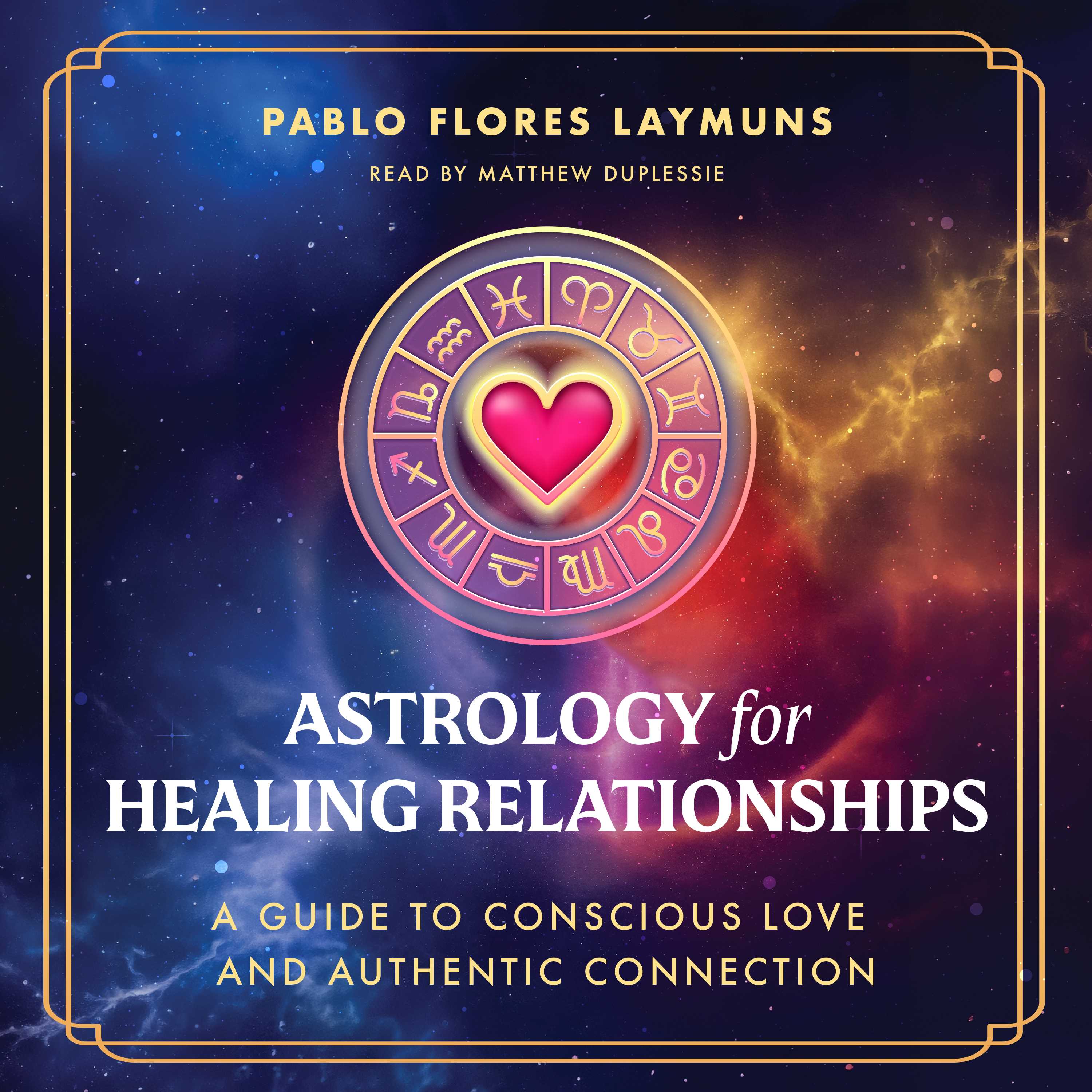
Astrology for Healing Relationships
A Guide to Conscious Love and Authentic Connection
Read by Matthew Duplessie
Published by Simon & Schuster/Inner Traditions
Distributed by Simon & Schuster
LIST PRICE $23.99
PRICE MAY VARY BY RETAILER
Digital products purchased on SimonandSchuster.com must be read on the Simon & Schuster Books app. Learn more.
Get 25% off with code GIFT26 plus free shipping on orders of $40 or more. Discount on physical products only. Terms apply.
Buy from Other Retailers
Table of Contents
About the Book
• Reveals how to identify and transform unconscious emotional patterns by using your birth chart
• Explores how psychological astrology—especially the influence of the Moon and Venus—shapes your emotional needs, love patterns, and partnerships
• Offers practical tools to nurture your inner child and turn relationship challenges into opportunities for growth
Drawing on the principles of psychological and evolutionary astrology, Pablo Flores Laymuns shows that the relationships we attract, the experiences we have with others, and the kinds of people we are drawn to are not random, but reflections of our inner world. Giving special attention to the Moon and Venus, he explores how your birth chart can help you understand what your relationships reveal about you, offering a path to deeper self-knowledge, emotional healing, and more conscious love.
The author gives practical exercises for mapping your birth chart to recognize the roots of your emotional wounds. By applying his targeted healing methods, you will learn to address fears of intimacy and abandonment, low self-worth, jealousy, emotional detachment, and idealization in love. He explains how to interpret key planetary aspects that shape your relationships and keep you from experiencing greater fulfillment in love.
By working with planetary archetypes, the author gives step-by-step practices for nurturing your inner child, setting healthy boundaries, and integrating shadow dynamics. He also gives guided visualizations, journaling prompts, flower essence protocols, and therapeutic tools to heal specific planetary wounds. Applying these practices will guide you in fostering healthier, more conscious relationships rooted in self-awareness, emotional maturity, and authenticity.
Excerpt
Introduction
The Astrology of Love and Inner Healing
One of the problems that affects people the most is the challenge of having a couple relationship and healthily coexisting with someone else. It is not by chance that there has been a boom in the sale of one-person apartments during the past ten years. People prefer virtual relationships over real ones, and socially we tend to self-isolate and focus on ourselves.
Couples are constantly facing problems when living together, including communicating and reaching agreements, among other difficulties. But the truth is that the great majority of these problems are not couple issues as such, but rather cohabitation problems—that is, conflicts that will always arise when we develop close and more intimate relationships with others, sharing personal spaces. Our inability to talk, to empathize, to put ourselves in someone else’s shoes are all symptoms of how difficult it is for us to healthily relate to others; we do not know how to come to an agreement, when to cave in or when to defend a position. This does not happen only with our partners; it also happens with all the people with whom we have close relationships.
Divorce and separation rates are astounding, and it seems as if relationships have become disposable. Our tolerance toward conflicts is very low; we do not know how to overcome the challenges that naturally arise in a two-way relationship. We want everything to be fast and to fit our desires. We are so focused on ourselves that we find it really hard to spend time with someone else and even harder to listen to their needs. Many people are stuck in relationships where they are not happy, where they do not feel loved or valued by their partner.
If things do not work out or if we are not satisfied with our relationship, most people tend to blame their partners, make them responsible for the conflicts, frustrations, and difficulties. It is so common to hear phrases of this kind:
If my partner changed this, everything would be so much easier and I would be able to relax more.
My partner does not give me what I need.
If only he or she was more relaxed.
If he or she was more mature, responsible, and collaborative, everything would be easier.
Many times we think we are trying to save the relationship, but the only thing we do is blame the other—casting ourselves as the victim—instead of looking at ourselves and assuming we are as responsible as the person in front of us.
We do not own the fact that the conflict in our relationships is a personal issue, and as long as we do not understand that having satisfactory relationships is also our responsibility, we will not be happy because we will not have solved the root problem.
This book has been written to establish better couple relationships and bonds that are healthier, happier, and more honest. However, it is characterized by one thing: The focus is not on what the other person does or does not do, but on oneself. In this way, phrases such as “If my partner changed” or “I am not lucky in love” do not fit in the vision suggested in the following pages, because it is not the most appropriate way to act if we actually want to heal our relationships and find someone we can get along with.
It is hard to propose this, since our whole culture and the education we received from a young age tend to place the responsibility for conflict on the other person. Since we were children, we have identified ourselves as the “good guys” or the ones doing the right thing, and we tend to think that others are wrong or are acting in the wrong way. And this applies to both macro aspects in our lives, such as our country, religion, or class, and to micro aspects, like our family, home, friends, team, and so on.
In order to change our point of view or to see how inaccurate it is, we need to start questioning the foundations of who we are and why we act the way we do. This will involve asking ourselves what love is to each one of us. Especially because the kind of love we look for in a partner has nothing to do with the love that spiritual masters and guides talk so much about, which is mainly related to the flow of giving and receiving. Today, our concept of love is more associated with having someone else who can make us feel safe and supported—that is, who can make us happy. We want a partner who fills our inner void, who ends our sense of loneliness, who makes us feel valuable and loved. We are convinced that if this soulmate actually appeared, our life would be complete.
If we were more honest and said the things we feel when we start dating someone, laying all our cards on the table, it would sound something like this:
I am going to give you the responsibility to make me happy, to give me what I need for my life to make sense. I want you to make me feel loved, the way I was when I was little and lived with my parents, or else give me the love that I did not get from my family.
I want you to know that every one of your actions will affect me significantly, since I depend on you. I want you to adjust to my needs and never let me down, to be my emotional support. Now, if for any reason you are not able to give me what I ask for, you should know that we will be in trouble, because all my built-up frustration, loneliness, and rage will be taken out on you. You belong to me now, and you are no longer free: You are here to make me feel fulfilled and satisfied.
With a statement of this kind, chances are our partner will turn around and never come back.
The truth is that we are more concerned with taking than giving. We demand that the other person give us what we want, and at the same time we insist that they change and adapt to our demands. Even in cases where the person says they give more than they receive, the problem is the same: reciprocity. We expect the other to provide what we need, and we give with the hope of receiving something in return. In many cases, we do not end the relationship because we are terrified of being alone. In other words, we either ask excessively or give excessively; what we lack is the ability to receive, to value, and to be grateful for what the other person can offer us.
Masters and wisdom traditions talk about a much more balanced kind of love, where no one takes or gives in excess. But in order to achieve this, first we need to love and appreciate ourselves—precisely what we do not do—as well as to learn to give to ourselves, to provide ourselves with what makes us happy. This is why we suffer so much when a relationship ends; many times we feel that our life loses its meaning at that moment. This happens because we put everything we have on the other person, instead of sharing a part of us with them, so if our partner is gone, then we are left empty.
When happiness is placed outside, depending on someone else, the focus of attention goes from the inside to the outside, and we lose something extremely valuable: the possibility of knowing ourselves, understanding why we act the way we do, contemplating our real needs, and being able to affectively support ourselves.
We live in a society that is constantly distracting us, bombarding us with stimuli and virtual relationships. It makes us believe that we can be complete by obtaining things. It is a system that does not want us to know ourselves and to start asking ourselves the questions that can actually bring us real happiness.
To be able to healthily relate to others, we need to wake up from this dream we live in, where we are almost unconscious. We have to stop and observe, halt the autopilot that time and again makes us fall into patterns that move us away from happiness, and ask ourselves what is it that we really want and need. Only then can we actually go for it.
If we wish to have healthy relationships, we should ask ourselves where we are coming from when we relate to others. Are we in a relationship to avoid being lonely? Are we looking for someone to give us emotional or economic security? Do we want someone to start a family with? Or are we looking for someone to share a joint project?
These are not trivial questions; these subconscious needs that we do not realize we have (or maybe we do) are going to have consequences in our relationships. If we look for someone to give us something that we cannot get for ourselves, we are jeopardizing our will, our strength, our independence, and the possibility of being happy in a more real and fulfilling way. Moreover, it is essential to understand one of the most important universal principles: No one can give you what you do not give yourself. Expecting someone or something outside of you to fill an inner void is a recipe for disaster. For instance, if I do not love, value, or care for myself, it becomes nearly impossible to truly receive the love another can offer me.
About the Reader
Product Details
- Publisher: Simon & Schuster/Inner Traditions (February 2, 2027)
- Runtime: 12 hours and 54 minutes
- ISBN13: 9781668176023
Browse Related Books
Raves and Reviews
“Pablo Flores Laymuns achieves something uncommon: turning astrology into a real tool for healing. This book invites you to stop looking for someone to blame in love and to look inward instead, offering not easy answers, but the right questions to transform your relationships at their roots.”
– Coni Curi, graphic artist and illustrator of AstroTarot and Guided Astrology Workbook
“The striking difference between Pablo Flores Laymuns’s Astrology for Healing Relationships and other books on the subject is that pragmatic issues, such as running a household, daily life, and three-dimensional realities, are not swept under the rug but rather are finally given their due attention. This gives a relationship a genuine chance of succeeding through trials and tribulations—not merely in an imaginary romance.”
– Maja D’Aoust, Witch of the Dawn and author of Shadow Seer Tarot
Resources and Downloads
High Resolution Images
-
Book Cover Image (jpg): Astrology for Healing Relationships
Unabridged Audio Download 9781668176023