
Plus, receive recommendations and exclusive offers on all of your favorite books and authors from Simon & Schuster.
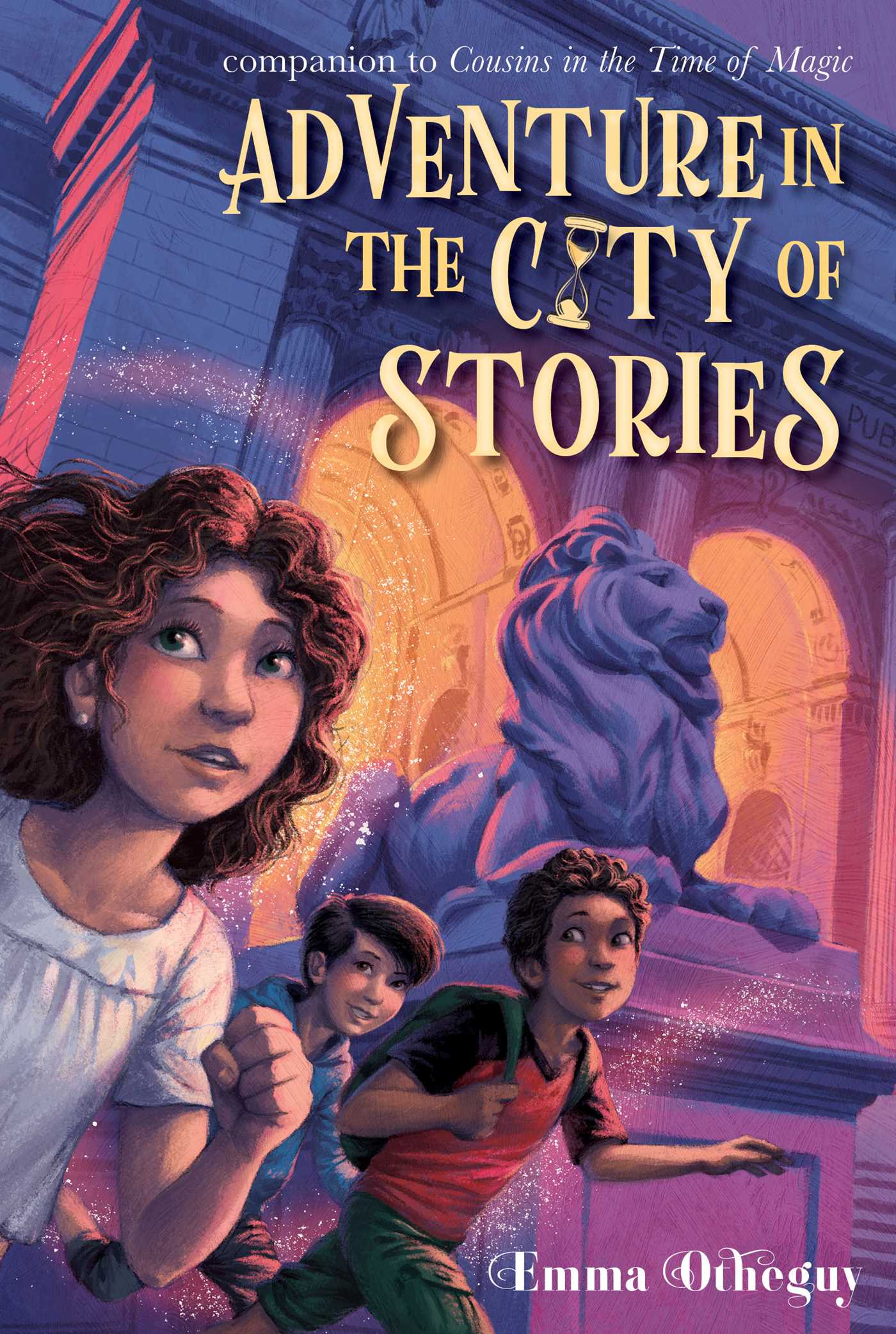
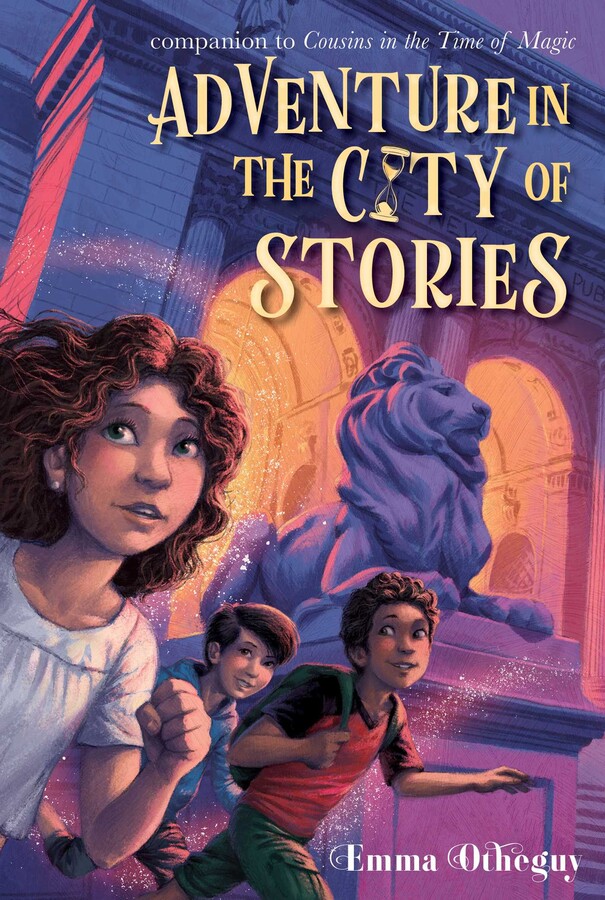
Adventure in the City of Stories
Part of Cousins in the Time of Magic
By Emma Otheguy
Illustrated by Poly Bernatene
LIST PRICE $10.99
PRICE MAY VARY BY RETAILER
Digital products purchased on SimonandSchuster.com must be read on the Simon & Schuster Books app. Learn more.
Free shipping when you spend $40. Terms apply.
Buy from Other Retailers
Table of Contents
About the Book
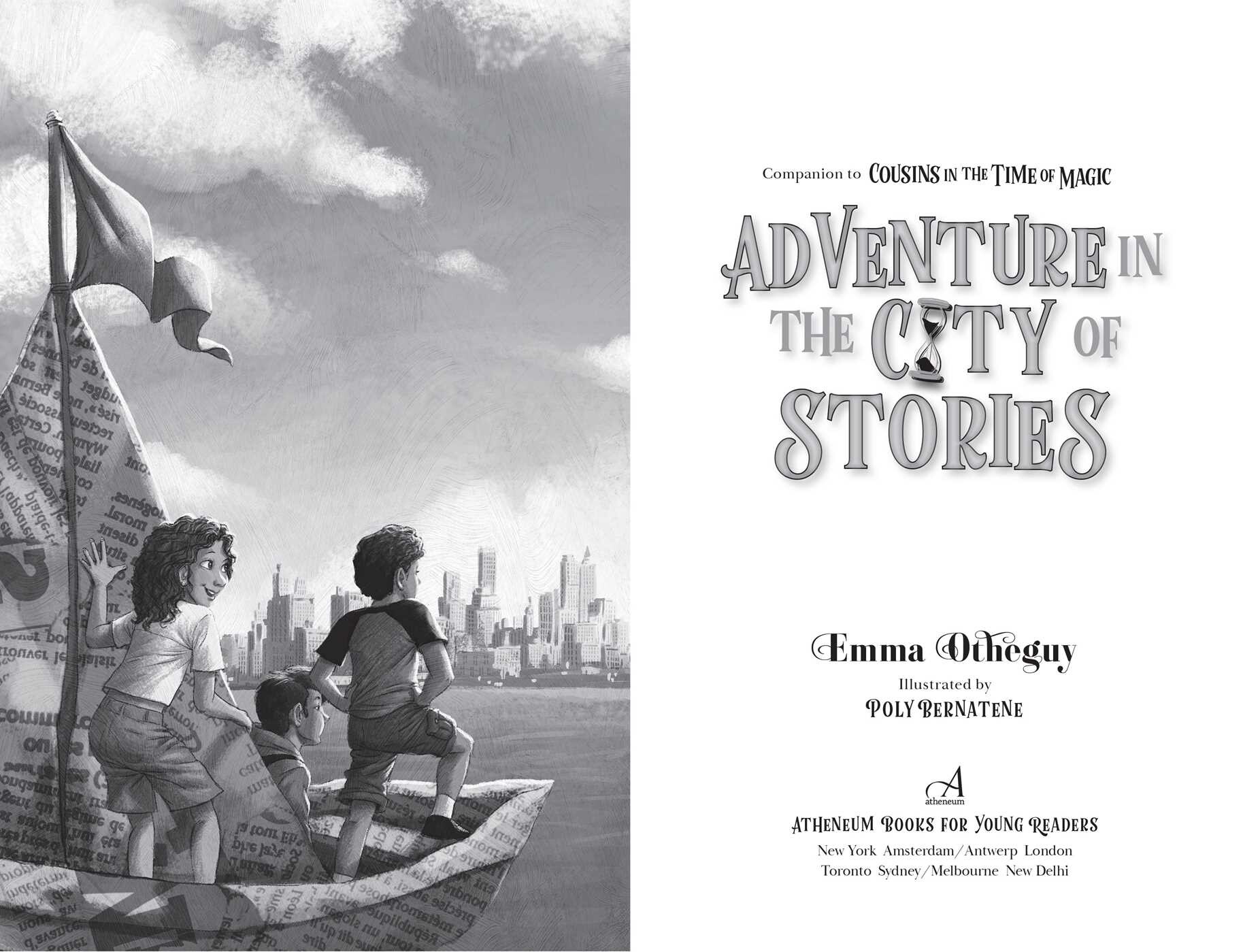
When their aunt is accused of stealing historical artifacts, cousins Jorge, Camila, and Siggy travel back in time to 1930s New York City to clear her name in this “fast-paced historical fantasy” (School Library Journal) companion to Cousins in the Time of Magic.
Cousins Jorge, Camila, and Siggy never imagined that dusty old puppets and a mysterious book would launch them into a time-traveling adventure. But when their aunt is accused of stealing historical treasures belonging to Pura Belpré, the trailblazing Latina librarian and storyteller, the trio is determined to clear her name. Their mission? Travel back in time to 1930s New York City and return Pura’s puppets and the signed first edition of her book, before anyone in the present can prove they’re missing.
But the past is full of danger. A powerful woman will stop at nothing to steal the book, a nosy neighbor is snooping around, and the hardship of the Great Depression is all around them. Luckily Jorge, Camila, and Siggy meet Antonia, a fierce Puerto Rican girl fighting injustice against her community.
The cousins will need courage, quick thinking, and a little help from history to protect Pura Belpré’s legacy, clear their aunt’s name, and make it back home. Can they pull it off before time runs out?
Cousins Jorge, Camila, and Siggy never imagined that dusty old puppets and a mysterious book would launch them into a time-traveling adventure. But when their aunt is accused of stealing historical treasures belonging to Pura Belpré, the trailblazing Latina librarian and storyteller, the trio is determined to clear her name. Their mission? Travel back in time to 1930s New York City and return Pura’s puppets and the signed first edition of her book, before anyone in the present can prove they’re missing.
But the past is full of danger. A powerful woman will stop at nothing to steal the book, a nosy neighbor is snooping around, and the hardship of the Great Depression is all around them. Luckily Jorge, Camila, and Siggy meet Antonia, a fierce Puerto Rican girl fighting injustice against her community.
The cousins will need courage, quick thinking, and a little help from history to protect Pura Belpré’s legacy, clear their aunt’s name, and make it back home. Can they pull it off before time runs out?
Reading Group Guide
Get a FREE ebook by joining our mailing list today! Plus, receive recommendations for your next Book Club read.
By clicking 'Sign me up' I agree to the Terms of Use and acknowledge the Privacy Policy and Notice of Financial Incentive. Free ebook offer available to NEW US subscribers only. Offer redeemable at Simon & Schuster's ebook fulfillment partner. Must redeem within 90 days. See full terms and conditions and this month's choices.
Reading Group Guide
Adventure in the City of Stories
By Emma Otheguy
About the Book
Jorge, Camila, and Siggy are back for another time-traveling journey as they race to clear Tía Xía’s name! She has been accused of stealing valuable artifacts: a signed copy of a picture book by the famous librarian Pura Belpré, and two handmade puppets. The cousins are sent back to 1930s New York City in the midst of the Great Depression when even paper for printing books was considered a luxury. Antonia, an outspoken Puerto Rican girl, rescues the cousins after they’re also accused of theft by a wealthy socialite. With the power of community and storytelling on their side, Jorge, Camila, and Siggy concoct a wild plan to amend the wrongdoings against their family and Antonia’s, but will time turn against them?
Discussion Questions
1. Camila, Tía Xía, Gabriela Mistral, and Antonia are all accused of wrongdoing. What are the similarities in their stories, and why does it matter that they are all women and girls?
2. Cooper seems to have it in for the Hernández family, showing prejudiced behavior and bullying them. How would you deal with bullying and prejudice? Why do you think Cooper acts this way? Use examples from the book and from your own experience to answer.
3. Tía Xía explains that Pura Belpré’s version of “La Cucaracha Martina” was “‘More than impressive. Bold. Radical.’” (Chapter two) Explain what she means by this. Think about the language(s) you and your family speak. How easy is it to find materials in these languages where you currently live? Share with the class.
4. Camila feels anger build in her chest at being wrongfully accused. (Chapter three) Has this ever happened to you? Or have you ever accused someone without knowing the full details? Why does this happen? How can it be prevented?
5. Mrs. Wilson uses the word “unassimilable” when speaking about Puerto Ricans. Describe United States culture and how someone would assimilate to it. Is assimilation possible? Discuss in small groups, then share with the class.
6. Camila remembers this saying about time travel: “If you sew a stitch in time, you pull a thousand threads.” (Chapter five) Think about a moment in history that you wish you could travel to, if you had the opportunity. If you changed something about that time period, how would your life change today?
7. The 135th Street Library is full of people with different skin tones, hair types, and accents. Antonia comments, “‘This isn’t Arturo’s library, this is everyone’s library.’” (Chapter seven) A library is meant to be a space that welcomes all. As a group, discuss your local library. What resources does it have available? Do you feel welcome? If not, how would you feel welcome? Can you share this feedback with the librarians?
8. What purpose does an archive serve? Use examples from the text to explain. Have you ever visited an archive? How is it different from a library?
9. Arthur Schomburg tells Antonia to show Mrs. Wilson evidence of Puerto Rican greatness. What is the evidence she provides, and is it enough to change Mrs. Wilson’s mind? Explain.
10. Why does it matter so much to the Wilsons to have Antonia write a positive review of them and their factory? Why do they expect Puerto Ricans to be grateful even when the Wilsons treat them poorly? Use examples from the text to support your response.
11. Why does Tía Xía show compassion toward Cooper, and what was your reaction to that? Do you think he deserves her understanding? Explain your answer.
12. Beatriz states, “‘When workers read, they have power.’” (Chapter twelve) Explain what she means by that. Use examples from the text, current events and history, or personal experience to respond.
13. What was your reaction to learning about the United States’ ban on flying the Puerto Rican flag in the novel? In small groups, share moments in history you were shocked or surprised to learn about. Did anyone in your group know parts of history that you or others didn’t? How do you learn about history, and why does it matter?
14. Beatriz reminds Antonia to write her perspective because all the workers at Mr. Wilson’s factory are Puerto Ricans, and he can’t afford to lose everyone if he punishes Antonia’s dad. Explain why there is power in numbers and why all the other workers would support Antonia’s family.
15. What makes Camila stop feeling “small and worthless inside” when she thinks about getting in trouble for sharing books in Spanish? (Chapter fourteen) Should she have felt that way in the first place? Explain.
16. Anne Carroll Moore was a librarian who opened the Central Children’s Room at the New York Public Library in 1911. She was a pioneer in changing children’s services in libraries, including advocating for children to borrow books to take home. Why is it important for children to have access to libraries? Why does story time exist?
17. How does Gabriela Mistral’s poem “Miedo” (Fear) make you feel? (Chapter fifteen) Do you agree with Camila’s explanation of “real power”? Explain.
18. Jorge states Pura’s book is “‘evidence that our stories are worth printing in books, and always have been.’” (Chapter sixteen) Find at least three other forms of media, including books, that act as evidence of the impact and greatness of Latinos in the United States.
Extension Activities
1. Principal Santos doesn’t think the kids should read about race in school, and decades prior, Eva Wilson believed books in Spanish shouldn’t exist. Why do these characters want to censor certain stories? Visit your school’s library and your public library, and explore their collection of books about race. How do their collections compare? Write a list of at least five reasons why it is important to learn about the histories and American experiences of ethnicities not your own.
2. In 1996, the American Library Association established the Pura Belpré Award, named after the first Latina librarian at the New York Public Library. Choose one of the books that have won the award, read it, and prepare a book report. ALA’s list of all winners and honor books can be found here: (https://www.ala.org/sites/default/files/2025-09/belpre_winners_coms_1996-to-present.pdf)
3. Gabriela Mistral decides to help the cousins because she also experienced being kicked out of school for writing her truth. Though she grew up in Chile, censorship and freedom of speech are global issues. Write an essay or a poem about what freedom of speech means to you and why it matters. You can reference a piece of history or a personal experience to help guide you.
4. Siggy realizes that the scary newspaper headlines contributed to Mrs. Wilson’s fear of Puerto Ricans, and he wonders, “Did the newspaper never print good stories about Puerto Ricans? Or was it that Mrs. Wilson never bothered to read those stories?” (Chapter six) What do you think? In groups of four, collect current newspapers from school, the library, or family members, and examine the headlines. What messages do they send? Are they targeting specific people? To ensure you have a complete understanding about a group of people or an event, choose one of the articles and find at least three additional sources from different news outlets and alternate perspectives.
5. Adventure in the City of Stories speaks to archives and books like “La Cucaracha Martina” as evidence of Latinos’ amazing history. As a class, think about what you want to leave as evidence of your life. Bring in an artifact that represents your story and present it to the class.
6. Camila thinks, “The Latino kids at Pura’s library were already a part of a great American story, with acting and music and literary stars all their own. They didn’t need to change anything to belong.” (Chapter thirteen) In groups, share your favorite great American stories, including stories you heard from your family. Write and illustrate your version, then compile all the stories into one book.
Guide written by Cynthia Medrano, Librarian at the Highland Park Public Library.
The websites referenced above are provided for informational purposes only and are not intended as an endorsement or promotion of any website. Simon & Schuster is not responsible for the functionality or content of any external website and expressly disclaims all responsibility and liability in connection therewith.
This guide has been provided by Simon & Schuster for classroom, library, and reading group use. It may be reproduced in its entirety or excerpted for these purposes. For more Simon & Schuster guides and classroom materials, please visit simonandschuster.net/m/prek12-teachers-librarians/teaching-resources.
Adventure in the City of Stories
By Emma Otheguy
About the Book
Jorge, Camila, and Siggy are back for another time-traveling journey as they race to clear Tía Xía’s name! She has been accused of stealing valuable artifacts: a signed copy of a picture book by the famous librarian Pura Belpré, and two handmade puppets. The cousins are sent back to 1930s New York City in the midst of the Great Depression when even paper for printing books was considered a luxury. Antonia, an outspoken Puerto Rican girl, rescues the cousins after they’re also accused of theft by a wealthy socialite. With the power of community and storytelling on their side, Jorge, Camila, and Siggy concoct a wild plan to amend the wrongdoings against their family and Antonia’s, but will time turn against them?
Discussion Questions
1. Camila, Tía Xía, Gabriela Mistral, and Antonia are all accused of wrongdoing. What are the similarities in their stories, and why does it matter that they are all women and girls?
2. Cooper seems to have it in for the Hernández family, showing prejudiced behavior and bullying them. How would you deal with bullying and prejudice? Why do you think Cooper acts this way? Use examples from the book and from your own experience to answer.
3. Tía Xía explains that Pura Belpré’s version of “La Cucaracha Martina” was “‘More than impressive. Bold. Radical.’” (Chapter two) Explain what she means by this. Think about the language(s) you and your family speak. How easy is it to find materials in these languages where you currently live? Share with the class.
4. Camila feels anger build in her chest at being wrongfully accused. (Chapter three) Has this ever happened to you? Or have you ever accused someone without knowing the full details? Why does this happen? How can it be prevented?
5. Mrs. Wilson uses the word “unassimilable” when speaking about Puerto Ricans. Describe United States culture and how someone would assimilate to it. Is assimilation possible? Discuss in small groups, then share with the class.
6. Camila remembers this saying about time travel: “If you sew a stitch in time, you pull a thousand threads.” (Chapter five) Think about a moment in history that you wish you could travel to, if you had the opportunity. If you changed something about that time period, how would your life change today?
7. The 135th Street Library is full of people with different skin tones, hair types, and accents. Antonia comments, “‘This isn’t Arturo’s library, this is everyone’s library.’” (Chapter seven) A library is meant to be a space that welcomes all. As a group, discuss your local library. What resources does it have available? Do you feel welcome? If not, how would you feel welcome? Can you share this feedback with the librarians?
8. What purpose does an archive serve? Use examples from the text to explain. Have you ever visited an archive? How is it different from a library?
9. Arthur Schomburg tells Antonia to show Mrs. Wilson evidence of Puerto Rican greatness. What is the evidence she provides, and is it enough to change Mrs. Wilson’s mind? Explain.
10. Why does it matter so much to the Wilsons to have Antonia write a positive review of them and their factory? Why do they expect Puerto Ricans to be grateful even when the Wilsons treat them poorly? Use examples from the text to support your response.
11. Why does Tía Xía show compassion toward Cooper, and what was your reaction to that? Do you think he deserves her understanding? Explain your answer.
12. Beatriz states, “‘When workers read, they have power.’” (Chapter twelve) Explain what she means by that. Use examples from the text, current events and history, or personal experience to respond.
13. What was your reaction to learning about the United States’ ban on flying the Puerto Rican flag in the novel? In small groups, share moments in history you were shocked or surprised to learn about. Did anyone in your group know parts of history that you or others didn’t? How do you learn about history, and why does it matter?
14. Beatriz reminds Antonia to write her perspective because all the workers at Mr. Wilson’s factory are Puerto Ricans, and he can’t afford to lose everyone if he punishes Antonia’s dad. Explain why there is power in numbers and why all the other workers would support Antonia’s family.
15. What makes Camila stop feeling “small and worthless inside” when she thinks about getting in trouble for sharing books in Spanish? (Chapter fourteen) Should she have felt that way in the first place? Explain.
16. Anne Carroll Moore was a librarian who opened the Central Children’s Room at the New York Public Library in 1911. She was a pioneer in changing children’s services in libraries, including advocating for children to borrow books to take home. Why is it important for children to have access to libraries? Why does story time exist?
17. How does Gabriela Mistral’s poem “Miedo” (Fear) make you feel? (Chapter fifteen) Do you agree with Camila’s explanation of “real power”? Explain.
18. Jorge states Pura’s book is “‘evidence that our stories are worth printing in books, and always have been.’” (Chapter sixteen) Find at least three other forms of media, including books, that act as evidence of the impact and greatness of Latinos in the United States.
Extension Activities
1. Principal Santos doesn’t think the kids should read about race in school, and decades prior, Eva Wilson believed books in Spanish shouldn’t exist. Why do these characters want to censor certain stories? Visit your school’s library and your public library, and explore their collection of books about race. How do their collections compare? Write a list of at least five reasons why it is important to learn about the histories and American experiences of ethnicities not your own.
2. In 1996, the American Library Association established the Pura Belpré Award, named after the first Latina librarian at the New York Public Library. Choose one of the books that have won the award, read it, and prepare a book report. ALA’s list of all winners and honor books can be found here: (https://www.ala.org/sites/default/files/2025-09/belpre_winners_coms_1996-to-present.pdf)
3. Gabriela Mistral decides to help the cousins because she also experienced being kicked out of school for writing her truth. Though she grew up in Chile, censorship and freedom of speech are global issues. Write an essay or a poem about what freedom of speech means to you and why it matters. You can reference a piece of history or a personal experience to help guide you.
4. Siggy realizes that the scary newspaper headlines contributed to Mrs. Wilson’s fear of Puerto Ricans, and he wonders, “Did the newspaper never print good stories about Puerto Ricans? Or was it that Mrs. Wilson never bothered to read those stories?” (Chapter six) What do you think? In groups of four, collect current newspapers from school, the library, or family members, and examine the headlines. What messages do they send? Are they targeting specific people? To ensure you have a complete understanding about a group of people or an event, choose one of the articles and find at least three additional sources from different news outlets and alternate perspectives.
5. Adventure in the City of Stories speaks to archives and books like “La Cucaracha Martina” as evidence of Latinos’ amazing history. As a class, think about what you want to leave as evidence of your life. Bring in an artifact that represents your story and present it to the class.
6. Camila thinks, “The Latino kids at Pura’s library were already a part of a great American story, with acting and music and literary stars all their own. They didn’t need to change anything to belong.” (Chapter thirteen) In groups, share your favorite great American stories, including stories you heard from your family. Write and illustrate your version, then compile all the stories into one book.
Guide written by Cynthia Medrano, Librarian at the Highland Park Public Library.
The websites referenced above are provided for informational purposes only and are not intended as an endorsement or promotion of any website. Simon & Schuster is not responsible for the functionality or content of any external website and expressly disclaims all responsibility and liability in connection therewith.
This guide has been provided by Simon & Schuster for classroom, library, and reading group use. It may be reproduced in its entirety or excerpted for these purposes. For more Simon & Schuster guides and classroom materials, please visit simonandschuster.net/m/prek12-teachers-librarians/teaching-resources.
About the Author
Photograph Emma Otheguy
Emma Otheguy is the author of several books for young readers, including the picture books A Sled for Gabo and Martina Has Too Many Tías, the bilingual picture book Martí’s Song for Freedom, the middle grade Cousins in the Time of Magic series, and the middle grade novels Sofía Acosta Makes a Scene, Silver Meadows Summer, and, with Adam Gidwitz, The Madre de Aguas of Cuba, part of the Unicorn Rescue Society series. Visit her at EmmaOtheguy.com.
About the Illustrator
Poly Bernatene was born in 1972 in Buenos Aires, Argentina, and has been drawing ever since. He graduated from Buenos Aires’s art school, where he developed a great interest in managing different techniques in his work. He has worked in advertisement, animation, and comics. During the last fifteen years, he has established an exciting career as a professional illustrator, having published more than sixty children’s books in eleven countries.
Product Details
- Publisher: Atheneum Books for Young Readers (July 21, 2026)
- Length: 224 pages
- ISBN13: 9781665915236
- Grades: 3 - 7
- Ages: 8 - 12
Browse Related Books
Raves and Reviews
“A fast-paced historical fantasy that skillfully blends time travel, 1930s Latine literary history, contemporary book banning, and longstanding racial, ethnic, and linguistic bias, strengthened by the author’s historical notes.”
– School Library Journal
“This fast-paced adventure has depth and cultural relevance, blending Latine history with timely themes about whose stories are valued. . . . A time-travel quest that honors the power of preserving and sharing stories.”
– Kirkus Reviews
Resources and Downloads
High Resolution Images
-
Book Cover Image (jpg): Adventure in the City of Stories
eBook 9781665915236
-
Author Photo (jpg): Emma Otheguy Photograph Emma Otheguy(0.1 MB)
Any use of an author photo must include its respective photo credit