

Plus, receive recommendations and exclusive offers on all of your favorite books and authors from Simon & Schuster.
0:00 /
LIST PRICE $18.99
PRICE MAY VARY BY RETAILER
Get 20% off with code JULY20 plus free shipping on orders of $40 or more. Discount on physical products only. Terms apply.
Buy from Other Retailers
Table of Contents
About The Book
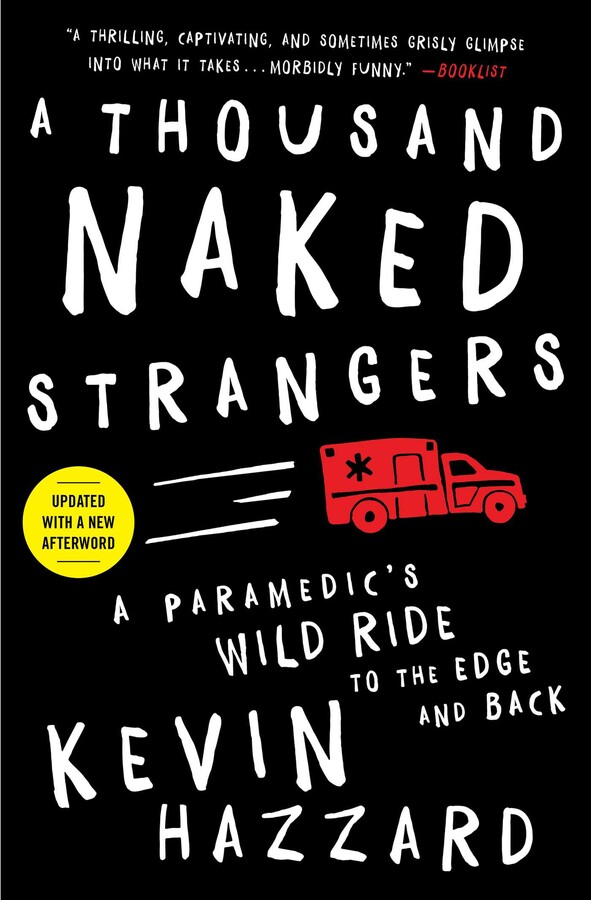
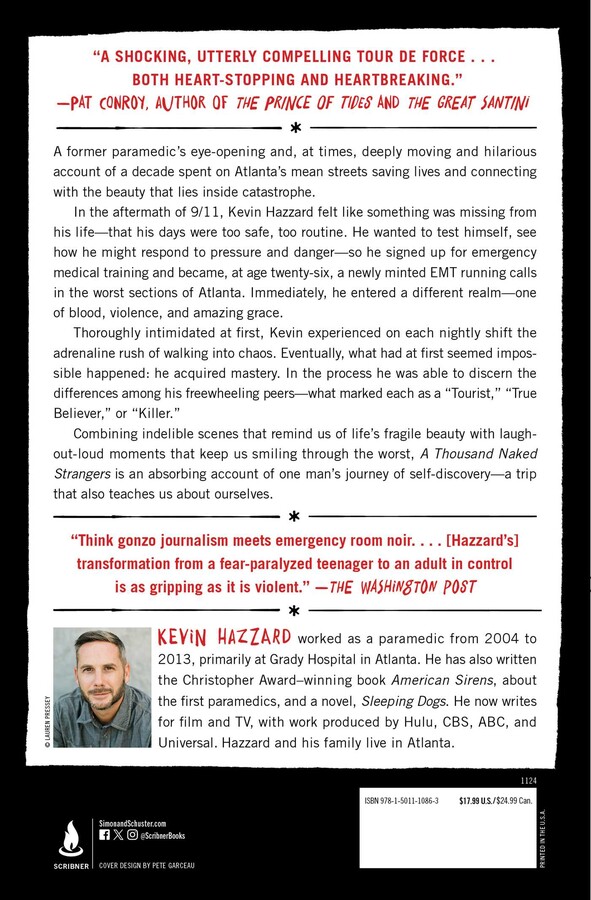
A former paramedic’s "thrilling, captivating" (Booklist), and mordantly funny account of a decade spent as a first responder in Atlanta saving lives and connecting with the drama and occasional beauty that lies inside catastrophe.
In the aftermath of 9/11 Kevin Hazzard felt that something was missing from his life—his days were too safe, too routine. A failed salesman turned local reporter, he wanted to test himself, see how he might respond to pressure and danger. He signed up for emergency medical training and became, at age twenty-six, a newly minted EMT running calls in the worst sections of Atlanta. His life entered a different realm—one of blood, violence, and amazing grace.
Thoroughly intimidated at first and frequently terrified, he experienced on a nightly basis the adrenaline rush of walking into chaos. But in his downtime, Kevin reflected on how people’s facades drop away when catastrophe strikes. As his hours on the job piled up, he realized he was beginning to see into the truth of things. There is no pretense five beats into a chest compression, or in an alley next to a crack den, or on a dimly lit highway where cars have collided. Eventually, what had at first seemed impossible happened: Kevin acquired mastery. And in the process he was able to discern the professional differences between his freewheeling peers, what marked each—as he termed them—as “a tourist,” “true believer,” or “killer.”
Combining indelible scenes that remind us of life’s fragile beauty with laugh-out-loud moments that keep us smiling through the worst, A Thousand Naked Strangers is an absorbing read about one man’s journey of self-discovery—a trip that also teaches us about ourselves.
In the aftermath of 9/11 Kevin Hazzard felt that something was missing from his life—his days were too safe, too routine. A failed salesman turned local reporter, he wanted to test himself, see how he might respond to pressure and danger. He signed up for emergency medical training and became, at age twenty-six, a newly minted EMT running calls in the worst sections of Atlanta. His life entered a different realm—one of blood, violence, and amazing grace.
Thoroughly intimidated at first and frequently terrified, he experienced on a nightly basis the adrenaline rush of walking into chaos. But in his downtime, Kevin reflected on how people’s facades drop away when catastrophe strikes. As his hours on the job piled up, he realized he was beginning to see into the truth of things. There is no pretense five beats into a chest compression, or in an alley next to a crack den, or on a dimly lit highway where cars have collided. Eventually, what had at first seemed impossible happened: Kevin acquired mastery. And in the process he was able to discern the professional differences between his freewheeling peers, what marked each—as he termed them—as “a tourist,” “true believer,” or “killer.”
Combining indelible scenes that remind us of life’s fragile beauty with laugh-out-loud moments that keep us smiling through the worst, A Thousand Naked Strangers is an absorbing read about one man’s journey of self-discovery—a trip that also teaches us about ourselves.
Excerpt
A Thousand Naked Strangers
Six dead bodies. Each unknown to the others—different lives, different endings—stuck in six different morgues. Through the magic of photography, they’ve congregated here—naked, lascivious—in Appendix J of my EMT textbook. The first could be napping. The rest have been either burned or bludgeoned or shot in the face. One is a child. Though no longer alone, they remain nameless, remembered only for their usefulness to Western medicine. Their eyes have been blacked out, but all else is left uncovered. The woman has a huge mound of pubic hair: proof, according to the guy next to me, that she died in the 1970s. From behind us, a girl asks what page we’re looking at, and the pubic hair expert—who hasn’t yet gotten paid and so hasn’t yet bought a textbook, who’s leaning over my shoulder and breathing tobacco breath into my ear—tells her to flip to Appendix J. Page 310. He says he’s seen plenty of dead people, and these, the ones in our book, they’re nothing. The girl agrees. “You want dead bodies,” she says, “good ones? Go to the Internet.”
They’re kindred spirits, these two, and they gravitate to each other, finally, thankfully, leaving me to my anxiety. I slam the book shut as tiny beads of sweat dot my forehead. I’m hot, dizzy, and my face is flushed. For a second I think I’m about to pass out, but then my mouth starts watering and I realize, no. I’m gonna puke. Swallow hard. A deep breath. Class hasn’t started, the door is open. I can still leave without being noticed. Retreating? No, no, you got it all wrong. I am Richard Fucking Nixon, and this is peace with honor. Then the teacher walks in. The door shuts behind him. Eyes front, there is no escape.
He drops his bag on the table. Hands on his hips, legs spread wide. “Welcome to EMT school. Who’s ready to get started?”
• • •
At the time of the 9/11 attacks, I was a reporter and my wife, Sabrina, whom I’d met in college, was working her way up in the world of ad sales. We lived in a small century-old bungalow on the south side of Atlanta, and everything was great until the world changed. In an instant we were at war. Since I’d graduated years before from The Citadel, many of my friends happened to be in the military. As I attended city council meetings and reported on budget cuts and judicial appointments, my friends were killing and being killed. Sabrina and I had dinner one night with a friend who led the first convoy of marines into Iraq. As he described the desert and the land mines and told stories of helicopters flying so low he could feel the heat coming off the rockets they fired, I thought of all the things I hadn’t done.
I’d had my chances to join the military during college but hadn’t. I thought about it again, but not seriously. Still, I wanted to be tested. I wanted to prove to myself that I could handle the pressure of life-and-death moments. How I’d do that, I couldn’t say. Ultimately, opportunity would present itself in the form of a sewage disaster. The county was deep into an enormous wastewater project, and scaffolding leading down into the yawning tunnel collapsed one night. A half-dozen workers simply disappeared into the earth. My editor sent me to cover the rescue. I spent a long quiet night staring into the hole, hoping to see survivors but knowing there’d be only bodies. I wrote stories about the project, the faulty scaffolding, the dead. I wrote about the rescuers: specially trained fire-medics who carried themselves in a way that said they knew something, if not necessarily about the world, then surely about themselves.
In the summer of 2002, a tiny publisher put out my first book—a short and rambling coming-of-age novel. Once it was out, I quit reporting but stayed with the paper. Because I needed time but also money, I got a night job as a paper boy. In the span of two days, I went from writing newspapers to delivering them. Our friends thought I’d lost my mind. During the long dark nights, as I drove around delivering papers to the far reaches of Fulton County, my thoughts would wander to my friends in Iraq and Afghanistan. Slowly, those stories I’d written about paramedics crept back into my consciousness.
“So go back to school,” Sabrina said one morning when I brought it up.
Shut up and take action—this is her solution to all problems. How nice it must feel to be a type A in a world gone soft. That afternoon I started poking around on the Internet, and by nightfall, almost by accident, I was enrolled in an EMT program at a local technical college.
This was a rash decision. I knew nothing about medicine, and the only experience I’d had dealing with emergencies did not end well. It was the summer of 1997, and I was leading Jet Ski tours when two guys crashed into each other. I didn’t see it, but I heard the thud, and when I got there I found them floating in the water—one startled, the other missing a mouth. His eyes were wide and bulging. His face below the cheekbones was gone; blood and teeth dripped into the water. His skin hung slack where his jaw should’ve been. I was young, scared, overwhelmed. I did the only thing bystanders are asked not to do in an emergency: I panicked.
• • •
Seven years later, here I am. In EMT school. The door is shut, class has started. I’m embarking on a career that will require me not merely to witness emergencies but to participate in the rescue. I can’t help thinking I’ve made a huge mistake.
With me in the classroom are two dozen misfits, all looking for a respectable job. Our instructor is Alan, a lifelong medic who came up when EMS was in its infancy. He tells stories of running calls on dark streets and in cramped apartments. His tales smell of blood and desperation. They’re real and exciting but scary, since eventually the dying patients will be ours. And though we’re a long way from that, the photographs in the book make clear what awaits us. Maybe he can read my mind—hell, maybe I’m not the only one having second thoughts—because Alan tells us, right out of the gate, if we’re not sure we can handle this, now is the time to leave. A couple of people laugh as though the mere suggestion is ridiculous, but I’m not one of them. I didn’t grow up wanting to be an EMT, nor do I know if I’ll like it. What I do know is I want to get hip-deep in the things that matter. I want to know if I’m more than the kid who panicked that summer day in 1997. I want to know if I can be counted on.
So I stay.
1
I’ve Made a Mistake
Six dead bodies. Each unknown to the others—different lives, different endings—stuck in six different morgues. Through the magic of photography, they’ve congregated here—naked, lascivious—in Appendix J of my EMT textbook. The first could be napping. The rest have been either burned or bludgeoned or shot in the face. One is a child. Though no longer alone, they remain nameless, remembered only for their usefulness to Western medicine. Their eyes have been blacked out, but all else is left uncovered. The woman has a huge mound of pubic hair: proof, according to the guy next to me, that she died in the 1970s. From behind us, a girl asks what page we’re looking at, and the pubic hair expert—who hasn’t yet gotten paid and so hasn’t yet bought a textbook, who’s leaning over my shoulder and breathing tobacco breath into my ear—tells her to flip to Appendix J. Page 310. He says he’s seen plenty of dead people, and these, the ones in our book, they’re nothing. The girl agrees. “You want dead bodies,” she says, “good ones? Go to the Internet.”
They’re kindred spirits, these two, and they gravitate to each other, finally, thankfully, leaving me to my anxiety. I slam the book shut as tiny beads of sweat dot my forehead. I’m hot, dizzy, and my face is flushed. For a second I think I’m about to pass out, but then my mouth starts watering and I realize, no. I’m gonna puke. Swallow hard. A deep breath. Class hasn’t started, the door is open. I can still leave without being noticed. Retreating? No, no, you got it all wrong. I am Richard Fucking Nixon, and this is peace with honor. Then the teacher walks in. The door shuts behind him. Eyes front, there is no escape.
He drops his bag on the table. Hands on his hips, legs spread wide. “Welcome to EMT school. Who’s ready to get started?”
• • •
At the time of the 9/11 attacks, I was a reporter and my wife, Sabrina, whom I’d met in college, was working her way up in the world of ad sales. We lived in a small century-old bungalow on the south side of Atlanta, and everything was great until the world changed. In an instant we were at war. Since I’d graduated years before from The Citadel, many of my friends happened to be in the military. As I attended city council meetings and reported on budget cuts and judicial appointments, my friends were killing and being killed. Sabrina and I had dinner one night with a friend who led the first convoy of marines into Iraq. As he described the desert and the land mines and told stories of helicopters flying so low he could feel the heat coming off the rockets they fired, I thought of all the things I hadn’t done.
I’d had my chances to join the military during college but hadn’t. I thought about it again, but not seriously. Still, I wanted to be tested. I wanted to prove to myself that I could handle the pressure of life-and-death moments. How I’d do that, I couldn’t say. Ultimately, opportunity would present itself in the form of a sewage disaster. The county was deep into an enormous wastewater project, and scaffolding leading down into the yawning tunnel collapsed one night. A half-dozen workers simply disappeared into the earth. My editor sent me to cover the rescue. I spent a long quiet night staring into the hole, hoping to see survivors but knowing there’d be only bodies. I wrote stories about the project, the faulty scaffolding, the dead. I wrote about the rescuers: specially trained fire-medics who carried themselves in a way that said they knew something, if not necessarily about the world, then surely about themselves.
In the summer of 2002, a tiny publisher put out my first book—a short and rambling coming-of-age novel. Once it was out, I quit reporting but stayed with the paper. Because I needed time but also money, I got a night job as a paper boy. In the span of two days, I went from writing newspapers to delivering them. Our friends thought I’d lost my mind. During the long dark nights, as I drove around delivering papers to the far reaches of Fulton County, my thoughts would wander to my friends in Iraq and Afghanistan. Slowly, those stories I’d written about paramedics crept back into my consciousness.
“So go back to school,” Sabrina said one morning when I brought it up.
Shut up and take action—this is her solution to all problems. How nice it must feel to be a type A in a world gone soft. That afternoon I started poking around on the Internet, and by nightfall, almost by accident, I was enrolled in an EMT program at a local technical college.
This was a rash decision. I knew nothing about medicine, and the only experience I’d had dealing with emergencies did not end well. It was the summer of 1997, and I was leading Jet Ski tours when two guys crashed into each other. I didn’t see it, but I heard the thud, and when I got there I found them floating in the water—one startled, the other missing a mouth. His eyes were wide and bulging. His face below the cheekbones was gone; blood and teeth dripped into the water. His skin hung slack where his jaw should’ve been. I was young, scared, overwhelmed. I did the only thing bystanders are asked not to do in an emergency: I panicked.
• • •
Seven years later, here I am. In EMT school. The door is shut, class has started. I’m embarking on a career that will require me not merely to witness emergencies but to participate in the rescue. I can’t help thinking I’ve made a huge mistake.
With me in the classroom are two dozen misfits, all looking for a respectable job. Our instructor is Alan, a lifelong medic who came up when EMS was in its infancy. He tells stories of running calls on dark streets and in cramped apartments. His tales smell of blood and desperation. They’re real and exciting but scary, since eventually the dying patients will be ours. And though we’re a long way from that, the photographs in the book make clear what awaits us. Maybe he can read my mind—hell, maybe I’m not the only one having second thoughts—because Alan tells us, right out of the gate, if we’re not sure we can handle this, now is the time to leave. A couple of people laugh as though the mere suggestion is ridiculous, but I’m not one of them. I didn’t grow up wanting to be an EMT, nor do I know if I’ll like it. What I do know is I want to get hip-deep in the things that matter. I want to know if I’m more than the kid who panicked that summer day in 1997. I want to know if I can be counted on.
So I stay.
About The Author
Lauren Pressey
Kevin Hazzard worked as a paramedic from 2004 to 2013, primarily at Grady Hospital in Atlanta. He has also written the Christopher Award–winning book American Sirens, about the first paramedics, and a novel, Sleeping Dogs. He now writes for film/TV, with work produced by Hulu, CBS, ABC, and Universal. He and his family live in Atlanta.
Product Details
- Publisher: Scribner (September 20, 2016)
- Length: 304 pages
- ISBN13: 9781501110863
Browse Related Books
Raves and Reviews
“A wild, winding ride...Think gonzo journalism meets emergency room noir…[Hazzard's] transformation from a fear-paralyzed teenager to an adult in control is as gripping as it is violent.”
—The Washington Post
“Fascinating reading.”
—People
“A gripping account…Hazzard is just the kind of human being you hope would come to your rescue.”
—BookPage
“It’s Hazzard’s insight into life’s foibles and his skill as a writer that allow the reader to share his experiences and marvel at what often greets emergency medical technicians when they answer a call…There’s gore...There’s empathy…There’s even humor.”
—The Buffalo News
“A well-crafted chronicle of gunshots, heart attacks, overdoses, and car crashes…exciting reading.”
—San Antonio Express-News
“Action-packed…[Features] anecdotes both thrilling and startlingly gory…A vivid, pummeling ride-along with an emergency paramedic.”
—Kirkus Reviews
“Hazzard’s unblinking view of chaos is not for weak stomachs, but it’s variously raw, poetic, and profoundly hopeful.”
—Publishers Weekly
“A thrilling, captivating, and sometimes grisly glimpse into what it takes to be a first responder...frank and morbidly funny.”
—Booklist
“A shocking, utterly compelling tour de force…I couldn’t let the book go.”
—Pat Conroy, author of The Prince of Tides and The Great Santini
“No one has a closer view into our fearful hearts than the paramedic, and no one writes it like Kevin Hazzard. He's given us a deep intimate portrait of the toll it takes to every day witness our most vulnerable moments.”
—Joe Connelly, author of Bringing Out the Dead
“Hazzard excels at the small yet unforgettable details: what appears in the tread of his shoe, what scatters onto the floor of his ambulance. You'll begin this journey as a guilty voyeur, seeing things you really shouldn't, but, by the end, be transformed.”
—Katrina Firlik, author of Another Day in the Frontal Lobe
Resources and Downloads
High Resolution Images
-
Book Cover Image (jpg): A Thousand Naked Strangers
Trade Paperback 9781501110863
-
Author Photo (jpg): Kevin Hazzard Lauren Pressey(0.1 MB)
Any use of an author photo must include its respective photo credit