

Plus, receive recommendations and exclusive offers on all of your favorite books and authors from Simon & Schuster.
0:00 /
LIST PRICE $14.99
PRICE MAY VARY BY RETAILER
Digital products purchased on SimonandSchuster.com must be read on the Simon & Schuster Books app. Learn more.
Free shipping when you spend $40. Terms apply.
Buy from Other Retailers
Table of Contents
About the Book
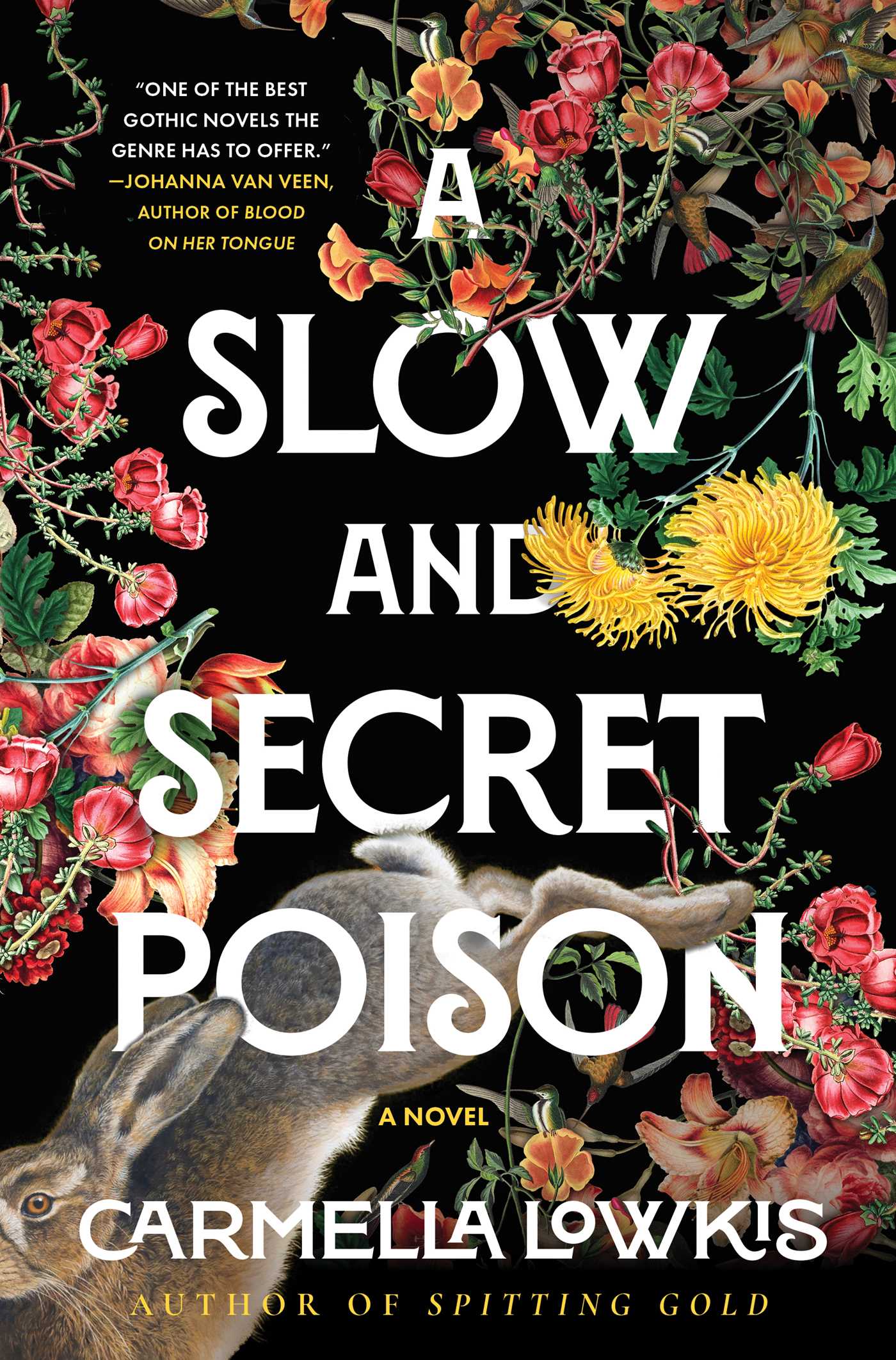
In the early 1900s, a young gardener at a lush English manor falls in love with her employer whose past is shrouded in deadly secrets—from the author of the “twisty, Gothic thriller” (Entertainment Weekly) Spitting Gold.
In 1925, Vee Morgan arrives at Harfold Manor, a once-grand country estate in Wiltshire, to begin her new post as gardener. She hopes the crumbling manor will offer her a fresh start, far from the darkness of her own past.
But the place is shadowed by grief and memories of long-faded glory, its rooms haunted by the only surviving member of the family, Lady Arabella Lascy. Vee is fascinated by her enigmatic new employer, a woman obsessed with the curse she believes has killed her family one by one and is coming for her next. Arabella's only hope for escape is a local folktale: the fabled dancing hare said to have blessed Hardfold centuries ago.
Drawn ever deeper into the house’s secrets and Lady Arabella’s spell, Vee soon realizes that the greatest danger may lie not in Harfold’s haunting history but in the truths she has tried so hard to bury.
Lush, atmospheric, and charged with desire and dread, A Slow and Secret Poison is a gothic tale of obsession, betrayal, and the perilous bargains we strike with the past.
Excerpt
Chapter 1 CHAPTER 1
There’s a dead deer in the way. No question of getting past it, not on this narrow country lane. The taxi rolls leisurely to a halt, headlights illuminating glistening clots of blood on matted fur, a mouth held in a permanent scream. The engine trundles softly.
After a minute, I lean over from the back seat. “Can’t you do something?”
The driver glances at me in the mirror. “I don’t know what to tell you, love,” he says. “I can’t get around that.”
“Isn’t there another road?”
He shakes his head. “Nah.”
“But this road has to come out somewhere, hasn’t it?” I’m trying my best to keep the frustration from my voice, but he’s not making it easy for me.
The man purses his lips and blows out through them. “Not unless I go all the way back up the Warminster road and loop around.”
“Can’t you—I don’t know—move it?” I wave at the deer. Its eyes are stuck open in a sorry gaze, as if still trying to bargain with whatever it saw during those last moments.
He shrugs. “I’ve got a bad back.”
I glance at my pocket watch, angling its face to catch the last of the September evening light. First the delayed train, now this: not a good first impression. “Alright, I’ll move it, then.”
The driver guffaws, though I wasn’t joking. “Look, love,” he says, with a scratch of the nose. “The village is just over there. See the lights? It’s five minutes’ walk, tops.”
I look out at the dim, muddy road. The overgrown verge. The tiny glimmer of yellow showing through the trees. “You want me to get out here?” I’m regretting the skirt, smart hat, and dress shoes I let Gladys talk me into wearing. Just for the first day, so they know you’re a nice girl, like. After all the things that have been said about me, I couldn’t help but find this funny.
“Can’t be far,” says the driver. “Be near on half an hour to go the other way.”
At least I don’t have much to carry—just the one suitcase and Dad’s old holdall. I climb reluctantly out of the cab.
“Straight up the road to the village, then it’s a track on the left,” says the driver. “You’ll be fine, love; can’t miss it.”
I was meant to be greeted at the station by a Mr. Reacher—the estate manager I’ve been exchanging letters back and forth with in preparation for today. But whether because of the late train or another reason, when I arrived, I found that he’d buggered off, leaving this prepaid cabbie in his place. Must cost a fortune, the distance we’ve traveled. I consider making a last-ditch argument in favor of moving the deer—if only to get the fare’s worth out of him—but then I look at the creature’s sharp-twisted neck and think better of it.
There’s the grunt of a revving engine and the taxi begins to reverse, not waiting to see me on my way. Probably wanting to get home. Wife, kids, evening paper to read. Besides, even in my nice-girl skirt, something in the way I carry myself always seems to kill any gentlemanly impulses. Intentional, of course. The headlights swing round into the hedge as the taxi finds a place to turn. Then just the receding glow. Then darkness.
Once my eyes have adjusted, I heft up the suitcase and step onto the verge, trying to avoid anything that might be a bit of deer. It’s not a five-minute walk. It takes a quarter hour to find the “track on the left”—which is, in fact, on the right. But here it is, a hand-painted wooden board: HARFOLD MANOR. I thought it sounded rather grand when I first read the advert in the Morning Post, but what I’m currently seeing is a lot of mud, and I suspect the place has been misrepresented.
Still, I’ve been lucky to get the job; it’s not as if people up and down the country are jumping at the chance to employ a woman gardener. Especially one without any formal horticultural qualifications. I didn’t expect to hear back when I sent the letter of application—not least because the listing was a good few weeks old by the time I’d convinced myself to write. But then the reply came almost immediately, as if there’d been no deliberation at all. Reacher’s abominable small handwriting offered me the job then and there, laying out the terms of employment. He didn’t even ask for a reference.
My way to the manor is completely dark, sloping down between steep wooded banks that blot out the final wilt of twilight. I slide and stumble as I go, caught off guard by sudden changes in texture, sudden obstacles. The fucking dress shoes. If I ever see that taxi driver again…
Finally, I reach the end of the track, the bleat of a lantern coming into view. A pair of gate posts part the trees. When I get closer, I see that two leaping rabbits or hares or suchlike are carved into them, one on either side. Between them, a set of cast-iron gates bear a swirling design. Shut tight.
While I’m distracted, my toe hits something unyielding and I go tripping forward. Hands and knees in the mud. Hat knocked off and lost in the darkness. My bags have landed a foot in front of me—thankfully still held closed by their straps. Scrambling to my feet, I grab my luggage, and in this frenzy almost jump out my skin when I look up to see a man now standing on the other side of the gates.
This newcomer is middle-aged, wearing a flatcap and tweeds. Not tall, but broad-shouldered and stocky. Wellies on his feet. A weathered tan to his skin. He’s holding an electric torch, the beam of which he now sweeps over me like a night watchman. “Miss Morgan? That you there?” He has a proper Wiltshire accent, the syllables swallowing one another up. “Blimey, what’s happened to you, then?”
I shake my head and move closer. He’s not dressed like an estate manager, so perhaps he’s the groundsman mentioned in Reacher’s instructions. “Mr. Allen?” I guess.
He hesitates a moment as he takes me in, then slides back the bolt, pulling one half of the gate narrowly open. As I squeeze through, he puts a hand out for my suitcase, extends the other to shake. “Call me Tom.” It sounds almost like “Tam,” the way he says it.
“Vee,” I say, then clarify, “Morgan, yes.” It’s clear I’m not what he was expecting. Unusual enough for a gardener to be female, but I’m also an odd age at twenty-five—too old still to be saving up for marriage, too young to have given up on the possibility. I’ve got my dad’s ungainly height, my mam’s thick black hair worn in a messy Eton crop. A strong Cardiff accent. And I’m covered in mud. Although maybe mud comes with the profession.
Tom trudges up the drive, nodding for me to follow. “We thought you’d be here round nine,” he says. It doesn’t sound accusatory—just like a topic of conversation. Making small talk.
“The train was delayed,” I say. “Something on the line, I think it was. Then later, just outside the village, the taxi couldn’t get through. There was a deer. You know, dead.” I have a sudden urge to pull a face to illustrate, eyes crossed and tongue lolling. Thankfully I fight it back.
Tom nods as if this is nothing unusual. “That’ll be that lot from Warminster. Always tearing about the lanes, drunk as you like.” He looks me over again. “You’re best wearing white so they can see you in time to stop.”
I try not to recall the way the deer’s neck had been twisted. Its sorry eyes. The crawling feeling up my spine.
“Mr. Reacher said to apologize that he couldn’t wait for you, only he had to get off away to London. He’s often up there on business.” Tom leads me up the drive till we reach a fork. The main path continues, fat and self-assured, with a gem of light at its end. “The manor,” says Tom, nodding at it. We turn off and take a simpler, graveled track to the cottage. My cottage.
I’d hardly believed my luck when I’d learned the job came with its own place on the grounds. Are you sure this isn’t a bit impulsive? Gladys had asked when I broke the news—which was rich coming from her—but I’d known there was no point in deliberating. It was just what I’d been after: a chance to start afresh.
In the halo of Tom’s torch, I make out yellow Cotswold stone, a door that needs a paint. Crabbed windows with leaded panes. It’s perfect.
Tom holds out his hand. “Key,” he says. The metal’s warm from his pocket. “Have the torch as well. We’re not on the electrics yet, but the gas comes out for you, and I’ve left some water. Me and the missus are up at the manor if you have any problems. Round the back door.”
I nod. “And her Ladyship?” Lady Lascy’s looping, fierce signature had sealed the employment contract—although it was Reacher who’d arranged everything. I imagine ladies don’t bother with that kind of paperwork. They have charity galas or what-have-you to organize.
“Oh,” says Tom, setting down my case on the front step. “No, you won’t see much of her, I don’t suppose.” Leaving the remark to hang unexplored, he heads back toward the manor.
My key scrapes inside the lock, sticks for a moment, then turns. The door opens inward. I expect a creak, but the hinges are well-oiled. The smell of still air and old, chilly buildings. A narrow front hall with a side table, on which a key dish and a vase of dahlias have been set out for me. I brush a finger over one of the blooms and smile. Did Tom leave these? There’s something touching in the thought of a man like him out among the flowers, delicately selecting the best to cut.
There isn’t much to explore. One up, one down. The ground floor room is squarish, the ceiling low—not so low I have to stoop, but I’ll need to watch my head on the doorframe. Upstairs, I find the luxury of a double bed. The sheets are white, with a pink flower pattern on thin, faded fabric. The headboard is pushed up against the chimney breast—that’ll be welcome warmth come winter. A number of cushions with needlepoint designs are scattered about. They all show hares performing various antics: jumping, boxing, sleeping. The furniture looks old, scuffed and warped with poor use. When I open the wardrobe to hang up my clothes, there are deep scores in the wood on the inside, all the way around the bottom third of the door—rodents, I assume. Bloody marvelous.
From one of the bedroom windows, I spot squares of illumination that I guess come from the manor building. We’re closer neighbors than I’d imagined, me and Lady Lascy. Maybe I’ll pop round for a cup of tea, I joke to myself.
As I lie down to sleep, I’m struck by the change in soundscape. No women moving about, no rush of late-night traffic or drunken shouts of merrymakers staggering home. Instead, the creaks and groans of the cottage settling, the rattle of the wind. Unfamiliar animal noises from outside. Then a scritch-scritch-scritch. Maybe from the wardrobe. Maybe the attic. A creature scampering with little claws on wood. Moving in the ceiling above me—almost the sound of a rattling tin. Not so different from Cardiff after all. Wherever you go, there’s always vermin.
The next morning, Tom takes me on a tour of the gardens. Even so early in the morning, the day is shaping up beautifully, with an open, cloudless sky the blue of cornflowers. A light breeze carries the cow-smell of manure from over the fields. Insects hum lazily at the edge of hearing.
I’m back in my overalls and work boots today, one of Dad’s straw sun hats on my head. The familiar garments feel like a sigh of relief. Gladys is one of my best friends, and I respect her opinion to no end, but that doesn’t mean I have to listen every time. The fact of the matter is, I’m here to be a gardener, not a secretary. They aren’t going to care what I wear, so long as I can keep the plants alive.
Harfold’s grounds cover around forty acres, including the crop of woodland I had to walk through last night. “Used to be closer on three hundred when I was a lad,” says Tom, “but then Lord Lascy sold a lot of it off. That’s Henry Lascy, her Ladyship’s late father. Lots of tenant farmers lost their homes and their livelihoods overnight, as it were.” He shakes his head in disapproval. “Nasty business.”
“Mmm,” I say, noncommittal. Better settle in before I plunge too deep into local politics. I’m here to keep my head down, after all.
“But yours was never a farm cottage,” Tom continues. “That’s always been for the head gardener.”
From this, I take that there must once have been a team of gardeners. And now it’s just me and Tom to look after all this glorious, sweeping land.
The head gardener’s cottage is on the edge of the estate, a stream marking its border from open farms beyond, hills speckled with white and brown sheep. A little way off to the left, more of Harfold village—a few roofs, the church tower. On the other side, the cottage backs onto an overgrown paddock. “Horses, is it?” I ask, nodding at what looks like a coach house and stables.
A shadow in Tom’s expression. “Not for a couple of years.”
We cross the east lawn, following an uphill slope till we catch the main driveway. Scruffy yews line its sides, their original shapes almost obscured by summer growth.
“They’ll need doing, then,” I say.
“Feel free to be as artistic as you like.” Tom has a cheeky, boyish smile that peels the decades from his face. He’s not too bad a sort, I don’t think. Reminds me a bit of Mam—the nose for gossip. So long as he stays interested in other people’s business and not mine, we’ll be right as rain with each other.
Up the drive, I finally get my first proper sight of the manor. I don’t know enough about architecture to date it, but I think it’s a good age. Georgian, possibly. The main body is a heavy oblong of red brick, decorated with lighter stone detail that oozes the aura of Old England. Ivy clambers up its face to give it a bearded look. The hipped roof is done in dark slate, with moldings underneath it all carved in elaborate designs. Everything would be beautifully symmetrical, down to the pair of slender chimney stacks, if it weren’t for an extra wing that stretches back on the west side. Such an odd, lopsided shape for a building. And, while the window and doorframes are painted a cheery white, as we approach I see the cracks and chips, the dirt and lichen. It’s one of those buildings that looks less and less impressive the closer you stand.
“That’s us.” Tom nods. “Nora’s in town this morning to put the orders in, but you’ll meet her later on. My wife, that is,” he adds, when he sees me looking blank at the name.
“And the other staff?” I ask.
Tom chuckles. “It’s just us.”
“Only the two of you to look after this whole place, you mean?” I can’t keep the incredulity from my voice.
“These days? Yup.”
“And just her Ladyship living here?”
Tom nods. “Mr. Reacher is often about, though, when he’s not in London.”
I look up at the gleaming windows. Lady Lascy must rattle round in all that space like the last match in the box.
The Allens’ wing overlooks a kitchen garden, the well in one corner and a henhouse in the other. A hatch against the main wall that I guess must lead into a cellar. “You’ll help yourself to eggs, mind?” Tom insists. “Nora will do us some lunch later.” He nods in the direction of the back door. “Just come on through at two o’clock.”
There are several garden rooms beyond the kitchen plot: a paved terrace at the front of the house, followed by a rose garden, water garden, and statue garden. A crusty potting shed. A vast greenhouse plump with glossy tomatoes and massive, knobbled cucumbers. And still, there’s more. Tom leads me up a set of uneven steps to the west lawn, a level rectangle that must be perfect for games. As if to confirm this, a weathered blue summer house is stacked full of ancient-looking croquet hoops, tennis racquets, and folding chairs. But the grass is too long for anything of the sort at the moment, growing over my ankles.
A walled orchard separates the games lawn from the main road. A swarm of stately trees, twisted and knotted, heavy with the apples and pears and quinces of the season. There are already windfalls clogging the grass underfoot. The sweet, heady smell of decaying fruit.
Finally, right at the end of the grounds, Tom leads me to a sizeable lake and boathouse. “How big did you say your last place was?” he asks, dabbing his neck with a hanky. It’s warming up now the late summer sun has climbed a way in the sky.
I try to remember what I’d put in my application letter, if I’d even mentioned it. Another strange oversight from Reacher not to have verified my references, but then I wouldn’t be here if he’d thought to. “A bit smaller than this,” I say in the end.
Tom’s eyes have drifted to a nearby coot, bobbing its head up and down in the water as it looks for food. “It’s a lot, mind,” he says, “but Lady Lascy doesn’t want anything fancy doing with it.” He rummages in his pockets, pulls out a bit of bread crust. “It was all Bruce could do to keep up with the watering, these past months.”
It’s been an endlessly dry, hot summer, with record-breaking low rainfall. The entirety of Britain has been stinking to high heaven.
“He’d been here for donkey’s years,” Tom goes on, “but his rheumatism’s too much for it now. He’s moved in with his sister down the village. Nice woman. Bit of a drinker, though.” He chucks the bread out with an under-arm throw, so it plops down a few feet from the hungry bird. “I’m sure he wouldn’t mind having a talk, if you’ve got any questions. It’s the white cottage by the church.”
“I’ll look out for it,” I say, though I doubt I’ll be making social calls around the village any time soon. I’m here to get away from the judgment of others, not to invite any more of it.
Lunch is in the Allens’ quarters. Two o’clock—Lady Lascy keeps late hours, and so must we. My stomach’s growling loud enough to wake the dead by the time my pocket watch has ticked its way around. I don’t know how the Allens put up with it. I scrub the dirt from my face and hands, run a brush through my hair. I’ve only been doing a spot of light weeding this morning, but I already look a sight.
The back entrance has its own little porch and a knocker that looks—again—like a jumping rabbit or hare. I’m starting to think someone round here has a fondness for the creatures. When I come closer, I find the door’s been left open a crack, propped with a stopper. From inside, I catch the faint sound of singing—a woman’s voice, breathy and high. After a line or so, I recognize the hymn as “All Things Bright and Beautiful.”
I peer inside, nudging the door. “Hello?” I call. “Tom?”
I’m met with a flurry of barking, followed by a large gray blur. A dog hurls itself at me, forepaws ramming into my chest so it’s all I can do to keep my footing. Hot, meaty breath in my face. Tongue flopping out. I shove its snout away.
The singing cuts off. “Mutton! Get back here, boy!” The woman has the same countryside accent as Tom.
The dog plops back onto four legs but otherwise ignores the order. He’s a massive thing, above waist height. Scruffy face with a downward muzzle and big blob of a nose. Two alert brown eyes. His legs are strangely spindly, greyhound-ish, holding up a broad, muscular body. Oversized paws. Stubby tail wagging—at least that means he thinks he’s being friendly.
“That the gardener?” calls the woman. She must be Mr. Allen’s wife. Nora, I think he said.
I snatch my fingers out of licking range, seeing as I’ve just washed them. “Yes.”
“Mind you clean your boots.”
I obligingly knock them a bit on the scraper, then step in. The corridor is whitewashed, lined with coat pegs and a shoe rack on one side. A stark drop in temperature where thick walls have kept the heat at bay. The dog pushes past me, skittering through to where I assume Mrs. Allen can be found. I follow.
A dim kitchen, lamps not lit at this time of day. There’s a rectangular wooden table, sturdy and functional, and wooden sideboards too. Cupboards, a deep basin of a sink, an enamel oven in front of which the dog has flopped down. Mrs. Allen is stirring a pot on the stovetop, but turns when I enter. Like her husband, she’s a sturdy build, with graying curls and soft, droopy cheeks. Blue flowers patterning her dress, under a grease-specked wraparound apron.
“Afternoon—Mrs. Allen? I’m…” I gesture back out the door, in the direction of the cottage. “Miss Morgan. Vee.”
Mrs. Allen nods to the table, where three places are already set out. “Won’t be a minute.” Doesn’t invite me to call her Nora in return. Well, I can’t charm everyone right away…
As soon as I sit, Mutton is up again, pressing his head into my lap.
“Watch your food with him, he’s a greedy sod.” Mrs. Allen has her eyes on the kitchen clock. Although nothing in particular has passed between us, I sense that she doesn’t want me here; a stiffness in her shoulders. There’s none of the warmth that her husband has offered. She goes back to stirring, ignoring me. The dog, on the other hand, won’t let me alone, but I’m quite happy to ruffle his ears. His wide, glistening eyes have a certain appeal. He’s got a powerful aroma to him, though.
“Is Tom not joining us?” I ask after a while.
“He’s just bringing her Ladyship her lunch.” She jerks her head in the direction of a set of service bells on the wall—a reminder of our mutual employer. “She likes to have it sliced up for her first. He’ll be back in a tick.” A saucepan lid chugs out steam in a clack-clack echo. Mrs. Allen lifts it to let a cloud escape, then places it back.
I wonder at the detail about Tom slicing up the food. Whether there’s a reason Lady Lascy can’t do it herself, or if it’s simply the level of service she expects from her staff. “Does she eat alone, then?” I ask.
“She doesn’t have much choice.” Mrs. Allen wipes her hands on a rag, then hangs it over the oven rail. “She won’t have anyone else inside the house these days. Just us and Mr. Reacher. That’s her cousin.” I hadn’t realized the estate manager was a relative of Lady Lascy.
Another silence. Mrs. Allen doesn’t resume her singing. A shame—it wasn’t bad. I’m about to ask how long she’s worked here at Harfold—just to stave off the boredom—when a door closes somewhere beyond. Heavy footsteps. A few seconds later, Tom comes in through a side entrance. He still has his work clothes on: flannel shirt and braces. Must have waited table in them. I can’t picture it, Tom placing food down daintily in front of a lady. Can’t picture yet who this lady must be.
Mrs. Allen serves up. Joint of pork, small potatoes, broad beans and a celeriac mash. A little ale, malty on the tongue. The food is under-seasoned, all texture boiled out of it. Not a patch on Mam’s cooking.
Now that Tom’s here, the conversation is easier, picks up a natural flow. He acts as conductor, pulling me into an account of the morning’s work, then summoning Mrs. Allen to help deliver an anecdote about the cows up the road. It’s possible Mrs. Allen’s earlier chilliness wasn’t personal after all—with Tom for a husband, maybe she doesn’t need much social skill. You get that with couples sometimes. Mam and Dad are a bit like that: Mam’s a chatter, Dad’s a touch more introspective. Though that might be from what happened during the war. Anyone would come back quieter after that.
“So what brung you here from Cardiff, Vee?” Tom asks. “No gardens out that way?”
I give a slight shrug of the shoulders. “I just needed a change.” The Allens are waiting for me to elaborate, rattle off the usual lines about the grime of city living, wanting to spend time out in nature. I impale a particularly firm bean with my fork. “When you’ve been in the same place your whole life, it can feel a bit small, can’t it?”
All those whispers. The people who thought they knew me, thought they knew everything about my story. The turned heads when I walked into the grocer’s. The little boy who spat on my shoe that time.
Tom winks at his wife. “That’s not me, is it, Nora? I was born in the Prescotts’ place up the village and I’ve stayed here ever since. Oh, I could never leave.”
Mrs. Allen sets her cutlery down with a light clatter. “It’s a long way to come, though,” she says, not satisfied with my answer. “Do you not have family back at home?”
“My mam and dad moved away.”
“But you must have other relations?” she presses. “Or friends, at least?”
I try for a winning smile. “I’m sure I’ll make some new ones.”
Mrs. Allen sniffs. “There’s not much in the way of social life out here.”
There wasn’t for me in Cardiff, either, in the end. I’ve been staying with a couple of pals the past year: Gladys and Lou, the only ones who stuck with me. A camp bed on their kitchen floor, that cold in winter I’d had to sleep with my coat on. Clatter of train tracks out the window. Smell of cooking fat. Mice bold as anything—too clever for the traps, but I could never bring myself to poison them, hated to think of their little bodies in spasms, froth at the mouth. I’d been forever throwing slippers at the bloody things. Not that it was fair for me to complain. Lou and Gladys never said anything, but I knew what they were risking, taking me in. Two women living together like the pair of them, it only worked as long as nobody was looking too carefully, and people haven’t been able to look away from me this past year. I’d known when it was time to move on.
Mains finished, Mrs. Allen dollops out four helpings of a gooseberry fool. Sets one of them aside under a cheesecloth. Hands the others around. Passes Tom the sugar bowl so he can deposit four heaped spoonfuls over his serving. For my part, I relish the tart burst of flavor after a rather bland meal.
Tom is telling a story about Reacher, how he’s exploring investments in the capital. “You’ll see him come by soon enough, I’m sure. He’s hard to miss.” He raises his eyebrows, inviting me into a confidence. “A committed bachelor, if you catch my meaning. But I expect you’d know all about that sort of thing?” His expression is casually blank.
I must have misheard. I know that other people can read me as a committed spinster myself—I walk only the finest line of plausible deniability, after all—but this older man from a little farming village isn’t the type I’d expect to state it outright. And in such a neutral tone…
A strained silence stretches out, then Tom’s expression is suddenly swept with embarrassment, and he stammers, “Being from the city, I meant. I imagine there’s all sorts there.”
Now it’s my turn to look embarrassed. “Right you are.” But it’s too late to shake off the misunderstanding.
“I’ve always liked Mr. Reacher,” says Tom, in some kind of olive branch. “It’s never bothered me that he’s…”
The strained silence is back. Mrs. Allen clatters the spoon noisily in her pudding bowl. Mutton, as if sensing a change in our mood, thuds his tail on the floor tiles.
Sudden shrilling. One of the servants’ bells has gone off, its brass mouth still trembling with the memory of the noise. Tom and Mrs. Allen both stand at the same time, a wordless conversation passing back and forth between them.
“I’ll go,” says Mrs. Allen, plucking up the last portion of fool. She half turns to me with a sharp nod. “See you tomorrow, Miss Morgan.”
I rise from the chair too. “I shouldn’t come and introduce myself, should I?”
Panic flickers in Mrs. Allen’s eyes but then disappears again so quickly I can’t be sure I didn’t make it up. “Oh no,” she says, “her Ladyship won’t want that.”
“She doesn’t want to meet me, then? Check me over?” Can’t help but press the point—I’m curious about her now. Want to see for myself what kind of person lives in this grand old house all by herself.
“I told you earlier,” says Mrs. Allen, “Lady Lascy is very particular.” She closes the side door firmly behind her.
As I head back across the east lawn, I feel the bulk of the manor at my back—a single window lighted on the ground floor, even in the middle of the day. A creeping, prickling itch as if I’m being watched. I glance over my shoulder. Can’t spot anyone. But even as I enter my cottage, shutting the door tight behind me, that call bell continues to echo like a voice in my ears.
About the Author
Photograph by Ashley Rose
Carmella Lowkis grew up in Wiltshire, UK, and has a degree in English literature and creative writing from the University of Warwick, where she was mentored by Sunday Times (London) bestselling author Sarah Moss. After graduating, she worked in libraries before moving into book marketing. Carmella lives in London with her girlfriend. You can follow her on X and Instagram @CarmellaLowkis. She is the author of A Slow and Secret Poison and Spitting Gold.
Product Details
- Publisher: Atria Books (February 10, 2026)
- Length: 288 pages
- ISBN13: 9781668025000
Browse Related Books
Raves and Reviews
"Lowkis skillfully delivers a gothic mood . . . A Slow and Secret Poison gives readers a thrilling mystery and a positive window into the past all at once" —Bookpage
"An enticing sapphic love story that takes place on a supposedly cursed English manor...Lowkis effortlessly toggles between past and present, and the novel swerves artfully from gothic tropes to knotty and surprising psychological suspense. There’s much to admire in this twisty tale.” —Publishers Weekly
"The family secrets of both women haunt this twisty gothic. Recommended for readers of Sarah Waters, Adrienne Young, and Catriona Ward who like books with darkness around every corner and inside every character." —Booklist
“A Slow and Secret Poison is Sapphic Gothic at its finest: it tricks and deceives the reader, charms you into one version of the story, frightens you with omens of a certain kind of evil, then flips the table over and makes you question everything—and everyone—you believed, and the nature of evil itself.” —The Lesbrary
"I was utterly captivated—a truly compelling, immersive tale. If Agatha Christie and Shirley Jackson had ever teamed up to write a novel, it would have turned out like this: intricately plotted, seductive, and sinister." —Naomi Kelsey, author of The Burnings
“Carmella Lowkis has a true talent for the creeping gothic. Her characters are alluring and settings entrancing. A Slow and Secret Poison conjures the uncertainty and dark potential of the interbellum in Great Britain in a thoroughly engrossing way. For fans of Sarah Waters, A Slow and Secret Poison is a must.” —Emma Hinds, author of The Knowing
“A Slow and Secret Poison is one of the best gothic novels the genre has to offer. Twisty, erotic, and atmospheric, this one is sure to linger long after you have finished reading.” —Johanna van Veen, author of Blood on Her Tongue and My Darling Dreadful Thing
“Full of rich gothic decay and ratcheting tension, A Slow and Secret Poison is an incisive exploration of how privilege and class haunt us all. The sapphic love story kept me constantly guessing, even as twist after twist left me reeling.” —Danielle Giles, author of Mere
“Atmospheric and delicious, A Slow and Secret Poison slowly unfolds its mysteries, taking in a 1920s sapphic love story, the class intrigue of The Little Stranger, and a reminder that some parts of the natural world are also poisonous. Carmella Lowkis has done it again with this deeply satisfying and gothic stunner.” —Ally Wilkes, author of All the White Spaces and Where the Dead Wait
Praise for Carmella Lowkis's debut Spitting Gold
“A twisty, Gothic thriller…that has serious Sarah Waters vibes.”—Entertainment Weekly
"This atmospheric tale has twists, schemes, and surprises that will keep the reader guessing until the last page."—Booklist
"Magnificent debut...Lowkis skillfully orchestrates the contentious relationship between Sylvie and Charlotte, each of whom resort to subterfuges and schemes, and pulls off a series of surprising twists that completely change the shape of the story. It’s an auspicious first outing from a writer to watch."—Publishers Weekly, starred review
Resources and Downloads
High Resolution Images
-
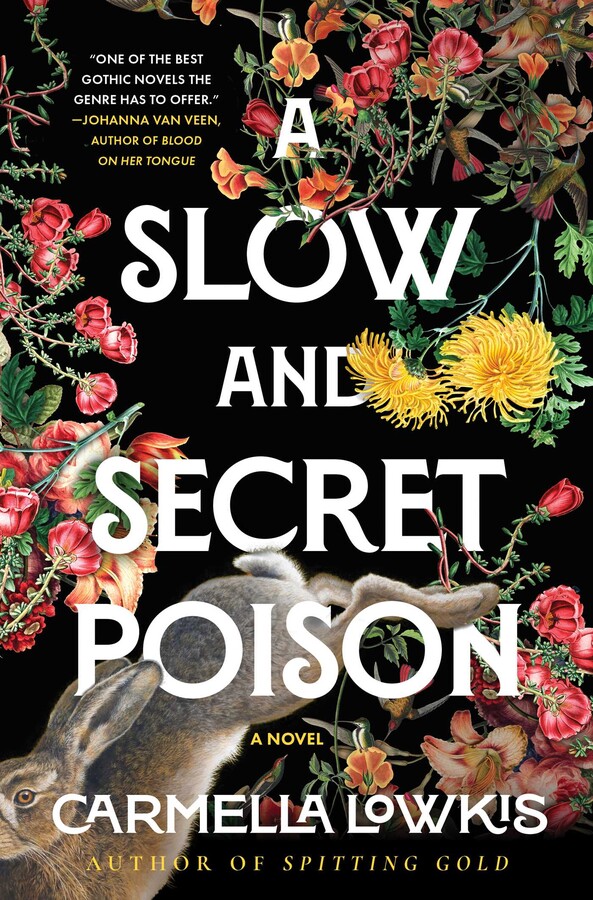
Book Cover Image (jpg): A Slow and Secret Poison
eBook 9781668025000
-
Author Photo (jpg): Carmella Lowkis Photograph by Ashley Rose(0.1 MB)
Any use of an author photo must include its respective photo credit