


Plus, receive recommendations and exclusive offers on all of your favorite books and authors from Simon & Schuster.
0:00 /
LIST PRICE $18.00
PRICE MAY VARY BY RETAILER
Get 20% off with code FALL26 plus free shipping on orders of $40 or more. Discount on physical products only. Terms apply.
Buy from Other Retailers
Table of Contents
About the Book
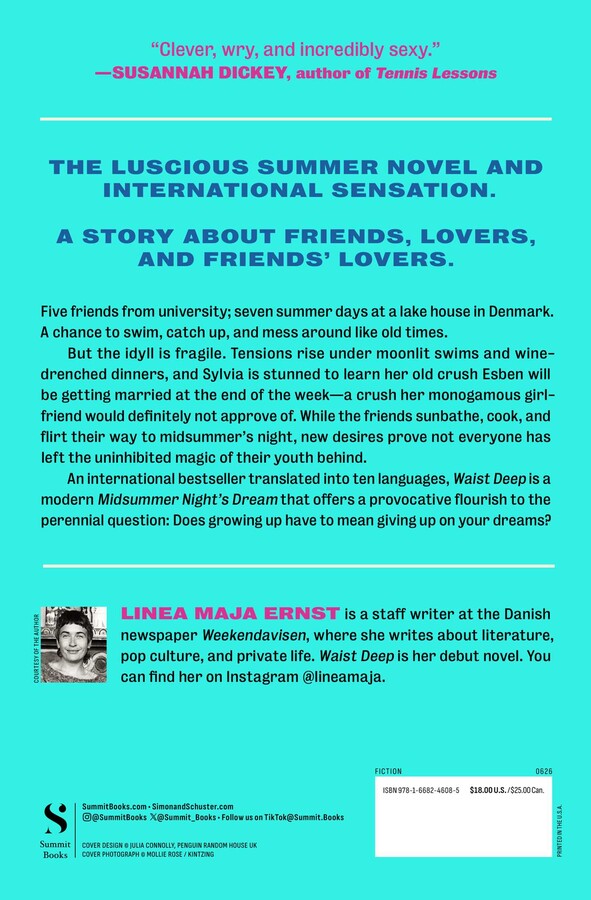
“Clever, wry, and incredibly sexy.” —Susannah Dickey, author of Tennis Lessons
The luscious summer novel and international sensation.
A story about friends, lovers, and friends' lovers.
Five friends from university; seven summer days in a lakehouse in Denmark. A chance to swim, catch up, and mess around like old times.
But the idyll is fragile. Lost without the uninhibited magic of their youth, Sylvia is left wondering what happened to the radical ways of living they embraced at university. Tensions rise under moonlit swims and wine-drenched dinners, and Sylvia is stunned to learn her old crush Esben will be getting married at the end of the week—a crush her monogamous girlfriend would definitely not approve. While the group sunbathe, cook, and flirt their way to midsummer night, new desires prove not everyone has left their arcadian fantasies behind.
An instant bestseller in Scandinavia and now translated into ten languages, Waist Deep is a modern Midsummer Night’s Dream that offers a provocative flourish to the perennial question: does growing up have to mean giving up on your dreams?
The luscious summer novel and international sensation.
A story about friends, lovers, and friends' lovers.
Five friends from university; seven summer days in a lakehouse in Denmark. A chance to swim, catch up, and mess around like old times.
But the idyll is fragile. Lost without the uninhibited magic of their youth, Sylvia is left wondering what happened to the radical ways of living they embraced at university. Tensions rise under moonlit swims and wine-drenched dinners, and Sylvia is stunned to learn her old crush Esben will be getting married at the end of the week—a crush her monogamous girlfriend would definitely not approve. While the group sunbathe, cook, and flirt their way to midsummer night, new desires prove not everyone has left their arcadian fantasies behind.
An instant bestseller in Scandinavia and now translated into ten languages, Waist Deep is a modern Midsummer Night’s Dream that offers a provocative flourish to the perennial question: does growing up have to mean giving up on your dreams?
Excerpt
Day 1 Day 1
Sylvia tries to get comfortable in the back seat. She reclines, shifts around, puts her feet up on the driver’s seat. She loves how transparent Charlie’s ears are, her backlit skin conch red. Sylvia tickles Charlie’s earlobe with her big toe.
Charlie gives Sylvia’s foot a squeeze. “Could you sit up, please?”
Sylvia thinks that the rules of traffic shouldn’t apply to the forest, but she straightens up anyway, sits cross-legged instead. She notices her panties are bunched, so she unbuttons her shorts, sticks her hand down into them, runs a finger along her labia, slides between them, and adjusts the cotton fabric. She cups her hand beneath her nose; she’s always loved the smell: briny, whitish, floral.
Sylvia read somewhere that if you dab a bit behind your ears like perfume, it’ll work like an aphrodisiac.
She dabs behind her ears, runs her fingers through her hair.
Outside the window, the woods slide past. The asphalt road turns to gravel, the summer light dims. They drive through the older part of the woods. Midsummer is approaching and everything is green and plump with moisture. The beech trees are knotty, the moss aglow and luminescent. There are large windfallen trees with their roots in the air; there are pines, seven-trunked beech clusters twisting their crowns up and over the woodland road, their reflections glistening on the bumper of the old dark purple Volvo, a square retiree that Charlie has sentimentally insisted on keeping; she fixes it herself.
“Don’t you want to learn how to drive?” Charlie asks her now and then, and Sylvia says she’s too scattered, always spacing out, prone to panicking, hands aflutter, and if you’ve just run someone over at a crossing, that kind of behavior isn’t cute anymore.
Charlie is a calm driver, her hands resting on the wheel. Sylvia can’t take her eyes off them. She can’t help but see it as coded—the driver’s license—as butch, as grown up, a sign of having your act together. Of course, in the countryside here in Himmerland, everyone has a driver’s license. But metropolitan kids age differently.
And see practical necessities like a driver’s license as intriguing forms of personal expression.
Sylvia considers herself a back-seat type, a passenger princess. She likes to be driven; she loves it when Charlie picks her up.
Charlie, who feels like home, like a boulder in the sun. Their eyes meet in the rearview mirror, Charlie’s moss-green eyes. She smiles.
“Are you tired?”
“No, I’m excited to see everyone! We haven’t seen each other in ages.”
“Remind me. What kind of house is it again?”
“A forester’s lodge,” Sylvia says. “Karen’s parents own it.”
Charlie suppresses a grin. “And what exactly is a forester’s lodge?”
“Actually… I don’t know.”
Charlie laughs.
“But it sounds very romantic and particular, which I love!”
“Of course your friends don’t have just a normal Danish summerhouse.” Charlie smiles as she signals to turn, following the rules even though the gravel road is deserted. “They are also very romantic and particular and articulate.”
“They’re nice!” Sylvia says.
“Yes, they’re nice.”
Charlie, Sylvia thinks, ought to be able to romanticize living conditions. Her houseboat, where they live most of the time, is beyond dreamy. The way the bed is a nest at the stern, how the whole boat rocks with the weather and their movements (sublime sex on a thundery night). There are little niches in all the surfaces to hold things, hooks for the mugs. Those antediluvian windows—are they called portholes?
Sylvia loves the boat, loves Charlie helping her on deck, catching her, wrapping an arm around her waist.
But she’s tired of the eternal maintenance, the practical tasks; something is perpetually in need of repair. At least Charlie looks fantastic scraping barnacles off the keel when she takes the boat out of the water. Charlie is good with her hands, not a talker, whereas Sylvia’s university friends are garrulous, gushing. It makes Charlie insecure.
“I’ve got you,” Sylvia says.
Esben and Karen have already arrived. The house is right by the lake, and the map on Charlie’s phone starts glitching; the service is bad, the roads in the woods are ancient.
Gry is on her way too, is somewhere nearby.
“Have you always been so close? Even at university?” Charlie asks.
“At first, mostly just Esben and me and Karen were friends. And then Quince and I bonded. And Karen and Gry have become really close over the past few years—they’re both in similar places with their adult jobs and serious relationships.”
Charlie looks at her in the mirror.
“But yeah, we’re all really close.” Sylvia smiles.
They’ve been driving for hours; they left Copenhagen around noon, and it’s almost evening now, but there’s still light in the sky. Gry had made a plan for them all weeks ago, taking the coordination upon herself: “Why don’t we aim to get there by dinnertime? That would work best for the kids.”
Sylvia wishes the kids could have stayed at home with their dinnertimes and bedtimes, but she can’t wait to throw her arms around her friends. To see Esben. She likes the person she becomes when he’s there.
Charlie clears her throat.
“I can see the lake ahead. Should we wake up Quince?”
Quince has been sleeping next to Sylvia for most of the journey, his head resting on the window; he apologized when they picked him up, hungover from the previous night, a trace of blue-green glitter on his cheekbone. It shimmers in the evening sun. Quince had been out dancing, ended up jumping in the harbor at dawn with some new friends; it had all started with a poetry reading. If it were up to him, they wouldn’t have left until afternoon, but he made a valiant effort, chatting with Charlie and Sylvia for the first leg of the drive, and now he’s been sleeping since Funen. Between stifled yawns, Quince told them about his night, about meeting Cosmos, the most beautiful man he’d ever seen, though regretfully they only shook hands. Then he conked out. Sylvia admires that about Quince, how easily he falls for people and how easily he lets them go.
They turn down an even smaller road, bony with crisscrossing roots, soft with pine needles, that leads them across the little peninsula that juts out into the lake. Here, you’re hidden. Bluish pines. A strip of shore; clear water over the glittering lake bed. A firepit.
They park by the edge of the water. Sylvia turns to Quince, tickles his knee to wake him up. He draws up his shoulders, shivers awake.
And there’s the house, just as the forest becomes a forest. Black-painted logs between the birch trees, stone foundation, a thick golden thatched roof, and a deck catching the sunshine. It looks like it’s been here for ages, robust; the chimney suggests a fireplace. At the same time, the white gazebo-like frames hugging the swollen windows make it seem refined. Climbing roses clamber over the windbreak, and there is Esben. He waves enthusiastically, walks over to meet them with outstretched arms, but with an awkwardness to his body language, both effusive and stiff, as if he’s overcoming his innate shyness, insisting on being warmhearted. It’s irresistible. Sylvia is already out of the car, falling into Esben’s arms. His stubble, his shirt, the thin fabric of his shorts. He shaved his head recently, and it’s already growing back dark. Thin-framed glasses. He looks like a German idealist poet, distant and romantic, like a tarot-card page, a boyish feudal prince.
But here he is, in the flesh. She feels him relax against her, swaying slightly; he folds his arms around her. This is no cordial hug; he squeezes her tight, and she takes a deep breath, her nose pressed against the collar of his shirt.
“It’s so good to see you!”
Sylvia carefully frees herself so Esben can greet Charlie and Quince.
Quince awakes to a buzzing landscape, to Sylvia, Charlie, and Esben talking. He blinks the sleep away, succumbing to the view. The twilight sky is watercolor red, the forest burning with fireweed and poppies. The grass looks soft, inviting. Madum Lake is quiet and dazzling; the silver birch trees stand watch, dipping their catkins into the water, their leaves quivering on bowed branches, a curtain wanting to be drawn, a hushed drumroll.
He feels the anticipation bubbling up. How enchanting! A week in the woods by the lake, all of them together again. We can celebrate and sunbathe and make lavish dinners, sit outside in the summer night, deep in conversation until the sun rises. It’ll be like our own clever talk show, fabulous and never-ending. Maybe we’ll go skinny-dipping? Throw a rave in the woods? His suitcase is full of fantastic outfits.
For years, the friends have been admonishing one another, saying that they need to get together more often. But time passes—three months, then six. Another baby, more obligations. A new job, mortgages. They’re all becoming more set in their ways. But they’re also more mature, less insecure.
Back when they were students, Quince wasn’t really there. Not wholeheartedly. Part of him always felt like he wasn’t able to be himself. But now he’s finally living out his youth, or maybe something better. He wants to share it with the rest of them.
He looks out at the lake, feels the others’ gazes following his.
The water is smooth and purple. A spray of white aquatic plants skirts the shore. It makes you want to hop right in. Quince shuts his eyes.
Takes it all in: This place romanticizes itself.
Karen throws open the deck doors, steps into the evening sun to receive her friends. She waves but stays where she is. They go to her. Karen has always been a vision. Long blond elvish hair, a swan’s neck, divine cheekbones; she’s gotten slimmer with age, but stronger too; there’s a strength to her that doesn’t require muscle, that stands out all the more in her fragility. She looks like a princess, but she is a knight, a fortress.
Quince has the urge to kneel, not in a romantic way but as a courtly ritual, to acknowledge her beauty, her dignity, as the warm light of the evening sun finds her like a projector, but she would think he was making fun of her; she’s not theatrically inclined. So instead, he hugs her, they all do, one by one; the hug is their preferred greeting, equalizing, amorphous, their bodies melting platonically together. Karen tolerates it; she doesn’t really like hugs. Quince wonders with a smile whether she would have preferred him to kneel before her after all—alas!
He wouldn’t call Karen nice exactly, but she’s just—there’s something unyielding about her, something good and steely. Quince remembers when they all went to Bakken for his twenty-fifth birthday and he was so touched by how they understood him, how they indulged his childish impulses, the joy of cheering, shrieking on the rides, the cotton candy. They waited in line, Karen and him, the only ones brave enough to try the most daunting roller coaster. She probably wasn’t that into the idea, but she didn’t want him to have to go alone. He was overjoyed, had pulled her to the end of the platform so they could get in the last car. He explained that it was most fun to sit at the very back, where the drop was biggest, the rush in your belly greatest—and as Karen was nodding, listening intently, a few teenage boys sneaked past them. Quince was willing to let it go. They’re just kids, he told himself, and something about groups of teenage boys always made him nervous. “Hey!” Karen shouted. “We’re waiting for that car—you can’t just cut the line.” He loved her for that: for scolding the kids, for her sense of principle, for the fact that he was under her protection.
Karen shows them to their rooms. Quince gets the west-facing bedroom, with a view of the lake and the sunset. This is a bachelor’s room—light wood walls, a single bed, an oak washstand at the window with a bright marble top, a shaving bowl, a white enamel washing jug, a bouquet of wildflowers sprinkling the marble slab, an old mirror with green-speckled glass. Karen waits in the doorway.
“I hope you like it. My parents decorated the place. It’s a little too much.”
“I love when things are too much.” Quince beams. “A gable room!”
“No, a gable room would be upstairs or under the eaves,” Karen corrects him. She turns to show Sylvia and Charlie to their room. Quince bites his tongue. He opens the window to the hollyhocks gently knocking against the frame, shepherding in the evening air, the scent of elderflowers hanging like sweet dust, mixing with the smell of fresh water. He almost can’t handle it: the view, the potential; it reminds him of a film, but which one? The lazy summer night, the sun, tall white flowers in overgrown grass; he doesn’t know what they’re called, but they scream June! He almost wishes he were more buttoned up, reserved, so he could let go, whipped up by the sun-ripe days and the forest, loosen a tie, but he’s already as loose as can be; he doesn’t even know how to knot a tie, but one of the others could probably show him. He’s good at asking for help.
The landscape also reminds him of Thunderclump, the children’s film that takes place over one long Scandinavian summer night when the toys come to life. He was a daydreamer as a child; he still is, and how can you not be when the trees are huddled up like a dark, midsummer green choir? It recalls something Greek, something Shakespearean. He imagines a Puck, a Pan, a sexy faun in the woods, in the reeds. Nimble, half naked. With a crown of morning glories, maybe wearing clothes left by lovers on the forest floor—stockings like long, smoke-colored gloves, a ripped-open shirt, lacy pants. Tousled hair and clear eyes. If this were a film or a play, Puck would step out to introduce the plot, hands gleefully rubbing together: six friends—one week—a summerhouse.
But then he hears a distant growl. Another car arrives; its driver expertly parks. A snow-gray Tesla, the ultimate family vehicle. Its brutal sensibility punctures the pastoral scene. Quince watches from the window. It was all too arcadian anyway, he thinks. A little contrast is good, and now Gry is here, thank God; he hates waiting.
Gry alights, her squall of curls kept in place by French braids, a shirt with puff sleeves, exquisite hips in expensive mom jeans. Quince loves Gry’s brawny driving, that she can make a Tesla rumble. She’s otherwise so mild-mannered. Now she’s unpacking her buttermilk-blond kids from the back seat. Vera and Sejr are sticky and swollen from the heat, but maybe that’s just how kids look. Vera must be five now, Sejr around three.
The front passenger door opens.
Oh no. Is he here too?
He steps out of the car. Tall and blond. A sun god with a political science degree. There are some men who look like sculptures of Apollo, whose features are so regular that they almost appear rational; clean-cut vitalism boys, the worst. You can see that Adam has been the picture of health since he was a child, an athletic kid with spiky blond hair, the boy you both feared and secretly admired on the playground. A particular expression of masculinity: cultured rather than coarse; he’s comfortable in his skin and thus even more intimidating. Oxford shirt. Fresh trim.
Quince turns from the window.
Gry usually comes by herself with a good excuse for Adam. Quince has met him only a handful of times. Officially, that’s because he’s always working (he’s an adviser or director or whatever at one of the ministries; Quince can’t remember which, only that it is an important one, one that requires responsibility, calm brutality behind a standing desk, presumably), but he assumes the excuses have more to do with Adam’s distaste for their group of literary, eccentric artist types, over-the-top queers. Well, Quince is not going to let Adam ruin his idyllic vision for the week, even if he’s walking around looking like a Euroman.
He revises the cast: six friends and Adam.
Quince falls backward onto the single bed. He catches a glimpse of himself in the mirror among the pillowcases, golden red in the rays from the low sun. He shakes out his curls; swooning suits him. He considers for a moment. Do you say swoon or faint? There used to be more words to describe flinging yourself down dramatically. He would like to revive them.
Esben knocks on the doorframe. Quince props himself up on an elbow.
“Gry and Adam are here. Are you ready for dinner?”
Adam offers his hand, introduces himself.
“We’ve met before,” Quince says.
“Oh, right… what’s your name again? Matcha?”
“Quince,” says Quince, narrowing his eyes. They take their seats out on the deck. Karen stands up at the head of the table to introduce the meal Esben has prepared.
“On the menu tonight we have grilled perch from the lake that Esben caught—illegally.”
They laugh at Karen’s scandalized tone. Esben smiles, looking down at the table, seeming both apologetic and a little proud. Sheepishly, he says: “But there are so many of them out there, waiting to be caught!”
“And what else are we having?”
A cassava mash, a traditional South American dish, whipped stiff with starch. Esben placidly explains that the root contains cyanide, that if you don’t peel and prepare it properly, it can kill you. Normally, this type of information would make Sylvia panic, and the casual threat of collective cyanide poisoning does make her anxious, but with Esben, she would rather run the risk and appear cosmopolitan and easygoing in his eyes. She strokes the antique silverware. And in the worst case, at least they will die together.
It’s been twelve years since they all met, Sylvia, Esben, Karen, Gry, and Quince, who was called something else back then. They biked to school through the early-morning haze, filed into the lecture hall. They were thinner, trepidatious. Their eyes were on the blackboard, on one another. Literary theory, cultural theory, semester after semester. They idolized their professors, who were Olympic gods to them, magnificent and fallible, each one a type: a Lacanian genius, an awkward Marxist in Balenciaga, a middle-aged professor known for leaning in too close to his female students, an elegant lock of hair falling over his forehead. He flirts with almost everyone, Sylvia had thought at the time, sulking, offended, why doesn’t he want to flirt with me?
They gossiped about their professors, bonding between lectures while flopped on threadbare couches in the student bar, ordering the cheapest coffee and beer they would ever drink. Eventually, they admitted how little of the theories they understood, but they got smarter, sharper, in the soporific library light; they developed their own personal tastes, an interest in ecocriticism, gender studies, the Bloomsbury Group, New Journalism. Bent over their books, they thought to themselves: I’m a failure, and then: Everyone in this library wants me.
Each of them had been the brightest in their high-school class, and while they were relieved to have finally found a home at the university, they also had to suffer the unforeseen humiliation of being average, mediocre, for the first time in their lives. They didn’t know who they were anymore. They were more themselves than ever. They were longing to be seen but couldn’t bear to be known. They threw parties in the tiny student accommodations each of them shared with three other roommates. They drank ironic piña coladas from unironic mason jars. They became friends, fell in love with each other. If two of them kissed one night, it didn’t mean anything, but if they slept together, maybe that meant something? Karen and Esben started sleeping together with the simultaneous ease and self-consciousness with which they did everything back then. Sylvia had thought, This is a phase, like everything else. But Esben and Karen got more and more serious; they traveled the world, returned home, and have been together ever since.
They have all settled into serious relationships, serious lives.
At school, they used to see one another every day; now it’s only rarely. They haven’t lost touch intentionally; it’s just what happens. They had kids, coupled up, started careers; they have things to take care of now. They see one another at the playground; they meet for coffee; they hear about one another’s lives, but they aren’t part of them.
It’s been too long, but they’re all finally together again. Sylvia takes in her friends around the table. Now they are here, now the sun is setting and the blackbirds are singing and there’s black-currant wine and the birch trees are swooshing, and if anyone breathes a word about interest rates, she’ll start screaming and never stop.
Esben, their bashful poet turned poacher, is wearing the same worn, raspberry-red suede jacket he’s had since they were students.
Gry leans toward him.
“I just finished your book, Esben. It was so touching. I’m going to give it to everyone I know,” she says.
“Oh, thank you. I’m so happy to hear that.” He smiles but seems not to want to say more about it. Esben is polite, uncomfortable in the spotlight. The past few months must have been hard on him, Sylvia thinks. His previous two books were small, serious, formally experimental, hits with a niche crowd, the first a collection of understated poetry, the second a literary meditation on the lives of the saints. But his new one, a novel about his mother, was an instant sensation.
Esben passes Adam a platter—bitter endive, rosehip leaves, and red currants, which gleam against the expensive beige fabric of his oxford shirt. Adam presents the wines he and Gry brought: “This one is pure and simple, no-nonsense, from desiccated grapes harvested after a dry season with relentless sunshine, a very winey wine. This one has a rougher mouthfeel, dirty and barnyardy.”
Gry is happy that Adam came. Karen had told her about her ulterior motive, the surprise planned for the holiday, why it was crucial they were all there. Gry enjoys being in on the secret. Her friends don’t really know Adam, but they’ll like him if they spend some time with him, and he can always talk to Karen. Karen and Adam are made of the same stuff. They watch every episode of The Debate and are always ready to discuss what was or wasn’t said at this or that press conference. Adam isn’t tight-lipped about his work. He is unsparingly honest. He makes his own rules. Right now, for example, he’s talking to Karen about the minister he works for but doesn’t respect.
Karen listens while Adam speaks, but she won’t let herself be charmed by his confidence. She crosses her arms, asks him pointed questions, so Adam talks faster, as he does when he is trying to convince somebody that he is right. Karen is someone you want to measure up to. Gry is used to turning the small pangs of envy she feels into affection; otherwise, she couldn’t be in her company. You have to be content in Karen’s orbit. Karen has probably never doubted her beauty or her intelligence, Gry thinks. How is it even possible to be a woman without an inferiority complex, without impostor syndrome? Karen is unstoppable; she enters meeting rooms with the poise of Margaret Thatcher and the face of Grace Kelly. Karen used to work as a model back when they were students, but she never spoke about modeling as if it were trivial or beneath her. After she got a part-time job at a newspaper, she consistently introduced herself as a journalist, and she let her modeling career expire as soon as she was hired full-time. Now she’s an editor at a major newspaper, international affairs. She and Esben, the ultimate power couple.
Esben gets up to go inside. He pauses behind Sylvia’s chair and musses her hair, the dark bird’s nest that is always coming undone, falling over her shoulders. She’s wearing a thin camisole, no bra. Gry wants to hear what Sylvia has been up to; there’s always a new project. Sylvia has a different, fluttering confidence; she’s always seemed so free, at home in her anti-career. She works as a guide at a deserted museum, and she is always writing things that never seem to go anywhere: a television script, a book of essays. At one point, she started painting, then she spent two months in Canada working on a regenerative farm. Mercurial, manic Sylvia. She looks up happily, the sun on her face, and puts her hand on Esben’s.
“Wow, everything is so delicious! And it’s so beautiful here! I’m so happy that we’re all here together!”
The children let themselves be put to bed. Gry is back at the table in under fifteen minutes. She feels the old atmosphere buzzing around them, around the whole table. Finally, they are back together again. The conversation runs down familiar paths, old jokes, stupid but carefully chosen darlings. Should they put on some music? Some B-list flops? Maybe the crown prince’s fiftieth-birthday playlist? Or should they say “the king” now? What about David Owe’s album? “How about the Michael Carøe one with the English covers?” Gry chimes in, and the others like that. She’s relieved to get it right.
The night is generous; the light hangs around as if boasting: Oh my, is it nine o’clock already? Well, I suppose I could stay another hour. Dusk arrives, slow and pastel blue, its arm draped around the sunset like an embrace. Maybe just one more glass?
“What do we need to do?” Gry asks. “Should we make a plan for the week? We can take turns cooking.” She offers to make a chart.
Is she about to start clearing the table? Quince wonders, sinking lower into his chair, hanging on the armrests, but not because Gry seems harried. It’s easy to relax in her presence. She doesn’t make you feel bad about it; she’s so caring in her essence. Lots of people become worn out, sunken, depleted by motherhood, but Gry’s maternalism is natural, sublime. She has always been so strong and feminine. Back when they were students, she carried a yoga mat slung over her shoulder like a quiver, and she still looks girlish, with that shock of hair, her elaborate braids, and those rosy cheeks. And yet she seems to be an eternal mother, carrying her children with those fantastic arms, bluish veins twisting and spreading down to the backs of her hands. She could be in a garden with a jug on her hip, a checkered handkerchief around her head; she has phenomenal posture. And now she’s taking out her knitting, her calm aura enveloping them all. It feels as if at any moment, a deer might pad over and rest its head in her lap. Quince wants to rest his head in her lap. To fall and hurt himself so she can comfort him. Maybe motherhood suits Gry so well because she has always been a mother to them, Quince thinks. But she’s not old-fashioned. Her knitting, her rhubarb preserves couldn’t be more modern. Right now, she’s knitting a green and brown vest that looks like something from the National Museum, a hipster bog-girl outfit, and there are rose peppercorns in the jars of jam she brought because she couldn’t stop herself from bringing something.
Quince refills Gry’s glass, pouring in deep red black-currant vermouth, a little Campari, a splash of gin until the liquid is precariously close to the rim, as if to keep her in her seat.
“Now, don’t you try to take care of anything. The only thing you need to worry about is getting a little drunk,” he says.
Just try to be nonchalant, Gry tells herself, relax, but it’s difficult; she can get so overwhelmed by how brilliant her friends are, how interesting, the ease with which they express themselves; they’ve only become more radiant, more eccentric, more themselves with time. Just look at Quince, lining his glass up next to hers, pouring himself a tall summer Negroni.
On Quince’s other side, Sylvia is resting her head on his shoulder. Quince, her best, pleasure-loving friend, tipsy in the evening sun. Could Sylvia love anyone more? Quince, who seems younger than the rest of them, maybe because he’s just gone through his second puberty. Quince, all gentle cleverness. He teaches film and media at a high school, and all his students are probably in love with him, willing to endure Pasolini marathons for him. His soft, bleached curls, the reddish hue of a box dye’s cheap chemistry, bronze eyes, a tawny tan. He looks like someone Zeus might kidnap, a boy who would resist but mostly for the drama of it. Ganymede in a crop top or a white undershirt or, now, better, finally bare-chested. Borne by tender vanity on his new body’s behalf, the meticulously built muscle, he has been careful not to pump too hard.
“Anyone want a beer?” Adam asks. He’s already on his feet, heading over to pick up a few bottles for the table.
(Of course he needs a beer right now, Quince thinks, but it isn’t just about getting the beer—it’s an excuse for Adam to do something, practical type that he is, always needing to be productive.)
Adam brings back the beer and sits down next to Charlie, who hasn’t touched her glass of wine. She takes a beer and passes her cigarettes to Adam, a silent, amicable transaction. Charlie, Quince thinks tenderly, who is so androgynous, like a medieval angel, muscular and soft. Quince nudges Sylvia so she can appreciate Charlie’s beauty too, and Sylvia follows his gaze, sees the ray of light landing on Charlie as she exhales smoke against the sunset. Quince and Sylvia let out a simultaneous sigh—smoking suits Charlie so well, and it suits the table too as the smoke catches the light. Sylvia is grateful that she and Quince can share this moment of adoration. They’re both equally gushy, have always worked each other up about people or things or the last rays of sunlight colliding in a jug of water or crashing in copper waves across the table onto Charlie’s tousled hair, golden on golden. Someone has to notice, after all, and they always do.
Sylvia points to the lake, to the bluish gleam suspended over the shallows and the tall stems topped with fine light-blue flowers growing out of the water.
“Does anybody know what those plants by the lake are called?”
Gry lights up. This is all her.
“Those are lobelias! Actually, the lake is called a lobelia lake, because of the flowers. They grow in only a few places in Jutland, in areas where the water is clear enough for the light to reach the bottom. In folklore, people use lobelias as love amulets. You’re supposed to pick the flowers in midsummer.”
This is what Gry is working on at the university—hydromythology, a project at the crossroads of ecocriticism and folk studies. Wetlands as a topos of endangered botany and Scandinavian folklore. She studies sources related to traditional medicine, local myths about sea creatures and the coast, variations on the nixie, the river man. On the drive, she told the children about the brook horse, a fearsome, magical creature who lures his victims into the depths of lakes and tributaries. Yes, from Frozen II, Vera said with a knowing nod. This lake is supposed to be enchanted, and Gry reminded herself to ask Karen about it, the wicked spirits.
“Lobelias are hermaphroditic and reproduce asexually,” Gry adds now. “They’re kind of queer, you could even say.” Sylvia smiles politely, makes an effort not to roll her eyes; she kicks Quince’s foot under the table and receives a smug bump in response. Sylvia and Quince have talked about this before, about how only heterosexual academics would ever call a plant queer, because to them, everything that’s slightly odd, slightly off-kilter, is totally gay and exciting.
Now the twilight means business, turning into dusk, and reluctantly they agree to break up the party while they can still see. Gry starts to clear the table.
Charlie and Sylvia settle in, or, rather, Sylvia lounges on the bed while Charlie rummages through their bags. She throws a tote bag to Sylvia, a surprise. Inside are Sylvia’s favorite sweets—cheap milk chocolate she would never eat in front of the others—and a pair of wide brown leather handcuffs, supple from use. Charlie looks at her.
“Are you in the mood for this or that or both? Your choice, honey.”
Sylvia beams. Sometimes she forgets how spoiled, how lucky, she is. Charlie takes such good care of her. She lies back, shuts her eyes, feels the alcohol and the evening sun coming through the window warming her cheeks. Charlie crawls over to her, pushes a knee between her legs, separates them.
Charlie grabs Sylvia’s hips, flips her over, pulls her up onto her knees. Sylvia arches her back; she’s wet, heavy, just from the way Charlie treats her; she’s so strong, so caring, so safe. And yet—a predatory instinct.
“What do you want, baby?”
Something changes, turns insistent, hungry, in Charlie’s voice as she deftly ties Sylvia’s hands behind her back, snaps the leather cuffs around her wrists, runs her fingers through Sylvia’s hair.
“I want you to be rough with me.”
Sylvia’s voice is already broken. Charlie presses Sylvia’s face into the pillow and Sylvia writhes, plays resistant, whines, but only to make Charlie tighten her grip. Charlie slaps her two times, hard, quick. Sylvia feels the blood filling the imprint of a palm on one of her buttocks. Charlie puts her hand to the mark, feels Sylvia submit, whimpering.
“Don’t move.”
Sylvia loves the determination, the difference in Charlie’s voice, the feeling of the pillowcase against her cheek, how flushed she gets, the heat, the cool fabric, her skin goose-bumped and burning; the redness in her face, her ass; her cunt getting wet, swelling, getting tight, soft, around Charlie’s two fingers pushing into her. It’s too much, too fast. She moans. “You’re too big, Daddy.”
The dirty talk started as a joke, but it actually worked, so it became part of their repertoire. Charlie shushes her, whispers in her ear, her fingers moving faster, rhythmically: “Be quiet—everyone can hear you.”
She’s teasing her, Sylvia knows. Charlie isn’t embarrassed; she loves Sylvia’s sounds. In company, Charlie is reserved, tries not to draw attention to herself or say the wrong thing. Among Sylvia’s friends, she is the only one who didn’t study the humanities or social sciences, who doesn’t worship subtle irony.
Sylvia moans, shuts her eyes. She likes that it hurts, and even though Charlie doesn’t know what she’s punishing her for, it feels good. She looks over her shoulder at Charlie’s wheaten hair, her sweaty forehead, tireless forearms. When they’re in bed together, Charlie is a god; she’s psychic, she’s inside Sylvia’s head, she knows how to move, how to make Sylvia’s body vibrate; she feels Sylvia glowing inside, blows on the embers.
Sylvia lets go of her thoughts, lets Charlie hold them instead. She flows into her body, the swells; she holds her breath, tenses her abdominal muscles. It’s hard to come like this, on her stomach, on her knees, but the orgasms are better; she can feel years of accumulated tension easing, her muscles and complexes melting away, a thaw rushing through her, surging from her belly up through her spine, spilling into her brain, out of her mouth.
And Sylvia doesn’t care if anyone hears them, that she can’t keep her voice in her throat when she comes, into the pillow—a broken sound of gratitude, something between a moan and a melody; she is full and trembling; there isn’t anywhere she’d rather be.
Sylvia tries to get comfortable in the back seat. She reclines, shifts around, puts her feet up on the driver’s seat. She loves how transparent Charlie’s ears are, her backlit skin conch red. Sylvia tickles Charlie’s earlobe with her big toe.
Charlie gives Sylvia’s foot a squeeze. “Could you sit up, please?”
Sylvia thinks that the rules of traffic shouldn’t apply to the forest, but she straightens up anyway, sits cross-legged instead. She notices her panties are bunched, so she unbuttons her shorts, sticks her hand down into them, runs a finger along her labia, slides between them, and adjusts the cotton fabric. She cups her hand beneath her nose; she’s always loved the smell: briny, whitish, floral.
Sylvia read somewhere that if you dab a bit behind your ears like perfume, it’ll work like an aphrodisiac.
She dabs behind her ears, runs her fingers through her hair.
Outside the window, the woods slide past. The asphalt road turns to gravel, the summer light dims. They drive through the older part of the woods. Midsummer is approaching and everything is green and plump with moisture. The beech trees are knotty, the moss aglow and luminescent. There are large windfallen trees with their roots in the air; there are pines, seven-trunked beech clusters twisting their crowns up and over the woodland road, their reflections glistening on the bumper of the old dark purple Volvo, a square retiree that Charlie has sentimentally insisted on keeping; she fixes it herself.
“Don’t you want to learn how to drive?” Charlie asks her now and then, and Sylvia says she’s too scattered, always spacing out, prone to panicking, hands aflutter, and if you’ve just run someone over at a crossing, that kind of behavior isn’t cute anymore.
Charlie is a calm driver, her hands resting on the wheel. Sylvia can’t take her eyes off them. She can’t help but see it as coded—the driver’s license—as butch, as grown up, a sign of having your act together. Of course, in the countryside here in Himmerland, everyone has a driver’s license. But metropolitan kids age differently.
And see practical necessities like a driver’s license as intriguing forms of personal expression.
Sylvia considers herself a back-seat type, a passenger princess. She likes to be driven; she loves it when Charlie picks her up.
Charlie, who feels like home, like a boulder in the sun. Their eyes meet in the rearview mirror, Charlie’s moss-green eyes. She smiles.
“Are you tired?”
“No, I’m excited to see everyone! We haven’t seen each other in ages.”
“Remind me. What kind of house is it again?”
“A forester’s lodge,” Sylvia says. “Karen’s parents own it.”
Charlie suppresses a grin. “And what exactly is a forester’s lodge?”
“Actually… I don’t know.”
Charlie laughs.
“But it sounds very romantic and particular, which I love!”
“Of course your friends don’t have just a normal Danish summerhouse.” Charlie smiles as she signals to turn, following the rules even though the gravel road is deserted. “They are also very romantic and particular and articulate.”
“They’re nice!” Sylvia says.
“Yes, they’re nice.”
Charlie, Sylvia thinks, ought to be able to romanticize living conditions. Her houseboat, where they live most of the time, is beyond dreamy. The way the bed is a nest at the stern, how the whole boat rocks with the weather and their movements (sublime sex on a thundery night). There are little niches in all the surfaces to hold things, hooks for the mugs. Those antediluvian windows—are they called portholes?
Sylvia loves the boat, loves Charlie helping her on deck, catching her, wrapping an arm around her waist.
But she’s tired of the eternal maintenance, the practical tasks; something is perpetually in need of repair. At least Charlie looks fantastic scraping barnacles off the keel when she takes the boat out of the water. Charlie is good with her hands, not a talker, whereas Sylvia’s university friends are garrulous, gushing. It makes Charlie insecure.
“I’ve got you,” Sylvia says.
Esben and Karen have already arrived. The house is right by the lake, and the map on Charlie’s phone starts glitching; the service is bad, the roads in the woods are ancient.
Gry is on her way too, is somewhere nearby.
“Have you always been so close? Even at university?” Charlie asks.
“At first, mostly just Esben and me and Karen were friends. And then Quince and I bonded. And Karen and Gry have become really close over the past few years—they’re both in similar places with their adult jobs and serious relationships.”
Charlie looks at her in the mirror.
“But yeah, we’re all really close.” Sylvia smiles.
They’ve been driving for hours; they left Copenhagen around noon, and it’s almost evening now, but there’s still light in the sky. Gry had made a plan for them all weeks ago, taking the coordination upon herself: “Why don’t we aim to get there by dinnertime? That would work best for the kids.”
Sylvia wishes the kids could have stayed at home with their dinnertimes and bedtimes, but she can’t wait to throw her arms around her friends. To see Esben. She likes the person she becomes when he’s there.
Charlie clears her throat.
“I can see the lake ahead. Should we wake up Quince?”
Quince has been sleeping next to Sylvia for most of the journey, his head resting on the window; he apologized when they picked him up, hungover from the previous night, a trace of blue-green glitter on his cheekbone. It shimmers in the evening sun. Quince had been out dancing, ended up jumping in the harbor at dawn with some new friends; it had all started with a poetry reading. If it were up to him, they wouldn’t have left until afternoon, but he made a valiant effort, chatting with Charlie and Sylvia for the first leg of the drive, and now he’s been sleeping since Funen. Between stifled yawns, Quince told them about his night, about meeting Cosmos, the most beautiful man he’d ever seen, though regretfully they only shook hands. Then he conked out. Sylvia admires that about Quince, how easily he falls for people and how easily he lets them go.
They turn down an even smaller road, bony with crisscrossing roots, soft with pine needles, that leads them across the little peninsula that juts out into the lake. Here, you’re hidden. Bluish pines. A strip of shore; clear water over the glittering lake bed. A firepit.
They park by the edge of the water. Sylvia turns to Quince, tickles his knee to wake him up. He draws up his shoulders, shivers awake.
And there’s the house, just as the forest becomes a forest. Black-painted logs between the birch trees, stone foundation, a thick golden thatched roof, and a deck catching the sunshine. It looks like it’s been here for ages, robust; the chimney suggests a fireplace. At the same time, the white gazebo-like frames hugging the swollen windows make it seem refined. Climbing roses clamber over the windbreak, and there is Esben. He waves enthusiastically, walks over to meet them with outstretched arms, but with an awkwardness to his body language, both effusive and stiff, as if he’s overcoming his innate shyness, insisting on being warmhearted. It’s irresistible. Sylvia is already out of the car, falling into Esben’s arms. His stubble, his shirt, the thin fabric of his shorts. He shaved his head recently, and it’s already growing back dark. Thin-framed glasses. He looks like a German idealist poet, distant and romantic, like a tarot-card page, a boyish feudal prince.
But here he is, in the flesh. She feels him relax against her, swaying slightly; he folds his arms around her. This is no cordial hug; he squeezes her tight, and she takes a deep breath, her nose pressed against the collar of his shirt.
“It’s so good to see you!”
Sylvia carefully frees herself so Esben can greet Charlie and Quince.
Quince awakes to a buzzing landscape, to Sylvia, Charlie, and Esben talking. He blinks the sleep away, succumbing to the view. The twilight sky is watercolor red, the forest burning with fireweed and poppies. The grass looks soft, inviting. Madum Lake is quiet and dazzling; the silver birch trees stand watch, dipping their catkins into the water, their leaves quivering on bowed branches, a curtain wanting to be drawn, a hushed drumroll.
He feels the anticipation bubbling up. How enchanting! A week in the woods by the lake, all of them together again. We can celebrate and sunbathe and make lavish dinners, sit outside in the summer night, deep in conversation until the sun rises. It’ll be like our own clever talk show, fabulous and never-ending. Maybe we’ll go skinny-dipping? Throw a rave in the woods? His suitcase is full of fantastic outfits.
For years, the friends have been admonishing one another, saying that they need to get together more often. But time passes—three months, then six. Another baby, more obligations. A new job, mortgages. They’re all becoming more set in their ways. But they’re also more mature, less insecure.
Back when they were students, Quince wasn’t really there. Not wholeheartedly. Part of him always felt like he wasn’t able to be himself. But now he’s finally living out his youth, or maybe something better. He wants to share it with the rest of them.
He looks out at the lake, feels the others’ gazes following his.
The water is smooth and purple. A spray of white aquatic plants skirts the shore. It makes you want to hop right in. Quince shuts his eyes.
Takes it all in: This place romanticizes itself.
Karen throws open the deck doors, steps into the evening sun to receive her friends. She waves but stays where she is. They go to her. Karen has always been a vision. Long blond elvish hair, a swan’s neck, divine cheekbones; she’s gotten slimmer with age, but stronger too; there’s a strength to her that doesn’t require muscle, that stands out all the more in her fragility. She looks like a princess, but she is a knight, a fortress.
Quince has the urge to kneel, not in a romantic way but as a courtly ritual, to acknowledge her beauty, her dignity, as the warm light of the evening sun finds her like a projector, but she would think he was making fun of her; she’s not theatrically inclined. So instead, he hugs her, they all do, one by one; the hug is their preferred greeting, equalizing, amorphous, their bodies melting platonically together. Karen tolerates it; she doesn’t really like hugs. Quince wonders with a smile whether she would have preferred him to kneel before her after all—alas!
He wouldn’t call Karen nice exactly, but she’s just—there’s something unyielding about her, something good and steely. Quince remembers when they all went to Bakken for his twenty-fifth birthday and he was so touched by how they understood him, how they indulged his childish impulses, the joy of cheering, shrieking on the rides, the cotton candy. They waited in line, Karen and him, the only ones brave enough to try the most daunting roller coaster. She probably wasn’t that into the idea, but she didn’t want him to have to go alone. He was overjoyed, had pulled her to the end of the platform so they could get in the last car. He explained that it was most fun to sit at the very back, where the drop was biggest, the rush in your belly greatest—and as Karen was nodding, listening intently, a few teenage boys sneaked past them. Quince was willing to let it go. They’re just kids, he told himself, and something about groups of teenage boys always made him nervous. “Hey!” Karen shouted. “We’re waiting for that car—you can’t just cut the line.” He loved her for that: for scolding the kids, for her sense of principle, for the fact that he was under her protection.
Karen shows them to their rooms. Quince gets the west-facing bedroom, with a view of the lake and the sunset. This is a bachelor’s room—light wood walls, a single bed, an oak washstand at the window with a bright marble top, a shaving bowl, a white enamel washing jug, a bouquet of wildflowers sprinkling the marble slab, an old mirror with green-speckled glass. Karen waits in the doorway.
“I hope you like it. My parents decorated the place. It’s a little too much.”
“I love when things are too much.” Quince beams. “A gable room!”
“No, a gable room would be upstairs or under the eaves,” Karen corrects him. She turns to show Sylvia and Charlie to their room. Quince bites his tongue. He opens the window to the hollyhocks gently knocking against the frame, shepherding in the evening air, the scent of elderflowers hanging like sweet dust, mixing with the smell of fresh water. He almost can’t handle it: the view, the potential; it reminds him of a film, but which one? The lazy summer night, the sun, tall white flowers in overgrown grass; he doesn’t know what they’re called, but they scream June! He almost wishes he were more buttoned up, reserved, so he could let go, whipped up by the sun-ripe days and the forest, loosen a tie, but he’s already as loose as can be; he doesn’t even know how to knot a tie, but one of the others could probably show him. He’s good at asking for help.
The landscape also reminds him of Thunderclump, the children’s film that takes place over one long Scandinavian summer night when the toys come to life. He was a daydreamer as a child; he still is, and how can you not be when the trees are huddled up like a dark, midsummer green choir? It recalls something Greek, something Shakespearean. He imagines a Puck, a Pan, a sexy faun in the woods, in the reeds. Nimble, half naked. With a crown of morning glories, maybe wearing clothes left by lovers on the forest floor—stockings like long, smoke-colored gloves, a ripped-open shirt, lacy pants. Tousled hair and clear eyes. If this were a film or a play, Puck would step out to introduce the plot, hands gleefully rubbing together: six friends—one week—a summerhouse.
But then he hears a distant growl. Another car arrives; its driver expertly parks. A snow-gray Tesla, the ultimate family vehicle. Its brutal sensibility punctures the pastoral scene. Quince watches from the window. It was all too arcadian anyway, he thinks. A little contrast is good, and now Gry is here, thank God; he hates waiting.
Gry alights, her squall of curls kept in place by French braids, a shirt with puff sleeves, exquisite hips in expensive mom jeans. Quince loves Gry’s brawny driving, that she can make a Tesla rumble. She’s otherwise so mild-mannered. Now she’s unpacking her buttermilk-blond kids from the back seat. Vera and Sejr are sticky and swollen from the heat, but maybe that’s just how kids look. Vera must be five now, Sejr around three.
The front passenger door opens.
Oh no. Is he here too?
He steps out of the car. Tall and blond. A sun god with a political science degree. There are some men who look like sculptures of Apollo, whose features are so regular that they almost appear rational; clean-cut vitalism boys, the worst. You can see that Adam has been the picture of health since he was a child, an athletic kid with spiky blond hair, the boy you both feared and secretly admired on the playground. A particular expression of masculinity: cultured rather than coarse; he’s comfortable in his skin and thus even more intimidating. Oxford shirt. Fresh trim.
Quince turns from the window.
Gry usually comes by herself with a good excuse for Adam. Quince has met him only a handful of times. Officially, that’s because he’s always working (he’s an adviser or director or whatever at one of the ministries; Quince can’t remember which, only that it is an important one, one that requires responsibility, calm brutality behind a standing desk, presumably), but he assumes the excuses have more to do with Adam’s distaste for their group of literary, eccentric artist types, over-the-top queers. Well, Quince is not going to let Adam ruin his idyllic vision for the week, even if he’s walking around looking like a Euroman.
He revises the cast: six friends and Adam.
Quince falls backward onto the single bed. He catches a glimpse of himself in the mirror among the pillowcases, golden red in the rays from the low sun. He shakes out his curls; swooning suits him. He considers for a moment. Do you say swoon or faint? There used to be more words to describe flinging yourself down dramatically. He would like to revive them.
Esben knocks on the doorframe. Quince props himself up on an elbow.
“Gry and Adam are here. Are you ready for dinner?”
Adam offers his hand, introduces himself.
“We’ve met before,” Quince says.
“Oh, right… what’s your name again? Matcha?”
“Quince,” says Quince, narrowing his eyes. They take their seats out on the deck. Karen stands up at the head of the table to introduce the meal Esben has prepared.
“On the menu tonight we have grilled perch from the lake that Esben caught—illegally.”
They laugh at Karen’s scandalized tone. Esben smiles, looking down at the table, seeming both apologetic and a little proud. Sheepishly, he says: “But there are so many of them out there, waiting to be caught!”
“And what else are we having?”
A cassava mash, a traditional South American dish, whipped stiff with starch. Esben placidly explains that the root contains cyanide, that if you don’t peel and prepare it properly, it can kill you. Normally, this type of information would make Sylvia panic, and the casual threat of collective cyanide poisoning does make her anxious, but with Esben, she would rather run the risk and appear cosmopolitan and easygoing in his eyes. She strokes the antique silverware. And in the worst case, at least they will die together.
It’s been twelve years since they all met, Sylvia, Esben, Karen, Gry, and Quince, who was called something else back then. They biked to school through the early-morning haze, filed into the lecture hall. They were thinner, trepidatious. Their eyes were on the blackboard, on one another. Literary theory, cultural theory, semester after semester. They idolized their professors, who were Olympic gods to them, magnificent and fallible, each one a type: a Lacanian genius, an awkward Marxist in Balenciaga, a middle-aged professor known for leaning in too close to his female students, an elegant lock of hair falling over his forehead. He flirts with almost everyone, Sylvia had thought at the time, sulking, offended, why doesn’t he want to flirt with me?
They gossiped about their professors, bonding between lectures while flopped on threadbare couches in the student bar, ordering the cheapest coffee and beer they would ever drink. Eventually, they admitted how little of the theories they understood, but they got smarter, sharper, in the soporific library light; they developed their own personal tastes, an interest in ecocriticism, gender studies, the Bloomsbury Group, New Journalism. Bent over their books, they thought to themselves: I’m a failure, and then: Everyone in this library wants me.
Each of them had been the brightest in their high-school class, and while they were relieved to have finally found a home at the university, they also had to suffer the unforeseen humiliation of being average, mediocre, for the first time in their lives. They didn’t know who they were anymore. They were more themselves than ever. They were longing to be seen but couldn’t bear to be known. They threw parties in the tiny student accommodations each of them shared with three other roommates. They drank ironic piña coladas from unironic mason jars. They became friends, fell in love with each other. If two of them kissed one night, it didn’t mean anything, but if they slept together, maybe that meant something? Karen and Esben started sleeping together with the simultaneous ease and self-consciousness with which they did everything back then. Sylvia had thought, This is a phase, like everything else. But Esben and Karen got more and more serious; they traveled the world, returned home, and have been together ever since.
They have all settled into serious relationships, serious lives.
At school, they used to see one another every day; now it’s only rarely. They haven’t lost touch intentionally; it’s just what happens. They had kids, coupled up, started careers; they have things to take care of now. They see one another at the playground; they meet for coffee; they hear about one another’s lives, but they aren’t part of them.
It’s been too long, but they’re all finally together again. Sylvia takes in her friends around the table. Now they are here, now the sun is setting and the blackbirds are singing and there’s black-currant wine and the birch trees are swooshing, and if anyone breathes a word about interest rates, she’ll start screaming and never stop.
Esben, their bashful poet turned poacher, is wearing the same worn, raspberry-red suede jacket he’s had since they were students.
Gry leans toward him.
“I just finished your book, Esben. It was so touching. I’m going to give it to everyone I know,” she says.
“Oh, thank you. I’m so happy to hear that.” He smiles but seems not to want to say more about it. Esben is polite, uncomfortable in the spotlight. The past few months must have been hard on him, Sylvia thinks. His previous two books were small, serious, formally experimental, hits with a niche crowd, the first a collection of understated poetry, the second a literary meditation on the lives of the saints. But his new one, a novel about his mother, was an instant sensation.
Esben passes Adam a platter—bitter endive, rosehip leaves, and red currants, which gleam against the expensive beige fabric of his oxford shirt. Adam presents the wines he and Gry brought: “This one is pure and simple, no-nonsense, from desiccated grapes harvested after a dry season with relentless sunshine, a very winey wine. This one has a rougher mouthfeel, dirty and barnyardy.”
Gry is happy that Adam came. Karen had told her about her ulterior motive, the surprise planned for the holiday, why it was crucial they were all there. Gry enjoys being in on the secret. Her friends don’t really know Adam, but they’ll like him if they spend some time with him, and he can always talk to Karen. Karen and Adam are made of the same stuff. They watch every episode of The Debate and are always ready to discuss what was or wasn’t said at this or that press conference. Adam isn’t tight-lipped about his work. He is unsparingly honest. He makes his own rules. Right now, for example, he’s talking to Karen about the minister he works for but doesn’t respect.
Karen listens while Adam speaks, but she won’t let herself be charmed by his confidence. She crosses her arms, asks him pointed questions, so Adam talks faster, as he does when he is trying to convince somebody that he is right. Karen is someone you want to measure up to. Gry is used to turning the small pangs of envy she feels into affection; otherwise, she couldn’t be in her company. You have to be content in Karen’s orbit. Karen has probably never doubted her beauty or her intelligence, Gry thinks. How is it even possible to be a woman without an inferiority complex, without impostor syndrome? Karen is unstoppable; she enters meeting rooms with the poise of Margaret Thatcher and the face of Grace Kelly. Karen used to work as a model back when they were students, but she never spoke about modeling as if it were trivial or beneath her. After she got a part-time job at a newspaper, she consistently introduced herself as a journalist, and she let her modeling career expire as soon as she was hired full-time. Now she’s an editor at a major newspaper, international affairs. She and Esben, the ultimate power couple.
Esben gets up to go inside. He pauses behind Sylvia’s chair and musses her hair, the dark bird’s nest that is always coming undone, falling over her shoulders. She’s wearing a thin camisole, no bra. Gry wants to hear what Sylvia has been up to; there’s always a new project. Sylvia has a different, fluttering confidence; she’s always seemed so free, at home in her anti-career. She works as a guide at a deserted museum, and she is always writing things that never seem to go anywhere: a television script, a book of essays. At one point, she started painting, then she spent two months in Canada working on a regenerative farm. Mercurial, manic Sylvia. She looks up happily, the sun on her face, and puts her hand on Esben’s.
“Wow, everything is so delicious! And it’s so beautiful here! I’m so happy that we’re all here together!”
The children let themselves be put to bed. Gry is back at the table in under fifteen minutes. She feels the old atmosphere buzzing around them, around the whole table. Finally, they are back together again. The conversation runs down familiar paths, old jokes, stupid but carefully chosen darlings. Should they put on some music? Some B-list flops? Maybe the crown prince’s fiftieth-birthday playlist? Or should they say “the king” now? What about David Owe’s album? “How about the Michael Carøe one with the English covers?” Gry chimes in, and the others like that. She’s relieved to get it right.
The night is generous; the light hangs around as if boasting: Oh my, is it nine o’clock already? Well, I suppose I could stay another hour. Dusk arrives, slow and pastel blue, its arm draped around the sunset like an embrace. Maybe just one more glass?
“What do we need to do?” Gry asks. “Should we make a plan for the week? We can take turns cooking.” She offers to make a chart.
Is she about to start clearing the table? Quince wonders, sinking lower into his chair, hanging on the armrests, but not because Gry seems harried. It’s easy to relax in her presence. She doesn’t make you feel bad about it; she’s so caring in her essence. Lots of people become worn out, sunken, depleted by motherhood, but Gry’s maternalism is natural, sublime. She has always been so strong and feminine. Back when they were students, she carried a yoga mat slung over her shoulder like a quiver, and she still looks girlish, with that shock of hair, her elaborate braids, and those rosy cheeks. And yet she seems to be an eternal mother, carrying her children with those fantastic arms, bluish veins twisting and spreading down to the backs of her hands. She could be in a garden with a jug on her hip, a checkered handkerchief around her head; she has phenomenal posture. And now she’s taking out her knitting, her calm aura enveloping them all. It feels as if at any moment, a deer might pad over and rest its head in her lap. Quince wants to rest his head in her lap. To fall and hurt himself so she can comfort him. Maybe motherhood suits Gry so well because she has always been a mother to them, Quince thinks. But she’s not old-fashioned. Her knitting, her rhubarb preserves couldn’t be more modern. Right now, she’s knitting a green and brown vest that looks like something from the National Museum, a hipster bog-girl outfit, and there are rose peppercorns in the jars of jam she brought because she couldn’t stop herself from bringing something.
Quince refills Gry’s glass, pouring in deep red black-currant vermouth, a little Campari, a splash of gin until the liquid is precariously close to the rim, as if to keep her in her seat.
“Now, don’t you try to take care of anything. The only thing you need to worry about is getting a little drunk,” he says.
Just try to be nonchalant, Gry tells herself, relax, but it’s difficult; she can get so overwhelmed by how brilliant her friends are, how interesting, the ease with which they express themselves; they’ve only become more radiant, more eccentric, more themselves with time. Just look at Quince, lining his glass up next to hers, pouring himself a tall summer Negroni.
On Quince’s other side, Sylvia is resting her head on his shoulder. Quince, her best, pleasure-loving friend, tipsy in the evening sun. Could Sylvia love anyone more? Quince, who seems younger than the rest of them, maybe because he’s just gone through his second puberty. Quince, all gentle cleverness. He teaches film and media at a high school, and all his students are probably in love with him, willing to endure Pasolini marathons for him. His soft, bleached curls, the reddish hue of a box dye’s cheap chemistry, bronze eyes, a tawny tan. He looks like someone Zeus might kidnap, a boy who would resist but mostly for the drama of it. Ganymede in a crop top or a white undershirt or, now, better, finally bare-chested. Borne by tender vanity on his new body’s behalf, the meticulously built muscle, he has been careful not to pump too hard.
“Anyone want a beer?” Adam asks. He’s already on his feet, heading over to pick up a few bottles for the table.
(Of course he needs a beer right now, Quince thinks, but it isn’t just about getting the beer—it’s an excuse for Adam to do something, practical type that he is, always needing to be productive.)
Adam brings back the beer and sits down next to Charlie, who hasn’t touched her glass of wine. She takes a beer and passes her cigarettes to Adam, a silent, amicable transaction. Charlie, Quince thinks tenderly, who is so androgynous, like a medieval angel, muscular and soft. Quince nudges Sylvia so she can appreciate Charlie’s beauty too, and Sylvia follows his gaze, sees the ray of light landing on Charlie as she exhales smoke against the sunset. Quince and Sylvia let out a simultaneous sigh—smoking suits Charlie so well, and it suits the table too as the smoke catches the light. Sylvia is grateful that she and Quince can share this moment of adoration. They’re both equally gushy, have always worked each other up about people or things or the last rays of sunlight colliding in a jug of water or crashing in copper waves across the table onto Charlie’s tousled hair, golden on golden. Someone has to notice, after all, and they always do.
Sylvia points to the lake, to the bluish gleam suspended over the shallows and the tall stems topped with fine light-blue flowers growing out of the water.
“Does anybody know what those plants by the lake are called?”
Gry lights up. This is all her.
“Those are lobelias! Actually, the lake is called a lobelia lake, because of the flowers. They grow in only a few places in Jutland, in areas where the water is clear enough for the light to reach the bottom. In folklore, people use lobelias as love amulets. You’re supposed to pick the flowers in midsummer.”
This is what Gry is working on at the university—hydromythology, a project at the crossroads of ecocriticism and folk studies. Wetlands as a topos of endangered botany and Scandinavian folklore. She studies sources related to traditional medicine, local myths about sea creatures and the coast, variations on the nixie, the river man. On the drive, she told the children about the brook horse, a fearsome, magical creature who lures his victims into the depths of lakes and tributaries. Yes, from Frozen II, Vera said with a knowing nod. This lake is supposed to be enchanted, and Gry reminded herself to ask Karen about it, the wicked spirits.
“Lobelias are hermaphroditic and reproduce asexually,” Gry adds now. “They’re kind of queer, you could even say.” Sylvia smiles politely, makes an effort not to roll her eyes; she kicks Quince’s foot under the table and receives a smug bump in response. Sylvia and Quince have talked about this before, about how only heterosexual academics would ever call a plant queer, because to them, everything that’s slightly odd, slightly off-kilter, is totally gay and exciting.
Now the twilight means business, turning into dusk, and reluctantly they agree to break up the party while they can still see. Gry starts to clear the table.
Charlie and Sylvia settle in, or, rather, Sylvia lounges on the bed while Charlie rummages through their bags. She throws a tote bag to Sylvia, a surprise. Inside are Sylvia’s favorite sweets—cheap milk chocolate she would never eat in front of the others—and a pair of wide brown leather handcuffs, supple from use. Charlie looks at her.
“Are you in the mood for this or that or both? Your choice, honey.”
Sylvia beams. Sometimes she forgets how spoiled, how lucky, she is. Charlie takes such good care of her. She lies back, shuts her eyes, feels the alcohol and the evening sun coming through the window warming her cheeks. Charlie crawls over to her, pushes a knee between her legs, separates them.
Charlie grabs Sylvia’s hips, flips her over, pulls her up onto her knees. Sylvia arches her back; she’s wet, heavy, just from the way Charlie treats her; she’s so strong, so caring, so safe. And yet—a predatory instinct.
“What do you want, baby?”
Something changes, turns insistent, hungry, in Charlie’s voice as she deftly ties Sylvia’s hands behind her back, snaps the leather cuffs around her wrists, runs her fingers through Sylvia’s hair.
“I want you to be rough with me.”
Sylvia’s voice is already broken. Charlie presses Sylvia’s face into the pillow and Sylvia writhes, plays resistant, whines, but only to make Charlie tighten her grip. Charlie slaps her two times, hard, quick. Sylvia feels the blood filling the imprint of a palm on one of her buttocks. Charlie puts her hand to the mark, feels Sylvia submit, whimpering.
“Don’t move.”
Sylvia loves the determination, the difference in Charlie’s voice, the feeling of the pillowcase against her cheek, how flushed she gets, the heat, the cool fabric, her skin goose-bumped and burning; the redness in her face, her ass; her cunt getting wet, swelling, getting tight, soft, around Charlie’s two fingers pushing into her. It’s too much, too fast. She moans. “You’re too big, Daddy.”
The dirty talk started as a joke, but it actually worked, so it became part of their repertoire. Charlie shushes her, whispers in her ear, her fingers moving faster, rhythmically: “Be quiet—everyone can hear you.”
She’s teasing her, Sylvia knows. Charlie isn’t embarrassed; she loves Sylvia’s sounds. In company, Charlie is reserved, tries not to draw attention to herself or say the wrong thing. Among Sylvia’s friends, she is the only one who didn’t study the humanities or social sciences, who doesn’t worship subtle irony.
Sylvia moans, shuts her eyes. She likes that it hurts, and even though Charlie doesn’t know what she’s punishing her for, it feels good. She looks over her shoulder at Charlie’s wheaten hair, her sweaty forehead, tireless forearms. When they’re in bed together, Charlie is a god; she’s psychic, she’s inside Sylvia’s head, she knows how to move, how to make Sylvia’s body vibrate; she feels Sylvia glowing inside, blows on the embers.
Sylvia lets go of her thoughts, lets Charlie hold them instead. She flows into her body, the swells; she holds her breath, tenses her abdominal muscles. It’s hard to come like this, on her stomach, on her knees, but the orgasms are better; she can feel years of accumulated tension easing, her muscles and complexes melting away, a thaw rushing through her, surging from her belly up through her spine, spilling into her brain, out of her mouth.
And Sylvia doesn’t care if anyone hears them, that she can’t keep her voice in her throat when she comes, into the pillow—a broken sound of gratitude, something between a moan and a melody; she is full and trembling; there isn’t anywhere she’d rather be.
Product Details
- Publisher: S&S/Summit Books (June 9, 2026)
- Length: 224 pages
- ISBN13: 9781668246085
Browse Related Books
Raves and Reviews
"The Quintessential Millennial Novel” —Vogue
"So much more profound than its first impression as a smart summer read and, perhaps, why it’s been translated into 10 languages and optioned for a movie adaptation." —The New York Times
“The kaleidoscopic novel heralded as the book of the summer” —Dazed
“A cross between Vincenzo Latronico’s Perfection and Shakespeare’s A Midsummer Night’s Dream…[a] deft portrait of millennial disenchantment.” —Paulina Prosnitz, Air Mail
"Overlay of incisive social commentary akin to a comedy of manners or an Austenian social critique." —Elisa Faison
“Clever, wry, and incredibly sexy” —Susannah Dickey, author of Tennis Lessons
“Sensuous and vivid, simmering with sexual tension and with an undercurrent of deep longing... A book to devour” —Laura Kay, author of Wild Things
“Trembles and flashes with hot emotion, confusion and pangs of longing.
I loved its cast of characters” —Amy Key, author of Arrangements in Blue
“Delicious, and provocative” —Esther Freud, author of My Sister and Other Lovers
"One of the best queer translations of the year." —Queer Book Club
“A gorgeous Big Chill novel.” —Emily Temple, LitHub
"A top rec if you went to a liberal arts college and your book club is also your polycule." —Christopher's Books
"A lush, decadent exploration of the blurry boundaries between sexuality and gender, lovers and friends, that will leave you yearning for wine-drenched summer evenings." —British GQ
“Timeless and folkloric” —TLS
“An evocative debut about the fragility and fluidity of adult friendship” —The Observer
“Beautiful and sensuous” —The Daily Mail
"A fascinating, articulate, and entertaining look into the complexities of adult relationships." —Kirkus Reviews
Resources and Downloads
High Resolution Images
-
Book Cover Image (jpg): Waist Deep
Trade Paperback 9781668246085