
Plus, receive recommendations and exclusive offers on all of your favorite books and authors from Simon & Schuster.
0:00 /
LIST PRICE $29.99
PRICE MAY VARY BY RETAILER
Free shipping when you spend $40. Terms apply.
Buy from Other Retailers
Table of Contents
About the Book
“A riveting tale about war, intrigue, love, and perseverance.” —John Grisham
“Absorbing...Unfolds like a detective novel...The story barrels ahead urgently...Duty, anger, sorrow, conscience and even hope mix together to form the novel’s bracingly intimate ending.” —The Wall Street Journal
“What if not two but three atomic bombs wound up in the Pacific theater?...Hawley’s impeccably detailed narrative offers an unnerving fictional answer...The novel’s tension mounts in highly cinematic fashion, despite our awareness of what the history books tell us.” —The New York Times
“Thrilling...Builds to a pulse-pounding climax. The result is the most imaginative take on Hiroshima since Edwin Corley’s The Jesus Factor.” —Publishers Weekly (starred review)
A sweeping and suspenseful novel of love and war, set in Japan during the final days of World War II, with a shocking historical premise: three atomic bombs were actually delivered to the Pacific—not two—and when one of them falls into the hands of the Japanese, the fate of a couple that has been separated from one another becomes entangled with the fate of this terrifying new device.
War has taken everything from physicist Keizo Kan. His young daughter was killed in the Great Tokyo Air Raid, and now his Japanese American wife, Noriko, has been imprisoned by the brutal Thought Police. An American bomber, downed over Japan on the first day of August 1945, offers the scientist a surprising chance at salvation. The Imperial Army dispatches him to examine an unusual device recovered from the plane’s wreckage—a bomb containing uranium—and tells him that if he can unlock its mysteries, his wife will be released.
Working in secrecy under crushing pressure, Kan begins to disassemble the bomb and study its components. One of his assistants falls ill after mishandling the uranium, but his alarming deterioration, and Kan’s own symptoms, are ignored by the commanding officer demanding results. Desperate to stave off Japan’s surrender to the Allies, the army will stop at nothing to harness the weapon’s unimaginable power. They order Kan to prepare the bomb for manual detonation over a target—a suicide mission that will strike a devastating blow against the Americans. Kan is soon confronted with a series of agonizing decisions that will test his courage, his loyalty, and his very humanity.
An extraordinary debut novel that is the result of twenty-seven years of work by its author, Daikon is a gripping and powerfully moving saga that calls to mind such classics as Cold Mountain. It is set amid the chaos and despair of the world’s third largest city lying in ruins, its population starving and its leadership under escalating assault from without and within. Here is a haunting epic of love, survival, and impossible choices that introduces a singular new voice on the literary landscape.
“Absorbing...Unfolds like a detective novel...The story barrels ahead urgently...Duty, anger, sorrow, conscience and even hope mix together to form the novel’s bracingly intimate ending.” —The Wall Street Journal
“What if not two but three atomic bombs wound up in the Pacific theater?...Hawley’s impeccably detailed narrative offers an unnerving fictional answer...The novel’s tension mounts in highly cinematic fashion, despite our awareness of what the history books tell us.” —The New York Times
“Thrilling...Builds to a pulse-pounding climax. The result is the most imaginative take on Hiroshima since Edwin Corley’s The Jesus Factor.” —Publishers Weekly (starred review)
A sweeping and suspenseful novel of love and war, set in Japan during the final days of World War II, with a shocking historical premise: three atomic bombs were actually delivered to the Pacific—not two—and when one of them falls into the hands of the Japanese, the fate of a couple that has been separated from one another becomes entangled with the fate of this terrifying new device.
War has taken everything from physicist Keizo Kan. His young daughter was killed in the Great Tokyo Air Raid, and now his Japanese American wife, Noriko, has been imprisoned by the brutal Thought Police. An American bomber, downed over Japan on the first day of August 1945, offers the scientist a surprising chance at salvation. The Imperial Army dispatches him to examine an unusual device recovered from the plane’s wreckage—a bomb containing uranium—and tells him that if he can unlock its mysteries, his wife will be released.
Working in secrecy under crushing pressure, Kan begins to disassemble the bomb and study its components. One of his assistants falls ill after mishandling the uranium, but his alarming deterioration, and Kan’s own symptoms, are ignored by the commanding officer demanding results. Desperate to stave off Japan’s surrender to the Allies, the army will stop at nothing to harness the weapon’s unimaginable power. They order Kan to prepare the bomb for manual detonation over a target—a suicide mission that will strike a devastating blow against the Americans. Kan is soon confronted with a series of agonizing decisions that will test his courage, his loyalty, and his very humanity.
An extraordinary debut novel that is the result of twenty-seven years of work by its author, Daikon is a gripping and powerfully moving saga that calls to mind such classics as Cold Mountain. It is set amid the chaos and despair of the world’s third largest city lying in ruins, its population starving and its leadership under escalating assault from without and within. Here is a haunting epic of love, survival, and impossible choices that introduces a singular new voice on the literary landscape.
Reading Group Guide
Get a FREE ebook by joining our mailing list today! Plus, receive recommendations for your next Book Club read.
By clicking 'Sign me up' I agree to the Terms of Use and acknowledge the Privacy Policy and Notice of Financial Incentive. Free ebook offer available to NEW US subscribers only. Offer redeemable at Simon & Schuster's ebook fulfillment partner. Must redeem within 90 days. See full terms and conditions and this month's choices.
Daikon
Samuel Hawley
Reading Group Guide
Introduction
World War II is nearing its end when a third atomic bomb falls into the hands of the Japanese military. This third bomb, code-named “Daikon” because of its shape, could have the power to radically change the outcome of the war. It certainly changes the lives of Keizo and Noriko Kan, the couple at the heart of Samuel Hawley’s debut novel, Daikon. When the Japanese discover the Daikon, physicist Keizo is told that if he unlocks its secrets and reassembles the bomb, his wife may be released from a notoriously brutal prison. What ensues is a riveting page-turner, a love story, a thriller, and a brilliantly researched and beautifully written work of historical fiction.
Discussion Questions
1. The Prologue is notably different from the rest of Daikon in many ways. Why do you think the author chose to begin with this romantic, nostalgic scene in America? Do you think the desired effect is achieved?
2. Daikon is ultimately a story of homecoming. At the end of the book, Keizo, Noriko, and Yagi all experience coming home or rebuilding home, in different ways. Did you find yourself drawn to one of their stories more than the others?
3. At the end of the book, it is revealed that Aiko’s name, which means “child of love,” is hidden within “Daikon.” A “child of love” nested in a bomb. How is this symbolic of the motivations Keizo has, and the choices he makes, toward the end of the war?
4. Though they are both starkly different in many ways, both Keizo Kan and Colonel Sagara exhibit what appears to be bravery. Especially toward the end of the book, how do their shows of bravery differ?
5. On page 111, the commander addressing the kaiten pilots is heard to say, “[The enemy] loves his country and has his own national spirit . . . So you must strengthen your Japanese spirit. You must love your country even more and fight even harder!” Who do you think exhibits patriotism and love of their country most profoundly in Daikon? Are there any shows of patriotism that surprised you?
6. What literary devices does the author employ to keep suspense high throughout the book?
7. Compare and contrast Colonel Sagara and Captain Onda. In what ways are they similar, and different?
8. Further tension between Keizo and Japanese military ideals is introduced when Keizo recalls his time studying under Oppenheimer in California. How did Oppenheimer’s words to Keizo on page 197 change how Keizo thought about physics, thereby affecting his future work on the bomb in Japan?
9. How do you think Noriko, Keizo, and Yagi would each define “home?” How might their answers vary?
10. Yagi and Keizo could easily have been enemies, but instead they gradually developed a powerful friendship that outlasted the war. At what point did their strong bond begin to form?
11. Reread Colonel Sagara’s story in chapter 8. Now that you have read the entire book, do these pages spark empathy within you or encourage you to look at Sagara differently than you did when you finished the book?
12. Throughout the book, the flashbacks are put in italics to differentiate them from the rest of the text. Why do you think the author chose to use italics in this way? What effect does it have on the reader?
13. How did you respond to finding Aiko’s name hidden in Daikon?
Enhance Your Book Club
1. Daikon is a masterclass in writing about love: love of one’s romantic partner (Keizo and Noriko), love of one’s friend (Keizo and Yagi), and love of one’s country. Choose one of the above and make a list of techniques the author uses to bring this love to life for the reader. Once you’ve studied this, try your own hand at writing a love scene or a love letter! Set a timer for twenty to thirty minutes and borrow the author’s techniques for your own short piece of writing. Afterward, discuss this experience with the group.
2. There is a long history of people all over the world singing folk songs, songs of home, during the war to recall what they once knew (and hope to know again soon). On page 178, Yagi and Kan find comfort in singing Crossing the Hill. Choose a favorite folk song, or look up one with which you aren’t familiar, and do a bit of research—does this tune have any significant connection to wartime? The answer may surprise you! If you aren’t familiar with many folk songs, try searching one of the following: “Looking for a Home;” “Battle Hymn of the Republic;” “Amazing Grace.”
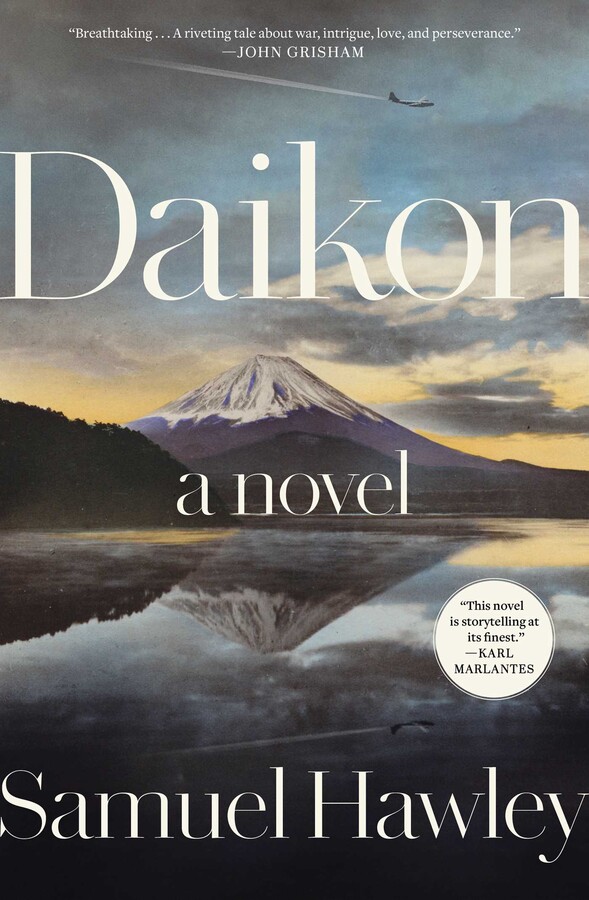
3. Analyze the covers of a variety of novels set during WWII. What commonalities do you find? How is the cover of Daikon similar/different to these other covers? Why do you think this cover was used to represent a novel so rich with a variety of themes?
A Conversation with Samuel Hawley
What made you first consider writing a what-if story about a third atomic bomb?
Back in the late 1990s I was doing a lot of reading about the Hiroshima and Nagasaki atomic bombs, the story from both the American and the Japanese side. One thing that struck me was how either of these missions could have so easily failed. Neither the Hiroshima uranium bomb nor the Nagasaki plutonium bomb had been fully tested, dropped from a plane to remotely detonate over a target. What if something went wrong? What if one of the bombs was a dud? What if it fell to earth and didn’t explode and the Japanese recovered it? I was intrigued by the idea and started trying to imagine what might have happened next. How long would it have taken the Japanese to figure out what this bomb was? What would they have done with it? How would the volatile political situation in Tokyo have played out if the Japanese had possessed an atomic bomb? As I mulled over these questions, a novel became to take shape in my mind.
You grew up in South Korea and taught English in Korea and Japan for many years. How did this personal history influence the writing of Daikon?
The biggest influence my Korea experience had on Daikon was probably on my decision to make the character of Petty Officer Yagi an ethnic Korean. I probably wouldn’t have done that otherwise, and it had a big impact on the story. Beyond that, there were little things I remember from that time that influenced how I imagined Japan in the final days of the war. The references in the novel to treeless hillsides, for example, to pine trees being cut down for fuel—this is how I remember Seoul from my childhood, the hills denuded for firewood. One of the biggest shocks I experienced when I returned to Korea many years later was that there were so many trees! Colonel Sagara’s teenage memory of falling down Mt. Fuji, which I liked for its symbolic value—this actually happened to my older brother, Jim Hawley, when he was at the World Boy Scout Jamboree held in Japan in 1971. He fell down Fuji while racing down the scree on the descent and returned home with a stitched-up face and our dad’s Olympus camera broken. The Riken complex where Keizo Kan worked—the original pre-war campus of Yonsei University in Seoul was in the back of my mind when I was composing these scenes. When Kan and Yagi are on a freight train bound for Tama Airfield and pass through Numazu, and Kan remembers the trip to Hakone where Aiko was conceived—my wife and I lived near here from 1988 to 1990, when we first went to Japan to teach English at a little language school called F.I.A., run by a jazz musician named Shoichi Kaneko. We lived in the village of Iwanami, a few stops north of Numazu on the Gotemba line, and took several enjoyable hikes to Hakone.
You must have done a great deal of research into WWII in Japan and the mechanics of the atomic bomb. What did your research project look like? What part of the process did you find most exciting?
I did indeed do a lot of research for Daikon. I like doing research. I actually like it more than writing, because there’s no pressure to produce anything in the end, a scene or a chapter or a book, that has to be judged. Research is simply an act of doing. I can be pretty obsessive about it, but I find it a satisfying kind of obsession, maybe like what a squirrel feels as it busily hunts for nuts to stash away for the winter.
Most of the research that went into Daikon was simply dogged, methodical work. But there were moments of quiet satisfaction along the way—finding a diagram of the thermal diffusion separator that was built at the Riken for Project Ni-Go’s failed attempt to enrich uranium, for example—and a few eureka moments too. The biggest concerned the development of Petty Officer Yagi. I didn’t like how I’d written him in earlier drafts. He seemed wooden and dull. Then I stumbled on the little-known story of Japanese actor Toshiro Mifune’s experience in the war, and in that moment something clicked. Yagi became a young Mifune in my mind, a quirky, real person that I could imagine, right down to the way he spoke and grunted—and in that imagining, a whole new dynamic emerged between Yagi and Kan. It was like things fell into place after that. The story finally worked! It even led to the novel getting a new title, Daikon. (For anyone that’s interested, I made a video about Toshiro Mifune in the war. You can watch it on my YouTube channel.)
The second eureka moment concerned the prologue, where Keizo and Noriko are together in San Francisco before the war and Keizo is too shy to propose. I was struggling to come up with a scene, something based around them going to a movie. Once again, it was research that guided me to the finished scene. I went through old San Francisco and Oakland newspapers to see what was playing at local theaters at the time (Jan. 1937), The Plainsman, Pigskin Parade, My Man Godfrey, Camille, etc., and I read up on various films and looked up their posters online. When I saw the poster for Camille, with the tagline “Garbo Loves Taylor”—boom, right there, the scene came to me in a flash. It was glimpsing those three words on that poster.
Keizo’s relationship with Noriko and his unlikely friendship with Yagi are very significant threads in this war story. Why did you choose to focus so heavily on these relationships and the ways that they developed under great duress?
The story as I originally conceived it was very different. The main focus was on the political struggle between the hardliners in the Japanese government who were determined to continue the war and the moderates who wanted to accept the Allies’ terms of surrender. Colonel Sagara was the key character in all this. But I found that what I was writing just wasn’t compelling. Sagara’s motivation, his desire to fight on—it was intellectually interesting but it didn’t move me in a personal way. But Keizo and Noriko Kan’s struggle to survive, and the impossible choices they faced—that was personal. I could feel it. I could imagine in a very visceral way, for example, the fear that Keizo must have experienced in being forced to go on a suicide mission; and Noriko’s terror during the firebombing of Tokyo; and Yagi’s conflicted feelings about his home country Japan, angry at being treated as an outsider. So I developed their characters more and more, and gradually all the political intrigue and struggle I had envisioned faded into the background, to the point where whole chapters I had written were reduced to just a few sentences or disappeared altogether.
Were there any books or texts that were particularly influential to you as you wrote Daikon?
Daikon revolves around the atomic bomb—the Japanese recovering it and investigating it and ultimately reassembling it to use against the Americans. To write a believable story, I therefore needed to have a good idea of what the bomb looked like and how it worked. It was a main character and I needed to get to know it. I needed details. I found them in Atomic Bombs by John Coster-Mullen[CJ1] , a truck driver who through amateur research and study and sheer perseverance became a leading expert on the “Little Boy” (Hiroshima) and “Fat Man” (Nagasaki) atomic bombs. It was Coster-Mullen, for example, who first revealed that the uranium projectile that was fired down the barrel inside the Hiroshima bomb slid onto the uranium target (i.e. was female), rather than the other way around, as previously depicted in all books. This was classified information that Coster-Mullen figured it out by pure deduction. Without his valuable book, I probably never would have even started writing Daikon.
Why did you wait until Noriko discovered she was again pregnant to reveal the details of Aiko’s death?
The death of her daughter, Aiko, was so traumatic for Noriko that she has blocked it off in a corner of her mind. In revealing her story to the reader, I wanted to do it in stages, like peeling away the layers of an onion, going deeper and deeper until we get to that most painful moment that Noriko has been unable to face, the moment in the river with Aiko struggling and Noriko drowning and the animal instinct taking over. As for Noriko being pregnant, I felt this was needed to give her the motivation and strength to carry on, to get to Tokyo and reunite with Keizo and rebuild their family, even if she has to crawl the whole way there. Finally, I wanted to make Noriko and Keizo symbolize Japan at the end of the story. They have both suffered horribly, but there is hope ahead, the prospect of renewal in the form of their new child. The closing sentence, “They followed the Americans onto the train,” is meant to symbolize Japan’s post-war history, the country embarking on a new journey into the American occupation and increasing prosperity beyond.
You’ve written several works of nonfiction, but this is your first novel. Was there anything that surprised you about the novel-writing process?
I find writing nonfiction easier than fiction because the plot of the story is already somewhat set. It’s history. It’s what happened. As a writer, you have to learn the details (research, interview people, etc.), then figure out how to tell the story in an interesting way. But the story is already there. In other words, there are parameters set with nonfiction, boundaries within which you operate. With fiction, there are no boundaries. You are in an open field that stretches all the way to the horizon, an endless sheet of blank paper, and you can write basically anything. And that’s hard!
Flashbacks into Noriko’s American radio show work are fascinating and, at times, entertaining. Is there a particular reason that you chose to feature one American-born character with perhaps the most emphasized connection to Western culture?
My conception of Keizo Kan was as a Japanese scientist who studied in the United States, at UC Berkeley. From there it was a natural progression to imagine him meeting and marrying a Japanese American woman during his time in Oakland/San Francisco. As for Noriko herself, she began to take shape from my study of Iva Toguri, who was labeled Tokyo Rose. Iva was a young Nisei woman from Los Angeles who was visiting relatives in Japan at the time of the Pearl Harbor attack and ended up being marooned there for the duration of the war. She went to work at Radio Tokyo as a propaganda announcer to earn a living and support herself, but she remained loyal to the United States, subtly undermining the intended demoralizing effect of her broadcasts so that they became mere entertainment. She was delighted when America won the war and she was at last free to go home. But when she did, she was charged with treason and sent to prison. (She was pardoned in 1977.) I felt great sympathy for Iva as I researched about her and was really interested in her story. When I decided that I needed to put Keizo Kan’s wife in peril, to cast her into prison, I therefore borrowed from Iva’s NHK experience to flesh out Noriko’s character, to make Noriko “problematic.”
Daikon can be (and has been) categorized as many things: a love story, a thriller, speculative fiction. If you had to use just one or two words to describe this book, what would you choose, and why?
This was not my first conception of the novel, by the way. Daikon as I originally wrote it was alternate history—but a different kind of alternate history. Usually with alternate history novels, the story takes place after the big change that is the premise for the transformed world the author imagines. An example is Philip K. Dick’s The Man in the High Tower, set in 1962 in a re-imagined world where Germany and Japan won WWII seventeen years before. I think almost all alternative history is like this: the “change” in history that makes the novel “alternate” has already happened. A shift has occurred that has created an intriguing new world in which the characters live. What I originally tried to do with Daikon, which I thought would be different, maybe almost unique, was to write a story about the change, the shift, as it was actually happening. It started out in the prologue as totally factual narrative history, the story of the B-29 Enola Gay, manned by Colonel Paul Tibbets and crew, all real people, taking off from Tinian on August 6, 1945, to drop the first atomic bomb on Hiroshima. Then, around page six, the plane develops an engine fire and crashes. At that point, narrative history becomes alternate history. In the rest of the story we follow history as it veers off in this new course.
It was my agent, Warren Frazier, who first suggested that this approach was not wholly effective because there would always be the thought in the back of the reader’s mind, “Yeah, but this isn’t how it really played out. We all know that the Enola Gay didn’t crash. It didn’t actually happen that way.” And he was right. I also realized that the attempt to rewrite history as it was happening was part of what had made it so hard for me to write the story in the first place. So, at Warren’s suggestion, I shifted the story from alternate history to hidden history, moving the opening back five days to August 1, 1945, and a covered-up earlier atomic bomb mission. Doing that was so freeing! I now had a timeline to follow, a framework to operate within. It released me from the burden of rewriting history and allowed me to concentrate on the characters more fully.
You were born in Korea to Canadian parents, have lived in Japan, and currently reside in Turkey. What does home mean to you, and do you relate to a particular character’s understanding of home in Daikon?
I guess you could say that Daikon is ultimately about people who are trying to find or restore a sense of “home.” We see this most dramatically with Keizo and Noriko Kan, their house destroyed and their daughter killed in the Great Tokyo Air Raid on the night of March 9-10, 1945. It leaves them both distraught and broken. But then hope is rekindled, sending them on a quest to restore their “home,” to rebuild something of what they had.
Petty Officer Yagi has lost his home, too, the childhood home where he grew up in Osaka. But he never had the same sense of “home” that the Kans’ had. As an ethnic Korean in Japan, he has never fully belonged. He must always be an outsider. In Daikon we see dying glimmers of his youthful yearning to be accepted, to “belong.” But he never can. In the epilogue, when we encounter Yagi for the last time, he has embraced his outsider status by becoming a yakuza gangster.
In my own much less dramatic life, I can relate to Yagi. I was born and grew up in South Korea, the son of missionary parents. Our foreign community in Seoul and at Taechon Beach on the Yellow Sea where we spent summers was “home” for me from 1960 until 1975, a kind of protective bubble. Then my family returned to Canada, and I never quite fit in after that. After graduating from university, I became an English teacher and eventually returned to Korea. I taught at Yonsei University in Seoul, in the very neighborhood where I’d grown up. But everything had changed so much by then that it was like the home I’d known had never existed. And at Taechon Beach—the cabins in the pines had been largely replaced by hotels and condos. So I can understand Yagi’s feelings, in my own small way. I suspect a lot of readers out there can too. We lose our childhood sense of security and belonging when we grow up, and for the rest of our lives a part of us yearns to recover it. But we never quite can.
Daikon took twenty-seven years to write and publish. What advice would you give to aspiring novelists who feel discouraged by the amount of time it is taking to write and perfect their work?
It took me five major attempts, going back to the late 1990s, to get Daikon finished to my satisfaction. Earlier drafts just weren’t any good and I gave up in disgust and worked on something else. It was the first book I ever tried writing—and by the time I finished it, I’d written ten other books!
Perhaps the most important lesson I learned from this long struggle is that a premise devoid of character is not a starting point for a novel. (“Imagine the end of WWII, but with the Japanese having an atomic bomb.”) This is a recipe for cardboard characters—which is exactly what I got in my first attempts at writing Daikon. A lot of the struggle I had was simply bringing the characters to life, to the point where I actually cared about them. So lesson number one to aspiring writers: Make character your starting point. Who is the main character in your story and what is his or her predicament? Get that nailed down to the point where you can express it in just one or two sentences. It’s stupidly simple. But it took me a long time to learn, to really internalize, this lesson.
If there’s a single lesson in all this, maybe it’s the following: When you’re on a 1,000-mile journey, don’t give up at mile 999.
[CJ1]No s per: https://www.amazon.com/Atom-Bombs-Secret-Inside-Little/dp/B0006S2AJ0
Samuel Hawley
Reading Group Guide
Introduction
World War II is nearing its end when a third atomic bomb falls into the hands of the Japanese military. This third bomb, code-named “Daikon” because of its shape, could have the power to radically change the outcome of the war. It certainly changes the lives of Keizo and Noriko Kan, the couple at the heart of Samuel Hawley’s debut novel, Daikon. When the Japanese discover the Daikon, physicist Keizo is told that if he unlocks its secrets and reassembles the bomb, his wife may be released from a notoriously brutal prison. What ensues is a riveting page-turner, a love story, a thriller, and a brilliantly researched and beautifully written work of historical fiction.
Discussion Questions
1. The Prologue is notably different from the rest of Daikon in many ways. Why do you think the author chose to begin with this romantic, nostalgic scene in America? Do you think the desired effect is achieved?
2. Daikon is ultimately a story of homecoming. At the end of the book, Keizo, Noriko, and Yagi all experience coming home or rebuilding home, in different ways. Did you find yourself drawn to one of their stories more than the others?
3. At the end of the book, it is revealed that Aiko’s name, which means “child of love,” is hidden within “Daikon.” A “child of love” nested in a bomb. How is this symbolic of the motivations Keizo has, and the choices he makes, toward the end of the war?
4. Though they are both starkly different in many ways, both Keizo Kan and Colonel Sagara exhibit what appears to be bravery. Especially toward the end of the book, how do their shows of bravery differ?
5. On page 111, the commander addressing the kaiten pilots is heard to say, “[The enemy] loves his country and has his own national spirit . . . So you must strengthen your Japanese spirit. You must love your country even more and fight even harder!” Who do you think exhibits patriotism and love of their country most profoundly in Daikon? Are there any shows of patriotism that surprised you?
6. What literary devices does the author employ to keep suspense high throughout the book?
7. Compare and contrast Colonel Sagara and Captain Onda. In what ways are they similar, and different?
8. Further tension between Keizo and Japanese military ideals is introduced when Keizo recalls his time studying under Oppenheimer in California. How did Oppenheimer’s words to Keizo on page 197 change how Keizo thought about physics, thereby affecting his future work on the bomb in Japan?
9. How do you think Noriko, Keizo, and Yagi would each define “home?” How might their answers vary?
10. Yagi and Keizo could easily have been enemies, but instead they gradually developed a powerful friendship that outlasted the war. At what point did their strong bond begin to form?
11. Reread Colonel Sagara’s story in chapter 8. Now that you have read the entire book, do these pages spark empathy within you or encourage you to look at Sagara differently than you did when you finished the book?
12. Throughout the book, the flashbacks are put in italics to differentiate them from the rest of the text. Why do you think the author chose to use italics in this way? What effect does it have on the reader?
13. How did you respond to finding Aiko’s name hidden in Daikon?
Enhance Your Book Club
1. Daikon is a masterclass in writing about love: love of one’s romantic partner (Keizo and Noriko), love of one’s friend (Keizo and Yagi), and love of one’s country. Choose one of the above and make a list of techniques the author uses to bring this love to life for the reader. Once you’ve studied this, try your own hand at writing a love scene or a love letter! Set a timer for twenty to thirty minutes and borrow the author’s techniques for your own short piece of writing. Afterward, discuss this experience with the group.
2. There is a long history of people all over the world singing folk songs, songs of home, during the war to recall what they once knew (and hope to know again soon). On page 178, Yagi and Kan find comfort in singing Crossing the Hill. Choose a favorite folk song, or look up one with which you aren’t familiar, and do a bit of research—does this tune have any significant connection to wartime? The answer may surprise you! If you aren’t familiar with many folk songs, try searching one of the following: “Looking for a Home;” “Battle Hymn of the Republic;” “Amazing Grace.”
3. Analyze the covers of a variety of novels set during WWII. What commonalities do you find? How is the cover of Daikon similar/different to these other covers? Why do you think this cover was used to represent a novel so rich with a variety of themes?
A Conversation with Samuel Hawley
What made you first consider writing a what-if story about a third atomic bomb?
Back in the late 1990s I was doing a lot of reading about the Hiroshima and Nagasaki atomic bombs, the story from both the American and the Japanese side. One thing that struck me was how either of these missions could have so easily failed. Neither the Hiroshima uranium bomb nor the Nagasaki plutonium bomb had been fully tested, dropped from a plane to remotely detonate over a target. What if something went wrong? What if one of the bombs was a dud? What if it fell to earth and didn’t explode and the Japanese recovered it? I was intrigued by the idea and started trying to imagine what might have happened next. How long would it have taken the Japanese to figure out what this bomb was? What would they have done with it? How would the volatile political situation in Tokyo have played out if the Japanese had possessed an atomic bomb? As I mulled over these questions, a novel became to take shape in my mind.
You grew up in South Korea and taught English in Korea and Japan for many years. How did this personal history influence the writing of Daikon?
The biggest influence my Korea experience had on Daikon was probably on my decision to make the character of Petty Officer Yagi an ethnic Korean. I probably wouldn’t have done that otherwise, and it had a big impact on the story. Beyond that, there were little things I remember from that time that influenced how I imagined Japan in the final days of the war. The references in the novel to treeless hillsides, for example, to pine trees being cut down for fuel—this is how I remember Seoul from my childhood, the hills denuded for firewood. One of the biggest shocks I experienced when I returned to Korea many years later was that there were so many trees! Colonel Sagara’s teenage memory of falling down Mt. Fuji, which I liked for its symbolic value—this actually happened to my older brother, Jim Hawley, when he was at the World Boy Scout Jamboree held in Japan in 1971. He fell down Fuji while racing down the scree on the descent and returned home with a stitched-up face and our dad’s Olympus camera broken. The Riken complex where Keizo Kan worked—the original pre-war campus of Yonsei University in Seoul was in the back of my mind when I was composing these scenes. When Kan and Yagi are on a freight train bound for Tama Airfield and pass through Numazu, and Kan remembers the trip to Hakone where Aiko was conceived—my wife and I lived near here from 1988 to 1990, when we first went to Japan to teach English at a little language school called F.I.A., run by a jazz musician named Shoichi Kaneko. We lived in the village of Iwanami, a few stops north of Numazu on the Gotemba line, and took several enjoyable hikes to Hakone.
You must have done a great deal of research into WWII in Japan and the mechanics of the atomic bomb. What did your research project look like? What part of the process did you find most exciting?
I did indeed do a lot of research for Daikon. I like doing research. I actually like it more than writing, because there’s no pressure to produce anything in the end, a scene or a chapter or a book, that has to be judged. Research is simply an act of doing. I can be pretty obsessive about it, but I find it a satisfying kind of obsession, maybe like what a squirrel feels as it busily hunts for nuts to stash away for the winter.
Most of the research that went into Daikon was simply dogged, methodical work. But there were moments of quiet satisfaction along the way—finding a diagram of the thermal diffusion separator that was built at the Riken for Project Ni-Go’s failed attempt to enrich uranium, for example—and a few eureka moments too. The biggest concerned the development of Petty Officer Yagi. I didn’t like how I’d written him in earlier drafts. He seemed wooden and dull. Then I stumbled on the little-known story of Japanese actor Toshiro Mifune’s experience in the war, and in that moment something clicked. Yagi became a young Mifune in my mind, a quirky, real person that I could imagine, right down to the way he spoke and grunted—and in that imagining, a whole new dynamic emerged between Yagi and Kan. It was like things fell into place after that. The story finally worked! It even led to the novel getting a new title, Daikon. (For anyone that’s interested, I made a video about Toshiro Mifune in the war. You can watch it on my YouTube channel.)
The second eureka moment concerned the prologue, where Keizo and Noriko are together in San Francisco before the war and Keizo is too shy to propose. I was struggling to come up with a scene, something based around them going to a movie. Once again, it was research that guided me to the finished scene. I went through old San Francisco and Oakland newspapers to see what was playing at local theaters at the time (Jan. 1937), The Plainsman, Pigskin Parade, My Man Godfrey, Camille, etc., and I read up on various films and looked up their posters online. When I saw the poster for Camille, with the tagline “Garbo Loves Taylor”—boom, right there, the scene came to me in a flash. It was glimpsing those three words on that poster.
Keizo’s relationship with Noriko and his unlikely friendship with Yagi are very significant threads in this war story. Why did you choose to focus so heavily on these relationships and the ways that they developed under great duress?
The story as I originally conceived it was very different. The main focus was on the political struggle between the hardliners in the Japanese government who were determined to continue the war and the moderates who wanted to accept the Allies’ terms of surrender. Colonel Sagara was the key character in all this. But I found that what I was writing just wasn’t compelling. Sagara’s motivation, his desire to fight on—it was intellectually interesting but it didn’t move me in a personal way. But Keizo and Noriko Kan’s struggle to survive, and the impossible choices they faced—that was personal. I could feel it. I could imagine in a very visceral way, for example, the fear that Keizo must have experienced in being forced to go on a suicide mission; and Noriko’s terror during the firebombing of Tokyo; and Yagi’s conflicted feelings about his home country Japan, angry at being treated as an outsider. So I developed their characters more and more, and gradually all the political intrigue and struggle I had envisioned faded into the background, to the point where whole chapters I had written were reduced to just a few sentences or disappeared altogether.
Were there any books or texts that were particularly influential to you as you wrote Daikon?
Daikon revolves around the atomic bomb—the Japanese recovering it and investigating it and ultimately reassembling it to use against the Americans. To write a believable story, I therefore needed to have a good idea of what the bomb looked like and how it worked. It was a main character and I needed to get to know it. I needed details. I found them in Atomic Bombs by John Coster-Mullen[CJ1] , a truck driver who through amateur research and study and sheer perseverance became a leading expert on the “Little Boy” (Hiroshima) and “Fat Man” (Nagasaki) atomic bombs. It was Coster-Mullen, for example, who first revealed that the uranium projectile that was fired down the barrel inside the Hiroshima bomb slid onto the uranium target (i.e. was female), rather than the other way around, as previously depicted in all books. This was classified information that Coster-Mullen figured it out by pure deduction. Without his valuable book, I probably never would have even started writing Daikon.
Why did you wait until Noriko discovered she was again pregnant to reveal the details of Aiko’s death?
The death of her daughter, Aiko, was so traumatic for Noriko that she has blocked it off in a corner of her mind. In revealing her story to the reader, I wanted to do it in stages, like peeling away the layers of an onion, going deeper and deeper until we get to that most painful moment that Noriko has been unable to face, the moment in the river with Aiko struggling and Noriko drowning and the animal instinct taking over. As for Noriko being pregnant, I felt this was needed to give her the motivation and strength to carry on, to get to Tokyo and reunite with Keizo and rebuild their family, even if she has to crawl the whole way there. Finally, I wanted to make Noriko and Keizo symbolize Japan at the end of the story. They have both suffered horribly, but there is hope ahead, the prospect of renewal in the form of their new child. The closing sentence, “They followed the Americans onto the train,” is meant to symbolize Japan’s post-war history, the country embarking on a new journey into the American occupation and increasing prosperity beyond.
You’ve written several works of nonfiction, but this is your first novel. Was there anything that surprised you about the novel-writing process?
I find writing nonfiction easier than fiction because the plot of the story is already somewhat set. It’s history. It’s what happened. As a writer, you have to learn the details (research, interview people, etc.), then figure out how to tell the story in an interesting way. But the story is already there. In other words, there are parameters set with nonfiction, boundaries within which you operate. With fiction, there are no boundaries. You are in an open field that stretches all the way to the horizon, an endless sheet of blank paper, and you can write basically anything. And that’s hard!
Flashbacks into Noriko’s American radio show work are fascinating and, at times, entertaining. Is there a particular reason that you chose to feature one American-born character with perhaps the most emphasized connection to Western culture?
My conception of Keizo Kan was as a Japanese scientist who studied in the United States, at UC Berkeley. From there it was a natural progression to imagine him meeting and marrying a Japanese American woman during his time in Oakland/San Francisco. As for Noriko herself, she began to take shape from my study of Iva Toguri, who was labeled Tokyo Rose. Iva was a young Nisei woman from Los Angeles who was visiting relatives in Japan at the time of the Pearl Harbor attack and ended up being marooned there for the duration of the war. She went to work at Radio Tokyo as a propaganda announcer to earn a living and support herself, but she remained loyal to the United States, subtly undermining the intended demoralizing effect of her broadcasts so that they became mere entertainment. She was delighted when America won the war and she was at last free to go home. But when she did, she was charged with treason and sent to prison. (She was pardoned in 1977.) I felt great sympathy for Iva as I researched about her and was really interested in her story. When I decided that I needed to put Keizo Kan’s wife in peril, to cast her into prison, I therefore borrowed from Iva’s NHK experience to flesh out Noriko’s character, to make Noriko “problematic.”
Daikon can be (and has been) categorized as many things: a love story, a thriller, speculative fiction. If you had to use just one or two words to describe this book, what would you choose, and why?
This was not my first conception of the novel, by the way. Daikon as I originally wrote it was alternate history—but a different kind of alternate history. Usually with alternate history novels, the story takes place after the big change that is the premise for the transformed world the author imagines. An example is Philip K. Dick’s The Man in the High Tower, set in 1962 in a re-imagined world where Germany and Japan won WWII seventeen years before. I think almost all alternative history is like this: the “change” in history that makes the novel “alternate” has already happened. A shift has occurred that has created an intriguing new world in which the characters live. What I originally tried to do with Daikon, which I thought would be different, maybe almost unique, was to write a story about the change, the shift, as it was actually happening. It started out in the prologue as totally factual narrative history, the story of the B-29 Enola Gay, manned by Colonel Paul Tibbets and crew, all real people, taking off from Tinian on August 6, 1945, to drop the first atomic bomb on Hiroshima. Then, around page six, the plane develops an engine fire and crashes. At that point, narrative history becomes alternate history. In the rest of the story we follow history as it veers off in this new course.
It was my agent, Warren Frazier, who first suggested that this approach was not wholly effective because there would always be the thought in the back of the reader’s mind, “Yeah, but this isn’t how it really played out. We all know that the Enola Gay didn’t crash. It didn’t actually happen that way.” And he was right. I also realized that the attempt to rewrite history as it was happening was part of what had made it so hard for me to write the story in the first place. So, at Warren’s suggestion, I shifted the story from alternate history to hidden history, moving the opening back five days to August 1, 1945, and a covered-up earlier atomic bomb mission. Doing that was so freeing! I now had a timeline to follow, a framework to operate within. It released me from the burden of rewriting history and allowed me to concentrate on the characters more fully.
You were born in Korea to Canadian parents, have lived in Japan, and currently reside in Turkey. What does home mean to you, and do you relate to a particular character’s understanding of home in Daikon?
I guess you could say that Daikon is ultimately about people who are trying to find or restore a sense of “home.” We see this most dramatically with Keizo and Noriko Kan, their house destroyed and their daughter killed in the Great Tokyo Air Raid on the night of March 9-10, 1945. It leaves them both distraught and broken. But then hope is rekindled, sending them on a quest to restore their “home,” to rebuild something of what they had.
Petty Officer Yagi has lost his home, too, the childhood home where he grew up in Osaka. But he never had the same sense of “home” that the Kans’ had. As an ethnic Korean in Japan, he has never fully belonged. He must always be an outsider. In Daikon we see dying glimmers of his youthful yearning to be accepted, to “belong.” But he never can. In the epilogue, when we encounter Yagi for the last time, he has embraced his outsider status by becoming a yakuza gangster.
In my own much less dramatic life, I can relate to Yagi. I was born and grew up in South Korea, the son of missionary parents. Our foreign community in Seoul and at Taechon Beach on the Yellow Sea where we spent summers was “home” for me from 1960 until 1975, a kind of protective bubble. Then my family returned to Canada, and I never quite fit in after that. After graduating from university, I became an English teacher and eventually returned to Korea. I taught at Yonsei University in Seoul, in the very neighborhood where I’d grown up. But everything had changed so much by then that it was like the home I’d known had never existed. And at Taechon Beach—the cabins in the pines had been largely replaced by hotels and condos. So I can understand Yagi’s feelings, in my own small way. I suspect a lot of readers out there can too. We lose our childhood sense of security and belonging when we grow up, and for the rest of our lives a part of us yearns to recover it. But we never quite can.
Daikon took twenty-seven years to write and publish. What advice would you give to aspiring novelists who feel discouraged by the amount of time it is taking to write and perfect their work?
It took me five major attempts, going back to the late 1990s, to get Daikon finished to my satisfaction. Earlier drafts just weren’t any good and I gave up in disgust and worked on something else. It was the first book I ever tried writing—and by the time I finished it, I’d written ten other books!
Perhaps the most important lesson I learned from this long struggle is that a premise devoid of character is not a starting point for a novel. (“Imagine the end of WWII, but with the Japanese having an atomic bomb.”) This is a recipe for cardboard characters—which is exactly what I got in my first attempts at writing Daikon. A lot of the struggle I had was simply bringing the characters to life, to the point where I actually cared about them. So lesson number one to aspiring writers: Make character your starting point. Who is the main character in your story and what is his or her predicament? Get that nailed down to the point where you can express it in just one or two sentences. It’s stupidly simple. But it took me a long time to learn, to really internalize, this lesson.
If there’s a single lesson in all this, maybe it’s the following: When you’re on a 1,000-mile journey, don’t give up at mile 999.
[CJ1]No s per: https://www.amazon.com/Atom-Bombs-Secret-Inside-Little/dp/B0006S2AJ0
About the Author
Margaret Dillon
Samuel Hawley was born and raised in South Korea, the son of Canadian missionaries, and taught English in Korea and Japan for nearly two decades. He is the author of the nonfiction book The Imjin War, the most comprehensive account in English of Japan’s 16th-century invasion of Korea and attempted conquest of China. He currently lives in Istanbul, Turkey. Daikon is his debut novel.
Product Details
- Publisher: Avid Reader Press/Simon & Schuster (July 8, 2025)
- Length: 352 pages
- ISBN13: 9781668083055
Browse Related Books
Raves and Reviews
“Hawley spins a compelling tale told entirely from the Japanese perspective. Deeply researched science; a window into nationalism in all its ugliness; love, resilience and humanity even as everything around you is destroyed. . . . Daikon is alternative history at its best.”
— NPR
“What if not two but three atomic bombs wound up in the Pacific theater? And what if the third one fell into the hands of the enemy when an American plane crashed on the Japanese mainland? Hawley’s impeccably detailed narrative offers an unnerving fictional answer. . . . The novel’s tension mounts in highly cinematic fashion, despite our awareness of what the history books tell us.”
—Alida Becker, The New York Times
“[An] absorbing alternative history . . . Daikon—the word, meaning radish, becomes the bomb’s codename—unfolds like a detective novel, as Kan works backward to grasp how the weapon was made. . . . The story barrels ahead urgently, as the bombings of Hiroshima and Nagasaki take place while Kan is working. . . . Duty, anger, sorrow, conscience and even hope mix together to form the novel’s bracingly intimate ending. Even in alternate histories, it is startling to consider how single decisions can decide worldwide outcomes.”
—Sam Sacks, The Wall Street Journal
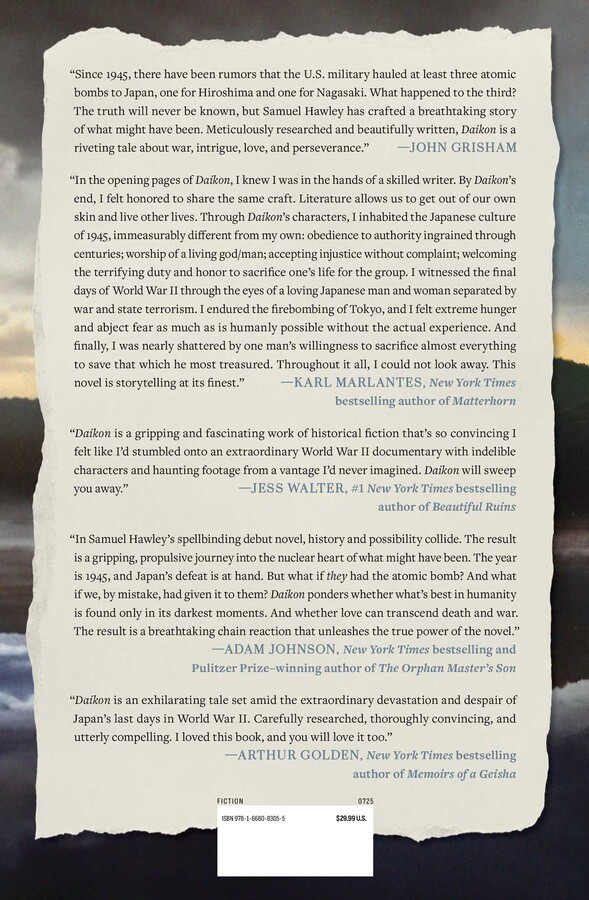
“Since 1945, there have been rumors that the U.S. military hauled at least three atomic bombs to Japan, one for Hiroshima and one for Nagasaki. What happened to the third? The truth will never be known, but Samuel Hawley has crafted a breathtaking story of what might have been. Meticulously researched and beautifully written, Daikon is a riveting tale about war, intrigue, love, and perseverance.”
—John Grisham
“It’s the last gasp of WWII in a world with three atomic bombs—and Japan has one of them. A young physicist and his imprisoned wife get caught in the crosshairs in this stunning novel that takes a fresh, unexpected look at a well-trod period in history.”
—People magazine
“An engrossing and thought-provoking novel . . . The plot feels entirely plausible, and none of the characters fit any obvious stereotypes. . . . The author’s research is impressive as he describes how the bomb is designed to work, the tensions within the Japanese power structure, and details of Japanese culture.”
—Kirkus Reviews (starred review)
“Daikon is a gripping and fascinating work of historical fiction that’s so convincing I felt like I’d stumbled onto an extraordinary World War II documentary with indelible characters and haunting footage from a vantage I’d never imagined. Daikon will sweep you away.”
—Jess Walter, #1 New York Times bestselling author of Beautiful Ruins
“Thrilling . . . Builds to a pulse-pounding climax. The result is the most imaginative take on Hiroshima since Edwin Corley’s The Jesus Factor.”
—Publishers Weekly (starred review)
“Propelled by the tensions between hard-liners and those open to surrender . . . [Daikon is] a realistic and tightly plotted narrative told through Japanese eyes.”
—Booklist (starred review)
“In the opening pages of Daikon, I knew I was in the hands of a skilled writer. By Daikon’s end, I felt honored to share the same craft. Literature allows us to get out of our own skins and live other lives. Through Daikon’s characters, I inhabited the Japanese culture of 1945, immeasurably different from my own: obedience to authority ingrained through centuries; worship of a living god/man; accepting injustice without complaint; welcoming the terrifying duty and honor to sacrifice one’s life for the group. I witnessed the final days of World War II through the eyes of a loving Japanese man and woman separated by war and state terrorism. I endured the firebombing of Tokyo, and I felt extreme hunger and abject fear as much as is humanly possible without the actual experience. And finally, I was nearly shattered by one man’s willingness to sacrifice almost everything to save that which he most treasured. Throughout it all, I could not look away. This novel is storytelling at its finest.”
—Karl Marlantes, New York Times bestselling author of Matterhorn
“A suspenseful tale of love and intrigue set in Japan during the closing days of World War II.”
—Esquire
Resources and Downloads
High Resolution Images
-
Book Cover Image (jpg): Daikon
Hardcover 9781668083055
-
Author Photo (jpg): Samuel Hawley Margaret Dillon(0.1 MB)
Any use of an author photo must include its respective photo credit