Plus, receive recommendations and exclusive offers on all of your favorite books and authors from Simon & Schuster.
0:00 /
Next Stop
LIST PRICE $13.99
PRICE MAY VARY BY RETAILER
Digital products purchased on SimonandSchuster.com must be read on the Simon & Schuster Books app. Learn more.
Free shipping when you spend $40. Terms apply.
Buy from Other Retailers
Table of Contents
About the Book
* WINNER OF THE EDWARD LEWIS WALLANT AWARD AND FINALIST FOR THE SAMI ROHR PRIZE *
A gripping and hauntingly prescient novel that explores the precariousness of Jewish American life after a black hole consumes Israel, setting off a chain of global anomalies plunging the world into a time of peril and miracles.
When a black hole suddenly consumes Israel and as mysterious anomalies spread across the globe, suddenly the world teeters on the brink of chaos. As antisemitic paranoia and violence escalate, Jewish citizens Ethan and Ella find themselves navigating a landscape fraught with danger and uncertainty.
Ella, a dedicated photojournalist, captures the shifting dynamics of their nameless American city, documenting the resilience and struggles of its Jewish residents. Some are drawn to the anomalies, disappearing into an abandoned subway system that seems to connect the world, while others form militias in the south. Yet, Ethan, Ella, and her young son Michael choose to remain, seeking solace in small joys amidst the hostility.
But then thousands of commercial planes vanish from the sky. Air travel stops. Borders close. Refugees pour into the capital. Eventually all Jews in the city are forced to relocate to the Pale, an area sandwiched between a park and a river. There, under the watchful eye of border guards, drones, and robotic dogs, they form a fragile new society.
Suspenseful, thought-provoking, and brilliantly conceived, Next Stop is a masterful blend of speculative fiction and family drama. Invoking biblical and historical themes in a world eerily similar to our own, it is a profound exploration of memory, identity, and survival.
A gripping and hauntingly prescient novel that explores the precariousness of Jewish American life after a black hole consumes Israel, setting off a chain of global anomalies plunging the world into a time of peril and miracles.
When a black hole suddenly consumes Israel and as mysterious anomalies spread across the globe, suddenly the world teeters on the brink of chaos. As antisemitic paranoia and violence escalate, Jewish citizens Ethan and Ella find themselves navigating a landscape fraught with danger and uncertainty.
Ella, a dedicated photojournalist, captures the shifting dynamics of their nameless American city, documenting the resilience and struggles of its Jewish residents. Some are drawn to the anomalies, disappearing into an abandoned subway system that seems to connect the world, while others form militias in the south. Yet, Ethan, Ella, and her young son Michael choose to remain, seeking solace in small joys amidst the hostility.
But then thousands of commercial planes vanish from the sky. Air travel stops. Borders close. Refugees pour into the capital. Eventually all Jews in the city are forced to relocate to the Pale, an area sandwiched between a park and a river. There, under the watchful eye of border guards, drones, and robotic dogs, they form a fragile new society.
Suspenseful, thought-provoking, and brilliantly conceived, Next Stop is a masterful blend of speculative fiction and family drama. Invoking biblical and historical themes in a world eerily similar to our own, it is a profound exploration of memory, identity, and survival.
Reading Group Guide
Get a FREE ebook by joining our mailing list today! Plus, receive recommendations for your next Book Club read.
By clicking 'Sign me up' I agree to the Terms of Use and acknowledge the Privacy Policy and Notice of Financial Incentive. Free ebook offer available to NEW US subscribers only. Offer redeemable at Simon & Schuster's ebook fulfillment partner. Must redeem within 90 days. See full terms and conditions and this month's choices.
This reading group guide for Next Stop includes an introduction, discussion questions, ideas for enhancing your book club, and a Q&A with author Benjamin Resnick. The suggested questions are intended to help your reading group find new and interesting angles and topics for your discussion. We hope that these ideas will enrich your conversation and increase your enjoyment of the book.
Introduction
A strange, inexplicable series of events, including the disappearance of the entire State of Israel into a black hole, results in rampant antisemitism that forces Jewish people to make life-changing decisions: Do they venture south and join a militia? Do they follow the magnetic call of these anomalies and parachute down? Do they stay and scrape together a life in heavily policed neighborhoods as an increasingly hostile world seems to devolve around them? Resnick’s prophetic debut follows a young, blended family—Ethan, Ella, and her son, Michael—as they seek safety, community, and connection in a society on the brink. A speculative family story about love in catastrophe, Next Stop is an uncannily resonant novel that both invokes and challenges the fault lines between our collective, national, and individual histories and futures.
Discussion Questions
1. Next Stop takes place in an unnamed city in the United States. How do you think the story would change if the city were named? Why might Resnick have chosen to keep the city nameless?
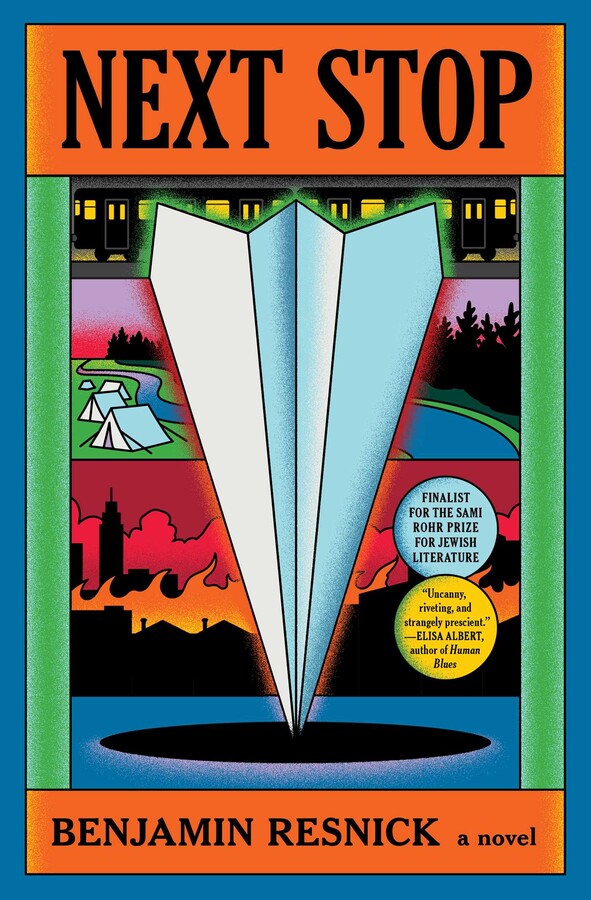
2. Ethan and Ella initially bond when she tells him she likes paper airplanes because “they seem very free and very light, even when they crash” (page 8). What do you think Ethan likes about paper airplanes? Why?
3. Throughout the book, many characters are displaced and forced to reckon with the fact the places they once considered home pose a threat to their safety. How do you think the characters’ perception of home changes as a result?
4. As Ethan considers his future and his relationship with Ella, he asks her if she thinks they would have ended up together if they were not faced with the systemic antisemitism that arose in the aftermath of the events (page 200). What do you think brought Ella and Ethan together? Is it the same thing keeping them together?
5. When the Rosenfelds flee the city and move to the Pale, Ethan helps them settle—he finds them an apartment, helps them get health insurance, and guides them through the school-enrollment process (page 195). Are Ethan, Ella, and Michael able to find the community and support they provide to others while living in the Pale? How?
6. How would you describe Michael? What do you think enables him to survive and find joy amid prevalent antisemitism?
7. When reflecting on her relationship with Ethan, Ella looks at him and thinks: “When cast out on endless waters there are some who thrash and kick. Others surrender. He looked like a man drowning and it enraged her and filled her with compassion” (page 208). Why did she have this reaction? Do you agree with Ella’s judgment?
8. Put yourself in Ethan’s and Ella’s shoes. Torn between staying with elder family members and exposing yourself to danger or moving underground to safety and isolation, what would you have done?
9. Shortly before Ella decides that going underground would ensure the family’s safety, she and her father watch as the Rabbits organize “a seder-night exodus” (page 213). What is the significance of witnessing this on the first night of Passover, the holiday commemorating the liberation of Jewish people from slavery in Egypt?
10. How does Ethan’s definition of family evolve throughout the novel? How does his relationship to Ella and Michael change?
11. How do you interpret the messiah character? In what ways does his appearance advance the plot?
12. Despite the threat of the unknown looming over Michael and Nathaniel at the end of the novel, the boys seem hopeful with the “promises of the next station, the new station” (page 287). What might life be like after their arrival at this new station?
Enhance Your Book Club
Ethan lives in an unnamed city in the United States. Consider and discuss how the narrative would have been different if it were told from the perspective of someone coming from a small town or rural community rather than a big city.
Think about when Michael boards the train without his mother. Though he has effectively lost his parents, he is unafraid as he reads the posters along the train car walls. Create some of the posters that may have inspired hope for Michael.
Read chapters XVI and XVII of the book together. How does the tone differ across these two chapters? Discuss how Resnick’s word choice and use of literary devices help him achieve the differences within twenty-one pages.
A Conversation with Benjamin Resnick
What was your day-to-day writing process like for Next Stop? Did you work with any sort of outline?
I tend to write in a very methodical way. When I am actively working on a project my rule for myself is to write five hundred words a day, every day, except for Shabbat, and I usually do manage to do that until I have a completed draft. The editing process is a little different, of course, and for me that usually involves clarifying and making cuts. I’m not a fan of lengthy exposition in fiction and in my effort to avoid that sometimes my stories come out a bit too cryptic on the first go around. So I wind up explaining things more as I edit. But I’m also a big believer in cuts, and in the motto that shorter is usually better.
I don’t work from detailed written outlines. I do, however, find that I am most successful when I have a pretty good idea of where the story is going at the outset. And I make notes to myself throughout, which I usually keep at the end of the document. Deleting all of those notes when I finally finish a draft is always satisfying.
Were there any books, or media generally, that energized or encouraged you as you developed this novel?
In its early stages, some of the themes and atmosphere of Next Stop were inspired by Mohsin Hamid’s Exit West and by the dreamlike aspects of Kazuo Ishiguro’s work. In a similar way, though I didn’t read it until after my book came out, Paul Lynch’s Prophet Song feels like Next Stop’s spiritual cousin. And I absolutely love Ursula K. Le Guin’s novels, particularly The Dispossessed and The Left Hand of Darkness. She was simply a master storyteller and world-builder and I think everyone writing speculative fiction in English owes her a great debt.
In a very different vein, I also had shows like The Walking Dead rattling around in my head. Next Stop is not postapocalyptic zombie fiction, but it shares an affinity with some of those stories, at least in my imagination.
How is your storytelling influenced by your work as a rabbi? Is your writing informed at all by your experience as a professional chef?
Rabbis are storytellers in many different and important ways. As a rabbi I frequently tell people that I talk for a living. All day long I have conversations with fascinating people about the things that matter most to them. And those conversations almost always involve hearing stories and telling stories. That’s an incredible way to move through life and I’m sure it influences my fiction in all kinds of ways, consciously and unconsciously.
But it’s also true that the kind of writing I do when I’m working on something like a sermon is very different from the kind of writing I do when I’m working on a novel. Writing sermons is usually a very fluid process for me. I write them quickly and very soon after they’re done they’re out in the world and I get instant feedback. Fiction writing isn’t like that at all—it’s slow and much more difficult for me and, of course, it’s a more protracted process.
Also, when it comes to sermons I don’t think originality is really the main currency. In a sermon you’re not necessarily trying to be innovative. Instead you’re trying to be an authentic voice of an ancient tradition, like a musician playing a piece by a great master. You want to play it in a way that people will be able to hear it and in a way that will be maximally impactful. That requires creativity, but you’re not trying to say something brand new. In contrast, with fiction the canvas is much bigger and, at least in my imagination, I’m trying to create something that is genuinely novel.
Is my writing informed by my past work as a chef? That’s a fantastic question and not one that I’ve been asked before! My restaurant days were so long ago that the truth is it’s hard for me to really know how they come through in my writing. But I’m sure they do. Just as our dreams are populated by aspects of ourselves, I think that everything we do as fiction writers is, on some level, self-referential. Sometimes people ask if my characters are autobiographical or based on people that I know, and the answer I usually give is “No, not on a conscious level.” A novel isn’t a diary or a memoir. But at the end of the day all my stories are populated by people I dreamed up, so on some level they’re all me, or different sides of me, or instantiations of ideas I want to explore. Getting back to the question, even though I haven’t cooked professionally for many years, I still love food and cooking and my sense of myself as a semiprofessional cook remains an important part of my identity. So I think that must come out in my writing somehow, even if I’d be hard-pressed to identify it.
Which of the characters in Next Stop did you find easiest to write? If you could return to any in the form of a short story or novella, who would you want to explore?
I hardly ever find writing fiction easy, but I really enjoyed writing about Michael and if I were going to return to the world of Next Stop, I would want to see what happened to him and what he’s doing now, probably as an adult.
Is there a section, scene, or sentence in the book about which you are especially proud?
My favorite sentence in the book is “It was a strange feature of life in their city that babies came home in cabs, on buses, on subways, as though they were people and not small gods.” Parenting is one of the central preoccupations in the book (and in my life!) and that sentence captures a lot about my own experience as a father.
Relatedly (and following up on the previous question), I’m also really proud of Michael as a character and I enjoy writing about children in general. It’s important to take children seriously as characters and that’s a specific kind of challenge, in part, I think, because children change so quickly. A five-year-old is really different from a six-and-a-half-year-old (in terms of interests, speech, etc.) even though that’s not so much time from an adult perspective. So if you’re telling a story that unfolds over, say, a couple of years, and you’re including child characters, you need to have an intensity of focus and remain attentive to those changes. I’ve gotten really nice feedback about the characterization of Michael and that’s extremely gratifying.
On page 233, Joel carves the following inscription on a subway tile after Ella, Ethan, and Michael leave:
כאן גרה משפחה יהודית שמחה בין התחנה הקודמת לתחנה הבאה
Would you mind translating this to English?
I am actually hesitant to translate it because it was very important to me that it remain untranslated and untransliterated in the book. But you’ve made it this far so here you go: “Here lived a happy Jewish family between the previous stop and the next stop.”
I wanted it to be untranslated in the book because I imagined three different ways of experiencing it, all of which are related to what I think the book is trying to do. For Hebrew readers, it’s like a surprising embrace, a moment of secret intimacy and pride. For readers who have a little bit of Hebrew (i.e., many American Jews), it functions as a little homework assignment (they can look it up!) and might also inspire a twinge of guilt, reminding them that they need to work on their Hebrew (and, as a rabbi, I’m here to say that they really should!). And for readers with no Hebrew whatsoever, it heightens the foreignness of the story, positioning those readers on the outside, to some extent.
Did you ever consider writing Next Stop in a more literal way, with more certainty around its bigger questions? Where do you imagine the subway to be going?
No, not really. Creating a dreamlike, quasi-mythological atmosphere was important to me from the beginning. I never want to be cryptic for the sake of being cryptic, but I like books that invite speculation and, in order to really accomplish that, I think writers need to be withholding, to a point. I also think stories linger in the mind for longer when they remain somewhat mysterious. Or that’s true for me, anyway.
So I do have my own ideas about where the subway is going, but in keeping with the spirit of what I just said, I won’t share them. I will say that, at least for me, the subway is not heading off into oblivion. Eventually the children will arrive somewhere and begin to build something new. Most readers that I’ve talked to seem to interpret it that way, though I have had some readers who think the ending is really bleak and that the train is just a one-way ride to nowhere. That’s not how I see it, but the book leaves it open.
I’ll also add that my own tolerance for unanswered questions—and for multiple answers to the same question—is probably higher than average and I suspect that’s something I inherited from my ancestors. Endless questions and interpretive ambiguities strike me as central features of Jewish tradition.
What advice would you give Michael at the end of the novel?
Try to hold on to both the past and the future at the same moment. And remember that being a Jew is a wonderful thing.
How do you define home?
Fundamentally, home is wherever my wife and children are. That’s a cliché but it’s completely true, which is why everyone says it! It’s also the case that there are some corners of the world—physical places—where I feel more at home than others. To a large extent I’m sure that’s a function of the fact that I’ve spent lots of time with my family in those places, and so they become part of our shared history and a part of how we love and relate to one another.
But I don’t think that’s the only thing going on and in some ways my connection to certain cities and places is more mysterious to me. I grew up in Chicago and I wouldn’t say that Chicago is still my home, but I will always love the Chicago Cubs. On the other hand, I’ve lived much of my adult life in New York City and I love it passionately, but I have only a passing interest in the Mets. And ever since graduating from college I’ve felt that New York City is one of my homes, even though we moved away for several years and even though we now live just outside of it. I don’t know how to explain that entirely. In a similar way I feel profoundly at home whenever I’m in Israel, even though I only really lived there once, for about eight months, when I was in rabbinical school. But the bougainvillea in Jerusalem are a part of my soul every bit as much as the tulips in Central Park.
What message would you hope your readers learn from Next Stop?
In my mind, an overarching message is that the scaffolding around which we build our lives day to day—our shared vision of society, our politics, our health and physical safety—is inherently fragile. And the veneer that shields us from profound uncertainty and even crisis is quite thin. And at the same time, we have each other. We are children and parents and we are members of communities and nations and those things matter and sometimes they will save us, even if only temporarily.
Introduction
A strange, inexplicable series of events, including the disappearance of the entire State of Israel into a black hole, results in rampant antisemitism that forces Jewish people to make life-changing decisions: Do they venture south and join a militia? Do they follow the magnetic call of these anomalies and parachute down? Do they stay and scrape together a life in heavily policed neighborhoods as an increasingly hostile world seems to devolve around them? Resnick’s prophetic debut follows a young, blended family—Ethan, Ella, and her son, Michael—as they seek safety, community, and connection in a society on the brink. A speculative family story about love in catastrophe, Next Stop is an uncannily resonant novel that both invokes and challenges the fault lines between our collective, national, and individual histories and futures.
Discussion Questions
1. Next Stop takes place in an unnamed city in the United States. How do you think the story would change if the city were named? Why might Resnick have chosen to keep the city nameless?
2. Ethan and Ella initially bond when she tells him she likes paper airplanes because “they seem very free and very light, even when they crash” (page 8). What do you think Ethan likes about paper airplanes? Why?
3. Throughout the book, many characters are displaced and forced to reckon with the fact the places they once considered home pose a threat to their safety. How do you think the characters’ perception of home changes as a result?
4. As Ethan considers his future and his relationship with Ella, he asks her if she thinks they would have ended up together if they were not faced with the systemic antisemitism that arose in the aftermath of the events (page 200). What do you think brought Ella and Ethan together? Is it the same thing keeping them together?
5. When the Rosenfelds flee the city and move to the Pale, Ethan helps them settle—he finds them an apartment, helps them get health insurance, and guides them through the school-enrollment process (page 195). Are Ethan, Ella, and Michael able to find the community and support they provide to others while living in the Pale? How?
6. How would you describe Michael? What do you think enables him to survive and find joy amid prevalent antisemitism?
7. When reflecting on her relationship with Ethan, Ella looks at him and thinks: “When cast out on endless waters there are some who thrash and kick. Others surrender. He looked like a man drowning and it enraged her and filled her with compassion” (page 208). Why did she have this reaction? Do you agree with Ella’s judgment?
8. Put yourself in Ethan’s and Ella’s shoes. Torn between staying with elder family members and exposing yourself to danger or moving underground to safety and isolation, what would you have done?
9. Shortly before Ella decides that going underground would ensure the family’s safety, she and her father watch as the Rabbits organize “a seder-night exodus” (page 213). What is the significance of witnessing this on the first night of Passover, the holiday commemorating the liberation of Jewish people from slavery in Egypt?
10. How does Ethan’s definition of family evolve throughout the novel? How does his relationship to Ella and Michael change?
11. How do you interpret the messiah character? In what ways does his appearance advance the plot?
12. Despite the threat of the unknown looming over Michael and Nathaniel at the end of the novel, the boys seem hopeful with the “promises of the next station, the new station” (page 287). What might life be like after their arrival at this new station?
Enhance Your Book Club
Ethan lives in an unnamed city in the United States. Consider and discuss how the narrative would have been different if it were told from the perspective of someone coming from a small town or rural community rather than a big city.
Think about when Michael boards the train without his mother. Though he has effectively lost his parents, he is unafraid as he reads the posters along the train car walls. Create some of the posters that may have inspired hope for Michael.
Read chapters XVI and XVII of the book together. How does the tone differ across these two chapters? Discuss how Resnick’s word choice and use of literary devices help him achieve the differences within twenty-one pages.
A Conversation with Benjamin Resnick
What was your day-to-day writing process like for Next Stop? Did you work with any sort of outline?
I tend to write in a very methodical way. When I am actively working on a project my rule for myself is to write five hundred words a day, every day, except for Shabbat, and I usually do manage to do that until I have a completed draft. The editing process is a little different, of course, and for me that usually involves clarifying and making cuts. I’m not a fan of lengthy exposition in fiction and in my effort to avoid that sometimes my stories come out a bit too cryptic on the first go around. So I wind up explaining things more as I edit. But I’m also a big believer in cuts, and in the motto that shorter is usually better.
I don’t work from detailed written outlines. I do, however, find that I am most successful when I have a pretty good idea of where the story is going at the outset. And I make notes to myself throughout, which I usually keep at the end of the document. Deleting all of those notes when I finally finish a draft is always satisfying.
Were there any books, or media generally, that energized or encouraged you as you developed this novel?
In its early stages, some of the themes and atmosphere of Next Stop were inspired by Mohsin Hamid’s Exit West and by the dreamlike aspects of Kazuo Ishiguro’s work. In a similar way, though I didn’t read it until after my book came out, Paul Lynch’s Prophet Song feels like Next Stop’s spiritual cousin. And I absolutely love Ursula K. Le Guin’s novels, particularly The Dispossessed and The Left Hand of Darkness. She was simply a master storyteller and world-builder and I think everyone writing speculative fiction in English owes her a great debt.
In a very different vein, I also had shows like The Walking Dead rattling around in my head. Next Stop is not postapocalyptic zombie fiction, but it shares an affinity with some of those stories, at least in my imagination.
How is your storytelling influenced by your work as a rabbi? Is your writing informed at all by your experience as a professional chef?
Rabbis are storytellers in many different and important ways. As a rabbi I frequently tell people that I talk for a living. All day long I have conversations with fascinating people about the things that matter most to them. And those conversations almost always involve hearing stories and telling stories. That’s an incredible way to move through life and I’m sure it influences my fiction in all kinds of ways, consciously and unconsciously.
But it’s also true that the kind of writing I do when I’m working on something like a sermon is very different from the kind of writing I do when I’m working on a novel. Writing sermons is usually a very fluid process for me. I write them quickly and very soon after they’re done they’re out in the world and I get instant feedback. Fiction writing isn’t like that at all—it’s slow and much more difficult for me and, of course, it’s a more protracted process.
Also, when it comes to sermons I don’t think originality is really the main currency. In a sermon you’re not necessarily trying to be innovative. Instead you’re trying to be an authentic voice of an ancient tradition, like a musician playing a piece by a great master. You want to play it in a way that people will be able to hear it and in a way that will be maximally impactful. That requires creativity, but you’re not trying to say something brand new. In contrast, with fiction the canvas is much bigger and, at least in my imagination, I’m trying to create something that is genuinely novel.
Is my writing informed by my past work as a chef? That’s a fantastic question and not one that I’ve been asked before! My restaurant days were so long ago that the truth is it’s hard for me to really know how they come through in my writing. But I’m sure they do. Just as our dreams are populated by aspects of ourselves, I think that everything we do as fiction writers is, on some level, self-referential. Sometimes people ask if my characters are autobiographical or based on people that I know, and the answer I usually give is “No, not on a conscious level.” A novel isn’t a diary or a memoir. But at the end of the day all my stories are populated by people I dreamed up, so on some level they’re all me, or different sides of me, or instantiations of ideas I want to explore. Getting back to the question, even though I haven’t cooked professionally for many years, I still love food and cooking and my sense of myself as a semiprofessional cook remains an important part of my identity. So I think that must come out in my writing somehow, even if I’d be hard-pressed to identify it.
Which of the characters in Next Stop did you find easiest to write? If you could return to any in the form of a short story or novella, who would you want to explore?
I hardly ever find writing fiction easy, but I really enjoyed writing about Michael and if I were going to return to the world of Next Stop, I would want to see what happened to him and what he’s doing now, probably as an adult.
Is there a section, scene, or sentence in the book about which you are especially proud?
My favorite sentence in the book is “It was a strange feature of life in their city that babies came home in cabs, on buses, on subways, as though they were people and not small gods.” Parenting is one of the central preoccupations in the book (and in my life!) and that sentence captures a lot about my own experience as a father.
Relatedly (and following up on the previous question), I’m also really proud of Michael as a character and I enjoy writing about children in general. It’s important to take children seriously as characters and that’s a specific kind of challenge, in part, I think, because children change so quickly. A five-year-old is really different from a six-and-a-half-year-old (in terms of interests, speech, etc.) even though that’s not so much time from an adult perspective. So if you’re telling a story that unfolds over, say, a couple of years, and you’re including child characters, you need to have an intensity of focus and remain attentive to those changes. I’ve gotten really nice feedback about the characterization of Michael and that’s extremely gratifying.
On page 233, Joel carves the following inscription on a subway tile after Ella, Ethan, and Michael leave:
כאן גרה משפחה יהודית שמחה בין התחנה הקודמת לתחנה הבאה
Would you mind translating this to English?
I am actually hesitant to translate it because it was very important to me that it remain untranslated and untransliterated in the book. But you’ve made it this far so here you go: “Here lived a happy Jewish family between the previous stop and the next stop.”
I wanted it to be untranslated in the book because I imagined three different ways of experiencing it, all of which are related to what I think the book is trying to do. For Hebrew readers, it’s like a surprising embrace, a moment of secret intimacy and pride. For readers who have a little bit of Hebrew (i.e., many American Jews), it functions as a little homework assignment (they can look it up!) and might also inspire a twinge of guilt, reminding them that they need to work on their Hebrew (and, as a rabbi, I’m here to say that they really should!). And for readers with no Hebrew whatsoever, it heightens the foreignness of the story, positioning those readers on the outside, to some extent.
Did you ever consider writing Next Stop in a more literal way, with more certainty around its bigger questions? Where do you imagine the subway to be going?
No, not really. Creating a dreamlike, quasi-mythological atmosphere was important to me from the beginning. I never want to be cryptic for the sake of being cryptic, but I like books that invite speculation and, in order to really accomplish that, I think writers need to be withholding, to a point. I also think stories linger in the mind for longer when they remain somewhat mysterious. Or that’s true for me, anyway.
So I do have my own ideas about where the subway is going, but in keeping with the spirit of what I just said, I won’t share them. I will say that, at least for me, the subway is not heading off into oblivion. Eventually the children will arrive somewhere and begin to build something new. Most readers that I’ve talked to seem to interpret it that way, though I have had some readers who think the ending is really bleak and that the train is just a one-way ride to nowhere. That’s not how I see it, but the book leaves it open.
I’ll also add that my own tolerance for unanswered questions—and for multiple answers to the same question—is probably higher than average and I suspect that’s something I inherited from my ancestors. Endless questions and interpretive ambiguities strike me as central features of Jewish tradition.
What advice would you give Michael at the end of the novel?
Try to hold on to both the past and the future at the same moment. And remember that being a Jew is a wonderful thing.
How do you define home?
Fundamentally, home is wherever my wife and children are. That’s a cliché but it’s completely true, which is why everyone says it! It’s also the case that there are some corners of the world—physical places—where I feel more at home than others. To a large extent I’m sure that’s a function of the fact that I’ve spent lots of time with my family in those places, and so they become part of our shared history and a part of how we love and relate to one another.
But I don’t think that’s the only thing going on and in some ways my connection to certain cities and places is more mysterious to me. I grew up in Chicago and I wouldn’t say that Chicago is still my home, but I will always love the Chicago Cubs. On the other hand, I’ve lived much of my adult life in New York City and I love it passionately, but I have only a passing interest in the Mets. And ever since graduating from college I’ve felt that New York City is one of my homes, even though we moved away for several years and even though we now live just outside of it. I don’t know how to explain that entirely. In a similar way I feel profoundly at home whenever I’m in Israel, even though I only really lived there once, for about eight months, when I was in rabbinical school. But the bougainvillea in Jerusalem are a part of my soul every bit as much as the tulips in Central Park.
What message would you hope your readers learn from Next Stop?
In my mind, an overarching message is that the scaffolding around which we build our lives day to day—our shared vision of society, our politics, our health and physical safety—is inherently fragile. And the veneer that shields us from profound uncertainty and even crisis is quite thin. And at the same time, we have each other. We are children and parents and we are members of communities and nations and those things matter and sometimes they will save us, even if only temporarily.
About the Author
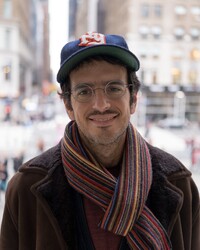
Photograph by Ken Resnick
Benjamin Resnick is the rabbi of the Pelham Jewish Center in New York. Ordained at the Jewish Theological Seminary of America, he lives in Pelham with his family. Next Stop is his first novel.
Product Details
- Publisher: Avid Reader Press/Simon & Schuster (September 10, 2024)
- Length: 304 pages
- ISBN13: 9781668066652
Browse Related Books
Raves and Reviews
“A striking debut. . . Resnick skillfully uses the raw materials of postapocalyptic fiction and speaks lucidly to his Jewish characters’ legacy of displacement. This timely tale will appeal to fans of speculative fantasies by Michael Chabon and Lavie Tidhar.” —Publishers Weekly
“Resnick’s prose is lucid and moves at a steady clip, never dwelling anywhere too long, avoiding the kind of teeth-gnashing misery one might expect in a novel about persecution and ethnic cleansing. For all its futuristic terrors, this is really a story about a family.” —Jewish Book Council
"Uncanny, riveting, and strangely prescient, Next Stop is that rarest of narratives: a glimpse into an unthinkable past, present, and future all at once. Only a magician or a mystic could pull off such a thing." —Elisa Albert, author of Human Blues
"Next Stop is either prophetic—with its depiction of flailing morality, administrative cowardice, and fact-resistant discourse—or it is timeless, in that there is really no moment Benjamin Resnick couldn't have written the book. I'm reminded of both Bernard Malamud's God's Grace and Emily St. John Mandel's Station Eleven—it's that feeling of gently and easily reading something of crushing horror. What you will find here is what we all hope to find as readers: a good story about people up against the odds; people who are, ultimately, us." —Derek B. Miller, author of The Curse of Pietro Houdini
"With the whimsy of Salinger, the humor of Vonnegut, and more than a little of the prophetic weirdness of Kafka, Next Stop is the rarest of gems: a novel made up of equal parts human intimacy and broad foresight. Benjamin Resnick's debut is a clarion call, a profound cosmic joke, a canary in the global coalmine, and a disconcerting work of art." —Daniel Torday, author of The Last Flight of Poxl West
“It is a brave and troubling novel. Using elements from apocalyptic fiction like Station Eleven, Resnick was influenced by the great Jewish writers and has made use of the legacy of displacement in an extremely chilling read.” —Melanie Fleishman, Center for Fiction
Resources and Downloads
High Resolution Images
-
Book Cover Image (jpg): Next Stop
eBook 9781668066652
-
Author Photo (jpg): Benjamin Resnick Photograph by Ken Resnick(0.1 MB)
Any use of an author photo must include its respective photo credit